Trump & Putin Meet But No Mention Of ‘Golden Shower’ Blackmail Report

How is it that when Donald Trump meets Vladimir Putin for the first time, as he did today, no reference is made in any US media report – at least that I can find – to the well-publicised claim that Putin has been blackmailing Trump for years with a lurid sex video made by Russian intelligence?

The claim, in the form of a report – originally commissioned by Trump’s Republican primary opponents – which was compiled by a former British MI6 agent turned private dick, caused a sensation when it was published last January, although much of the mainstream US media had been sitting on it for much longer.

You would think that such a scandalous claim would at least merit a mention somewhere in the media coverage today, when the alleged victim of the blackmail met the alleged perp. But no, it’s not there.

The fact that the report now virtually has the status of a non-thing in the American media is a telling little clue that Trump has become a little more untouchable, even normal, with time.

Notice also how Trump’s remarks in Poland about threats to ‘Western civilization’ were treated almost as normal by much of the media, despite their distinctive fascistic overtones.

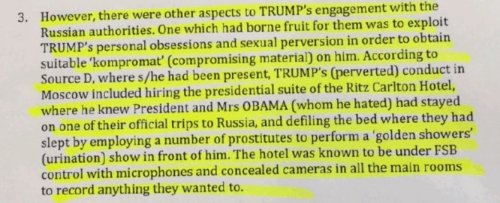
Anyway, the full document can be found elsewhere on thebrokenelbow (search under ‘Trump blackmail document’). Here though is the relevant paragraph:

‘Loadsa Money!’ – Clear Sign Stormont Will Return

‘Follow the money’, is usually the best advice when seeking other people’s motives and intentions. The headline and story below from a late edition of The Irish Times, is perhaps the clearest indication yet that a deal will be made to restore the Stormont government.

It’s the one thing both the DUP and the Shinners have no difficulty agreeing. The rest will follow. You just can’t keep those snouts away from the trough!

Assembly members must still be paid, say DUP and Sinn Féin

Frustration and disappointment at collapse of talks but MLAs plan to work all summer

By Gerry Moriarty

Northern Ireland’s 90 Assembly members should continue to be paid through the summer despite the collapse of the Stormont talks, the DUP and Sinn Féin have insisted.

Just one question though. All 90 Assembly members negotiating the same deal? Do they have a room big enough?


The Sham Fight At Stormont

Here are the reasons why, probably at the end of the Orange marching season, the DUP and Sinn Fein will cut a deal to restore the power-sharing government at Stormont.

Firstly, Sinn Fein have nowhere else to go. Stormont has, ironically, become the party’s only raison d’etre in the North, the irony being derived from the Provisional IRA’s founding aim to destroy the place.

Without a place in government, Sinn Fein has nothing else to show for the peace process or for the IRA abandoning not just its war and weapons but with them the ideological foundations for Irish republicanism, aka the principle of consent. All relinquished at the insistence of the IRA’s opponents.

War or peace were the choices facing the Provos and having plumped for the latter they must play the game, fully, or raise elemental questions about SF’s ability to survive as a political entity.

So central has Stormont become to the Provos’ existence that Gerry Adams recently accorded it a central role in the job of ‘persuading’ the Unionists into a united Ireland. And without Stormont where would the leverage then come from, assuming a return to war is neither realistic nor desirable?

Sinn Fein created this ‘crisis’ by demanding Arlene Foster’s resignation while an inquiry was held into the so-called ‘cash for ash’ scandal. There is now no mention of this demand, presumably because SF knows what the response will be.

Nonetheless, Sinn Fein did very well in the special election prompted by Martin McGuinness’ withdrawal as deputy First Minister in response to Foster’s refusal to stand down.

The party was able to whip up Fenian blood in anger at the DUP and did that well enough to increase the size of its Assembly team, run the DUP perilously close in their respective shares of the vote and to see off a burgeoning left-wing challenge from Eamon McCann’s People Before Profit party.

If the British decided that the likelihood of an agreement was so slim that only a fresh election could move the logjam, could Sinn Fein guarantee that all those gains from last March could be protected and repeated? A big risk, I would say.

Finally there is Theresa May’s loot, aka the bribe to the DUP to keep her slippers under the bed at Downing Street for a few weeks more. It is worth between £1.5 and £2 billion, an awful lot of money.

If Stormont was restored Sinn Fein would, via its ministerial team, be entitled to a significant say in how, and more important, where it would be spent. Now to be sure I am certain that la familie Robinson is already plotting ways to frustrate the Shinners in this regard, but if Sinn Fein was in the Executive it could at least fight back.

Earlier today I listened to an academic from Liverpool university proclaiming on BBC Radio 4 that the DUP were sitting pretty. They had got their money from May and now could just sit back and allow it to be spent. Ergo, no pressure to go back to government with Sinn Fein.

Really?

So the DUP squeezes £2 billion or thereabouts from a fatally wounded British prime minister and then sits back to allow her proconsul in Belfast to decide how to spend their money?

Really!

No, having extracted the bribe, the DUP would be insane not to want the final say on how it is spent, or at least as much of it as they can control. It is why most people become politicians, so they can spend taxpayers’ money on their coveted schemes and plots, even more so when you’ve just won the equivalent of several lucrative lotteries. To surrender that right to others would be the height of irrationality, not to say lunacy.

And these days the DUP is a party of conventional politicians. The days of Paisleyite protesting are now a dim memory and the people who stand under his party’s banner these days want to take their seats and exercise governmental power like conventional politicians.

I suspect there are many in Sinn Fein who feel the same way but are too timid to say so, at least publicly.

In just over a week or so, up to 100,000 Orangemen will gather in the picturesque Co. Down village of Scarva for the annual sham fight between King Billy and King James, a battle whose outcome is pre-ordained by history. There is as much chance of a deal not being done at Stormont as King James departing the field at Scarva as the victor.

Postscript: Sinn Fein has made recognition of the Irish language the battleground for restoration of Stormont. There was a time when the Shinners might instead have chosen a commitment to spend Theresa May’s £2 billion on the abolition of food banks as their precondition.

The Bizarre World Of Donald Trump And Roy Cohn……

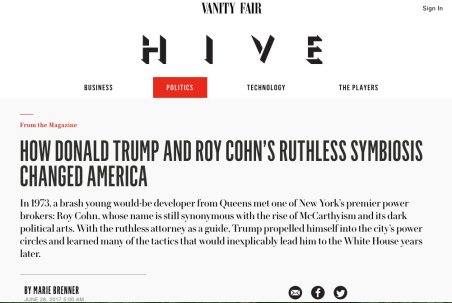
This is a great piece from Vanity Fair on the bizarre but pivotal relationship between Donald Trump and Roy Cohn, the malefic adjutant of Joe McCarthy, the red-baiting US Senator who in the 1950’s gave his name to a notorious era of witch-hunting in America.

Written by veteran reporter Marie Brenner, the story leaves little doubt that but for Cohn, Donald Trump might have become a kinder, gentler person.

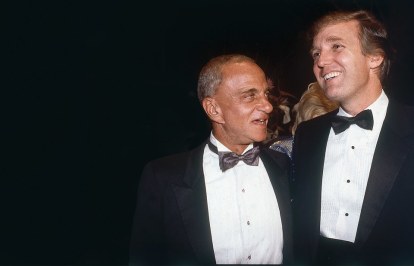
Roy Cohn and Donald Trump in New York circa 1983

Enjoy:

“‘Donald calls me 15 to 20 times a day,” Roy Cohn told me on the day we met. “He is always asking, ‘What is the status of this . . . and that?’”

It was 1980. I had been assigned to write a story on Donald Trump, the brash young developer who was then trying to make a name for himself in New York City, and I had come to see the man who, at the time, was in many ways Trump’s alter ego: the wily, menacing lawyer who had gained national renown, and enmity, for his ravenous anti-Communist grandstanding.

Trump was 34 and using the connections of his father, Brooklyn and Queens real-estate developer Fred Trump, as he navigated the rough-and-tumble world of political bosses. He had recently opened the Grand Hyatt Hotel, bringing life back to a dreary area near Grand Central Terminal during a period when the city had yet to fully recover from near bankruptcy. His wife, Ivana, led me through the construction site in a white wool Thierry Mugler jumpsuit. “When will it be finished? When?,” she shouted at workers as she clicked through in stiletto heels.

News. Hollywood. Style. Culture.

For more high-profile interviews, stunning photography, and thought-provoking features, subscribe now to Vanity Fair magazine.

The tabloids couldn’t get enough of the Trumps’ theatrics. And as Donald Trump’s Hyatt rose, so too did the hidden hand of his attorney Roy Cohn, always there to help with the shady tax abatements, the zoning variances, the sweetheart deals, and the threats to those who might stand in the project’s way.

Cohn was best known as a ruthless prosecutor. During the Red Scare of the 1950s, he and Wisconsin senator Joe McCarthy, the fabulist and virulent nationalist crusader, had hauled dozens of alleged “Communist sympathizers” before a Senate panel. Earlier, the House Un-American Activities Committee had skewered artists and entertainers on similar charges, resulting in a trail of fear, prison sentences, and ruined careers for hundreds, many of whom had found common cause in fighting Fascism. But in the decades since, Cohn had become the premier practitioner of hardball deal-making in New York, having mastered the arcane rules of the city’s Favor Bank (the local cabal of interconnected influence peddlers) and its magical ability to provide inside fixes for its machers and rogues.

“You knew when you were in Cohn’s presence you were in the presence of pure evil,” said lawyer Victor A. Kovner, who had known him for years. Cohn’s power derived largely from his ability to scare potential adversaries with hollow threats and spurious lawsuits. And the fee he demanded for his services? Ironclad loyalty.

Trump—who would remain loyal to Cohn for many years—would be one of the last and most enduring beneficiaries of Cohn’s power. But as Trump would confide in 1980, he already seemed to be trying to distance himself from Cohn’s inevitable taint: “All I can tell you is he’s been vicious to others in his protection of me,” Trump told me, as if to wave away a stench. “He’s a genius. He’s a lousy lawyer, but he’s a genius.”

Bleak House

On the day I arrived at Cohn’s office, in his imposing limestone town house on East 68th Street, his Rolls-Royce was parked outside. But all elegance stopped at the front door. It was a fetid place, a shambles of dusty bedrooms and office warrens where young male assistants made their way up and down the stairs. Cohn often greeted visitors in a robe. On occasion, I.R.S. agents were said to sit in the hallway and, knowing Cohn’s reputation as a deadbeat, were there to intercept any envelopes with money.

Cohn’s bedroom was crowded with a collection of stuffed frogs that sat on the floor, propped against a large TV. Everything about him suggested a curious combination of an arrested child and a sleaze. I sat on a small sofa covered with dozens of stuffed creatures that exploded with dust as I tried to move them aside. Cohn was compact, with a mirthless smile, the scars from his plastic surgeries visible around his ears. As he spoke, his tongue darted in and out; he twirled his Rolodex, as if to impress me with his network of contacts. The kind of law Cohn practiced, in fact, needed only a telephone. (The New Yorker would later report that his longtime switchboard operator taped his calls and kept notes of conversations.)

Who did not know Roy Cohn’s backstory, even in 1980? Cohn—whose great-uncle had founded Lionel, the toy-train company—grew up as an only child, doted on by an overbearing mother who followed him to summer camp and lived with him until she died. Every night he was seated at his family’s Park Avenue dinner table, which was an unofficial command post of the Favor Bank bosses who’d helped make his father, Al Cohn, a Bronx county judge, and later a State Supreme Court judge. (During the Depression, Roy’s uncle Bernard Marcus had been sent to prison in a bank-fraud case, and Roy’s childhood was marked by visits to Sing Sing.) By high school, Cohn was fixing a parking ticket or two for one of his teachers.

After graduating from Columbia Law School at 20, he became an assistant U.S. attorney and an expert in “subversive activities,” allowing him to segue into his role in the 1951 espionage trial of Julius and Ethel Rosenberg. (Cohn persuaded the star witness, Ethel Rosenberg’s brother, David Greenglass, to change his testimony; in Cohn’s autobiography, written with Sidney Zion, Cohn claimed that he had encouraged the judge, already intent on sending Julius to the electric chair, to also order Ethel’s execution, despite the fact that she was a mother with two children.) Come 1953, this legal prodigy was named McCarthy’s boy-wonder chief counsel, and the news photos told the tale: the sharp-faced, heavy-lidded 26-year-old with cherubic cheeks, whispering intimately into the ear of the bloated McCarthy. Cohn’s special skill as the senator’s henchman was character assassination. Indeed, after testifying in front of him, an engineer with the Voice of America radio news service committed suicide. Cohn never showed a shred of remorse.

Seeing Trump and Cohn enter a room together had a hint of vaudeville. “Donald is my best friend,” Cohn said back then.

Despite McCarthy’s very public demise when the hearings proved to be trumped-up witch hunts, Cohn would emerge largely unscathed, going on to become one of the last great power brokers of New York. His friends and clients came to include New York’s Francis Cardinal Spellman and Yankees owner George Steinbrenner. Cohn would become an occasional guest at the Reagan White House and a constant presence at Studio 54.

By the time I met with Cohn, he had already been indicted four times on charges ranging from extortion and blackmail to bribery, conspiracy, securities fraud, and obstruction of justice. But he had been acquitted in each instance and in the process had begun to behave as if he were somehow a super-patriot who was above the law. At a gay bar in Provincetown, as reported by Cohn biographer Nicholas von Hoffman, a friend described Cohn’s behavior at a local lounge: “Roy sang three choruses of ‘God Bless America,’ got a hard-on and went home to bed.”

Cohn, with his bravado, reckless opportunism, legal pyrotechnics, and serial fabrication, became a fitting mentor for the young real-estate scion. And as Trump’s first major project, the Grand Hyatt, was set to open, he was already involved in multiple controversies. He was warring with the city about tax abatements and other concessions. He had hoodwinked his very own partner, Hyatt chief Jay Pritzker, by changing a term in a deal when Pritzker was unreachable—on a trip to Nepal. In 1980, while erecting what would become Trump Tower, he antagonized a range of arts patrons and city officials when his team demolished the Art Deco friezes decorating the 1929 building. Vilified in the headlines—and by the Establishment—Trump offered a response that was pure Roy Cohn: “Who cares?” he said. “Let’s say that I had given that junk to the Met. They would have just put them in their basement.”

For author Sam Roberts, the essence of Cohn’s influence on Trump was the triad: “Roy was a master of situational immorality . . . . He worked with a three-dimensional strategy, which was: 1. Never settle, never surrender. 2. Counter-attack, counter-sue immediately. 3. No matter what happens, no matter how deeply into the muck you get, claim victory and never admit defeat.” As columnist Liz Smith once observed, “Donald lost his moral compass when he made an alliance with Roy Cohn.”

HAIR APPARENT
Donald’s parents, Mary and Fred Trump, at a New York City benefit, 1988.

When Donald Met Roy

Let’s go back further still, to 1973. Trump, 27, was living in a rent-controlled studio, wearing French cuffs, and taking his dates to the Peacock Alley, the bar in the lobby of the Waldorf Astoria. At the time, the lockbox of Establishment New York was tightly closed to the Trumps of Queens, despite their mansion in Jamaica Estates.

Riding around Brooklyn in a Rolls-Royce, Trump’s mother, Mary, collected quarters from laundry rooms in various Trump buildings. Trump’s father, Fred, had already beaten back two scandals in which he was accused of overcharging and profiteering at some of his government-financed apartment complexes, and was now facing an even more explosive charge—systemic discrimination against black and other minority tenants. The Trumps, however, were connected to Favor Bank politicians in the Brooklyn Democratic machine, which, in tandem with the Mob bosses, still influenced who got many of the judgeships and patronage jobs. It was twilight in a Damon Runyon world, before the reformers moved in.

As Donald Trump would later tell the story, he ran into Cohn for the first time at Le Club, a members-only nightspot in Manhattan’s East 50s, where models and fashionistas and Eurotrash went to be seen. “The government has just filed suit against our company,” Trump explained, “saying that we discriminated against blacks . . . . What do you think I should do?”

“Tell them to go to hell and fight the thing in court and let them prove you discriminated,” Cohn shot back. The Trumps would soon retain Cohn to represent them.

The evidence was damning. At 39 Trump-owned properties, according to the Department of Justice lawsuit, widespread practices were used to avoid renting to blacks, including implementing a secret code. When a prospective black renter would apply for an apartment, the paperwork would allegedly be marked with a C—indicating “colored” (a charge that, if true, would constitute a violation of the Fair Housing Act). Nevertheless, the Trumps countersued the government. “It just stunned me,” the lawyer and journalist Steven Brill recently recalled. “They actually got reporters to appear for a press conference where they announced that they were suing [the Justice Department] for defamation for $100 million. You couldn’t get through your second day of law school without knowing it was a totally bogus lawsuit. And, of course, it was thrown out.”

A race-discrimination case of this magnitude might have sunk many a developer, but Cohn persisted. Under his guidance, the Trumps settled by agreeing to stipulations to prevent future discrimination at their properties—but came away without admitting guilt. (With that, a Trump strategy was launched. Decades later, when questioned about the case in one of the presidential debates, Trump would declare, “It was a federal lawsuit—[we] were sued. We settled the suit . . . with no admission of guilt.”)

Cohn continued to go on the attack for the Trumps. “I was a young reporter just starting my first job, at the New York Post [in 1974],” book publisher David Rosenthal told me. “I was working on illegal campaign contributions and I started looking at the records that had come from a group of buildings in Brooklyn, which showed massive donations to [Democrat] Hugh Carey, then running for governor of New York. They had all come from buildings that I had traced to Fred Trump . . . . My story was published and my editors were thrilled.

“The next day, my phone rang and it was Roy Cohn. ‘You piece of shit! We are going to ruin you! You have a lot of fucking nerve!’ ” Shaken, Rosenthal, then 21, went to his editors. “Their jaws dropped. I thought I was finished. I was sure Cohn’s next call would be to Dolly Schiff, the owner of the paper. Of course, the call never came. The story was true. They had skirted the New York finance laws.”

For about a decade, the tax abatements and legal loopholes that Trump was able to finesse came about, in large part, because of Cohn. The time he spent on Trump matters was not reduced to “billable hours,” wrote the late investigative journalist Wayne Barrett in Trump: The Greatest Show on Earth. Instead, Cohn asked for payment only when his cash supply ran low.

Steve Brill again saw Cohn’s stamp when Trump struck back, defending the case against Trump University. It was, Brill asserted, “a scam against the very people who [eventually] voted for Trump—the middle and lower middle class . . . . The first thing Trump does is sue one of the plaintiffs. She wins and the judge awards her $800,000 in legal fees, and Trump appeals, and in that decision he’s compared to Bernie Madoff . . . . This strategy was pure Cohn: ‘Attack your accuser.’ ”

After Brill’s investigation was published, Brill said, he received a call from one of Trump’s lawyers. “I understand you may do a follow-up,” he told Brill, adding a bit of advice: “Just be careful.” “Thanks,” Brill replied. “And let me give you some advice: ‘You better get the check because this guy is never going to pay you.’ Being a deadbeat was also pure Cohn.” (A White House spokesperson says this claim is totally false.)

Cohn approaches his Bentley, 1977.

Boys from the Boroughs

How to explain the symbiosis that existed between Roy Cohn and Donald Trump? Cohn and Trump were twinned by what drove them. They were both sons of powerful fathers, young men who had started their careers clouded by family scandal. Both had been private-school students from the boroughs who’d grown up with their noses pressed against the glass of dazzling Manhattan. Both squired attractive women around town. (Cohn would describe his close friend Barbara Walters, the TV newswoman, as his fiancée. “Of course, it was absurd,” Liz Smith said, “but Barbara put up with it.”)

Sometime during the 2016 presidential campaign, Brill noticed that Donald Trump was using Cohn’s exact phrases. “I began to hear, ‘If you want to know the truth,’ and ‘that I can tell you . . .’ and ‘to be absolutely frank’—a sign that the Big Lie was coming,” Brill said.

Cohn—possessed of a keen intellect, unlike Trump—could keep a jury spellbound. When he was indicted for bribery, in 1969, his lawyer suffered a heart attack near the end of the trial. Cohn deftly stepped in and did a seven-hour closing argument—never once referring to a notepad. He was acquitted. “I don’t want to know what the law is,” he famously said, “I want to know who the judge is.”

When Cohn spoke, he would fix you with a hypnotic stare. His eyes were the palest blue, all the more startling because they appeared to protrude from the sides of his head. While Al Pacino’s version of Cohn (in Mike Nichols’s 2003 HBO adaptation of Tony Kushner’s Angels in America) captured Cohn’s intensity, it failed to convey his child-like yearning to be liked. “He was raised as a miniature adult,” Tom Wolfe once observed.

Cohn liked to throw parties crowded with celebrities, judges, Mob bosses, and politicians—some of whom were either coming from or on their way to prison—causing Cohn’s close friend the comedian Joey Adams to remark, “If you’re indicted, you’re invited.” But it was Cohn’s circle of legal aides and after-hours pals that also held sway. “Roy loved to surround himself with attractive straight men,” said divorce attorney Robert S. Cohen, who, before taking on clients such as Michael Bloomberg—and both of Trump’s ex-wives (Ivana Trump and Marla Maples)—began his career working for Cohn. “[Roy had] a coterie. If he could have had a relationship with any of them, he would have.”

Cohn’s cousin David L. Marcus concurred. Soon after graduating from Brown in the early 80s, Marcus recalled, he sought Cohn out. While they had encountered each other over the years at family gatherings, Marcus’s parents had despised Cohn since his McCarthy days, and a chill had set in. But Cohn, intrigued by the attention of his long-lost cousin, welcomed him. Marcus, a journalist who would later share a Pulitzer Prize, recently said that he was astonished by the atmosphere of creepy intimacy that, in those days, seemed to perfume Cohn’s attitude toward his acolytes, including one in particular. “There was a party in the mid-1980s, where Mailer was, and Andy Warhol, [when] in walked Trump,” recounted Marcus. “Roy dropped everyone else and fussed over him . . . Roy had that ability to focus on you. I felt that Roy was attracted to Trump, more than in a big-brotherly way.

“Donald fit the pattern of the hangers-on and the disciples around Roy. He was tall and blond and . . . frankly, über-Gentile. Something about Roy’s self-hating-Jewish persona drew him to fair-haired boys. And at these parties there was a bevy of blond guys, almost midwestern, and Donald was paying homage to Roy . . . I wondered then if Roy was attracted to him.”

“Thwarted loves obsessed Roy Cohn’s life,” added a lawyer who first met Cohn in the 60s, characterizing some of the men, both gay and straight, in Cohn’s orbit. “He would become sexually obsessed with cock-tease guys who would sense his need and not shun him. These were unrequited relationships. The way he would expiate the sexual energy was possessive mentoring. Introducing them to everyone in town and taking them places.”

Seeing Trump and Cohn enter a room together had a hint of vaudeville. Donald, standing six feet two inches, would typically enter first, with a burlesque macho-man’s gait, walking as if he led from his toes. A few feet behind would be Cohn, skinny, eyes darting, his features slightly caved in from plastic surgery. “Donald is my best friend,” Cohn said back then, shortly after he had thrown a 37th-birthday party for Trump. And over the years, several who knew Cohn would remark on Donald Trump’s resemblance to the most infamous of Roy Cohn’s blond, rich-boy obsessions: David Schine.

Cohn at his East 68th Street town house, with a photo of himself and Trump, 1984.

Patriot Games

Consider the episode—and the compulsion—that ended Roy Cohn’s time in the capital and Joe McCarthy’s Senate career. In the mid-50s, Cohn was in the headlines for the malicious circus of the hearings. Scores of witnesses were being bullied by Cohn or McCarthy or both. “Are you now or have you ever been a member of the Communist Party?,” Cohn demanded in his nasal honk, a spectacle replayed in the evenings on TV and radio.

It was amid this high drama that a young man had come into Cohn’s life. The heir to a hotel-and-movie franchise, the feckless David Schine had reportedly pulled D’s in his first year at Harvard. But in 1952, he wrote a pamphlet on the evils of Communism and was soon introduced to Cohn. It was, for Cohn, a coup de foudre, and Schine came on the McCarthy committee as an unpaid “research assistant.” Dispatched on a tour of Europe to investigate possible subversion at army bases and American Embassies—which included ridding the consular libraries of “subversive literature” (among them works by Dashiell Hammett and Mark Twain)—the pair were dogged by rumors that they were lovers. (Cohn told friends that they were not.) Whispers also began to swirl about McCarthy’s sexual orientation.

In lavender Washington, Cohn was known as both a closeted homosexual and homophobic, among those leading the charge against supposedly gay witnesses who he and others believed should lose their government jobs because they were “security risks.” When Schine was drafted as a private and not a commissioned officer, Cohn threatened he would “wreck the army.” McCarthy even mentioned to Robert T. Stevens, the secretary of the army, that “Roy thinks Dave ought to be a general and operate from a penthouse in the Waldorf Astoria.” President Dwight Eisenhower, meanwhile, angered by McCarthy’s attacks and fearful that the senator’s zealotry was severely damaging the president’s agenda and the G.O.P. itself, sent word to the army counsel to write a report on Cohn’s harassment tactics. According to historian David A. Nichols, the president secretly ordered the document to be released to key legislators and the press, and the revelations were explosive, resulting in the Army-McCarthy hearings.

Over 36 days, 20 million Americans watched. It was all there: Cohn and Schine’s jaunt to Europe, Cohn’s ultimatums, McCarthy’s smears. The high point came when the army’s sly Boston lawyer, Joseph Welch, shook his head in pained disbelief at McCarthy’s attempt to slander one of Welch’s own assistants, imploring the senator, “Have you no sense of decency, sir, at long last . . . ?” Within weeks, Cohn was banished and McCarthy was soon censured.

Cohn played it as a win. After the debacle, he returned to New York and attended a party thrown in his honor at the Hotel Astor. It would be the first example of his ability to project victory from defeat and induce moral amnesia upon a mesmerized New York—a gambit not dissimilar to those later utilized by his confrère Donald Trump.

Another of Cohn’s tactics was to befriend the town’s top gossip columnists, such as Leonard Lyons and George Sokolsky, who would bring Cohn to the Stork Club. He was irresistible to tabloid writers, always ready with scandal-tinged tales. “Roy would be hired by a divorce client in the morning and be leaking their case in the afternoon,” New Yorker writer Ken Auletta recalled. Columnist Liz Smith said she learned to distrust most items he gave her. A similar reliance on the press would also become a vital component of the young Trump’s playbook.

“[Roy] would call me up and it was always short—‘George, Roy,’ ” said former New York Post political reporter George Arzt, who was later Mayor Ed Koch’s press secretary. “He would drop a dime on someone, hoping I would print it.”

 My initiation to the louche world of Roy Cohn came in 1980—at a lunch with Trump in the room upstairs at the ‘21’ Club, the first time I had been there. “Anybody who is anybody here sits between the columns,” Trump told me. I was expecting our meal to be one-on-one, but a guest joined us that day. “This is Stanley Friedman,” Trump said. “He is Roy Cohn’s law partner.” The lunch agenda, not surprisingly, turned into a sales pitch, with Friedman offering a monologue on what Roy Cohn had already done for Trump. (Friedman, in pure Tammany Hall style, worked for the city while assisting Cohn, and would later go to prison for taking kickbacks in a parking-ticket scandal.)

“Roy could fix anyone in the city,” Friedman told me that day. “He’s a genius . . . . It is a good thing Roy isn’t here today. He would stab all the food off your plate.” A Cohn quirk was to rarely order food and, instead, commandeer the meals of his dining partners. I wrote then about the moment when hotel titan Bob Tisch came by the table. “I beat Bob Tisch on the convention site,” Trump said loudly. “But we’re good friends now, good friends. Isn’t that right, Bob?”

Trump, at the time, was developing a sullen moxie that rivaled Cohn’s. The lawyer Tom Baer, for instance, did not know what to expect when he got a call one day to meet with Trump. Baer had been recently appointed by Mayor Koch to represent the city in all aspects of what was to become its new convention center, and Baer was trying to line up possible partnerships. “Donald said, ‘I would be willing to contribute the land,’ ” Baer would remember. “ ‘I think it is only fair that it be named Trump Center’ ”—after his father.

“I called Ed Koch, and he said, ‘Fuck him! Fuck him.’ I said, ‘I don’t talk that way.’ He said, ‘I don’t care how you talk! Fuck him!’ So, I used my best lawyer-ese, and I called him back and said, ‘The mayor is so grateful for your offer. But he is not inclined to agree.’ ” Some time later Trump went to Deputy Mayor Peter Solomon and reportedly proposed a deal entitling him to a $4.4 million commission. (He eventually got $500,000.) Recalled Baer, “He spoke to the representatives of the governor [too]. He wasn’t going to be deterred because pisher Tom Baer told him he couldn’t do it . . . . Koch [just shook his head and] thought, This guy is ridiculous.”

Left, Cohn with Senator Joseph McCarthy, 1954; Right, Cohn with real-estate doyenne Alice Mason and TV newswoman Barbara Walters at Le Cirque, 1983, photographed by Harry Benson.

“You Need to See Donald”

‘Come and make your pitch to me,” Roy Cohn told Roger Stone when they met at a New York dinner party in 1979. Stone, though only 27, had achieved a degree of notoriety as one of Richard Nixon’s political dirty-tricksters. At the time, he was running Ronald Reagan’s presidential-campaign organization in New York, New Jersey, and Connecticut, and he needed office space.

Stone appeared on East 68th Street to find Cohn, just awakened, in his robe, sitting with one of his clients, Mob boss “Fat Tony” Salerno, of the Genovese crime family. “In front of [Roy] was a slab of cream cheese and three burnt slices of bacon,” Stone remembered. “He ate the cream cheese with his pointing finger. He listened to my pitch and said, ‘You need to see Donald Trump. I will get you in, but then you are on your own.’ ”

“I went to see him,” Stone told me, “and Trump said, ‘How do you get Reagan to 270 electoral votes?’ He was very interested [in the mechanics]—a political junkie. Then he said, ‘O.K., we are in. Go see my father.’ ” Out Stone went to Avenue Z, in Coney Island, and met Fred Trump in his office, which was crowded with cigar-store Indians. “True to his word, I got $200,000. The checks came in $1,000 denominations, the maximum donation you could give. All of these checks were written to ‘Reagan For President.’ It was not illegal—it was bundling. Check trading.” For Reagan’s state headquarters, the Trumps found Stone and the campaign a decrepit town house next to the ‘21’ Club. Stone was now, like Donald Trump, inside the Cohn tent.

And Stone soon seized the moment to cash in. After Reagan was elected, his administration softened the strict rules for corporations seeking government largesse. Soon Stone and Paul Manafort, Trump’s future campaign manager, were lobbyists, reaping the bonanzas that could flow with Favor Bank introductions. Their first client, Stone recalled, was none other than Donald Trump, who retained him, irrespective of any role Manafort might have had in the firm, for help with federal issues such as obtaining a permit from the Army Corps of Engineers to dredge the channel to the Atlantic City marina to accommodate his yacht, the Trump Princess.

“We made no bones about it,” Stone recently said. “We wanted money. And it came pouring in.” Stone and Manafort charged hefty fees to introduce blue-chip corporations—such as Ronald Perelman’s MacAndrews & Forbes and Rupert Murdoch’s News Corp.—to their former campaign colleagues, some of whom were now running the Reagan White House. It was all cozy and connected—and reminiscent of Roy Cohn.

By 2000, Stone had offered his talents to a new candidate: Trump himself. That year Stone traveled the country to help Trump explore the viability of running as a Reform Party candidate. But at a stop in Florida, things halted abruptly. “I’m tired,” Stone recalled Trump telling him. “Cancel the rest of this. I am going to my room to watch TV.” In Stone’s view, “His heart was never in it.” (A White House spokesperson disputes this account.)

“You have to let Donald be Donald,” Stone explained. “We have been friends for 40 years . . . . Look what happened with the ‘birther’ push. You don’t want to hear this, but when he started that campaign 7 out of 10 Republicans at the time believed that Obama was born in Kenya. And, let’s face it, many still question it. Donald still believes it.” (In fact, candidate Trump released an official statement two months before Election Day asserting, unequivocally, that “Barack Obama was born in the United States.”)

Stone’s modus operandi, even to this day, has seemed to be vintage Cohn. Fired by Trump for what one of his spokesmen called Stone’s desire “to use the campaign for his own personal publicity,” Stone went into overdrive, fighting back and scheduling interviews in which he praised candidate Trump. (Stone denied he was fired and says he resigned.) Stone recently expressed concern that Jared Kushner’s inexperience and façade of centrist policies might very well scuttle the already beleaguered Trump presidency. And he fretted about Trump’s daughter Ivanka as well, saying that he found it “disturbing” when Saudi Arabia and the United Arab Emirates, in May, pledged $100 million to a World Bank women’s entrepreneurial fund—a project she had promoted.

Yet Stone would not concede that his decades-long relationship with Trump had become strained, even though Stone, along with some members of the administration, are facing allegations that they’ve had questionable contacts with a variety of Russian nationals. (All have denied any wrongdoing.) “There is nothing to any of this,” Stone claimed. “Donald knows he has my loyalty and friendship. I leave a message when I want to speak with him.”

All along there had been something deeper connecting Stone and Trump and Roy Cohn: the climate of suspicion and fear that had helped bring all three to power. Although Stone, like many around Cohn in the 70s and 80s, was too young to have observed how Cohn helped poison America in the McCarthy years, Stone had learned at the feet of Richard Nixon, the ultimate American paranoid. And the politics of paranoia that Cohn and Stone had cynically mastered would eventually make them kindred spirits. Just as the two of them had come to prominence by exploiting a grave national mood (Cohn in the 50s, Stone in the 70s), it was this same sense of American angst, resurgent in 2016, that would ultimately help elect Donald Trump.

“Pro-Americanism,” Stone said, “is a common thread for McCarthy, Goldwater, Nixon, [and] Reagan. The heir to that tradition is Donald Trump. When you combine that with the bare-knuckled tactics of Roy Cohn—or a Roger Stone—that is how you win elections. So Roy has an impact on Donald’s understanding of how to deal with the media—attack, attack, attack, never defend.”

The Long Good-Bye

Roger Stone was there in 1982 when Roy Cohn was at his peak. At the time, Cohn was trying to help Trump realize his dream of opening casinos in Atlantic City. Crucial to his success would be a sympathetic New Jersey governor. And Cohn and Stone were working hard to elect their candidate: Republican Tom Kean. Stone, as it turned out, was Kean’s campaign manager, and after Kean won in a close race, Stone would remain as an unofficial adviser.

Trump began to purchase boardwalk real estate. He built one casino and bought another. His prospects looked bright. But Cohn’s downfall was imminent. Word would soon begin to circulate that Cohn was battling AIDS. He denied it. He was also battling disbarment—under a cloud of fraud and ethical-misconduct charges. (Cohn, along with other misdeeds, had stiffed a client on a loan and altered the terms of a virtually comatose client’s will—in his hospital room—making himself its co-executor.)

Cohn tried to keep up a good face. But Trump, among other clients, began to shift his business elsewhere. “Donald found out about [Cohn’s condition] and just dropped him like a hot potato,” Cohn’s personal secretary, Susan Bell, was quoted as saying. (A White House spokesperson says this claim is totally false.)

Cohn sensed his growing isolation. And for whatever reason, he decided, according to journalist Wayne Barrett, to help the efforts of Trump’s sister Maryanne Trump Barry, who was seeking an appointment to the federal bench. “Maryanne wanted the job,” Stone would recall. “She did not want Roy and Donald to do anything. She was attempting to get it on her own.”

Stone remembered that when it appeared someone else was in line for the job Cohn approached Reagan’s attorney general, Ed Meese, for help. In the end, Barry got the plum post. “Roy can do the impossible,” Trump reportedly said when he heard the news. The next day, Barrett noted, Barry called Cohn to thank him. (According to the Times, Trump, when asked in 2015, said his sister “got the appointment totally on her own merit.” For herself, Barry admitted to Trump-family biographer Gwenda Blair, “There’s no question Donald helped me get on the bench. I was good, but not that good.”)

Cohn at home in Greenwich, Connecticut, 1986, photographed by Mary Ellen Mark.

By 1985, Cohn was seriously ill—“I have liver cancer,” he contended—and he started calling in his last markers. He phoned New York Times columnist William Safire, whom he’d known since Safire’s days as a publicist. And, sure enough, Safire ran a piece attacking the “buzzards of the bar” who had “dredged up” fraud charges to get even with Cohn, “[the] hard-hitting anti-legal-establishment right-winger at a time when he is physically unable to defend himself.” Roger Stone would recall Trump phoning him and asking, “ ‘Have you seen Bill Safire’s column?’ He called me to point it out to me. He said, ‘This is going to be terrific for Roy.’ “

Cohn also had asked a favor of Trump: Could he give him a hotel room for his lover, who was dying of AIDS? A room was found in the Barbizon Plaza Hotel. Months passed. Then Cohn got the bill. Then another. He refused to pay. At some point, according to The New York Times’s Jonathan Mahler and Matt Flegenheimer, Trump would present Cohn with a thank-you gift for a decade of favors: a pair of diamond cuff links. The diamonds turned out to be fakes.

Tensions between the two became progressively strained. And the dying Cohn, as Barrett would describe him in those waning days, would say, “Donald pisses ice water.”

That said, Trump did come out to testify on Cohn’s behalf at his 1986 disbarment hearing, one of 37 character witnesses, including Barbara Walters and William Safire. But none of it mattered. Cohn, after putting up a four-year fight, was kicked out of the New York Bar for “dishonesty, fraud, deceit, and misrepresentation.” Cohn’s nefarious practices had finally caught up with him.

Trump, by then a presence in Atlantic City, was setting his sights on a third casino. Roy Cohn, in contrast, would die almost penniless, given how much he owed the I.R.S. And his funeral made it clear what Cohn and his friends and family had felt, in the end, about Trump. The real-estate developer was not one of the speakers. He was not asked to be a pallbearer. Trump, in Barrett’s account, did show up, however, and stood in the back.

Thirty years later, on the day after Donald J. Trump was elected president, Roger Stone was one of the callers who got through to his old friend at Trump Tower. “Mr. President,” said Stone. “Oh please, call me Donald,” Stone remembered Trump saying.

A few moments later, Trump sounded wistful. “Wouldn’t Roy love to see this moment? Boy, do we miss him.”

Sinn Fein Eyes May’s Millions & Drops Foster Condition As Deal Nears

According to Henry McDonald in tomorrow’s Guardian, Sinn Fein has “quietly dropped” the insistence that Arlene Foster step aside from the First Minister post while the wood pellet scandal is “investigated”.

A sure sign that the party has decided to cut a deal? We’ll see. But it makes sense. Better to have a share in spending all of Theresa May’s spondoolicks than leaving it to Brokendick, or whatever he’s called, to fritter away.

Whatever happened to “Sinn Fein: The Voice of Principled Leadership”?

Here’s what the Grauniad says:

Prior to these latest talks Sinn Féin had insisted that Foster could not be re-nominated by the DUP as first minister while a high powered independent inquiry takes places into the RHI scandal.

However, it appears the party has quietly dropped this demand as one of its so-called ‘red lines’ in the negotiations.

‘History Repeats Itself First As Tragedy, Second As Farce’ – Karl Marx


I decided some time ago that if the B.B.R. [Jeremy Corbyn, the ‘Big Bad Red’] came within eight votes, the Orange card would be the one to play. Please God it may turn out the ace of trumps and not the two.

(Theresa May)

Seymour Hersh On Trump’s Syrian Missile Attack….

Famed American journalist, Seymour Hersh could get no US outlet to publish his investigation into Donald Trump’s Tomahawk missile attack on Syria last April, carried out in retaliation for an alleged nerve gas attack which killed civilians and children.

Hersh writes that the attack was authorised by Trump despite the absence of any US intelligence to support the claim of Syrian responsibility.

Unable to interest any American publication in his article, the one-time sorrespondent for The New Yorker magazine instead had to go to Germany where the magazine Die Welt agreed to publish it. Here it is:

Trump‘s Red Line

Von Seymour M. Hersh | Stand: 12:41 Uhr | Lesedauer: 24 Minuten
Anzeige

On April 6, United States President Donald Trump authorized an early morning Tomahawk missile strike on Shayrat Air Base in central Syria in retaliation for what he said was a deadly nerve agent attack carried out by the Syrian government two days earlier in the rebel-held town of Khan Sheikhoun. Trump issued the order despite having been warned by the U.S. intelligence community that it had found no evidence that the Syrians had used a chemical weapon.

The available intelligence made clear that the Syrians had targeted a jihadist meeting site on April 4 using a Russian-supplied guided bomb equipped with conventional explosives. Details of the attack, including information on its so-called high-value targets, had been provided by the Russians days in advance to American and allied military officials in Doha, whose mission is to coordinate all U.S., allied, Syrian and Russian Air Force operations in the region.

Some American military and intelligence officials were especially distressed by the president’s determination to ignore the evidence. “None of this makes any sense,” one officer told colleagues upon learning of the decision to bomb. “We KNOW that there was no chemical attack … the Russians are furious. Claiming we have the real intel and know the truth … I guess it didn’t matter whether we elected Clinton or Trump.“

Within hours of the April 4 bombing, the world’s media was saturated with photographs and videos from Khan Sheikhoun. Pictures of dead and dying victims, allegedly suffering from the symptoms of nerve gas poisoning, were uploaded to social media by local activists, including the White Helmets, a first responder group known for its close association with the Syrian opposition.

The provenance of the photos was not clear and no international observers have yet inspected the site, but the immediate popular assumption worldwide was that this was a deliberate use of the nerve agent sarin, authorized by President Bashar Assad of Syria. Trump endorsed that assumption by issuing a statement within hours of the attack, describing Assad’s “heinous actions” as being a consequence of the Obama administration’s “weakness and irresolution” in addressing what he said was Syria’s past use of chemical weapons.

To the dismay of many senior members of his national security team, Trump could not be swayed over the next 48 hours of intense briefings and decision-making. In a series of interviews, I learned of the total disconnect between the president and many of his military advisers and intelligence officials, as well as officers on the ground in the region who had an entirely different understanding of the nature of Syria’s attack on Khan Sheikhoun. I was provided with evidence of that disconnect, in the form of transcripts of real-time communications, immediately following the Syrian attack on April 4. In an important pre-strike process known as deconfliction, U.S. and Russian officers routinely supply one another with advance details of planned flight paths and target coordinates, to ensure that there is no risk of collision or accidental encounter (the Russians speak on behalf of the Syrian military). This information is supplied daily to the American AWACS surveillance planes that monitor the flights once airborne. Deconfliction’s success and importance can be measured by the fact that there has yet to be one collision, or even a near miss, among the high-powered supersonic American, Allied, Russian and Syrian fighter bombers.

Anzeige
Russian and Syrian Air Force officers gave details of the carefully planned flight path to and from Khan Shiekhoun on April 4 directly, in English, to the deconfliction monitors aboard the AWACS plane, which was on patrol near the Turkish border, 60 miles or more to the north.

The Syrian target at Khan Sheikhoun, as shared with the Americans at Doha, was depicted as a two-story cinder-block building in the northern part of town. Russian intelligence, which is shared when necessary with Syria and the U.S. as part of their joint fight against jihadist groups, had established that a high-level meeting of jihadist leaders was to take place in the building, including representatives of Ahrar al-Sham and the al-Qaida-affiliated group formerly known as Jabhat al-Nusra. The two groups had recently joined forces, and controlled the town and surrounding area. Russian intelligence depicted the cinder-block building as a command and control center that housed a grocery and other commercial premises on its ground floor with other essential shops nearby, including a fabric shop and an electronics store.

“The rebels control the population by controlling the distribution of goods that people need to live – food, water, cooking oil, propane gas, fertilizers for growing their crops, and insecticides to protect the crops,” a senior adviser to the American intelligence community, who has served in senior positions in the Defense Department and Central Intelligence Agency, told me. The basement was used as storage for rockets, weapons and ammunition, as well as products that could be distributed for free to the community, among them medicines and chlorine-based decontaminants for cleansing the bodies of the dead before burial. The meeting place – a regional headquarters – was on the floor above. “It was an established meeting place,” the senior adviser said. “A long-time facility that would have had security, weapons, communications, files and a map center.” The Russians were intent on confirming their intelligence and deployed a drone for days above the site to monitor communications and develop what is known in the intelligence community as a POL – a pattern of life. The goal was to take note of those going in and out of the building, and to track weapons being moved back and forth, including rockets and ammunition.

One reason for the Russian message to Washington about the intended target was to ensure that any CIA asset or informant who had managed to work his way into the jihadist leadership was forewarned not to attend the meeting. I was told that the Russians passed the warning directly to the CIA. “They were playing the game right,” the senior adviser said. The Russian guidance noted that the jihadist meeting was coming at a time of acute pressure for the insurgents: Presumably Jabhat al-Nusra and Ahrar al-Sham were desperately seeking a path forward in the new political climate. In the last few days of March, Trump and two of his key national security aides – Secretary of State Rex Tillerson and UN Ambassador Nikki Haley – had made statements acknowledging that, as the New York Times put it, the White House “has abandoned the goal” of pressuring Assad “to leave power, marking a sharp departure from the Middle East policy that guided the Obama administration for more than five years.” White House Press Secretary Sean Spicer told a press briefing on March 31 that “there is a political reality that we have to accept,” implying that Assad was there to stay.

Russian and Syrian intelligence officials, who coordinate operations closely with the American command posts, made it clear that the planned strike on Khan Sheikhoun was special because of the high-value target. “It was a red-hot change. The mission was out of the ordinary – scrub the sked,” the senior adviser told me. “Every operations officer in the region” – in the Army, Marine Corps, Air Force, CIA and NSA – “had to know there was something going on. The Russians gave the Syrian Air Force a guided bomb and that was a rarity. They’re skimpy with their guided bombs and rarely share them with the Syrian Air Force. And the Syrians assigned their best pilot to the mission, with the best wingman.” The advance intelligence on the target, as supplied by the Russians, was given the highest possible score inside the American community.

The Execute Order governing U.S. military operations in theater, which was issued by the Chairman of the Joint Chiefs of Staff, provide instructions that demarcate the relationship between the American and Russian forces operating in Syria. “It’s like an ops order – ‘Here’s what you are authorized to do,’” the adviser said. “We do not share operational control with the Russians. We don’t do combined operations with them, or activities directly in support of one of their operations. But coordination is permitted. We keep each other apprised of what’s happening and within this package is the mutual exchange of intelligence. If we get a hot tip that could help the Russians do their mission, that’s coordination; and the Russians do the same for us. When we get a hot tip about a command and control facility,” the adviser added, referring to the target in Khan Sheikhoun, “we do what we can to help them act on it.” “This was not a chemical weapons strike,” the adviser said. “That’s a fairy tale. If so, everyone involved in transferring, loading and arming the weapon – you’ve got to make it appear like a regular 500-pound conventional bomb – would be wearing Hazmat protective clothing in case of a leak. There would be very little chance of survival without such gear. Military grade sarin includes additives designed to increase toxicity and lethality. Every batch that comes out is maximized for death. That is why it is made. It is odorless and invisible and death can come within a minute. No cloud. Why produce a weapon that people can run away from?”

The target was struck at 6:55 a.m. on April 4, just before midnight in Washington. A Bomb Damage Assessment (BDA) by the U.S. military later determined that the heat and force of the 500-pound Syrian bomb triggered a series of secondary explosions that could have generated a huge toxic cloud that began to spread over the town, formed by the release of the fertilizers, disinfectants and other goods stored in the basement, its effect magnified by the dense morning air, which trapped the fumes close to the ground. According to intelligence estimates, the senior adviser said, the strike itself killed up to four jihadist leaders, and an unknown number of drivers and security aides. There is no confirmed count of the number of civilians killed by the poisonous gases that were released by the secondary explosions, although opposition activists reported that there were more than 80 dead, and outlets such as CNN have put the figure as high as 92. A team from Médecins Sans Frontières, treating victims from Khan Sheikhoun at a clinic 60 miles to the north, reported that “eight patients showed symptoms – including constricted pupils, muscle spasms and involuntary defecation – which are consistent with exposure to a neurotoxic agent such as sarin gas or similar compounds.” MSF also visited other hospitals that had received victims and found that patients there “smelled of bleach, suggesting that they had been exposed to chlorine.” In other words, evidence suggested that there was more than one chemical responsible for the symptoms observed, which would not have been the case if the Syrian Air Force – as opposition activists insisted – had dropped a sarin bomb, which has no percussive or ignition power to trigger secondary explosions. The range of symptoms is, however, consistent with the release of a mixture of chemicals, including chlorine and the organophosphates used in many fertilizers, which can cause neurotoxic effects similar to those of sarin.

The internet swung into action within hours, and gruesome photographs of the victims flooded television networks and YouTube. U.S. intelligence was tasked with establishing what had happened. Among the pieces of information received was an intercept of Syrian communications collected before the attack by an allied nation. The intercept, which had a particularly strong effect on some of Trump’s aides, did not mention nerve gas or sarin, but it did quote a Syrian general discussing a “special” weapon and the need for a highly skilled pilot to man the attack plane. The reference, as those in the American intelligence community understood, and many of the inexperienced aides and family members close to Trump may not have, was to a Russian-supplied bomb with its built-in guidance system. “If you’ve already decided it was a gas attack, you will then inevitably read the talk about a special weapon as involving a sarin bomb,” the adviser said. “Did the Syrians plan the attack on Khan Sheikhoun? Absolutely. Do we have intercepts to prove it? Absolutely. Did they plan to use sarin? No. But the president did not say: ‘We have a problem and let’s look into it.’ He wanted to bomb the shit out of Syria.”

At the UN the next day, Ambassador Haley created a media sensation when she displayed photographs of the dead and accused Russia of being complicit. “How many more children have to die before Russia cares?” she asked. NBC News, in a typical report that day, quoted American officials as confirming that nerve gas had been used and Haley tied the attack directly to Syrian President Assad. “We know that yesterday’s attack was a new low even for the barbaric Assad regime,” she said. There was irony in America’s rush to blame Syria and criticize Russia for its support of Syria’s denial of any use of gas in Khan Sheikhoun, as Ambassador Haley and others in Washington did. “What doesn’t occur to most Americans” the adviser said, “is if there had been a Syrian nerve gas attack authorized by Bashar, the Russians would be 10 times as upset as anyone in the West. Russia’s strategy against ISIS, which involves getting American cooperation, would have been destroyed and Bashar would be responsible for pissing off Russia, with unknown consequences for him. Bashar would do that? When he’s on the verge of winning the war? Are you kidding me?”

Trump, a constant watcher of television news, said, while King Abdullah of Jordan was sitting next to him in the Oval Office, that what had happened was “horrible, horrible” and a “terrible affront to humanity.” Asked if his administration would change its policy toward the Assad government, he said: “You will see.” He gave a hint of the response to come at the subsequent news conference with King Abdullah: “When you kill innocent children, innocent babies – babies, little babies – with a chemical gas that is so lethal … that crosses many, many lines, beyond a red line . … That attack on children yesterday had a big impact on me. Big impact … It’s very, very possible … that my attitude toward Syria and Assad has changed very much.”

Within hours of viewing the photos, the adviser said, Trump instructed the national defense apparatus to plan for retaliation against Syria. “He did this before he talked to anybody about it. The planners then asked the CIA and DIA if there was any evidence that Syria had sarin stored at a nearby airport or somewhere in the area. Their military had to have it somewhere in the area in order to bomb with it.” “The answer was, ‘We have no evidence that Syria had sarin or used it,’” the adviser said. “The CIA also told them that there was no residual delivery for sarin at Sheyrat [the airfield from which the Syrian SU-24 bombers had taken off on April 4] and Assad had no motive to commit political suicide.” Everyone involved, except perhaps the president, also understood that a highly skilled United Nations team had spent more than a year in the aftermath of an alleged sarin attack in 2013 by Syria, removing what was said to be all chemical weapons from a dozen Syrian chemical weapons depots.

At this point, the adviser said, the president’s national security planners were more than a little rattled: “No one knew the provenance of the photographs. We didn’t know who the children were or how they got hurt. Sarin actually is very easy to detect because it penetrates paint, and all one would have to do is get a paint sample. We knew there was a cloud and we knew it hurt people. But you cannot jump from there to certainty that Assad had hidden sarin from the UN because he wanted to use it in Khan Sheikhoun.” The intelligence made clear that a Syrian Air Force SU-24 fighter bomber had used a conventional weapon to hit its target: There had been no chemical warhead. And yet it was impossible for the experts to persuade the president of this once he had made up his mind. “The president saw the photographs of poisoned little girls and said it was an Assad atrocity,” the senior adviser said. “It’s typical of human nature. You jump to the conclusion you want. Intelligence analysts do not argue with a president. They’re not going to tell the president, ‘if you interpret the data this way, I quit.’”

The national security advisers understood their dilemma: Trump wanted to respond to the affront to humanity committed by Syria and he did not want to be dissuaded. They were dealing with a man they considered to be not unkind and not stupid, but his limitations when it came to national security decisions were severe. “Everyone close to him knows his proclivity for acting precipitously when he does not know the facts,” the adviser said. “He doesn’t read anything and has no real historical knowledge. He wants verbal briefings and photographs. He’s a risk-taker. He can accept the consequences of a bad decision in the business world; he will just lose money. But in our world, lives will be lost and there will be long-term damage to our national security if he guesses wrong. He was told we did not have evidence of Syrian involvement and yet Trump says: ‘Do it.”’

On April 6, Trump convened a meeting of national security officials at his Mar-a-Lago resort in Florida. The meeting was not to decide what to do, but how best to do it – or, as some wanted, how to do the least and keep Trump happy. “The boss knew before the meeting that they didn’t have the intelligence, but that was not the issue,” the adviser said. “The meeting was about, ‘Here’s what I’m going to do,’ and then he gets the options.”

The available intelligence was not relevant. The most experienced man at the table was Secretary of Defense James Mattis, a retired Marine Corps general who had the president’s respect and understood, perhaps, how quickly that could evaporate. Mike Pompeo, the CIA director whose agency had consistently reported that it had no evidence of a Syrian chemical bomb, was not present. Secretary of State Tillerson was admired on the inside for his willingness to work long hours and his avid reading of diplomatic cables and reports, but he knew little about waging war and the management of a bombing raid. Those present were in a bind, the adviser said. “The president was emotionally energized by the disaster and he wanted options.” He got four of them, in order of extremity. Option one was to do nothing. All involved, the adviser said, understood that was a non-starter. Option two was a slap on the wrist: to bomb an airfield in Syria, but only after alerting the Russians and, through them, the Syrians, to avoid too many casualties. A few of the planners called this the “gorilla option”: America would glower and beat its chest to provoke fear and demonstrate resolve, but cause little significant damage. The third option was to adopt the strike package that had been presented to Obama in 2013, and which he ultimately chose not to pursue. The plan called for the massive bombing of the main Syrian airfields and command and control centers using B1 and B52 aircraft launched from their bases in the U.S. Option four was “decapitation”: to remove Assad by bombing his palace in Damascus, as well as his command and control network and all of the underground bunkers he could possibly retreat to in a crisis.

“Trump ruled out option one off the bat,” the senior adviser said, and the assassination of Assad was never considered. “But he said, in essence: ‘You’re the military and I want military action.’” The president was also initially opposed to the idea of giving the Russians advance warning before the strike, but reluctantly accepted it. “We gave him the Goldilocks option – not too hot, not too cold, but just right.” The discussion had its bizarre moments. Tillerson wondered at the Mar-a-Lago meeting why the president could not simply call in the B52 bombers and pulverize the air base. He was told that B52s were very vulnerable to surface-to-air missiles (SAMs) in the area and using such planes would require suppression fire that could kill some Russian defenders. “What is that?” Tillerson asked. Well, sir, he was told, that means we would have to destroy the upgraded SAM sites along the B52 flight path, and those are manned by Russians, and we possibly would be confronted with a much more difficult situation. “The lesson here was: Thank God for the military men at the meeting,” the adviser said. “They did the best they could when confronted with a decision that had already been made.”

Fifty-nine Tomahawk missiles were fired from two U.S. Navy destroyers on duty in the Mediterranean, the Ross and the Porter, at Shayrat Air Base near the government-controlled city of Homs. The strike was as successful as hoped, in terms of doing minimal damage. The missiles have a light payload – roughly 220 pounds of HBX, the military’s modern version of TNT. The airfield’s gasoline storage tanks, a primary target, were pulverized, the senior adviser said, triggering a huge fire and clouds of smoke that interfered with the guidance system of following missiles. As many as 24 missiles missed their targets and only a few of the Tomahawks actually penetrated into hangars, destroying nine Syrian aircraft, many fewer than claimed by the Trump administration. I was told that none of the nine was operational: such damaged aircraft are what the Air Force calls hangar queens. “They were sacrificial lambs,” the senior adviser said. Most of the important personnel and operational fighter planes had been flown to nearby bases hours before the raid began. The two runways and parking places for aircraft, which had also been targeted, were repaired and back in operation within eight hours or so. All in all, it was little more than an expensive fireworks display.

“It was a totally Trump show from beginning to end,” the senior adviser said. “A few of the president’s senior national security advisers viewed the mission as a minimized bad presidential decision, and one that they had an obligation to carry out. But I don’t think our national security people are going to allow themselves to be hustled into a bad decision again. If Trump had gone for option three, there might have been some immediate resignations.”

After the meeting, with the Tomahawks on their way, Trump spoke to the nation from Mar-a-Lago, and accused Assad of using nerve gas to choke out “the lives of helpless men, women and children. It was a slow and brutal death for so many … No child of God should ever suffer such horror.” The next few days were his most successful as president. America rallied around its commander in chief, as it always does in times of war. Trump, who had campaigned as someone who advocated making peace with Assad, was bombing Syria 11 weeks after taking office, and was hailed for doing so by Republicans, Democrats and the media alike. One prominent TV anchorman, Brian Williams of MSNBC, used the word “beautiful” to describe the images of the Tomahawks being launched at sea. Speaking on CNN, Fareed Zakaria said: “I think Donald Trump became president of the United States.” A review of the top 100 American newspapers showed that 39 of them published editorials supporting the bombing in its aftermath, including the New York Times, Washington Post and Wall Street Journal.

Five days later, the Trump administration gathered the national media for a background briefing on the Syrian operation that was conducted by a senior White House official who was not to be identified. The gist of the briefing was that Russia’s heated and persistent denial of any sarin use in the Khan Sheikhoun bombing was a lie because President Trump had said sarin had been used. That assertion, which was not challenged or disputed by any of the reporters present, became the basis for a series of further criticisms:

– The continued lying by the Trump administration about Syria’s use of sarin led to widespread belief in the American media and public that Russia had chosen to be involved in a corrupt disinformation and cover-up campaign on the part of Syria.

– Russia’s military forces had been co-located with Syria’s at the Shayrat airfield (as they are throughout Syria), raising the possibility that Russia had advance notice of Syria’s determination to use sarin at Khan Sheikhoun and did nothing to stop it.

– Syria’s use of sarin and Russia’s defense of that use strongly suggested that Syria withheld stocks of the nerve agent from the UN disarmament team that spent much of 2014 inspecting and removing all declared chemical warfare agents from 12 Syrian chemical weapons depots, pursuant to the agreement worked out by the Obama administration and Russia after Syria’s alleged, but still unproven, use of sarin the year before against a rebel redoubt in a suburb of Damascus.

The briefer, to his credit, was careful to use the words “think,” “suggest” and “believe” at least 10 times during the 30-minute event. But he also said that his briefing was based on data that had been declassified by “our colleagues in the intelligence community.” What the briefer did not say, and may not have known, was that much of the classified information in the community made the point that Syria had not used sarin in the April 4 bombing attack.

The mainstream press responded the way the White House had hoped it would: Stories attacking Russia’s alleged cover-up of Syria’s sarin use dominated the news and many media outlets ignored the briefer’s myriad caveats. There was a sense of renewed Cold War. The New York Times, for example – America’s leading newspaper – put the following headline on its account: “White House Accuses Russia of Cover-Up in Syria Chemical Attack.” The Times’ account did note a Russian denial, but what was described by the briefer as “declassified information” suddenly became a “declassified intelligence report.” Yet there was no formal intelligence report stating that Syria had used sarin, merely a “summary based on declassified information about the attacks,” as the briefer referred to it.

The crisis slid into the background by the end of April, as Russia, Syria and the United States remained focused on annihilating ISIS and the militias of al-Qaida. Some of those who had worked through the crisis, however, were left with lingering concerns. “The Salafists and jihadists got everything they wanted out of their hyped-up Syrian nerve gas ploy,” the senior adviser to the U.S. intelligence community told me, referring to the flare up of tensions between Syria, Russia and America. “The issue is, what if there’s another false flag sarin attack credited to hated Syria? Trump has upped the ante and painted himself into a corner with his decision to bomb. And do not think these guys are not planning the next faked attack. Trump will have no choice but to bomb again, and harder. He’s incapable of saying he made a mistake.”

The White House did not answer specific questions about the bombing of Khan Sheikhoun and the airport of Shayrat. These questions were send via e-mail to the White House on June 15 and never answered.

LESEN SIE AUCH

The Humming Birds Are Back…..

It’s my favorite time of the year, when the humming birds return from Brazil for a summer of supping nectar – or the nearest we can get – in upper New York State. A depressing question, though: how long before Trump’s climate policies kill them off?

There Is No Principled Reason Anymore Why Sinn Fein Should Not Take Seats At Westminster

I was mildly amused last week to see Sinn Fein’s luminaries reclaim one of their founding principles in the wake of the recent UK election – the one that says true republicans cannot take their seats at Westminster, aka abstentionism – even though the underlying doctrine, the refusal to accept British sovereignty in Northern Ireland, has been repeatedly gnawed away by the same people during the last two or three decades.

In fact, it is no exaggeration to say that Sinn Fein would not be where it is now, with members elected to the three relevant parliaments in these islands, unless it had, in various ways, some big, some small, accepted that Britain, with the Queen as its titular head, is the sovereign power in the North.

The question of Sinn Fein dropping abstentionism at the House of Commons had never raised its head properly, however, until the recent UK general election, followed by the Grenfell fire, created a crisis for the policy of neo-liberal austerity, an arithmetic dilemma in the House of Commons for Theresa May and a generalised horror in Britain at the prospect of a troglodytic DUP calling the shots in government.

The arguments for Sinn Fein taking their seats at Westminster right now are thus pretty strong, some would argue, incontestable on both political and moral grounds.

First the arithmetic. If Sinn Fein was to take up its seats in the present UK parliament, the party could make Theresa May’s putative deal with the DUP very rickety indeed, perhaps even unsustainable.

With seven SF MP’s at the Palace of Westminster, the Tory-DUP majority could be reduced to two or three, meaning that a delayed taxi ride carrying a restaurant table full of Conservative MP’s to a late night House of Commons division, could precipitate another election and the downfall of what is rapidly becoming, in the wake of the Grenfell disaster, the most unpopular not to say detested UK government in recent memory.

By taking their seats in these wretched circumstances Sinn Fein would amass a bucket load of goodwill with everyone in Britain left of Kenneth Clarke, while sharpening rancour towards the DUP and the Unionist cause. To say that sympathy for the cause of Irish independence, and a new respect for Sinn Fein, would be strengthened as a result may not be an exaggeration.

But no, it was not to be.

Here is Gerry Adams writing in The Journal the other day and asking ‘….what kind of Irish leader would swear loyalty to the English crown?’:

To take seats in Westminster requires that a successful Irish republican MP begin their political life by accepting that the British state has the right to sovereignty over Ireland or a part of the island. It also means that their first political act as an MP is to take the oath which states:

“I … swear by Almighty God that I will be faithful and bear true allegiance to Her Majesty Queen Elizabeth, her heirs and successors, according to Law. So help me God.”

Let me be very clear. I am an Irish republican. I believe in the sovereignty of the Irish people. I am against monarchies and elites of all kinds. As the MP for west Belfast I was very proud to represent all of the people of west Belfast for decades. Those who voted for me in election after election saw no disadvantage in my being an active abstentionist.

Where Sinn Féin fundamentally differ from the Dublin establishment parties is in our commitment to Irish national self-determination, to the unity and sovereignty of this island and the ending of partition. Their demand that Sinn Féin MPs should take the Oath of Allegiance and accept British sovereignty has nothing to do with what is good for the people of the North, or for those who voted for us on the basis of our abstentionist position, it is about trying to do what the SDLP failed to do – present Sinn Féin as a party that refuses to represent its electorate.

Fianna Fáil especially has a short memory. Its founding leaders stood on a platform of abolishing the British oath to the Dáil. The war cry was “Dismiss the Imperialists – Abolish the Oath – Vote for the Fianna Fáil candidates – One Allegiance Only.”

Is Micheál Martin now telling us that if his party ever stands candidates in the North, and they are successful, that they will take the Oath to the English Queen? What kind of Irish leader of a party which claims to be “The Republican Party” would ask Irish men and women to ignore their electoral mandate, swear loyalty to the English Queen, or legitimise the British Parliament’s role in Ireland?

Danny Morrison chimed in as well, writing on his blog:

How can I object to Britain interfering in Irish affairs if I go over and interfere in theirs?

Well, I hate to have to remind people of their own history but surely Gerry Adams and Danny Morrison cannot have forgotten that under their guidance and leadership, virtually every principle that Sinn Fein and the IRA said they believed in, especially those dealing with British sovereignty in Northern Ireland, was essentially dumped during the journey towards the Good Friday Agreement.

In fact, it is no exaggeration to say that the 1998 deal would not have been possible otherwise. And throughout this process, the manoeuvre was accomplished by redesignating ‘principles’ as ‘tactics’.

Why, then, cannot they do the same with Westminster abstentionism?

It all began, ironically enough, in the IRA, back in the 1970’s when internment was phased out and the British turned to a new policy to defeat the IRA, one that depended on no-jury courts processing confessions, many of which were extracted by, to say the least, dubious methods employed by RUC interrogators.

The jails were filling up thanks in great part to an IRA ‘principle’ which said that its members could never recognise the courts in the North because they were British courts. To recognise them by submitting a not guilty plea and mounting a defence was regarded as being tantamount to recognising British sovereignty and the role of the British Crown in the judicial and political process.

Sheer pragmatism and the knowledge that strict adherence to the principle could precipitate the IRA’s defeat, forced a change. IRA members were allowed to submit pleas and put forward a defence in court. This may not have resulted in a flood of acquittals but it certainly slowed the conveyor belt to the Maze prison.

Once that principle was discarded, and replaced by a tactic, it became so much easier when, a decade or so later, the peace process began to take shape and it became necessary for the Provo leadership to confront other, once hallowed principles.

The list of discarded principles and newly discovered tactics that followed is a long one. Here are some of the highlights:

At the top of the list is the IRA’s armed struggle and its retention of weapons. Both of these were once untouchable principles but they both were discarded when judged necessary by the leadership and were relegated to the status of tactics, on a par with fighting elections and getting bums on the back seats of ministerial cars.

The principle here was that since politics implied compromise, politics would not achieve British withdrawal. Only violence could do that.

Here was another. For decades republicans would have nothing to do with the RUC, except when under arrest, because to do so – for instance by filing for police permission to hold parades or protests – was tantamount to recognising the RUC’s authority and thus the legitimacy of the state the IRA was pledged to destroy. But that principle also became a tactic to be dropped, and by the mid to late 1980’s republicans were trooping down to their local police stations to fill out the necessary forms.

In fact any interaction with the institutions of the Northern Ireland state, its officials, council chambers and bodies – which hitherto had been forbidden because it amounted to recognition of British sovereignty – became an acceptable tactic during the early years of the peace process. Like other, once un-crossable lines, it could be bent, broken or passed over in the overarching search for the deal that brought us the GFA.

Nowhere was this theological shift more central to subsequent events than the traditional republican attitude towards the two states in Ireland, a stance that translated into a traditional, utter refusal to accept or recognise the institutions created by the 1921 Treaty.

The parliaments in Dublin and Belfast were created by the British government as the central features of an imposed settlement at the conclusion of the Anglo-Irish war, and symbolic of this is that members of both bodies were obliged to swear an oath of fealty to the British Crown, at least initially.

To accept Stormont or the Dail – the latter once known dismissively by the IRA as ‘Leinster House’ – implicitly means accepting the right of the British government, and Crown, to set and keep these institutions in place and to determine, at least at the outset, their rules and limitations.

That is why the non-subscribing IRA refused to recognise or take seats in either institution and dedicated itself to their destruction. The people of all Ireland in an election in 1919, repeated in 1921, had voted for complete independence, which the IRA asserted in arms, and here was the Treaty throwing those votes into the garbage.

To do otherwise than rejecting the 1921 settlement meant, for traditional republicans of the 1969 Provo vintage, accepting the legitimacy of the British Crown and the legality of partition, the exact same reason Gerry Adams and Danny Morrison now give for  refusing to take their seats on the Labour benches behind their old buddy, Jeremy Corbyn.

Yet both Adams and Morrison proposed and accepted SF taking seats in the other two parliaments involved in the partition settlement.

But it doesn’t stop there. When the Queen, or any other member of the Royal Family visits Northern Ireland, they are on a trip to a part of the kingdom over which the House of Windsor claims suzerainty.

So when Martin McGuinness met the Queen, and stood in a line to shake her hand, was he not implicitly, and even explicitly, accepting the legitimacy of this royal claim? And what, pray, is the difference between that and stating the same, courtesy of a parliamentary oath, that asserts, as Gerry Adams put it, that:

‘…..the British state has the right to sovereignty over Ireland or a part of the island’.

On one famous occasion in the early years of SF’s journey to peace, when the British insisted that those elected to the North’s councils would have to sign an oath of non-violence, the party agreed to do so, even though some of those councillors were IRA members and others accepted its ultimate authority.

Danny Morrison had a solution to this difficulty; if he was elected, he declared, he would sign the oath:

‘….with his tongue stuck so far into his cheek, it would come out through the top of his head.’

Why cannot Sinn Fein’s MP’s now do the same next week at the Westminster parliament and stick their tongues deep into their cheeks? That would at least be consistent with all they have done over the last two decades or more. After all once a principle is breached even in part, it is breached for good and in its entirety.

Sir Billy Connolly?

Seriously? What a shame…..The Big Yin sells out, Big Time! Anyway here is Billy Connolly, pre-Hollywood, when he still did the Glasgow circuit and was known only to a small and select following, with his maybe best ever rendition, ‘The Crucifixion’. Oh the memories of Wednesday nights in Malone Ave, McGuffin and a few joints! And Ben from Crossmaglen!  Enjoy: