Trump’s America (cont’d)

July 27, 2017
By Joe Kloc

U.S. president Donald Trump, who in the 1990s posed as his own spokesperson to brag to tabloid reporters about cheating on the woman with whom he was cheating on his wife, appointed as his communications director Anthony Scaramucci, a former hedge-fund manager who in 2015 called Trump a “hack” from “Queens County” with a “big mouth,” and who after his appointment made several media appearances in which he said he loved Trump, said leaks from the White House offended him “as a Roman Catholic,” said he was going to “fire everyone,” and said he took the job so he could “aid and abet” Trump. Scaramucci told a journalist the president discussed with him his ability to pardon himself and members of his staff, a lawyer for Trump said Trump had never discussed pardons with anyone, and Trump tweeted that he could pardon whomever he wants. Trump then tweeted that because of the cost of health care for transgender soldiers he would ban them from serving in the U.S. military, which spends an estimated ten times as much on medications that treat erectile dysfunction; and Scaramucci praised Trump as a man capable of throwing a football in a “dead spiral” through a tire. Trump gave a speech before 40,000 Boy Scouts as young as 11 in which he announced that during his presidency children will say “Merry Christmas” when they “go shopping,” and told a story about when he was a “very young” man at a cocktail party in New York City with “the hottest people” and met for the first time a real-estate developer named William Levitt, who gave him life advice; and it was reported that Trump told the same story in a 2004 book, except in the latter version he was 47 years old and already acquainted with Levitt, who he claimed died two weeks after the party, but who news reports indicate spent the last 18 months of his life in the hospital suffering from a ruptured intestine. Trump said that he “could use some more loyalty,” joked that he would “fire” one of his cabinet members, told reporters that he regretted hiring another of his cabinet members, and accepted the resignation of his press secretary, Sean Spicer, who during his six-month tenure asked journalists to be “big boys and girls,” referred to concentration camps as “Holocaust centers,” was spotted on one occasion hiding from reporters behind bushes on the White House lawn, and was spotted on another occasion dragging up the White House driveway a mini fridge he had taken from his staffers so he could cool beverages in his office. Trump said he would “get somebody” if the Republican bill to repeal and replace the Affordable Care Act did not pass the Senate; and, after the bill failed, Trump’s secretary of the interior phoned both of Alaska’s senators and delivered a message that one senator told reporters made it “pretty clear” that “pro-jobs” policies in the state “are going to stop.” Energy secretary Rick Perry had a phone call in which he discussed the “scientific development” of making fuel from pig manure and home-brewed alcohol with a caller who he thought was the Ukrainian prime minister but who he later discovered was a prankster from Russia. A Trump adviser said that special counsel Robert Mueller’s team of investigators looking into the Trump campaign’s ties to the Russian government were working for the Democrats because several of them had in the past three decades donated to the Democrats a total of $56,000, an amount less than the individual Democratic contributions of Trump’s son-in-law, his daughter, his secretaries of the treasury and commerce, and Trump himself, who has donated more than $250,000 over the past 20 years. One of Trump’s former campaign managers told a reporter that Trump has “the legal authority” to fire Mueller, a former Republican congressman said there would be a “tsunami” if Trump fired Mueller, it was reported that Trump has been considering firing Mueller, and meteorologists reported that a tropical storm named Don had formed in the Atlantic, but that it wouldn’t last long.
Sources are footnoted at the permanent URL for this Weekly Review.

Comments, clarifications, and corrections are always welcome at harpers-weekly@harpers.org. Please note that your letter may be included in next week’s mailing and on Harpers.org.

© 2017 Harper’s Magazine Foundation

Declassified FBI Files on Noraid, Parts 7, 8 and 9 (1983 – 1985)

*UPDATE: Thanks to Nate Lavey who points out that ‘RUC’ may in fact be FBI-speak for ‘Referred Upon Completion’ rather than the former NI police force. You can see here that the acronym/phrase is part of the government’s law and order lexicon.

Two of these FBI files in thebrokenelbow’s continuing analysis of the Nate Lavey FBI archive are skimpy affairs. Part 7, which begins in December 1983 and ends in September 1984 is a mere 19 pages long, nearly half of which have been nearly entirely redacted.

Part 8, which spans September and October 1987, is even shorter, at just twelve pages, and deals almost entirely with plans to deal with anticipated Noraid-inspired protests at concerts performed by the regimental band of the Grenadier Guards, a British Army outfit touring North America.

*Both files have, for the first time, markings which suggest that FBI intel on Noraid was now being shared with the RUC. In Part 8, for instance, a stamp announced: ‘RUC ON THIS’; in part 7 it appears that one document may have been partly based on RUC-provided intel.

These are the first such references to intel sharing with the RUC in the archive and they prompt an interesting question or two, to wit, what level of co-operation existed before this, and if this was a new development, how did it come about?:

Part 7 is the more interesting of the two documents, if only because less of it has been redacted and its contents demonstrate how closely the Irish-American community was under surveillance for signs of pro-IRA views and activity.

The FBI investigation described in the files begins when a TV viewer in Kentucky answered an advertisement ‘in support of a movement to oust the British from Northern Ireland’. The unnamed Kentucky citizen then received correspondence from, inter alia, the Irish-American Unity Conference (IAUC) and this sparks an FBI probe into the source of this contact.

The IAUC was of interest to the FBI because Noraid was one of nine Irish-American groups which came together at a conference in Chicago, Illinois in July 1983 to form the umbrella group whose aim was to agitate for Irish unity in American political life.

The sender turns out to be a man called ‘Delaney’ who was originally from Chicago but moved to San Antonio, Texas where the correspondence to Kentucky originated. We know his name because the redactor missed one instance where it appears.

‘Delaney’ turns out to be clean – ‘there is no derogatory information on him’, in FBI-speak – although he is active in the AOH. Interviewed by the FBI in Texas, ‘Delaney’ stated that his main aim was to promote ‘harmony between Protestants and Catholics’, but the FBI notes ominously: ‘….one cannot rule out, however, the possibility that (Delaney) harbors anti-British sentiments’.

The message from this document is that in its hunt for IRA sympathisers in the US, few in the Irish-American community were immune from FBI surveillance, even if they were members of respectable groups like the AOH or the IAUC, since they were linked with Noraid through the formation of the IAUC.

Given the absence of any further reference to ‘the Kentucky citizen’, it seems this person may have been a freelance fisher, and possibly a Unionist/British sympathizer, intent on discovering who had placed the TV advert and then passing on the intel to the FBI. I would not find this surprising since in my experience ‘dropping the dime’ is a major American past-time, a relic, perhaps, of hysterical anti-communism.

Part 9, a file which covers 1984 and 1985, is an altogether more substantial document at 168 pages in length; it includes evidence of two recurring features of the FBI’s dealings with Noraid: an apparent obsession with Noraid’s  annual summer trip to Ireland being one, and penetration of the organisation’s ranks in the search for intelligence being the other.

Both these activities were carried out in the belief that one way or another Noraid was the American vehicle used to provide the IRA in Ireland with money and guns to fight its war against the British.

The Noraid summer tour of Ireland, which usually happened every August, appears to have been regarded by the FBI as an opportunity for Noraid to deliver money to the Provos, and sending an informer along with the delegation, which could number over 100 people, was always an FBI priority.

Both these aspects of the FBI’s surveillance of Noraid appear very early on in Part 9 of the archive in a report of intel provided by what the FBI called ‘a confidential and reliable source of continuing value’ concerning Chicago Noraid leader, Alex Murphy.

The intel on Murphy is contained in a May 14th, 1985 ‘New York teletype’, i.e. a confidential message to the Director of the FBI from the FBI’s New York office, and this suggests that the source on Murphy was a figure in the New York branch of Noraid.

The teletype describes what appears to be a phone conversation between Murphy and an unnamed activist from Ireland. We know this because the report describes Murphy asking the activist how long he/she would be in the United States. The activist asks Murphy for an address in Chicago he could write to and there is some apparent talk of the activist appearing at Noraid fundraisers.

The fact that the ‘confidential and reliable source’ was privy to such an exchange – which common sense suggests was a conversation between Murphy and an IRA figure of some stature visiting the US – may mean that he or she was part of, or close to a high level of Noraid activity in New York.

A native of Belfast, born in 1912, Murphy had an FBI file since 1977, according to Part 9, when he was described as the head of Southside Chicago chapter of Noraid. The report adds:

Alex Murphy was also indexed in Chicago file 199F-465-44, page 4, dated August 1982, wherein he was referred to as being a suspect of having carried money from the US to the provisional IRISH REPUBLICAN ARMY (PIRA) in Ireland’.

Presumably in the hope of stumbling across another such transaction, the FBI’s informer in the ranks of the Detroit branch of Noraid had joined the delegation for the August 1985 tour of Ireland and a report dated August 22nd, 1985 details what he told his FBI handlers he had learned.

The informer, DE -T1, who has figured in earlier document in the Lavey archive, told his handlers that a branch of Noraid would be established in Norway, of all places, and that a hitherto unheard of Noraid front group had been created, known as the ‘Irish Defense Committee’. DE-Ti also reported on contacts between Noraid figures and presumed senior Provos, all of whose names are redacted in the document.

But of money changing hands between Noraid and the IRA there was no mention.

The FBI report also includes a New York Times’ report of Noraid’s participation in the internment anniversary march in west Belfast, traditionally the high point of the annual Noraid tour. Written by the paper’s London correspondent, Jo Thomas, the report carries a quote from Sinn Fein’s (and the IRA’s) director of publicity, Danny Morrison, which he might not like to be reminded of:

Mr Morrison said he saw no prospect of uniting Ireland by constitutional means. “There’s only two ways our troubles can be ended”, he said. “Either we surrender and give in, or we go on to victory.”

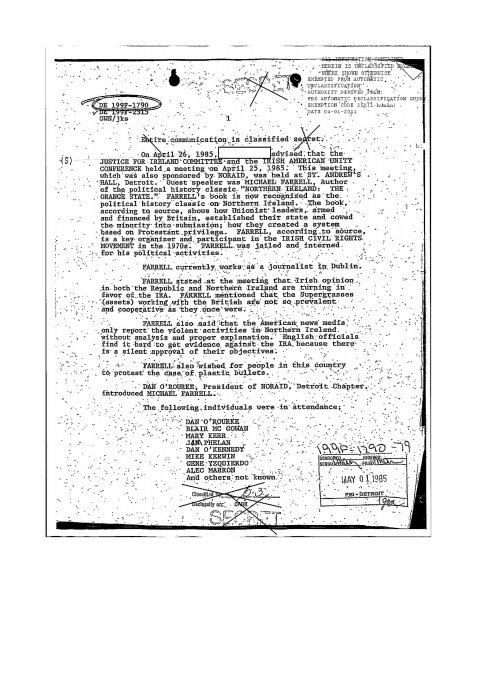
The FBI’s confidential sources reported on more than Noraid activity, as the following report on an April 26, 1985 meeting organised by IAUC and a body called the Justice for Ireland Committee illustrates. Noraid also sponsored the meeting and its chairman introduced the main speaker, Michael Farrell, the Northern civil rights and left-wing political leader.

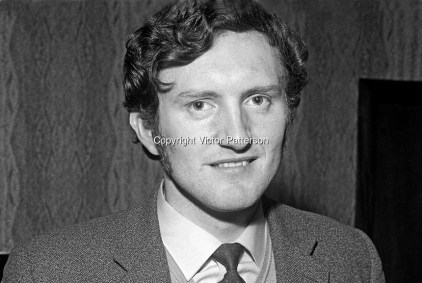
MIchael Farrell, in his days as a student leader

The FBI report of the meeting is almost entirely taken up with Farrell’s remarks, which include the surprising claim that:

‘Irish opinion in both the Republic and Northern Ireland are turning in favor of the IRA.’

Anyway, here are the three FBI files, Parts 7, 8 and 9:


Claim Of IRA Heist Of $500 Million Art Haul Came ‘After A Few Guinnesses’!!!

File this under ‘ludicrous’ – and subtly racist.

A CBS television report, broadcast on July 12th, believe it or not, quotes a so-called art investigator as claiming that a half billion dollar art collection stolen from a Boston, Mass. art museum in 1990, is now in the hands of the IRA.

And how does Arthur Brand  – touted by CBS as ‘the Indiana Jones of the art world’, no less – know that the 13 masterpieces, including a Rembrandt and a Vermeer, valued at $500 million are now gathering dust in an IRA art dump? Well, it’s obvious isn’t it? It’s the IRA, so he gathered his intel in a pub, over what he calls ‘Guinnesses’. Where else could it happen?

Here is how the super sleuth knew he was on to the big story. By the way when will Americans learn that the plural of one glass or pint of Guinness is two glasses or pints of Guinness?` There’s no such thing as ‘Guinnesses’.

Anyway he managed to persuade a highly paid CBS reporter, a producer and a presenter to run with this rubbish:

“We have had talks with… former members of the IRA – and after a few Guinnesses, after a few talks – you can see in their eyes that they know more,” Brand said.

“How do we believe you?” Doane asked.

“Well, I have a track record. We have found some pieces back before. So let’s give this a shot,” Brand said.

I didn’t make that up. Here’s the full report:

Investigator “100 percent sure” stolen art in Boston heist is in Ireland

CBS News July 12, 2017, 8:51 AM

Twenty-seven years later, it’s still a mystery.

The biggest art heist in history, thieves targeted some of the highest-value art from Boston’s Isabella Stewart Gardner Museum, leaving behind empty frames, tied-up security guards and few clues.

The 13 stolen masterpieces valued at around half-a-billion dollars included a Rembrandt and a Vermeer, reports CBS News correspondent Seth Doane.

“I’m 100 percent sure that they are in Ireland. Hundred percent sure. No doubt in my mind,” art investigator Arthur Brand said. He’s described as the Indiana Jones of the art world.

It’s an audacious claim to make after nearly three decades. But Brand alleges his leads point to the Irish Republican Army, or the IRA.

ctm-0712-art-investigator-arthur-brand.jpg
Seth Doane speaks with art investigator Arthur Brand

CBS News

“We have had talks with… former members of the IRA – and after a few Guinnesses, after a few talks – you can see in their eyes that they know more,” Brand said.

“How do we believe you?” Doane asked.

“Well, I have a track record. We have found some pieces back before. So let’s give this a shot,” Brand said.

Brand’s highest-profile find to date came working with German police to recover bronze horse statues which stood in front of Adolf Hitler’s Grand Chancellery building. He also helped recover Salvador Dali’s “Adolescence.”

“How is this stolen art used?” Doane asked.

“They use it as payment for drug deals, for arm deals,” Brand said. “Sometimes they use it for, like, art-napping. They kidnap paintings and they use it as – to get a lesser sentence.”

To find pieces the black market, Brand claims to have brokered deals with terrorist groups, the mafia and a slew of shady characters.

“On one hand you have the police, insurance companies, collectors, and on the other hand you have the criminals, the art thieves and the forgers. So there are two different kind of worlds and they do not communicate. So I put myself in the middle,” Brand said.

Recently he helped recover art which had been stolen from Westfries Museum in his native Holland.

“For the Netherlands – and especially for the town of Hoorn – these paintings are their history,” Brand said.

The paintings had been stolen in 2005 in the quaint town of Hoorn. Eleven years later, thanks to leads that Brand followed to Ukraine, five of the 24 pieces were returned with great fanfare.

“They stole a catalogue of 17th century Dutch masters,” museum director Ad Geerdink said.

“And you’ve left these empty frames as a reminder?” Doane asked.

“And as a protest,” Geerdink said.

“Why a protest?” Doane asked.

“Art crime, well, there isn’t anyone dead. Okay, it’s art – so many people don’t take it too seriously,” Geerdink said.

But, Brand said folks should. Interpol ranks art crime as the 4th highest-grossing criminal trade.

“When you steal a Rembrandt or a Van Gogh – this is… international cultural heritage. It belongs to you, to me, to the viewers,” Brand said.

The Gardner Museum is offering a $10 million reward and welcomes any efforts to get the stolen work back. But when we asked about Brand’s leads, they told us: “They’re not new… we’ve covered them years ago.”

“The museum is skeptical. The museum says your leads are dead-ends,” Doane said.

“Of course. Yes, but – well, we’ll see if it’s a dead end,” Brand said.

Navigating this underworld requires patience, a bit of luck – and a fair share of bravado.

Brand said he doesn’t care about the reward money, so what’s behind the drive?

“It’s the fame. If you solve the Isabella Stewart Gardner theft after 27 years, what more can you do?” Brand said.

It’s an irresistible challenge for what so far has been an unsolvable mystery.

A Guide To Trump’s Russian Links


A useful pocket guide to the links beween Russia and Team Trump produced by the ever assiduous McClatchy newspaper group. Note the minot but not insignificant role played by Roman Abramovich, the owner of Chelsea FC.

Will Trump Privatise The Afghan War?

Mind-boggling stuff here courtesy of The American Conservative magazine. The problem is that with this White House, it is not inconceivable. Obscene and scary, for sure, but not unthinkable. Monetise war and you make it permanent, in the same way the American prison population is the world’s largest. All part of Making America Great Again!

Exclusive: Bannon & Kushner Want to Outsource Afghanistan to Mercenaries

By Mark Perry • July 18, 2017

On July 10, the New York Times revealed that the Trump White House had recruited Erik Prince, the founder of the notorious private security firm Blackwater, and wealthy Trump backer Steve Feinberg, the owner of the high-profile military contractor DynCorp International, to “devise alternatives to the Pentagon’s plan to send thousands of additional troops to Afghanistan.” The story suggested that the president and his top advisers were dissatisfied with the military’s thinking on the conflict, the subject of an intense series of a consultations between senior military officers and Trump’s national security team over the last several months.

While the recruitment of Prince and Feinberg, who are close friends, was intended to provide new options for winning the 16-year war, the administration has been hesitant to describe their role. Both men are controversial for their advocacy of the U.S. government contracting out the Afghan conflict to a private company that would build Afghan state capacity, provide logistical support to the Afghan army, and battle the Taliban. At the very least, the new arrangement would mean a lighter footprint for the U.S. military (or perhaps none at all); at the most it would mean that corporate America, and not the U.S. government, would be responsible for running an overseas war—a kind of “War Inc.”

“Dyncorp has its hands all over Afghanistan anyway, and I mean they’re just everywhere,” a high-level former intelligence officer who is privy to the administration’s thinking told me, “so [senior White House adviser Steve] Bannon and crew figure, ‘What the hell, let’s just turn the whole country over to them.’”

But the proposal has shocked the handful of senior Pentagon and CIA officials familiar with it, who point out the difficulty the United States has had in controlling private armies—and those who run them. This was particularly true of Blackwater, whose contractors gave the U.S. military fits in Iraq’s Anbar Province in the aftermath of Operation Iraqi Freedom, where both national security adviser H.R. McMaster and Defense Secretary James Mattis served in key command positions. Senior military officers blame Blackwater for destabilizing Fallujah in 2004 (forcing Mattis to send his Marines into the city in “Operation Vigilant Resolve”) and for the deaths of 20 Iraqi civilians in Baghdad (the “Nisour Square Massacre”) in 2007.

“That Trump’s people would even think that McMaster or Mattis would listen to Prince shows just how tone-deaf they are,” a senior military officer told me after the Times piece was published. “If there’s one name guaranteed to get H.R.’s back up it’s Erik Prince. How you can’t know that is beyond me.” Even so, Bannon and Trump son-in-law Jared Kushner insisted that McMaster read a May 31 Wall Street Journal oped written by Prince entitled “The MacArthur Model for Afghanistan.” The president read the article and liked it, McMaster was told.

In fact, Prince’s op-ed read like a plea for new business for his Hong Kong-based Frontier Services Group (FSG), which would supplant the U.S. military in providing “reliable logistics and aviation support” to Afghan security forces, monitor a new effort to exploit Afghanistan’s vast mineral holdings, be charged with building Afghan state capacity and, not least, oversee an aggressive air campaign targeting the Taliban. Prince suggested that a “viceroy,” a Douglas MacArthur-like figure, be appointed to oversee the effort. In sum, Prince’s plan would turn Afghanistan over to an American version of Britain’s famed East India Company—which, as Prince wrote, “prevailed in the region” for 250 years by relying on private military units. It was a neat package: the Prince model would save the U.S. billions of dollars, help build Afghanistan’s economy, and settle the conflict by forcing the Taliban back to the negotiating table.

McMaster didn’t buy it, as he told Prince when they met at the White House soon after Prince’s Wall Street Journal article appeared. According to the McMaster colleague who spoke with TAC, “The meeting began well enough,” but soon devolved into a series of increasingly acrimonious exchanges. “It got ugly fast,” TAC was told. McMaster, who is notoriously short-fused, told Prince “in no uncertain terms” that the United States wasn’t going to replicate the British colonial empire in South Asia and wasn’t going to serve as an agent for FSG profits. (The details of this meeting remain uncertain, but the White House did not respond to requests for comment on this article.)

But, while the reaction to Prince’s ideas on Afghanistan was immediate and negative, the views of Feinberg proved less controversial, in part because the New York financier went out of his way to solicit outside opinions on the conflict and to sidle up to Washington insiders with strong ties to officials close to both McMaster and Mattis. Feinberg, who is close to Trump and was a major donor to his 2016 campaign, also had an in-depth discussion with the president on his ideas, we were told. “This isn’t Steve’s first time at the dance,” says a fellow business executive who has known him for years. “He knew that if he showed up at meetings on Afghanistan with dollar signs in his eyes this would be a non-starter.”

Over the last three weeks, Feinberg has quietly held a series of high-level meetings on the conflict, which included a recent dinner at Washington, D.C.’s Trump International Hotel. Included in the confab, TAC was told, was then-Dyncorp CEO Lewis Von Thaer and Ambassador Michael Gfoeller, a now retired 26-year veteran of the U.S. diplomatic service and close associate of retired Gen. David Petraeus. Since that dinner, Von Thaer’s place as a Feinberg sidekick has been filled by George Krivo, brought on to bring added credibility to Feinberg’s Afghanistan initiative. Krivo is a 20-year Army veteran, served in Bosnia and Iraq, and was once a policy adviser to the Chairman of the Joint Chiefs of Staff. Additionally, as TAC has been reliably told, Von Thaer (who has moved on to become the head of Battelle, a well-heeled Ohio-based research firm), “was never entirely comfortable with the whole Dyncorp hired gun thing.”

That is certainly not true for career diplomat Gfoeller, a smooth foreign-policy intellectual. Gfoeller was Petraeus’s senior political adviser from 2008 to 2010, before heading off to Exxon Mobil, where he served as the corporate giant’s head of Middle East and North African affairs in its office of government relations. Not surprisingly, Gfoeller’s stint at Exxon Mobil also put him inside the orbit of Rex Tillerson, a not inconsiderable ally in any effort to reshape the U.S. approach to Afghanistan.

“Sitting down with Gfoeller was the smartest thing Steve could do,” a Middle East hand says. “When you get to Mike, you get to Petraeus, when you get to Petraeus you get to Mattis. You have to remember, Mattis and Petraeus worked together on the counterinsurgency manual and they remain in close touch. Gfoeller is a known quantity in the Mattis Pentagon.” Indeed over the last weeks Feinberg and Gfoeller have become nearly inseparable, a tag team intent on selling the Feinberg-Prince initiative in official Washington. “It’s an unbeatable constellation—you have the money man [Feinberg], the public intellectual who adds heft [Gfoeller], and the can-do adventurer, Erik Prince,” the high level former intelligence officer told me. “You add Krivo to that mix, with his JCS contacts, and suddenly this looks sellable. But Gfoeller is the key.”

Indeed, Gfoeller might well be the most important under-the-radar official in Washington, with ties not only to Petraeus at global investment powerhouse KKR but also to the Washington, D.C.-based Chertoff Group (a security firm headed by former Secretary of Homeland Security Michael Chertoff) and the U.S. intelligence community. This latter is the result of his work as coordinator of U.S. counterterrorism policy while serving as deputy chief of mission in Saudi Arabia. Gfoeller’s intelligence community ties are crucial because a large segment of that community loathes military contractors. “The key here is [CIA Director] Mike Pompeo and [National Intelligence Director] Dan Coats. They will be asked to sign off on this and their opposition would probably kill it. That’s why Gfoeller is important. He’s the guy who would sell this across the river [at the CIA headquarters in Langley].” Under the Feinberg initiative, TAC has been told Dyncorp would not answer up a military chain, but be under the supervision of the CIA.

Feinberg also solicited the views of a number of well-known development hands with experience in South Asia, including economists tasked with building Afghanistan’s economic capacity during the Bush and Obama years. That effort, initially headed up by former Rumsfeld trouble-shooter Marty Hoffman and labeled the “Afghan Reachback” program, identified extensive mineral deposits that could be used to attract international business investments. Additionally, Gfoeller promoted the establishment of a “New Silk Road” that would link the Afghan economy more tightly with its neighbors during the Obama years—a high profile effort that brought him into close contact with the corporate side of the Afghanistan conflict.

“I have to admit, watching this guy Feinberg work is pretty impressive,” says the high level former intelligence officer interviewed by TAC. “He’s checked all the boxes, conferred with all the right people and gotten Bannon on his side. Forget a MacArthur-like viceroy for Afghanistan. Right now it looks like that viceroy will be Feinberg.”

Yet when Steve Bannon suggested that Defense Secretary Mattis meet with Feinberg, Mattis politely but firmly declined. Mattis’s “no” was, in large part, the result of having to subdue Fallujah after four Blackwater contractors died there in 2004 (“he’s convinced that his Marines died for Blackwater,” I was told, “and he hasn’t forgotten that”). For Mattis, the issue with the Feinberg initiative is accountability. “The problem is that mercenaries don’t come under the Uniform Code of Military Justice,” a senior Pentagon officer says. “If they were under a UCMJ structure there could be confidence in command and control and there would be accountability. But they’re not; which means their behavior is impossible to control. Young testosterone filled men carrying weapons and operating outside the law is a recipe for disaster. That scared the hell out of Mattis in 2004, and it scares the hell out of him now.”

As crucially, TAC has been told, Mattis doesn’t believe that Prince or Feinberg understand the conflict. Indeed, according to a senior Pentagon officer, both Mattis and McMaster believe the real challenge for the Trump administration isn’t Afghanistan but Pakistan—which is what former CIA officer Bruce Riedel told Barack Obama aboard Air Force One after his own 90-day deep dive into the Afghanistan problem back in 2009. The Taliban are making gains in Afghanistan, Riedel said, because Pakistan is allowing them to.

That’s true now, eight years later. The one who knows this best is McMaster. During the first week of April, he appointed Lisa Curtis, a South Asia expert at the Heritage Foundation, to head up the NSC’s South Asia desk. The Curtis appointment signaled McMaster’s acceptance of Curtis’s view that to succeed in Afghanistan the U.S. needed to be tougher with Islamabad. Curtis made this point prior to her appointment in a widely circulated paper that she wrote with Husain Haqqani, an official of the Hudson Institute.

In “A New U.S. Approach to Pakistan: Enforcing Aid Conditions without Cutting Ties,” Curtis and Haqqani proposed the adoption of a new get-tough approach to Pakistan as a necessary centerpiece for resolving the Afghanistan war. The United States, the two wrote, should “no longer sacrifice its anti-terrorism principles in the region for the sake of pursuing an ‘even-handed’ South Asia policy, but rather should levy costs on Pakistan for policies that help perpetuate terrorism in the region.” It won’t be enough for the Trump White House to somehow “coax” a change in views in Pakistan, as was done during the Obama years. What will be needed is for the United States to enforce its principles, even if that means losing an ally.

This means that while Trump advisers Bannon and Kushner promote what they tout as the administration’s new thinking and foster the plans of men whom they consider “out of the box” thinkers—such as Prince, Feinberg, Gfoeller and Krivo—the powerhouse figures of Mattis, McMaster, and Curtis have yet to weigh in. Then too, highly respected former CIA officers who served in South Asia, are known to be upset by the Feinberg proposal, and are expected to weigh in against it with Pompeo. The key, ultimately, will be Trump. He will decide whether America’s wars should continue to be fought by Americans or whether they will be contracted out to an out-of-uniform army of guns for hire who will be allowed to kill in the name of America.

Pat Finucane Centre Refuses To Release Adams Document

The Sinn Fein leader Gerry Adams yesterday announced that he intends to appeal two convictions dating back to 1975 on charges that he attempted to escape from Long Kesh internment camp, once when he was with a group of prisoners trying to cut through barbed wire and another when he switched places with a visitor.

Mr Adams, who publicly denies ever being in the IRA, said in a statement:

“Following the recovery of a document by the Pat Finucane Centre in October 2009 from the British National Archives in London, I instructed my solicitor to begin proceedings to seek leave to appeal the 1975 convictions.”

So, what is in this document found by the Pat Finucane Centre (PFC) at the Kew archives in 2009?

Well, Mr Adams is not saying and neither is the PFC.

This was the Centre’s emailed reply today to a request from myself for a copy of the Kew document:

A couple of thoughts. One, regarding this statement: “PFC has a policy whereby if we find document(s) concerning an individual……(W)e only publish or disseminate this information with third parties with the explicit consent of the individual and if they ask us to do so.”

I must have acquired dozens and dozens of files from the Pat Finucane Centre over the years and I was grateful always for the friendly help given by the researchers there.

Many, if not most of the documents that came my way, mention individuals by name and this problem of seeking permission from those individuals before I was given access never raised its head once.

Now, admittedly most of the names were of serving or former members of the security forces and that suggests that if the person or persons named in a Kew document were combatants then the PFC does not apply the rule. But surely Gerry Adams falls into the same category as other combatants in the Troubles and should be treated in the same fashion?

And bear in mind that this is how the PFC defines its aims and identity on its website:

The PFC is a non-party political, anti-sectarian human rights group advocating a non-violent resolution of the conflict on the island of Ireland.

PFC believe that all participants to the conflict have violated human rights.

So, by that definition Gerry Adams and the British military commanders share the same status – as violators of human rights as well as participants in the conflict – and should be treated equally by the ‘non-party political’ PFC.

So if General so-and-so is named without his permission in a document and the document is released by the PFC to journalists like me, then so should a document naming Gerry Adams.

Unless, that is, the PFC is endorsing Mr Adam’s own claim that he was never a participant in the Troubles and thus should be treated like an ordinary, uninvolved civilian.

I can understand the PFC not wishing to embarrass non-involved civilians, but Mr Adams, like his equivalents in the RUC, British Army and UDR, was never a civilian.

The other solution to this is for Gerry Adams to simply make the document public. After all by placing it on the shelves at Kew for academics and researchers to peruse, that is what the Brits have done.

Has France Just Elected A Tony Blair As President?

Colorful Backstory To The Latest Twist In Trump Scandal…….

A fascinating back story to the latest revelations in the never-ending Trump scandal has been provided today by the progressive New York Jewish publication, The Forward, in an account which could be filed under “You Could Not Make This Up.”

It includes a multifarious cast of characters and plots which includes Vladimir Putin; his feud with the hedge-fund manager/grandson of the former leader of the US Communist Party; the financier’s friend and lawyer murdered, possibly on Putin’s say-so, in a Russian jail; Joseph Stalin; a Kremlin-friendly Russian lawyer – and of course la familie Trump.

It is a ripping yarn, penned by JJ Goldberg. Enjoy:

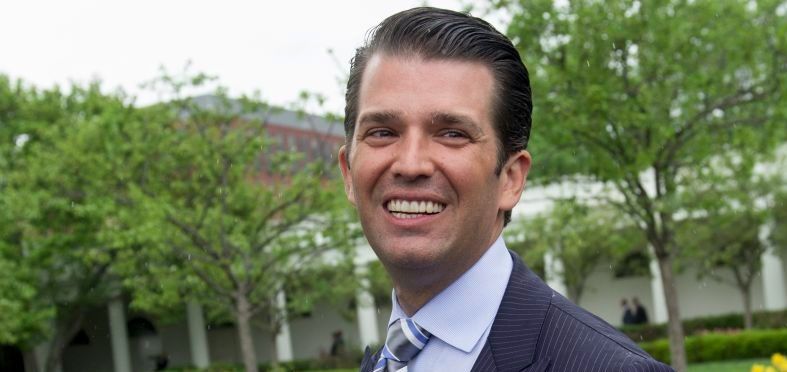
Donald Trump Jr.

The Secret Jewish History Of Donald Trump Jr.’s Russia Scandal

There’s much that we don’t know about the bonds that tie Donald Trump, his campaign or his family to Vladimir Putin’s Kremlin. But there are some important clues that are mostly being overlooked. To follow the trail, it helps to recall that the Trumps are not the only American family whose tangled ties to the Kremlin contributed to our current mess.

In fact, no figure in this saga has a more tangled family relationship with the Kremlin than the London-based hedge fund manager Bill Browder. A major investor in Russia, Browder got himself into a deadly feud with the Putin regime a decade ago. It began with Browder, a brash young foreign investor, challenging the corrupt billionaire oligarchs who surround Putin and lord it over everyone else. It led eventually to Trump Tower, where a shadowy Russian lawyer met last year with Donald Trump’s son, son-in-law and presidential campaign manager to explore enlisting the Trumps on Putin’s side of the feud.

Along the way, the feud turned deadly in November 2009, when Browder’s Moscow lawyer and friend Sergei Magnitsky died in a Moscow prison after being held without charges for a year under barbaric conditions. From there the feud jumped to Capitol Hill, where Browder won passage in 2012 of the so-called Magnitsky Law imposing sanctions on the Putin cronies associated with the lawyer’s death. Putin, reportedly apoplectic over the new sanctions, retaliated by abruptly outlawing the popular practice of American couples adopting Russian orphans.

And from there the feud led to Trump Tower, where a Russian lawyer with Kremlin ties, Natalia Veselnitskaya, met in June 2016 with three of Donald Trump’s top associates: his son Donald Trump Jr., son-in-law Jared Kushner and presidential campaign manager Paul Manafort. Her goal was to enlist them in Putin’s effort to overturn the hated sanctions. The bait: an offer to supply damaging information on Hillary Clinton.

Trump Jr., when first questioned about the meeting, said the Russian wanted to talk about “Russian orphans.” That’s about right. “Orphans” is apparently Kremlin code for “Magnitsky sanctions.”

We don’t know what information about Clinton was on offer, but it was just weeks later that America was first bombarded with damaging Clinton information hacked from Democratic Party computers on Putin’s orders.

Examining the Browder-Kremlin feud thus seems to clear up at least some of the mystery surrounding the Trump-Kremlin relationship. To fully understand the Browder-Kremlin feud, though, it’s important to note that it’s much older than either Bill Browder or Vladimir Putin. It goes back to the time of Browder’s grandfather, Earl Browder, longtime head of the Communist Party USA.

The Kansas-born son of a Methodist preacher, Browder joined the Communist Party shortly after the party’s birth in the aftermath of the Russian Revolution. Rising quickly through the ranks, he took over in 1930 as general secretary, head of the party, and held the post until 1945. He led American communism through the Great Depression and World War II, the years when the party had its closest flirtation with respectability, thanks to its labor and civil rights activism in the 1930s and the U.S.-Soviet wartime alliance in the 1940s (just ignore that little interlude when Stalin was allied with Hitler). Browder ran for president twice on a Communist ticket, in 1936 and 1940. His running mate, James Ford, was the first African American ever to appear on any national presidential ticket.

Browder was probably the closest thing the party ever had to a popular national figure. In 1945, though, he was summarily deposed from party leadership on Stalin’s orders. He was expelled from the party a year later, in 1946. He returned home to Yonkers and lived out his life far from the public eye. He died in 1973, when grandson Bill Browder was 9.

The reason for Browder’s humiliating fall was his advocacy of what’s called Browderism: an effort to take American communism away from its conspiratorial, revolutionary roots and remake it as a sort of left-liberal reformism. The heresy was tolerable from Moscow’s viewpoint during the depression and war years, when Stalin needed the American public’s goodwill. Starting in 1945, though, he was gearing up for a long cold war against the capitalist West. The last straw came when Browder formally reorganized the party as a liberal civic association. Stalin needed it to remain a conspiratorial underground, available for infiltrating unions and stealing nuclear secrets.

That’s the history, in broad strokes. What remains unclear is what the impact was of Browder’s humiliation by Stalin on his grandson’s feud with Putin. Bill Browder sends out mixed signals.

He describes his childhood and his relationship with his grandfather at some length in a 2015 memoir, “Red Notice.” It’s a gripping account of his feud with Putin & Co., of Magnitsky’s tortured death and of Browder’s own growing outrage at Putin’s Russia, with its culture of casual brutality. The early part of the book, though, is a lighthearted tale of a normal childhood in a conventional suburban household of communists. It’s almost like two books. In the second half he has something he urgently wants to say. In the first half he has a lot that he seems unable to get out.

Bill Browder’s father, Felix Browder, was born in 1927 Moscow, where Earl Browder spent several years doing party work. While in Moscow, Earl Browder met and married Raisa Berkman, described by his grandson as “a Russian Jewish intellectual.” Felix Browder was the first of three sons. All three grew up to be distinguished mathematicians at Berkman’s encouragement. None had any role in public or political life. The reader infers that Berkman didn’t much like what politics did to her husband, and wishes Bill Browder had something to say on the topic. But he didn’t.

Felix Browder was married in 1949 to Eva Tislowitz, a child refugee from Nazi-ruled Vienna who was sent to America on her own, was raised in an American foster home and graduated from Massachusetts Institute of Technology. Of himself, Bill Browder writes that he was an indifferent student, but he decided in high school that when he grew up he “would put on a suit and tie and become a capitalist. Nothing would piss my family off more than that.” He sounds like an utterly normal American teenager whose family just happened to be communists.

Reading between the lines of the memoir, the reader infers that Bill Browder’s Jewish upbringing was equally conventional, despite the family’s unconventional politics. He writes casually of his best friend as “a Jewish kid.” Similar phrasings pop up repeatedly when he interacts with a fellow Jew. Moving to London after college to learn investment banking, he affectionately describes his traditional wedding in London’s fashionable Marble Arch Synagogue. He writes of taking David, his son from his first, Jewish marriage, to spend Christmas with his second, non-Jewish family, and one senses his mild discomfort at celebrating the Christian holiday “even though David and I are Jewish.”

After working at several London investment houses he decides to set up his own hedge fund, specializing in post-communist Russia and Eastern Europe. Why Eastern Europe? It’s 1990, and communism is collapsing. “My grandfather had been the biggest communist in America,” he writes, “and as I watched these events unfold, I decided that I wanted to become the biggest capitalist in Eastern Europe.” He did, in fact. He became the biggest foreign investor in Russia, until Putin’s henchmen raided his offices, cleaned out his bank accounts and murdered his lawyer, Magnitsky.

But there’s a reticence in his Jewish narrative. One of his first jobs in London is with the investment operation of the publishing billionaire Robert Maxwell. As it happens, Maxwell was originally a Czech Jewish Holocaust survivor who fled and became a decorated British soldier, then helped in 1948 to set up the secret arms supply line to newly independent Israel from communist Czechoslovakia. He was also rumored to be a longtime Mossad agent. But you learn none of that from Browder’s memoir.

The silence is particularly striking because when Browder launches his own fund, he hires a former Israeli Mossad agent, Ariel, to set up his security operation, manned mainly by Israelis. Over time, Browder and Ariel become close. How did that connection come about? Was it through Maxwell? Wherever it started, the origin would add to the story. Why not tell it?

When Browder sets up his own fund, Hermitage Capital Management — named for the famed czarist-era St. Petersburg art museum, though that’s not explained either — his first investor is Beny Steinmetz, the Israeli diamond billionaire. Browder tells how Steinmetz introduced him to the Lebanese-Brazilian Jewish banking billionaire Edmond Safra, who invests and becomes not just a partner but also a mentor and friend.

Safra is also internationally renowned as the dean of Sephardi Jewish philanthropy; the main backer of Israel’s Shas party, the Sephardi Torah Guardians, and of New York’s Holocaust memorial museum, and a megadonor to Yeshiva University, Hebrew University, the Weizmann Institute and much more. Browder must have known all that. Considering the closeness of the two, it’s surprising that none of it gets mentioned.

It’s possible that Browder’s reticence about his Jewish connections is simply another instance of the inarticulateness that seizes so many American Jews when they try to address their Jewishness. It’s a topic they don’t much think about. Anyway, Browder has so much to say on another topic of vital importance, Russian brutality, that it may be pointless to pick on the parts he left out. It could be, too, that Earl Browder was an early example of what’s now a widespread phenomenon — a Jewish-gentile marriage that has not a Jew marrying out of the Jewish community but a gentile marrying in. If we’re looking at a Methodist preacher’s son who became America’s most important communist and then settled down to raise a suburban Jewish family, it’s a great story, but not an urgent one. We don’t need Bill Browder to tell it.

There was a moment, however, when Browder seemed to let down the veil just a bit and show a hint of his inner turmoil regarding his own background. It came in a 2012 interview with New Republic writer Julia Ioffe, who is herself a Russian Jewish émigré. Browder was in Washington at the time, lobbying for his Magnitsky Act. Ioffe suggested there was a certain irony that he, an American-born expat, naturalized British, who’d voluntarily and unnecessarily renounced his U.S. citizenship, was now looking to Washington for moral leadership on the world stage.

“I don’t want to get into this too much,” Ioffe quotes Browder as saying, “but we came from a family that was persecuted in America, so I don’t have the same sort of, uh…. We were communists and we were persecuted in the McCarthy era.”

He added that “in a certain way, now I’m being politically persecuted in Russia.” And, Ioffe notes, he recalled that his grandfather “was kicked out of the Communist Party by Stalin, and they started killing all the people who were supporters of Browderism.”

That’s a far cry from the Grandpa-was-a-bigshot-commie approach that he would later take in his memoir. There’s a pain there. He comes from a family of American communists who’ve been spurned and betrayed by both America and communism. Nothing lighthearted about it.

In 2012, even in 2015, one could say it’s all Bill Browder’s private business. A casual observer might wonder whether and how much his battle with the Putin regime reflected an ancient grudge resurfacing across the generations, but there was nothing urgent about it. Now the stakes have changed. It could be, far-fetched though it seems, that the crisis in American governance exploding before us right now is just the latest twist in an old grudge match between the Soviet dictator and the sad, betrayed world of American Jewish communist idealism. That’s something we need to know about.

Corbynism Re-assessed

Matt Bolton offers an interesting corrective to those on the Right and Left who believe Jeremy Corbyn’s recent general election success heralds the renewal of radicalism in the British Labour party. Thanks to LS for this tip. This article originally appeared in the Sheffield Political Economy Research Institute (SPERI) blog.

speri.comment: the political economy blog

13 June 2017

Reassessing Corbynism: success, contradictions and a difficult path ahead

Corbyn’s success in building an alliance that extends from Greens to UKIP voters only postpones the moment of Labour’s reckoning with Brexit

Matt Bolton, Doctoral Researcher, University of Roehampton

The trickle of mea culpas from the rapidly diminishing band of Corbyn-sceptics following the election result has now turned into a flood, and not without cause.  Once widely-held truisms – Corbynism is a ‘movement’ more clicktivist than canvasser, Corbyn himself is electorally toxic, Labour face a 1931-style demolition and the collapse of its Parliamentary presence – have been shown to be categorically wrong.  Corbyn ran an energetic, positive, smart campaign, founded on an unashamedly tax-and-spend manifesto.  The quick-witted air war was backed up online and through unprecedented numbers of volunteers taking to the streets to engage potential Labour voters and getting them to turn out on polling day.  Such mass activism had long been promised by Corbyn’s most vocal supporters, but aside from his own leadership campaigns, had been in sparse evidence on the ground.  But there is no doubt that when it came to the crunch, Corbynism cashed its activist cheques.  This level of enthusiastic political engagement would simply not have taken place with another leader – although the suspicion persists that a lot of the urgency was the product of retrospective regret on behalf of younger Remainers that they had not done the same (or perhaps even voted) during the EU referendum.

The election result also clearly demonstrates that Corbynism has not destroyed the party’s parliamentary presence.  Labour has made some promising gains, particularly in England, and as Paul Mason notes, seem to have somehow picked up votes both from the liberal and green metropolitan left, and a decent sized portion of the former UKIP vote.  This was undoubtedly a remarkable and wholly unexpected achievement, one which few in the top echelons of either party thought possible up until the moment of the exit poll.  But while Labour are rightly still celebrating a welcome electoral step forward, not to mention capitalising on the total collapse of Theresa May’s authority as Prime Minister, unpicking the reasons why Corbyn was able to bring this unlikely electoral coalition together reveals that many of the criticisms levelled at the Corbyn project continue to hold.  Indeed, in some ways this election has merely postponed a true reckoning with the contradictions and regressive tendencies that run through the Corbynist worldview.  In particular, Corbyn’s success postpones once again the moment of reckoning at which the left finally recognises that the acceptance of Brexit and the end of free movement constitutes a fundamental, generational defeat, one for which gains in the House of Commons, however welcome, are scant recompense.  With this in mind, then, this article is not yet another mea culpa.  It is rather an attempt to take stock of what has changed and what has not, in the form of some first thoughts on how this election result – and in particular Corbyn’s Green-UKIP alliance – was possible.

This was the first post-deficit election

Direct comparisons with previous elections (whether on seats or vote share) are misleading.  Each election takes place in an entirely different context, which shapes what can and cannot be said within the campaign, and what is regarded (rightly or wrongly) as ‘credible’.  Much of the day to day grind of politics consists of the battle to shape that context (as can be seen with the struggle  over the ‘hard’ or ‘soft’ interpretation of the referendum result, a battle which until Thursday night at least, May seemed to have comprehensively won).  The 2015 election was dominated by discussion of the deficit and debt.  The endless repetitions of how the Tories were still ‘clearing up Labour’s mess’ trapped Ed Miliband in political-economic territory from which he could never win  –  every word from his mouth was framed by the context of how Labour’s supposed overspending had led to the crash and the ‘deficit’.  This frame has, incredibly, now virtually disappeared. Labour were careful to cost their manifesto nonetheless – demonstrating that the difference between their position and Miliband’s cannot be explained by mere hard left ‘will power’ – and the Tories failure to bother doing the same, lazily assuming the line from 2015 still held sway, left any attacks they made on Labour’s spending plans seem hollow and hypocritical.  But it was the combination of austerity finally starting to bite the lower middle classes in a way it hadn’t in 2015 (school cuts and the NHS winter crisis cut through in a huge way) and Brexit that really wiped the economic slate clean.  The Leave promises of an extra £350m a week for the NHS, regardless of their veracity, put public spending for services back on the ‘credible’ electoral playing field in a way that we have not seen since 2005.  Add in May’s own desire to boost infrastructure spending, and Corbyn and McDonnell had the space to make spending commitments that were just not available to Miliband.  They made the most of it.

The left’s instinctive trust in Corbyn allows him to successfully triangulate

The idea that Corbyn is a truly authentic man who has stuck to his principles through thick and thin is prevalent even amongst his fiercest critics.  It is also his greatest weapon when it comes to keeping the left (and the youth vote) onside while in reality triangulating as ably –  if not more so –  as any Blairite.  Labour’s policy on immigration in this election was well to the right of the 2015 manifesto.  Miliband was pilloried by the left for proposing ‘controls on immigration’, which slogans on mugs aside, amounted to a two year ban on EU migrants receiving benefits.  Corbyn’s manifesto went even further than May herself by pledging to end free movement of people from the EU come what may in the Brexit negotiations.  While the effect of this was to almost entirely drain the ‘immigration debate’ from the election in a way unimaginable even six months ago, this was only due to the total capitulation of both Corbyn and the broader left on the issue.  The immigration policy in Labour’s 2017 manifesto was more extreme in concrete terms than what most of the Leave side were proposing in the referendum -  in essence assuring full withdrawal from the single market, whatever the consequences -  and yet Corbyn’s supporters on the left accepted it because they refuse to believe that Corbyn himself, as a man of principle, can really mean it.  While every word Miliband (or indeed virtually anyone else who is not Corbyn) is treated with suspicion, despite the pro-single market arguments of the contemporary Blair being inherently far less punitive on immigration than Corbyn’s position, Corbyn is given the benefit of the doubt every time, even when the policy is written down in black and white.  This is triangulation of the highest order, enabling Labour to appeal to hardline anti-migrant UKIP voters while also keeping the trust of the ‘cosmopolitan’ urban left.  It is doubtful any other Labour leader would have been capable of achieving this.  Yet the faith in Corbyn’s supposedly unshakeable core beliefs is such that his party’s policies on immigration barely register amongst people who would be incandescent with rage if another Labour leader even vaguely gestured towards them.

The same applies to Labour’s policy on welfare.  Corbyn’s victory in the first leadership campaign in 2015 was secured by his voting against benefit cuts, while his rivals abstained on the second reading of the Welfare Reform bill (although they did vote against it in the final reading).  This was held up as proof that Corbyn was not only politically but morally superior to his opponents.  Yet in his manifesto, as Chaminda Jayanetti has admirably shown, Corbyn did not pledge to reverse benefit cuts, nor remove the benefit cap.  Once again, those who were most vocal in condemning the abstainers have not raised a word in criticism against Corbyn.  The same pattern appeared again and again in the campaign itself  –  once-vocal advocates for police abolition now enthusiastically cheered Corbyn on as he castigated May for police cuts, and similarly backed Corbyn as he celebrated May’s infamous ‘dementia tax’ U-turn even though the new proposal to cap contributions to elderly care places far more of the burden on the poorest demographics than the original manifesto proposal.  None of these policies could be classed as radical or left wing, and all would be fiercely criticised from the left if proposed or supported by any other Labour leader.  Yet Corbyn gets away with it time after time, on reputation alone.

The problem with this is not triangulation in-and-of itself – contrary to hard left mythology, it is an inherent necessity of political action in a parliamentary system which requires a broad majority in the country in order to govern.  Rather, it is that policies which cannot objectively be regarded as left-wing – and indeed in real terms would be catastrophic for the living conditions of the working class – are uncritically supported, even deemed ‘socialist’, merely by dint of coming from Corbyn’s mouth.  The opposite is true when it comes to how Corbyn’s supporters view the soft left, with policies proposed by them regarded as a priori ‘Blairite’ regardless of actual content.  This an emotional response, not a political one, and its only consequence hitherto has been the perpetuation of Tory rule.

But Brexit is the one issue where triangulation is impossible

However, in a political economy entirely overdetermined by the unprecedented circumstances of Brexit, this strategy of inverse Blairism – sounding left while (in many, though not all, ways) acting right – however skilfully managed, cannot hold.  While Corbyn’s much derided ‘0% strategy’ on Brexit proved to a be a short-term electoral masterstroke, assuring Red Kippers that he was committed to pulling out of the single market and clamping down on immigration, while allowing Remainers to project their hopes for a softer landing onto him, at some point a decision has to be made.  It cannot be continually pushed down the line, hedged and obfuscated by vague promises of ‘tariff-free access’.  Every one of Corbyn’s much-vaunted manifesto pledges relies on an increased tax-take and growth strategy which are predicated upon remaining in the single market, and thus entail retaining free movement.  Yet his manifesto promise to end free movement (reiterated by John McDonnell in the weekend after the election result) makes nationalist protectionism the axiomatic position of both major parties, one which for Labour cannot be overturned without shedding one half of the electoral coalition which has secured Corbyn’s position.

The struggle to win the support of the ex-UKIP Leave vote has led to Farage’s nativist agenda poisoning the well of the British polity as a whole, left and right – the real reason he is still never off the airwaves, despite UKIP’s ostensible collapse.  The risk on one side is of economic catastrophe, on the other the development of a ‘stab in the back’ myth of national betrayal.  No amount of energetic canvassing or witty memes can bridge such an abyss.  It requires the political courage to be truly honest with the electorate about the consequences of withdrawal from the single market, traits which for all Corbyn’s purported authenticity have, in this context at least, been in short supply.

‘Britain First’  –  a foreign policy to unite UKIP and the Greens

It was remarkable to see how few punches the Tories and their supportive media managed to land with regard to Corbyn’s supposed links with the IRA and Islamist groups.  Once again, Corbyn’s ‘principled’ persona and skilful ‘Monsieur Zen’ interview style enabled him to dodge even the worst allegations (laying a wreath for a man involved in the 1972 Munich massacre of Israeli Olympic athletes) by quietly explaining that all he has ever worked for is ‘peace’.  This is buttressed by the ever-growing mythology around his being on the ‘right side of history’   – particularly his opposition to apartheid (ignoring the fact that no Labour MP ever supported apartheid, and that ‘Blairite’ MPs like Peter Hain did far more to actually oppose it on the ground than Corbyn ever did) and his alleged role in the Northern Ireland peace process (a claim not merely denied but laughed at by anyone who actually was involved).  Leaving aside for now whether the real consequence of his eternal non-interventionist position, regardless of context, is actually ‘peace’  –  rather than the brutal crushing of popular democratic revolutions, vicious theocratic dictatorships and/or interminable civil war  –  the key point is that this position is one of the very few which can unite Labour left, Green and UKIP voters.  The spectre of Iraq and the rise of ISIS has led to the popularity of an isolationist foreign policy across the UK political spectrum, in much the same way as in the US where Trump and the Greens’ Jill Stein share many presuppositions when it comes to international relations.  While the left think of such foreign policy positions in naively ethical terms, the right portray them as ‘America [or Britain] First’.  Corbyn would not use such nationalist language himself, but that is undoubtedly what Red-UKIP voters hear in his statements on foreign policy, and this along with his rejection of free movement goes some way to explaining the return of UKIP voters to the Labour fold.

The ‘rigged economy’ conspiracy theory

In a previous critique of Corbynism, I examined the ‘personalised’ critique of capitalism which underlies the worldview of Corbyn and many of his supporters.  This perspective sees poverty, economic crashes, inequality and even war as being the result of the conscious behaviour of shadowy ‘global elites’, usually in the financial sector.  Such a viewpoint, common amongst right and left, fails to grasp capital as an abstract social relation, dominating both rich and poor alike, and at its most extreme can lead to anti-Semitic conspiracy theories of Jewish plots to rule the world through control of the banks.  The prevalence of this kind of foreshortened critique of capitalism (or neoliberalism, as popularly understood) goes some way to explain the spread of conspiracy theories about the ‘Rothschilds’ and ‘Zionists’ through much of the ‘Canary’/‘Skwawkbox’ left, as well as the alt-right – they are not contingent or accidental, but the consequence of pushing an analysis of capitalism as conspiracy to its logical conclusion.

Since his ‘populist turn’ at the start of the year, Corbyn has severely ramped up this kind of talk.  Throughout the election campaign there were endless references to the ‘rigged economy’ set up by elites which had ‘ripped off’ the British people.  Like the isolationist foreign policy, this discourse has an appeal to both the ‘anti-vax’ wing of the Green left and the Trumpian-UKIP right, with the vagueness of the ‘rigged’ concept allowing people to point the finger of accusation at whatever scapegoat fits their particular prejudice.  While it can be effective, there is an inherent risk in this kind of approach to politics, in that it can rapidly spiral out of control and in unexpected directions if not strictly supervised.  There is no guarantee that once let out of the bottle this kind of personalised critique of capitalism will inevitably lead in a progressive direction.  If it is true that Corbyn has managed to patch up a right-left electoral alliance on these grounds  –  along with implied migration controls and an isolationist foreign policy  –  it will require extreme vigilance to ensure it does not veer onto a regressive track.

Once again, the spectre of Brexit on the horizon multiplies this risk many times over.  The rhetoric of a ‘rigged system’ lays the groundwork for the hard right press and politicians of all stripes to pin the blame for a botched, economically disastrous full withdrawal, or a humiliating ‘retreat’ to a ‘Norway model’ compromise that retains free movement, on nebulous, shadowy ‘others’.  It is not hard to see how such grievance-based politics based on images of conspiratorial elites plotting against the noble, honest ‘people’ could be utilised by a genuinely populist and charismatic hard right leader, either blaming economic disaster on the machinations of ‘those pulling the strings’ or ramping up anti-migrant rhetoric to force a de facto hard Brexit by means of expelling migrants through intimidation rather than legislation.

There is nothing inevitable about any of this, but until the Corbynite left recognise the danger of building their programme on such ambiguous rhetorical ground, in such an intensely volatile political conjuncture, it is a risk that lies coiled within the movement, regardless of how triumphant it may feel today.

Amateur Hour At Trump Tower

The New York Times story below appears to be the smoking gun in the Trumpgate scandal: the text of an email exchange last June between an obscure former British tabloid reporter and Donald Trump Jr. offering Russian government dirt on Hillary Clinton during the impending US presidential election campaign.

What strikes this writer is the sheer amateurishness of the plot, not least the Russian failure to protect the secrecy of the emails flying between Russia and Trump Tower, or alternatively not using a more discrete and deniable way to make contact with team Trump, like flying the British contact to New York for a face-to-face meeting with people he seemingly knew well enough already.

If that was not feasible then the very least the Russians should have done was to ensure that both the British contact – former tabloid reporter turned music publicist, Rob Goldstone – and Donald Jr. were equipped with an email encryption programme.

The best know of these is GPG, a derivative of PGP (Pretty Good Privacy). It is easy to load, at least on an Apple computer, and even easier to operate. Encrypted emails can only be opened once passwords, or keys, unique to the recipient and sender are created and in the event of the authorities demanding access say, to Donald Jr’s password, well…..passwords can so easily be forgotten or lost.

If Donald Jr and Mr Goldstone had been using GPG, today’s New York Times story would never have been written.

I have been using PGP or GPG for many years, during my time as a journalist in Belfast, where I assumed both the British and the Provos would be interested in some of my emails. Myself and the two researchers for the Boston College archive project communicated using a commercial version of PGP. I also display my GPG public key on the front page of this blog in case someone wishes to communicate using encryption.

If any of my readers would like to download GPG, here is a link.

So why didn’t the Russians employ this basic precaution? Conspiracy theorists will doubtless conclude that this was a deliberate mistake intended to create confusion and conflict in American politics once the emails were discovered – and anyway who could have imagined a Trump victory last June?

I suspect, however, that the simpler explanation is the right one, that it was a simple cock-up born of stupidity and hubris on the part of the FSB, the post-Communist successors to the KGB.

If I’m right then the big losers out of this affair, aside from la familie Trump, will be the reputation and standing of the Russian intelligence services.

Russian Dirt on Clinton? ‘I Love It’ Donald Trump Jr. Said

Donald Trump Jr. after speaking at the Republican National Convention, in Cleveland. Sam Hodgson for The New York Times

The June 3, 2016, email sent to Donald Trump Jr. could hardly have been more explicit: One of his father’s former Russian business partners had been contacted by a senior Russian government official and was offering to provide the Trump campaign with dirt on Hillary Clinton.

The documents “would incriminate Hillary and her dealings with Russia and would be very useful to your father,” read the email, written by a trusted intermediary, who added, “This is obviously very high level and sensitive information but is part of Russia and its government’s support for Mr. Trump.”

If the future president’s elder son was surprised or disturbed by the provenance of the promised material — or the notion that it was part of an ongoing effort by the Russian government to aid his father’s campaign — he gave no indication.

He replied within minutes: “If it’s what you say I love it especially later in the summer.”

Four days later, after a flurry of emails, the intermediary wrote back, proposing a meeting in New York on Thursday with a “Russian government attorney.”

Donald Trump Jr. agreed, adding that he would likely bring along “Paul Manafort (campaign boss)” and “my brother-in-law,” Jared Kushner, now one of the president’s closest White House advisers.

On June 9, the Russian lawyer was sitting in the younger Mr. Trump’s office on the 25th floor of Trump Tower, just one level below the office of the future president.

Over the last several days, The New York Times has disclosed the existence of the meeting, whom it involved and what it was about. The story has unfolded as The Times has been able to confirm details of the meetings.

But the email exchanges, which were reviewed by The Times, offer a detailed unspooling of how the meeting with the Kremlin-connected Russian lawyer, Natalia Veselnitskaya, came about — and just how eager Donald J. Trump was to accept what he was explicitly told was the Russian government’s help.

The Justice Department, as well as the House and Senate Intelligence Committees, is examining whether any of President Trump’s associates colluded with the Russian government to disrupt last year’s election. American intelligence agencies have determined that the Russian government tried to sway the election in favor of Mr. Trump.

The precise nature of the promised damaging information about Mrs. Clinton is unclear, and there is no evidence to suggest that it was related to Russian-government computer hacking that led to the release of thousands of Democratic National Committee emails. But in recent days, accounts by some of the central organizers of the meeting, including Donald Trump Jr., have evolved or have been contradicted by the written email records.

On Monday, Donald Trump Jr. said on Twitter that it was hardly unusual to take information on an opponent. And on Tuesday morning, he tweeted, “Media & Dems are extremely invested in the Russia story. If this nonsense meeting is all they have after a yr, I understand the desperation!”

The back story to the June 9 meeting involves an eclectic cast of characters the Trump family knew from its business dealings in Moscow.

The initial email outreach came from Rob Goldstone, a British-born former tabloid reporter and entertainment publicist who first met the future president when the Trump Organization was attempting to do business in Russia.


In the June 3 email, Mr. Goldstone told Donald J. Trump Jr. that he was writing on behalf of a mutual friend, one of Russia’s biggest pop music stars, Emin Agalarov. Emin, who professionally uses his first name only, is the son of Aras Agalarov, a real estate tycoon sometimes called the “Donald Trump of Russia.”

The elder Agalarov boasts close ties to Mr. Putin: his company has won several large state building contracts, and Mr. Putin awarded him the “Order of Honor of the Russian Federation.”

Mr. Agalarov joined with the elder Mr. Trump to bring the Miss Universe contest to Moscow in 2013, and the Trump and Agalarov families grew relatively close.

When Emin released a music video with a theme borrowed from the television show, The Apprentice, Mr. Trump, then the show’s star, made a cameo appearance, delivering his trademark line: “You’re fired!” The elder Mr. Agalarov had also partnered with the Trumps to build a Trump hotel in Moscow, but it has never came to fruition.