Libya Revisited: The Follies, Lies And Crimes Of A Humanitarian Intervention

UPDATE – I forgot to say that the author of this fascinating piece is Alan J Kuperman.

As readers of this blog may guess, there is a soft spot in my heart for Libya. I spent two happy years there in the early 1970’s teaching English to Arab students at Tripoli University and these happened to be some of the best years of the Gaddafi dictatorship, when he was seriously intent on redistributing oil income to the country’s people.

Libyan leader, Muammar Gaddafi, slain by Jihadi forces in 2011

Libyan leader, Muammar Gaddafi, slain by Jihadi forces in 2011

Roads were being built all over the place as were homes, schools and hospitals. Everyone had a job, usually working in some government office, and Libyan pockets were stuffed with dinars. Our bosses were friendly and hospitable, fillet steak was sold at the same price as stewing meat in subsidised butchers shops, home made booze was always within reach and the warm Mediterranean sea and its golden beaches were never more than half a mile away. And we were young.

Clearly things went downhill after I left for reasons and in ways which would take too much space to describe here. By the mid-2000’s Gaddafi had decided to maneuver his way out of his self-imposed dead end and made his peace with the West.

Tony Blair and a host of American neocons were welcomed and feted in his desert tent in an effort cling on to power but it didn’t work out, as I suspected it wouldn’t. Gaddafi gave up his pathetic stock of chemical weapons, allowing Bush to claim his Iraq intervention had worked, European leaders wooed him quite nakedly for his money and Gaddafi turned into a clown. He made the fatal mistake of mistaking their approaches for friendship and the advent of a new-found respectability while all the time they held knives behind their backs, biding their time but ready to strike.

And so when the West, in the shape of NATO bombers and special forces on the ground intervened in 2011, allegedly on the grounds of preventing a civilian slaughter in Benghazi by Gaddafi forces, I didn’t quite believe the reasons they gave. Not only did the story not hang together but I knew from personal experience the deep layer of Western hostility to his regime and the desire for revenge for his past activities that existed in London and Washington. If they were looking for an excuse to remove him, the Arab Spring provided it.

Now the Belfer Center at Harvard School of Government has added substance to that suspicion in a devastating analysis of the Libyan intervention and its aftermath that should make all those crying for a similar US exercise in Syria serious pause for thought. Here is their report:

Policy Brief • September 2013

Quarterly Journal: International Security

Lessons from Libya: How Not to Intervene

BOTTOM LINES

The Conventional Wisdom Is Wrong. Libya’s 2011 uprising was never peaceful, but instead was armed and violent from the start. Muammar al-Qaddafi did not target civilians or resort to indiscriminate force. Although inspired by humanitarian impulse, NATO’s intervention did not aim mainly to protect civilians, but rather to overthrow Qaddafi’s regime, even at the expense of increasing the harm to Libyans.

The Intervention Backfired. NATO’s action magnified the conflict’s duration about sixfold, and its death toll at least sevenfold, while also exacerbating human rights abuses, humanitarian suffering, Islamic radicalism, and weapons proliferation in Libya and its neighbors. If Libya was a “model intervention,” then it was a model of failure.

Three Lessons. First, beware rebel propaganda that seeks intervention by falsely crying genocide. Second, avoid intervening on humanitarian grounds in ways that reward rebels and thus endanger civilians, unless the state is already targeting noncombatants. Third, resist the tendency of humanitarian intervention to morph into regime change, which amplifies the risk to civilians.

By Alan J. Kuperman

This policy brief is based on “A Model Humanitarian Intervention? Reassessing NATO’s Libya Campaign,” which appears in the Summer 2013 issue of Interna- tional Security.

A MODEL INTERVENTION?

Many commentators have praised NATO’s 2011 intervention in Libya as a humanitarian success for averting a bloodbath in that country’s second largest city, Benghazi, and helping eliminate the dictatorial regime of Muammar al-Qaddafi. These proponents accordingly claim that the intervention demonstrates how to successfully implement a humanitarian principle known as the responsibility to protect (R2P). Indeed, the top U.S. representatives to the transatlantic alliance declared that “NATO’s operation in Libya has rightly been hailed as a model intervention.” A more rigorous assessment, however, reveals that NATO’s intervention backfired: it increased the duration of Libya’s civil war by about six times and its death toll by at least seven times, while also exacerbating human rights abuses, humanitarian suffering, Islamic radicalism, and weapons proliferation in Libya and its neighbors. If this is a “model intervention,” then it is a model of failure.

FLAWED NARRATIVE

The conventional account of Libya’s conflict and NATO’s intervention is misleading in several key aspects. First, contrary to Western media reports, Qaddafi did not initiate Libya’s violence by targeting peaceful protesters. The United Nations and Amnesty International have documented that in all four Libyan cities initially consumed by civil conflict in mid-February 2011—Benghazi, Al Bayda, Tripoli, and Misurata—violence was actually initiated by the protesters. The government responded to the rebels militarily but never intentionally targeted civilians or resorted to “indiscriminate” force, as Western media claimed. Early press accounts exaggerated the death toll by a factor of ten, citing “more than 2,000 deaths” in Benghazi during the initial days of the

September 2013

uprising, whereas Human Rights Watch (HRW) later documented only 233 deaths across all of Libya in that period.

Further evidence that Qaddafi avoided targeting civilians comes from the Libyan city that was most consumed by the early fighting, Misurata. HRW reports that of the 949 people wounded there in the rebellion’s initial seven weeks, only 30 were women or children, meaning that Qaddafi’s forces focused narrowly on combatants. During that same period, only 257 people were killed among the city’s population of 400,000—a fraction less than 0.0006—providing additional proof that the government avoided using force indiscriminately. Moreover, Qaddafi did not perpetrate a “bloodbath” in any of the cities that his forces recaptured from rebels prior to NATO inter- vention—including Ajdabiya, Bani Walid, Brega, Ras Lanuf, Zawiya, and much of Misurata—so there was virtually no risk of such an outcome if he had been permitted to recapture the last rebel stronghold of Benghazi.

The conventional wisdom is also wrong in asserting that NATO’s main goal in Libya was to protect civilians. Evidence reveals that NATO’s primary aim was to overthrow Qaddafi’s regime, even at the expense of increasing the harm to Libyans. NATO attacked Libyan forces indiscriminately, including some in retreat and others in Qaddafi’s hometown of Sirte, where they posed no threat to civilians. Moreover, NATO continued to aid the rebels even when they repeatedly rejected government cease-fire offers that could have ended the violence and spared civilians. Such military assistance included weapons, training, and covert deployment of hundreds of troops from Qatar, eventually enabling the rebels to capture and summarily execute Qaddafi and seize power in October 2011.

THE INTERVENTION BACKFIRED

The biggest misconception about NATO’s intervention is that it saved lives and benefited Libya and its neighbors. In reality, when NATO intervened in mid- March 2011, Qaddafi already had regained control of most of Libya, while the rebels were retreating rapidly toward Egypt. Thus, the conflict was about to end, barely six weeks after it started, at a toll of about 1,000 dead, including soldiers, rebels, and civilians caught in the crossfire. By intervening, NATO enabled the rebels to resume their attack, which prolonged the war for another seven months and caused at least 7,000 more deaths.

The best development in postwar Libya was the democratic election of July 2012, which brought to office a moderate, secular coalition government—a stark change from Qaddafi’s four-decade dictator- ship. Other developments, however, have been less encouraging. The victorious rebels perpetrated scores of reprisal killings and expelled 30,000 mostly black residents of Tawerga on grounds that some had been “mercenaries” for Qaddafi. HRW reported in 2012 that such abuses “appear to be so widespread and systematic that they may amount to crimes against humanity.” Ironically, such racial or ethnic violence had never occurred in Qaddafi’s Libya.

Radical Islamist groups, suppressed under Qaddafi, emerged as the fiercest rebels during the war and refused to disarm or submit to government authority afterward. Their persistent threat was highlighted by the September 2012 attack on U.S. facilities in Benghazi that killed Ambassador Christopher Stevens and three of his colleagues. Even more recently, in April 2013, a vehicle bomb destroyed half of the French em- bassy in the capital, Tripoli. In light of such insecurity, it is understandable that most Libyans responding to a postwar poll expressed nostalgia for a strong leader such as Qaddafi.

Among neighboring countries, Mali, which previously had been the region’s exceptional example of peace and democracy, has suffered the worst consequences from the intervention. After Qaddafi’s defeat, his ethnic Tuareg soldiers of Malian descent fled home and launched a rebellion in their country’s north, prompting the Malian army to overthrow the president. The rebellion soon was hijacked by local Islamist forces and al-Qaida, which together imposed

For more from International Security, please visit http://belfercenter.org/IS

September 2013

sharia and declared the vast north an independent country. By December 2012, the northern half of Mali had become “the largest territory controlled by Islamic extremists in the world,” according to the chairman of the U.S. Senate Subcommittee on Africa. This chaos also spurred massive displacement of hundreds of thousands of Malian civilians, which Amnesty International characterized as “Mali’s worst human rights situation in 50 years.”

Sophisticated weapons from Qaddafi’s arsenal—including up to 15,000 man-portable, surface-to-air missiles unaccounted for as of 2012—leaked to radical Islamists throughout the region. NATO’s intervention on behalf of Libya’s rebels also encouraged Syria’s formerly peaceful protesters to switch to violence in mid-2011, in hopes of attracting a similar intervention. The resulting escalation in Syria magnified that country’s killing rate by tenfold.

LESSONS

NATO’s intervention in Libya offers at least three im- portant lessons for implementing the responsibility to protect. First, potential interveners should beware both misinformation and rebel propaganda. If Western countries had accurately perceived Libya’s initial civil conflict—as Qaddafi using discriminate force against violent tribal, regional, and radical Islamist rebels—NATO would have been much less likely to launch its counterproductive intervention.

The second lesson is that humanitarian intervention can backfire by escalating rebellion. This is because some substate groups believe that by violently provoking state retaliation, they can attract such intervention

RELATED RESOURCES

to help achieve their political objectives, including regime change. The resulting escalation, however, magnifies the threat to noncombatants before any potential intervention can protect them. Thus, the prospect of humanitarian intervention, which is intended to protect civilians, may instead imperil them via a moral hazard dynamic. To mitigate this pathology, it is essential to avoid intervening on humanitarian grounds in ways that reward rebels, unless the state is targeting noncombatants.

A final lesson is that intervention initially motivated by the desire to protect civilians is prone to expanding its objective to include regime change, even if doing so magnifies the danger to civilians, contrary to the interveners’ original intent. That is partly because intervening states, when justifying their use of force to domestic and international audiences, demonize the regime of the country they are targeting. This demonization later inhibits the interveners from considering a negotiated settlement that would permit the regime or its leaders to retain some power, which typically would be the quickest way to end the violence and protect noncombatants. Such lessons from NATO’s use of force in Libya suggest the need for considerable caution and a comprehensive exploration of alternatives when contemplating if and how to conduct humanitarian military intervention.

•••

Statements and views expressed in this policy brief are solely those of the author and do not imply endorsement by Harvard University, the Harvard Kennedy School, or the Belfer Center for Science and International Affairs.

Crawford, Timothy W., and Alan J. Kuperman, eds. Gambling on Humanitarian Intervention: Moral Hazard, Rebellion, and Civil War (New York: Routledge, 2006).

Kuperman, Alan J. “The Moral Hazard of Humanitarian Intervention: Lessons from the Balkans,” International Studies Quarterly, Vol. 52, No. 1 (March 2008), pp. 49–80.

Roberts, Hugh. “Who Said Gaddafi Had to Go?” London Review of Books, Vol. 33, No. 22 (November 2011), pp. 8–18.

UN Human Rights Council, nineteenth session, “Report of the International Commission of Inquiry on Libya,” A/HRC/19/68, ad- vance unedited version, March 2, 2012.

For more from International Security, please visit http://belfercenter.org/IS

September 2013

ABOUT THE BELFER CENTER

The Belfer Center is the hub of the Harvard Kennedy School’s research, teaching, and training in international security affairs, environmental and resource issues, and science and technology policy.

The Center has a dual mission: (1) to provide leadership in advancing policy-relevant knowledge about the most important challenges of international security and other critical issues where science, technology, environmental policy, and international affairs intersect; and (2) to prepare future generations of leaders for these arenas. Center researchers not only conduct scholarly research, but also develop prescriptions for policy reform. Faculty and fellows analyze global challenges from nuclear proliferation and terrorism to climate change and energy policy.

ABOUT THE AUTHOR

Alan J. Kuperman is Associate Professor of Public Affairs in the Lyndon B. Johnson School of Public Affairs at the University of Texas, Austin. During 2013–14, he will be a Jennings Randolph Senior Fel- low at the U.S. Institute of Peace, in Washington, D.C.

ABOUT international security

International Security is America’s leading peer- reviewed journal of security affairs. It provides sophisticated analyses of contemporary, theoretical, and historical security issues. International Security is edited at Harvard Kennedy School’s Belfer Center for Science and International Affairs and is published by The MIT Press.

For more information about this publication, please contact the International Security editorial assistant at 617-495-1914.

“As The Officer Commanding The Derry Part Of The IRA…?” – That Tom Mangold Interview With Martin McGuinness Now On YouTube

Many thanks to “Wicklow” for this tip that the famous Tom Mangold interview with a young Martin McGuinness is now on YouTube, the one which begins with the celebrated question: “As the officer commanding the Derry part of the IRA Provisionals….?

It was, allegedly, the threat that this interview would be used against him that persuaded him both to give evidence to the Saville Tribunal confirming his IRA membership at the time of Bloody Sunday and to refine the description of his IRA career so that he supposedly left the organisation back in 1974.

Up until then the report in the London Independent below was how he normally dealt with the matter, which more or less accorded with the traditional stance of IRA members when confronted by the membership question, i.e. a non-denial denial. Given his conviction in a Dublin court for IRA offences and his courtroom boast of his pride at being an IRA activist he could hardly do anything else. Unencumbered by such baggage, Gerry Adams is on the other hand able to issue flat denials of IRA associations.

Wearing a moustache, Martin McGuinness in Garda custody prior to one of his court appearances in Dublin

Wearing a moustache, Martin McGuinness in Garda custody prior to one of his court appearances in Dublin

The report, which was published in August 1993, appeared after a screening of the Cook Report on ITV which claimed that he was “the man in charge of the IRA”. McGuinness’ assertion that he was not the Chief of Staff was actually correct. Tom ‘Slab’ Murphy held that job. But his claim that he was not a member of the IRA was untrue. He was Northern Commander in 1993, or just had been, and since the IRA’s war was fought largely in the North one could argue that he was a very important member of the IRA at least, if not the man actually in charge. Here is the relevant part of The Independent report:

Mr McGuinness did not appear on the programme, but yesterday gave a series of interviews in which he denied its claims. He told a BBC interviewer that as a young man he ‘took up a particular stance which I’m not prepared to elaborate on in this programme’.

Asked if he had ever been a member of the IRA, he replied: ‘I’m not stating any opinion at all about what I was in the past. What I’m saying is I’m not a member of the IRA. I’m not chief of staff of the IRA and I’m not Britain’s number one terrorist.’

After his appearance at the Saville Tribunal, McGuinness’ narrative was polished so that while he was not denying IRA membership in the early 1970’s, he insisted he had left the organisation in 1974 or thereabouts. For reasons that defy understanding his half-lie is paraded by some in the media as evidence of his ethical superiority to Gerry Adams when in fact it is qualitatively no different and arguably is worse.

Anyway here is the YouTube video. The Mangold part is about half way through and starts at 4 minutes 30 seconds. Enjoy:

Obama’s Syrian War: Oh What Tangled Webs We Weave When First We Practise To Deceive!

This just in on the Politico website. A cracker. O’Bagy’s resignation should be followed by Kerry’s:

The Syria researcher whose Wall Street Journal op-ed piece was cited by Secretary of State John Kerry and Sen. John McCain during congressional hearings about the use of force has been fired from the Institute for the Study of War for lying about having a Ph.D., the group announced on Wednesday.

“The Institute for the Study of War has learned and confirmed that, contrary to her representations, Ms. Elizabeth O’Bagy does not in fact have a Ph.D. degree from Georgetown University,” the institute said in a statement. “ISW has accordingly terminated Ms. O’Bagy’s employment, effective immediately.”

O’Bagy told POLITICO in an interview Monday that she had submitted and defended her dissertation and was waiting for Georgetown University to confer her degree. O’Bagy said she was in a dual master’s and doctorate program at Georgetown.

Elizabeth O'Bagy - discredited neocon bites the dust

Elizabeth O’Bagy – discredited neocon bites the dust

Kimberly Kagan, who founded the ISW in 2007, said in an interview that while she was “deeply saddened” by the situation, she stands by O’Bagy’s work on Syria.

”Everything I’ve looked at is rock solid,” Kagan told POLITICO. “Every thread that we have pulled upon has been verified through multiple sources.”

Paul Gigot, editorial page editor of The Wall Street Journal, told POLITICO in a statement that “we were not aware of Elizabeth O’Bagy’s academic claims or credentials when we published her Aug. 31 op-ed, and the op-ed made no reference to them.”

“We also were not aware of her affiliation with the Syrian Emergency Task Force, and we published a clarification when we learned of it,” Gigot said. “We are investigating the contents of her op-ed to the best of our ability, but to date we have seen no evidence to suggest any information in the piece was false.”

O’Bagy started at the institute as an unpaid intern and was pulled into their work on Syria when a researcher needed a fluent Arabic speaker, which transformed her internship into a much longer gig. Kagan hired O’Bagy as an analyst around August or September 2012, and said her understanding was that O’Bagy was working toward her Ph.D. at Georgetown.

Kagan originally gave May of this year as a rough estimate of when O’Bagy’s biography on the ISW site was updated to state she had obtained her Ph.D. But the internet archive the Wayback Machine captured a version of O’Bagy’s biography page that listed her as in a joint Master’s/Ph.D. program as of June 23. Another organization O’Bagy was affiliated with, the Syrian Emergency Task Force, listed her as Dr. O’Bagy on May 13, however.

When asked further about the timing of O’Bagy’s academic claim, Kagan told POLITICO that O’Bagy “misrepresented to me in May that she had successfully defended her dissertation.” Kagan said she then started to call her Dr. O’Bagy, but that the website change only came later this summer when ISW did a broad staff update.

“I began calling her Dr. O’Bagy at that time in internal official communications,” she said. “ISW updates staff bios in intervals. We had a batch of staff changes in June and July, and I expect that we changed it around that time. ISW therefore presented Elizabeth as Dr. O’Bagy on the website quite a bit later than in our internal documents. I have confidence that the public change transpired in accordance with records at internet archival sites.”

Georgetown University’s office of communications, meanwhile, said in a statement that “Georgetown University confirms that Elizabeth O’Bagy received a Bachelor of Arts degree in 2009 and a Master of Arts degree in 2013. At this time she is not a registered student.”

According to Kagan, O’Bagy in May led her to believe she had successfully defended her dissertation when she had actually failed her defense.

O’Bagy’s op-ed piece for the Journal, “On the Front Lines of Syria’s Civil War,” was cited by both Kerry and McCain last week. McCain read from the piece last Tuesday to Kerry, calling it “an important op-ed by Dr. Elizabeth O’Bagy.” The next day, Kerry also brought up the piece before a House Foreign Affairs Committee hearing and described it as a “very interesting article” and recommended that members read it.

But the piece had also come under fire for misrepresenting her affiliations. Originally the op-ed only listed O’Bagy, 26, as only “a senior analyst” at the ISW, later adding a clarification that disclosed her connection to a Syrian rebel advocacy group.

“In addition to her role at the Institute for the Study of War, Ms. O’Bagy is affiliated with the Syrian Emergency Task Force, a nonprofit operating as a 501(c)(3) pending IRS approval that subcontracts with the U.S. and British governments to provide aid to the Syrian opposition,” the WSJ added in its clarification.

O’Bagy wrote on Twitter after the uproar that “I have never tried to hide that Ive worked closely with opposition & rebel commanders. Thats what allows me to travel more safely in Syria,” adding that “I’m not trying to trick America here. I’m just trying to show a different side to the conflict that few people have the chance to see.”

O’Bagy, who has traveled widely with rebel forces in Syria, had been a senior research analyst with ISW. Her biography on the site before she was fired, according to a Google cache from Sept. 4, stated that “Dr. Elizabeth O’Bagy is a Senior Research Analyst and the Syria Team Lead at the Institute for the Study of War, where she focuses on Syrian politics and security. Her major reports on the Syrian opposition include: The Free Syrian Army, Jihad in Syria, and Syria’s Political Opposition.” Her online bio was also updated last Friday in response to the online furor — spurred in part by a report in The Daily Caller about her affiliation with the SETF — over the WSJ piece to read: “I work with the Syrian Emergency Task Force in an advisory capacity on a number of humanitarian aid and governance building contracts.”

And in the press release announcing she joined the Syrian Emergency Task Force on May 13, the group called her “Dr. Elizabeth O’Bagy” and said she “recently gained a Master’s in Arab Studies from Georgetown University. Prior to ISW, she received a Critical Language Scholarship to study Arabic in Tangier Morocco and studied Arabic at the American University in Cairo.”

Georgetown’s Center for Contemporary Arab Studies lists O’Bagy as one of the 20 graduates from this year’s Master of Arts in Arab Studies program.

On Monday, O’Bagy responded to critics of her work on Syria.

“I’m not a warmonger,” she told POLITICO. “I’m not advocating the United Staets start a war or get in the middle of one. At heart, I’m just a researcher. I love being in the field. I love doing the interviews and collecting the data.”

Help Kickstart World War III!

Thanks to one of my favourite websites, Naked Capitalism for this:

Chucky Ar Troll!

I post these two stories without comment, since comment seems unnecessary. The first is from the Irish edition of the Daily Mirror, dated Saturday, September 7th, 2013. The second is from the same day’s Irish Examiner. Good luck with your new career in Sinn Fein, Chris (p.s. someone suggested a better headline for this piece so I have altered it; apologies to Irish language purists).

Enjoy:

Irish Daily Mirror:

Chris Andrews says he has joined Sinn Fein to make the changes Ireland needs

7 Sep 2013 17:24

He claims Fianna Fail no longer represents the ideals of its founders

Former Fianna Fail TD Chris Andrews has said his decision to join Sinn Fein was based on the party’s commitment to pursue the changes that Ireland needs.

The national executive earlier accepted his application to join its ranks just a year after he left the party his grandfather founded.

Mr Andrews said going to a new party was not an easy decision as his family has been involved in Fianna Fail since its foundations.

“But it has become very clear to me that the party no longer represented the ideals or values of its founders, including my grandfather,” he said.

“I left Fianna Fail in 2012 following a long period of disillusionment at how distant the party had become from ordinary people suffering the brunt of social and economic problems.

“I have joined Sinn Fein because I firmly believe that it is genuinely committed to pursuing the political, social and economic change that Ireland now requires.

“My decision has been influenced by my first-hand experience of Sinn Fein’s work at community level, its role in the Peace Process, its strong commitment to a united Ireland and its track record on international solidarity.

“As someone who is advocating change I must be willing to change personally and politically.”

Mr Andrews, who served as a TD for Dublin South-East, is hoping to run in the next local elections in the Ringsend area.

He said the problems that Ireland faces require a major political and economic change.

“I do not believe that such change can be delivered through Fianna Fail, Fine Gael or Labour,” he added.

“Nor can it be delivered by ‘Independents’.”

Mr Andrews is the nephew of David Andrews, a former Fianna Fail minister who helped negotiate the Good Friday Agreement, and his grandfather Todd Andrews helped found Fianna Fail.

He resigned from Fianna Fail last year following a social media controversy and clash with party leader Micheal Martin.

It emerged the 49-year-old set up a phoney Twitter account which he used to criticise Mr Martin and other figures within the party.

He was discovered after Eddy Carroll, husband of senior party figure Kathryn Byrne, used video and photo surveillance to catch him in the act.

Sinn Fein party whip Aengus O Snodaigh said he was pleased to welcome Mr Andrews into the party.

“Both Chris and I have worked on campaigns together and indeed were shipmates on the 2008 and 2011 freedom flotillas to Gaza,” he added.

“I have known Chris for a long time and regard him a person genuinely committed to building a better country for all our citizens.”

Irish Examiner:

Andrews in fresh SF tweets controversy

Saturday, September 07, 2013

Former Fianna Fáil TD Chris Andrews has been left red-faced just hours before he applies to join Sinn Féin after a series of tweets emerged in which he accused the party of being corrupt, referred to the IRA murder of Jean McConville, the Northern Bank raid and “the number of people Sinn Féin reps have killed over the years”.

Using a phoney Twitter account he also insinuated that Sinn Féin president Gerry Adams was a member of the IRA — an accusation widely believed but always denied by the SF leader.

Later today Sinn Féin’s national executive is expected to consider an application from the son of the late Fianna Fáil MEP Niall Andrews to join the party with a view to running in next summer’s local elections in Dublin.

However, it has emerged that Chris Andrews, 49, made a series of highly critical tweets of Sinn Féin in March and April of 2012 from the same phoney Twitter account @brianformerff which he used to criticise Fianna Fáil leader Micheál Martin and other figures within the party.

On that occasion he was uncovered after the husband of a senior FF party figure used video and photo surveillance to catch him in the act. He admitted the tweets were his and resigned from the party before a disciplinary process was begun.

In this latest embarrassment he engaged with other Twitter account users saying “… given what SF has done to innocent people it’s a bit much listening to you pontificate”.

He mocks one Twitter user for “believing everything Mahon report says but doesn’t belive (sic) that Gerry Adams was in the IRA!”.

Referring to the brutal 1972 murder of Belfast mother of 10 Jean McConville who was abducted from her Belfast home, shot in the back of the head, and her body buried in a Co Louth beach, he tweeted, “Was it not corrupt to bury mother of 10 Jean Mc Conville. Is that acceptable to you. Selective outrage I thinks.”

Other tweets referred to “workers on their way to bank raids” and “so Ira never done bank robberies”. In 2004, £26.5m was robbed from the Northern Bank in Belfast. Both the British and Irish governments blamed the IRA for carrying out one of the biggest bank raids in UK history. Sinn Féin has denied the IRA was responsible.

Last year, Andrews was unmasked as the person behind the anonymous @brianformerff account which posted over 300 tweets, many highly derogatory of Micheál Martin and other senior FF party figures.

Days after being exposed in Aug 2012 Mr Andrews said: “I take full responsibility for it. It was the wrong thing to do. I regret doing it. For someone who is generally outspoken and not afraid to speak out, I regret that I did not say things publicly six months ago.”

Mr Andrews is a grandson of one of Fianna Fáil’s founders Todd Andrews and a nephew of David Andrews, a former Fianna Fáil minister who helped negotiate the Good Friday Agreement.

Yesterday, Mr Adams would not be drawn on whether he believed Mr Andrews would be a suitable SF candidate.

Chris Andrews was not available for comment.

Fianna Fáil also refused to comment.

Goodbye Dave Cox And Good Riddance!

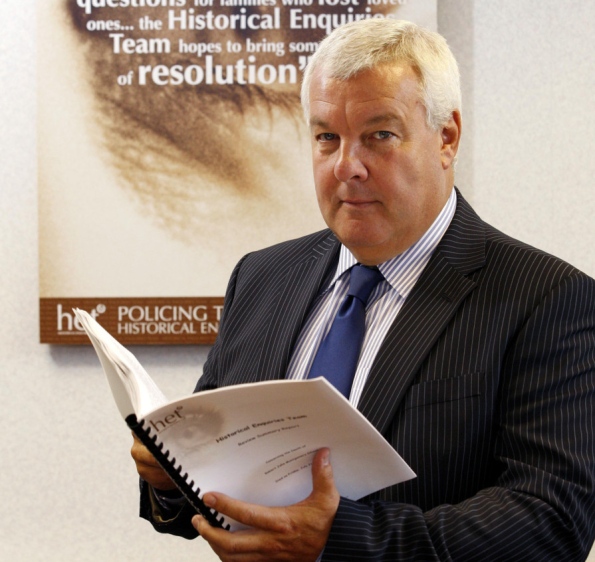
I was delighted to hear that the former head of the Historical Enquiries Team (HET), former Scotland Yard detective Dave Cox has been forced to take early retirement in the wake of a damning report by the British Inspectorate of Constabulary which found that the HET, under his direction, had treated killings carried out by state forces with less rigour and scrupulousness than paramilitary cases.

The HET, set up in 2005 as part of the peace deal, was supposed to investigate all 3,300 killings between 1968 and 1998. Cox’s sacking is an official admission it failed in this task.

Dave Cox - boss of the Historical Enquiries Team. Forced to resign after security force bias exposed in his investigations.

Dave Cox – boss of the Historical Enquiries Team. Forced to resign after security force bias exposed in his investigations.

This conclusion will have come as no surprise to readers of thebrokenelbow.com who learned of the HET’s bias and disregard for ordinary victims of violence from two pieces we published back in January 2012 dealing with the case of Patrick McCullough, a 17-year old Catholic who was gunned down by Loyalists near his North Belfast home in 1972. You can read them here and here.

His case was highlighted by his brother, Catholic priest Joseph McCullough who wrote to The Irish Times about officialdom’s uncaring attitude towards Patrick’s death. No serious attempt had been made by the police, Fr Joe said, to discover who pulled the trigger and the HET’s attitude he described as “abysmal”. The police ineptitude or worse was in stark contrast to the efforts of Irish News reporter Sharon O’Neill who able to discover not only that the UVF had killed Patrick McCullough but to put names to the killers who, she wrote, were well known in the area as the culprits.

Only when his letter was published and the HET shamed in public did officers from the unit contact him. Fr Joe was also interviewed by thebrokenelbow.com  and he told of how after his brother was killed in a drive-by shooting on the Antrim Road, the police – in those days the RUC – never came near the home to explain what happened or to update the family on the investigation.

But the home was visited by the British Army who invaded the street in which the McCullough’s lived. They were ostensibly searching the area for weapons but the only house they raided was the McCullough’s, a respectable, peaceable family with no history of republican activity. Fr Joe suspected they were going to plant  weapons in the house to discredit the family and thereby justify the Loyalist killing and would have had the local parish priest not intervened.

All these circumstances strengthened the suspicion that perhaps Patrick McCullough’s killers and the security forces were colluding together. To add insult to injury the RUC then lost all the paperwork on the case and so Patrick McCullough’s sad death was forgotten. I wrote about the case because of the contrast with all the energy officialdom has recently invested in investigating the Jean McConville case where the IRA was the culprit.

The pro-security bias of the HET lies behind the scandalous treatment of the McCullough family and evidence for it can be found in the HET’s official video which is still available on YouTube. This is what I wrote in January, 2011:

The film features four victims, the son of a Catholic shot dead by the UDA; the sister of a British soldier shot dead, presumably by the IRA; the husband of a victim of the IRA’s Shankill Road Fish Shop bomb and the brother of two Catholic men killed by the UVF.

And what’s missing? Well any relatives of people killed by the police or army, that’s who’s missing. Seemingly they don’t rate a mention on the HET video and that is not insignificant surely? It means they don’t really appear on the HET radar and in such a way are almost airbrushed out of existence. The video provides a subliminal and fascinating peek into the HET’s consciousness.

That’s not to say that in the video the HET’s commander Dave Cox does not at all address the issue of security force collusion in killings. He does, but look at how he deals with it: “(Victims ask) Could his death have been avoided, was there collusion? Most times we are able to actually answer and dispel those worries.”

In other words: “Our work is about nailing all those terrible terrorists and setting minds to rest about the role of the RUC and army.” It’s an approach that dovetails exactly with the state narrative of the Troubles, with the state and its forces on the good side and everyone else on the bad side. Problem is, it wasn’t ever as simple as that.

Here’s the video and Dave Cox’s appearances start at 1 minutes 7 seconds:

And confirmation of this bias was there in the Inspectorate of Constabulary’s report published this July, which detailed all the various ways in which security force killings were treated more leniently than others by the HET (e.g. soldiers who pulled triggers were never interviewed under caution, meaning it would be so much harder to charge them if evidence emerged during questioning of a crime. If they claimed to be sick they could avoid being interviewed, and so on. None of this magnanimity was shown to non-security force suspects).

The pro-Army/Police bias was so intense that it was codified into the rules governing the HET’s investigations. Add to that the fact that the HET’s intelligence branch was stuffed full with former RUC Special Branch officers and the result is all too predictable.

Here is what the HET Operational Guide states:

“HET maintains it is not appropriate to compare the review processes in military cases with reviews of murders committed by terrorists. Soldiers were deployed on the streets of Northern Ireland in an official and lawful capacity, bound by the laws of the UK and military Standard Operating Procedures of that time.” (HMIC report, pp 74-75)

So, there you have it. The official body charged with investigating Northern Ireland’s troubled and violent past is set up on the basis that killings carried out by soldiers were probably lawful whereas those committed by groups like the IRA were crimes. So no need to investigate security force slayings with any enthusiasm or vigour.

It is not possible to deal with this subject without making two comments. One is that the approach of officers like Dave Cox and his colleagues in the HET are confirmation that for many in the British security apparatus the war against the IRA goes on. In theory the peace process was supposed to signal a score draw in the battle between the British state and republicanism; in practice ‘la lotta continua’ in the British mindset. The IRA has stopped shooting soldiers and policemen and stopped planting bombs; but the British are still trying to put republicans in jail.

The other obvious comment is that all this happened on Sinn Fein’s watch but the party charged with overseeing Nationalism’s interests in the peace deal did nothing to stop it, not even to issue warnings about the HET’s all too obvious bias. The HET’s faults were exposed by a Belfast academic, Dr Patricia Lundy, not by a Sinn Fein minister or Assembly member (nor any SDLP ones either) and it took seven years to get rid of the man responsible for them. What, one may ask, is the point of being in government if such things are allowed to happen under your nose and you do nothing about them?

Anyway Dave Cox will soon be taking the Liverpool ferry back home. It will be good to see the back of him.

Syria: Toxic Levels Of Hypocrisy Discovered In Damascus Restaurant

Congratulations to the London Independent and reporter Heather Saul for digging up this photo of US Secretary of State, John Kerry and Syrian dictator Bashar al-Assad dining with their respective wives, Teresa Heinz-Kerry and Asma al-Assad at a Damascus restaurant. This apparently happened in February 2009.

AssadKerrydinner

As Kerry beats the war drums for President Obama on the eve of a Congressional vote aimed at giving US forces a virtual military carte blanche for operations in Syria, he is not likely to welcome being reminded of this cordial get together with, as The Independent reminds us, someone Kerry now calls “a thug” and whom he has compared to Nazi leader Adolf Hitler.

Kerry was visiting Syria in his capacity as chairman of the Senate Foreign Relations Committee and according to other British newspaper reports he met Assad around six times.

The Independent report continues:

During the visit, he said in a press conference: “President Barack Obama’s administration considers Syria a key player in Washington’s efforts to revive the stalled Middle East peace process.

”Syria is an essential player in bringing peace and stability to the region”.

Pass the zinc bucket please!

Obama, Syria And The New Neocons: The Hypocrisies Of The Humanitarian Interventionists

I found this wonderful article by Andrew Levine about Syria and Obama on the blog run by the equally wonderful Norman Finkelstein and couldn’t resist making it available to readers of The Broken Elbow.

Levine’s argument is that the Democrats have devised their own version of neoconservatism which it seems we may get to see in action soon over the skies of Syria. Unlike those nasty Republicans the Dems justify their invasions and regime changes on humanitarian grounds, a pretext which makes the overthrow of people like Gaddafi so much more acceptable. But it is still neoconservatism, just as Obama’s health care reforms are essentially still the same old insurance company rip-offs. It just looks nicer.

Gaddafi’s sin was not that he was an enemy of the West – he had put all that behind him and now entertained the likes of Tony Blair in his bedouin tent – but that he was marshalling Black Africa into an independent bloc, playing hardball with the oil companies and refusing to share all that fresh water trapped under his desert sands with Western corporations (reserves equivalent, it is said, to a thousand years of the River Nile flowing). So when he was ousted courtesy of a proxy land war and massive NATO air power it was justified on the basis of his threats against the people of Benghazi.

As Levine points out it was Bill Clinton, good ole Slick Willy, who first developed the approach in the Balkans and Barack Obama has made it one of his administration’s distinguishing footprints.. His team contains two of the most vocal proponents of this new neoconservatism; one is Susan Rice, his national security adviser and the other is Ireland’s own Samantha Power, his UN ambassador and a figure sure to set the Dublin media slobbering with excitement when we see her urging the bombing of Syria to save Syria.

Anyway here is Andrew Levine’s piece. It makes a lot of sense:

August 27, 2013
The Hypocrisies of the Humanitarian Interventionists
by ANDREW LEVINE
To die by cobra is not to die by bad pork

– Gregory Corso, “Bomb”

Who would have imagined that, five years into Barack Obama’s tenancy of the White House, American whistleblowers would seek refuge in Russia (or China or in formerly subservient but now robustly independent South American countries) or that investigative journalists and documentary film makers would find Germany or Brazil safer havens in which to practice their trade than the United States?

The answer is no one: not even those of us who have always been skeptical not just of Obama’s leadership skills but also of his intentions.

At the same time, some things haven’t changed: the American government, like all governments, still wallows in hypocrisy.

But even with a President more “disappointing” than anyone would have imagined, and a government that demonizes its enemies’ depredations and cloaks its own in the mantle of “humanitarian” righteousness, the “line in the sand” that the Syrian government may or may not have crossed is still over the top.

Remarkably, though, hardly anyone in the political or media mainstream sees it that way.

President Obama declared long ago and more than once that should Syria’s President Hafez Al-Assad use chemical weapons against rebels trying to overthrow his government, he would risk bringing the United States – and whatever “coalition of the willing” partners he could cobble together – into the war on the rebel side.

It was plain even at the time that Obama had boxed himself in. If that line is crossed and he does nothing about it, he will look indecisive and weak. With elections (always) looming, a President, especially a Democratic one, cannot afford that. Neither can any leader of an imperialist super-power that bullies the world.

As of now, it is not certain what actually happened August 21 in Jobar, a rebel-held district on the outskirts of Damascus. All that is known for sure is that a lot of people, perhaps as many as thirteen hundred (though probably fewer), died.

Informed observers agree that chemical weapons were used, but there is no agreement on the identity of the perpetrators; each side blames the other. The predominant view – promoted by Western governments and by Assad’s enemies in the Arabian Peninsula and also by many Western and Middle Eastern journalists, is that it was Assad’s “regime.”

[In media parlance, the government Assad leads is a “regime,” while Obama heads an “administration.” “Regime” sounds nasty, and “regime change” is sometimes an estimable goal. “Administrations,” on the other hand, are benign and, as the word suggests, almost apolitical. School boards, universities and public utilities (the ones that haven’t yet been privatized) have administrations; dictatorships have regimes.]

Maybe Assad really is culpable; he has never been a leader who bothered much about ethical side constraints, and he does seem intent on holding onto power by any means necessary.

But the cui bono? (who benefits?) principle suggests the opposite. The Syrian government plainly has enough popular support to withstand the forces arrayed against it. Indeed, it seems to be winning the war.

Amidst all the murder and mayhem, it has become increasingly evident that the rebel forces cannot win — unless something happens to alter the balance of forces.

And what could happen besides Western, especially American, intervention?

Saudi Arabia and other Gulf states have been arming the rebels for some time; lately the West has joined in as well. The United States has already announced its intention to increase its already considerable share.

At the same time, our leaders understand that siding with the rebels is a risky business if only because the forces in rebellion include some of the Islamists the U.S. is fighting against elsewhere. The Obama administration has always been clueless on the Middle East, but there are limits even to its folly.

And so the prospects for a successful proxy war against the Syrian government are bleak; rebel forces can tie the Assad “regime” down, but not destroy it.

To effect regime change – in other words, to overthrow Assad’s government — the U.S. and its allies may have to go to war on their own.

But for that idea to sell, a suitable pretext must be found. Only then might the United Nations be persuaded to approve military action. So far, principled Russian and Chinese opposition have blocked that prospect.

In our topsy-turvy world those countries are not only better than the United States on the right of international humanitarian asylum, but also on other venerable precepts of international law – like those that uphold the right of sovereign states to be free from external, unprovoked aggression.

The United States has lately settled on a different principle sometimes called the “responsibility (and right) to protect.” That ostensibly well-intentioned notion is a concoction of “humanitarian interventionists.” Obama has brought some notorious proponents of that idea into his administration – Susan Rice and Samantha Powers, among others.

Humanitarian interventionism is neo-conservatism for liberals. It operates to “justify” the United States and other Western countries taking on the role of planetary gendarmes ever at the ready to visit death and destruction upon “regimes” that challenge American domination or otherwise thwart the empire’s will.

Because Russia – and therefore the United Nations Security Council – was not willing to go along, the Clinton administration had to resort to this kind of thinking to excuse the 1999 NATO bombing campaign against Serbian areas throughout the former Yugoslavia.

The pretext then was a “humanitarian crisis” in Kosovo. George Bush would go on to deploy even phonier pretexts to justify his wars. But it was the Clinton administration that showed how it could be done.

When hard core neocons came into power under Bush and Dick Cheney, the humanitarian intervention excuse became otiose — real neocons don’t need no stinkin’ responsibilities or rights to overthrow governments they don’t like. Under Obama’s aegis, with the neocons gone, the idea has sprung back to life.

Since he took office, the responsibility (and right) to protect has been invoked, at least implicitly, in each of the large-scale military misadventures Obama has undertaken — the “surge” in Afghanistan and the overthrow of the Libyan government in 2011. The former was his fabrication; in the latter, he only “led from behind.”

If the Obama administration has learned anything from those mistakes, there is no sign of it. And so, in our name, Syria is on line to become the next killing field.

Since drones are not enough, that will mean bombers – shades of Kosovo – and perhaps cruise missiles; anything to keep American casualties down.

That is crucial because, like Clinton before him, Obama fears hostile public opinion. In Clinton’s time, there were still vestiges of the Vietnam Syndrome to overcome. Now, as the endless wars spawned in the aftermath of 9/11 drag on, the public has grown war-weary.

Syrian casualties, however, are another story; racking them up is the whole point. To stop Assad from killing Syrians with poison gas, Obama will kill them with cruise missiles and bombs.

It is hard to see how anyone can endorse a program so ludicrous, and so morally flawed, without the words sticking in their craw – and yet they do.

And even in a world that where rank hypocrites run the show, as they always have, the hypocrisy in this instance is so breathtaking it can hardly be believed.

After all, Obama is the Commander-in-Chief of a military that, within recent years, has used napalm, white phosphorous and depleted uranium shells, along with a host of other conventional and non-conventional horrors. These weapons are not illegal under international law if used against combatants (a fine point the U.S. often ignores), but they are no less terrible than sarin gas.

Chemical weapons fall into a separate category, but not because they are more horrendous than other weapons now widely in use. They are different for historical reasons that are sometimes set aside, but that sometimes weigh heavily in official circles when it suits nefarious government purposes.

Saddam Hussein used multiple chemical agents, reportedly supplied by the United States, against Iran during the Iran-Iraq War, and then in 1988, he used chemical weapons against the Kurdish town of Halabja, killing more than 3000 (perhaps as many as 5000) people, and injuring many others.

None of this bothered the United States until Bush the father found it expedient to demonize his erstwhile collaborator, the Iraqi dictator, during the buildup to the Bush family’s First Gulf War. Even then, it was only the massacre of the Kurds that provoked outrage; gassing Iranians was fine.

Chemical weapons cause injury and death; they ought never to be used. But they have been used without complaint on the part of “the world community,” and they are inherently no worse than many weapons that the American military regularly deploys.

They are certainly not worse than the nuclear weapons that figure prominently still in American strategic planning documents, and that might well be used should the United States or Israel invade Iran and then find their operations going poorly.

Why, then, is the use of chemical weapons in Syria, in the course of an on-going civil war, a reasonable basis for drawing a line in the sand, one that could trigger further disasters around the entire region and throughout the world?

The cynical answer is that neocons and humanitarian interventionists need pretexts, and this is the best they are likely to get. But then there is also the issue of historical memory.

In the aftermath of the First World War, where chemical weapons were indeed more horrifying than any other weapons in use, there were attempts to outlaw war and also, as it were, to civilize it. Needless to say, little came of these well-intentioned efforts.

But a taboo on the use of chemical weapons in combat did take hold. It held up even during the Second World War, and then in the countless counter-insurgency wars the West fought in its aftermath.

That this taboo endured is all the more remarkable inasmuch as it was not legally binding until 1997, when the Chemical Weapons Convention finally went into effect. Syria, by the way, has never been a signatory to that pact.

Why the special revulsion to chemical weapons? Is it worse to be attacked with sarin gas than with bombs or cruise missiles or, for that matter, with Obama’s drones?

Nothing beats drones for terrorizing populations because one never knows when they are coming, and there is no way to protect against them.

For the rest, including poison gas, at least there are shelters and gas masks. But what difference would that make to the dead and dying?

* * *

Why then draw a line in the sand where Obama did?

Could it be because chemical weapons are illegal (though not in Syria)? That would be a more credible explanation if our Commander-in-Chief and his minions in the military-security state complex weren’t quite as heedless of the spirit – and sometimes the letter – of the law as they have repeatedly shown themselves to be.

A more likely explanation is that, at various points in recent months, Obama found it convenient to throw the neocons and humanitarian interventionists a bone, and didn’t quite think through the consequences.

But then why is there so much acquiescence worldwide to the idea that if the Syrian government did indeed cross the line, then something must be done? It is as if the world is in the grip of a dangerous collective imbecility?

The irony is that Obama plainly knows better; the last thing he wants – or needs — is another war of choice in the Middle East.

But he may not be able to resist the pressure.

It is coming full blast from the (increasingly vociferous) War Party in Congress, from Israel, from Britain and France (always eager, lately, for lovely little wars), and of course from the hordes of chicken-hawk pundits who populate the mainstream media.

This may be a case where the problem is not Obama’s instincts or judgment so much as his weakness, his inability to lead. That he drew a line in the sand doesn’t help either.

In all likelihood, there is still time for him to put reason in control, and Just Say No. Don’t count on it, however.

ANDREW LEVINE is a Senior Scholar at the Institute for Policy Studies, the author most recently of THE AMERICAN IDEOLOGY (Routledge) and POLITICAL KEY WORDS (Blackwell) as well as of many other books and articles in political philosophy. His most recent book is In Bad Faith: What’s Wrong With the Opium of the People. He was a Professor (philosophy) at the University of Wisconsin-Madison and a Research Professor (philosophy) at the University of Maryland-College Park. He is a contributor to Hopeless: Barack Obama and the Politics of Illusion (AK Press).

Seven Countries in Five Years – Obama Embraces Cheney’s Neoconservatism

Obamacheney

As Obama rushes towards conflict in Syria, I thought it would be worth recalling what one key witness to escalation to the Iraq debacle remembered about those days for point of similarity. General Wesley Clark gave the interview below in September 2011 and in it he recalled a conversation he had with a ranking General at the Pentagon just ten days or so after the 9/11 attacks.

At that point the US had already secretly decided to go to war with Saddam Hussein even though there was no evidence to link him to the attack on the Pentagon and the World Trade Centre. A few weeks later Clark again met the same general and this time he was shown a Department of Defence memo outlining how the US could take down seven countries in five years.

Well, more than five years have elapsed since that memo was drafted but some of those countries on the DoD list have indeed fallen into the Western orbit or nearly have. Clark listed them: Iraq, Lebanon, Somalia, Sudan, Libya, Iran and Syria. The list was the work of the neoconservative cabal that had infiltrated the highest reaches of US policy formation and whose leader was Bush’s Vice-President Dick Cheney. We thought they had been kicked out in disgrace in 2008 but it looks as if they are back in town.

Toppling Syria is arguably the keystone of this neocon strategy. If Assad falls then so will Lebanon (i.e. Hezbollah) and Iran will be greatly weakened. So will the pro-Shiite government in Baghdad. The stage will be set for the destruction of Islamic rule in Iran and the return of a regime hospitable to the West while Iraq will be isolated. The Middle East and it vast resources of carbon-based fuels will once again will safely under Western control.

It is a neocon wet dream come true and if anyone had predicted in 2008 that Obama would be the president to facilitate all this they would have been laughed out of the room. I have a feeling it won’t work out, just as it failed miserably in Iraq. But before then an awful lot of innocent people are likely to be killed, some in horrible ways. Thank you Mr Obama. Anyway here’s Genera; Clark:

Obama, The President Of ‘Change You Can Believe In’, Embraces War In Syria

Obama1

“To us, it looks as though Bush, Cheney and Rumsfeld never left the White House. It’s basically the same policy, as if US leaders had learned nothing and forgotten nothing in the past decade. They want to topple foreign leaders they regard as adversaries, without even making the most basic calculations of the consequences. An intervention in Syria will only enlarge the area of instability in the Middle East and expand the scope of terrorist activity. I am at a complete loss to understand what the US thinks it is doing” – Alexei Pushkov, chair of Russia’s State Duma’s international affairs committee, quoted in the Christian Science Monitor.

Those of my readers with a gentle or sensitive disposition should not, repeat not, watch the YouTube video below. This is a serious warning. Ever since I first saw it on that great little blog The Moon of Alabama two weeks ago,  I have been wrestling with myself over whether or not to post the video myself. There were good reasons on both sides of the argument.

On the negative side there is no doubt that it will be deeply upsetting and horrifying to nearly everyone who watches it and as the person responsible for placing it on this site, I could be accused of a piece of exploitative sensationalism. Nor did I wish anyone to misinterpret my use of this film as an expression of support for the noxious Assad government in Damascus. It most definitely is not that.

On the other side of the argument the video brutally captures the essence of the people whose side Obama, Cameron, the French and goodness knows who else seem about to take in the bloody civil war in Syria. It savagely illustrates an aspect of the opposition to the Assad regime that has been grossly under-reported in the Western media, for reasons all to do with the post 9/11 transformation of the press in America and Britain into cheerleaders for government. Both seemed compelling reasons to blog the video. But still I hesitated.

It wasn’t until I read today that Tony Blair had emerged from whichever hole in the ground he currently inhabits to voice his support, courtesy of the columns of The Times newspaper, for armed Western intervention in Syria, using many of the spurious human rights arguments that he employed to justify the invasion of Iraq – especially when the WMD rationale was exposed as an outrageous lie. It was then that I made up my mind to post the video.

When a leader such as Tony Blair has been exposed as a brazen fabricator who tricked his country into war and caused the countless deaths of innumerable innocent civilians, nothing he ever says afterwards can or should be believed. In The Times, Blair argued that Western intervention was necessary to save Syria’s civilian population from Assad’s brutality and the “affiliates of Al Qaeda” who hope to exploit the instability.

There are two lies implanted in Blair’s words. One is that the real reason for the West waging war against Syria is not humanitarian but self interest. Destroying the Assad regime and replacing it with a post-Gaddafi Libyan style leadership, which presumably is the West’s ideal, would isolate Iran and strengthen Israel, the West’s proxy in the Middle East, and empower the Saudi/Gulf plutocrats whose oil sustains Western economic growth. Pacifying the region, embedding its leadership and placing it under stable pro-Western influence is what this is all about. It’s called neo-conservatism folks, the idea that brought you Bush, Cheney and now Obama. Samantha Power’s finest hour beckons.

The second lie concerns Al Qaeda. What Blair does not mention is that but for the invasion of Iraq, Al Qaeda would never have had a foothold in the region and would not now be vying for power in Syria. The group was ruthlessly put down by Saddam who regarded Osama bin Laden and his gospel as deeply menacing, as the West knew well.

With their invasion and overthrow of Saddam, Blair and Bush facilitated the growth of Al Qaeda in Iraq just as Obama and Cameron nourished it in Libya and just as they have sustained and fed the jihadists of Syria who feature so brutally in this video. The West’s role in creating Al Qaeda may be debatable but there is no doubt that no-one has done more to sustain and license the group and its violence.

The only outcome of an Obama/Cameron intervention in Syria will be another massive boost for the jihadist cause. After all they are the only people really fighting the Assad government; the pro-West Free Syrians are mostly languishing in comfort on the Turkish border. To the victor will go the spoils.

The quality and nature of these jihadists are bloodily evident in this video which, by the way, has almost entirely been ignored by the mainstream media. The two children executed by the Syrian freedom fighters, whose deaths are shown, were accused of being loyal to Assad and so were sentenced to death by an anonymous judge in a kangaroo court and gunned down by hooded, chanting stooges. Had the two boys been slaughtered by pro-Assad gunmen would their deaths have been so quickly ignored by our media?

When the Cruise missiles begin to streak through the night skies and our television screens are lit up by brightly colored explosions, remember that it is these people, monsters who took young innocent lives in the name of an extremist, medieval sect of an otherwise tolerant religion, who will gain most by all that follows.

Next on that list are all those in the West – in America in particular – who have been suckled by the eternal terrorist threat, surely the most lucrative boondoggle in history: the spooks who spy on us all, the corporations who make the drones and the missiles and bombs, the arms makers, the generals, the media moguls and the politicians who feed off our fear.

All these people, each thriving off the violence of the other, will be hoping that Barack Obama, the man who came to power by opposing one immoral war will press the button to start another one. It looks like they may get their way.