“He’s a very cold person”, remembered Freddie Scappaticci of Martin McGuinness. “He doesn’t have friends in the IRA. He has what he calls ‘comrades’”.
Freddie Scappaticci is probably better known to the world outside the IRA as ‘Steaknife’, perhaps the most valuable double agent in the pay of British Intelligence during the Troubles.
At the time he made those remarks, ‘Scap’, as he was better known to his republican colleagues, had been stood down from his senior post in the Internal Security Unit, the IRA’s feared spy-catchers, and was instead secretly helping Central Television’s ‘Cook Report’ research a planned programme on the Derry IRA leader.
The conversation from which those remarks were plucked took place in the car park of the Culloden Hotel, near Holywood, Co Down, a plush area known as ‘the gold coast’ because of the wealth of many of its residents. The exchange was covertly taped by the TV team, then hidden away for many years at the request of the RUC but eventually published on YouTube.
Although some three years had passed since Scappaticci had been at the centre of the IRA, he still kept in touch. And as a senior figure in the ‘nutting squad’, as the security unit was sometimes called, he had had many dealings with McGuinness and knew him well.
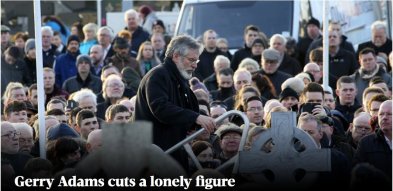
There was an obvious follow-up question but it wasn’t put to him: into which category did Gerry Adams fall? Was he a friend or a comrade? Adams himself, in his funeral oration at the republican plot in Derry’s City cemetery on Thursday, covered both bases, mourning the loss ‘of a dear friend and comrade’. But then he would.
Whatever the truth, Martin McGuinness’ untimely death means that Sinn Fein and Gerry Adams will never be quite the same again, and that a new urgency has been injected into Adams’ political ambitions in the South.
For best part of three decades, certainly since he swung the critical 1986 ard-fheis for Adams, persuading Sinn Fein delegates to drop Dail abstentionism with a speech that shrieked of unyielding IRA ferocity, the names Adams and McGuinness have gone together in the public mind like Lennon and McCartney or Morecambe and Wise. Take John Lennon or Eric Morecambe away and things are never quite the same again. Now it’s just Gerry Adams.
As the media went into overdrive last week praising Martin McGuinness the peacemaker, it was impossible not to wonder what Gerry Adams made of it all. After all, he was the real architect of the IRA’s peace strategy, the one who conceived it and launched it and here was McGuinness being lauded for his work. To be sure, McGuinness helped calm IRA nerves long enough to deliver two ceasefires and IRA decommissioning, but it would be Adams that the dissidents would come gunning for first.
Nor could it have escaped Gerry Adams’ attention that McGuinness was well-liked and popular in a way he never was nor could ever be. Everyone up at Stormont, Unionists, Nationalists, government officials, doormen, they all called him ‘Marty’, like he was their favourite uncle. It is just not conceivable to imagine Gerry Adams on the receiving end of such endearment.
And while Adams’ IRA past was constantly excavated by media and political enemies, McGuinness was mostly given or a bye ball, his excursion into the 2011 presidential election notwithstanding.
While Adams was excoriated for claiming he had never been in the IRA, McGuinness was praised for admitting his membership. The fact that the Derry man actually lied outrageously, claiming that he had left the IRA in 1974 when he didn’t, was largely overlooked by the media as was the easily checked truth that in the mid to late 1970’s his IRA career, as Chief of Staff and Northern Commander, was really only beginning, not ending.
Adams was constantly disparaged for his alleged role in IRA atrocities, from the disappearances of Jean McConville and others to the most recent war of words over the IRA murder of prison warder Brian Stack. But not McGuinness.
The Derry man’s past was as murky as Adams’ if not more so. He too had been directly involved in disappearing an alleged informer, a Derry man called Pat Duffy, a 37 year old father of seven, who was shot dead on McGuinness’ orders and his body buried in a Co Donegal bog in 1973. Only when his neighbours and some of McGuinness’ IRA comrades protested was Duffy’s lime-covered corpse returned to his family. Yet who has heard of Pat Duffy?
Or Frank Hegarty, a Derry informer who fled to England but was lured back to an assassin’s bullet when McGuinness, on bended knee according to one account, persuaded his mother to tell him that he would be safe if he returned to Ireland. A recent correspondent remarked about this killing: ‘In the annals or armed republican history, I think this event is almost uniquely evil – to make a mother unwittingly complicit in the killing of her son.’
But it was only when McGuinness ventured southwards to run in the 2011 Presidential election that he got a taste of the vilification that Adams experiences on a regular basis. Vying with the DUP for power in Belfast bothered no-one in Dublin but threatening to disrupt a long established and comfortable power structure in Dail Eireann was an entirely different proposition.
The Sinn Fein strategy south of the Border seemed to be a clever one. While McGuinness would look after the North, Adams would move South at the opportune moment and steer the party into power, riding the party’s peace process popularity into government. If all went to plan, Sinn Fein rear ends would soon be resting on seats around Cabinet tables on both sides of the Border. Not quite Irish unity but a massive achievement nonetheless.
Except it hasn’t quite worked out like that. The DUP without the new Paisley has become like the DUP with the old Paisley, giving Sinn Fein little choice but to provoke a crisis and leave government. Martin McGuinness is now no more, his replacement is hardly in the same league and there seems little prospect of Stormont being repaired any time soon.
Nor has the Southern strategy worked to plan, or rather it has not worked as quickly or effectively as Adams and his advisers would have wished. Growth has been steady but hardly dramatic. Five Dail seats in 2002, four in 2007, fourteen in 2011 and 23 in 2016; the collapse in the Fianna Fail vote post the 2008 crash, from 41.6 per cent share in 2007 to 17.4 in 2011 did not translate into proportionate Sinn Fein gains. And under Micheal Martin, FF has gradually recovered lost ground, disappointing those who predicted the party would be swallowed by Sinn Fein.
Meanwhile time passes and time is not on Gerry Adams’ side. This October he will be 69 years old, thirty-five of them spent at the head of Sinn Fein and still not a day spent at a ministerial desk. Martin McGuinness’ sudden departure has to be an uncomfortable reminder of his own mortality and his failure, so far, to make a lasting mark on Southern politics.
Ironically some of the auguries are encouraging. Sinn Fein’s electoral performance in the recent Northern election could translate into a bounce further South, especially if Adams, who is leading his party negotiations in Belfast to restore Stormont, can stabilise the peace process and repair relations with Arlene Foster. There’s nothing like a bit of statesmanship to polish the image.
The Brexit vote in the UK and the likely damage it could cause in both parts of Ireland has kindled anti-British sentiment on both sides of the Border, creating fertile conditions for Sinn Fein should Enda Kenny’s anticipated departure force a general election. Not coincidentally the recent outburst of united Ireland sentiment is remarkable for the fact that so much of it is emanating from south of the Border. A good sign for SF.
And Sinn Fein has lowered its expectations accordingly, signaling to potential partners that it will now be happy to enter government as a minority partner. Better to be deputy to the Taoiseach than nothing at all.
Gerry Adams badly needs to get into government in Dublin. That will be his mark on history. Martin McGuinness’ premature departure is a blunt reminder to the Sinn Fein president that opportunities knock rarely at anyone’s door. When they do, they should be grasped, quickly and firmly.















 The Broken Elbow
Tuesday 21 March 2017 15.43 GMT Last modified on Wednesday 22 March 2017 11.32 GMT