Boston College Decision

The Broken Elbow carries the following response from Ed Moloney and Anthony McIntyre to the decision by a US court to deny a motion to quash a subpoena compelling the handover of material from the College’s oral history archive. The court also ruled against a motion to intervene by both Moloney and McIntyre:


“We are naturally disappointed but we confidently expect BC to take up Judge Young’s implied invitation to lodge an appeal. One way or another this fight will go on. There are very important issues at stake – legal & political – that could adversely affect vital and essential US interests, both domestic & international. Not least among the latter is the Good Friday Agreement in which President Clinton, Senator Mitchell and virtually the entire American body politic invested so much energy, time, effort and not least their personal & national prestige to bring a seemingly intractable and bloody conflict to an end.

“As anyone familiar with the background to this case can attest, the enforcement of these subpoenas has the real potential to create an immensely destabilising political crisis in Northern Ireland. It comes at a time when the British government is refusing to properly investigate allegations of murder connived at by its own security and intelligence services. The double standards involved in all this will send a clear and unmistakable message to everyone in Northern Ireland, a message that reverberates down through the sad, tragic and bloody history of Ireland’s relationship with Britain.

“It would be an event of extraordinary irony that a decision of a court in a country which expended so much political capital to secure peace in Ireland could threaten all that was achieved over so many long and difficult years. Given Boston College’s long record of nurturing a resolution to the conflict as well as the solemn assurances to protect confidentiality given to those involved in this oral history project, we therefore look forward to an early announcement of the college’s intention to appeal.”

Tangled Webs……..

Yet Clare’s sharp questions must I shun

Must separate Constance from the nun

Oh! what a tangled web we weave

When first we practice to deceive!

Sir Walter Scott, Marmion

My apologies first to regular followers of this blog for the recent inactivity which I soon hope to correct. I was on a trip to Ireland – for work purposes but it was also my first substantial solo journey, and therefore road test, since my broken elbow thankfully began to heal (take a bow Hospital for Special Surgery!) – and that along with the busy aftermath back in New York has kept me away from the WordPress keyboard.

I have therefore had no opportunity to respond to Irish News’ editor, Noel Doran’s reply to my most recent broadside dealing with the disgraceful role his correspondent Rebekah…..sorry, Allison Morris played in the events which led to the US government slapping subpoenas on Boston College (BC) on behalf of the PSNI in Belfast. Just to remind readers it is my – our – unshakable belief that this affair of the BC subpoenas began when Morris passed on a tape recorded interview she had with former IRA activist Dolours Price in February 2010 to a character called Ciaran Barnes, a reporter on the Belfast Sunday Life tabloid who used the material from the interview for a lurid article about Dolours Price’s alleged role in ‘disappearing’ IRA victims in the early 1970‘s.

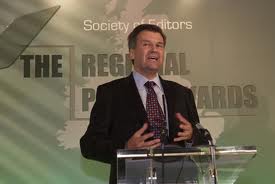
Noel Doran, Editor of the Irish News

Barnes wrote the story in such a way as to make it appear he had been given access to BC archive and that the information in his article had come from interviews she gave the college and not from Morris’ tape. Only one copy of each BC interview exists and they are held under conditions of great security in Boston and no-one, aside from myself, the researcher and a small group of people at the college know what she said in those interviews.

Fast forward some fourteen months and Barnes’ false, misleading claim allowed the PSNI to pursue BC and to con the US Department of Justice into seeking Dolours Price’s interviews and doing the work they themselves should have done back in Belfast more than a year earlier, i.e. get their hands on Morris’ tape.

The US authorities in turn cited Barnes’ “access” to the BC archive (see page 4) to justify the subpoenas, a claim that has no merit whatsoever because Barnes got nowhere near the archive and never would have. I mean just think about it. Boston College, one of the most prestigious & respected colleges in North America, has this super sensitive and costly archive of interviews with IRA veterans and suddenly, out of the blue gets the head staggers and allows Ciaran Barnes, a little known reporter in a small circulation paper better known for its garish exposes of Thai prostitutes peddling their trade in Belfast, entree to its secret inner sanctums? Is that really credible?

His article on Dolours Price was, we firmly believe, based on Allison Morris’ interview and the fiction of him having access to the archive in Boston was contrived by Barnes to hide his real source: Allison Morris’ tape. All this was used by the PSNI/US Department of Justice in a self-serving but fundamentally bogus way to vindicate their legal action. But the PSNI and DoJ could not have done this had Morris & Barnes not made it possible.

In other words a legal action that could have incalculable consequences was, we maintain, brought about by a piece of shameful journalistic chicanery that is, as I have said before, on a par with the Murdoch hacking scandal in the way that in both instances the journalists involved treated their sources with contempt, betraying their trust in the pursuit of lurid headlines and the dubious glory that comes with them.

I first went public with all this in an interview on TheWildGeese.com website, Noel Doran responded and then I answered. His reply to my reply can be read here and there are links to other pieces on this site which readers can follow up if they have the requisite interest and energy.

In his final reply Noel Doran seems besotted with my failure to ring him up to ask for his version of the story, that this was somehow a journalistic failure on my part. In an earlier reply to this complaint I tried to explain why this was not an appropriate course of action by making a comparison with one of Herman Cain’s more lurid recent sex scandals. A woman comes forward to complain of an inappropriate advance by Cain made in the past. She clearly knows that whereof she speaks but according to Doran she really should have checked with Cain before going public. But she doesn’t because she knows the truth and she is not going to demean herself or cast doubt on her own credibility by doing anything but go public.

I knew, we knew, immediately we got our hands on the US Attorney’s plea to the Massachusetts court back last May and June that our suspicions about Allison Morris and Ciaran Barnes were well-founded, that Barnes’ article was based on Morris’ tape recording not the BC archive. We already knew this because it could not have been otherwise but the US Attorney’s document was incontrovertible confirmation.

The woman propositioned by Herman Cain knew that when he pulled her head down to his crotch it was not to admire his new leather belt just as we knew that Barnes and Morris had contrived the Boston College fiction to cover the real source of the article, to wit Morris’ tape. Just as the woman in the Herman Cain story knew there was no point, no reason for double checking with Cain we knew, I knew, there was no point, no reason to ring Noel Doran. Would Herman Cain admit he was looking a blow job? Would Noel Doran admit his reporter had conspired with Ciaran Barnes to deceive and mislead?

Doran also said that I had given a “ludicrously flawed” account of telephone calls he had made to Dolours Price’s sister Marian. Well, as Noel Doran knows, Marian Price cannot adjudicate on this as she is being held on remand in Maghaberry jail and I would be content to leave this as it stands until she is able to give her side of the story.

But Doran missed the point I was making. I was not talking just about conversations between him and Marion Price but those that took place earlier, between members of the Price family, Allison Morris and, indirectly, Noel Doran on the day that Dolours was interviewed in her Dublin home. During these exchanges Morris was asked to leave Dolours Price’s home on the grounds that she was in no mental state to give a coherent interview (she was being treated at a Dublin psychiatric institution at the time) but Morris refused. Noel Doran has not dealt with these conversations or why it was or on whose instructions Morris refused to leave, and since I have a very good reason to know what was actually said and what happened that day, I can well understand why he has kept mum. We may return to this at a later date.

Doran complains that I split hairs over whether or not the Allison Morris piece that did appear in the Irish News in February 2010 – the article that was negotiated in those phone calls between Marian Price and Noel Doran in a deal that Morris subsequently betrayed – was an interview or not. I called it an interview, Doran said it was not, that it was “a factual report on important new developments”. So we did a bit more research and discovered that Doran’s own newspaper had described Morris’ article as “an interview”. This is important because the information in Morris’ article was clearly based on an interview with Dolours and the fact that there had actually been an interview was important to establish. Once we found evidence that the Irish News itself regarded the Allison Morris-Dolours Price conversation as “an interview” then that task had been accomplished. All that remained was to determine how that interview had been conducted.

It is one of the oldest tricks in the journalist playbook that when you have a story that you can't use yourself, perhaps because you've made a deal with, or given a promise to a source, then one way of getting it out is to pass it on to a friend in another outlet. If the subsequent story makes your own coverage look good so much the better. In the months after her and Ciaran Barnes' articles on Dolours Price appeared in their respective newspapers, Allison Morris applied for two journalistic prizes and won them both. She submitted a three article portfolio for each and her Dolours Price interview featured both times. Here she is pictured just after receiving the NUJ's Regional Journalist of the Year award in June 2010. The other prize, a month earlier, was from the Society of British Regional Editors which also awarded the Irish News the prize of regional newspaper of the year. The photograph of Noel Doran further up this page was taken as he accepted that award. Is it stretching credibility to think that by handing over her tape of Dolours Price to Ciaran Barnes, Allison Morris made all these prizes possible?

What we did not yet know for certain was whether the interview had been tape-recorded. We were pretty sure it had but we needed confirmation and I will discuss below the significance of that.

When I wrote on the TheWildGeese.com I said this about the Allison Morris tape: “Whether the PSNI have ever tried to obtain the Irish News tape is a mystery, which no one seems able to solve”. That was pretty much a shot in the dark. I didn’t know with absolute certainty that there was a tape. Members of the Price family had told us there was but we lacked independent or authoritative confirmation and, like the woman pestered by Herman Cain, there was no way that we could trust anyone in the Irish News to tell the truth, no reason to phone Noel Doran, in fact a reason not to.

Now, courtesy of Noel Doran’s latest piece on TheWildGeese and his eagerness to score a point against me, we have that proof. He writes: “As I have pointed out, Moloney himself could have solved this ‘mystery’ through one simple telephone call. We would have been happy to tell him that PSNI detectives did attempt to obtain the Irish News tape (my emphasis) but were informed that we were no longer in possession of any such material.”

Thanks Noel. Now we know beyond a shadow of a doubt that there was a tape, that Allison Morris tape-recorded her interview with Dolours Price. And why is this important? It is in fact a crucial piece of evidence because in his article in the Sunday Life, Ciaran Barnes wrote that he had heard a tape of Dolours Price confessing her part in the “disappearances” of 1972. We know for absolute certainty and can prove it, that Barnes did not have access to any of BC’s tapes and we also know that he did not interview Dolours Price himself. So if he listened to a tape it can only have been Allison Morris’ tape. There was no other tape. Remember as well that the Sunday Life report appeared just three days after Morris’s article appeared in the Irish News and that the two are long-time buddies. Conclusion: Allison Morris handed her tape to Barnes who concealed this by blaming BC. The subpoenas against BC are thus essentially spurious.

On the other hand if there really hadn’t been an Irish News tape or if we couldn’t prove it, then we would have been back to square one and the case against Allison Morris, Ciaran Barnes and the Irish News/Sunday Life would have been fatally undermined. But that concern has evaporated like snow on a ditch in May. As I say, thanks a bundle Noel!

(Incidentally Noel Doran neglected to mention that when the PSNI came to the Irish News looking for Allison Morris’ tape it was in June 2011, some fifteen months after the Irish News and Sunday Life articles had appeared. The PSNI visit to Noel Doran’s office came only after BC’s lawyers had highlighted, in a submission to the Massachusetts court, their failure to probe those two newspapers. All this highlights a fundamental flaw in the treaty that permits such cross-border, transnational subpoenas that should be of concern to American jurists, politicians and citizens, especially those with any concern for the Fourth Amendment: the US courts are being asked to do the work the PSNI were either too lazy or incompetent to do themselves.)

In my final TheWIldGeese.com article I pointed out that since Ciaran Barnes had had no contact with anyone associated with BC and the paramilitary oral history project before he wrote his piece on Dolours Price (or since), he could not have known from us that she had given an interview to the college. After all this was highly secret information which evidently Dolours had passed on to Allison Morris. Morris’ intense interest in the BC archive in 2010 is a matter of record (not least in her reportage in the Irish News during the weeks before Voices From The Grave was published) and it would have been astonishing if she had not asked Dolours Price if she had taken part in the project.

It was evident from what Barnes wrote that someone had told him – but it was definitely not us nor Dolours since she had not spoken to him either. I went on to say that the only possible source for this information was Allison Morris. Yet both her failure and that of Noel Doran to deny this was truly damning. Had they not told Barnes, the suggestion that they had would have jumped out at them and they would have indignantly & loudly shouted out their innocence, denying any part in this part of the story. But they didn’t. And like the dog that didn’t bark their silence was damning.

That’s the problem with cover ups. They get so convoluted, intricate and tangled that you forget what you should say and what you shouldn’t say, what you have said and what you haven’t said and invariably you screw up. That’s twice now that Noel Doran has done just that. As far as this story is concerned he might be better from now on keeping the lid of his computer firmly closed.

Boston College: The Role Of The Irish News & Sunday Life

The Irish history website, TheWildGeese.com has been hosting a debate between myself and Noel Doran, the editor of the Irish News in Belfast over who was ultimately responsible for the issuing of  subpoenas by the PSNI in conjunction with the US Department of Justice seeking oral history material stored at Boston College, Massachusetts.

(Many thanks are due to The Wild Geese, incidentally, for performing this valuable function)

The first subpoena demanded that interviews with the former IRA bomber Dolours Price be handed over to detectives from the PSNI and a second, later subpoena sought any others that deal with the disappearance of Jean McConville in 1972 that were collected by the college as part of a Troubles-based oral history project. (The PSNI also wanted Brendan Hughes’ interviews but these were already in the public domain and published in the book Voices From The Grave)

As the former director of the Belfast Project, as it was called, which collected the Boston College interviews, it has been my contention that the subpoenas would never have been issued, and the oral history archive would have remained secure & undisturbed, but for the actions of two reporters at the Irish News and Sunday Life.

In February, 2010 an Irish News reporter, Allison Morris taped an interview with Dolours Price at her home in Dublin about her alleged role in a number of IRA ‘disappearances’ carried out in 1972. As a result of family objections, largely because of Dolours Price’s troubled psychological condition at the time, the article that eventually appeared was toned down; “the juicy bits”, as one family member described them, were largely left out.
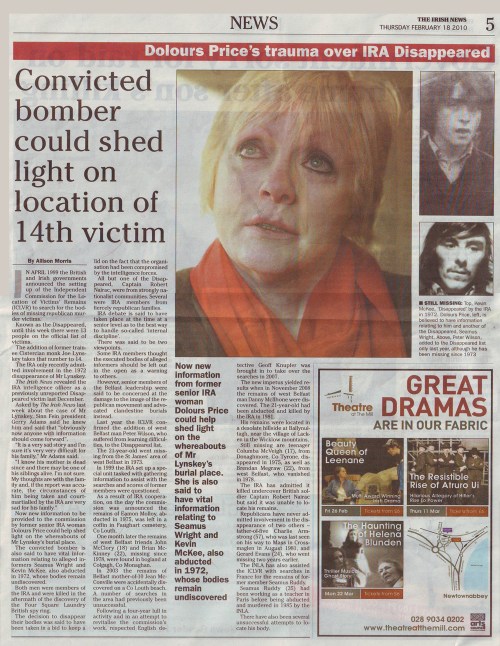
If matters had been left at that, everything would have been fine. But it is my strong belief that the tape was then passed on to another journalist, Ciaran Barnes of the Sunday Life, a small Belfast tabloid, and it was this that caused the trouble. Three days later Barnes’ article, a sensationalised account of Dolours Price’s alleged role in the disappearance of Jean McConville and others appeared in the Sunday Life. The story, he claimed, was based on tape recordings that he had listened to.
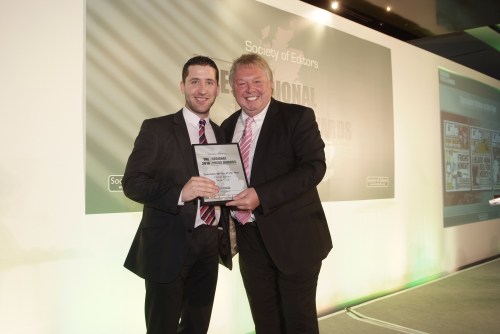
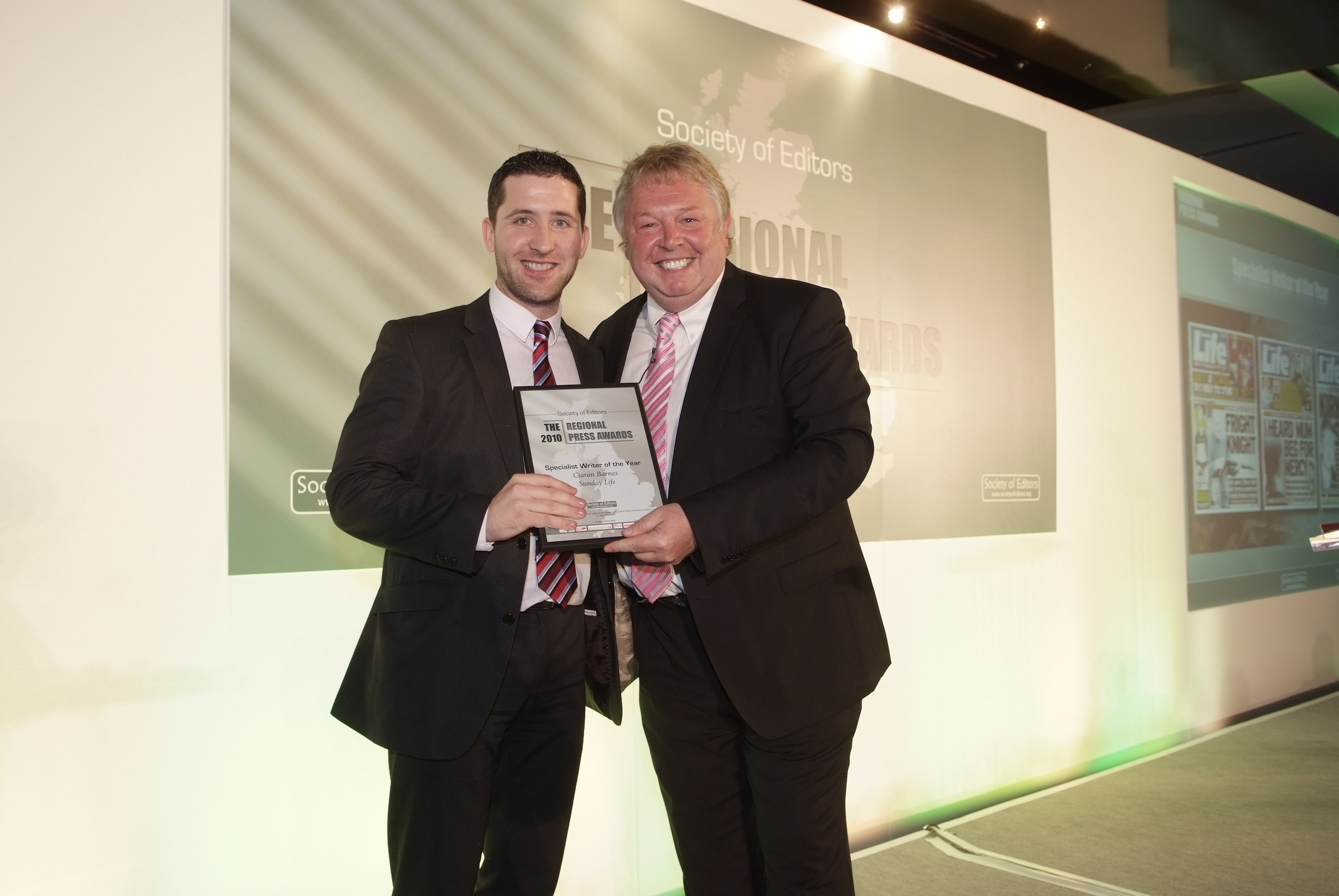
In May 2011, a few days after the US Department of Justice served subpoenas on Boston College, the Regional Press (i.e. provincial newspapers) awards ceremony was held in London. Hosted by the Society of Editors, the three NI-based players in the Boston College drama, Irish News editor Noel Doran, Irish News reporter Allison Morris and Sunday Life reporter Ciaran Barnes all won prizes. Here Barnes accepts the Specialist Writer of the Year award.

The problem was that he had written the story in such a way as to strongly suggest that the tapes he listened to had come from the archive stored at Boston College. Since I knew this was nonsense, that it simply could not have happened, I concluded that Barnes did this to deflect attention away from the real source, the tape recording made by Allison Morris of the Irish News.

Barnes’ alleged access to the Boston College archive was cited by the US Attorney in Massachusetts as justification for serving the subpoenas. Her implied logic went like this: since we had apparently broken the seal of confidentiality given to Dolours Price by handing the interview over to Barnes we could no longer use that defence and must therefore surrender the material.
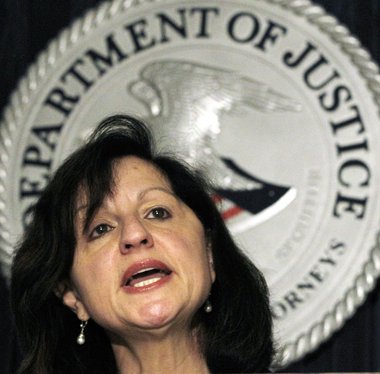
US Attorney for Massachusetts, Carmen Ortiz

The US Attorney’s claim is baseless, however. Ciaran Barnes was never allowed to hear Boston College’s interviews and neither he nor the US Attorney & the PSNI know whether Barnes’ article in any way reflected what Dolours Price had really said in her Boston College interview. Instead his information came from Allison Morris’ tape, something that we have concluded in the weeks and months since the subpoenas were served. Establishing the truth of this would demonstrate that the subpoenas were unjustified and unwarranted and should therefore be withdrawn. That is why I raised the issue when The WIld Geese asked to interview me about the Boston College affair.

Understandably, Noel Doran, the Irish News editor disputes all this and made his views clear in a response published by the Wild Geese. I recently answered him in a posting which can be read here.
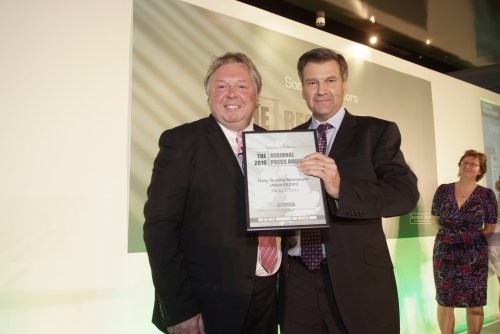
Noel Doran accepts Daily Newspaper of Year award given to the Irish News

Because of limitations on wordage imposed by The WIld Geese I wasn’t able to answer all of Noel Doran’s points on that site and confined myself to two major elements of his defence. I said I would answer the other issues here.

One complaint he made was that I had not run my allegations past him first. That would have been appropriate if I was a disinterested, uninvolved reporter assigned by a news desk to write the story up in a ‘he says/they say’ way. But I am not that reporter. Instead I am the injured party in a far-reaching dispute with other parties over events whose consequences are serious not just for those involved but for the long and proud tradition of oral history in the United States.

A pertinent analogy would be that of Sharon Bialek, the former National Restaurant Association staffer who recently accused Republican Presidential hopeful Herman Cain of sexual harrassment. If Noel Doran’s logic was followed in that instance then she should have checked with Cain before going public. (“Can I just clarify something Herman before the press conference? When you pulled my head down to your crotch were you looking for a blow job or just inviting me to admire the exquisite artwork on your new leather belt?”) I think not. I make my case, Noel Doran makes his and let the readers judge.
Sharon Bialek & Herman Cain

That was one reason why I suggested to The Wild Geese that they get a response both from the Irish News and the Sunday Life. Since I had a dog in the fight, I was not the one to do that. For whatever reason Allison Morris apparently did not respond while the Sunday Life said the paper was not prepared to discuss Ciaran Barnes’ sources for its Dolours Price story.

Noel Doran also disputes the account given to us by members of the Price family and describes at some length his interaction with Dolours Price’s sister, Marian.

Marian Price

Since Marian Price is currently being held on remand at Maghaberry jail and may not be able to read much less respond to this debate, it is rather pointless going back and forth without her input. Suffice it to say that we stand over our version of events.

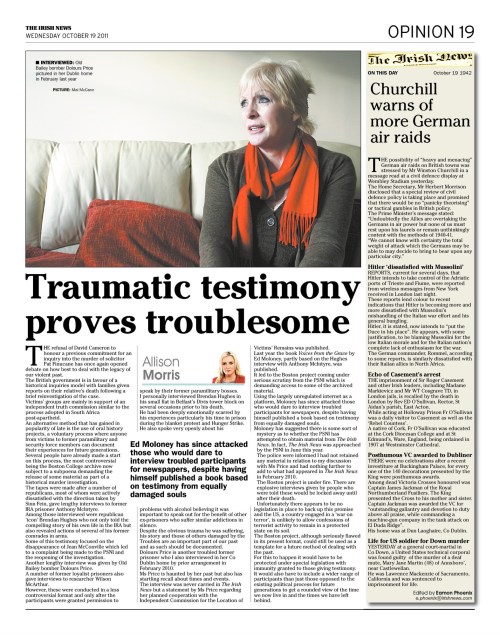
Noel Doran’s article on The Wild Geese was not the only response from the Irish News on this matter. On October 19th, Allison Morris finally broke her silence and penned this article for her newspaper:
I emailed Noel Doran asking for the right of reply which he granted but with the proviso that my article had to be limited to 500 words. In contrast, Allison Morris’ piece was some 750 words long and limiting my response meant that I was not able to answer every point that she made.

For instance, she wrote that researcher Anthony McIntyre had interviewed people, “most of whom were actively damaged souls dissatisfied with the direction taken by Sinn Fein”. How does she know this? Has she been granted access to the entire archive and read/listened to all the interviews? Of course not. She does not and cannot know who has been interviewed, what they said or what their views were about the Sinn Fein strategy.

Her logic is fatally flawed: because Brendan Hughes was critical of his old colleague Gerry Adams it follows that everyone else interviewed by Boston College must be similarly inclined. Nor does she know who was or was not “damaged” – as nor do I – as she put it. And what does she mean by “damaged” anyway? Is she suggesting that we only sought out people psychologically scarred by the Troubles? If so she should produce the evidence.
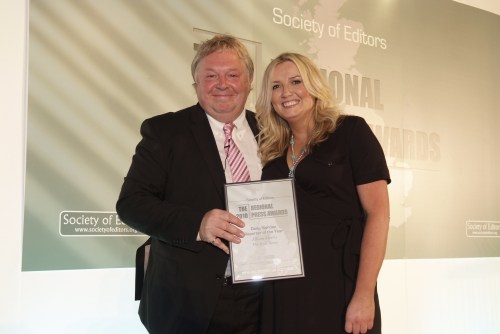
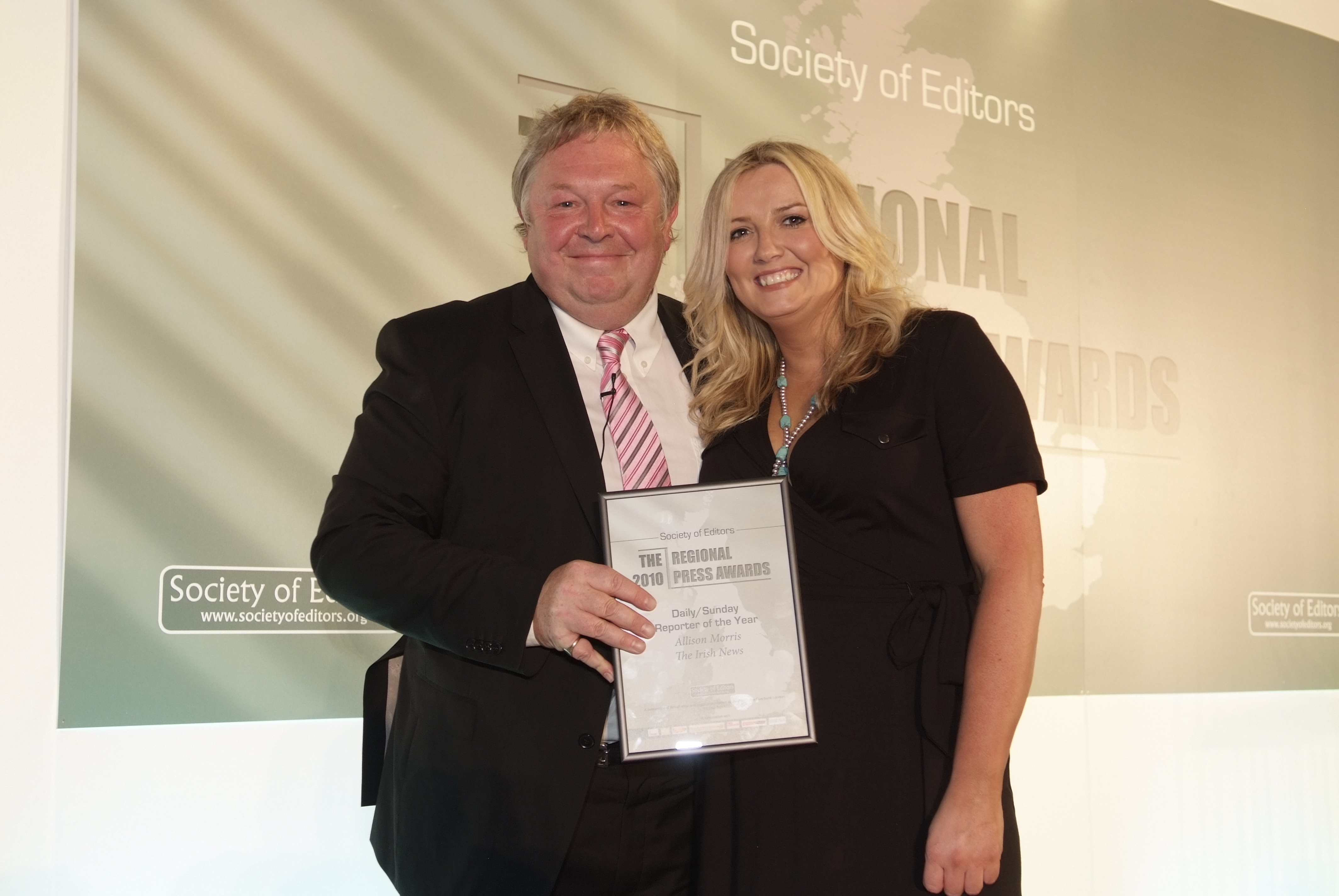
Allison Morris accepts the award for Daily Reporter of the Year for a portfolio which included her articles on Dolours Price

I am naturally limited by what I can say about all this but since it is a canard that has gained some currency – not least because of Sinn Fein’s displeasure and anger at Brendan Hughes’ interviews – I feel it is legitimate and necessary to point out that this is not a Provisional IRA archive but a republican archive and its reach stretches across the full spectrum of that tradition’s ideology during the length of the Troubles. After all more than the Provos were involved on the Nationalist side of the conflict.

The only criteria that were applied were these: Was the person willing to give an interview and would they tell the truth, as best as could be ascertained? I can tell you that it was not an easy task persuading people to talk about their paramilitary pasts and that in itself severely limited the size of the pool within which we could fish. As to whether the truth was being told, that is always difficult to judge. But some lies are so obvious, like “I was never in the IRA, only in Sinn Fein”, or “The Official IRA ceased to exist in 1972”, or “The INLA never traded guns or intelligence with Loyalists” that they announced themselves and excluded their tellers from our sort of exercise.

She also suggested that it was Brendan Hughes’ interview which led to the subpoenas being issued when she knows full well it was the Sunday Life story, based on her tapes, which did that.

Despite being denied the space to answer all these points I nonetheless sent Noel Doran the following 500 word article:

Oct 23 – In her weekly column (October 19th), written to answer allegations I made concerning her tape-recorded interview with Dolours Price and its role in the serving of subpoenas on Boston College, your correspondent Allison Morris failed to list, much less answer them. Your readers deserve to know what they were so I will rehearse them here.

At the time of the interview, Dolours Price was under the care of a psychiatric hospital in Dublin and taking strong medication, key facts notably absent from Allison Morris’ column. Dolours was unwell and her family believed that the interview should never have been authorised nor its contents divulged. They even asked Allison Morris to leave her home during the interview but she did not do so.

Allison Morris now claims that the interview was not used and instead her article was based on a separate statement from Dolours Price that she would go to the Disappeared Commission. This is Jesuitical hair-splitting and mendacious since a casual reading of her piece shows that it was based on much more.

If her article was not based on her interview then Allison Morris needs to explain why the chairman of the judges of the Society of Editors praised her “three-page interview with London bomber Dolours Price”, for which he awarded her the Daily/Sunday reporter of the year prize last May.

What happened after the interview was unforgivable. Allison Morris’ tape was passed on to the Sunday Life which wrote the story so that it appeared the reporter had gained access to Dolours Price’s interviews with Boston College when no such thing had happened or would ever have been permitted.

This claimed breach of confidentiality served to justify the subpoenas presented by the US Attorney’s office in Massachusetts which said in its affidavit to the federal court: “….the reporter (Ciaran Barnes) was permitted to listen to portions of Ms Price’s Boston College interviews”. Nothing could be further from the truth. I believe the Sunday Life wrote its report in this way to hide the real origin of its story, viz Allison Morris’ tape.

Behaviour like this is staggeringly unethical. Its potential consequences, not least for the future of oral history in the US as well as for all those concerned, are unthinkable.

Alison Morris’ astonishing and unsettling disclosure that the PSNI approached the Irish News only after the subpoenas were served, when our responding affidavits highlighted the above facts, begs obvious questions: was the PSNI monstrously incompetent or just giving preferential treatment to NI’s premier Catholic daily paper?

To deflect from her misdeeds, Ms Morris accused me of hypocrisy, of “having…..published a book based on testimony from equally damaged souls”. This is a reference to Brendan Hughes. Whatever his problems, he was not a psychiatric patient on medication. He wanted his account published. That became possible when he died and the pledge of confidentiality was lifted. We treated Brendan Hughes with scrupulous probity. Can Allison Morris say she behaved similarly towards Dolours Price?

The article never appeared. I received the following email from Noel Doran explaining his reasons for not publishing it:

Hi Ed,

As I said in my last email to you, we would be happy to provide you with a right of reply to the Allison Morris column of October 19. What you have actually offered is a list of separate allegations which, as I have already demonstrated through my detailed factual statement to TheWildGeese.com, are almost all false. If you wish to challenge other decisions taken by the Sunday Life, the PSNI or the Society of Editors, you should contact them directly. We remain ready to give you the opportunity to respond to the points Allison put forward, but, for legal reasons alone, no responsible newspaper could consider publishing your initial contribution. If you wish to revise it, let me know.

Noel Doran.

I then wrote the following letter to the Irish News hoping that it would see the light of day in the paper’s columns. It never did.

Dear Sir,

On October 18th, I received the following email from your correspondent, Allison Morris:

“Ed,

In my regular Irish News column due to be published tomorrow, I will be responding to allegations made by yourself during a recent interview with TheWildGeese.com regarding my conduct. A rebuttal has also been submitted to The Wild Geese by Irish News editor Noel Doran for publication.

Regards

Allison Morris ”

Your readers should know that my interview with the Wild Geese website concerned the role of the Irish News and Allison Morris in the subpoenas served against Boston College by the US Attorney’s office in Massachusetts on behalf of the PSNI seeking interviews with former paramilitary activists archived there.

Allison Morris’ article duly appeared but she evaded most of what was in my Wild Geese interview and instead ploughed a different field, for instance claiming that Boston College interviewers had chosen as subjects only people who were opposed to the peace process, something she has absolutely no way of knowing. I asked for the right of reply which the editor granted me and I duly sent the article in for publication.

However in an email to me from the editor of the Irish News yesterday I was told that I can only have right of reply to those of my allegations that Allison chose to write about along with spurious additional assertions on her part and nothing else, and that since she chose to ignore the bulk of what I said in that Wild Geese interview that none of my article can therefore appear in the Irish News. This is a novel way of approaching such matters. Person A makes 10 allegations against person B who replies by writing an article in Northern Ireland’s largest Catholic newspaper but answers only 1 of those allegations. Person A asks to respond to that article, is told that he can but only if he ignores the other nine allegations which haven’t been answered and this, person A is told, settles the matter. In another field of activity they might call this kangaroo justice.

I am puzzled as to why the Irish News is behaving like this? If the Irish News has truly been maligned by my allegations and have an answer for them then you would lose absolutely nothing by publishing my right to reply article because, presumably, you would have an answer to all that I say. The fact that you will not give space to my article can lead people to only one conclusion.

Yours etc,

Ed Moloney

New York
A number of issues arise out of all this. One is the behaviour of the PSNI. The Irish News and Sunday Life articles appeared in February 2010 but the PSNI made no move on the matter of Dolours Price until March 2011 when the procedure for serving subpoenas was initiated. In the prior thirteen months PSNI detectives had made no effort at all, as far as one can ascertain, to interview either Allison Morris or Ciaran Barnes or even to approach their newspapers. Even though the PSNI,  its predecessor, the RUC and even Scotland Yard have used subpoenas without compunction in the past and did so with considerable speed against other reporters & newspapers in Northern Ireland no such thing happened to the Irish News or the Sunday Life. Why not?

Instead the only action taken was against Boston College. Only after the college responded to the subpoenas by pointing out that the college had not made its archive available to Ciaran Barnes and that his story was instead based upon Allison Morris’ tape-recorded interview, did detectives in the PSNI stir themselves to perform a task that should have been the first item on their to-do list. It took until June of this year, nearly a month after Boston College had delivered its affidavits and sixteen months after the Irish News and Sunday Life articles were published, for the PSNI to finally get round to questioning Allison Morris. By which time of course she was able to tell them that she had “not retained” the “material” for the story she wrote, i.e. her tape was now swimming with the fishes. Quelle surprise!

So here we have a situation in which the full powers and majesty of the US Department of Justice are being deployed against one of America’s premier colleges on behalf of a police force which didn’t perform even the minimum investigation before seeking its co-operation. They never asked simple questions like: ‘Did Ciaran Barnes really get hold of Dolours Price’s Boston College interview and if so, does he still have it?’, or ‘Are we absolutely sure she said what he claims she said?’ How extraordinary! How do Americans feel about being used in such a shoddy & incompetent way by a foreign police force?

Another issue is this. Whatever about the proprieties of interviewing Dolours Price while she was receiving psychiatric care, Noel Doran behaved properly by not running the full interview when he was made aware of her family’s concerns over her health (even if parts of Allison Morris’ article were clearly based on that interview).

He made a deal with her family which I cannot think he personally dishonoured or ever had any intention to dishonour. But someone did. The logic of events points in only one direction: a person with access to it, made Allison Morris’ tape available to Ciaran Barnes and by so doing betrayed the arrangement Noel Doran had made with the Price family and thus enabled the PSNI to issue subpoenas against Boston College. If I were in his shoes I would be very angry and would want to know exactly who that person was so I could take the appropriate action.

The final issue concerns Ciaran Barnes and the Sunday Life. I understand fully their reluctance to reveal the sources for their Dolours Price story. If I was them I would respond in the same way. But there is nothing to stop them from making it clear that Boston College was not their source, that no-one from the college or the Belfast Project assisted them and that they did not have access to Dolours Price’s interviews lodged at the college. That would not entail naming their source but in this way they could still emerge from this wretched affair with honour.

Why Provo Lies About The Past Are So Dumb!

I have never been able to figure out the reasoning behind Gerry Adams’ and Martin McGuinness’ insistence on lying about their past lives as IRA members and even less so now as it becomes clear that it was McGuinness’ insistence on doing so that led directly to Sinn Fein’s less than stellar performance in the Irish presidential election.

Whatever the rationale there can be no doubt now that for both men, and their party, the decision has been at best, stupid and self-defeating and at worst, a disaster.

First, take a look at McGuinness’ showing in the presidential election. This was billed as the election that could push Sinn Fein through the credibility barrier in the South and place the party on the cusp of government. The plan was simple: underline Fianna Fail’s fall last February with a result that said Southern politics have utterly and irretrievably changed; Fianna Fail is a relic of a dead past and Sinn Fein is the new, coming electoral force.

But it didn’t quite work out that way. McGuinness’ 13.7 per cent of the first preference vote was better than SF’s general election tally of nine months ago for sure, but as one shrewd analysis pointed out, that was not comparing like with like. The real and adjusted rise in SF’s vote was around two-and-a-half points, well short of the vote-doubling that the party’s managers had hoped for.

Not only that but Fianna Fail did what no-one expected and put on a convincing impression of Lazarus. The FF result in the West Dublin by-election, the creditable performance of Sean Gallagher, the ersatz Fianna Failer – despite the late-breaking brown envelope scandal – and the fact that Sinn Fein was outpolled in all but one of the Border constituencies, its home ground, all spoke to dashed hopes that Martin McGuinness’ candidacy would bring an historic breakthrough.

There can be little doubt that McGuinness’ decision to stick by the lie he told the Saville Tribunal, that he had left the IRA “in the early part of the 1970’s” – later finessed to 1974 since he was in jail on IRA offences until then – was his undoing.

No-one could quite believe the story that he walked out on the IRA all those years ago yet still carried enough clout to persuade his former comrades to end their war, become ministers in a British administration and destroy all their guns. Imagine the scene: the Army Council is in session when there’s a knock on the door. It opens to reveal the Chuckle-like grin of Martin McGuinness. “Hi guys!”, he says nervously. “You might not remember me but I used to be one of youse a while back. Those were some days, I can tell you! Listen I have a couple of ideas I’d like to run past you. Got a minute?”

It was never going to work and it didn’t. McGuinness was chosen to carry SF’s banner because he was the Provos’ Mr Nice Guy, the Chuckle twin who had tamed the raging bull, Ian Paisley and made friends with that sinister-looking Peter Robinson, a hero of the peace process who was so much more fun to be with than grouchy old Gerry.

Martin was probably expecting a gentle stroll in the general direction of Phoenix Park with much agreeable talk of how well he had performed in the Northern government and how pleased he was to have helped end the war. But instead his campaign was dogged by questions about his credibility and all because of the IRA lie. For sure there was an element in the Southern media predisposed against him – call them West Brits if you wish – but the lie about leaving the IRA in 1974 was a sheer gift to his enemies. Other, more neutral elements in both the media and electorate could hardly be blamed if they joined the sceptics. It was an election after all and elections are supposed to be about the candidates’ honesty and integrity.

Remember also that Martin McGuinness was the candidate and not Gerry Adams and why that was so. The Sinn Fein president and Louth TD has been lying longer and more profoundly about his IRA past than McGuinness, although to be fair the only reason why the Derry man is not denying any association at all with the IRA, as Gerry has been doing since at least 1982, is probably that pesky interview he had on the streets of Derry with the BBC’s Tom Mangold: “As the commander of the IRA Provisionals in Derry, can you tell us…..?”And so on, with nary a word of protest from the bold Martin!

Nonetheless look at the damage that lie has done to Gerry? It drove Brendan Hughes, his old buddy-in-arms, to complete distraction and, in my view, was the driving force behind Hughes’ decision to tell all to Boston College, detailing Adams’ part in leading the Belfast IRA and later the IRA nationally and not least the role Gerry played in the disappearance of Jean McConville, a revelation that has indelibly tainted the SF leader beyond repair.

The McConville connection may not be the only reason Gerry Adams didn’t stand for SF in this presidential election but it was one reason and it is why once-fondly held hopes that he might end his days sleeping in the presidential bedroom have been dashed forever.

But for the lie that wouldn’t have happened and but for his own version of it, Martin McGuinness might still be regarded as the Provo leader who still had a vestige of rectitude. Instead, McGuinness will forever be linked to Frank Hegarty, the Enniskillen bombing, the use of human bombs – and of course the outrageous fib about leaving the IRA in 1974.

I don’t know why the two men embarked on their lies in the first place. I could never see any advantage to it and so many potential pitfalls it just didn’t make sense. The other thing is that it was unnecessary. Some reporters have taken the view that there was only two choices: lie about their IRA membership or admit it and risk a jail term. Not true. They could have done what a previous generation of Republicans did, men like Ruairi O Bradaigh and Daithi O Conail who would reply, when asked if they were in the IRA, “Mind your own business!”, or words to that effect.

Actually, it is not entirely true to say that I can’t think of a reason why they chose to lie because I can – although I don’t have smoking gun proof. Lying about his IRA links was sold internally at the time it started, during the campaign for the 1982 Assembly election, as something Adams had to do to frustrate a hostile media and it was okay because it was just a tactic, nothing more or less than that, just like car bombs or “up and unders” or personating in West Belfast or fixing the vote at the 1986 SF ard-fheis: these were things that had to be done to win the war.

And what that did was to make telling lies an excusable and acceptable tactic, a very handy device when the peace process began and it became necessary to sell one story to the British, Irish and American governments about the ultimate intentions of the Provo leadership and an entirely different version to their own grassroots.

But now the tactic has come back to bite those who devised it in the bum. I can’t say I have much sympathy for them.

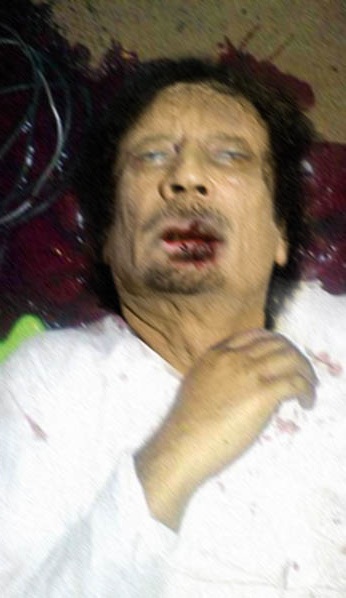
So, Farewell Muammar al-Gaddafi

UPDATED BELOW

You weren’t a saint for sure, but you weren’t the worst either. I can think of many others in your region, in Bahrain, Yemen or Syria for instance, who were more deserving of your bloody & brutal end – but you did not have the leverage that the leaders of those countries enjoyed. Perhaps if you had allowed Al Qaeda a small foothold somewhere deep in the desert where they could have posed a threat to the US, or if you shared a Border with Israel or had friends in the Saudi Royal family, you’d still be living and ruling the roost. But you only had oil – and lots of underground water – and that stuff is so easy to steal.

You started off well way back in September 1969, determined to erase Libya’s shameful and violent past as a toy of colonial powers and to make sure that the country’s oil wealth was used to benefit the largest number of people. There aren’t many oil states around the world that can make that claim.

Gaddafi as a young revolutionary

You also stood beside other peoples who had suffered from colonialism. A lot of the time your choice of partners reflected well on you. You supported South Africa’s fight against apartheid at a time when major figures in the country I now live in who boast of their support for democracy, like Dick Cheney, opposed the release of Nelson Mandela from Robbin Island. At other times you made really bad choices, like Idi Amin for instance. But I could see where you were coming from.

Most observers think you overstepped the mark when you made Ronnie Reagan an enemy. That set you on the path to Lockerbie, UN sanctions and the near crippling of your economy. Then you let the West back in, smiled at the oil companies, opened the door to the IMF who liberalised your economy, impoverished your people and wrote the script that led to your downfall. Others say it was your sons, greedy for wealth and contemptuous of your people’s needs, that really let you down.

All this probably did play a big part in your tragedy but I suspect you made your big mistake at the start of your reign, when you took on Big Oil and won. What you did broke the stranglehold the Seven Sisters – Standard Oil of New Jersey, Standard Oil of New York (now Exxon), Standard Oil of California (now Chevron), Gulf Oil, Texaco, Royal Dutch Shell and Anlgo-Perisan (now BP) – held on the oil producing countries. By doing that you breathed life into OPEC and put spine into their backbone; almost single-handed, you opened the way for the 1973 oil embargo and the emergence of oil as a potent political weapon. You gave the Arab world real clout, a new self-respect and a pride in their power to bend and twist the economies of the powerful. I suspect the Western powers never forgave you for that and were always looking to get their revenge. This week they did. The bullets that killed you were fired by Libyans but the gun was put in their hands by NATO.

So what will your legacy be? This is where I think the verdict will be unkind to you. You had a deep strain of pragmatism and that helped you survive for over forty years but you ignored it when when you shouldn’t have. Long before the Benghazi rebels reached for their guns you should have introduced real political reforms, recognised that you had outstayed your welcome and acknowledged the pent up rage & frustration driving the Arab Spring.

Even if that had heralded the end of your family’s reign, you would have been able to retire gracefully, with sufficient wealth to sustain your entire family and with the thanks of a grateful people and the Arab world ringing in your ears. You spent much of your life trying to bring down the tyrants of Saudi Arabia, of the Gulf and North Africa. If you had bowed out in the way you should have, the example you set would have done so much more to undermine and dethrone them.

But you didn’t and instead you have paved the way for the recolonisation of Libya. The same powers you overthrew in 1969 – the French, the British, the Italians and the Americans – will now be swaggering back into Tripoli, this time determined not to let the past repeat itself and intent on persuading Libya’s new rulers to acknowledge the debt owed to them. For that, Muammar, history is unlikely to forgive you.

So farewell then al-Gaddafi. I will always have a special place in my heart for your country and what it did to turn my life around all those many years ago. But you should have gone when you had the chance.

This interview, screened by the estimable Real Network News, gives a foretaste of what may lie ahead for Libya. Watch and become depressed.

UPDATE

Hillary Clinton, who had predicted Gaddafi’s death during a trip to Libya a few days before, jokes about the dictator’s brutal end with a CBS reporter and implicitly claims credit for it.

Double Standards at Slugger O’Toole?

Slugger O’Toole is Northern Ireland’s best known and most widely-read current affairs blog. Set up by Mick Fealty in 2002, it initially concentrated on Northern Ireland matters but has gradually expanded the breadth of its coverage, and its list of contributors, to include most points on the political and geographic compass. But there’s no doubt that it is Slugger’s coverage of Northern Ireland that brings the clicks.

Mick Fealty, founder of Slugger O'Toole

And Northern Ireland politics being what they are, there is no shortage of controversy about the stories that the blog posts, especially in the comments section where insults and abuse abound and often come close to violating the strict libel laws that operate in Ireland and the UK. Policing the comments section, and keeping Slugger O’Toole out of the libel courts, is surely one of Fealty’s more unenviable tasks.

Most of the time the system he put in place in recent years – requiring commenters to register and applying a ‘play the ball, not the man’ policy – seems to work and does so fairly, excluding the more egregious vilification. But like others who have had dealings with Slugger O’Toole, I have come across complaints of inconsistency and even double standards in the application of that policy, that those who are powerful, financially and politically, get a better deal than those who aren’t. Others say there are protected and unprotected species on the site, that is some journalists and public figures about whom criticism is rarely tolerated, much less abuse, and others about whom almost anything can be inferred.

Normally, I would dismiss complaints like this as sour grapes from people who came off second best in debates with opponents. Normally that would be my reaction, except I have personal experience at the hands of Slugger O’Toole and Mick Fealty that gives substance & weight to the complaint.

Back in April/May 2005 I was contacted by a friend in Belfast who suggested I have a look at some of the comments directed at me on one posting placed on the blog towards the end of April. There I read that I was “a sneaky little bully” who had no real republican sources but plenty in the security forces; that I hankered for a return to the days of “bombs and bullets” and that I had acted as adviser/policy developer and “consigliero” (sic) for the IRA leadership.

Now normally I would shrug off such slanderous nonsense. Ever since my book ‘A Secret History of the IRA’ was published I had been on the receiving end of mountains of similar abuse, mostly from Sinn Fein supporters who didn’t like what they had read between its covers. And there I would have left it except as I scanned the site I came across this, a comment posted on April 28th, 2005 by someone calling him or herself ‘Concerned Loyalist’ in response to other comments about a BBC Newsnight report that had named the membership of the IRA’s Army Council:
“Chris Gaskin,
You said that Newsnight have “put these men’s lives in danger”. How?
Around Christmas I named, on Slugger, the exact same 7 men as IRA Army Council members, but Mick took it off as he felt it could be libellous, which is fair enough……Concerned Loyalist”

I have to say that enraged me. Double standards in the treatment of people always do. Mick Fealty had moved immediately to protect the reputation of people who had directed a campaign of bombing, shooting & death in Ireland for many years yet had done nothing at all when I, a reporter of some standing, was called an IRA “consigliero”.

I am not a person who likes to contemplate suing. I dislike the libel laws which I believe are constructed more to protect the rich & powerful and to hide their excesses from public scrutiny than to prevent malicious commentary about innocent people. I didn’t want to sue in this case but I did write to Mick Fealty asking that the comments about me be removed. My first letter was ignored but eventually a lengthy correspondence ensued. However it wasn’t until the end of July that the matter was brought to an end, admittedly in a less than satisfactory way, and the comments removed. The Army Council got immediate satisfaction; I had to wait nearly three months.

Last week, Mick Fealty removed another posting from his site that concerned myself, but this time most definitely not at my request or wish. I had given an interview to an Irish-American website called TheWildGeese.com about the

Dolours Price, pictured several years ago

ongoing legal and political struggle to prevent the US authorities from confiscating archived interviews with former IRA members, notably Dolours Price, lodged in the archives of Boston College on behalf, we suspect, of the PSNI. But we don’t know for sure who is behind this as the subpoenas have, in echoes of the days of the Star Chamber, been sealed to maintain secrecy.

Those involved in our campaign had been investigating the background to the subpoenas, and particularly how the authorities in Northern Ireland and the US had come to know that Dolours Price had been interviewed by Boston College, whose project to collect paramilitary oral history had been overseen by myself. Over the past months we had worked out the following explanation for events:

♦ while a patient at a psychiatric hospital in Dublin, Dolours Price had been interviewed on tape by Allison Morris of the Irish News paper in Belfast about the background to the disappearance of Jean McConville amongst others. The interview took place at her home when she was on weekend leave from the hospital but technically still under its care;

♦ that during the interview, one of Dolours Price’s sons arrived unexpectedly, realised what was happening and that his mother was in no fit mental state to be interviewed and asked Morris to leave. She didn’t, the son contacted one of his aunts who, by phone also asked her to leave; she again stayed put;
♦ that on learning of the interview the Price family had asked the Irish News not to run the interview because of her distressed & unreliable mental state;
♦ that the editor of the Irish News agreed a compromise with the Price family, that “the juicy bits”, as one family member put it, would be not be used;
♦ that the editor of the Irish News, Noel Doran had kept his side of the deal but his reporter Allison Morris had not and instead had passed her tape of Dolours Price onto a friend, Ciaran Barnes in the Sunday Life tabloid newspaper in what was a blatant betrayal of the arrangement agreed to and honoured by her editor;

♦ that Ciaran Barnes had written a report with all “the juicy bits” most definitely included and wrote his report in such a way that it appeared that he had been given access to Dolours Price’s interview with Boston College and that the details of his subsequent report in the Sunday Life, including her alleged role in the disappearance of Jean McConville and others, had come from that interview;
♦ that Ciaran Barnes most definitely had not been given access to Boston College’s archive and that neither he nor anyone else knew what Dolours Price had said in her interview which was given when she was in a much healthier and rational mental state;
♦ that Dolours Price did not have, and could not have had, a copy of her interviews with Boston College and therefore could not have been the source for any tape recording of herself given to Boston College. The only copies of interviews carried out for the Belfast Project on behalf of Boston College were lodged at the Burns Library on the campus in Boston with access limited to the librarian, Dr Robert K O’Neill;
♦ that Ciaran Barnes’ motive in behaving in this way, to infer or otherwise suggest that he had been given access to Boston College’s tape, was to hide the fact that his information had come instead from Allison Morris’ tape and that Morris’ role in betraying her source Dolours Price, and undermining her editor, would remain hidden.

Allison Morris receives the British regional press award for Daily/Sunday reporter of the year on May 12th 2011, a few days after subpoenas were served on Boston College. Her portfolio of winning articles included her interview with Dolours Price

Be in no doubt about the seriousness of all this. In order to justify the PSNI’s subpoenas against Boston College, the office of the US Attorney in Massachusetts, Carmen Ortiz cited the Sunday Life report as a causal factor for her legal action and took Barnes’ inference that he had listened to the Boston College tape to a higher level, saying:

“Ms. Price’s interviews by Boston College were the subject of news reports published in Northern Ireland in 2010, in which Ms. Price admitted her involvement in the murder and ‘disappearances’ of at least four persons whom the IRA targeted: Jean McConville, Joe Lynskey, Seamus Wright and Kevin McKee…..Moreover according to one news report, the reporter was permitted to listen to portions of Ms. Price’s Boston College interviews.”

In other words, Ms Ortiz was saying: ‘We are demanding these interviews at Boston College because we have reason to believe, thanks to Mr Barnes’ journalism in the Sunday Life, that they include her confession to the disappearance of Jean McConville and others. Furthermore because Boston College evidently gave Dolours Price’s interviews to Ciaran Barnes or Dolours Price gave them to Barnes, the promise of confidentiality given to all interviewees had been broken and Boston College could no longer claim the protection of that promise. So please hand them over right now!’

Ciaran Barnes

Thanks to their deception and trickery Allison Morris and Ciaran Barnes have substantial and direct responsibility for this attempt to raid the archives of Boston College, an effort which has the potential to imperil the future of oral history in the United States, destroy Boston College’s invaluable historical archive and put myself and my researcher Anthony McIntyre in countless difficulties. A straight line can be drawn, in other words, between their behaviour and the subpoenas served on Boston College. Without the former, the latter could and would not have happened.

It was for this reason that in my interview with The Wild Geese website I said that “Boston College is the victim of journalistic ethics that are on a par with Rupert Murdoch’s hacking operations”. Notice, I did not say News International’s criminal behaviour but their ethical behaviour. And what I meant was that the deception of Morris and Barnes and Murdoch’s hacking shared the same disrespect for and mistreatment of sources in the search for headlines, a sensational story and professional advancement.

There is substantial reason to believe that Ciaran Barnes also broke the section of the Press Complaints Council’s code of behaviour which states, inter alia: “The Press must take care not to publish inaccurate, misleading or distorted information…..”, while Allison Morris could be accused of contravening the section which says: “They (reporters) must not persist in questioning, telephoning, pursuing or photographing individuals once asked to desist; nor remain on their property when asked to leave and must not follow them…..”

This is a story that asks very hard questions of the Northern Ireland media. There are other reasons why the story is of considerable public interest, or rather questions that arise about the PSNI’s handling of this affair which make it so:

♦ Have the Irish News and/or Sunday Life been subpoena’d by the PSNI to hand over Allison Morris’ taped interview with Dolours Price?
♦ Does the Allison Morris tape still exist or has it been destroyed?
♦ Did the PSNI ever make any effort to discover if there was a tape recording of Dolours Price’s interview separate from those in the Boston College archives and if so, when did they make it? Was it immediately after the reports appeared in the Irish News & Sunday Life or did the PSNI wait, and if so, for how long?
♦ Has the PSNI ever attempted to interview Allison Morris and/or Ciaran Barnes about these matters?
♦ Does the Irish News have any other record or proof of Allison Morris’ interview with Dolours Price? If so, what is it and a) has the newspaper handed it over to the PSNI or b) has the PSNI subpoena’d it or even inquired about it?
♦ Has the PSNI handled this matter in such a way that local media sources remain unaffected and unharmed by their inquiry while the brunt falls upon Boston College?

These are all questions which, as I say, make this a story of overwhelming public interest in Northern Ireland, especially as society there grapples with the vexed problems of how to deal with the past. My interview with The WIld Geese was immediately noticed by Slugger O’Toole contributor Mark McGregor who recognised its significance and wrote it up in a lengthy blog which he posted on the site at 7.24 pm (Belfast time) on Monday, October 11th. It stayed there for three hours or so, after which Mick Fealty removed it.

Mick Fealty has yet, at the time of this posting, to make any reference to this incident on his blog much less explain why he acted in the way he did. I am told that he did this because of a fear of legal action against his site. Perhaps he will now come forward to explain so we can judge whether the threat was a real one or, as often happens with more powerful, influential and affluent parties, it was merely a bluff to kill off the story before it spiraled out of control.

In the meantime here is the post that was removed from Slugger O’Toole. Enjoy.

“Mark McGregor,  Mon 10 October 2011, 7:24pm

“When I asked ‘Did local media have a role in the Boston College case?’ I noted how articles by Allison Morris and Ciaran Barnes appeared central to the case being pursued in the US courts by the Attorney General to access oral history archives on behalf of an unknown wing of the British State. Their articles remain Exhibits 1 & 2 in the case.

“Mick later followed up noting a Private Eye article that states:

The subpoenas are based on a false claim that one of the interviews with Price, published in the Sunday Life newspaper in February last year, was based on an interview with the Boston College project

“Now Ed Moloney in an interview with TheWildGeese.com goes much further placing Morris and Barnes central to this case and seemingly with questions to answer:

In February 2010, Dolours was in a psychiatric hospital in Dublin and while there she contacted the Irish News in Belfast and said she had things to tell the paper. That weekend, she was given leave to go home, but she was technically still under psychiatric care from the hospital. The Irish News’ journalist Allison Morris arrived at her home and tape-recorded the interview. Dolours told a story about her involvement in the disappearance of several people in 1972, including Jean McConville. Toward the end of the interview, one of her sons arrived home and realized what was happening. He told Morris that his mother was a psychiatric patient, was taking drugs and was not in a fit state to give anyone an interview, that whatever she said was totally unreliable. He demanded that the interview end and that the tape not be used. Morris refused. He then phoned his aunt, who repeated the demand and was again refused. She then phoned the editor of the Irish News, and, after much discussion, he said that he would use the interview but agreed to keep “the juicy bits” out to minimize the damage to Dolours Price, which he did. We believe that what happened next was that Allison Morris betrayed Dolours Price and reneged on the agreement with her family and passed the tape on to a friend, Ciaran Barnes, who worked in the Sunday Life, a tabloid Belfast newspaper. He wrote up the story with “the juicy bits” very much in, and, in order to disguise the fact that he had got the information from Allison Morris’ tape, wrote the piece in such a way that it appeared that he had gained access to Dolours Price’s taped interviews at Boston College, which needless to say was impossible. It is on the basis of this deception that the subpoenas were served on Boston College, that the information in Barnes’ article came from BC when it didn’t. The information, in fact, came from the Irish News tape, which was passed on, in contravention of an agreement with Dolours Price’s family, to Barnes. Whether the PSNI (Police Service of Northern Ireland) have ever tried to obtain the Irish News tape is a mystery, which no one seems able to solve. But there is no doubt that the subpoenas served on BC are based on a lie, that the admissions Dolours Price allegedly made and which were reported in the Sunday Life came from Boston College. They did not. …

This is what the Massachusetts U.S. Attorney (Carmen M. Ortiz) had to say in her subpoena (see page 4 of link) to justify the demand for Dolours Price’s interviews: “Ms. Price’s interviews by Boston College were the subject of news reports published in Northern Ireland in 2010, in which Ms. Price admitted her involvement in the murder and ‘disappearances’ of at least four persons whom the IRA targeted: Jean McConville, Joe Lynskey, Seamus Wright and Kevin McKee. See Exhibits 1 and 2. Moreover according to one news report, the reporter was permitted to listen to portions of Ms. Price’s Boston College interviews.”

That last sentence is a lie. He (Barnes) was not and never would be permitted access to Boston College’s interviews. Boston College is the victim of journalistic ethics in Belfast that are on a par with Rupert Murdoch’s hacking operations, and you can quote me.”

[emphasis added]

“Given Moloney’s statements questions may arise at the Society of Editors, Regional Press Awards as they declared Morris DAILY/SUNDAY REPORTER OF THE YEAR based on a three piece portfolio of work including that Price interview.

“I closed my initial blog with – Given the use of these articles to expedite the subpeona, it is surprising these publications and journalists have not been more proactive in examining this issue, their role in its advancement and just how valuable their articles are as a possible central plank for legal action. Moloney’s claim of an integrity issue may go some way to explain the reluctance from both journalists and publications to examine the role they had from the outset.”

A Question For Martin McGuinness

Here’s an interesting question to put to Martin McGuinness, one that has nothing to do with his IRA associations. I have read him saying that on the day Sinn Fein nominated him as the party’s candidate for the Aras, he was actually inside the Wall Street stock exchange alongside Peter Robinson discussing job promotion for NI with the exchange’s executives. It appears to have been his way of countering the insinuation that his violent IRA background would make him unfit to hold such a high office as the Irish presidency.

Not long after that hundreds and then thousands of demonstrators took to nearby streets in “Occupy Wall Street” protests against Wall Street’s corruption, greed and stranglehold over US politics. It is the first manifestation of public anger in this country at Wall Street’s ability to escape punishment for their wild, unchecked financial excesses which plunged the US and European economies into such a deep recession, impoverishing millions of innocent people.

As far as I know Martin McGuinness has not said a word about the OWS protests, although I stand ready to be corrected. But one of Sinn Fein’s staunchest allies in the US, Republican Congressman Peter King of Long Island has, and this weekend joined the growing right-wing chorus of condemnation cum mockery of the Wall Street protesters. Speaking on a radio show hosted by Laura Ingraham, a favoured megaphone of the American Conservative movement, King had this to say: “It’s really important for us not to give any legitimacy to these people in the streets. I remember what happened in the 1960s when the left-wing took to the streets and somehow the media glorified them and it ended up shaping policy. We can’t allow that to happen.”   You can hear more of that interview below.

Earlier this year, in an exercise designed to pander to anti-Muslim sentiment in this country, King hosted a series of Congressional hearings about the so-called radicalisation of American Muslims. The hearings were widely condemned by liberal opinion as inflammatory and racist and also highly selective, since he did not include in his investigation other home-grown extremists, like the more numerous, well armed and manifestly violent White supremacist and other hate groups in this country. Since King was the most prominent Sinn Fein supporter in America, the party was asked for its reaction to his hearings and as far as I know said nothing.

John Kennedy’s cartoon captures Peter King’s mendacity pretty well:

Once again it would be beneficial to hear Sinn Fein’s attitude to Peter King’s views, this time on the need for the media to suppress coverage of the OWS protests. After all Sinn Fein presents itself to the Irish voter as the friend of all those who were victims of the Irish banks’ casino capitalism and has vowed to defend their interests and punish those responsible for impoverishing so many Irish people. And here is their biggest fan in America calling for people with those exact same views in the US to be gagged. So what does Sinn Fein, and particularly Martin McGuinness think of the OWS protests? Are they, is he on the side of the protesters or on the side of Peter King & the Wall Street executives with whom the SF candidate for the Park was recently closeted? T’would be interesting to know.

The Smile On The Face Tells A Story

It is election season again in America. Having run rings around Obama, Republicans believe he is there for the taking in 2012 and opinion polls say they’re right, he’s fated to be a one-term President.

Elected on the promise of bringing change (which meant undoing George W Bush’s disasters at home and abroad) Obama instead gave America more of the same; his foreign policy and embrace of neoliberal economics were indistinguishable from both of his predecessors, Bush & Clinton. As a result the economy is in the tank, the GOP refuses to help him get it out of the tank (and why should they?) and Obama’s disillusioned liberal base has all but abandoned him.

At this late stage, Obama has decided to move “left”, demanding higher taxes on the wealthy and talking the language of class warfare. Is this a genuine shift or merely a meaningless, cynical tactic to re-energise the voters who embraced him so readily in 2008? “Yes, We Can” replaced by “No, I won’t” and now superseded by “Yes, I Really Will This Time”?

Former New York Times reporter, Chris Hedges has written that what the voters bought into in that election was ‘Brand Obama’, a skilfully constructed advertising and marketing campaign designed to persuade voters they were buying something very different than the usual politician. No accident, he says, that at the Association of National Advertisers annual conference in October 2008, the Obama campaign “was named Advertising Age’s marketer of the year for 2008 and edged out runners-up Apple and Zappos.com.” The product was the same old rubbish but dressed up to appear exciting, new and promising.

If true that means Obama is mostly a phoney and a fraud, concerned not with substance but appearance and image. When I first saw the following video I was struck by the same thought. And also a little awed by how much discipline and training  must have gone into Obama’s performance – awed and a little horrified. Enjoy! (Best viewed in full screen)

Occupy Wall Street – The Interview Fox Wouldn’t Air

When your coverage of a protest against corruption, greed & inequality demands that you portray those involved as mindless, work-shy hippies with such a confused political philosophy that they haven’t even worked up a list of demands, what do you do when you encounter an articulate, intelligent protester who is a) able to explain fluently just why he and thousands of others have taken to the streets and b) won’t pander to the media’s caricature of the protest? Answer: lose the interview. Which is exactly what Fox News’ Greta van Susteren did when her interviewer encountered Jesse LaGreca (see below). US media coverage of the Wall Street protest has oscillated between ignoring it, pouring ridicule on it and, more recently, sounding the alarm and warning of the dangers it poses to American capitalism and Wall Street bankers. Taking it seriously and asking why it is happening has yet to feature in any prominent way.

Martin McGuinness & Frank Hegarty

The story of how Martin McGuinness allegedly lured Derry IRA informer Frank Hegarty back from England, promising his mother – on bended knee according to accounts – that he would not be harmed, only for Hegarty to end up on a lonely country road with a bullet in his head has been told here, here, here and here.

Doubtless it will figure again in the course of the Presidential campaign and will be used by his opponents and enemies as evidence of the man’s flawed character and unfitness to represent the people of Ireland in the Phoenix Park.

I am not going to rehearse the story here but I thought it might be useful to place the McGuinness-Hegarty tale in the context of the time it happened, 1986, and the politics of the then IRA leadership. That way it might be possible to understand why it happened.

The story begins in February 1978 when Gerry Adams was arrested and charged with IRA membership just a few days after the awful La Mon tragedy when a botched firebombing of the hotel on the outskirts of east Belfast killed twelve people, all Protestants, who were incinerated to death, and injured thirty more, some horribly.

The move against Adams was done to placate angry Unionist public opinion, understandably, but the charge of IRA membership was impossible to sustain – short of self-incrimination membership charges were never successful. But it did keep Adams off the streets for the best part of a year. He had been released from Long Kesh a year or so earlier and had set about implementing the re-organisation he, Ivor Bell, Brendan Hughes and others had plotted in jail. So placing him in the remand wing of Crumlin Road jail removed a key player at an important moment.

Changes in security policy introduced after the lengthy but ineffective ceasefire of 1974/75, especially the use of Castlereagh interrogation centre, had brought the IRA to its knees and close to defeat. Adams’ re-organisation, principally the introduction of a new Northern Command, was beginning to revive the IRA when La Mon happened.

With his arrest Adams automatically lost the post of Chief of Staff, which he had just taken from Seamus Twomey, and so Martin McGuinness, then Northern Commander, replaced him. The subsequent three or four years were to provide dramatic evidence that the IRA was indeed back in business and while not the force it had been in 1972, it was nonetheless strong enough to sustain the ‘long war’ crafted in Long Kesh. It was during these years that the rank and file trust in the Adams-McGuinness leadership was created, a trust that would prove so valuable when the peace process began.

By the summer of 1982 however the IRA was set on a different path. The hunger strikes of 1981 had created an opportunity for Sinn Fein to enter electoral politics. Owen Carron had replaced Bobby Sands as MP for Fermanagh-South Tyrone, a council seat had been won in Carrickmore, Co. Tyrone but the big test, Sinn Fein standing in a Northern Ireland-wide election, was yet to come. That October it did when the British held elections to a new putative power-sharing Assembly, a body doomed to failure by the result which saw Sinn Fein win ten per cent of the vote and stun the Irish political and media establishment.

Martin McGuinness badly wanted to stand in that poll. He knew he was popular enough in Derry to win a seat and such was the level of post-hunger strike Nationalist anger in the city that he might even give John Hume a scare. The problem was that he was Chief of Staff and others on the Army Council bridled at the thought of their commander holding a seat at Stormont, even on an abstentionist basis.

So McGuinness was obliged to give up the post, handing it to Ivor Bell, one of Gerry Adams’ closest colleagues in the Belfast IRA. Less than a year later however Bell was also arrested and briefly held on charges based on evidence given by Belfast Brigade supergrass Robert ‘Beano’ Lean. Although Lean later retracted, Bell lost the Chief of Staff job which went to Aughnacloy man, Kevin McKenna. (A few years later Bell was forced out of the IRA altogether when his unease at Sinn Fein’s political direction and anger and suspicion at the deprioritisation of the IRA combined to persuade him to launch a tilt at Adams which failed). It is around this time that the Frank Hegarty story really begins.

During his tenure as Chief of Staff, Ivor Bell had dismissed Frank Hegarty from the IRA. A member of the organisation since the early 1970’s, Hegarty had risen to the post of Northern Command Quartermaster (QM) by 1982, a significantly important job. But he was also having an affair with the wife of a soldier in the Ulster Defence Regiment, the mostly Protestant militia created in 1970 to replace the B Specials. Someone in the IRA found out about Hegarty’s dalliance and reported him. Clearly his liaison made him vulnerable to blackmail and since he was now regarded as a potential informer Hegarty had to go.

Some time after that Hegarty was approached by the Force Research Unit (FRU), a British Army agent-running unit with headquarters at Thiepval Barracks, Lisburn and persuaded to rejoin the IRA which he did. How no red flag was raised in the IRA at Hegarty’s return would become one of the divisive issues in the affair, especially as he also managed to inveigle his way back into the Northern Command quartermaster’s department.

The Force Research Unit had ambitious plans for Hegarty telling him, as the IRA learned when they eventually interrogated him, that they wanted him to rise as high as he could, even as high as Quartermaster General (QMG). The FRU would remove his bosses, one by one, to facilitate his ascent.

By the end of 1985 Hegarty had been seconded to work on attachment to the QMG’s department to help shift weapons which were beginning to arrive from Libya. A year or so earlier Libyan Intelligence and the IRA had struck an audacious and ambitious deal. The Libyans would supply hundreds of tons of weaponry and millions of pounds if the IRA pledged to make life for Mrs Thatcher’s government uncomfortable, something the IRA had no difficulty agreeing. It was Libya’s revenge for the expulsion of their diplomats after the shooting of WPC Yvonne Fletcher while the IRA then laid plans for a major military offensive, based on the Vietnamese ‘Tet’ offensive, designed to sicken British public opinion with Northern Ireland and perhaps force the British to take counterproductive security measures such as internment.

Hegarty was part of a squad that moving some 80 AK-47’s smuggled in from Libya in August 1985 to dumps in the north-west. The weapons were stored in two temporary dumps in Roscommon and Sligo when they were discovered. The Garda Special Branch were ultimately responsible for everything that happened afterwards. Eager for a coup against the IRA the Garda insisted on raiding the dumps, ignoring British advice to ‘jark’ the weapons instead, that is bug them so they could be followed to their destination.

Hegarty had been told that the weapons had come from Europe and the presence of some Belgian rifles in the dumps seemed to authenticate that. Nonetheless British & Irish intelligence had come very close to discovering the Libyan arms smuggling venture at a very early point.

Realising that his past expulsion from the IRA would surface when the IRA investigated the arms seizure and that he would then be the prime suspect for betraying the weapons, Hegarty fled to England where MI5 housed him at a secure location. Homesick and missing his family Hegarty contacted them by phone, the Provos found out and at this point Martin McGuinness entered the story. He was enticed back home, naively believing McGuinness’ assurances about his wellbeing, interrogated by the IRA’s Internal Security Unit and then killed.

So why did Martin McGuinness go out of his way to cajole Hegarty back to Derry? It was, after all, a high-risk enterprise. He must have known that Hegarty had no chance of surviving and that he would be killed. He also knew that Hegarty’s family would be angry with him for so blatantly misleading them and that in all likelihood they would make their feelings known publicly and blame him for the killing. His name and reputation would be sullied for ever. He could have sent someone else to lie to the Hegarty family but he knew that Hegarty would accept assurances from no-one with less clout and authority in the IRA than himself. It was, we can then conclude, enormously important for McGuinness not just that Hegarty be brought back to Derry but that McGuinness be known as the man who brought him back. Again the question, why?

The answer might well lie in the intense rivalry and mutual dislike between Martin McGuinness and Kevin McKenna and the vying between them for the Chief of Staff job. According to IRA sources who knew the two men well and observed them in action, a deep loathing characterised the relationship.

For his part McKenna, a very private, publicity-shy figure, deeply resented constant media reports that McGuinness was the real Chief of Staff and more so that, as someone who was one of the more media-friendly Provo leaders, he had done very little to discourage that impression. McGuinness on the other hand, according to former colleagues, harboured ambitions to get his old Chief of Staff job back, especially so when the Libyan deal was struck. If there was an IRA ‘Tet’ offensive, Martin McGuinness wanted to be known as the man who led it. And McKenna stood in his way.

By late 1985, Kevin McKenna had been Chief of Staff for just two years but already there had been some bitter clashes between them at leadership meetings. At one Army Council meeting McGuinness launched such a powerful assault on McKenna’s stewardship of the IRA that it seemed as if the Chief of Staff might be forced to offer his resignation. Only the intervention of ‘Slab’ Murphy to show support for McKenna stopped that happening.

The Garda swoop on the Libyan arms dumps and Hegarty’s flight to England brought a new and deadly intensity to the rivalry. The first question was how on earth Frank Hegarty had got back into the IRA? Since both McGuinness and Hegarty were Derry men who had been in the city’s IRA units together in the 1970’s & knew each other, and since McGuinness was now Northern Commander and Hegarty was attached to Northern Command then surely, McKenna and others asked, McGuinness must have known that he had got back into the IRA?

The question was full of unspoken menace and danger for McGuinness. The IRA knew full well that when British intelligence wanted to infiltrate and advance agents inside their ranks they would sometimes use other agents to smooth their path. If McGuinness had allowed Hegarty back into the IRA knowing his past, then this made McGuinness a suspected British agent. McGuinness denied, according to these IRA sources, knowing anything about Hegarty’s re-instatement and initially said the informer must have been someone else (during his interrogation by the IRA Hegarty claimed that McGuinness had in fact known and approved his return to the ranks. This sparked another blazing row between McGuinness and McKenna but Hegarty’s assertion was unprovable).

One way of clearing his name, or at least going some way to doing so, would be if McGuinness were to play a leading part in luring Hegarty back to Derry and to his death. It wouldn’t settle the matter since the IRA was well aware that British intelligence would have little compunction in sacrificing one, now useless informer to protect another active and more valuable one but it would suffice until some more compelling evidence against McGuinness emerged, if it ever did.

None of this means that McGuinness was an informer. But it does suggest that he was frightened of being labeled one and that if he didn’t act to clear his name, his arch-rival Kevin McKenna would triumph and his IRA career might be so clouded with doubt and suspicion that it would be effectively over. As it was the Frank Hegarty affair killed off any chances that McGuinness would oust McKenna and replace him as Chief of Staff. McKenna would serve as Chief of Staff for another eleven years until he was replaced in 1997 by ‘Slab’ Murphy. He was the Provisional IRA’s longest serving commander. McGuinness survived and has prospered so well that he is now a contender for the Aras.

Postscript: Frank Hegarty’s FRU handler was Ian Hirst, better known as Martin Ingram and the man who outed Freddie Scappaticci, the notorious British agent in the IRA’s Internal Security Unit whose codename was Steaknife. Handlers often get very attached to their agents and there’s no doubt that Ian/Martin was deeply affected by Hegarty’s death. I have often wondered if his understandable anger at McGuinness for coaxing Hegarty to his death led him to make his own, later allegations that McGuinness worked as a double agent for MI6. Intriguing stuff, but will we ever get definitive answers to all these questions?