First of all, my apologies for taking so long to get to the final part of this blog’s assessment of the De Silva report on the assassination of Pat Finucane. Other stories and events diverted me, while analysing the De Silva report page by page was itself necessarily a lengthy and time-consuming business.
To start, a few general observations about the report. The first thing to say is that this is in many ways an extraordinary document, well-written and full of detail about the workings of a world that was the hidden background to the Troubles for nearly four decades. I strongly recommend that regulars at this blog should read the full report which can be accessed here.
Rich in insights into how the strange beings that dwell in the murky depths of intelligence work earn their weekly shilling, De Silva opens up a door, well maybe a half a door to a parallel universe. Isn’t it odd, for example, in the age of emails, RSS and Twitter that MI5 still call some of their internal messages “telegrams”, as if they were operating out of Dublin Castle circa 1920, still scouring the island for Michael Collins?

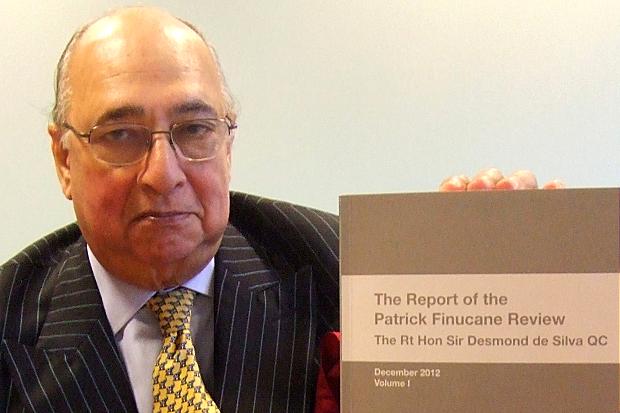
Sir Desmond de Silva with his Review of the Pat Finucane killing
Not least of the spectacles to which De Silva treats his readers is the vision of three major intelligence agencies, MI5, the RUC Special Branch and the British Army’s Force Research Unit expending almost as much energy and rancour fighting each other as they did the Provisional IRA. There have been many government-ordered reports over the years into aspects of security policy in Northern Ireland but none quite as revealing and, in an incestuous way, entertaining.
That said it is not possible to read De Silva’s report without two thoughts forming in the mind. One is that he raises more questions than are answered; the second is that the state of affairs he describes is so disturbing and damning that the death of Pat Finucane cannot, should not be left at this.
Time and time again as I read what this FRU commander, or Special Branch man or MI5 officer claimed in this or that memo or “telegram”, I found myself saying, “Well maybe, but I’d like to see how you deal with Michael Lavery asking you questions about that in the witness box.” The irony of the De Silva report is that while it was conceived in the hope that it would lay to rest forever the demand for a public inquiry into the Finucane affair, the effect and consequence may be quite the opposite.
There is though much wrong with De Silva’s report, much to criticise about his modus operandi for instance, in particular the one-dimensional assumptions upon which it is based, especially in the area of counter intelligence. Then there is his failure to grasp, or maybe refusal to acknowledge, the political context within which the Pat Finucane drama unfolded, a drama that was every bit as secretive as the events surrounding the lawyer’s slaying.
He operates on the assumption, for instance, that counter intelligence (CI) work is just about saving lives, that the FRU or RUC Special Branch recruited agents with the sole aim of intercepting paramilitary operations that could end with people being killed, so that baddies would end up in jail. In the real world of CI, however, such a goal can often be the last thing on the mind of the handler and his bosses.
The other goals of CI can range from manipulating the leadership of an enemy group by advancing the careers of some and derailing the careers of others through to shaping its policies and ideology via agents of influence.
So an agent such as Brian Nelson, the UDA intelligence chief at the centre of the Finucane story, could be used to steer the UDA towards killing IRA targets whose removal would create a vacancy in the ranks and the opportunity for his handlers to slot in their own replacement. Equally, Nelson could have been used to ensure that the UDA did not target IRA activists who were themselves double agents or, as happened in the case of Gerry Adams, political leaders who were taking their organisation in a direction which the State generally approved. Or he could have been used to steer the UDA in a military direction whose political and psychological impact on the enemy, i.e. the IRA, benefited the State.
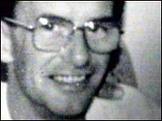
Brian Nelson – UDA intelligence chief and FRU double agent
But in De Silva’s world, Nelson had only one purpose and that was to provide the authorities with information that would stop people being killed and put UDA gunmen behind bars. That, we are told, is why he was recruited and De Silva’s judges much of this whole affair by this metric.
This approach is deficient in a number of ways. To begin with, De Silva’s report is entirely free of political context. When the Force Research Unit and MI5 together vied for Brian Nelson’s services in 1986 and 1987 and made repeated attempts to tempt him back to Belfast from West Germany, the still secret peace process was gathering momentum.
By 1986, Fr Alex Reid had reached out to Fianna Fail leader, Charles Haughey on Gerry Adams’ behalf and a year later would send him a lengthy letter outlining the ways in which the IRA might end its violence. He also made contact with NI Secretary Tom King while a secret British message assured the Republican leadership that Britain had no special interests in Northern Ireland. In the same year, Sinn Fein dropped its opposition to taking seats in the Dublin parliament.
The next year, 1987, Haughey became Taoiseach and began a dialogue with Adams via Fr Reid. Later that year he asks SDLP leader John Hume to take his place thus giving birth to was became known as the Hume-Adams talks. In 1987 also the Eksund gun-running ship was intercepted, effectively ending the IRA’s military option. And MI6 officer Michael Oatley re-establishes contact with Martin McGuinness.
This is the context in which Brian Nelson is wooed by the FRU and MI5 to come back to Belfast to be the UDA’s intelligence chief with the brief to target IRA activists and we are asked to believe that the sole purpose of this was to save lives? How credible is that?
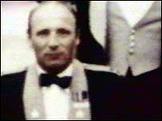
Col. Gordon Kerr, commander of the FRU when Nelson was re-recruited as an agent
We don’t know whether Nelson had any other function, or whether he was used to advance more secret strategic goals and the reason why highlights another key flaw in the De Silva inquiry. De Silva’s report is almost entirely based on documents, a million pages of them he says, produced by past investigations, some led by John Stevens for instance, and voluntarily provided at his request by the security agencies, in particular the Ministry of Defence, MI5 and the Police Service of Northern Ireland.
In his Executive Summary, he writes:
“Although I had no statutory powers of compulsion, I was given access to all the evidence that I sought, including highly sensitive intelligence files.” WIthin that phrase “no statutory powers of compulsion” lies the possibly fatal weakness of his inquiry.
As De Silva himself concedes, the story of previous investigations into Pat Finucane’s killing is one of “serious obstruction” which he himself chronicles in sometimes painful detail. The security agencies involved in this affair, the Force Research Unit, the RUC Special Branch and MI5 regularly lied to each other and their political bosses, forged documents, plotted against each other, engaged in black propaganda, lied to outside investigators and concealed evidence from them. And they even attempted to destroy evidence.

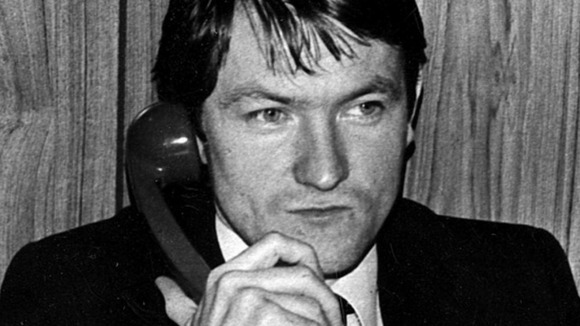
Pat Finucane
With varying degrees of culpability, they perverted the course of justice so egregiously and repeatedly that had you and I done the same, dear reader, we would be eating porridge for breakfast in a small cell for a long time.
But then, all of sudden, we are expected to believe that these same organisations became willing accomplices in the search for truth and happily turned over all the material they were asked for. There is no reason to believe that Sir Desmond de Silva is anything but the most principled and proficient investigator but he was dealing with organisations whose basic trade is deceit, who have have dealt in deceit for years, in MI5’s case for many decades, and whose ability to mislead their political masters is unrivaled – as De Silva’s own account convincingly records.
Notwithstanding De Silva’s praise for his staff who had, he writes, “a vital grasp of the location and content of the million pages of documents which formed the basis of the Review”, I don’t think I am alone in saying that an inquiry with the statutory power to search for and demand all documents and whose dealings in this regard were held in public would instill greater confidence.
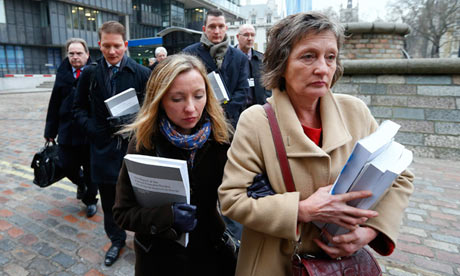
Geraldine Finucane, Pat Finucane’s widow leads her family into court in Belfast to challenge David Cameron’s refusal to hold the promised public inquiry into her husband’s assassination
One more point before I turn to some substantive issues arising from the report. Perhaps the best way to express it is in the form of a question. Was the De Silva inquiry, or review to give it its official name, set up in the knowledge that if instead a public inquiry of the sort demanded by Pat Finucane’s family, fellow lawyers and civil liberties groups had been instituted, it would inevitably touch on the activities of Freddie Scappaticci, or ‘Steakknife’, to give him his Force Research Unit codename? In other words the best way to avoid a public inquiry into the Finucane killing spilling over into the Freddie Scappaticci business was to commission De Silva to lead a document-based review?
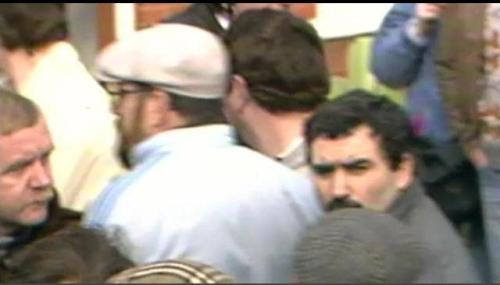
Freddie Scappaticci (wearing dark moustache), FRU double agent and IRA spycatcher – his absence from De Silva’s report makes it Hamlet without the prince.
We cannot answer that question but one thing is sure. Had Scap’s activities as a senior figure and FRU double agent in the IRA’s Internal Security Unit come under a forensic microscope at a public tribunal then Britain’s intelligence establishment would really have something to worry about – and so would their political masters at Westminster.
Scappaticci’s role was to ferret out and kill informers. One account of his activities, in ‘Killing Rage’ by the late Eamon Collins, one of the best books ever about the Provisional IRA, has Scap boasting of personally “nutting” one unfortunate individual who had confessed his treachery. When he was outed as a FRU agent, The Guardian quoted an IRA source as saying about Scap: “He was the bogeyman of the IRA: judge, jury and executioner.” the paper said he may have been involved in 40 murders.
Presumably he killed others and did so with the knowledge and approval of his FRU handlers, for how else could he have survived as a double agent unless he did? The outstanding question is this: was Scap’s role to protect real informers by killing innocents who he either framed or otherwise persuaded to confess? In other word did the FRU, and therefore the British State, connive not just at murder but the murder of the guiltless, so to speak?
By contrast, Brian Nelson was never a trigger-man. He provided intelligence for UDA hits and did reconnaissance work for some killings, including Pat Finucane’s, but he was never involved directly in the wet and messy end of the UDA’s violence.
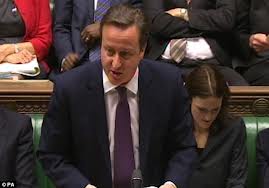
British prime minister, David Cameron tells the House of Commons the results of De Silva’s review. He reneged on a promise by Tony Blair to set up a public inquiry.
And because of that De Silva is able to compose a chapter devoted to the difficulties of agent-handling and involvement in criminal activity which consists of a civilised if somewhat anguished discussion of the ethical cum legal issues and the history of the interminable attempts to resolve them. And so we learn that the military directive governing the FRU’s agent handling says: “All operations are to be conducted within the Law and all members of FRU remain subject to Civilian and Military law at all times”, and “It is unlawful for any person to authorise an unlawful act”. Balderdash, of course, but the bureaucratic equivalent of CYA, a document to point to if things go pear-shaped which they did in Nelson’s case.
The reality, that in practice the FRU directive is nonsense and that double agents must get involved in criminal activity if they are to be of any use to the State is recognised by De Silva who also chronicles the lengthy wranglings of the intelligence agencies and senior bureaucrats to resolve the problem (the name of John Chilcott crops up repeatedly in this section incidentally).
This lies at the heart of the conundrum that has defied the efforts of Britain’s best mandarins to rectify. But at the end of the day no civil servant is going to recommend a set of rules, much less legislation, that makes his or her Minister responsible for murder.
And so in practice, as one ex-RUC officer tells De Silva, the British government’s attitude was “carry on what you’re doing but don’t tell us the details”. As things turned out the IRA’s ceasefire of 1994 came to the rescue and the various civil servants were able to file the whole matter away under ‘To Be Determined’.
De Silva’s discussion meanders on for page after page but because the subject is a UDA double agent who didn’t actually pull any triggers, it all seems relatively harmless. But imagine how different it would be if a public inquiry into Pat Finucane spilled over into the Freddie Scappaticci story and he was confirmed as a double agent who worked for the IRA’s spycatchers who tortured his victims before pumping bullets into their skulls? Imagine the proverbial that would hit the fan if that came out in public, a proverbial that would cover ministerial faces all over Whitehall and Stormont. So much better, then, to ask Sir Desmond de Silva to lead a mostly document-based review of just the Pat Finucane killing
So, Why Was Brian Nelson Recruited By The British?
Brian Nelson twice worked for British military intelligence, that we know of. A Shankill Road Loyalist, he joined the UDA in 1972 two years after being discharged from the British Army and a year later was convicted of brutal torturing and kidnapping a Catholic man who was electrocuted and burned with a blow torch. Nelson was escorting the man from the UDA club where he had been held, presumably to his death, when a passing Army patrol spotted the pair and he was arrested and his victim rescued.
Nelson was jailed for seven years, released in 1977 and in 1984 volunteered his services to the Force Research Unit as a spy. He became the UDA’s intelligence chief in West Belfast. A year later he was offered a job as a floor layer in West Germany and left Belfast, effectively quitting both the UDA and the FRU. Within months the FRU, soon accompanied by MI5, began trying to tempt Nelson back to Belfast to resume his work for the UDA. There was a “desperate need” , the FRU said, for intel on groups like the UDA who were selecting assassination targets on an ad hoc basis.

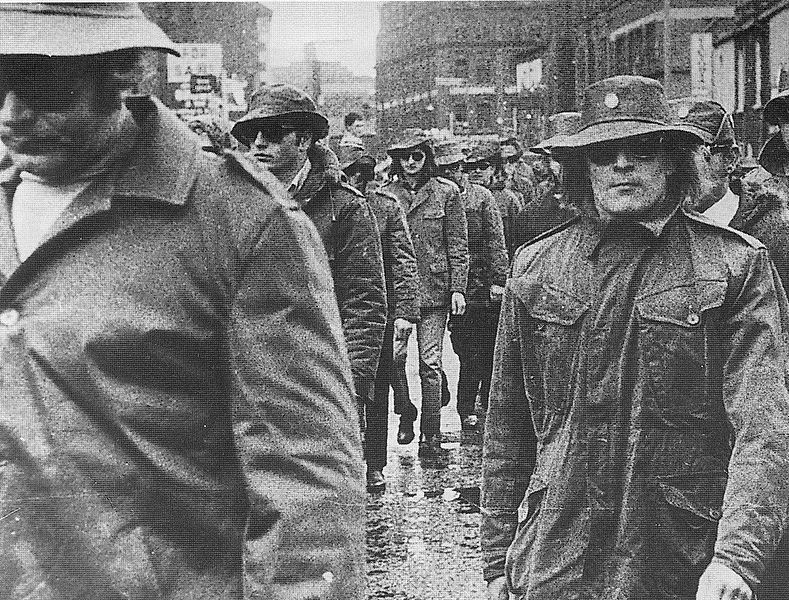
UDA members parade in North Belfast in the early 1970’s
Intelligence on the UDA had gone “downhill” another FRU officer complained in an internal document, not least because Nelson had withheld part of the password to his computer intelligence files and the West Belfast UDA could not access them. Which was, as de Silva noted, perhaps a very good reason to leave him in Germany.
There was another flaw in this argument. According to Lost Lives, the go-to compendium of violent deaths during the Troubles, the FRU’s rationale does not hold up. The UDA’s killing rate during the first half of the 1980’s, just prior to Nelson’s re-recruitment, was at a new low
In fact the worst years of UDA violence were behind Northern Ireland. During the early years of the Troubles, from 1972 through to 1975 the UDA killed scores each year but therafter the killing rate declined. Between 1976 and 1980, for instance, the UDA killed 83 people, an average of 16.6 each year. But between 1981 and 1986, it fell to 18, or an average of 3 for each of those six years. Contrast this to the three years which saw Brian Nelson back in the saddle, from 1987 to 1989. During that three year period thirty people died at the UDA’s hands, an average of 10 each year. The curve arched upwards when Brian Nelson returned to the Shankill and began working for the FRU.
Another way of looking at this is that when Brian Nelson was brought back to Belfast by the FRU and MI5, and the UDA’s intelligence weaknesses presumably rectified, the Loyalist group’s killing rate increased by over 300 per cent. If the aim of the exercise was to diminish the UDA’s ability to kill people by planting an agent in the engine room of death then it was a conspicuous failure.
It is against this background that the rationale for Brian Nelson’s re-recruitment given to De Silva by FRU’s CO, Colonel Gordon Kerr has to be judged.
This is what Kerr told the De Silva Review:
“…we carefully developed Nelson’s case in conjunction with [the RUC Special Branch] with the aim of making him the Chief Intelligence Officer for the UDA. By getting him into that position FRU and SB reasoned that we could persuade the UDA to centralise their targeting through Nelson and to concentrate their targeting on known PIRA activists, who by the very nature of their own terrorist positions were far harder targets. In this way, we could get advance warning of planned attacks, could stop the ad hoc targeting of Catholics and could exploit the information more easily because the harder PIRA targets demanded more reconnaissance and planning, and this gave the RUC time to prepare counter measures.”
This reasoning might make sense if Col. Kerr was speaking in 1972 when 71 people were killed by the UDA, or 1973 when 44 died, 1974 when 41 were killed or 1976 when 50 lives were expunged by UDA bullets or bombs. But in the five year period prior to Nelson’s re-recruitment the death toll was this: 1982 – 1; 1983 – 2; 1984 – 2; 1985 – 2 and 1986 – 6. In 1986, one of the six killed by the UDA was himself a UDA member and another, a Catholic barman allegedly involved in a feud with locals.
Did this level of killing, admittedly unbearable for the victims’ families, have such grave implications for the security situation in Northern Ireland that it warranted bringing Brian Nelson back from West Germany, sparking conflict and rivalry between MI5 and FRU, as De Silva testifies, for his services? Was it sufficiently serious that it justified breathing life back into the UDA’s intelligence machine and help make the UDA, at least on the Shankill Road, a much more efficient killing machine? A year after Nelson’s return from Germany, its killing rate had doubled and the supposed goal of taming the UDA’s killers further away than ever
Surprisingly De Silva takes none of this statistical detail into account when judging Col. Kerr’s explanation for Nelson’s re-recruitment but it seriously undermines the FRU’s case.
In his written and oral explanations to De Silva (more below), Col. Kerr took pains to insist that the FRU’s handling of Nelson was fully compatible with the stated purpose of his re-recruitment. This is what he said:
“It was constantly impressed upon Nelson that any information he passed out should be reported to FRU. Furthermore this so-called ‘proliferation’ was reported by FRU to RUC SB thus giving it the opportunity, if it saw fit, to arrest individuals in possession of the material.”
If this was the theory then the practice, as De Silva fully concedes and details, was very different. In practice Nelson often handed out targeting intel to UDA commanders but while he informed FRU he was doing this he never told them the names of those being targeted, thus rendering the intel useless. Nor does it seem that the FRU ever complained or attempted to rectify the shortcoming.
Furthermore, the FRU encouraged Nelson to disseminate his intelligence on the IRA widely at command levels in the UDA. This flew in the face of the stated claim that Nelson’s recruitment was meant to centralise the flow of intel by placing it in Nelson’s hands, to limit accessibility in other words, so that the FRU and RUC SB could fulfill the claimed mandate of using Nelson to restrict UDA attacks.
The effect of allowing Nelson to hand out his intel would be to encourage and increase the number of attacks or plots against Republicans. The FRU, and presumably the RUC SB and MI5, which had a full-time representative in the FRU office as well as access to their files, would have known this full well. And the manner in which the intel was given out, willy nilly, meant that the FRU and RUC would, in theory and absent informers elsewhere in the UDA, have little idea how it was to be used. The promised “counter measures” would therefore be difficult to organise if not impossible.
To the delight of his FRU handlers, Nelson also gave out intel to the UVF, with whom the UDA sometimes co-operated. This meant, at least theoretically, that control of subsequent events and ability to mount counter measures, were even more out of the control of the FRU.
According to Col. Kerr’s declaration to De Silva, Nelson’s role as a double agent would frustrate and inhibit UDA violence because intel he provided to the FRU would be passed on for action to the RUC Special Branch. So how did that work out in practice? Not very well, according to De Silva.
Summaries of Nelson’s intel that were destined for wider distribution, including to the RUC Special Branch, were known as Military Intelligence Source Reports or MISR’s. This is what De Silva has to say about this subject:
“It is clear to me from my analysis that the FRU generally did pass on to the RUC SB extensive information relating to Nelson’s dissemination of targeting material to the UDA and the UVF. However, the value to the RUC SB of the information contained in the MISRs was severely limited by the fact that they frequently did not include the names of individuals who were being targeted because Nelson had not provided that information to the FRU.”
To this list of breaches of Nelson’s terms of employment can be added two further contradictions. One, conceded by De Silva, was the fact that FRU handlers sometimes passed on targeting intel to Nelson, most notably in the case of Belfast republican Alex Maskey who narrowly escaped assassination after Nelson’s FRU handler had confirmed his car registration. That sort of behaviour was as inconsistent with Nelson’s supposed employment terms as it is possible to be.
The second was that the true number of lives saved by Nelson – and ultimately that is how his success as a double agent must be measured if Col. Kerr’s employment terms were correct – was miniscule. Although Col. Kerr would claim at Nelson’s trial that he had saved over 200 people, De Silva can document only three. One was a Republican target whose life was saved because of the FRU’s fear that Nelson might involved in the hit and thereby be at risk of arrest; a second was an informer and the third was Gerry Adams.
Taken together all this evidence strongly suggests that the stated terms for Nelson’s employment as a double agent were nonsense and that the FRU really hired him to facilitate attacks on and killings of Republicans.
The problem with this is that Nelson was not very good at this or rather that the FRU, for whatever reason, failed to provide him with the wherewithal in terms of intel that would have made the difference. During his two or three years as a double agent, Nelson facilitated four killings, none of whom were actual IRA members, was involved in ten attempted murders, according to De Silva, and numerous conspiracies to murder. Admittedly many of these, like Alex Maskey and Tommy Keenan, were prominent Provos but nonetheless the fact is that had the FRU opened up its intel files to Nelson then the UDA could have cut swathes through the IRA, albeit at the risk of endangering Nelson’s cover.
This, of course, assumes that killing Republicans was the real or only reason for his re-recruitment. By the late 1980’s British intelligence must have been aware of the developing peace process within the Provisional movement and since it was clearly in British interests to shape the IRA’s military and political policy to encourage it, the presence of a double agent inside the UDA would be very useful. He could, for instance, help the FRU prevent the UDA killing Republicans whose deaths would inhibit the process, or remove individuals who were becoming an obstacle to it.
The interdiction of the UDA plot to kill Gerry Adams with a limpet mine in May 1987 falls into this category. The given reasons for saving the SF leader’s life range, according to De Silva, from the fact that he was a sitting MP and his death would cause big problems for the British, to Nelson’s claim that his FRU handler told him that Adams’ death, “would have been totally counterproductive particularly considering the delicate balance of power within Sinn Fein”, a veiled reference to the slow but developing trek towards the 1994 IRA ceasefire.
Whatever the truth, the fact remains that saving Adams’ life alone made Nelson’s re-recruitment worth it to the British, given Adams’ key and creative role in leading the Provos towards the Good Friday Agreement a decade or so later.
While it is true that not many IRA members were targeted much less killed with Brian Nelson’s help, it is arguable that his real contribution was to effect a cultural change in the targeting policies of Loyalist paramilitaries whose goal was to accelerate the Republicans’ journey towards the 1994 IRA ceasefire. In that respect his recruitment greatly assisted British policy.
The remaining question is whether this was intentional or an unintended consequence of his re-recruitment by the FRU. It is not a feature of the Brian Nelson story that De Silva deals with at all, not least because his Review is mostly devoid of the political context, particularly the hidden one.
UDA targeting had gone through two distinct phases before Brian Nelson’s return to Belfast. In the 1970‘s the UDA, like the UVF, set out to kill Catholics indiscriminately. In 1980 there was a subtle change when the UDA began targeting what it termed the IRA’s “cheerleaders”, people like Bernadette Devlin, John Turnly and Miriam Daly.
But by the late 1980’s both the UDA and the UVF were targeting Republican activists on a sustained basis, as De Silva acknowledges: “By the late 1980’s many paramilitaries had installed security doors and alarms at their homes to provide a degree of protection”. Loyalists had always tried to kill Republicans if possible but these were largely opportunistic events. Post 1987, targeting Republicans became more willful, planned and constant.
And they were doing this to push the IRA and SInn Fein further and faster down the road towards the peace process. In his interviews with Boston College the UVF and PUP leader David Ervine described how his own group, the UVF, went down a road that had recently been charted and facilitated by Brian Nelson and the FRU:
“I think the biggest change came in, it had to be about 1989, with the creation, at the behest of the UVF, of a kitchen cabinet (with the PUP)…part of that kitchen cabinet discussion was about how you escalate the war to end the war…There would be many people within the UVF who had always felt that the only way to carry out a campaign was incisively and with stealth and absolute precision. They didn’t always have their way and the emotion and anger and opportunities sometimes mitigate against that, but (eventually) they seemed to have their way and there was a deliberate attempt to identify very specific targets. It was about trying to damage the Republican movement……and I think it did create a huge fear factor in Republicans, forcing them behind their steel doors…it was getting home because they were suing for peace”.
Later the various Loyalist groups came together to co-ordinate this military policy.
I can bear personal testament to the impact this targeting by Loyalists of Republican activists had. The western shore of Lough Neagh where east Tyrone and south Derry share access to Ireland’s and the British Isles’ largest freshwater lakes, famed for its eel fisheries and place in Celtic mythology. It was also one of the IRA’s toughest strongholds during the Troubles and played a vital role in the military struggle against the British.
In the late 1980’s through to the IRA ceasefire of 1994, the IRA in East Tyrone and the wider republican community came under a determined onslaught from two directions. The British Army’s elite counter terrorist unit, the Special Air Service (SAS) mounted repeated ambushes on IRA units, wiping out the cream of the IRA’s active service units and demoralising the rest.
At the same time Loyalists, led by UVF units from Tyrone and nearby north Armagh, targeted Republicans, both IRA and SInn Fein, mounting night-time assassinations, often based on excellent intelligence and spreading fear and panic within the activist community.
During one journalistic visit to the area during these years I called into the homes of two IRA families on the Loughshore, as the area is known locally. One had just installed the security measures referred to in De Silva’s Review and they were extensive. A metal grill door fixed to iron beams had been erected in the porchway meaning that if an attacker got through the front door, this would be an additional obstacle.
The grill door was locked up last thing at night as was a second grill door at the foot of the stairs. What was unusual about the second door was the way this was secured. The couple would retire to their bedroom and then lower two heavy metal beams down through specially made holes in the floor which would then slot into brackets holding the grill door in place downstairs. That way the door to the stair leading to their bedroom would be able to resist sledgehammer blows. They went through this ritual every night knowing that otherwise they might be shot dead in their beds.
When I visited the second family I discovered they had moved home and with good reason. A close relative had been shot dead in his kitchen by the UVF and the family reckoned their rural home was just too isolated to be safe. So, seeking greater safety in numbers, they moved to a nearby village where their new house was also fitted with metal grill doors. I sat drinking with the husband while the wife retired to bed. After some time I excused myself and made my way to the bathroom and on the way passed the couple’s bedroom. Through the door I could hear his wife having a nightmare. “Don’t shoot! Don’t shoot”, she cried.
There is no doubt in my mind that this Loyalist campaign was hugely important in spurring Republicans on the journey towards the IRA ceasefire of 1994 and subsequently the Good Friday Agreement of 1998, a deal which Loyalists like David Ervine welcomed as a defeat for the IRA. The terror induced by the Loyalist campaign, boosted by the fact that it was clearly based on accurate intelligence, produced a pro-peace mindset amongst many Tyrone republicans who otherwise would instinctively oppose the compromises that peace demanded and which their leaders now sought.
In all this, Brian Nelson can be considered a trailblazer. Was this serendipidity, a twist of fate, or was it intended? The jury is still out. But it is an interesting coincidence.
Did The FRU Know That The UDA Was Planning To Kill Pat Finucane?
While Desmond de Silva unequivocally finds the intelligence agencies guilty of collusion with Loyalists in the killing of Patrick Finucane, British prime minister David Cameron’s sense of relief was almost tangible when he stood up in the House of Commons, a fortnight or so before Christmas 2012, to tell fellow MP’s: “Sir Desmond is satisfied that there was not ‘an over-arching State conspiracy to murder Pat Finucane’”. This was the verdict the British government and security establishment had been hoping for (or even expecting?).
De Silva was able to come to this conclusion partly because he was able to show ignorance on the part of government Ministers of Brian Nelson and his relationship and work with the Force Research Unit (an ignorance of the activities of their underlings and the way they went about this type of work that was in its own way a disgrace – see below).
But it was also because De Silva took the crucial step of siding with the FRU, and therefore the British military establishment, on the critical question of FRU foreknowledge of the UDA plan to target and kill Pat Finucane.
Show that the FRU did know beforehand and the implication is that they allowed it to happen, and did so in a way that was far more proactive than the RUC Special Branch or MI5. Demonstrate that the FRU implicitly approved the Finucane assassination and responsibility is shared by MI5, who were privy to everything the FRU did and wrote down, and by FRU’s immediate military superiors at NI headquarters, the Commander of Land Forces and the GOC, and their bosses in the Ministry of Defence. Ultimately the buck would then stop at Ministerial level in the Home Office and Defence ministries if only because such a conclusion meant they had no control over their own departments. The repercussions would be devastating.
Absolving the FRU was arguably the most significant and consequential part of the De Silva Review for by so doing he really exonerated the British security establishment of any responsibility for activities usually associated with South American juntas, instead laying the blame for what happened on a dead man who cannot answer back. At the end of the day the extent of British government responsibility for the killing is what the Pat Finucane affair is all about.
There is, as I have written before, much in the De Silva review to commend it. His report offers an unprecedented glimpse into the world and working of organisations that have remained hidden for the length of the Troubles. It is a fascinating, interesting and valuable document but at the end of the day De SIlva’s Review will be judged on this one conclusion and the evidence he presents to support it.
By absolving the FRU of foreknowledge and thus responsibility, De Silva puts himself at odds with John Stevens’ inquiries which concluded the opposite, that British military intelligence was aware that the UDA was planning to kill the lawyer. The former head of the Metropolitan police, now a member of the House of Lords, conducted three separate inquiries, from 1989 through to 2003. In 2002, some of his detectives were cleared to give on the record interviews to BBC Panorama, which broadcast a two-part documentary, ‘A Licence To Murder’, in June that year. The following is an exchange between the reporter, John Ware and one of the Steven’s team:
WARE: When you came to examine the FRU files what struck you about the Finucane case?
NICHOLAS BENWELL Detective Sergeant, Stevens Enquiry, 1989-94: The lack of any information or intelligence that was in there. It was almost like it was a non-event.
WARE: Let me have a clear answer on this. Did the Stevens Enquiry come to the conclusion that military intelligence was colluding with their agent to ensure that the Loyalists shot the right people?
BENWELL: Yes, that was the conclusion that we came to.
WARE: So do you find Colonel Kerr’s insistence that neither the FRU nor Nelson knew that Patrick Finucane was going to be shot or was being even targeted, do you find that believable ?
BENWELL: No.
The Stevens’ team had come to this conclusion from an exhaustive investigation of the FRU’s activities but they had also interviewed Brian Nelson at length, extracting a statement that was in the region of one thousand pages long, according to the same Panorama report. Here is what Nelson told Stevens about his dealings with the FRU over the Pat Finucane killing:
“I would like to state that all information concerning the Finucane affair I passed on to military intelligence through my handlers. At no point did I ever conceal or withhold any information that I was party to from them.”
When questioned by the Stevens’ team, Nelson went on to give details of his part in the UDA plan to kill Pat Finucane. The UDA’s military commander in West Belfast, Eric McKee – known as L/28 in De Silva’s report – asked Nelson to locate the address of Finucane’s law office (which he claimed he failed to do) and later gave McKee a photograph of Pat Finucane, although he claimed it was really his client, former IRA hunger striker Pat McGeown, also pictured in the photo, that the UDA was interested in. Later, while in jail awaiting trial, Brian Nelson wrote a journal describing his life as a FRU double agent in which he repeated these details.
Nelson appears to have attempted to minimise the full extent of his role in helping the UDA plan the Finucane hit but intel collected by MI5 strongly suggested that he had done a reconnaissance of Pat Finucane’s home with a senior UDA figure, possibly Eric McKee, a fortnight or so before the lawyer was killed. Nelson’s immediate boss in the UDA, Tommy Lyttle, who was the organisation’s ‘supreme commander’ at this point, told the same to BBC reporter John Ware.
So Nelson told Stevens and wrote in his journal that he had known about the UDA targeting of Pat Finucane and that he had told this to his handlers in the FRU; his UDA boss Tommy Lyttle confirmed Nelson’s role to the BBC and MI5 had its own intel that Nelson scoped the Finucane home.
Despite this, De Silva comes down on the side of FRU commander Col. Gordon Kerr and says that the FRU did not know beforehand that the UDA was targeting Pat Finucane. Because of this ignorance, the FRU could not have saved his life by alerting the RUC and was therefore not responsible for his death. And so the British state is exonerated of the main charge against it.
So how does he do it?
When Nelson phoned his handler in the FRU or met her in person to pass on intelligence, a record was kept of the meeting, what De Silva called “exceptionally detailed contemporaneous documents recording a wealth of intelligence passed by Nelson to his handlers”. The documents were called Contact Forms (CF’s) or Telephone Contact Forms (TCF’s). It is these documents that De Silva cites to exculpate the FRU and thus the British government.
According to De Silva there is no reference in any CF’s to the UDA targeting of Pat Finucane in the lead up to the assassination and he speculates that Nelson may have lied about telling his handlers to minimise his culpability. The problem with this is that if it was true that Nelson had not briefed his handlers then of all people, Nelson would have known how easily disprovable his claim was and therefore how more incriminating being caught out lying would be.
But there are references to the Finucane killing in the days and weeks afterwards and it is these CF’s that, in De Silva’s eyes, absolve the FRU – they confirm Brian Nelson as a self-serving liar while providing contemporary documentary evidence that seemingly clear the FRU.
The first substantial conversation about the murder between Nelson and his handlers took place on February 14th, 1989, two days after the shooting and of all the CF’s De Silva cites, this is probably the most exculpatory. It leads the barrister to this conclusion: “I am firmly of the view that in this instance Nelson withheld critical information from his handlers.” You can read the CF, which has been heavily redacted, below:
The 14th Feb CF begins by baldly claiming that Nelson was unaware of the targeting of Pat Finucane, that he “seems to be left out of major operations only finding out about them after the event”. His handlers go on to complain that Nelson was reluctant to get too closely involved in anything “that might complicate life for himself or his family they recommend a “boss meet”, i.e. a meeting with a senior FRU officer to vitalise and motivate him.
What jumps out from this commentary is that Nelson has been working for the FRU for almost exactly two years but it is at this point, just after a hugely controversial killing, that the FRU realise their agent is not exactly on the ball and needs bucking up. Admittedly, De Silva cites earlier instances where the same complaint was made about Nelson within British intelligence circles but why no corrective action until now, at a most convenient point? One would have expected this comment to be accompanied by context, like a mention of the same problem appearing before. But it’s not there.
The CF then goes on to record that Nelson had been admonished for phoning his handler the morning after Pat Finucane’s killing to tell the FRU that the UDA had been responsible when he hadn’t known for certain that this was the case. De Silva says that this comment by the FRU supports the view that British military intelligence believed Nelson’s claim that he had been kept out of the loop. The interesting thing about the phone call is the lack of surprise in the response of Nelson’s handler when he passes on the intel.
So the Feb 14th CF establishes the FRU case that Nelson had not been party to the Finucane killing because people like Eric McKee were keeping him out of the loop. Nelson is lying, of course, but the FRU is telling the truth – that is what this part of the CF is saying.
The CF then goes on to claim that in the days before Pat Finucane was killed Nelson was asked for a photograph by Eric McKee but it was Pat McGeown, Nelson says, that the UDA was really interested in, not Pat Finucane. But the picture he provided was one of McGeown leaving Crumlin Road courthouse in Belfast in the company of Pat Finucane and as De Silva correctly notes, Nelson had many better photos of Pat McGeown in his intel dump but only one of Pat Finucane, the photo he handed over to Eric McKee. So clearly the real target was the solicitor and Nelson is again confirmed as a self-serving fabricator.
Other Contact Forms repeat the same theme, that Eric McKee kept Nelson out of the loop and that Nelson was withholding intel from the FRU, especially about Finucane.
And so, De Silva concludes:
“I should note at this stage that I consider the FRU CFs to be critical sources of evidence regarding Nelson’s activities. The CFs are exceptionally detailed contemporaneous documents recording a wealth of intelligence passed by Nelson to his handlers.
“Although the CFs were withheld from Sir John Stevens for a considerable period of time, I have not found any evidence to suggest that they were doctored to remove incriminating material.
“Indeed, as Chapter 7 demonstrated, many of the CFs contained material that was highly damaging to the FRU, including direct admissions that targeting information was passed to Nelson by his handlers. In these circumstances, it seems inconceivable that there was a attempt to amend the content of the CFs, since this damaging material would surely have been altered or deleted.”
There are several interesting not to say intriguing aspects to this statement. Yes, it is true that many of the CF’s damage the FRU and make the unit look bad but if I was concocting or doctoring these documents, or at least those parts dealing with Brian Nelson and Pat Finucane, I would make sure that they were damaging to the FRU because that is precisely how best to enhance credibility. Nothing would raise suspicions more than CF’s which painted the FRU in clean, white colours.
Not least of the points in De Silva’s remarks that jump out is the suggestion that FRU CF’s may have been “doctored”, or rather that De Silva felt it necessary to deal with the allegation and refute them. The way that he does so reveals the Achilles Heel of his Review and a persuasive
He had to do that because there has been an allegation, a detailed one in fact, from a FRU whistleblower, that the Contact Forms were indeed doctored to remove any material that linked the FRU to the Finucane killing.
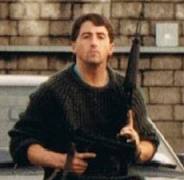
Ian Hurst, FRU agent handler turned whistleblower
Ian Hurst first emerged under the nome de contato of ‘Martin Ingram’ in the late 1990’s when he began making allegations that an IRA double agent codenamed Steakknife (later altered for legal reasons to Stakeknife) had been given a licence to kill by the Force Research Unit. Eventually, after the journalistic equivalent of a dance of the thousand veils. Steakknife was revealed to be Freddie Scappaticci, a Belfast IRA veteran and member of the IRA’s Internal Security Unit, the so-called “nutting squad” which searched out and killed British informers in the ranks.
Hurst/Ingram served two tours in Northern Ireland between 1981 and 1990 as an agent-handler for the FRU. He was based in Fermanagh in the FRU’s South Det and in Derry in the West Det and in both places ran agents. His information about Brian Nelson and the FRU is second-hand. He claims to have had conversations with FRU soldiers involved in the handling of Brian Nelson, in particular Nelson’s handler at the time of the Finucane killing, an officer called A/04.
The key piece of information that Hurst says he was told by A/04 is this:
“In January 1990 I remember [A/04] explaining to me that in relation to Nelson he would be spending several months sorting the CF’s out as there were a few problems and there needed to be a few subtle changes made to the CFs.” In his statement to the Stevens inquiry, Hurst said that A/04 “would be required to travel from Fermanagh to Lisburn for this reason”.
Ever since governments began establishing tribunals to investigate embarrassing allegations against themselves – and most times with the aim of dismissing them – a standard procedure has evolved to deal with whistleblowers and it is this: identify a weakness, a character defect in the whistleblower or an error in his/her story, magnify it and then cite it as a reason why everything the whistleblower says has to be suspect and should therefore be dismissed. And it usually works because it is in the nature of whistleblowers to be flawed characters who often get details wrong or allow their enthusiasm for exposing wrongdoing to distort their judgement.
The British are not alone in doing this. Bradley Manning’s sexuality, shyness and lack of social skills and other inadequacies have been highlighted by some in the US media as reasons to doubt or question his motives for leaking classified material to Wikileaks. If the US media operates anything like its counterparts in Britain and Ireland, you can be sure the federal authorities’ hand was at work somewhere in the denigration of Manning.
Fred Holroyd, a British military intelligence officer who in the 1980’s alleged collusion between the British Army and Loyalist paramilitaries was described thus, by Mr Justice Barron in his report to the Irish government on the 1974 Dublin & Monaghan bombings: “There are many reports on him suggesting that he is a Walter Mitty type. That is probably the easiest way of explaining it…” Well, I met and interviewed Holroyd at length and Walter Mitty he was not. In fact in the light of the Brian Nelson affair his allegations now seem uncontroversial.
(ADDED March 24th – There was this interesting piece in the London Independent yesterday about whistleblowers which highlights how brave they often are, what huge risks they take and how much they must sometimes pay for their allegiance to the truth in terms of career damage, financial cost and social opprobrium.)
In the case of Brian Nelson, the FRU and the assassination of Pat Finucane neither Ian Hurst nor Sir Desmond de Silva are exceptions to this rule. Hirst has made allegations that seem suspect, like the claim that there were three plots against Finucane’s life in the space of six months. Except that there were three plots but they were spread out over eight years, one in 1981, one in 1985 and the final,fatal one in 1989. De Silva also cites the fact that Hurst never worked in East Det, which ran Nelson, that his credibility was questioned by the Saville Tribunal into Bloody Sunday and that he, De Silva, never found any evidence to suggest the CF’s were doctored as justification for saying this about Ian Hurst:
“Given his general lack of credibility, I do not attach any weight to his allegations with respect to the FRU and the murder of Mr Finucane.”
Well maybe, but let’s see how the FRU and their bosses in the upper reaches of the British Army and Ministry of Defence measure up in the credibility stakes.
Here’s a list:
1. Sir Desmond de Silva gave the commander of the FRU, Col. Gordon Kerr the opportunity to submit a written paper to his Review and also allowed him to give an oral submission. Ian Hurst was given no opportunity, either in writing or verbally to defend his statements on the Pat Finucane killing;
2. The FRU lied about the reasons for re-recruiting Brian Nelson. They claimed he had been hired to redirect the UDA towards more complex attack on Republicans so that the RUC would find it easier to arrest their gunmen. No-one was arrested much less jailed because of Nelson’s intelligence and information passed from the FRU to RUC Special Branch often omitted the names of IRA members being targeted by the UDA on the basis of Nelson’s intel;
3. The FRU’s immediate superiors at British Army HQNI lied to the Stevens inquiry at the outset of their investigation, telling detectives that the military had no agent-running capability in Northern Ireland;
4. The FRU withheld their CF’s dealing with Brian Nelson from the Stevens inquiry for the best part of a year, more than sufficient time to “doctor” their contents, as Ian Hurst alleged;
5. When the Stevens team arrived in Belfast in the autumn of 1989 to investigate allegations of collusion between Loyalists and the security forces, the FRU took Nelson’s intel dump away from him in case Stevens discovered it and realised that much of his intel had come from the FRU;
6. When the Stevens team demanded the FRU’s CF’s, they were drip fed information that had been vetted by the military first. To obtain the original documents the Stevens team had to threaten to arrest the British GOC in Northern Ireland, Lt, Gen Sir John Walters;
7. Stevens’ detectives have made no secret of their suspicion that a fire in their Belfast offices was deliberate, was intended to destroy crucial evidence and had been set by the FRU. When Stevens detectives tried to phone for help they discovered the phones had been disconnected. The fire alarms did not work either. These were the responsibility of the RUC, suggesting the police may have also have had a hand in setting the fire;
8. The fire was set just before the Stevens’ team was about to make arrests of Loyalists including Brian Nelson. The FRU tipped off Nelson and he fled to London but eventually returned and was arrested;
9. The British Army and the Ministry of Defence lied to Defence Minister Tom King and to British prime Minister John Major. King was told by Britain’s military elite, a group that included the Chief of the General Staff, General Sir John Chapple and a bevy of senior army officers and mandarins from the MoD:
“Agents were regularly briefed not to commit crimes. Indeed ACOS G2 pointed out that FRU records have shown Nelson to have been regularly reminded not to become involved in criminal acts.”
This was a blatant lie. Prime minister John Major was briefed by Charles Powell, his private secretary that Nelson had been recruited:
“…with the purpose of saving the lives of those targeted by the UDA. This he appears to have done with considerable success……..he [Nelson] has saved a large number of lives by his activities.”
Again a blatant lie. De Silva, and John Stevens could find only two or at most three lives that Nelson had saved. The FRU claim, made by Col. Kerr, that he saved over 200 was a fiction, another lie to add to the long list.
So, dear reader, faced with a choice between Ian Hurst and the assorted bloc of FRU, British commanders and MoD mandarins, who would you choose to believe? Sir Desmond de Silva chose the people whose lies, obstructions and attempts to destroy evidence and pervert the course of justice he had meticulously charted. Ian Hurst he dismissed as a Walter Mitty.
As a journalist, it is not my job to choose between them but I can make a suggestion. Let’s have a proper public inquiry where we can test all these people and their claims under the glare of a public spotlight and the pressure of forensic interrogation.














 The Broken Elbow
You must be logged in to post a comment.