New US Envoy On NI’s Past Means Boston College Case Must Be Suspended

Following the appointment of former diplomat Richard Haass as new US special envoy to Northern Ireland, Ed Moloney and Anthony McIntyre call on the American and British authorities to suspend attempts to subpoena IRA interviews from the Belfast Project archive at Boston College until Dr Haass has completed his task of outlining an agreed and effective way to deal with the past.

They also call on the PSNI to similarly halt its criminal investigation of the Jean McConville disappearance.

We welcome the appointment of Dr Haass and hope that he succeeds in his task of creating a mechanism for dealing with the past that is not based on unconditional prosecutions. Pursuing the past by treating it as a series of crimes will deter and obstruct the search for truth while keeping the conflict alive in another guise. Failing to deal with the past in a way which neutralises it means that it will continue to haunt both the present and the future.

At the same time it is incumbent upon all parties to the conflict, paramilitary and security forces, from leaderships down to rank and file to commit themselves unalterably to the truth and make their records available to any investigatory process set up as a result of Dr Haass’s efforts. There must be openness and an end to implausible life stories. The dead and maimed of Northern Ireland deserve better.

Menendez Fires Volley Across British Bows On Boston College Archive

Senator Robert Menendez, chairman of the Senate Foreign Relations Committee and one of the most powerful Democrats in Congress has dramatically intervened in the Boston College subpoenas case by outlining a series of conditions that he says the US should impose if any further interviews from the Belfast Project archive at Boston College are handed over to the Police Service of Northern Ireland (PSNI) on foot of British subpoenas.

Senate Foreign Relatons Committee chairman Robert Menendez

Senate Foreign Relatons Committee chairman Robert Menendez

Menendez’s intervention came in the wake of the Boston-based First Circuit Court of Appeal’s June decision to impose separate limitations on the handover – reducing the number of interviews scheduled for handover from 85 to 12 – and only days after PSNI detectives had traveled to Boston to pick up tapes and transcripts of interviews made by the late Dolours Price, a former IRA member who in media interviews last autumn claimed to have helped ‘disappear’ alleged British Army informer Jean McConville in 1972.

The conditions outlined by Menendez were made in a letter sent to Secretary of State John Kerry on June 28th but only released last night to the media and they are sure to provoke controversy and opposition in some quarters in both parts of Ireland not least because the Senator lays claim to a US stake in the peace process and Good Friday Agreement in Northern Ireland.

He wrote: “Our country made a significant diplomatic investment in resolving ‘The Troubles’ in Northern Ireland. It would be a terrible error of judgement if the United States was not to engage now in the due diligence necessary to protect our investment in this hard-won peace.” With this language the Senate leader is saying unequivocally that the US has an interest in the possible negative effect on the peace process of handing over the Boston College tapes.

Secretary of State John Kerry

Secretary of State John Kerry

Menendez makes two important demands of Kerry and the Obama administration. One is that the State Department should vet the interviews scheduled for handover to determine whether their release would damage inter-communal relations or be counter to US national interests. He went on: “I share the concerns of many in the Irish-American community who have asserted that the nature of this request raises doubts about the wisdom of the British government’s Northern Ireland policies.”

But it is his second demand that will anger some in Northern Ireland. He says that the US should invoke a clause in the Treaty with Britain which allows for the transfer of the interviews only for purposes which the US approves and has given consent to.

This clause would allow the United States to bar the British authorities from releasing the interviews for civil proceedings. Although Senator Menendez does not go into detail it is clear that the effect of this condition would be to stop the family of Jean McConville from suing Gerry Adams or any of the interviewees in a civil court, an outcome the family and their supporters have openly admitted is something they hope to see happening.

In a short statement Boston College campaigners Ed Moloney and Anthony McIntyre welcomed Senator Menendez’ intervention and said they hoped and expected to see his letter soon translated into action.

Here is the full text of Senator Menendez’s letter:

The George Blake Prison Escape: An Interesting If Troubling Postscript

By Ed Moloney and Bob Mitchell

As regular readers of this blog will know The Broken Elbow published a piece recently suggesting that the Irish judiciary’s treatment of a famous British prison escape involving a notorious Soviet spy might hold out hope for NSA whistle blower Edward Snowden in the event that he was arrested at Shannon airport en route to South America and then faced extradition proceedings in Dublin.

The piece was prompted by a report that the US had sent an arrest warrant for Snowden to Dublin in case the former NSA spy chose to travel through Shannon to Cuba.

Edward Snowden

Edward Snowden

Just to recap: the spy was George Blake, an MI6 officer whose activities on behalf of the KGB were uncovered in 1961 and he was sentenced to 42 years in jail. Sent to Wormwood Scrubs he befriended there a colourful Irish criminal by the name of Sean Bourke who, angered at the savagery of Blake’s sentence, resolved to help him escape.

This he did in October 1966 and Bourke then drove Blake in a van to East Germany from where the pair then made their way to Moscow. After a year and a half in the Russian capital, Bourke decided to return to Dublin whereupon the British asked the Irish government to extradite him to the UK to face charges of helping Blake escape.

A British mugshot of George Blake

A British mugshot of George Blake

The case ended up in the Dublin High Court in 1969 where the presiding judge decided that the escape was a political offence and therefore excluded from the extradition treaty with Britain. The precedent is an encouraging one for Snowden in the event that he ever gets arrested at Shannon.

The George Blake-Sean Bourke saga did not end however with the Irish High Court decision. What happened next can now be told thanks to some detective work at the British government’s archives at Kew by my resourceful colleague Bob Mitchell.

But before telling that story some background is necessary. The Troubles in Northern Ireland erupted not long after Sean Bourke walked out of the Dublin court a free man and as the violence North of the border intensified the problems mounted for the Irish government then led by Jack Lynch, whose Fianna Fail party claimed the heritage of militant if constitutional Irish republicanism.

Fianna Fail (FF) arose out of opposition to the 1921 Anglo-Irish Treaty which inter alia partitioned the island into two states, one of which, Northern Ireland, stayed British. The anti-Treatyites in the IRA took up arms against the settlement, a short but vicious civil war followed and out of the ashes of the defeated republican ranks arose Fianna Fail, founded by Eamon de Valera and committed to the reunification of Ireland.

Jack Lynch with Margaret Thatcher in 1979 just before Charles Haughey took his job

Jack Lynch with Margaret Thatcher in 1979 just before Charles Haughey took his job

The mantle of de Valera’s inheritance did not sit easily on Jack Lynch’s shoulders however. He preached the gospel of compromise with the Northern state and met several times with the Unionist leadership at Stormont in an effort to normalise relations between the two entities. Not everyone in FF was happy with that approach. A civil rights movement was highlighting Unionist discrimination of Nationalists in Northern Ireland while the police and Loyalist mobs were opposing its marches and demonstrations with more and more violence. As the North slid towards the precipice and it was clear that Ireland was facing the gravest crisis since the Anglo-Irish war, some in Fianna Fail began reaching for the pikes hidden in the thatch.

In the summer of 1969, Northern Ireland exploded as Loyalist mobs went on a rampage of killing and burning in Nationalist areas of Belfast and Jack Lynch’s cabinet was soon rocked by scandal. What exactly happened is still a matter of strong contention but the allegation is that some of Lynch’s ministers, led by Charles Haughey, conspired to use government resources to arm some Nationalists north of the Border so that they could defend their districts and even held talks with the IRA in a bid to persuade it to leave the Southern government alone and instead concentrate its firepower North of the Border. It was never clear whether the arms were to be used solely for defense or also to take on the Northern security forces.

The affair, christened ‘The Arms Crisis’ when Haughey and several of his allies faced but were acquitted of criminal charges arising from the episode, would define and divide both Fianna Fail and much of Irish politics south of the Border throughout the Troubles. That alongside the fear that gripped the political establishment in Dublin after ‘Bloody Sunday’, that the wave of anger that surged through Ireland at the killings by British soldiers would spread, feed support for the Provisional IRA and destabilise the southern state, led the Lynch government to adopt a conciliatory and co-operative stance towards the British on Northern Ireland and aggressive hostility to the Provisionals.
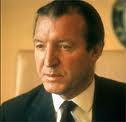
Charles Haughey, pictured around the time of the Arms Crisis

Charles Haughey, pictured around the time of the Arms Crisis

It is arguable that two figures symbolised this rift in mainstream Southern Irish politics. One was Charles Haughey who staged a remarkable recovery from the arms scandal to lead Fianna Fail and was three times Ireland’s prime minister from the late 1970’s to the early 1990’s. His periods as the state’s political leader are notable for a much more aggressive Nationalistic and aggressive tone with the British as well as antagonism towards opposition politicians who favoured a more accommodating approach to the British and Northern Unionists.

Two in that latter category stand out; one was Conor Cruise O’Brien and the other Garret FitzGerald, both men noted for their loathing of Irish republicanism in general and Charles Haughey in particular.

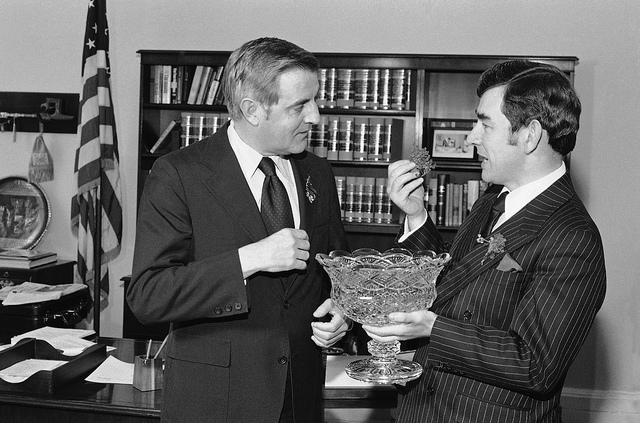
But for the sheer longevity and intensity of a shared hatred no-one can rival Sean Donlon, a diplomat in Ireland’s Department of Foreign Affairs, a former ambassador to Washington and a key architect of much of the Irish state’s policy, sans Charles Haughey, on Northern Ireland. He is credited with, for instance, moulding establishment Irish-American opinion against the IRA and created the so-called ‘Four Horsemen’ of Ted Kennedy, Tip O’Neill, Hugh Carey and Daniel Moynihan to advance Ireland’s interests in America.

Sean Donlon on St Patrick's Day, Washington DC meeting VP Walter Mondale - note the vase of shamrock

Sean Donlon (right) on St Patrick’s Day, Washington DC meeting VP Walter Mondale – note the obligatory if cliched vase of shamrock

Tellingly, Donlon later described his mission to Washington in these terms when Jack Lynch made him ambassador:

When telling me of my appointment, the then Taoiseach (prime minister), Jack Lynch said that the priorities in my mission were, firstly, to do everything possible to reduce US financial, political and logistical support for the Provisional IRA and, secondly, to work closely with the IDA to secure US investment in Ireland.

I was searching around for material to describe the intense rivalry and mutual detestation that characterised the Haughey-Donlon relationship when I came across this article posted on the Slugger O’Toole blog by former BBC journalist Brian Walker. I decided that nothing could better illustrate what was in my mind than this piece because it also introduced another key element of the story, the fact that the mainstream media took sides in this quarrel and overwhelmingly they plumped for Donlon – which, of course, is no surprise. Walker’s prose is quite extraordinary and he makes no apology at all for using the most emotive and unbalanced language throughout his article. It is a salutory reminder that when it comes to the David Gregory’s of journalism, Ireland is no slouch.

(Incidentally the article illustrates an important feature of Irish government policy-making in the US, which is that when it came to grassroots Irish-America as opposed the inside the beltway Irish-America, they really didn’t have a clue what they were talking about. The Irish National Caucus mentioned in the article is described as a supporter of IRA fund-raising and this, argued Donlon, made Haughey’s plan to support the group so dangerous. In fact the INC and the Provos’ money raising machine in America, Noraid, were at daggers drawn most of this time, and arguably ever since, precisely because the INC was a rival for IRA money. A sensible policy then would have been to boost the INC since the IRA would be the loser. But such subtlety was completely lost on the diplomats.) Anyway here is the Brian Walker article:

Anyway, before Sean Donlon was sent to Washington he was a counsellor in the Anglo-Irish division of Foreign Affairs and part of his job, in fact a big part of it was to journey Northwards to Belfast, Derry and various rural spots on a regular basis to talk to contacts face to face. These ‘travellers’, as they were known, also made sure to keep in touch with correspondents from the Dublin media as they were often valuable sources of gossip and confirmation.

So it was that Sean Donlon and Sean Bourke crossed paths on the evening of November 21st, 1972 in the company of Ciaran McKeown at the Wellington Park hotel, a favourite watering hole in South Belfast then as now for members of the moderate Northern Nationalist party, the SDLP. McKeown was correspondent for the Irish Press, now sadly no longer with us, but he went on to be one of the trio of Peace People leaders in the mid-1970’s alongside Betty Williams and Mairead Corrigan.
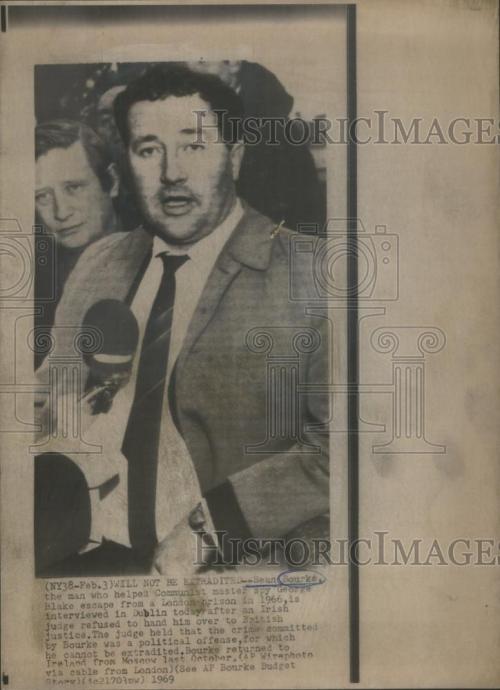
Sean Bourke - Irish court refused to extradite him to Britian because his offense was political

Sean Bourke – Irish court refused to extradite him to Britain because his offense was political

Ciaran McKeown in his Peace People days, flanked on his right by Mairead Corrigan and on right by Betty Williams

Ciaran McKeown in his Peace People days, flanked on his right by Mairead Corrigan and on left by Betty Williams

Anyway, I will leave the telling of the story of that night to Sir John Peck, the British ambassador to Dublin in 1973 and a figure who is known in British Foreign Office circles as an important sponsor of anti-Soviet black propaganda during the Cold War, as the linked obituary reveals. He helped set up the Information Research Department which later played a somewhat sinister and secretive role in Northern Ireland. He told the story of the night Sean Donlon met Sean Bourke by way of an official telegram, which made its way through bureaucratic channels to the desk of then British prime minister Ted Heath. Here is the Peck telegram (note he mistakenly has McKeown working for the Irish Independent):

Peck’s telegram was read by Heath and his response and the result of it can be read in this letter sent from his private secretary Christopher Roberts to Terry Platt in the Northern Ireland Office in Belfast. Copies were also sent to the Foreign Office and the Home Office doubtless because Heath’s reaction at the news of the sighting of Sean Bourke – “Get Him!” – suggested great excitement in the prime minister’s mind at the prospect of putting the Irish fugitive behind bars. Here is the letter:

British prime minister Ted Heath. When told that Sean Donlon had sighted Sean Bourke he responded: "Get Him!"

British prime minister Ted Heath. When told that Irish diplomat Sean Donlon had sighted Sean Bourke he responded: “Get Him!”

The story didn’t end there. A confidential letter was sent from then NI Secretary William Whitelaw to the British Army GOC, Sir Harry Tuzo informing him of the Bourke sighting and Ted Heath’s order to “Get Him!” and asking that the military “act accordingly”. A similar letter was sent to the RUC Chief Constable, Sir James Flanagan but that is not in the file. Here is the Tuzo letter:

So to summarise, a middle ranking Irish diplomat stumbles one evening into the Wellington Park hotel in Belfast to meet a journalist, recognises someone whom the highest court in his country says should not be extradited to Britain and three days later he contacts the British embassy in Dublin to tell them of his sighting presumably so that they can do what his own High Court would not do, which is to arrest him, send him to a court in London and lock him up for a very long time.

Two questions or thoughts occur to me about this story. The first is a question. Why didn’t Sean Donlon make his excuses and find the nearest phone to tell the British so they could arrest Sean Bourke there and then? Was it because suspicion would inevitably fall on him, whereas if he left it for two or three days the finger could be pointed at any number of people while the British would be almost as grateful for his favour?

The second is a thought. If this is how Irish diplomats behave towards one of their own countrymen at a time of huge conflict with an outside power which has, let us say, a less than distinguished record over six or so centuries for its humane treatment of the Irish, what on earth would they not do for the Yanks? Perhaps on second thoughts Edward Snowden might be better giving Shannon airport a wide berth.

Crisis In Historical Enquiries Team Probe Of NI’s Past Shows Need For A Fresh Start And An End To Boston College Probe

Statement from Ed Moloney & Anthony McIntyre on the failures of the Historical Enquiries Team (HET):

Following the decision by the Policing Board of Northern Ireland to suspend all reviews by the HET of military cases and in light of the board’s expression of no confidence in the leadership of the HET on foot of a damning report by the British Inspectorate of Constabulary into the HET’s performance, we call upon the British authorities to immediately suspend the ongoing PSNI investigation resulting from the subpoenas served on Boston College.

We also urge both the US and British governments to immediately withdraw the subpoenas served against Boston College’s Belfast Archive.

It is clear from the HMIC report, from the rigorous investigations carried out by Dr Patricia Lundy, from our own examination of the HET’s record and from the response of public and politicians to this crisis that there is no confidence in the way the British authorities are dealing with the sensitive and all important issue of Northern Ireland’s troubled past.

The way the authorities have invested so much time and money pursuing the Boston archives is in stark contrast to the slipshod and half-hearted efforts that the HET has put into investigating state sponsored violence, especially killings carried out by the British Army. This, we believe, is symptomatic of the double standards that have infected the HET-based approach to dealing with the past.

We urge the British and Irish governments to suspend all criminal and non-criminal inquiries into the past until agreement has been reached by all parties on a credible way forward and a mechanism to deal with the past has been created in such a way that it commands widespread confidence and support.

Should Edward Snowden Head To Shannon Airport?

Only a week or so after assuring the world that he was not “going to be scrambling jets to get a 29 year-old hacker”, President Obama is doing just that, and in spades, metaphorically and literally ramping up the diplomatic pressure in a bid to secure the arrest of NSA whistleblower Edward Snowden.

Edward Snowden

Edward Snowden

First he got his vice president Joe Biden to lean on Ecuador’s President Rafael Correa, apparently reminding him that his country’s use of the US dollar as its domestic currency could turn out to be a problem should Ecuador decide to give Snowden a safe haven.

Then, reportedly at the behest of the CIA, a number of European countries refused Bolivian president Evo Morales over flight permission as his jet attempted to return to La Paz from Moscow where Morales had attended a conference about oil. Apparently the American spy agency believed, wrongly it turned out, that Snowden was on board and was making good his escape from the transit area of Moscow’s international airport.

This morning we learn, courtesy of the Irish Times that the US authorities have sent a provisional arrest warrant for Snowden to Dublin just in case the former NSA contractor attempts to fly to South America via Cuba. All flights from Europe to Havana stop over at Shannon airport on the western coast of Ireland for refueling and anticipating that Snowden might take this route, the Americans are asking the Irish to detain him as soon as he lands.

Ironically, the Americans may have highlighted a handy escape route for the beleaguered Snowden, whose life threatens to become a tragic parody of the Tom Hanks’ movie, The Terminal.

I say this for two reasons. First, because the extradition treaty between Ireland and the US outlines two key exceptions both of which arguably apply to Snowden. One is a political exemption clause and the other is a bar on extraditing anyone for an offence which could merit the death penalty in the requesting state. The second reason has to do with a forty year precedent set by the Irish Supreme Court in which the political exemption clause was granted in a case which has some parallels with Snowden’s current situation.

First the treaty, which was signed in July 1983 and confirmed in 2005. Article IV (b) says that extradition will not happen:

….when the offence for which extradition is requested is a political offence. Reference to a political offence shall not include the taking or attempted taking of the life of a Head of State or a member of his or her family;
Then Article VI which has this to say:

Where the offence for which extradition is sought is punishable by death under the laws in the Requesting State and not punishable by death under the laws in the Requested State, the Requested State may grant extradition on the condition that the death penalty shall not be imposed on the person sought, or if for procedural reasons such condition cannot be complied with by the Requesting State, on condition that the death penalty if imposed shall not be carried out. If the Requesting State accepts extradition subject to conditions pursuant to this Article, it shall comply with the conditions. If the Requesting State does not accept the conditions, the request for extradition may be denied.
So, if arrested at Shannon, Snowden could invoke the political exemption clause in the treaty to stop the US from extraditing him. Also the Irish government would be obliged to demand a guarantee from the US that Snowden would not be executed if found guilty of espionage which theoretically he could be. If the US was to refuse then Snowden could not be sent back to America.
Here is the full text of the US-Ireland Extradition Treaty:
The key issue though is whether Snowden would qualify for the political exemption clause in the treaty and here the track record of the Irish judicary gives the American fugitive cause for optimism. The most famous, non-IRA instance in which the political exemption clause was successfully invoked took place at the height of the Cold War and shares some of the cloak and dagger characteristics of the Edward Snowden story, not least that the central figure in both cases was a spy who changed sides. Crucially, the Irish Supreme Court placed espionage and the theft of secrets firmly in the category of a political offence.
The story begins in 1961 when the British discovered a Soviet spy in the ranks of MI6, the foreign intelligence service and Britain’s equivalent of the American CIA. The spy was called George Blake and his double role was revealed by a Polish defector Michael Goleniewski. The discovery of Blake came at the end of a decade of  spy fever in Britain and the realisation that the Soviets had fully penetrated the inner sanctums of British intelligence. Blake was the only spy the British had managed to catch red-handed and the court that convicted him handed down a savage 42-year sentence (savage by European standards that is).
A British mugshot of George Blake

A British mugshot of George Blake

Blake was sent to Wormwood Scrubs jail and there he met two left-wing anti-nuclear activists who had been imprisoned for their political activities and an Irish criminal called Sean Bourke, whose only other claim to fame was that the actor Richard Harris was a cousin. The Irishman was outraged at the severity of Blake’s sentence and with the help of the two CND activists, Bourke determined to help Blake escape. When Bourke  was released at the end of his sentence in 1966, the escape plan was put into action.
Bourke smuggled in a walkie talkie to Blake and used it to arrange a date for the escape, October 22nd, 1966. While Blake made his way to the prison wall, Bourke waited with a rope ladder contrived out of knitting needles which he threw over the wall to Blake. As he struggled to negotiate the improvised ladder Blake fell and was knocked unconscious  but Bourke managed to carry him to a waiting van and drove him to safety.
Sean Bourke - Irish court refused to extradite him to Britian because his offense was political

Sean Bourke – Irish court refused to extradite him to Britian because his offense was political

Bourke had arranged accommodation for himself and Blake in London and the pair laid low for a while. Then Bourke drove Blake across the English channel to East Germany and then to Moscow where, like Edward Snowden now, the duo took refuge.
Bourke and Moscow did not however get on well and  after eighteen months or so he decided to return to Dublin. The British soon learned of his return and applied to the Dublin government to institute extradition proceedings under 1965 legislation. A lower court granted the application but the case eventually made its way to the Irish High Court.
There Bourke explained that while he was no Communist he had acted to help Blake escape out of humanitarian considerations: “(Blake) was languishing in prison with 42 years facing him and he was just another human being.” The judge, the Hon Daniel O’Keeffe decided that since Bourke was motivated by a desire to make the police look foolish and that Blake’s activities embraced espionage that these would qualify as a political exemption and he ruled against extradition. Needless to say the British were outraged at the verdict and tried without success to get it reversed.
So, the Sean Bourke precedent has survived and is there for Edward Snowden to take advantage of. Since he too was a spy who changed sides, in his case to inform the world of widespread US snooping, and that he too went on the run to avoid capture, there are enough features in common between his case and that of Sean Bourke to give hope that he also could prevail in the Irish courts. There is also likely to be considerable sympathy in Ireland for Snowden since his motives are clearly altruistic.
His only problem with this strategy is how to get to Shannon without the Americans contriving at his arrest elsewhere in Europe. But if he was able to make the trip Ireland and Edward Snowden would make an interesting match.

David Gregory Dances To Power

If the affair over Edward Snowdon’s flight from Hong Kong to wherever he’s going has shown us anything, it is that the mainstream US media is well down the road to the sort of subservience and spinelessness which characterised so much, if not all the Irish media during the Troubles.

On Sunday’s NBC political show ‘Meet The Press’, host David Gregory threw this question at Glenn Greenwald, The Guardian journalist and commentator who along with Bart Gellman in The Washington Post wrote up most of the stories generated by Snowden’s defection from the National Security Agency, America’s official eavesdropper: “To the extent that you have aided and abetted Snowden, even in his current movements, why shouldn’t you, Mr. Greenwald, be charged with a crime?”

Gregory was asking a question that former IRA fellow traveler cum sneaking regarder Congressman Peter King had put into the public arena last week and if he had couched it in those terms, along the lines of: “Peter King thinks you should be prosecuted. How do you react?”, that would have been fine. (Or, when interviewing President Obama which he does from time to time, he had asked: ‘Given that your drones kill without any judicial process and that the victims include innocent civilians and children shouldn’t you, Mr President, be charged with a crime?’ then I would have had no problem. But he hasn’t and he never would.)

But the way he framed the question was designed to subtly show that he agreed with King, an impression that was strengthened when he went on to question Greenwald’s journalistic qualifications. (Incidentally Gregory’s network, NBC employs Chelsea Clinton but no worries about her journalistic credentials!)

I have to admit to a certain bias here. I had spotted David Gregory a long time ago as one of American media’s true reptiles, the sort of ambitious guy to whom access was everything since it brought success, fame and money while the pursuit of truth, and the bravery that is needed to expose it, very secondary. I should add that this required no special skill at all. You just needed to watch him in action.

The parallels between what is happening to American journalism now and what happened to Irish journalism during the Troubles are by no means exact and they cannot be. America is a much larger place and there will always be a healthy audience and market for the non-conventional view. That was not always the case in Ireland, although Vincent Browne’s Sunday Tribune and John Mulcahy’s Hibernia did afford a refuge of sorts.

But with the mainstream American media it is not hard to detect signs of the malaise that downed its Irish equivalent during the Troubles and contributed, I firmly believe, to the conflict lasting longer than it needed to. The malaise, of course, is fear, fear that if you report in a certain way or choose certain subjects to report on you will be accused of harbouring sympathy with the enemy, in our case the IRA, in America’s case Islamic terrorism, and your career will suffer – badly.

That is what was behind Gregory’s question to Greenwald. Implicit in the wording he chose was this statement: ‘I am asking him the question in this way to show everyone in power in Washington that I profoundly disagree with what he has done in publicising Edward Snowden’s leaks and that I, David Gregory, am utterly trustworthy and would never, ever dream of writing such a story myself.’

When I watched Gregory on ‘Meet The Press’, the memories came flooding back from Belfast in the 1980’s of watching or listening to a colleague using code language to say very similar things and knowing exactly what he or she really meant. And knowing also that I just couldn’t be like them.

Mind you in the case of David Gregory, the man has always been a creepy shithead. If you don’t believe me just have a look at him dancing with Bush’s brain, Karl Rove at the Radio and TV Correspondents Annual Dinner in 2007, a year before Gregory was promoted to the top political job in NBC. Gregory is the one to Rove’s immediate right. Watch and ask yourself this: would this man ever speak truth to power? Dance with it maybe but nothing more challenging:

Jean McConville, How Are You?

An extract from a Q & A session in The Guardian this afternoon with NSA leaker Edward Snowden, the former CIA technician turned whistleblower who has  lifted the lid on the can of worms that is Obama’s national security state:

“Q: Washington-based foreign affairs analyst Steve Clemons said he overheard at the capital’s Dulles airport four men discussing an intelligence conference they had just attended. Speaking about the leaks, one of them said, according to Clemons, that both the reporter and leaker should be “disappeared”. How do you feel about that?”

CLEMONS’ TWEET: “Steve Clemons @SCClemons
In Dulles UAL lounge listening to 4 US intel officials saying loudly leaker & reporter on #NSA stuff should be disappeared recorded a bit
11:42 AM – 8 Jun 2013
1,023 RETWEETS 201 FAVORITES”
ReplyRetweetFavorite

A: “Someone responded to the story said ‘real spies do not speak like that’. Well, I am a spy and that is how they talk. Whenever we had a debate in the office on how to handle crimes, they do not defend due process – they defend decisive action. They say it is better to kick someone out of a plane than let these people have a day in court. It is an authoritarian mindset in general.”

Boston Appeal Court Drastically Restricts Handover From Boston College Archive

Joint statement from Ed Moloney & Anthony McIntyre on First Circuit court’s decision to heavily truncate the number of Boston College interviews to be handed over to the PSNI:

From the very outset of the serving of these subpoenas over two years ago we have striven to resist completely the efforts by the PSNI, the British Home Office and the US Department of Justice to obtain any and all interviews from the Belfast Project archive at Boston College.

These were academic and journalistic documents of considerable historical importance to students of Irish politics and to conflict researchers to which no-one, outside of the interviewees themselves and ultimately Boston College had any right of ownership.

The interviews were given in strict confidence and on the understanding that they would eventually help everyone to understand why and how Ireland went through such a violent and traumatic period.

That they should be used to compensate for the investigatory incompetence and uncaring attitude of a police force stretching back over forty years or be used to further the reactionary politics of intransigent elements in Northern Ireland politics is not just unacceptable but in our view was a flagrant abuse of the legal process.

And in the context of the Obama White House’s current intolerable assault on journalistic and media rights in the United States, the co-operation of the US Justice Department in this disgraceful exercise deserved more condemnation and opposition from American academe than it ever got. Indeed the silence from that quarter during the last two years was almost deafening.

Nonetheless we do welcome today’s decision by the First Circuit to reduce from eight-five to eleven the number of interviews that qualify for handover under the terms of the subpoenas served on Boston College, a mere thirteen per cent of what the District Court in Boston had initially ordered to be surrendered.

The court instead said that only interviews that deal directly with the disappearance of Jean McConville can be handed over as opposed to the indiscriminate consignment of the entire contents of interviews with eight of our interviewees. We see this judgement as at least a partial indictment of the whole process.

Doubtless elements in the security apparatus in Northern Ireland and their allies in Britain were looking forward to a show trial in which almost the entire panoply of IRA violence during the Troubles would be the subject of proceedings in a Belfast court room. Now, that is not going to happen and to be sure there will be disappointment in these circles.

Cameron’s Lunatics Are Running The Asylum Again, This Time In Syria

It has come as no surprise to observers of the Cameron government in Britain that once again the neocons who helped put him in Downing Street have got their way on a foreign policy matter that could turn out to be even more disastrous than the war in Iraq, if such a thing was possible.

Last week, on the urging of Cameron and French President Fancois Hollande the EU let drop its arms embargo on Syria, which means that European powers can start supplying weapons to the Syrian rebels.

When Cameron began urging this course it was at the start of the uprising against Assad’s government and the rationale was simple: arm the pro-Western rebels so that the jihadists, who have been receiving truckloads of weapons from Gulf states, don’t get the credit for overthrowing Assad or become a major player in whatever emerges from the political ruins afterwards.

At the time it made a certain amount of sense but that was then and this is now. The war against Assad is not going well but even so the gains that have been made by the rebels have been won primarily by the jihadists. In contrast their pro-Western, moderate allies have little profile and less credibility.

In other words it is probably too late to alter the balance of power in the rebel camp in a decisive way while assisting Assad’s downfall at this stage can only be to the benefit of the jihadists. As in Libya, the impact of Western intervention and meddling in Syria will likely be not to buttress an “emerging democracy” but to strengthen the forces that the West most fears, that is militant Islam.

None of this has, of course, deterred the neocons who cluster around Cameron, both inside and outside his Cabinet. As a breed and species the neocons are fiercely resistant to common sense and rather like the ‘carved in stone’ Marxists that they came into being to banish, they are prisoners of their own rigid ideology. More on that further down but first a brief primer on the neocons in the Tory bit of the coalition government that is currently blighting Britain.

This rundown on neocon influence is from that sometimes excellent, sometimes infuriating conventional online daily, theweek.co.uk (the Henry Jackson Society is the British version of American neoconservatism):

Cameron’s campaign (to win the leadership of the Tory party) was masterminded by a triumvirate of MPs: Michael Gove, Ed Vaizey and George Osborne.

Gove, who believes the invasion of Iraq was a “proper British foreign policy success”, is the author of the polemic Celsius 7/7, which has been described as a “neo-con rallying cry” for its attacks on Islamism, which he describes as a “totalitarian ideology” on a par with Nazism and Communism, and says must be fiercely opposed.
He, along with Vaizey, is a signatory to the principles of the ultra-hawkish Henry Jackson Society, an organisation founded at Peterhouse College Cambridge in 2005 and named after a warmongering US Senator who opposed détente with the Soviet Union.
The Society supports the ‘maintenance of a strong military’ with a ‘global reach’; among its international patrons are the serial warmonger Richard ‘Prince of Darkness’ Perle, a former staffer of Henry Jackson who was considered one of the leading architects of the Iraq war, and Bill Kristol, the influential American journalist, formerly with the New York Times, who called for military strikes on Iranian nuclear facilities in 2006.
As for Osborne, Cameron’s Shadow Chancellor and right-hand man; he praised the “excellent neoconservative case” for war against Iraq.
 
There are other strong neocon influences on Cameron. Policy Exchange, which has been described as the Tory leader’s ‘favourite think-tank’, and which will have an open door to Number 10, was set up in 2002 by Michael Gove and fellow hawk Nicholas Boles, a member of the Notting Hill set who the Tories plan to parachute into the safe seat of Grantham and Stamford at the next election. Dean Godson, the group’s research director and adviser on security issues, has been described as “one of the best connected neoconservatives in Britain”.
When Godson, a former special assistant to the disgraced publisher Conrad Black, was dismissed by the Daily Telegraph, the newspaper’s editor Martin Newland said of him (and Black’s wife, fellow neocon Barbara Amiel, who also wrote for the paper): “It’s OK to be pro-Israel, but not to be unbelievably pro-Likud Israel. It’s OK to be pro-American but not look as if you’re taking instructions from Washington.”
In 2007, Policy Exchange was accused of deliberately stirring up anti-Muslim sentiment in Britain after a controversy over the veracity of some of the evidence it used in its report ‘The Hijacking of British Islam’.

The rigid ideology of neoconservatism of which I wrote above is nowhere more visibly cretinous and laughable than when its proponents are, or rather were, dealing with the peace process in Northern Ireland. I say ‘were’ because their interpretation of key aspects of the process were rendered so imbecilic by events that they have, rather sensibly, stopped talking about them.

The neocons have a way of dealing with and explaining situations like Northern Ireland which are both utterly simplistic but innately appealing, especially to those of an imperialist bent of mind. Terrorists are terrorists, they say, and can never be anything else so any effort by the terrorists to present themselves in a different light or to take a course that is not violent is just trickery and should be dismissed out of hand. The only way to treat terrorists is harshly and with a gun.

It is, of course, no accident or chance that American and British neoconservatives are amongst the stoutest supporters of Likud-style Zionism in Israel where politicians like Benjamin Netanyahu have made an art form out of their implacable refusal to negotiate with the Palestinians. And just as the PLO can never change its spots then neither can the IRA.

Except in the case of Ireland the neocon theory is demonstrably and, if it wasn’t so serious, hilariously wrong.

I cite as an example of how wrong, this article by David Frum from a June 21st, 2004 issue of the online version the conservative magazine National Review. David Frum was one of George W Bush’s inner circle and famously helped write Bush’s ‘Axis of Evil’ State of the Union speech on the eve of the invasion of Iraq. This article should be flourished in the face of every neoconservative who ever again proposes military action on foreign soil and it especially should be flung in the faces of Cameron’s neocon coterie:

Irish Lesson
The 1990s were an era of seeming peacemaking. In Israel, in Colombia, in Northern Ireland, enduring quarrels were being negotiated to apparent compromise. Nobel Prizes were awarded the Arab and Israeli peacemakers in 1994, and then the Irish peacemakers in 1998. We seemed decisively moving toward a better world—in my opinion, for what it is worth, one reason that the stock market managed to rise so high and fast in the mid-1990s despite the Bill Clinton tax increases of 1993.

I must confess that I was as caught up in the enthusiasm of those times too. Yet through it all, my phone kept ringing—and there on the other end was my friend Dean Godson, for many years the chief editorial writer of Britain’s Daily Telegraph, and as thoroughly unillusioned an observer of politics as exists on either side of the Atlantic.

Dean kept pointing out that the Israeli, Colombian, and Irish processes all shared a dangerous defect: They were attempts to make peace with terrorist adversaries who were not sincerely committed to peace. As US President Bill Clinton and British Prime Minister Tony Blair lavished their patience and ingenuity to bring the two sides together, Dean kept perceiving that Clinton and Blair were engaging in a massive self-deception—refusing to see facts as they were, because those facts were too ugly and depressing.

Dean was an editorialist, so you might have expected him to ventilate this insight through fierce little polemics of 600 words or so. His father was an American Jew born in Russia, so you might have expected him to concentrate his attention on the Arab-Israeli dispute. Instead, for no reason that any outsider could easily discern, Dean became profoundly concerned with the Irish quarrel—and passionately committed to the lonely struggle of what may qualify as the world’s least popular political constituency, the predominantly Protestant Unionists of northern Ireland. He has devoted the past five years to a colossal biography of the Unionist leader, David Trimble, co-winner of the 1998 prize. The book was published last week to almost unanimous acclaim in Britain and Ireland. It may be the only book ever to win glowing reviews from the leading papers of both northern and southern Ireland, the Belfast Telegraph and the Irish Times.

“Himself Alone”—the title is a punning reference to the Irish Republican group Sinn Fein, “ourselves alone”—is much more than just the story of one politician’s career. It is an attempt through very close study of day-by-day events to show how democratic politicians can be sucked into a process of concession-making to those who intend to destroy democracy.

Like Yasser Arafat’s PLO and the Colombian Marxist insurgents, the Irish republican negotiaters won concession after concession with promise after promise—only to pocket the concessions and break the promises.

The longer the process lasted, the further the democratic politicians drifted from their original intentions.

British politicians who entered the process intending to protect the union between northern Ireland and mainland Britain—a union cherished by a large majority of the population of northern Ireland—ended by inventing a new kind of multinational structure in which northern Ireland would somehow be jointly governed by Britain and the Republic of Ireland together.

Northern Irish politicians who entered the process to defend the union found themselves contemplating independence for northern Ireland—and estrangement from Britain—in order to protect themselves and their interests.

The elected politicians of southern Ireland—who privately recognized that northern Ireland could never be democratically united with the South—found themselves deputized to provide democratic legitimacy for terrorists they despised.

Well, I needn’t tell regular readers of this blog that since that Frum piece appeared, the IRA gave up all its weapons and de facto Sinn Fein has accepted the principle of consent, that there cannot be Irish unity without the consent of the people of Northern Ireland. They have also accepted the police forces and state institutions of both sides of the Border and have begun to describe the IRA’s campaign as ‘murder’.

Its senior personnel help to govern the state which a few years before they were pledged to destroy. A party which once defended throwing mortars into the back garden of 10 Downing Street now proudly boasts about persuading colleagues in the power-sharing Assembly to impose a five pence levy on supermarket plastic bags.

Now for my money you can’t really get more constitutional in your politics than that. And you can’t be more wrong than David Frum, Dean Godson and the Cameron allies who shared their analysis of Northern Ireland. The only remaining question is, why do such people still have influence over decisions that could cost lives?

Boston College, The AP & James Rosen Cases And The Wikileaks Connection

From the outset of the affair over the Boston College archives one aspect of the business has puzzled me and that was the apparent failure or refusal of the Obama Department of Justice (DoJ) to realise that the PSNI subpoeanas had the potential to cause big problems for one of the US’ few positive foreign policy successes in recent years (as opposed to negative successes like winning a war in Iraq at the cost of alienating and angering half the world).

It is, I would submit, undeniable that the peace process in Ireland and the Good Friday Agreement that it produced were in large measure the result of direct US involvement in Northern Ireland, firstly by the Clinton White House which broke the ice by giving Gerry Adams a visa to visit New York and then by the Bush administration, whose ambassador to the process, Mitchel Reiss arguably forced Adams and the Provos to complete IRA decommissioning, thus paving the way for the power-sharing, DUP-Sinn Fein government that currently sits at Stormont. Without these efforts it is very questionable that the process could have succeeded.

So why was the Obama DoJ, the Attorney-General, Eric Holder and the US Attorney’s office in Massachusetts so uncritically bent on going down a road that a few moments of due diligence would have revealed was littered with political tank traps that could quite readily destroy or seriously harm a project that American diplomats and politician were justifiably proud of, a project that set a positive example elsewhere in the troubled world that America polices?

After all we have all known since at least 2002 that any serious probe of the disappearance of Jean McConville would lead back to Gerry Adams, the principal architect and instigator of the IRA’s journey out of war but also the man, according to Brendan Hughes, who gave the order to disappear the alleged British Army spy. A threat to Adams, the Kim Il Sung of the Provos, is by extension a threat to the process. And to those who would say that the British would never countenance such a move I ask: well then why have they persisted with the subpoenas?

And it has also been evident since 2010 that if the British finally do shrink from prosecuting Adams, which is of course very possible, then there are others in the wings all too ready to take on the task. One of those is ex-Chief Superintendent Norman Baxter, the PSNI’s former liaison with those nice fellows in MI5, who  publicly called for Adams’ prosecution for war crimes in 2010 and failing that  endorsed Helen McKendry’s threat to sue Adams in a civil court for her mother’s murder and secret burial.

Indeed there are reasons to suspect Baxter’s hidden hand at work somewhere in this whole business and that a civil action was always the real if hidden goal of the action. He was the senior detective in the failed Omagh bomb trials which ended when the families, frustrated at the failure of criminal prosecutions, successfully took a civil case against the chief suspects. Is it beyond the bounds of credence that this subpoena effort had its genesis in his Omagh experience and the knowledge that if criminal proceedings fail or never materialise there is the alternative of a civil action against Adams, a person whom Baxter makes no secret of loathing?

Baxter knows that in a civil case the standard of proof is much less rigorous than for criminal trials: ‘on the balance of probabilities’ as opposed to ‘beyond all reasonable doubt’, a very telling advantage in a case that would be reliant almost entirely on peoples’ ancient recollections. And he knows that in all the important ways, for instance evidence would be presented in court by police witnesses, the proceedings would differ from a criminal prosecution only in the punishment available to the court. And if you don’t believe that, go ask O J Simpson.

Assuming the DoJ did its due diligence – and I am not assuming that it did – all this would have been quickly apparent to Eric Holder’s people but notwithstanding the risk that Obama’s White House could be remembered, at least in Ireland, for undoing all the good that Clinton and Bush did, it perservered. And not just perservered but pursued the case relentlessly even when opportunities to retire gracefully presented themselves (as with the death of Dolours Price).

One possible explanation of why the Obama administration has acted so evidently against US’ foreign policy interests by pursuing the BC tapes has emerged in the last fortnight or so with the chilling stories of the DoJ’s pursuit of the American news media for doing its job, i.e. unearthing government secrets and telling the public.

First there was the revelation that the DoJ had secretly acquired the work, home and cell phone records of some twenty journalists at the Associated Press in an effort to trace the leaker of a story that the government was planning to make public anyway, that it had, with the help of an agent, sabotaged a plot by Al Qaeda in Yemen to bomb a US-bound aircraft.

The government complained that the story endangered the life of its agent but it was going to do that itself by boasting about its achievement, something that automatically would have alerted Al Qaeda to the possible presence of a traitor in its ranks. (Ask the IRA: whenever a plot is interdicted in such a way the automatic assumption is that it was betrayed internally)

Then in the last day or so we have learned that in 2010 the same DoJ used a search warrant to acquire the email and phone records of a Fox News reporter, James Rosen in pursuit of a leaker who told him….now hold your breath….that North Korea might respond to new UN sanctions with more nuclear tests. Now even I, whose knowledge of North Korea is confined to writing stories about some dodgy bank notes that circulated in Ireland a while back by people not a mile away from the current leadership of the Irish Labour Party, could have written that story but nonetheless the brave folk in DoJ pursued Mr Rosen undaunted.

The worst aspect of the story however is that in order, it seems, to avoid a court challenge to the search warrant the DoJ accused Rosen of being a co-conspirator of the leaker and had aided and abetted the alleged breach of security. What Rosen did is what every journalist does, or, if they have any sense of self-worth, what they should do, which is to encourage holders of secrets to let them go.

The Obama DoJ’s action effectively threatens to criminalise the media in an unprecedented way. Obama had already, pre-Rosen, chalked up the worst record since Richard Nixon of pursuing journalists who had gotten hold of government secrets and leakers who provided them. But arguably Obama is worse. With Nixon you got what you expected and at least in his case he was fighting for his own survival. Obama, he of “Change We Can Believe In” and “Yes, We can”, was supposed to be different but now the hypocrisy (or is it cowardice, as in the act of a Black President seeking to assure the White establishment of his trustworthiness?) is breaking through, becoming visible even to his most zealous supporters.

The action against Rosen unquestionably pushes Obama ahead of Nixon in the creepy president stakes but it also sets the stage in a very convenient way for the prosecution of Wikileaks founder Julian Assange, if or when he is extradited from Sweden, via the UK, to the US. Assuming Bradley Manning is convicted of the spying charges he faces then Assange could, like Rosen, be accused of aiding and abetting Manning’s treachery. That compelling case is outlined here.

Which brings me back to the Boston College case. I am not arguing that it is on the same level as Wikileaks or the AP and Rosen cases but it does strike me that a DoJ in hot pursuit of Wikileaks, that is determined to bring Assange to his knees and, with threats and intimidation, to plug for evermore leaks from government – and in the process is ready to alienate what is normally a tame, well-behaved media and outrage both left and right –  is more likely than not to take a very uncompromising line in any legal action it is involved in which undermines the ability of non-government agencies, like Boston College, to claim the right of confidentiality. Even more so if the foreign government behind the action is one the US is dependent on to send Assange to Sweden and thus to a federal court.

And if all that implies a willingness to do damage to something like the Irish peace process then so be it. As the man said “Yes, We Can”.