The End Of American Empire…..And Other Scary Stories

Colonel Lawrence Wilkerson is one of the most fascinating people in and around the US system of government. He was chief of staff to Colin Powell when he was Secretary of State in the Bush White House, and in the years since has become not just an cutting critic of the neocon lunacy that began with the invasion of Iraq but a farsighted and prescient observer of the much larger picture, i.e. where America and the rest of the world is going.

This talk ranges far and wide to include some really scary inside stuff about climate change and what the NSA is up to out of even Edward Snowden’s sight, but deals primarily with the end of the American empire, or rather how all the disasters that have over come America, and the world in the last decade or so, from the invasion of Iraq to the financial collapse of 2008 are all classic tell-tale signs of imperial decline.

His talk lasts about forty minutes but I assure you is well worth listening to. That’s followed by fifty minutes or so of Q&A’s, which are also worth it. Enjoy:

Gerry Adams Dines At Bobby Van’s On Park Avenue

The peace process has its benefits.

A spy tells me that Gerry Adams was spotted last night dining – with ‘three Irish looking blokes’ – at the exclusive Bobby Van’s Steakhouse on Park Avenue and 46th Street.

bobby vans-3

Adams is in town to attend the annual Clinton Foundation fest, at which the champion of Wall Street, deregulation and the overwhelmingly successful effort to mass incarcerate America’s African-American population, entertains his enormously wealthy and influential buddies to a weekend of revelry, over-consumption and lobbying for spouse Hillary, who is bidding for the White House herself.

It is a measure of how far the boul’ Gerry has come from the backstreets of Ballymuck, that starters at Bobby Van’s begin at $14.95 and rise to $21.95; a salad can set you back $18.95; entrees start at $39.95 and rise to $53.95; side dishes, spuds to you and me, are $7.95. And that’s before you figure in a dessert and drinks.

boby vans2

God, ain’t this peace process just wunnerful!

Oh Dear! Oh Dear! Oh Dear! Someone Has Been Telling Porkies Up At Stormont Castle

At last, The Irish Times has a real story! Amazing! Read and enjoy, but bear in mind that anyone who suggests or insinuates that Marty has been telling lies is clearly an enemy of the peace process and should be exposed and denounced as such.

Noonan discussed ‘Project Eagle’ deal with Robinson, McGuinness

SF politician told Stormont inquiry into Nama sale he had been ‘kept in the dark’

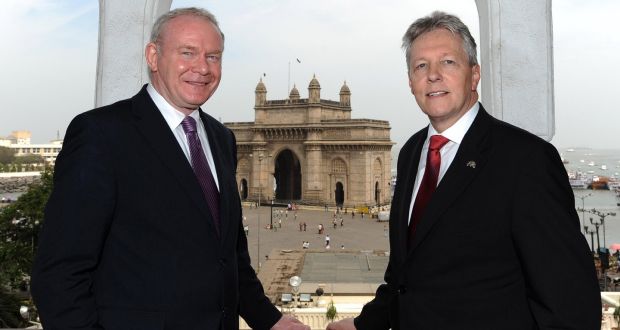
Northern Ireland Deputy First Minister Martin McGuinness and DUP leader and former first minister Peter Robinson took part in a conference call with Minister for Finance Michael Noonan to discuss the sale of Nama’s Northern Ireland portfolio. Photograph: Michael Cooper/PA Wire. Northern Ireland Deputy First Minister Martin McGuinness and DUP leader and former first minister Peter Robinson took part in a conference call with Minister for Finance Michael Noonan to discuss the sale of Nama’s Northern Ireland portfolio. Photograph: Michael Cooper/PA Wire.
Wed, Sep 30, 2015, 21:34

In records released by the Department of Finance on Wednesday night, a telephone log from January 2014 lists the three as participants in a conference call that took place at the request of then Northern First Minister Mr Robinson and Deputy First Minister Mr McGuinness.

Last week, Mr McGuinness told the Stormont inquiry investigating the sale of the Project Eagle portfolio he had been “kept in the dark” over the transaction.

Mr McGuinness said it was “totally and absolutely wrong” to say he was fully briefed about the Nama sale process from start to finish.

The controversial sale of the £1.2 billion (€1.6 billion) Project Eagle portfolio to US firm Cerberus is the subject of both criminal and parliamentary investigations in the North.

The inquiries arose after TD Mick Wallace claimed during the summer that £7 million transferred from a Belfast law firm involved in the transaction to an Isle of Man bank account was destined for a number of Northern political figures.

Mr McGuinness said last week he was not aware of a January 2014 letter to Nama from Mr Robinson’s principal private secretary, which was a copy of a “letter of intent” on the proposed management of the Northern Ireland portfolio.

The letter, according to Nama, appeared to summarise an agreement between Pimco, a company then interested in acquiring the portfolio, and the Northern Ireland Executive, which outlined details of a proposed memorandum of understanding.

The call log released by the Department of Finance said that, during the January 2014 conversation, Mr Robinson “reiterated the comfort provided by the commitments Pimco had made”.

The call log does not record any comments made by Mr McGuinness. The Deputy First Minister has said he was not privy to a litany of phonecalls and contacts in relation to the sale of the portfolio, some of which included Mr Noonan.

Both Nama and the chair of the Northern Ireland finance committee, Sinn Féin’s Daithí McKay, will on Thursday address the Dáil’s Public Accounts Committee on the sale controversy.

Sometimes I Just So Detest The Media That I Occasionally Work For….

Late last night I was surfing the early editions of the UK and Irish print media, ranging from The Irish Times to The Independent, and I came across this headline in The Guardian: ‘Republican presidential hopeful Carly Fiorina endorses torture’.

So I clicked on the link and found the article which had been written by one Ben Jacobs, only to read the following opening sentence: “Republican presidential candidate Carly Fiorina has endorsed waterboarding, the controversial interrogation method that has been called torture….”

The heart sank, not just because of the rank chickenheartedness that leaped out of that sentence but of all the woeful memories it re-awoke of covering the Troubles in Ireland when fellow reporters would take refuge in similarly shifty wording.

Like: “Last night British soldiers responded to Catholic rioters in Ballymurphy with what some locals described as barbaric levels of violence”.

The qualifying adverb “some” is there to indicate that not all the people of Ballymurphy felt that way (begging the obvious questions: how does the reporter know?) while the absence of a first-hand account is indicative either of an unwillingness to report what the reporter actually saw or to disguise the fact that while the riot was underway he/she was relaxing in the first floor bar of the Europa hotel.

Invariably it was the former.

And so with Ben Jacobs, the insertion of the phrase “….that has been called torture….” is there to indicate that Mr Jacobs has no opinion on waterboarding, one way or the other.

Some call it torture, others do not.

But not Mr Jacobs.

He belongs to the school of journalism which reports the insistence of flat-earthers that the world is not round but flat thus: “Opinions on shape of earth differ.”

Now, that’s what I call responsible, balanced journalism!

Stormont Oral History Archive Must Be Boycotted

The British government have in the last week or so published the Bill incorporating the main elements of the so-called Stormont House Agreement and included in its provisions is a proposal for an Oral History Archive to collect memories of the Troubles.

In all the history of law-making there surely can be no equal to the asinine, vacuous and ultimately cowardly thinking that went into the framing of this idea. Surrendering almost entirely to the victims’ lobby in Northern Ireland, the drafters have included a provision that at a stroke of a pen renders the OHA useless, pointless and irrelevant.

This is what the drafters have inserted:

  1. The OHA will not be exempt from any court order served for the release of information in an oral history held by the archive, including requests for disclosure in relation to criminal investigations. Nor will it be exempt from any statutory duty to report crimes.

It goes without  saying that any former member of any of the North’s various paramilitary groups, either Republican or Loyalist who decides they wish to tell his or her story honestly, frankly and completely, would have to be completely insane to co-operate in any way with the Oral History Archive.

All they would be doing is talking themselves into a jail term. Note that the Bill will oblige the interviewers and bureaucrats running this idiot scheme to report any crime or offence admitted by the interviewees. People co-operating with this madness would save everyone an awful lot of time and money by instead making an appointment at the nearest PSNI station.

As an idea designed to discover the truth of what happened during the Troubles, the OHA as described in this Bill is a piece of lunacy.

It is also a disturbing example of the power now wielded by victims groups and the cowardice of those in power.

The victims (and we were all victims in one way or another) have a right to know what happened to their loved ones. But this idea will not advance their hopes in one smidgen. Rather it will set them back forever.

The victims groups must decide what they want. The truth or revenge. If it is revenge then they will never get it, certainly not by the OHA route. If they want truth then they should lobby government to erase this killer clause.

As for academia, the OHA is a challenge to their courage and integrity. There is no doubt in my mind what they should do. Boycott this OHA, deprive it of the respectability and integrity it needs to survive, do so openly, publicly and loudly and by so doing force NI’s politicians to do the right thing.

The truth shall set you free, but the OHA will put you behind bars.

Here is the Bill:

Stormont Crisis: Lord Carlile’s Secret Work For PSNI/MI5 Revealed

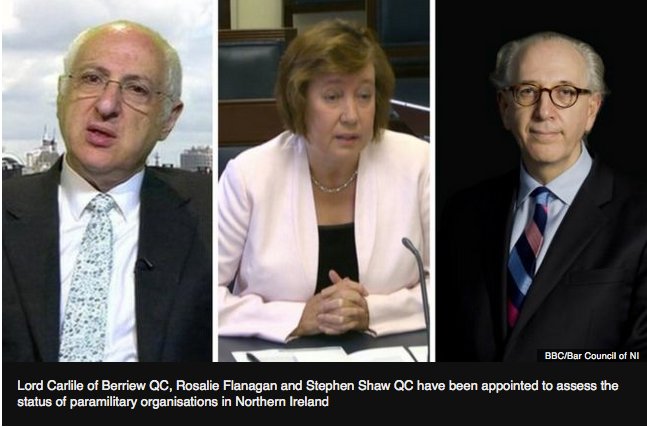
Lord Carlile of Berriew, the Liberal Democrat Peer and senior barrister who is one of the three people named by the British government to pronounce on the security assessment of the Provisional IRA in the wake of the killing of Kevin McGuigan, has a secret job deciding whether the PSNI and MI5 are justified in withdrawing close force protection to members of the establishment in Northern Ireland, including senior judicial figures, who are under threat of dissident republican violence.

His work has brought him into conflict with legal figures who have complained that Lord Carlile too readily accepts the PSNI/MI5 judgement that security force protection should be withdrawn from high ranking figures. The PSNI in particular is believed to be keen to reduce levels of personal protection, both for financial reasons and because the security threat against judges and other high profile targets has in the view of security experts diminished.

Lord Carlile - has a secret job as a one-man court adjudicating appeals against withdrawals of security protection to establishment figures, including top judges.

Lord Carlile – has a secret job as a one-man court adjudicating appeals against PSNI withdrawals of security protection to establishment figures, including top judges. Critics say he sides too often with the PSNI.

Along with Catholic retired senior civil servant, Rosalie Flanagan and senior QC, Stephen Shaw, who is a born again Christian and believed to be the DUP’s nominee to the three person panel, Lord Carlile was appointed this week by NI Secretary, Theresa Villiers to review and pronounce on a PSNI/MI5 assessment of the current state of the IRA due to be delivered before mid-October.

Close force protection involves armed police guards, drivers and home protection on a 24-hour basis, an expensive allocation of police resources. Given the reduced security threat and the need to save money, the PSNI is keen to scale down its commitment to providing this protection but in doing so it has raised establishment hackles.

Lord Carlile, known as Alex Carlile, the Liberal Democrat MP for Mongomeryshire before his elevation to the House of Lords, is described in a Northern Ireland Office press release as “the independent reviewer of national security arrangements in Northern Ireland since 2007”.

In actuality he acts as a one-man court of appeal when the PSNI decides to withdraw close force protection to figures previously regarded as potential republican targets, such as judges, senior legal figures like senior and junior Crown Counsels, and senior civil servants. These decisions often require the input of the British Security Service, MI5.

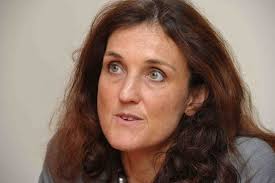
NI Secretary Theresa Villiers. On eof her nominees to the the assessment panel believes every word in the Bible is literally true; another is accused of believing every word the PSNI utters.....

NI Secretary Theresa Villiers. One of her nominees to the the assessment panel believes every word in the Bible is literally true; another is accused of believing every word the PSNI utters…..

Figures who have had their protection removed have complained, sources have told thebrokenelbow.com, that the withdrawal of protection has been premature and that a threat still exists. They say Lord Carlile is too often and easily inclined to accept the security forces’ judgement on such matters.

The extent of the threat to judges, barristers working for the prosecution service, senior civil servants and other likely targets is, for obvious reasons, not a widely discussed or publicized subject. The secrecy surrounding the subject makes an objective assessment difficult, to say the least.

But one example stands out.

In September 2009, a pipe bomb was found outside the North Belfast home of Judge Seamus Treacy and he was forced to move to a safer location and sell his home. The Real IRA is believed to have been behind the threat.

Judge Treacy was, prior to his elevation, a well known human rights barrister who accepted regular briefs from Madden & Finucane, a law firm founded by Pat Finucane, who was assassinated by the UDA in 1989 allegedly because of his republican sympathies.

Judge Seamus Treacy address a human rights conference as Pat Finucane's son, Michael listens....

Judge Seamus Treacy address a human rights conference as Pat Finucane’s son, John listens….a Real IRA bomb in 2009 forced him to flee his home

In the wake of the peace process, Judge Treacy accepted a seat on the bench.

Whether the dissident threat extends beyond figures previously known for their role in defending Republicans but who have since decided to identify fully with the legal system, is largely an unknown, since for obvious reasons a cloak of secrecy normally covers such matters.

But during the Troubles, the Provisional IRA regularly targeted judges and magistrates and common sense suggest that if the dissidents were capable they would try to do the same.

Whether or not the accusation is true, the claim that Lord Carlile is overly inclined to accept the PSNI and MI5’s word on such threats, especially since the criticism emanates from members of the establishment in Northern Ireland, will raise doubts about his ability to be impartial if faced with a security assessment of the IRA that downplays its threat, or one that minimises the influence of the Sinn Fein leadership over the IRA’s activities.

Whatever the truth, the decision to put the future of the Good Friday Agreement in the hands of three outsiders has already been complicated by revelations about the disposition of two of three named to make the decision.

In the case of one nominee, Stephen Shaw, he apparently believes that every word in the Bible is literally true; in the case of another, Lord Carlile, he stands accused of believing every word uttered by the PSNI.

Whatever the truth, it is not the most auspicious of starts for Theresa Villiers’ panel.

Stormont Crisis: Peter Robinson’s Man On IMC Mk2 Is A Happy-Clappy, Born Again Christian

Stephen Shaw, the senior barrister who is one of three people appointed by the British government to assess the status of the Provisional IRA following the killing of Kevin McGuigan, is a born-again Christian with strong links to the evangelical wing of the DUP.

Shaw,Stephen

Stephen Shaw QC, evangelical Christian and lay preacher

He is a lay preacher at the Scrabo Hall Fellowship near Newtownards, Co Down – which gets its name from the distinctive Scrabo tower overlooking the town. His church is a branch of the Plymouth Brethren movement.

Scrabo Tower outside Newtownards

Scrabo Tower outside Newtownards

Mr Shaw, who was called to the Bar in 1980, where he specialised in civil law, and got silk, i.e. was made a QC, in 2001, has also preached at the NI Assembly Christian Fellowship, a group of fundamentalist and evangelical Assembly Members and Stormont staff which is dominated by the DUP.

According to one account of Mr Shaw’s sermon: “…..he invited us to approach the gospel and the resurrection of Christ from a juror’s perspective, weighing the claims, the counter claims …to consider the ‘evidence’ of the gospel.”

The DUP Assembly member and former Minister in the power-sharing Executive, Nelson McCausland is a leading member of the group. Mr Shaw’s church website carries links to his various sermons, which were available until today when the link ceased to function.

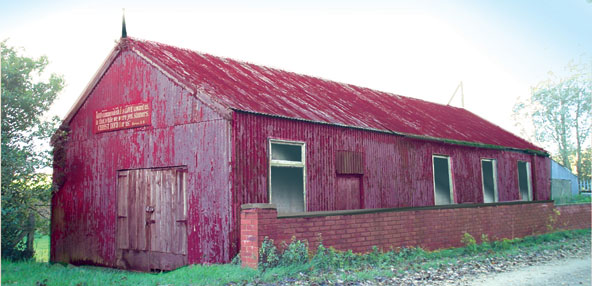
The Scrabo Hall, circa 1906, not long after the church was founded

The Scrabo Hall, circa 1906, not long after the church was founded

Mr Shaw’s church, part of the Open Brethren movement as opposed to the stricter Exclusive Brethren, believes in the literal truth of the Bible. The Scrabo Fellowship’s website defines its attitude to the Bible in simple terms:

The Bible, as originally given, is inspired by God and every word is infallible. Through it God speaks to us today. It is the only authority for what we believe and practice.

Scrabo Hall, a century later. The Plymouth Brethren are known for their business acumen and affluence

Scrabo Hall, in 2006, a century after its foundation. The Plymouth Brethren are known for their business acumen and affluence

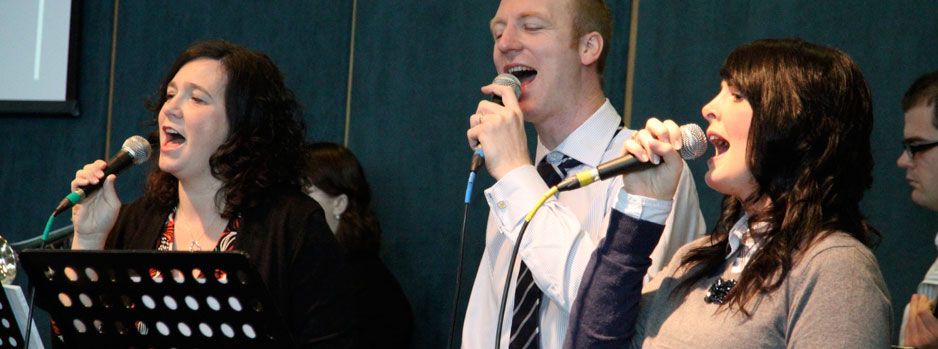
Services at the Scrabo Fellowship Hall, are, to judge from the videos and photos available on its website, characterised by much singing and clapping, accompanied by guitar music and drums. It is a style of worship that is often known as ‘happy-clappy’ Christianity.

Mr Shaw’s curriculum vitae, accessible on the Bar Library official website, shows that he has done legal work for Castlereagh Council in East Belfast, which is dominated by the DUP. Castlereagh Council was the springboard for the Robinson family’s political career in Northern Ireland. Both Peter Robinson and his wife, Iris were leading members of the body for many years.

Scrabo Hall - home of happy-clappy Christianity

Scrabo Hall – home of happy-clappy Christianity

All these aspects of Stephen Shaw’s career and background would strongly support the proposition that he is effectively the DUP’s nominee, if not Peter Robinson’s, on the three person assessment body appointed by NI Secretary Theresa Villiers.

They have been charged with making a judgement on the security force assessment of the Provisional IRA in the wake of the killings of IRA members ‘Jock’ Davison and Kevin McGuigan and the PSNI claim that IRA members were involved in the latter death.

“He is very highly thought of by fellow evangelicals”, one well placed Christian source told thebrokenelbow.com.

As a much respected figure in the North’s evangelical circles, the verdict that Mr Shaw delivers on the IRA would give Mr Robinson all the cover he needs in the community that to him and his party really matters: the evangelical Christian wing of Unionism.

If Mr Robinson has these people on his side, the Paisleyite wing in other words, he should have little difficulty bringing the bulk of Unionism with him.

A betting man – of which there would be none at Scrabo Hall Fellowship – would thus put his money on the Assembly and Executive returning to normality before long.

That is if the welfare business is also taken care of………

Stormont Crisis: Does One Of The New IMC Trio Have A Conflict Of Interest?

This profile of Stephen Shaw QC, one of Cruella’s three nominees for IMC Mk II, speaks for itself really. Never been in a criminal trial in his life, by the looks of it; never had a client from the grubby backstreets of of Belfast or Derry. Represented mostly rich folk according to his official c.v. A paramilitary ingenue down to his bootstraps.

So it begs two questions: first, a nice guy, undoubtedly, but what on earth would he know about the Provos, except they may have robbed some of the banks that he represented?

The other is a twofold issue. Mr Shaw received(s) income from his work for the Assembly Speaker which he will/might lose if the GFA collapses; that gives him a dog in the fight. Secondly, which Speaker of the Assembly did he do work for? Was it the current Speaker, Mitchel McLaughlin, who doubles as a member of the SF leadership group?

Mitchel has at least one saving grace: he is the only Shinner telling the truth when he says he was never in the IRA. But isn’t there a possible conflict of interest there? He is an important cog in the SF machine, after all.

Shaw,Stephen

Barrister Profile
STEPHEN SHAW QC

Year of Call: 1980

QC: 2001

Main Areas of Practice

Administrative Law or Judicial Review
Commercial Law
Company Law
Land Law
Biography

As Senior Counsel (QC) since December 2001 I have concentrated on commercial, chancery and public law. My work embraces strategic advice as well as litigation, arbitration and mediation. I have acted for banks, public companies (plc) and private business as well as the Speaker of the Northern Ireland Assembly and local and central government. I also undertake cases in the Lands Tribunal, rates appeals, rent reviews, arbitrations and planning appeals.

Outside of the law I am involved with charities active in the developing world.

Qualifications

LL.B Queen’s University Belfast

Barrister at Law

Queen’s Counsel

Lecturer in law at University of Ulster [part time until 1985]

Member of the Council of Law Reports Northern Ireland

Member Chancery Court Liaison Committee

Planning Appeals Commission [PAC]

Member of Independent Complaints Appeal Panel

Member of CARB, the all Ireland disciplinary body for accountants

1998; Called to the Bar of Ireland

Experience

My recent caseload includes work for • Facebook • High Street Banks, including: AIB, Bank of Ireland, Danske Bank, IRBC, NAMA, Ulster Bank and The Royal Bank of Scotland • Norbrook Laboratories Ltd • KPMG and insolvency practitioners • The Official Receiver for Northern Ireland • Local government including Lisburn City Council; the District Councils for Antrim, Ards and Castlereagh • Northern Ireland Water Limited (NIW) • NCP • The Northern Ireland Transport Holding Company • DOE Planning Service • Land and Property Services and the Commissioner of Valuation for Northern Ireland

Publications

I have published in the Northern Ireland Legal Quarterly (NILQ)

Back to Search Results

Stormont Crisis: The Gravy Train Versus Something Really Different

I see that Theresa Villiers has appointed the three wise monkeys who will doubtless rubber stamp the doubtless already agreed formula which allows everyone to continue pretending that the Provos do not have an armed wing, or if they do that it operates independently of the SF leadership, so they can all get back on board the gravy train at Stormont.

NI Secretary Theresa Villiers - why do I always think of Cruella D'Evil when I see her photo?

NI Secretary Theresa Villiers – why do I always think of Cruella D’Evil when I see her photo?

Why such cynicism? Because it is merited. The crisis was a sham one from the get-go. Every single party to the St Andrews deal knew full well that Sinn Fein would need to maintain an armed wing in case the dissident republicans got uppity. The Provos wanted a more formal recognition, i.e. retention of some guns sanctified by Blair and Ahern but what they got instead was a nod and wink go-ahead. It was enough.

Even, or perhaps one should say especially, the DUP was aware that IRA decommissioning was incomplete but made no fuss, instead demanding something SF was wont to do anyway, which was to accept the PSNI. With that delivered, and the guns issue hopefully sidelined, Ian Paisley careened happily, nay enthusiastically into government with Sinn Fein.

Only when ‘Jock’ Davison and then Kevin McGuigan were killed by the non-existent wing did the loose thread begin to unravel the ball of deception. And but for Catherine McCartney’s brave denunciation of the PSNI would the police top brass have ever come clean on IRA responsibility for the McGuigan slaying? An interesting question.

Would you buy a used lie from these people?

Would you buy a used lie from these people?

Here below is another take on the ‘crisis’ at Stormont, from former journalist and now US-based consultant, Michael McDowell who begins from the premise that the existing institutions have broken down, that another IMC-type body to monitor paramilitary activity just won’t wash, that a fresh start needs to be made and the Good Friday Agreement replaced. One doesn’t have to agree with all his arguments to know there is much truth in what he says.

But I rather think the gravy train will trundle down the tracks nonetheless. That gravy just tastes so gooooooood! And there’s so much of it!

logo-belfast-b

It’s time for a new peace deal… with public support

If the Executive parties cannot reach agreement, the London and Dublin governments should seize the initiative and appeal to the electorate over the heads of the politicians, writes Michael H C McDowell in Washington, DC.

Published 22/09/2015

Prime Minister David Cameron and Taoiseach Enda Kenny

There is a possible solution to the political crisis at Stormont – but that solution requires imagination, energy and determination on the part of London, particularly, which pays the bills, and, secondarily, Dublin.

 Northern Ireland’s constitutional problems are not unique, in spite of the truly bizarre pride which many of our politicians take in rejecting suggestions from outside which might make the 1998 Good Friday Agreement work as it was originally intended to.

“That wouldn’t work here … you can’t compare us with other places … we need an Irish solution to an Irish problem … we’re not like anywhere else … we’ve tried that before,” are the pathetic bleatings of these political critics. And yet many of them have the cheek to travel around the world offering advice to other conflicted jurisdictions, boasting that our “model” should be replicated abroad.

Sadly, the current model is not successful. It might have been an initial success in 1998 and for a short period afterwards, but the Northern Ireland model is not fit-for-purpose any more.

Above all, the public must have confidence in the Executive and Assembly; it no longer has that confidence to any meaningful extent, as polls consistently show.

Calls for another quick fix – by resurrecting the Independent Monitoring Commission (IMC) in a “tougher” form – suggests a shifting of deckchairs on our political Titanic, unless, this time around, it leads to root-and-branch dismantling of the billions of pounds and euro in money-laundering, fuel-smuggling, racketeering, drug-running and criminal assets – and, of course, eliminating the killings and maimings on both sides of the border.

The public must be convinced that any “new” IMC has no hidden agenda and can unequivocally answer key questions – for example: “Is the IRA army council still operating, in any way?” And: “Are there still weapons being held by the IRA?”

 If the answers to either or both those questions is “Yes,” then Sinn Fein must lose its right to be in government with wholly democratic parties.

The man and woman in the street are already sceptical that this latest of so many rounds of talks will produce broad agreement among the DUP, Sinn Fein, Ulster Unionists, SDLP and Alliance.

Of course, it is worth having talks, but if they don’t work, what is the Plan B of the two governments? Well, there isn’t one.

A quick election is demanded by Sinn Fein, with their eyes on the southern election next year, but a Northern Ireland election would meet the definition of insanity – ie, repeating the same old exercise and expecting a different result. Instead, we would have the familiar political stalemate in the Executive and Assembly; indeed, it might be worse.

Direct rule from Westminster is favoured by others, but that takes away local decision-making and puts it in the hands of English ministers.

Joint-authority, with London and Dublin, puts a greener tinge on the body politic and infuriates unionists and, in any case, Dublin is just slowly emerging from a disastrous economic mess.

What would work instead? After 37 years in North America, seven of them in Canada, the rest in Boston, New York and Washington, I believe in taking calculated (I stress, calculated) risks and having that old American “can-do” attitude, thinking-out-of-the-box, and, yes, a “do-no-harm-either” approach.

Well, if the local parties cannot agree on a package which specifies an Executive formed by voluntary coalition, collective Cabinet responsibility on policies, forced resignations for misbehaviour or corruption, other reasonable accommodations, an official Opposition in the Assembly with powers to call and hold ministers to account, and mechanisms to achieve a political majority of elected representatives in both communities to pass community-sensitive legislation and other safeguards, then it is up to London and Dublin to pick up the ball which the feuding parties kicked out of the political pram.

Let the two governments put a take-it-or-leave-it package rejected by the warring politicians directly to the people of Northern Ireland in a referendum.

After all, it is more than 17 years since the Good Friday Agreement was supported by a majority in both communities in a high-turnout vote.

If the package is supported by the electorate, then London and Dublin can legitimately call a meaningful Northern Ireland Assembly election on the basis of that mandate from the people of the province expressed in the referendum. If it is rejected, then it’s back to direct rule or something less than joint authority. Or, if a referendum is seen as too high-risk, then have London impose the package, with support, ideally, from Dublin and Washington.

Admittedly, in 1998, the majority unionist and nationalist parties campaigned for a “Yes,” and it is possible the DUP and Sinn Fein could join in an unholy alliance for a “No.” That’s a call for the two governments to make.

A lesser risk would entail relatively minor reforms to strengthen the centre and weaken the two main sectarian parties, perhaps though a Northern Ireland-wide electoral “list” system of voting, as used in Scotland, which would enable the Ulster Unionists, SDLP and Alliance to get a stronger foothold in the institutions than the current STV system allows.

Surely, though, it is time for bolder actions? Now is the time to take risks for peace, in the spirit of 1998.

Again, an election now, or in a few weeks, will achieve nothing but further acrimony, and no doubt the turnout will reach an historic low.

The options I am suggesting will be resisted not only by the NI political parties (barring, possibly, Alliance and, at a long shot, the UUs and SDLP), but by the pusillanimous mandarins of the Northern Ireland Office, the mediocre Nervous Nellies of the Northern Ireland Civil Service and the sneaking-regarders of the Irish Department of Foreign Affairs. These naysayers must be ignored.

Yes, there is a precedent: my IMC idea was championed by Tony Blair’s chief of staff, Jonathan Powell. Number 10 overruled the NIO’s opposition to it and Bertie Ahern and the Taoiseach’s office chose to ignore the Department of Foreign Affairs’ doubts. The IMC came into being because of strong political leadership by Blair and Ahern. They were the ultimate “deciders”.

The people of Northern Ireland again and again have shown that they support power-sharing (including in the unionist community, please note) and such cross-community initiatives as integrated education and sharing of public facilities.

We have had much talk about “a shared future” but, many years on, no agreement on what that might mean. Can we seriously tackle sectarianism? Can we deal effectively with the horrors committed in the past?

And, lurking like a demon around the political corner, are the harsh penalties for not enacting welfare reform, which Sinn Fein reneged on months ago, with savage cuts in spending which would hurt the very poorest families in Northern Ireland. Like it or not, the Tories were elected with a majority and promised to cut welfare monies if elected.

Then there’s the supposed panacea of corporation tax – huge cuts in social services might be needed to replace the $300m alleged “savings” on that triumph-of-hope-over-experience idea. David Cameron and Enda Kenny have a major opportunity to break the political logjam in the north and give the vast majority of people who support true power-sharing the kind of joined-up government which they voted for in the 1998 referendum – not the DUP-Sinn Fein cynical carving-up of power.

The men, women and, above all, the next generation of citizens of Northern Ireland deserve better of their politicians.

Just producing a new “improved” (?) IMC is not enough, and our 108 overpaid, over-expensed, do-nothing MLAs need to be pushed off the gravy train of the public trough if they cannot do their job, lead and reach an accord. Let London and Dublin seize the initiative if the northern parties will not agree.

And, finally, please keep the United States out of it all, except for backing a final package, and ignore Capitol Hill’s undistinguished Amen Chorus for Sinn Fein. The ball must stay firmly in London’s and Dublin’s court, where it should be.

There is a possible solution.

  • Michael H C McDowell, a former Northern Ireland journalist, is an international affairs consultant based in Washington, DC

The Pig, The Prime Minister’s Prick And……..Ian Hislop!?!?

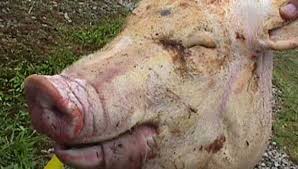
The story in Lord Ashcroft’s new book that David Cameron stuck his dick into a dead pig’s head as part of the initiation ceremony for membership of the super elite but disgustingly degenerate Piers Galveston Society at Oxford University, is completely credible.

images

We know that Cameron, as  the wealthy scion of a wealthy family, had already been inducted into the equally corrupt and venal Bullingdon Club, a collection of drunken upper class vandals whose favorite past-time was trashing expensive restaurants and puking through people’s windows after they had enjoyed their fill. Suffice it to say that the idiot lout, Boris Johnson was also a member.

Cameron, standing second from left, with his Bullingdon buddies at Oxford

Cameron, standing second from left, with his Bullingdon buddies at Oxford – Boris Johnson is seated, far right (appropriately)

It would thus be natural for an ambitious Cameron to graduate to the even more exclusive Piers Galveston Society – membership confined to a dozen – so-named after the allegedly gay lover cum confidante of the English King, Edward II, whose refusal, in 1312, to sack his corrupt and debauched inamorata cost Galveston his head at the hands of outraged aristocrats while Edward II, according to one account, was sent to an early death by the same angry barons some ten years later – but not before experiencing the sensation of a red hot poker exploring his rear passage.

Not surprisingly, the Piers Galveston Society or Dinner Club to give it its proper name, specialises in sexual and sybaritic excess.

Of such stuff are the English upper classes devised.

(Lord Sebastian, a member of the Bullingdon Club, pukes through Charles Ryder’s window at Oxford in Brideshead Revisited, the TV version of Evelyn Waugh’s celebrated novel)

So, as I wrote above, the revelation that David Cameron was a member of such an exclusive, debauched and lascivious group was hardly shocking to me. Nor even, the claim that he tried to get a blow job from a dead porker.

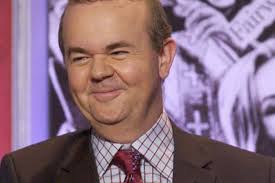
Ian Hislop was a member of the Piers Galveston Society - is nothing sacred?

Ian Hislop was a member of the Piers Galveston Society – is nothing sacred?

But what really shocked and, I have to say, disturbed me was the disclosure that among past members of this dissolute bunch was Private Eye editor Ian Hislop, a guy I have met, liked and admired for what I thought was a healthy distaste for all that was wrong with British society, not least the hypocrisy and dissolution of its ruling elite.

Never in a thousand years would I have imagined Ian Hislop sticking his member into a dead pig’s head as his toff mates laughed and jeered in encouragement.

But then life is a series of disappointments and disillusionments, one after the other.

Here is a piece, from 2001, in which Hislop admits his membership. As I said, disappointing and depressing:

Evening Standard: The Man Who Just Wants To Be Believed

Wednesday, November 7, 2001
Author: ANDREW BILLEN
MORE than 100 boxes of evidence line the right wall of Room 14 of the Royal Courts of Justice. On the other side, a matching number marches up to the witness stand.

We are in week five of Condliffe v Pressdram and Hislop, a libel action waged by a West Country accountant called Stuart Condliffe against Private Eye, which, back in March 1992, accused him of overcharging clients. It is a no win case for the Eye, which is resigned to paying huge legal costs even if the judge finds in its favour.

‘Excuse me,’ says Ian Hislop after he has greeted me. ‘I’d better sit at the front so I can nod at the judge.’ Given the magazine’s history before the libel courts, it is a dismally appropriate way for the Eye’s editor to be celebrating his organ’s 40th.

There are compensations, however.

This morning is Condliffe’s first on the stand and the crossexamination by the Eye’s QC, Ronald Thwaites, is brutal. It cheers Hislop up considerably and his mood further lightens when, emerging like a little blinking vole into the sunlight of the Strand at lunchtime, two passersby ask him to sign their birthday copies of the Eye. After 11 years as a team captain on the BBC’s Have I Got News For You, Hislop is not only wealthier than Richard Ingrams, whom he succeeded as the Eye’s editor in 1986, but much better known.

It would be a tragedy if his celebrity made him lose touch with his public, I say, once we have reached our restaurant in Chancery Lane. He orders a

medium-done steak and water and says he thinks this unlikely. ‘I was walking down Soho this morning and someone came up and said, ‘Love you on the show’.

So I was feeling very pleased with myself and a bloke in pinstripes walked past me and just said, ‘Not funny’. So I feel I haven’t quite got enough distance from the public. I commute, you see. There is no way out on a train.’

Court, he says, is hours of boredom and incomprehension and sudden moments of drama, such as this morning’s. He arrived as editor pledging to reduce the Eye’s legal bills, but it was not long before he was facing a Pounds 600,000 libel award to Sonia ‘Mrs Ripper’ Sutcliffe. If this was justice then he was a banana. He has ended one Ingrams tradition, however: printing gossip simply because it sounds true.

‘I don’t believe that ring of truth thing. I think it’s dangerous. What I always want of the item is for it to be believed. I can’t bear the thought of running all this journalism if everyone thinks, ‘Oh, take it with a pinch of salt.” Hislop wants the Eye to be believed partly because papers, generally, are not. He says when Private Eye was born (when he was one), its role was to print the true stories journalists couldn’t get into their own papers.

‘Nowadays it seems to be our job to point out that the ones that have been printed are not true.’

An under-reported difference between Ingrams and his protege is the contempt in which Hislop, who is basically a jokesmith, holds journalism.

‘It’s true,’ he says. ‘I’m not hugely impressed by journalists on the whole.

But I think that is a reasonable point of view for the editor of Private Eye to take.’

JOURNALISTS Peter McKay and Nigel Dempster were the first to leave under his editorship. With them went much of the paper’s coverage of what it used to call Ugandan Affairs. Conventionally one should praise the Eye’s restraint from sexual tittle-tattle these days. Yet, sex sometimes surely earns its place in even righteous gossip.

Let us imagine, I say, the obviously entirely imaginary case of a newspaper editor who campaigns for privacy rights and has a mistress himself.

Should his motives not be exposed? Ah, he says, this is an interesting case.

They had considered doing a ‘Hackwatch’ feature on just such an editor, but when they checked the cuttings they found that during his condemnation of the prurient coverage of Robin Cook’s divorce, he had admitted in his editorial that everyone on his paper had affairs all the time.

‘I don’t know how his wife felt about it but he made a good case.

But certainly most of the people who write for me are just looking for a loophole with which to get him.’

The other argument would be that tabloid editors who expose other people’s private lives should face similar humiliation themselves.

‘Yes, that is a very good point, and if there were a Piers Moron sexual legover story, that would be fine.’

The scarcity of boudoir gossip, which has removed all edge from an already weak Street of Shame column, has at least been compensated for by more coverage of other professions. Hislop has introduced insider columns on television, the railways, the NHS and even the advertising industry.

Its current pamphlet on the handling of the foot-and-mouth epidemic last week won praise from the Daily Telegraph. But it is, frankly, no longer a magazine the rich and powerful would bother trying to close down as Goldsmith and Maxwell wanted to. Whereas Ingrams’s Eye cost Cecil Parkinson his career, you can’t imagine Tony Blair caring less about what it says about his ministers.

He admits the paper lacks sources in Millbank: ‘Nobody’s actually handing us Jo Moore’s stuff, it’s true. They are not very leaky this lot, certainly not our way. The nationals have more of that stuff than we do. That’s probably an area that should be improved.’

But if the really big targets are left unmarked by the Eye, it does not mind duffing up easier ones.

In the current issue, the deeply troubled Michael Barrymore is given the line: ‘I want to put all this behind me and become the Queen of Television, the People’s Pooftah.’

On HIGNFY Hislop humiliated the highly strung Paula Yates and later called her a ‘slag’, a remark for which he sees no reason to apologise, even posthumously. It is not in the same league of cruelty – nor was he the ringleader – but Friday night’s debagging of Boris Johnson MP on HIGNFY was significant, too. Johnson, it should have been explained to viewers, had once revealed that contestants saw the questions before the recording. It was inevitable that Boris would eventually be cornered in the playground.

I ask if Hislop had been a bully during his decade boarding at Ardingly College in Sussex. He looks surprised. ‘Usually interviewers say, ‘Were you bullied at school?’ But it’s a better question, I think, for humorists to be asked, ‘Were you a bully?’ I certainly made jokes about people in order to prevent being bullied, not in order to amuse but in order to fire a warning shot.

‘Yes, I have memories of being unpleasant to some people at school, which I would find very sort of worrying now. Will Boyd wrote a play called Good And Bad At Games which I think to anyone who’s been to public school is a real shock because you just have an awful thought: ‘Did I behave like that or were there characters who were that badly treated? You know, misfits, people who didn’t fit in’.’

HISLOP, who is 5ft 6in – Dempster called him a ‘pushy midget’ at the time of his elevation – had his height to worry about. Then one day, aged 12, his headmaster called him out of class to tell him his mother had arrived from abroad with bad news: his father was dead.

‘I knew he was ill. But like all children you just assume, ‘Damn, he’s annoyingly not going to be around for a bit’. I was very worried that he wouldn’t be playing in the fathers’ cricket match because I was in the team.

Sadly, he wasn’t going to be doing anything at all.

So no, it was pretty miserable, but, in some senses, school was a saviour.’

The camaraderie of boys? ‘Yes. It was an alternative family in a way.’

Hislop went on to have a wonderful time at Ardingly, taking on the school magazine from his friend Nick Newman and appearing in revues that managed to both offend masters and amuse the head. He ended up head boy.

After a gap year spent on a kibbutz, he followed his mentors Newman and Simon Park, now a parish priest in Crouch End, to Oxford, where he drank plenty, joined the mock-decadent Piers Gaveston dining club and met his wife Victoria Hamson (who had been deputy head girl of her school). He started a funny little magazine called Passing Wind, which provided his excuse for interviewing Ingrams.

He made Lord Gnome laugh and within a few years the little Buddha had emerged as his anointed one.

I suggest that joining the male, public school-dominated world of Private Eye must have been like returning to the cosiness of Ardingly.

‘It was,’ he agrees, ‘like running the school mag again.’

I pass him a 1976 passage from Kenneth Tynan’s diaries, in which the priapic critic defined the Eye’s idiom – ‘the appalling Rees-Mogg’, ‘the wretched Wilson’ as schoolmaster English. Tynan wrote that the Eye’s contributors ‘develop from inky schoolboys into middle-aged schoolmasters without any intervening period of young manhood’. Was Hislop ever young? ‘Yes, I think I was probably young. I didn’t like punk but I liked Two-Tone quite a lot. I think I had a porkpie hat. Actually, I am sounding like the witness today. I did have a porkpie hat.’

At 41 he is indisputably middleaged now, and prosperous with it. He is rich not so much from the Eye (which pays its staff appallingly) but from personal appearances, the highly lucrative runs of HIGNFY and script writing for Dawn French and other TV stars.

Having sold his houses in Wandsworth and Somerset, he now lives quietly with Vicky and their son and daughter in a Kent village – the equivalent, one assumes, of Ingrams’s retreat to a cottage in Berkshire during his editorship (except for the cottage bit). He does not actually play the parish church organ as Ingrams did, but the God he ‘got’ at 15 during an evangelist revival at Ardingly, still sticks. His Anglicanism explains the accuracy of the Eye’s regular attack on Blair’s piety in St Albion Parish News.

A university friend, the publisher Mike Fishwick, says that despite his success Hislop is more than loyal to old friends. ‘He’s the gang leader, organises the get-togethers.

I find him very reassuring company because he is so consistent.

He has always known what he thinks about things. He is a grownup and, in a sense, always has been.’

He adds that he is good at compartmentalising his life. When Hislop talks of a period in 1994 when Victoria miscarried and his mother, Helen, was in a hospice, dying from leukaemia, his eyes begin to fill. Yet at the time Eye staff had no idea anything was wrong. ‘I felt,’ he says, ‘it was something I had to deal with and that it wouldn’t really help to share it.’

In another compartment, we should also remember, there is the Hislop who outfoxed his older rivals to take Lord Gnome’s seat and who is quite capable of sacking members of staff. People claim he never forgives. Did he invite Dempster or McKay to the Eye’s birthday boat party? ‘Er no, they seemed to slip off the guest list.

Funny that, isn’t it?’

That’s the essence of him and Ingrams, I say: Christians editing an unforgiving magazine. ‘Ah, we’re sinners, you see.’

BUT minor ones. On occasions like Diana’s death and the World Trade Center attack, when the Press’s nerve collectively fails, the Eye’s cynicism twinkles amid the sentimentality, almost virtuously. ‘There are things to say and comedy is the way we say them,’ as he puts it.

His father was 45 when he died from cancer and his mother barely over 60.

‘Genetically it doesn’t look too hot, does it?’ he admits.

Do their premature deaths affect his personality? ‘I think they must do. I haven’t done a lot of Anthony Clare or invited Raj (Persaud) to give me his views. But, yes, there must be a feeling of the clock ticking.’

But before the school-bell tolls, Hislop is around to ensure Private Eye never ages, let alone grows up.

Each fortnight the Eye emerges in its childishly middle-aged prime.

May it, and its editor, continue. On to age 94, at least.