Monthly Archives: January 2018

Understanding The Unrest In Iran

This is an effort to explain what is happening in Iran that is getting next to no air time in the West, and certainly not here in the US where the unrest is being seen almost exclusively in terms of internal Shiite politics. This other view, which comes from the left-wing Australian outlet, Red Flag, says the unrest has a lot to do with Iranian government neo-liberal economic policies, especially privatisation, which are sharpening class tensions and reducing living standards for working class Iranians:

The greatest radicalisation since 1979 as Iran explodes

Foad Asabani

What began as a small protest in Mashhad, north-east Iran, against price rises, high unemployment and other economic grievances has spread across 65-70 towns and cities around the country.

Workers and the poor have flooded the streets.

The chants and slogans within a day turned against the regime, against both moderates and hardliners, but with a focus on supreme leader Ali Khamenei. “Death to the dictator!”, “Death to Khamenei!” and “Death to (president Hassan) Rouhani!”, among other anti-government chants echo across the country.

In some cities, there have been protests of up to 50,000. In others, pockets of thousands gather in various suburbs, trying to beat back the security forces and connect with each other.

Ahvaz, the capital of Khuzestan province in the country’s south-west, has a predominantly Arab population subjected to severe repression and the object of racial oppression for decades. Eighty thousand protested there; the police station was razed. There had been a week of protests here earlier last year. The people had warned the government that, if their grievances were not addressed, there would be an uprising.

In many cities, workers have stormed local government buildings and taken over various institutions of the security forces, burning down police stations, overturning police cars and setting ablaze police motorcycles.

Cars owned by the rich, some banks and other signs of affluence have been attacked. Across the nation, workers are ripping down posters of the supreme leader and burning them with other symbols of the regime.

In Izeh, Khuzestan province, many of the 120,000 inhabitants have hunting rifles. The people have taken over the entire city.

Tehran, the national capital and largest city, hasn’t erupted in the way other cities have. In part, this is because the working class is more affluent, but it’s also because the repression is a lot more severe. Nevertheless, there have been many pockets of hundreds of people in the suburbs protesting and battling the security forces, trying to connect with each other and merge into centres such as Revolution Square.

Karaj, Iran’s fourth largest city and an hour west of Tehran, has a predominantly working class population, many of whom commute to Tehran daily. They are protesting in their thousands, smashing the windows of state buildings and setting fires in the streets. They have been met with extreme repression but show no signs of backing down and are battling it out with the security forces.

Students at various campuses in Tehran have been protesting, especially at Tehran University, and have been met with severe repression. The student demonstrations are left wing, and radical slogans such as “Smash the state!” are being chanted. Student activists who identify as Marxist are taking the lead, side-lining the moderates and hardliners, which were the dominant forces on the campuses during the 2009 Green Movement, which arose after Mahmoud Ahmadinejad’s re-election as president; many thought the result fraudulent.

Many students have been badly demoralised by the defeat of the 2009 movement. In its aftermath, many turned to drugs, mysticism and lifestyle or identity politics; others tried to gain positions within local government so that they wouldn’t remain so politically marginal and to have more influence on workers, dragging them to the right.

Left wing students have been critical of president Rouhani and rightly oppose his moderate faction, viewing it as little different to the hardliners. Both have the same agenda of implementing anti-worker policies.

Neoliberal attacks

The neoliberal program that began under hardliner president Akbar Hashemi Rafsanjani (1989-97) was expanded by the moderate Khatami government (1997-2005) and further entrenched under hardliner Mahmoud Ahmadinejad, who amended the constitution in 2006 to speed up the privatisation process. The neoliberal agenda has been implemented alongside austerity measures under Rouhani, whose government has privatised numerous state-owned enterprises.

So the major domestic rift between the hardliners and moderates concerns who will control the Iranian capital being privatised, and who will get the spoils of office.

But working class expectations had been raised when Rouhani came to power in 2013 promising to reinvigorate the economy and implement a civil rights charter. Although GDP has grown significantly in the past couple of years (6.4 percent in 2016), inequality has continued to grow dramatically, with more wealth transferred from workers into the hands of the ruling class.

Rouhani released a proposed budget a month ago, which called for slashing cash subsidies to the poor and raising fuel prices. The plan also included fees for things such as car registration and a departure tax. The president has been implementing austerity budgets since he came to office, in an effort to make Iran more attractive for investors. The austerity measures were implemented on top of years of recession, due to United Nations economic sanctions, squeezing even more wealth from the working class and the poor.

There are other contributing factors to the protests: a recent 40 percent jump in the price of staples, mass layoffs, unpaid wages for months across many workplaces in all industries, a labour movement resisting and struggling for several years against austerity and for independent unions, and the obscene wealth flaunted in front of the faces of the poor and the working class.

As with the Arab Spring of 2011, the situation was primed for an explosion; only a spark was needed. Now, the working class and the poor have unleashed the greatest radicalisation since the 1979 revolution.

Politics at the top

The factional struggles within the regime between the hardliners and the moderates, which created the cracks and fissures within the ruling class and paved the way for the Green Movement, are not the reasons for this uprising. Rouhani’s administration has tried to establish support within the ruling class, distributing handouts – to the liberal capitalists and to the security forces, to the hardliners and religious groups – to encourage members of the elite not to interfere with the government in different policy areas, from foreign politics to the economy.

For example, a large amount of spending in the most recent budget has been allocated to religious semi-public foundations, the Revolutionary Guards or the Office of the Leader, all of which are aligned to the hardliners. This is another factor that fuelled anger, especially among teachers.

Rouhani has also established a base within the liberal middle classes that led the 2009 movement and came out to protest in mass numbers against the hardliners back then; large sections of them turned against the moderates and the regime as the movement became more radical.

Not that the factional struggles within the regime have disappeared. The UN economic sanctions enforced on Iran during the Ahmadinejad era (2005-13) severely hurt capitalists of all hues. Khamenei and the hardliners came to view Ahmadinejad as a liability, so they sidelined him from the political establishment completely and barred him from running in any further elections.

For all these reasons, Rouhani’s government created a more stable situation. But the attacks eroded the government’s support among the working class and the poor, leading to significant developments in the class struggle.

Class struggle from below

Over the past year, civil servants, government workers, retired government workers, teachers, nurses, mine workers, petrochemical workers, manufacturing workers and public transport employees have all protested and gone on strike.

In March, teachers went on strike and protested across the country, demanding a pay increase, and an improvement to the government’s education system. Teachers have waged a long-running campaign on this front over the past decade. On World Teachers Day, 5 October, thousands of teachers gathered in cities across Iran to demand fair salaries and the right to form independent associations. Teacher activists have been threatened, summonsed, arrested and tortured by security forces.

Persian Gulf International Transport Company workers walked off the job on 23 October to protest against the privatisation of the company and to demand unpaid salaries. The regime denies the basic right of workers to form independent trade unions; however, workers have been organising themselves in their workplaces and advancing their demands.

On 19 and 20 September, workers from two factories, Azarab and Hepco in the industrial city of Arak, took strike action and fought police. Azarab and Hepco are privatised factories manufacturing heavy equipment, including for road construction and the petrochemical industries. Workers at these factories have gone without pay for four to six months.

On 2 December, workers at the giant Haft Tapeh sugar cane plantation and mill complex in Shush, near the border with Iraq, launched a new round of strikes and demonstrations following from a strike in July, after more than four months without wages or entitlements. The Haft Tapeh workers have launched numerous strikes and protests over the past decade.

Slogans

The Western political establishments and corporate media have made a great deal of slogans – such as “Not Gaza, not Lebanon, my soul is the redemption of Iran” or “Leave Syria and think about us” – being chanted by a minority in some of the protests, which are anyhow not the main slogans or chants in the uprising. As Michael Karadjis, a left wing political commentator and analyst correctly wrote:

“Many point to these slogans as evidence that the protestors are narrow nationalists only concerned about themselves and opposed to ‘helping’ other peoples in the region. While the misunderstood reference to Gaza does raise justified alarm bells … the demand to leave Syria is a manifestly internationalist slogan, similar to demands of the US antiwar movement for the US to leave Vietnam.

“After all, that movement did not begin as pure ‘internationalism’ – many wanted to end the state spending all that money destroying Vietnam and spend it at home to improve livelihoods. How many times have leftists in the West raised the slogan ‘Money for jobs not war’? What’s the difference?”

Liberals and workers

Outside of the campuses, there’s no organised force leading the uprising or intervening into it, unlike the 2009 movement that was led by the moderates who wanted to contain it to minor, liberal middle class demands. The workers knew that none of their grievances were being raised in that movement and hesitated to enter it as a mass force.

This time, the liberal middle classes are split, the upper middle class taking sides with the regime, worried that their own interests are being threatened. The moderates have been trying to derail the uprising and bring it under their own wing, but workers well understand that both the hardliners and the moderates are two faces of the same coin, wanting to further squeeze them, knowing that they are not organised. Both the moderates and hardliners have been using various tactics to have the protesters take up their chants and slogans, but they usually are beaten up, pushed out or booed and remain impotent in the face of the mass protests.

All indicators are that the uprising is continuing to expand and deepen. The teachers have called for a nationwide strike, which has the potential to be replicated in other industries given the militancy and class nature of the movement. Security forces are set to crack down even harder, but so far the people show no signs of retreating.

Can Donald Trump Read?

In the light of Michael Wolff’s controversial study of the early Trump presidency, ‘Fire and Fury’, and his claim that White House staff cannot get him to read documents, it is worth revisiting this video which asks an even more basic question: can Donald Trump read at all? (You need to activate the volume button)


That UVF Letter To Haughey – Here It Is

Journalism is still alive and well in Dublin, I am happy to report, at least in the form of one reporter who knows a story when she sees one.

Today in the London Times’ Irish edition, Dublin-based columnist Ann Marie Hourihane has done what other journalists and their publications had so lamentably failed to do when the latest crop of state papers were released by the government last week: she took a photograph of the now notorious alleged UVF letter to Charles Haughey sent to him in 1987 when he was Taoiseach, and published it in her weekly column.

(Full disclosure: Anne Marie is a friend and a former colleague from our Sunday Tribune days)

I had lambasted the Irish media in these columns for failing to do just that on at least two grounds: this was a controversial document whose bona fides has been challenged by Loyalists; and the public had the right to see the full document so as to make their own judgement not just on its authenticity but its central claim, which was that MI5, the British spy agency, had encouraged the UVF to assassinate Haughey.

As it turns out there is a lot more in the letter that never made it into print or any other Irish media, and that was another criticism that I made: judgements on these important documents released each year were being made by reporters who might not know anything about the subject matter.

In consequence important detail might be missing. One way of dealing with this is for newspapers and electronic media to reproduce in full the various documents, a course made easier thanks to the internet. That way the public gets to read documents in their original form and are better placed therefore to judge their credibility.

In this case a fuller read of the UVF letter reveals all sorts of interesting detail, none of which I can remember appearing in any Irish media report:

  • The UVF letter, signed by ‘Capt W Johnston’, endorsed Colin Wallace and Fred Holroyd ‘when they revealed that British Int were behind killings, kidnapping and a smear campaign against yourself’ (i.e. Haughey);
  • The inclusion of Colin Wallace’s name would be a red flag for many given the controversy over his credibility that has raged for many years;
  • MI5, MI6 and the SAS used the UVF between 1972 and 1978 and again in 1985;
  • The UVF killed 17 men on information supplied by British intelligence which supplied the UVF with explosives and intelligence on the whereabouts of targets;
  • The UVF letter purports to come from a Unit identified as ‘M.U.’ Loyalist sources say this probably is intended to suggest the letter came from the Mid-Ulster UVF, which in 1987 was led by Robin Jackson, a notorious killer nicknamed ‘The Jackal’. The Mid Ulster UVF played a prominent role in the Dublin-Monaghan bombings of 1974.

Loyalist sources continue to cast doubt on the authenticity of the letter. One source close to the UVF had this to say to thebrokenelbow.com about it:

Re the letter, I thought the notion was nonsense, I think after seeing it my instinct is confirmed. The very thought that they would mail a letter about any subject in such a way is a bit ridiculous never mind the nature of the subject matter.

That it is laid out as some type of common internal administrative document and it is the first time anyone has ever seen such thing after so many arms finds, arrests etc says a lot I think. Also why type the whole thing and then handwrite various parts; seems too elaborate to me. Also it looks that maybe the top and bottom parts, which appear to be from a printer or computer, have been photocopied and the main text overlaid from a typewriter.

In terms of the content I have never met anyone who would give any credence to Wallace and Holyroyd, at least from personal experience. It purports to come from Mid Ulster yet refers to information in regard to Hanna and Desertmartin which would have been Belfast based and challenges the accepted narrative on both. In regard to Simpson, that’s news to me and if it related to Desertmartin as suggested, it wouldn’t be.

I’m not sure of the details re Haughey or whether such details would have been in the public domain, so not sure if that betrays its origin, but Id be very dubious of all of it. It reads to me like something republicans might like to have been true, but even that is a stretch given its bizarre nature.

Here is Anne Marie’s piece in today’s Irish edition of the Times which contains a copy of the alleged UVF letter:

Archives may be dusty but opening them lets in light

Ann Marie Hourihane

State papers are a national resource and their investigation helps bring history to life

Every year we have to pretend to be excited about the release of state papers under the 30-year rule, but this year they really were exciting: a little bit too exciting, some people thought. They included the sensational revelation of a letter, contained in file 2017/10/34, which purported to come from the Ulster Volunteer Force. It was addressed, in rather shaky handwriting, to the taoiseach of the day, Charles Haughey, and stated that the UVF had been encouraged by British intelligence to assassinate him.

There are many strange things about this letter — not least the fact that it is typed on UVF notepaper, with the motto “For God & Ulster” printed at the bottom. Seasoned commentators on the Troubles, such as Ed Moloney, the former Irish Times and Sunday Tribune journalist, have expressed surprise that the UVF would write a letter at all, let alone one to an Irish taoiseach. In all his years covering Northern Ireland, Moloney said, he had never come across a letter from the UVF.

Balaclava Street, a loyalist blog that Moloney says is reliable, poured scorn on the letter, which is dated August 5, 1987, and speculated that it might have been written by opponents of the Anglo-Irish agreement trying to stir up trouble.

Nevertheless this document made the front page of many newspapers, with no discernible substantiating evidence from other sources.

On Tuesday, when the National Archive in Dublin opened after Christmas, I went in to see the letter, expecting the place to be thronged with excited researchers. Arriving just after noon I found myself only the third person in the lovely reading room, and no one had arrived to join us when I left two hours later. Although staff did say that they had been phoned by news organisations from around the world, all looking for the letter, the 1987 documents are not yet available online.

It seems strange that a country so obsessed by its own history is so far behind others in its attitude to and resourcing of research into its recent past. The UK releases its state papers after 20 years, so we are reading documents from London and Belfast a full decade in advance of our own. The Troubles always take centre stage in the release of our state papers, so this is particularly aggravating.

At one time journalists were only invited into the National Archive to view the newly-released papers in the days coming up to Christmas. Or they were invited in between Christmas and new year, which didn’t suit anybody either.

Now, journalists get access to the papers in early December. That gives them three weeks to check the stories they are going to print in the first days of the new year.

The files can arrive at the National Archive very shortly before what is called the media preview. The archive is entirely at the mercy of the government departments releasing the documents, which can arrive any time during the year, and some don’t arrive until the last minute. This has strong implications for the archive’s staff and their ability to pick out the documents that will be of interest.

Storage space has been cruelly limited and this affects the amount of documents the archive can store.

There are no plans to digitise all documents. According to John McDonough, director of the National Archive, a selection of 1987 documents will be online “in the first quarter” of this year. One former archivist told me: “Digitisation doesn’t solve everything.”

As it is, the present circumstances make the release of our state papers the poor relation when it comes to releases from national archives. It would be helpful if documents like the so-called UVF letter were available online so that they could be viewed in their entirety, and so that the context of the extracted quotes could be demonstrated.

For their part, archive staff would like journalists to cite the file numbers of the documents they are quoting: “It avoids ambiguity,” McDonough said. Only the Irish Examiner did so this year.

McDonough also points out that, like all cultural institutions, the archive is “coming out of a bad patch” with regard to funding, which stands at €1.5 million for 52 staff.

New legislation to amend the 1986 National Archives Act has already started its journey through the Oireachtas and should be law by the end of the year. This will instigate a 20-year rule, as opposed to 30. A project to provide the archive with more storage space will be overseen by the Office of Public Works and should be completed in three years.

As to the UVF letter, the printing of “For God and Ulster” at the bottom of it seems a lot of trouble to go to for a forgery. What do I know of these things — like most of the reporters covering the release of the state papers, almost nothing.

A paragraph of the letter states: “”We excuted [sic] some of our best men believing them to be traitors. Jim Hanna was killed as result of information given to us by MI5. Hanna was totally innocent and we killed one of our best volunteers”.

(The Times’ version of the UVF letter has been edited to remove some names.  I am reproducing both versions, the Times’ version and the unedited version. First the Times’ version)

The letter, purportedly from the UVF to Charles Haughey, was released by Ireland's National Archives under the 30-year rule

(Now the unedited version)

The letter, purportedly from the UVF to Charles Haughey, was released by Ireland’s National Archives under the 30-year rule

The authoritative listing Lost Lives states that James Andrew Hanna was killed on April 1, 1974. At the time the UVF denied killing him.

In the following paragraph, there is a listing of equipment the letter alleges was supplied to the UVF by MI5, including detonators. The next sentence simply says “Vol Logan, Vol Simpson his body was never got”. Again according to Lost Lives, there was a Charles Logan killed “when a UVF device exploded prematurely near Desertmartin” on November 18, 1973. The letter specifies Desertmartin. I could not find any listing for a Simpson in Lost Lives that would correspond to a death for a “Vol Simpson”. There are ten people by the name of Simpson listed among the dead in Lost Lives.

State papers are a national resource. They will of course contain unsubstantiated gossip and forgeries, as well as the truth. But at the very least they deserve respect from the authorities and investigation by journalists.

Trump’s Nuclear Button

Is Trump’s comment to N Korea leader Kim Jong un, about the size and strength of his nuclear button really just a case of penis envy?

Will The Real Jim Gibney Please Stand Up?

UPDATES – See below

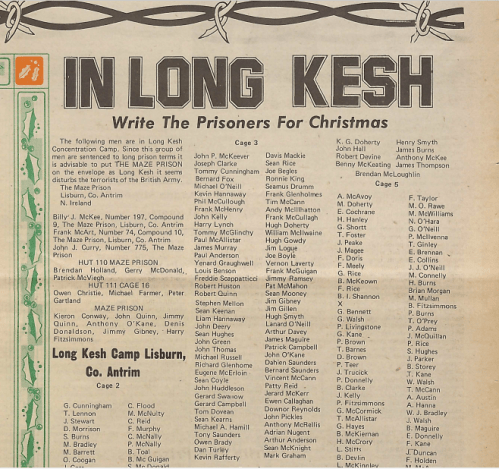
Your assistance, dear reader, is required to help answer this deceptively simple question. How many Jim Gibney’s are there who hailed from the Short Strand district of east Belfast, were members of the IRA and spent time in jail for their paramilitary activities? Were there two of them, or just one?

Jim Gibney, as he currently looks. A former national organiser for Sinn Fein and a close ally of Gerry Adams, he is a regular columnist with the Irish News….

The question arises out of a Facebook posting from Clifford Peoples in the last day or so in the form of a court report in The Irish News, dated May 23rd, 1972, which details how James Henry Gibney, a 20-year old motor mechanic from the Short Strand was given a 13-year jail term for bombing the Buffs Club in Belfast.

An IRA colleague, Joseph Patrick Surgenor, a 19-year old unemployed man, also from the Strand, was given eight years. James – or should we call him Jim – Gibney’s address was in Seaforde Street; Surgenor’s in Sheriff Street. Gibney’s sentence was to run concurrently with a 10-year term for another undisclosed offence prior to the bombing. Both men accused the RUC Special Branch of beating them to extract confessions.

(The Buffs Club – full name ‘Royal Antedeluvian Order of Buffaloes’ – is a charitable outfit with branches throughout Britain and the commonwealth. Although non-political it does require members to be ‘true and loyal supporters of the British Crown and Constitution’ and this along with a structure resembling a mix of the Orange Order and the Freemasons may have made it an IRA target [although its role as a prop of British imperialism In Ireland can only be guessed at!]).

While most commentators on Facebook appear convinced that this is the same Jim Gibney who became one of Sinn Fein’s most loyal acolytes, I am far from sure. The Jim Gibney who gained prominence as an Irish News columnist is also from the Short Strand, was in the IRA and served jail time for the cause. But I was not at all persuaded that he and the Facebook Jim Gibney were the one and same person for this simple reason .

In 1982, the Jim Gibney of Sinn Fein fame was arrested, charged, convicted but subsequently acquitted on appeal, of involvement in some quite disgusting sectarian murders in the Markets district of Belfast on the basis of testimony given by former IRA activist turned evangelical Christian, Kevin McGrady, one of the early ‘supergrasses’.

The killings happened in 1975, during the IRA ceasefire of that time and when the IRA in Belfast was under the leadership of people who believed that the best way to stop the avalanche of Loyalist slaughter of Catholics that had Nationalist Belfast living in terror, was to obey the dictum ‘an eye for an eye’.

But that chronology means that the James Gibney cited in that Irish News report cannot be the same James Gibney we all know – and who some, but not all love. The Irish News Jim Gibney would have been in jail during the killings of 1975.

Not only this, but in 1998 the Sinn Fein Jim Gibney gave a lengthy interview to the US public broadcasting station, PBS in which he said that he had been interned in 1972 and was released in 1974, a chronology which fits the Kevin McGrady episode but not The Irish News clipping.

So dear reader, your help would be appreciated. Were there two Jim Gibneys from the Short Strand active in the IRA?

UPDATE

Here is an important clue, courtesy of S, who emailed this extract which is from, I believe, The Irish People, the US publication associated with the Provos. You can clearly see there are two Gibneys in Long Kesh at Christmas time, 1972. One, Jim Gibney is an internee, in Cage 3 alongside future luminaries like Freddie Scappaticci and someone called Yenard Graughwell (can anyone shed light on this character?). So this syncs well with the story of the Sinn Fein Jim Gibney.

On the left hand side of the extract you can see a list of the sentenced IRA prisoners, i.e. those who have been processed through the courts. It includes, amid some famous characters like Billy McKee, Kieran Conway and Denis Donaldson, one Jimmy Gibney. That must be the character who features in The Irish News article. In other words a different Jim Gibney who, astonishingly, also hails from the Short Strand. Bizarre But mystery solved, methinks.

Gibneyx2

UPDATE TWO

Angela Nelson on Facebook has suggested that the two Gibneys were in fact cousins, which explains a lot but not why at least one set of parents was totally lacking in imagination!

Iran Riots – Is This Trump CIA Appointment Just A Coincidence?

I don’t know the answer to the question above, but it is worth considering in light of this New York Times article from June last year. It wouldn’t be the first time the CIA fomented riots to achieve regime change in Iran:

C.I.A. Names the ‘Dark Prince’ to Run Iran Operations, Signaling a Tougher Stance

By MATTHEW ROSENBERG and ADAM GOLDMANJUNE 2, 2017

Iranian voters in the city of Qom, south of Tehran, last month in the country’s first presidential election since its nuclear deal with world powers. Majid Saeedi/Getty Images

WASHINGTON — He is known as the Dark Prince or Ayatollah Mike, nicknames he earned as the Central Intelligence Agency officer who oversaw the hunt for Osama bin Laden and the American drone strike campaign that killed thousands of Islamist militants and hundreds of civilians.

Now the official, Michael D’Andrea, has a new job. He is running the C.I.A.’s Iran operations, according to current and former intelligence officials, an appointment that is the first major sign that the Trump administration is invoking the hard line the president took against Iran during his campaign.

Mr. D’Andrea’s new role is one of a number of moves inside the spy agency that signal a more muscular approach to covert operations under the leadership of Mike Pompeo, the conservative Republican and former congressman, the officials said. The agency also recently named a new chief of counterterrorism, who has begun pushing for greater latitude to strike militants.

Iran has been one of the hardest targets for the C.I.A. The agency has extremely limited access to the country — no American embassy is open to provide diplomatic cover — and Iran’s intelligence services have spent nearly four decades trying to counter American espionage and covert operations.

The challenge to start carrying out President Trump’s views falls to Mr. D’Andrea, a chain-smoking convert to Islam, who comes with an outsize reputation and the track record to back it up: Perhaps no single C.I.A. official is more responsible for weakening Al Qaeda.

“He can run a very aggressive program, but very smartly,” said Robert Eatinger, a former C.I.A. lawyer who was deeply involved in the agency’s drone program.

The C.I.A. declined to comment on Mr. D’Andrea’s role, saying it does not discuss the identities or work of clandestine officials. The officials spoke only on the condition of anonymity because Mr. D’Andrea remains undercover, as do many senior officials based at the agency’s headquarters in Langley, Va. Mr. Eatinger did not use his name. The New York Times is naming Mr. D’Andrea because his identity was previously published in news reports, and he is leading an important new administration initiative against Iran.

Mr. Trump called Iran “the number one terror state” and pledged throughout the campaign to dismantle or revise the landmark deal between Iran and six world powers in which Tehran agreed to limit its nuclear program in exchange for sanctions relief.

The president has not gone through with that threat, and his administration has quietly recertified Iran’s compliance with the deal. But he has invoked his hard line on Iran in other ways. Secretary of State Rex W. Tillerson has described the deal as a failure, and Mr. Trump has appointed to the National Security Council hawks eager to contain Iran and push regime change, the groundwork for which would most likely be laid through C.I.A. covert action.

Lt. Gen. H. R. McMaster, the national security adviser, was an armored cavalry commander during the early years of the war in Iraq, and he believes that Iranian agents who were aiding Iraqi insurgents were responsible for the deaths of a number of his soldiers. Derek Harvey, the senior director for the Middle East at the council, is also considered an Iran hawk.

And Ezra Cohen-Watnick, the council’s senior director for intelligence — the main White House liaison to intelligence agencies — has told other administration officials that he wants to use American spies to help oust the Iranian government, according to multiple defense and intelligence officials.

Mr. Pompeo, who represented south-central Kansas in the House, was among the fiercest congressional critics of the Iran deal. Two months before the election, he published an essay in Foreign Policy magazine titled, “Friends Don’t Let Friends Do Business With Iran.”

He pledged during his Senate confirmation hearing in January that should the deal remain in place, he would keep a fierce watch to ensure Tehran was sticking to the terms.

“The Iranians are professionals at cheating,” he said.

In Mr. D’Andrea, the director has found a workaholic to be his Iran sentinel. Mr. D’Andrea grew up in Northern Virginia in a family whose ties to the C.I.A. span two generations. He met his wife, who is Muslim, on a C.I.A. posting overseas, and converted to Islam to marry her, though he is not known to be particularly observant.

At the C.I.A., Mr. D’Andrea’s reputation for operational acumen is matched by his abrasive demeanor. “Surly” seems to be the most popular description, say those who have worked alongside him, and some people at the agency have refused to work for him.

A former agency official said that he had once asked Mr. D’Andrea, who has been known to keep a hideaway bed in his office, what he did for fun.

Mr. D’Andrea’s reply: “Work.”

Asked whether Mr. D’Andrea’s appointment was a sign that the C.I.A. planned to take up a more aggressive line toward Iran, Mr. Eatinger said, “I don’t think it’s the wrong read.”

Mr. D’Andrea’s personal views on Iran are not publicly known. It is also not his job to make policy but to execute it, and he has demonstrated that he is an aggressive operations officer.

In the years after the Sept. 11 attacks, Mr. D’Andrea was deeply involved in the detention and interrogation program, which resulted in the torture of a number of prisoners and was condemned in a sweeping Senate report in 2014 as inhumane and ineffective. Only the executive summary of the 6,700-page report has been made public; the Trump administration has begun returning copies of the full document to Congress, which is not subject to Freedom of Information Act requests, raising the prospect that it will never be released.

Mr. D’Andrea took over the agency’s Counterterrorism Center in early 2006 and spent the next nine years directing the hunt for militants around the world.

Operatives under his direction played a pivotal role in 2008 in the killing of Imad Mugniyah, the international operations chief for Hezbollah, the Iranian-backed Shiite militant group based in Lebanon. Working with the Israelis, the C.I.A. used a car bomb kill to Mr. Mugniyah as he walked home in Damascus, where Hezbollah enjoys strong ties with and support from the Syrian government.

At the same time, Mr. D’Andrea was ramping up the drone program inside Pakistan. Drones became the preferred counterterrorism tool of President Barack Obama, who personally approved strikes targeting militant leaders.

When Mr. D’Andrea took over as the counterterrorism chief, only a handful of the agency’s drones were operational in Pakistan, and there were only three strikes that year, according to the Long War Journal, which keeps a tally of drone activity. By 2010, when the drone campaign was at its height, the agency launched 117 strikes against Qaeda militants and other jihadists sheltering in the mountainous tribal areas that run along Pakistan’s northwestern border with Afghanistan.

The agency also expanded its drone program to Yemen under Mr. D’Andrea’s direction, and many in the C.I.A. credit him with playing an instrumental role in impairing Al Qaeda.

But there were also setbacks. Mr. D’Andrea was at the helm when a C.I.A. source secretly working for Al Qaeda blew himself up at an American base in Afghanistan, killing seven agency operatives. It was the single deadliest attack on C.I.A. personnel in more than a quarter-century.

And in January 2015, a drone struck a Qaeda compound in Pakistan where, unbeknown to the C.I.A., the militants were holding two hostages: Warren Weinstein, an American aid worker and economic adviser, and Giovanni Lo Porto, 37, an Italian. Both men were killed in the strike.

A few months later, Mr. D’Andrea moved to a new post reviewing the effectiveness of covert action programs.

Former agency officials said Mr. D’Andrea’s new job overseeing Iran operations was better suited to his talents.

“A lot of people I know were scared of him and thought he was reckless, but he really wasn’t,” Mr. Eatinger said. “He was very precise and held people to very high standards.”

Correction: June 6, 2017
An article on Saturday about Michael D’Andrea, who has been appointed to head the Central Intelligence Agency’s operations related to Iran, misidentified the type of Army unit that Lt. Gen. H. R. McMaster, the national security adviser, commanded during the early years of the war in Iraq. It was an armored cavalry unit, not an infantry unit.