As Trumpgate Begins A Look Back At Watergate From Seymour Hersh

As the Trump White House seemingly stumbles, almost inexorably, towards its own Watergate, it is worth looking back at the template through the eyes of that great journalist Seymour Hersh, writing here in The New Yorker magazine in the wake of the 2005 unmasking of ‘Deep Throat’, Mark Felt, the No 2 in the FBI in 1973 as the scandal unfolded.

Watergate Days

It was late in the evening on May 16, 1973, and I was in the Washington bureau of the Times, immersed in yet another story about Watergate. The paper had been overwhelmed by Bob Woodward and Carl Bernstein’s reporting for the Washington Post the previous year, and I was trying to catch up. The subject this time was Henry Kissinger, President Richard Nixon’s national-security adviser. I had called Kissinger to get his comment on a report, which the Times was planning to run, that he had been involved in wiretapping reporters, fellow Administration officials, and even his own aides on the National Security Council. At first, he had indignantly denied the story. When I told him that I had information from sources in the Justice Department that he had personally forwarded the wiretap requests to the F.B.I., he was silent, and then said that he might have to resign. The implicit message was that this would be bad for the country, and that the Times would be blamed. A few minutes later, the columnist James Reston, who was a friend of Kissinger’s, padded up to my desk and asked, gently, if I understood that “Henry” was serious about resigning. I did understand, but Watergate was more important than Kissinger.

Alexander Haig, Kissinger’s sometimes loyal deputy, had called a few times during the day to beat back the story. At around seven o’clock, there was a final call. “You’re Jewish, aren’t you, Seymour?” In all our previous conversations, I’d been “Sy.” I said yes. “Let me ask you one question, then,” Haig said. “Do you honestly believe that Henry Kissinger, a Jewish refugee from Germany who lost thirteen members of his family to the Nazis, could engage in such police-state tactics as wiretapping his own aides? If there is any doubt, you owe it to yourself, your beliefs, and your nation to give us one day to prove that your story is wrong.” That was Watergate, circa 1973. The Times printed the story the next day, and Kissinger did not resign.

Access to high-level sources within the government was not so unusual at that point. (I had been given the wiretap information by a senior F.B.I. official, now deceased.) But in the beginning there was only Woodward and Bernstein. In the first months of the scandal, in mid-1972, they had pounded out story after story about the Watergate break-in with little competition from other newspapers, and little support from them, either. To the dismay of Abe Rosenthal, who was then the Times’ managing editor, the paper’s Washington bureau had at first relied on assurances from Kissinger that the Post’s story would not lead to the most senior officials in the White House. I had deliberately continued writing about Vietnam, staying as far away from Watergate as possible. I didn’t believe Kissinger for a moment—but I also thought that Woodward and Bernstein were too far ahead, and too conversant with White House officials whose names I didn’t even know. Then, just before Christmas, Clifton Daniel was named Washington bureau chief of the Times. He bought me a box of Brooks Brothers shirts and sweaters—he did not think I was up to the Times’ dress standard—and told me that I was henceforth assigned to Watergate.

A few weeks later, after one of my early stories, which dealt with hush-money payments to a Watergate burglar, appeared in the Times, Woodward and Bernstein got in touch with me and essentially welcomed me aboard. That spring, when we were all doing a lot of daily reporting on the coverup, I spent a long evening with the two of them, talking about where the scandal might lead.

The Nixon White House was unable to spin the story, or to control it. In part, this was because of the wealth of information, including documents, that reporters got from sources within the Administration. Many reporters also had sources on the various congressional investigating committees and in the Justice Department and other agencies. One day, newspapers would publish classified C.I.A. memoranda dealing with White House pressure on the agency to help with the coverup; another day, there would be the Senate Watergate committee’s internal assessment of the credibility of Nixon’s men. If the President and his subordinates were upset about a Times story alleging that Nixon had used ethnic and religious slurs, the paper was able to present the White House with a transcript of his comments.

Anonymous sources were essential to the Watergate story. Reporters were in frequent contact with members of Nixon’s Cabinet and with high-level investigative and intelligence officials. Some of the men who met with the President, and advised him, provided scathing details about his demeanor and his often ill-advised outbursts..

I knew little about Woodward and Bernstein’s sources, and nothing about Deep Throat, whose importance was first made known in their 1974 book, “All the President’s Men.” I knew W. Mark Felt, identified last week as the critical Post source, as a senior F.B.I. official who, like others in the demoralized bureau, was talking to the press. In fact, at the time I thought that Felt was a source for a colleague of mine at the Times on at least one story. Felt was a first-rate contact, but Woodward and Bernstein had many excellent sources. Their stories were as accurate as any group of newspaper articles could be. I also suspected that they were talking to many of the same people I was. On one occasion, I visited someone I assumed was a secret source of my own and found a handwritten note saying “Kilroy Was Here” affixed to the outside office door—a token from Woodward.

Many people in government were outraged by the sheer bulk and gravity of the corrupt activities they witnessed in the White House. Reporters were their allies and confidants. Those men, who dealt with the most sensitive national-security issues, had their worst fears confirmed by the revelation, in July, 1973, of the White House’s taping system, which recorded their meetings and conversations with the President. They wondered what else they didn’t know. Some feared that the government might fall, and some talked to reporters about their concern that the President, facing impeachment, might try to hold on to his office by defying the Constitution.

By May of 1973, the White House coverup was unravelling, and the stalking of Richard Nixon by the wider press corps had begun. Woodward and Bernstein had been more than vindicated. The Nixon Administration, mired in a losing war in Vietnam, was also losing the battle against the truth at home. Throughout the two-year crisis, Watergate was perceived as a domestic issue, but its impact on foreign policy was profound. As memoirs by both Nixon and Kissinger show, neither man understood why the White House could not do what it wanted, at home or in Vietnam. The reason it couldn’t is, one hopes, just as valid today: they were operating in a democracy in which they were accountable to a Constitution and to a citizenry that held its leaders to a high standard of morality and integrity. That is the legacy of Watergate.

Stephen Fry On God

The Irish police are reportedly investigating whether British comedian Stephen Fry committed blasphemy during this interview with RTE’s Gay Byrne. The look of shock and horror on Gaybo’s face alone is worth watching. Enjoy:

Scappaticci: ‘Belfast’ – A Screenplay Written By Steak Knife’s FRU Handler, Peter Jones

By Ed Moloney and Bob Mitchell

Peter Jones is the soldier who the British Army credits with recruiting and  running Freddie Scappaticci, the Belfast activist who became a leading figure in the IRA’s spycatcher section, the Internal Security Unit and may have been active as one of the most valued British spies of the Troubles for nearly two decades.

Peter Jones in a photo taken from General John Wilsey’s book. Shortly after graduating he tried his hand at screenwriting and produced the play ‘Belfast’

Peter Jones did not rate a mention in the recent BBC Panorama documentary on Steak Knife – presenter John Ware said Jones had refused an interview and so he was excluded from the film – but this is what former NI GOC, General Sir John Wilsey, who served in the same regiment as Jones – The Devon and Dorsetshire’s – wrote about Peter Jones in his memoir of his time in Ireland, ‘The Ulster Tales’:

Peter Jones passes unnoticed in a crowd. Yet this dyslexic former Warrant Officer in the British infantry played so significant a role in Britain’s fight against terrorism during the Troubles in Northern Ireland, that his work as a source handler – that is, recruiter and controller of those prepared to assist the Security Forces – was formally recognised by the award, not just of the Queen’s Gallantry Medal but later of the George Medal too. At the time, only one other serviceman – a bomb disposal officer – held this double distinction.

A 1974 photo of Freddie Scappaticci, taken two years or so before his recruitment by Peter Jones
PICTURE COPYRIGHT: PACEMAKER PRESS

And here is how he described how Jones, who he calls PJ, recruited Scappaticci, who Wilsey met on one occasion to re-assure him about his safety:

Like a skilled and patient fisherman, PJ read the water well. He bided his time until, intuitively, he  judged the moment right to cast his fly. He then hooked and landed his fish. This fish represented the Security Forces’ biggest intelligence breakthrough at the time and, arguably, the Army’s most significant contribution to the whole campaign. PJ had secured a priceless asset that would run and run.

General Sir John Wilsey – he wrote that in Scappaticci, Jones had recruited ‘a priceless asset that would run and run.’

When Jones eventually quit the military, he earned a degree at University and tried his hand at screenwriting. We knew that from his Linkedin profile but had he written any scripts and had any been turned into a TV drama? And if so, was his experience as an agent handler reflected in his storyline?

My colleague and friend, Bob Mitchell, at my request, recently tracked down one script written by Jones, titled ‘Belfast’, which did indeed seem to be based on his military experience fighting the IRA. For Bob’s great work I am grateful. The full script is reproduced below. It has been slightly edited to remove traces of Jones’ contact details.

Peter Jones’ Linkedin profile, page 1

I was tempted to summarise the plot but thought better of it. If I did that I would be foisting my assessment on readers and that would not be fair. It does not seem that the screenplay was taken up by a production company, but it does allow us to peer a little into Peter Jones’ mind. Anyway read, enjoy and please post your comments and views about the script on the site.

Declassified FBI Files On Noraid, Parts Three & Four – 1980 And 1981

The death of Martin McGuinness, followed by more revelations and controversy concerning the IRA double agent, Freddie Scappaticci brought a workload that meant that I had to put on hold the series of posts dedicated to the FBI files on Irish Northern Aid (INA), or Noraid as it is popularly known, acquired by the New York-based tele-journalist, Nate Lavey.

So, now that a normality of sorts has been re-established, I can return to that task by publishing two more files, one opened in July 1980, the other in September 1981 which closes in August 1982. More will follow, in due course.

The first file illustrates a perennial problem for Irish revolutionaries, the danger of infiltration by informers. It was always a problem in Ireland where folklore, at least, has it that only Michael Collins’ intelligence skills prevented the 1916-1921 campaign experiencing the same disastrous end as its predecessors, defeats made possible in no small measure by informers.

Although the full history of the Provisional IRA’s military campaign is yet to be told, it is already clear that informers like Freddie Scappaticci played a key and maybe defining role.

Deterring infiltration by hostile agents must have been a big problem for Noraid given that the terrain on which it operated was so much more difficult than in Ireland, where it was by no means easy.

To begin with there was never the same level of hostility to the US forces of law and order from Irish-Americans as there was in Ireland to British and Irish units, especially the RUC and British Army.

The Irish-American community supported and joined the US military and the various forces of law and order in America, not least the FBI and saw no problem helping out the authorities. Giving information to the cops has very little of the opprobrium that exists in Ireland.

Nor could the same sanctions that were used in Ireland to deter informers – a bullet to the back of the traitor’s neck – be contemplated in America without fear of disproportionate consequences.

Add to that the FBI’s array of legal powers, not to mention its formidable ability to intimidate, and it must have been a relatively simple task for the US authorities to infiltrate Noraid.

And so, the first and really only substantial item in the first of these files, opened in July 1980, deals with the FBI monitoring, courtesy of a Noraid informer, the creation of an INA unit in Denver, Colorado.

Although significantly redacted it is clear from the file that the informer is part of the organising committee charged with setting up the unit. Everything that was to happen in Denver would be known to the FBI. In that part of America Noraid would be an open book to the government.

The early 1980’s were tumultuous years for Irish Northern Aid. The 1981 hunger strikes brought a surge of unprecedented financial and political support but also the active hostility of the FBI as it sought to link Noraid with weapons smuggling to the IRA.

In 1981 the FBI arrested five republican activists, including one of the founders of Noraid, and accused them of buying weapons and sending them to the IRA. Michael Flannery, who had helped create Noraid in 1970/71 was accused of giving money to George Harrison, a legendary IRA gun-runner, to buy weapons from a person who turned out to be an undercover FBI agent.

Their trial happened in the autumn of 1982 but all five were acquitted when they claimed that they believed that the undercover agent was a member of the CIA which had authorised the weapons purchase so that the IRA would not turn instead to the Soviet Union for guns.

Whether the jury were persuaded by this improbable argument or their verdict was more a judgement on the Thatcher government’s handling of the hunger strike is a matter of debate, but this was not the only bizarre aspect of the trial. One of the US government’s lawyers in the trial rejoiced in the name Ira H Block. If you don’t believe me, well here he is!

A year later, in May 1983, the US authorities had better luck when they secured the conviction of four men on a charge of attempting to buy weapons, including a Red Eye missile system, from an arms dealer who turned out to be another undercover FBI agent.

Although Michael Flannery, who was chosen as Grand Marshal of the New York St Patrick’s Day parade in 1983, much to the chagrin of the Irish and US governments, was undoubtedly a member of Noraid, the FBI had difficulty actively linking Noraid to weapons dealing.

Noraid’s official purpose was initially to raise money for the relief of Nationalist distress and then to provide funds to help the families of IRA prisoners in Irish jails.

One document in the second file shows that the FBI had some doubts about whether the linkage with weapons dealing was as direct as the Irish and British governments claimed. The FBI author, a Special Agent whose name was redacted, wondered whether Noraid’s real assistance to the IRA was to release funds for arms purchases which otherwise would have to spent on these families.

This is the most valuable and informative document in the second file; it is a seven page LHM (FBI’ese for Letter Head Memo) dated August 23rd, 1982, outlining the case for an operation to inflitrate Noraid so as to gather evidence of active involvement in arms dealings. The document was sent to the Special Agent in Charge (SAC) from an unnamed Special Agent.

The document says that the probe of Noraid was launched on September 30, 1981, ‘based on a summary of information by this writer which indicated that several NORAID principals were involved in gunrunning activities here in the US’.

The document summarises Noraid activities thus:

NORAID activities fall into two categories: propaganda and fund-raising. Propaganda activites include sponsoring speakers from Northern Ireland, demonstrating in front of various target locations, television appearances and letter writing campaigns. Fundraising activities are high pointed by the annual testimonial dinner at the Astorian Manner in Brooklyn, in New York and supplemented through contributions and activity fees made at a wide range of gatherings including sports events, dances, public gatherings, sales of literature and souvenirs, outright contributions and a series of alleged illegal activities. These illegal activities may include fencing operations and burglary rings.

There is no such place as the ‘Astorian Manner’ in New York. In these years Noraid held its annual dinner in the Astoria Manor which is in Queens, not Brooklyn.

Such a basic error is a disconcerting thing to find in an FBI report of such import. Also troubling is the methodology used to justify the suspicion that Noraid is involved in arms smuggling.

The FBI estimates Noraid’s annual income at this time at around $220,000 and because Noraid accounts subpoenaed by the Department of Justice show a considerable shortfall from this sum, i.e. some income is not accounted for, the FBI concludes that there must be another, secret bank account under Noraid’s control which is being used, possibly, to buy guns.

The figure of $220,000 in income also seems to have come, judging from the redactions, from a confidential source within Noraid, not from documentary evidence.

The report says:

Having shown that NORAID funds are poorly accounted for and that evidence strongly indicates that NORAID principals are the conduit for money to weapons purchasers for the IRA here in the United States, it can be presumed that a portion of the money which passes into the NORAID organisation ends up in Ireland in the form of weapons. The focus of the FBI investigation would be on that moneyused to purchase weapons in this country.

Note the use of the word ‘presumed’. The author also admits to a stunning inability heretofore by the FBI to link substantial Noraid involvement with IRA gun-running:

Since January 1981, 22 individuals connected to Irish terrorist activities have been arrested by Federal Authorities in the United States. Only in the case of FLANNERY’S arrest were authorities able to show a connection to NORAID. In all other cases, the defendants were in no way connected to NORAID and in some cases were known to be hostile to NORAID.

Recommending that the FBI insert an agent into Noraid to unearth a linkage, the report says:

Dictated by the style of necessary investigation, the undercover agent would have to spend a considerble (sic) amount of time working his way to the heart of the money collection activity. The best character for this role would be (redacted). His cover would have to be almost full time unless he had enough personal history in the Bronx and Brooklyn to have already established himself. The time period would be at least one year for the UCA to begin operating efficeintly (sic).

The report, which can be found on pages 97 to 103 of the file, concludes:

Just a couple of thoughts to close. Slowing the flow of contributions to NORAID would equally slow the flow of money used for guns. This of course prevents legitimate contributions from being made, a serious side effect. If money to NORAID does not go directly into gun coffers, but instead goes to Ireland which in turn frees money returned to the US for guns (which [redacted] has suggested may be the case) the FBI has no jurisdiction.

On the other hand NORAID may be only one of many conduits for gun money which may shift as often as the politics in the this struggle. Several different Irish unity groups may be the basis for the money flow. Effective work against that would involve penetrating each group separately.

Translation: We are not entirely sure if or how Noraid funds IRA gun purchases but let’s infiltrate them and we’ll find out and if there’s nothing there we’ll at least have messed them around a bit.

FBI terminology: FCI (Foreign Counterintelligence Investigation) also known as a ‘199’; UCA (Undercover Agent); SA (Special Agent); SAC (Special Agent in Charge); NYO (New York Office); LHM (Letter Head Memo).


Property Madness Revisits Ireland

Have a look at the various European properties below which have a roughly similar sales price of  €400k ($436k, £339k). The feature appeared in today’s Irish Times with no commentary.

Now, which of these would you like to live in? The bungalow near Galway (look at it and imagine it’s a cold rainy day!) or the house in sunny Portugal with a swimming pool, or the 15th century French chateau? Or how about the house in Crete with views of the Med, or the stone house in Italy which has olive, almond and other fruit trees in the garden?

If your answer is the same as mine, which is all of them except the place in Galway, then I think you must agree that Ireland is well on the way up a property price spiral similar to the one that brought about near financial collapse in 2008.

And of course the government won’t do anything about it because rising house prices make existing property owners, i.e. conservative voters, happy.

And newspapers like The Irish Times don’t mind too much either because the ad revenue generated by property bubbles is not to be sniffed at, especially in these parlous times for old fashioned print products. Maybe that’s why the piece was published without comment.

So, expect the spiral to continue upwards. My advice to Irish homeowners? Sell if you can and take the place in Portugal. Come to think of it why the hell are we staying in Trump’s America when we could be swimming in a pool in Portugal?

The 191sq m house in Crete is on a slope, giving it great views

In the village of Aptera, which dates to the Minoan era, this four-bedroom house has views of Souda Bay, Kalives Bay and inland to mountains. The 191sq m house is on a slope, giving it those great views from inside – mainly from a vast picture window in the living room on the upper floor – as well as from the terraces beside both levels of the house. There is parking for three cars and heating is solar powered.
Price: €400,000
Agent: Kritikoethos. com

Ireland: Galway

Re/Max is seeking €400,000 for this four-bedroom house on Coast Road, Oranmore, Co Galway

Re/Max is seeking €400,000 for this four-bedroom house on Coast Road, Oranmore, Co Galway

France: Poitou Charentes

The 15th century chateau in St Claud, France, has been renovated, yet period pieces remain

Things are dramatic right from the entrance to this 15th century chateau where a stair sweeps up from the hall. While the chateau, in St Claud, has been renovated, period pieces remain, including stone fireplaces, a wood-panelled dining room and all six upstairs bedrooms, exposed stone walls, wooden floors, decorative plasterwork and a stone floor in the 66sq m medieval kitchen. The chateau looks to a courtyard in one direction and a garden with lake in another.
Price: €399,950
Agent: frenchestateagents.com

Italy: Apulia

The stone house in Apulia, Italy, has two bedrooms, a bathroom and two receptions

Five minutes from Ceglie Messapica town, this two-storey stone house comes with trulli buildings in its garden, adding to the accommodation of 350sq m. The main house, in good condition, has two bedrooms, a bathroom and two receptions. The garden, surrounded by a dry-stone wall, has olive, almond, pine and other fruit trees. Brindisi airport is just over half an hour away.
Price: €400,000
Agent: Immobiliareprofim. com

Portugal: Albufeira

The 108sq m three-bedroom, four-bathroom home in Albufeira, Portugal, comes with a swimming pool

Close to the beaches at Oura and St John Fort, this house has a cool white aesthetic inside and out, with tiled floors and the odd exposed stone wall to add texture and tradition to the sleek interior. The 108sq m three-bedroom, four-bathroom home comes with a swimming pool.
Price: €399,000
Agent: Orbial.pt

Scappaticci: BBC’s John Ware And Myself Debate Role Of UK’s Joint Intelligence Committee

Following my criticism on this site, here and here, of BBC Panorama’s documentary on Freddie Scappaticci, the British agent in the IRA’s spy-catcher unit known as ‘Steak Knife’, the programme’s presenter, John Ware took issue with my comments on the Belfast-based website Slugger O’Toole.

You can read his critique here.

My response was published on Slugger this morning, and you can read it here.

Nothing like a spat between two journalists to enliven your day!

Enjoy.

Well, That Didn’t Take Long…..

Obama To Receive $400,000 Fee For Cantor-Fitzgerald Wall Street Speech

Posted By Ian Schwartz
On Date April 24, 2017

Fox Business Network’s Charlie Gasparino reported Monday afternoon that former President Obama is set to receive $400,000 for a speaking engagement at a Cantor-Fitzgerald event in the fall. Gasparino said the former president hasn’t been out of office but for 100 days and he is already “cashing in.” Cantor-Fitzgerald, a renowned financial services firm, notably lost the most employees of any organization that had office space in the World Trade Center on 9/11.

“What sources are telling FOX Business Network is that former President Obama, now less than 100 days out of office, has agreed to a speaking engagement during Cantor Fitzgerald’s healthcare conference in September,” FBN’s Gasparino said. “We understand that he is going to be the keynote speaker for the lunch, and he’s going to receive a fee of $400,000. We should point out that that’s in line with what Hilary Clinton got… we should point out that Cantor will neither confirm or deny.”

The Putin Scandal At Chelsea Football Club No-One Talks About

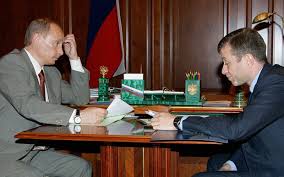
As Chelsea football club edge their way to the English premier league championship trophy, it is worth remembering just how the corrupt links between Chelsea’s Russian oligarch owner, Roman Abramovich and the Russian leader Vladimir Putin have made possible Chelsea’s dominance of English football over the last decade and more.

In this excellent piece from July 2013, Matthew Syed of The Times traced the sordid background to Abramovich’s entry to English football and the baleful influence he has exerted over the game ever since.

Syed’s article appeared just as the popularity of English soccer, especially in the US, was growing and along with that the huge profits that now threaten to transform the game beyond recognition.

With the cash registers cha-chinging away like crazy, few now want to be reminded of this seedy history. Putin’s influence over Donald Trump is fair game, it seems, but not his impact on English football.

Bruce Buck, by the way, is Chelsea’s chairman. Boris Berezovsky was a former business partner of Abramovich and an oligarch in his own right. Berezovsky, who called from his exile in London for the overthrow of Vladimir Putin, was involved in a famous courtroom battle with Abramovich in 2012, which you can read about here. He died about a year later, apparently by his own hand.

Putin and Abramovich

July 3, 2013 Wednesday
Buck stops here in the story of Abramovich

BY: Matthew Syed

It was kind of Bruce Buck to explain just what a benign influence Roman Abramovich, his boss, has exerted upon football these past ten years. Gracing these pages on Monday, Buck talked glowingly about Abramovich’s “passion for the game” and about how Chelsea “engage in hundreds of community activities at home and abroad”.

But he didn’t stop there. Buoyed, no doubt, by the ecstasies of being chairman of such a progressive and enlightened institution, he ventured into Mother Teresa territory to bring home to readers precisely why Abramovich has put his time and money into a football club in southwest London.

Those of us who thought it may have been about his fear of retribution from Vladimir Putin for his part in the rigged privatisations of the Boris Yeltsin era have had it wrong all these years. The very idea that Abramovich had been keen to buy a high-profile British asset as a shield against possible arrest, a theory bolstered by evidence in the Boris Berezovsky lawsuit last year, was not even mentioned by the American.

No, according to the lawyer who was paid to advise Abramovich on acquisitions in the former Soviet Union before being appointed chairman of Chelsea, the Russian billionaire is all about heart. All about passion.

In particular, he is about “building something sustainable, using the name of Chelsea Football Club to have a positive impact on the young and disadvantaged, and making a difference to communities, not just in London, but around the world”.

You may detect an undercurrent of sarcasm in my tone so far, but, whichever way you look at it, Buck is a remarkable character. For years he has attempted to act as the rational, sane, morally uplifting face of Chelsea Football Club. He has been the man who has talked to the press, sometimes even to the cameras, when worries about the moral basis of Chelsea have been at their most intense.

With his emollient persona and quiet demeanour, he has been of huge value to his boss. If an avuncular chap such as Bruce is so visibly involved with Chelsea, people wonder, why should we be concerned about the origins of the money that is bankrolling the operation? But on Monday in this newspaper, Buck chanced his arm, to my mind just a little too much. He attempted to present a portrait of Chelsea so utterly out of kilter with reality, so carefully idealised, that many people finally saw through the mirage. And they began to focus, perhaps for the first time, on the man who has become Abramovich’s lightning rod.

The lack of context in Buck’s portrait of Chelsea was breathtaking. After all, the money that Abramovich has lavished on Chelsea, and which the American was so keen to eulogise about, was gained in the most grotesque of circumstances. Don’t take my word for it. Jonathan Sumption, the QC for Abramovich in his trial with Berezovsky, admitted as much in open court last year.

The story is simple. In return for handing Abramovich and other oligarchs the mineral wealth of the Russian people at a fraction of its true price, Yeltsin was given a multimillion-pound loan and the use of leading television channels for propaganda in the 1996 presidential campaign. Paul Gregory, the economist, described the quid pro quo as “the largest single heist in corporate history and a lasting emblem of the corruption of modern Russia”.

Abramovich spent much of this on extravagant playthings, including a fleet of yachts, helicopters, his own private Boeing and homes around the world. Chelsea, however, were about kyrsha, the Russian word for protection. It was a purchase motivated more by careful political calculation than by passion.

The idea of Abramovich – the man who emerged triumphant from the bloody aluminium wars – as a romantic, dewy-eyed football fan is beneath contempt.

Chelsea do many admirable things. Buck is right to talk about the charitable work that is undertaken by many Premier League outfits, his own club included. But that should not obscure the wider context in which Chelsea operate, and their underlying financial basis.

The real question is: what does Buck have to say about the origin of the money that is paying his salary? It is all well and good arguing that the Russian’s desire is “to build an institution that will provide everlasting joy and pride to Chelsea fans”, but what about how Abramovich boosted his shareholding in Sibneft, the oil producer, by allegedly manipulating wage payments in order to take over worker-controlled stock and conducting a closed share issue in one of its most profitable subsidiaries? The purpose of a free press is to expose these things. It is about penetrating the bulls*** and shining a light on the true basis of relationships.

The reality is that Abramovich used Chelsea as a pawn in a game of far bigger stakes. It is certainly true – as many Chelsea fans point out – that he is not the first dubious owner to have piled into football, but that is no reason to refrain from highlighting the truth about his past. Neither is it a reason to back off those who surround him, and who have made a living defending him.

Buck likes to present Abramovich (and, by extension, himself) as an enlightened, progressive figure. He argues that the Russian has been a huge force for good in English football. The truth is precisely the opposite.

Abramovich has been, for a decade now, an insidious presence in our national game.

Heeeeeeeeeeee’s Back!

Not the one on the left, silly! But the one on the right!

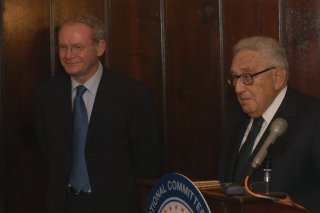
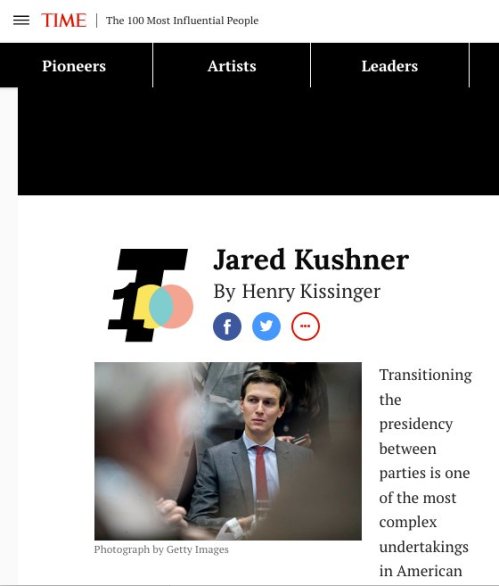
In the columns of Time magazine, un-indicted war criminal, Henry Kissinger reveals himself to be a sometime adviser to Jared Kushner, son-in-law of Donald Trump and said by mainstream media types to be the coming power behind the White House throne and replacement for right-wing loony Steve Bannon.

Canny investors are said to be placing stock market bets on Dow Chemicals, makers of napalm and Monsanto, manufacturers of Agent Orange.

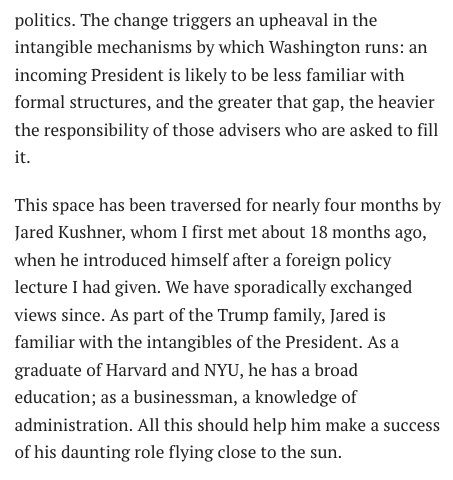
Here is what he says about his new protege:

That Syrian Gas Attack: An Alternative Version