How British Military Intelligence Operated During The Troubles

The description below, of how the British Army organised its intelligence operations during the Troubles which was published in the MacLean report on the killing of Billy Wright, must be regarded as a snapshot of its time, i.e. towards the end of the conflict, and not a definitive portrait of military intelligence throughout the period.

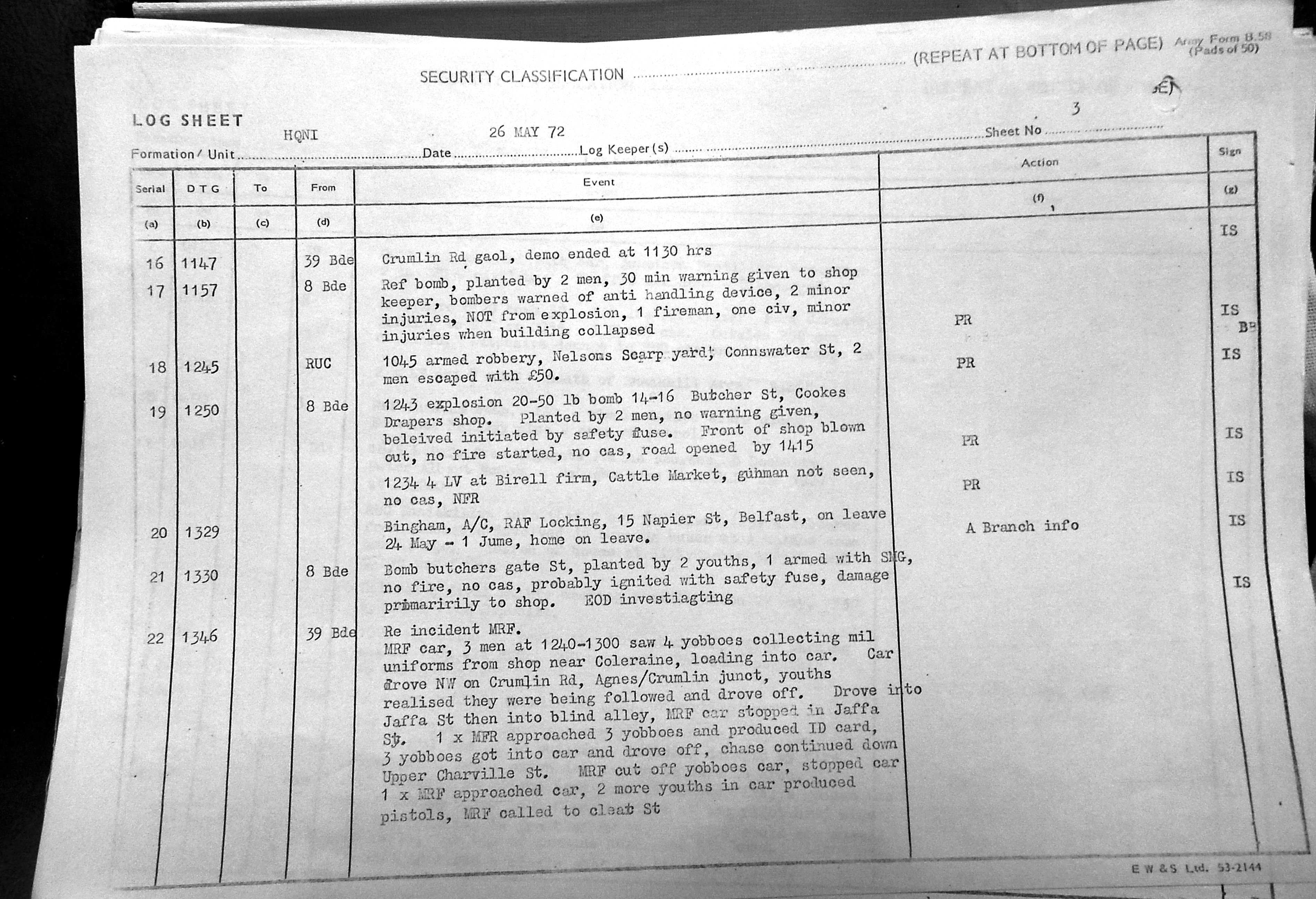
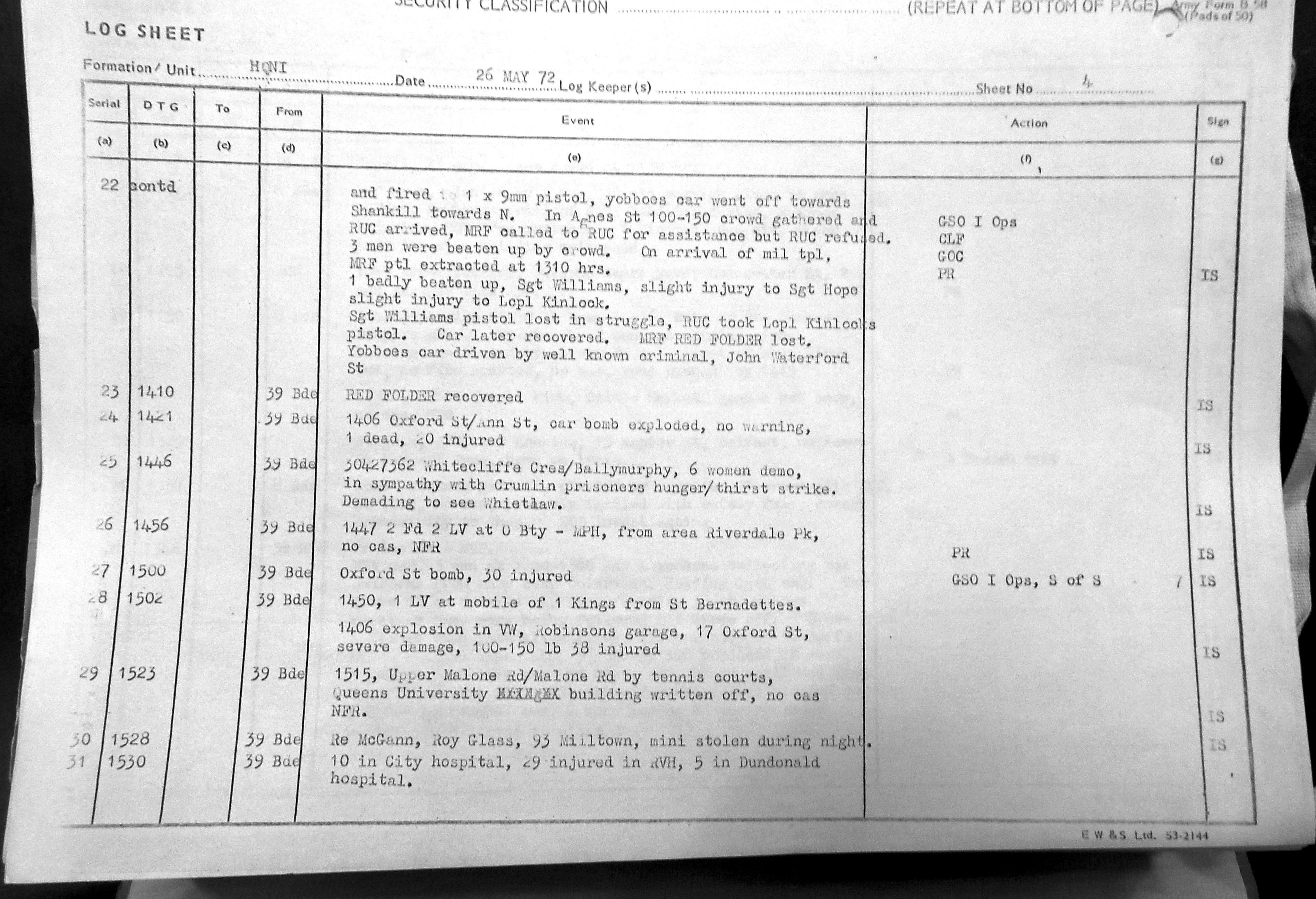
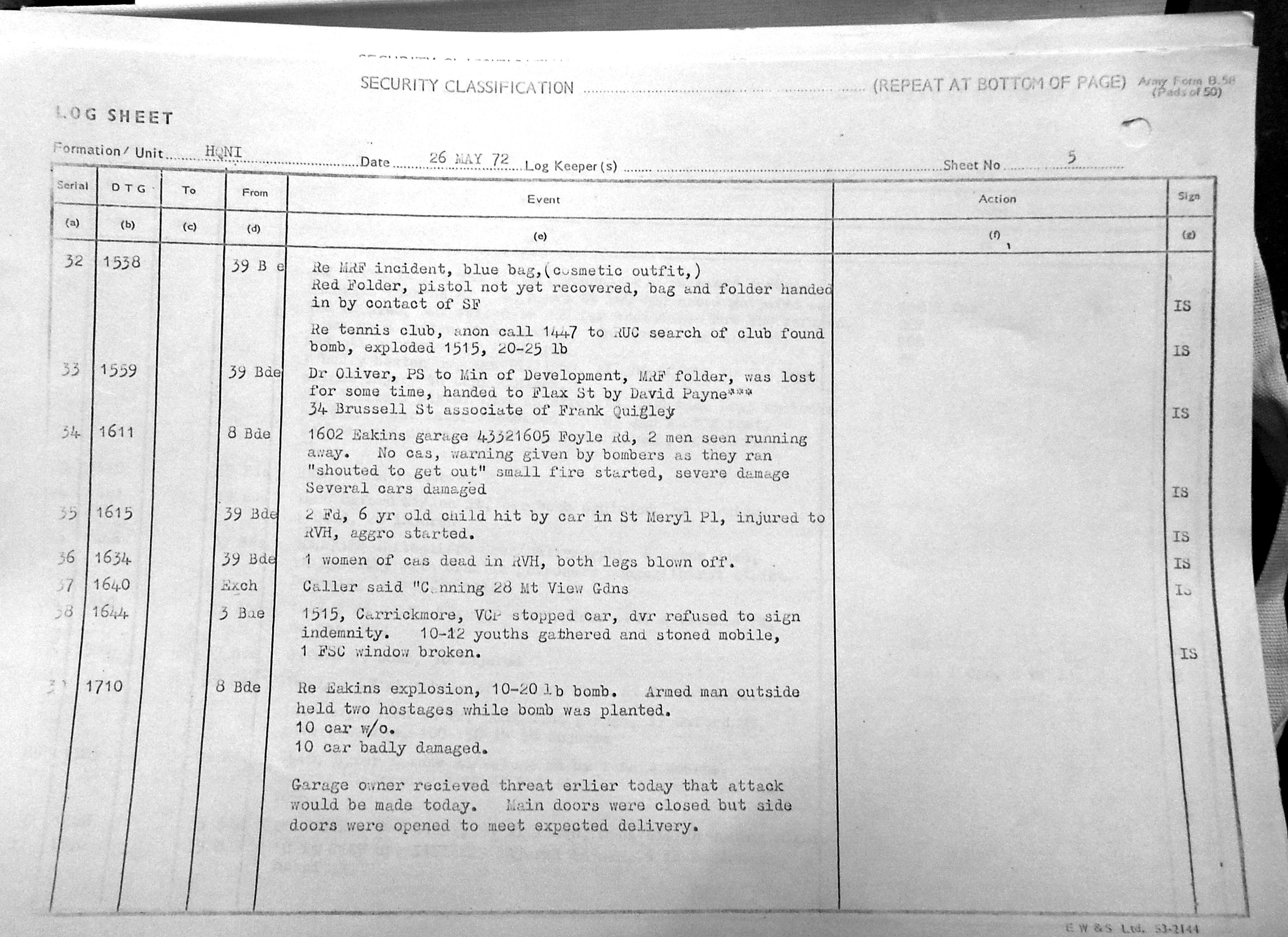
The British Army created a significant number of different units specialising in intelligence work during the course of the Troubles, beginning with the Mobile Reaction Force (MRF) in 1971/72 through to the Force Research Unit (FRU) in the 1980’s and 1990’s, with groups like the Special Reconaissance Unit (SRU) and ‘The Det’ – nickname for the 14 Field Security and Intelligence Company – inbetween.

At the time of the the MacLean report, military intelligence was in the hands of a group called the Joint Research Group (JRG), which was the British Army’s agent running unit:

The Army

The Structure and Role of Army Intelligence in Northern Ireland

5.166 The head of Army Intelligence in Northern Ireland was known as Chief G2, based at HQ NI at Thiepval Barracks, Lisburn. He worked directly to the GOC, and had overall responsibility for all Army intelligence operations in Northern Ireland, for the collection, collation and assessment of intelligence, and for liaison with RUC SB and with the Security Service. All intelligence was studied on a day-to-day basis, with a view to assessing any threats to security forces, particularly from the PIRA, and to consider issues which might affect the political process. The Chief G2 had a direct link with the RHSBs, and with the HSB at RUC HQ at Knock.

5.167 The Army presence in Northern Ireland in the 1990s consisted of three Brigades, arranged on a geographical basis, with 39 Brigade responsible for the Belfast Region. Each Brigade had an intelligence officer, known as the Regional Military Intelligence Officer (RMIO, also known as SO2G2), who worked directly to the Brigade Commander. Below this level came the Battalion. The Battalion Intelligence Officer (IO) was normally a junior officer on a limited deployment of between six months and two years. This person was not an intelligence specialist. Junior staff who undertook day-to-day analysis and collation of intelligence were drawn almost exclusively from the Intelligence Corps.

5.168 The Joint Support Group (JSG) (joint in that it represented all three services), commanded by a Lieutenant Colonel from the Intelligence Corps and with a total membership of a few hundred including civilian personnel, was the Army Source Handling Unit with its HQ based at HQ NI. Its sole function was to run covert agents within terrorist organisations in Northern Ireland. JSG personnel did not undertake covert surveillance operations using technical means.

5.169 The JSG was itself sub-divided into five Detachments, or Dets, which corresponded to the RUC SB regions. One Det related to the RUC Belfast Region, and two to each of the RUC North and South Regions. The OC of each Det would normally have a daily meeting with his SB counterpart, and information flowed in both directions, to ensure in particular that intelligence supplied by Army sources was not out of kilter with that provided by SB sources. Information from Army sources was recorded in documents known as Military Intelligence Source Reports (MISRs), produced and graded by the Agent Handler under the direction and guidance of the JSG Det OC. The MISR was then disseminated electronically on the CAISTER/MACER system, with distribution according to the grading of the MISR to the RUC SB and the Army. The Security Service could also access MISRs on MACER. Hard copy MISRs were provided to authorised addressees in certain circumstances.

5.170 The Army intelligence operation was divided into five areas of work, both at HQ NI and at Brigade level: weapons intelligence; assessment staff; special projects; liaison with the RUC; and clerical administration. The key assessment team at HQ NI consisted of a Major and several Captains. There were no military personnel embedded in the RUC Source Units, but a small Army detachment, consisting of one officer and three or four other ranks, was embedded in E3 at RUC SB HQ. The Chief G2 spoke to this group once a week in order to keep abreast of the particular interests and concerns of the RUC.

5.171 For administrative purposes, management of personnel and the provision of equipment there was an Intelligence Corps unit known as the Force Intelligence Unit (Northern Ireland) (FIU). The FIU played no part in the day-to-day operational work at Brigade or Battalion level, but did, for example, manage the Prison Liaison Office (PLO) at HMP Maze. The PLO provided background information, for example about notable paramilitary visitors to HMP Maze and about vehicle movements; the latter could be logged onto a special computer database known as VENGEFUL.

5.172 A great deal of Army intelligence was low-level, gathered by local Army units, and related to such things as vehicle movements and sightings of individuals. The GOC was more concerned with strategic intelligence, but he would also at times receive tactical reporting, especially during the marching season, when tactical intelligence was especially needed to enable the best deployment of troops to be decided.

5.173 Witness AD, an RMIO, told the Inquiry that he received reports from the Battalion IOs, and on the basis of this information he and his staff produced daily and weekly summaries. These were known as Dailies and Intelligence Summaries (INTSUMs). It was the function of the RMIO at Brigade level to assess the importance of the large amount of information coming in from the IOs, given that the Battalion Intelligence Unit was primarily manned by infantry private soldiers and junior NCOs, whereas the Brigade Intelligence Unit was manned by Intelligence Corps personnel with analytical skills. The Inquiry has seen a number of INTSUMs from the period immediately preceding the murder of Billy Wright, particularly relating to the movement of notable INLA members, contact between them and a PIRA member, and particular gatherings at addresses in Belfast. These INTSUMs may have related to the planning of the murder.

5.174 One of the functions of Army intelligence was to prepare ‘pen pictures’ of key paramilitary individuals who were of particular interest to the security forces in Northern Ireland, sometimes at the specific request of the RUC or the NIO. Witness EA (Principal British Army Intelligence Officer) acknowledged that these pen pictures would necessarily be out of date as soon as they were prepared, as new information was constantly coming in. The task of the collator was to keep all the intelligence in an ordered fashion, so that a pen picture which was as accurate and up to date as possible could be produced on demand.

5.175 The Chief G2 attended the weekly IRC meetings (for details see 5.90). Witness EA, who was appointed Chief G2 in 1998, spoke warmly in his evidence to the Inquiry of the good working relationships which existed between the Army, the RUC SB and the Security Service.5.176 Despite the overall impression conveyed by Witness EA of good, harmonious working relationships between the three organisations, there were clearly some underlying tensions. The primacy role of SB in intelligence gathering could cause difficulties, especially if and when SB was critical of the intelligence gathered by Army sources. The RSU would normally have a fuller picture than the JSG handlers, but that would not always mean that the Army intelligence was less accurate or valuable. Witness EA observed that the Northern Ireland intelligence structure had never been consciously designed; it had evolved, from the 1970s through to the 1990s, and this evolutionary process had not taken full account of the increasingly political nature of the conflict, as paramilitary violence gradually gave way to more subtle and sophisticated political negotiations.


How The RUC Special Branch Operated During The Troubles

More invaluable historical information from the MacLean Report on the 1997 killing of LVF leader Billy Wright by the INLA inside the Maze prison, this time about the operation of the RUC Special Branch and allied intelligence bodies. Some of the detail refers specifically to issues raised by the Wright slaying but that does not detract in the slightest from the value of this study:
The Royal Ulster Constabulary

5.37 During the period with which the Inquiry has been concerned, the police force in Northern Ireland was known as the RUC. Following the Good Friday Agreement in 1998, a major review of policing was undertaken by the Independent Commission on Policing in Northern Ireland, chaired by Christopher Patten, which reported in 1999, and as a result of which the police force changed its name to the Police Service of Northern Ireland (PSNI) and the office of Police Ombudsman was established. This accounts for the references in this Report both to the RUC and to the PSNI.

The Role and Structure of Special Branch

5.38 The function of SB in Northern Ireland was to collect, process and assess information about subversive groups, organisations and individuals from all available sources, and to disseminate security intelligence to those who needed to know it and were authorised to receive it. In 1997 the SB led the counter-terrorist effort in Northern Ireland, and most of the intelligence was either collected by or available to SB. Its relationship with other agencies is touched upon later, but the most important fact which differentiated the intelligence role of the SB in Northern Ireland from what happened in other parts of the UK was that SB had the lead role: elsewhere it was the Security Service which took on that responsibility, but in Northern Ireland the Security Service and the Ministry of Defence (MOD) were subordinate to the SB. The importance of SB in the sphere of intelligence cannot be overstated.

5.39 The second important principle which operated in Northern Ireland was that within SB there was an unusual degree of devolution from Headquarters (SB HQ) to the three Regions. Intelligence work went on at three levels: at RUC HQ, in the three Regions (Belfast, known as E5; North, known as E6; and South, known as E7/8), and in the 27 sub-divisions or local centres of SB operation. Each Regional Head of Special Branch (RHSB) exercised a remarkable degree of devolved authority, and not all intelligence gathered by and available to the Region was passed on to SB HQ. This arrangement, so unlike what was done in other parts of the UK, was said to be because the sheer volume of information during the Troubles could not have been handled by a single headquarters office.

5.40 The PSNI in their final submission pointed out that not all departments were intended to know what the other departments were doing. The PSNI assert that this was not an exceptional or unusual feature of an organisation dealing with intelligence where there was an ever present risk of infiltration or chance compromise. The officers in each department knew that if a function was required it could be actioned, but they did not necessarily know the manner in which it was going to be actioned by one of the related departments within SB. The PSNI emphasised that it was a system that operated on a strict ‘need to know’ principle, and it must be viewed in the particular context of an extremely difficult era.

Computerisation

5.41 The Inquiry has been considerably frustrated by the inability of the PSNI to produce comprehensive written documentation to cover the period with which we have been dealing, and this particular difficulty has been exacerbated by the fact that during the late 1990s a changeover was taking place from ‘hard copy’ records to computerised records.

5.42 No clearly reliable information has been found about precisely how and when decisions about computerisation were taken, nor about how the implementation was to take place. The Inquiry remains puzzled and frustrated that details of such an important move appear not to have been retained by the PSNI.

5.43 The computer systems in use by SB were relatively basic, and they were not the same at each level of operation. At the important Regional level, the computer system in use was called PRISM. At SB HQ, the system used to create and manage the RUC database was known as CAISTER, a name which was subsequently changed to MACER. The Inquiry has heard conflicting evidence about when the change of name took place, one witness believing that it happened in 1997, but acknowledging that it might not have changed until 1999. In any case, the two computer systems were not compatible, and PRISM was not networked to CAISTER/MACER. There was a PRISM computer terminal in SB HQ in 1997, and the SB HQ personnel made use of it from time to time.

5.44 The Inquiry has heard how information from sources was typed onto PRISM at Regional SB HQ. If it was felt that the information should be shared, it was transferred in handwriting to a document known as an SB50, or to a SIR at the Regional Source Unit (RSU). SB50s were gradually phased out during the late 1990s in favour of SIRs. Not all PRISM debriefs became SIRs, but those that did arrived at SB HQ desks on the MACER system and were stored in a stack on the MACER terminal.

5.45 There were cases where the intelligence needed to be more widely disseminated, but with more careful control over the content. This was particularly the case if it needed to be shared with the MOD, and in this case, a Secret Intelligence Dissemination Document was prepared, in which the intelligence had been further sanitised.

5.46 Former Assistant Chief Constable (ACC) Sam Kinkaid told the Inquiry that Regions retained control over the wording of Intelligence Reports (INTREPs) and their dissemination, primarily for reasons of source protection, and that not all information about serious crime that should have been disseminated was in fact shared with those who needed to know it. The ‘need to know’ criterion was used excessively, and with sometimes unhappy results in terms of the failure to share important information.

5.47  The nature of each computer system meant that there were serious shortcomings in terms of the use and analysis of intelligence. Witness ZCQ, who worked until June 1997 as Detective Chief Inspector on the Republican Desk at SB HQ (Desk E3A – see later in this Chapter for further details), said in evidence:‘… the old paper system was much easier to deal with … When computerisation came along, the way that the system was configured meant that different people could carry out searches in different ways, and at different times could actually produce different results. So I think the computerisation, rather than bringing us the aid it was meant to, actually posed us a number of difficulties in terms of retrieving material in as simple a fashion as we used to be able to do with the paper system.’That particular difficulty needs to be borne in mind when considering the way in which SB handled intelligence material, and the success (or otherwise) with which it was analysed and assessed.

The Warner Report

5.48 An important development which influenced the structure and working of RUC SB during the period covered by this Inquiry was A Review of Special Branch conducted by Sir Gerald Warner. This arose out of a perception by the UK government that there were shortcomings in the quality and strategic analysis of intelligence in Northern Ireland, and that a revised structure for SB, with a stronger emphasis on analysis, made possible by the introduction of trained analysts, would be highly beneficial. The breakdown of the Provisional Irish Republican Army (PIRA) ceasefire, with the planting of the Canary Wharf bomb in February 1996, had not been clearly foreseen by the intelligence agencies, despite the many indications of stresses in the ceasefire. There was a clear need to improve the processes by which political and strategic intelligence was collected and analysed. The Warner changes were introduced in the latter half of 1997, and resulted in the creation of a new Intelligence Management Group (IMG) to oversee and direct the work done by the existing departments known as E3 and E9.

5.49 The role of the IMG was fivefold: to act as the central collection point through which all operational, strategic and political intelligence arrived at RUC HQ from the SB regions and elsewhere; to act as the central point for decision making about the further dissemination of intelligence; to coordinate and guide the intelligence strategy of RUC SB; to conduct briefings and meetings with the Source Units in the regions (see paragraphs 5.70 and 5.71) in order to improve the flow of intelligence; and to provide the Head of Special Branch (HSB), as well as the various security and intelligence committees in Northern Ireland, with briefings and intelligence. In February 1998 the processes were further improved by the agreement of a Memorandum of Understanding between the IMG and the Assessments Group (AsGp) of the Security Service, setting out the respective roles of the two groups in the assessment and dissemination of intelligence.

5.50 Diagrammatic explanations of the structure of SB both pre-Warner and post-Warner are to be found at Appendix D to this Report. For the purposes of this Inquiry it is important to note that the crucial warnings regarding the Irish National Liberation Army (INLA) threat to the life of Billy Wright in April 1997, communicated by the Security Service to RUC SB, arrived before the Warner changes were implemented, and the lead addressees were the Chief Superintendent Intelligence, the Superintendent E3 and Deputy, E3 Republican Desk, Superintendent E9 for E9A and E9D, Desk Officers, DI E3E, RHSB(B) and Superintendents as appropriate.

The Departments of Special Branch

5.51 By the time of the murder of Billy Wright, the Warner Recommendations appear to have been implemented, so reference will be made here to the structure of SB as it was post-Warner. E1 was an administrative department; E2 dealt with training; E3, part of the new IMG, included the desks which handled intelligence about paramilitary activity. These were known as E3A in the case of the republican groups, and E3B in the case of loyalist groups. In addition to this there was Central Desk, formerly E9A, which concentrated on running ‘lifestyle’ operations, intended to build up an intelligence picture of different paramilitary groups and individual members of them. It also focused on high-level strategic targets, particularly within the PIRA. Its work was directed by the Intelligence Review Committee (IRC), a high-level body which was able to assess priorities for the work of Central Desk (see 5.90).

5.52 The regular morning meeting was a key feature of SB operation, both at HQ and at regional level. At HQ the morning meeting was attended by the head and deputy head of IMG and the heads of the Republican and Loyalist Desks and of E9A (later Central Desk). The main purpose of the meeting was to carry out a review of the intelligence which had been collated in the previous 24 hours, and to discuss what action, if any, was needed. Information was shared and briefings prepared for the HSB and his Deputy (DHSB), who would in turn brief the Chief Constable. Similar morning meetings took place in each Region, and briefings from the RHSB reached the HSB at HQ by mid-morning. No notes or minutes were taken at these morning meetings, but decisions were taken in the light of the current intelligence position, and whoever was nominated to take any specific action noted this down in his day book, which was a police-issued A4-size notebook. These books were not retained, which means that there is an absence of an audit trail of decisions taken at morning meetings. The Inquiry has heard conflicting evidence about the attendance at the daily morning meeting at HQ, but it seems more likely that the heads of desks met daily with the HSB and head of IMG, notwithstanding the claim by the latter that such meetings were only weekly. It was the role of SB HQ to be primarily concerned with strategic intelligence, and the head of the IMG had little knowledge of day-to-day tactical operations, organised by the Regional Tasking and Co-ordinating Groups (TCGs, described in more detail in 5.66 to 5.68).

5.53 E4 consisted of two departments, one of which ran surveillance operations (E4A). Some such operations were the responsibility of SB HQ although the majority of surveillance operations were run by the Regions (see below). The other department was known as the Headquarters Mobile Support Unit (HMSU), which provided teams of uniformed officers, including firearms teams, to carry out operations.

5.54 E5, E6, and E7/8 remained the same post-Warner as they had been previously, i.e. the regions of SB to which so much work was devolved.

5.55 The Head of the IMG met daily with the HSB, and (probably) with the heads of the desks, and less frequently with what was called the Senior Management Group. The daily morning meetings were about current events and problems, while the relatively infrequent Senior Management Group meetings were more to do with costs and policy, and involved RHSBs.

Contact between Special Branch HQ and Other Agencies

5.56 The E3A and E3B desks were the point of contact with other intelligence agencies, notably the Security Service and the MOD. They liaised with these agencies, and received intelligence from them. Security Service intelligence normally came to E3 by secure telex. It was then printed off in hard copy and circulated through the desks. SB received NIIRs in hard copy from the Security Service: these were a sanitised version of the raw intelligence. Copies were circulated to a defined readership for their information, but then returned to the Security Service with one copy retained in the registry. The information would then be entered onto the computer database as an INTREP, from which it could be retrieved by those qualified to have access to it. There might on occasion be disagreements between SB and the Security Service about intelligence, about its reliability or accuracy, and there were ways of flagging up such disagreements and seeking to resolve them. Witness FG, then an SB officer in E3A, claimed that the Security Service would not normally have intelligence of which SB were not already aware, since SB were the lead agency. He also made the point that there was a greater awareness within the Security Service of the political context of intelligence, and less concern with operational details. The Inquiry has, however, heard a good deal of evidence to indicate that the Security Service did in fact have access to much intelligence which was not known to SB and which they passed on to the RUC.

5.57 It was the responsibility of the desks to prepare assessments of intelligence for the benefit of senior management within the RUC. These took the form of Intelligence Management Group Intelligence Reports (IMGIRs), which were composite documents, drawing together a number of strands of reporting into a single document.

5.58 A further link between SB and the Security Service was provided by the Security Service officer who represented the Director and Co-ordinator of Intelligence (DCI) at RUC HQ Knock, known as DCI Rep Knock. He was mainly concerned with processing applications for warrants to install technical surveillance and eavesdropping equipment requested by SB, for which the permission of the SOSNI was required. DCI Rep Knock agreed that warrantry work ‘is the seeking of lawful authority for the undertaking … of intelligence-gathering by means which would otherwise be unlawful’. It was also the responsibility of this individual to distribute NIIRs to the RUC, after they had been produced by the AsGp of the Security Service.

5.59 Contact between SB and the Army normally took place primarily at regional level, so the Desk Officers at HQ had little contact with MOD personnel.

5.60 As far as the NIPS was concerned, contact between SB and the NIPS was at HQ level, between E3 and the PIU. There was also contact at regional level, and E3 sent a representative to the meetings of the PLG which discussed the MIARs which were prepared from prison intelligence.

5.61 A further link between SB and the NIPS was provided by the Prison Intelligence Liaison Officer (PILO), who was a Detective Constable attached initially to HMP Maze and then, when HMP Maze was closed in 2000, to HMP Maghaberry. He was known to the Inquiry as Witness FA. He had an office in the neighbouring Army compound outside HMP Maze, and his task was to obtain any intelligence which emanated from the prison, whether concerned with prisoners or visitors, which was likely to be of interest to SB. Non-urgent intelligence was written onto an SB50 and hand-delivered to the Divisional RUC office at Lisburn, where it would eventually be loaded onto the computer database. Urgent information was passed to Lisburn by telephone. Witness FA believed that he was always the conduit for intelligence coming in and out of HMP Maze, and it was very unlikely that any intelligence bypassed him. The fact of the PILO’s location in the Army compound was useful in that it allowed a ready interchange of intelligence between SB and the Army, in particular the Royal Military Police who manned the watchtower next to the visitors’ reception area.

Embedded Security Service Officers

5.62 Following the Warner Report a significant change took place which improved the ability of SB to analyse intelligence. Trained analysts were seconded from the Security Service to the desks at SB Headquarters, in particular to help with the preparation of IMGIRs. This meant that the strategic dimension of intelligence was more adequately treated than had been the case previously, when only fairly rudimentary analysis had been carried out by SB’s own personnel, none of whom had received specific training in the analysis of intelligence. The change also meant that the Security Service and the MOD received more of SB’s tactical intelligence.

The Regions

5.63 The importance of the Regions has already been emphasised and this part of the Chapter explains the structure of each Region, under an RHSB, assisted by a Deputy (DRHSB). It is noteworthy that the RHSB in Belfast Region in 1997, Witness ZBQ, had transferred from RUC Uniform Branch in 1996, and had never served previously in SB.

5.64 Under the DRHSB came the two main component parts of the Region: the TCG and the Support Unit, which in turn consisted of the Source Unit and the Project Unit. Each of these will be briefly described. Under them came the Divisional structure of each region.

5.65 There was a daily morning meeting chaired either by the RHSB or by his deputy at which the intelligence for the previous 24 hours was discussed and agreement was reached on what action needed to be taken. This meeting was also attended by the Divisional Superintendents, a representative from the TCG and representatives from the Support Unit’s Source Unit and Project Unit. This meeting was an opportunity for the sharing of information, and for decisions to be taken by the RHSB or his deputy in conjunction with the Head of the appropriate Division.

The Tasking and Co-ordinating Group

5.66 The main function of the TCG was to coordinate all security force operations within the Region, involving both long-term intelligence gathering operations (including pattern of life operations), and live action operations which might arise on a day-to-day basis. A live action operation would be mounted in response to specific intelligence which suggested, for example, that a particular act of terrorism was being planned. The decision to undertake an operation involved weighing up priorities and deciding how best to use the available resources. It might be necessary to postpone some of the long-term work if the need for live action operations necessitated using all available resources. Work on the long-term project might then be resumed later when the pressures were fewer.

5.67 Decisions about reactive operations would normally be taken at the regular daily morning meeting, but could be started at any time if the degree of urgency required an immediate response. Each operation would be in the hands of a case officer, with information shared with E4 and the HMSU. A suitable team for the operation would be selected, and approval sought from the Regional ACC and the HSB. The Regional ACC retained overall responsibility for the duration of the operation, and the HSB would brief the Chief Constable as necessary. Once an operation was approved, it was left to the TCG to run it. If the Army was involved in a TCG operation, a military liaison officer would be part of the team in the operations room. The TCG used both surveillance teams supplied by E4, and uniform support from the HMSU.

5.68 A record of each operation was kept on a file, with the records generated by the TCG in running an operation known as logs. Details were also entered on the PRISM computer system, but until mid-1998 hard copy records were also kept. An instruction was issued in June 1998 that records should be kept by the TCG, either in written form or on computer, for one year, or longer if a court case was pending.

Dedicated Army Units

5.69 These teams were much smaller than police teams. The Army team leader would come into the TCG each morning for the morning briefing. The TCG would provide the team with a target, but it then became a matter for the Army unit as to how surveillance was carried out. Police teams worked separately from the Army units, although tasks could be handed from one to the other. The dedicated Army units were never privy to SB intelligence, and most of the information they gathered was of a routine nature.

The Support Unit

5.70 The Support Unit consisted of two departments: the Source Unit, which dealt with human intelligence; and the Project Unit, which dealt with intelligence obtained by technical means.

5.71 The work of the Source Unit involved mainly the debriefing of SB Agent Handlers. This led to the creation of a debrief document, probably several pages long, made up of a narrative of the facts reported by the agent, together with appropriate comments and explanations added by the handler. Source protection was of paramount importance, but it was also vital that the right customers received the intelligence. The debrief would then be typed onto the PRISM intelligence database. In 1997, the number of debriefs handled each day varied considerably: as few as half a dozen could be received but the number might be much higher. If the information contained a threat to life, an action sheet would be prepared by the Source Unit. The handwritten debriefs were retained for as long as the agent was active.

5.72 The dissemination of intelligence ensured that, in theory, everyone who needed to know the intelligence received it; this included the TCG, the Divisions, and the RHSB. If wider dissemination was deemed to be necessary, for example to another Region, an SB50 would be produced, which was a sanitised version of the original debrief, and would eventually find its way onto the MACER/CAISTER intelligence database.

5.73 The Project Unit processed information obtained by technical means. It also had the capacity to run sources, and at times Project Unit staff acted as the secretariat for the RHSB. Decisions as to who should be targeted for technical attack were made at Divisional level. An intelligence case would be put together, and would be submitted to E3 and to the Security Service DCI, who would be asked to provide the necessary warrant for the installation of the technical device.

5.74 The product of eavesdropping was fed to a listening post, and the product was transcribed in the Project Unit. It was then kept and disseminated in hard copy form.

The Divisions

5.75 Each SB Region was sub-divided into Divisions. In the case of Belfast Region there were four: A (central); B (west); D (north); E (east). Each Division had a modest management structure under a detective superintendent, reporting to the DRHSB. B Division included HMP Maze. The core task of the Division was the collection of information from human sources. The recruitment of the sources themselves was authorised by the RHSB and the Divisional Superintendents. Details of those recruited were sent to the HSB or DHSB, and lists of all sources operating within the Belfast Region were securely maintained under their authority.

5.76 In the period between 1996 and 1998 a distinction was made between sources who were formally registered or recruited, and those who were regarded as casual contacts. Registered sources were given a code name and reference number and received regular payment; this did not apply to casual contacts. As soon as the recruitment process began, the candidate would be allocated a reference number; if the recruitment was for any reason unsuccessful (and each candidate had to be interviewed at least three times before registration), the number would simply be cancelled. The only instance in which an individual might have had two reference numbers would have been if he had been recruited, then stood down, and then recruited once more. Such an interruption would have been recorded in the individual’s personal file. There was an annual review of each source, conducted by the Source Unit, to which SB officers from the Division contributed. There was also an ongoing rolling assessment programme, and the services of an unproductive source could be terminated at any time.

5.77 The source handlers within the Division were normally detective constables or detective sergeants, and each source had a minimum of two handlers. The briefing of the sources was in accordance with the intelligence requirements which were fixed by the IRC, fed down to the Source Unit from the RHSB, and then passed on to the handlers in the Division. A record of the tasking of handlers was normally kept and the source product filed, and before a handler met a source, he would check the files for the latest tasking requirement. From time to time the TCG could task handlers in relation to an ongoing operation, for example with the object of identifying a hitherto unidentified person. After a handler had met a source, the handler would be debriefed in the Division by the case officer unless the matter was entirely routine. In case of urgency, intelligence could be passed verbally to the TCG. It was the task of the Detective Inspector within the Division to look at the previous day’s intelligence, ascertain the need for any re-tasking of sources, and brief the source handlers accordingly. The Inspector would then oversee whatever meetings were to be conducted on that day and review the product which came back from those meetings. If any action was required it would be decided at the morning meeting chaired by the RHSB.

Threats

5.78 Under RUC Force Order 60/91 a threat to life was to be communicated to the individual concerned. Former ACC Kinkaid’s report of 9 October 2007 to the Inquiry points this out:‘There were so many threats to be processed in 1997 that the procedures used were well known to all officers. Threats existed against security force members from paramilitaries, against paramilitaries from other paramilitaries (usually of a sectarian nature) and even within paramilitaries when feuds developed. Police officers had to warn members of paramilitary organisations they were under threat, including members of organisations who were planning attacks against the very police force who was passing the message.’

5.79 The Force Order set out in great detail the procedure in relation to the intimation of threat information in the case of different potential victims, politicians, prison officers and other individuals. In the case of prisoners, the case with which this Inquiry is concerned, paragraph 2(7) of the Force Order applied. Witness FG told the Inquiry that paragraph 2(4) also applied. There would be notification to the NIPS HQ, but ultimately it was a matter for the Division, who would deal with the threat in terms of direct contact with the governor of the prison concerned. The information would probably have been passed also to the relevant RSU, where an action sheet would have been prepared. The information on the action sheet would have been delivered either by the PILO or by local uniform police from the sub-division concerned, which in the case of HMP Maze was Lisburn. It would have been unusual for the Desk Officer to have contacted the prison directly, although he might well have passed the information on to the PIU.

5.80 Witness FA, PILO at HMP Maze, stated that he had never personally delivered threats to prisoners. The threat would have been passed by him to Prison Security and they would have warned the individual. Superintendent Stanley Clements, the Sub-Divisional Commander for Lisburn, had no recollection of any threats being passed through his office to be delivered to any prisoner. Such threats if they existed would be channelled through the SB Liaison Officer directly to the governor or his deputy who would deal with the threat. To comply with the Force Order would necessitate the production of the prisoner to the police. In order for the police to speak to the prisoner the authority of the governor was required, and within HMP Maze authority from the block Officer Commanding (OC) was also required. It was still at the discretion of the prisoner whether he spoke to the police. Superintendent Clements had no recollection of any request to deliver information regarding a threat to Billy Wright while he was in either HMP Maghaberry or HMP Maze. Threats to prisoners received by SB should normally have gone through the relevant Regional SB and resulted in the generation of an action sheet from the Source Unit in the Region, following which the information would be relayed to the prison.

Action Sheet

5.81 In relation to any threat, an action sheet would be created, and this would be done regardless of the threat assessment. It was an absolute obligation on the RUC to inform threatened individuals, unless there had been a conscious decision that the threat should not be passed on. It was a requirement on the part of the Regions, or stations within the Region, to keep a threats book. In relation to HMP Maze, the threats book would have been kept at Lisburn sub-division.

Monitoring Threats Received by the Regions

5.82 If intelligence had gone to the Regions in the first instance, it was the responsibility of the Desks at HQ to ensure that appropriate action had been taken. If SB HQ received information from the Regions about a threat to prison officers, it would have been discussed at the morning meeting. If the threat was immediate, by the time of the morning meeting some action would already have been taken in respect of that intelligence. This would not have been recorded but the fact that action was taken would have been recorded on the intelligence document that contained the details of the threat.

Security Service

5.83 If a threat was received by the Security Service, as in the case of the 21 April 1997 threat to the life of Billy Wright, it would be communicated to SB HQ. The Desk concerned would receive the information verbally from the Service by a telephone call, and the originator of the message and the recipient would agree a form of words to be used. The information would be recorded on a message pad, and a copy would be retained at the Desk. If the threat information was urgent, SB HQ would generate a debrief immediately and an action sheet. The action sheet would be passed to the appropriate sub-division, and the debrief would go onto the PRISM intelligence database and in due course onto the CAISTER/MACER intelligence database. If the threat was non-urgent, it would come from the Security Service in the form of a NIIR or a Source Report, and be processed thereafter. E3 prepared threat assessments, based on information such as how many previous similar threats had been received against a particular individual, and whether there was corroborative reporting.

5.84 A decision open to SB in response to a threat was the possibility of disruption, which could involve a number of possible actions, such as placing a uniform police patrol in the vicinity of the target; or moving a threatened individual or family (as sometimes happened overnight); or carrying out a search of a suspect property. The TCG controlled both the surveillance team (E4A) and the Specialist Firearms Team (part of the HMSU), either or both of which might have been involved in an operation to prevent a specific threat from being carried out.

5.85 Former ACC Kinkaid said,‘Clearly in the case of Billy Wright the existence of a threat to him in the prison could have been dealt with by a combination of warning and disruptions, i.e. moving him.’None of those who gave evidence to the Inquiry on behalf of the PSNI, including ACC Mr Alistair Finlay and former ACC Kinkaid, has been able to explain why the specific 21 April 1997 threat to the life of Billy Wright, received by SB from the Security Service on 24 April, was not passed to Billy Wright or to the NIPS. This is particularly surprising, since the Inquiry has heard evidence of at least eight occasions between 1991 and 1996 when the RUC did pass on threats to Billy Wright (see Chapter 4).

Submissions by the Police Service of Northern Ireland

5.86 In view of the sensitivity of the April threat, it was to be expected that Counsel for the PSNI would devote some time in his closing submissions to the matter of threats and how they were handled. He raised a number of questions about what properly constituted a threat, whether new information added to what was already known, whether any particular timeframe or location was included in the intelligence, what action could be taken in the light of that information, and the risks involved in taking action. He acknowledged the moral imperative to act on a threat, but emphasised the need to consider and assess the intelligence. The case made by Counsel for the PSNI in closing submissions is dealt with in greater detail in Chapter 15.

Structure and Background

Special Branch Participation in High-level Meetings

5.87 Senior SB officers attended a number of coordinating meetings. Four of those are referred to below.
(a) The Security Policy Meeting (SPM)

5.88 This was the most important meeting, attended by the SOSNI, the Chief Constable, the General Officer Commanding, the DCI and the PS. A brief from this meeting was prepared for the Chief Constable by the Detective Chief Inspector in charge of E3A, the Head of the E3 Desks, and would have covered the work of all the Desks. This was the means by which SB had input at the highest possible level in terms of the governance of Northern Ireland.
(b) The Province Executive Committee (PEC)

5.89 The HSB, or in his absence the DHSB, would attend these meetings for which a synopsis of intelligence would have been prepared for the HSB/DHSB. The DCI presented the political perspective on behalf of his customers in Whitehall and in Stormont. This provided both the RUC Deputy Chief Constable (DCC) Operations and the Commander Land Forces with a better understanding of the political imperatives which were driving government policy at the time. The minutes of this meeting were classified ‘secret’ and were kept either in SB HQ or in the Chief Constable’s Office.

(c) The Intelligence Review Committee

5.90 This meeting took place weekly, chaired by the DCI. It would be attended by the Head of the AsGp (HAG) and one or two of his subordinates, the Assistant Chief of Staff G2/G3 representing the Army, and the HSB or the Head of E3/IMG. This meeting dealt with strategic intelligence requirements and priorities, reviewing priorities on a monthly basis. The objective of the IRC was to ensure that middle-ranking officers in all three of the organisations concerned (the RUC, the Security Service and the Army) understood the impact of strategic intelligence requirements, and were working in a harmonious and coordinated way.

(d) Meetings with Chief Constable and Regional Assistant Chief Constables

5.91 The HSB had formal morning meetings with the Chief Constable, having spoken previously with his Deputy before the meeting. He also had morning meetings with the Regional Assistant Chief Constables, the Deputy Chief Constable (DCC), a representative from C Branch and Head of Operations Branch. Special Branch and the Criminal Investigation Department.

5.92 Mention has already been made of the mystery surrounding the failure of SB to take appropriate action in response to the threat to the life of Billy Wright which they received from the Security Service in April 1997. Since no explanation has been forthcoming for this failure, it can only be a matter of speculation. But it raises the question in principle of the willingness of SB to communicate adequately, a weakness which is also evident in the relationship between SB and the Criminal Investigation Department (CID). It would be natural to assume that these two arms of the RUC would have wished to work in the closest and most constructive partnership, but this appears not to have been the case in 1997.

5.93 This was made particularly clear to the Inquiry in the evidence which it heard about the investigation into the murder of Billy Wright, conducted by Detective Superintendent John Short of West Belfast CID and Detective Chief Inspector Noel Nicholl based at Lisburn CID. The matter of the investigation is dealt with more fully in Chapter 14 of this Report, but it is mentioned briefly here in view of its relevance to the structure and working of SB. In his evidence to the Inquiry Mr Short was asked whether he had approached SB to find out what relevant information they had which would be helpful in his investigation of the murder. His answers were not entirely clear; he did claim that a SB officer was attached to the murder inquiry team but he could remember nothing that SB had contributed. Mr Nicholl was more forthcoming and acknowledged to Counsel for the Wright family that if there was any intelligence about the murder before it took place, that intelligence would have been known to SB; that a SB officer sat in on the murder inquiry team, but that no intelligence was forthcoming. He expressed surprise that surveillance had taken place and intelligence been received, and yet nothing had been shared with the CID investigating officers. The Inquiry has seen clear evidence that relevant intelligence was available to SB.

5.94 It is important always to bear in mind the security constraints which attached to any sensitive intelligence in Northern Ireland in 1997, and the overwhelming predominance of the ‘need to know’ principle, often interpreted in its most restrictive form. But it remains the Panel’s impression that communication, even when highly desirable and even necessary for the carrying out of police work, was not always as effective as it should have been.
The Processing of Intelligence by Royal Ulster Constabulary Special Branch

5.95 Mr Chris Albiston, Head of the IMG in 1997, in his witness statement for the Inquiry, set out the Intelligence Cycle as it should in theory work.

5.96 First, the intelligence requirements needed to be established, and this was the task of the IRC (see 5.90).

5.97 Much intelligence also flowed naturally from very many sources and agents who were supplying it, and they did not by any means always work in accordance with a strategic plan. The flow of intelligence from a source was initially to the Agent Handler, who received the raw intelligence in debriefing the agent, discussed it with a case officer (or controller, the Agent Handler’s superior) at divisional level, and determined whether it needed to be disseminated with any degree of urgency. The intelligence, having been collected, was then subject to evaluation of the reliability of the source, and the likely accuracy of the information as a result of which a grading was applied. So, for example, B2 meant that the intelligence was from a usually reliable source, and had a high degree of credibility, and this particular grading is commonly found on SB intelligence documents from known sources.

5.98 Following this evaluation, the intelligence debrief was handwritten by the Agent Handler and submitted to the Source Unit at SB Regional HQ. The Handling Team then created a manuscript form SB50 (subsequently a computerised SIR), and passed it to typists who loaded it onto the CAISTER/MACER database. The Handling Team then passed a local action sheet to the CID. Meanwhile, the Source Unit put the intelligence onto the PRISM system, with care being taken to ensure that the PRISM document corresponded accurately with a handwritten debrief. Intelligence was then discussed with the RHSB at the morning meeting, and shared, as appropriate, with other Regions.

5.99 If other agencies were to have access to the intelligence, it would be disseminated from SB HQ, from the CAISTER/MACER database, and sanitised to varying degrees according to the ‘need to know’ principle, and with particular concern for source protection. If an operation was ongoing, then often the intelligence would not be shared with SB HQ. If new intelligence required a response in terms of operational action, that would be undertaken by the TCG. The PSNI in their final submission pointed out that RSUs had the opportunity to share intelligence with E3 and other divisions within the SB HQ structure. The decision upon the materials selected for sharing and the destination of such information was made at regional level.

5.100 One aspect of the processing of intelligence which left much to be desired was analysis. It was a perception that there was inadequate analysis of intelligence which was one of the reasons for the establishment of the Warner Report of 1996. As Mr Albiston pointed out, assessment and analysis are not the same thing, although the terms were frequently used as synonyms. He described analysis as ‘an independent art or science’, and it requires specific and specialised training. The Embedded Security Service Officers (ESSOs) at SB HQ (see 5.62) began to fill this gap in the capability of SB from 1997 onwards, but until that time analysis of a kind was carried out in the Regions and within the sub-divisional offices. The detective sergeant or inspector would try to identify a trend in the intelligence coming in, and to see whether it needed to be shared with another Region, but there were no formalised procedures. The Source Unit provided a weekly summary of intelligence, and drew such conclusions from it as it could. The Warner Report envisaged the provision of ESSOs also at SB Regional level, but this recommendation was not implemented.

5.101 Witness ZBQ (who served as RHSB) acknowledged that the regular morning meeting provided an essential part of the processing of intelligence, and offered some opportunity for informal analysis. It was suggested to him that if some aspect of intelligence was not picked up, or its significance not recognised, at the morning meeting, it might have been lost from sight; but he believed that the divisional superintendents concerned with it would have retained an awareness of it. He agreed that the memories of individuals played a large part in the handling of intelligence, which was by current standards a potential source of weakness. He also recalled the Alpass Report of 2000, which contained recommendations for improving the process of handling intelligence (see 5.112). The burden on senior managers had become very heavy by 1997, with 30–40 debriefs in a day, and although efforts were made to identify trends and draw together different strands of intelligence, it was not a system without shortcomings. Witness ZBH also acknowledged the point made by Alpass that full value was not always extracted from intelligence by SB because it was insufficiently studied and analysed.

5.102 Witness FG told the Inquiry that he was the main analyst at SB HQ for the dissident republican groups. He made use of information from CAISTER/MACER, and from such PRISM intelligence as the regions had provided to HQ. He created target lists of key individuals in the dissident republican world, identified their particular role (e.g. quartermaster), and worked out who was likely to be involved in military action or who might be storing weapons. This information was for the benefit of SB’s own operations and for its external customers, but most of it was tactical and the need was for more strategic intelligence, for which the politicians were crying out. They needed to know what the trends were, what was going on behind the scenes, from reliable sources rather than from paramilitary propaganda. After the ceasefires in 1994 and the renewed PIRA ceasefire in 1997, there was a strategic role for the IMG in monitoring the degree of compliance, and assessing the significance of the many breaches of the ceasefire which took place.

5.103 The reliability of sources varied greatly, and there were sometimes disagreements between the trust placed in an agent by the Agent Handler and the judgement of the SB Desk Officer. This was not unexpected, since Agent Handlers tended to be protective of their sources, but Desk Officers had a broader view from a variety of sources. Much of the intelligence which came in was in fact spurious, and there were some sources who became known as ‘intelligence nuisances’. Opinions about a particular source might well vary from one agency to another, and it was not unknown for a source to produce 99 per cent nonsense and one per cent good intelligence. Good Handlers and good Desk Officers needed to work together to recognise such sources and to decide whether to continue to pay them. The re-tasking of an agent was sometimes necessary, in which case a list of questions would be decided on, and put on the relevant source file for the handler to pick up before the next meeting with the source.

5.104 Some intelligence was so sensitive that the handler would immediately recognise that it required special treatment. The superintendent might decide that it should be the subject of a secret report, in which case the normal debrief process through the Source Unit would not be appropriate, and a secret report would be sent directly to the HSB with the RHSB informed. The Inquiry heard somewhat conflicting evidence about how frequently such extremely sensitive information would have to receive this special treatment, but it seems clear that there were very few such occasions. The PSNI in their final submission rejected the suggestion that handlers were in a position to sift and sort what they wanted to refer to the Source Unit, and that the way in which incoming information from sources was summarised had the potential to exclude data. This appeared to the Inquiry to be a particularly defensive statement, since the improper summarising of information from sources does not appear to have been suggested by those who gave evidence to the Inquiry.

5.105 The PSNI system did not provide to the Inquiry either documentary or electronic manuals about the regulation of the system. The PSNI defended this upon the grounds that it always had to be mindful of the great risk at which sources were operating, and it was necessary to protect them at all costs. The Home Office guidelines for dealing with ordinary crime sources were, it was said, not applicable to the particular circumstances in which SB and their agents were required to operate. PSNI drew attention to the reference made by Lord Stevens to their attempts to seek assistance from government with a view to obtaining further guidance and the establishment of guidelines which were appropriate to the special circumstances of Northern Ireland. The PSNI claimed that such further guidance was not forthcoming.

Group Numbers and Data Security Levels

5.106 Access to the PRISM database was restricted by reference to Data Security Levels (DSLs) and Group numbers in a wide range which related to the sensitivity of the information, and to the staff members who could have access to the intelligence. The CAISTER/MACER system, which was the central SB database for intelligence which was to be shared with other agencies, including the Army, used a similar protection set of DSLs, but in a different numerical range.

Dissemination of Criminal Intelligence

5.107 In 1997 criminal intelligence was recorded on a database known as PACIFIC, which in 1998 became the Integrated Criminal Information System (ICIS). It was not clear to the Inquiry whether SB had direct access to PACIFIC in 1997, although subsequently they did have access to ICIS. Witness DB (who led the Support Unit in Belfast Region SB) explained that SB could obtain information stored on the CID database either by asking the CID intelligence officer for the relevant division, or by interrogating the CID intelligence cell. There were also SB officers attached to the CID, through whom an enquiry could be directed. It was sometimes necessary to conceal the identity of the individual about whom an enquiry was being made, and in this case the approach was through the SB officers, or the particular enquiry could be combined with a number of others in order not to draw attention to the specific individual. Witness DB agreed that there was sometimes a reluctance on the part of SB to search the CID database, because there was a risk that the identity of a source might be revealed, and for this reason some SB officers did not use the system.

5.108 The CID sometimes volunteered information to SB about people who had access to weapons, and this intelligence entered the PRISM system in the same way as any other, in relation to its reliability, sensitivity and possible dissemination. If the information was from a particular source known to SB, that information would go on the source file, and individual handlers would then know that it was on the system.

5.109 SB also received from the CID copy debriefs and other documentation which related to subversive paramilitary activity, as opposed to straightforward criminality. It was not always obvious that there were national security implications in such intelligence, but SB expected to receive any criminal intelligence relating to weapons. If such information was passed to one particular RSU, it was also shared with the other Regions.

Intelligence Records Made and Held by Special Branch in 1997

Special Branch Headquarters

5.110 In the period 1996–98 SB held a huge number of paper files. The Inquiry received information from the PSNI which confirmed that before the introduction of computerisation all RUC intelligence was held on paper files, and that these files were maintained until 1998. Thereafter they were phased out as SB intelligence records were computerised. The PRISM (later superseded by CHISM) and CAISTER (later renamed MACER) databases contained data up to and including the government protection marking of ‘Secret’. So long as paper records were still in use centrally in the registry, not all the information was entered onto the PRISM database. Witness FG told the Inquiry that material received in 1997 would have been registered and stored electronically, including the oral debrief of a source and the SIR that was subsequently produced. Historical data, however, was held in paper form. He confirmed that these paper files continued in use, and would still be used today, as some of the intelligence would still be relevant to ongoing inquiries and cases.

5.111 Witness DB recalled that the following files were held centrally:• Agent Handler files;• files on all terrorist organisations;• correspondence with law enforcement agencies;• subject index files which dealt with buildings and threats to premises; • personal threat files which were paper files.Witness FG confirmed that the desks at SB HQ received technical product from E9 in hard copy format, and regular hard copy summaries from all covert surveillance operations in Northern Ireland.

5.112 Important information regarding the number of hard copy records held is to be found in the Alpass Report (John Alpass was Coordinator for Security and Intelligence with the UK Government Joint Intelligence Committee from 1996 to 1998), commissioned by the Chief Constable, Sir Ronnie Flanagan, in October 1999, and published in April 2000. It was undertaken by Alpass under the title The Royal Ulster Constabulary Special Branch Information Handling Procedures: An Independent Scrutiny, and the Terms of Reference included the task of scrutinising arrangements, practices and policies within SB for the handling and storage of secret intelligence, and the retention and destruction of records. Although the Alpass Report post-dates the period with which the Inquiry is specifically concerned, it is a valuable record of what still existed in 2000 in terms of hard copy records. Such records fell into two broad categories:• live files, in paper form, held in the KARDEX storage/retrieval system; and• closed and dormant files, stored either in paper form or on microfilm or microfiche.Alpass noted, with some concern, that documents marked ‘Top Secret’ were not stored in the central store, but were held by individual SB officers.

5.113 Alpass noted that by 1999 there were acute problems associated with storage, above all the lack of space. The KARDEX system was full, and the retrieval of archived files, which was a daily occurrence, was far from easy, with the staff working in extremely difficult conditions. He also noted that the microfilm records were in poor condition, as the work had not been carried out to the highest standards, and the process of conversion to microfilm or microfiche had ceased in 1992 because of the technical problems of the legibility and longevity of these records, which risked being irretrievably lost. When the decision was taken in 1992 to stop the microfilming programme, the recommendation was that the ‘paper mountain’ should be retained, but subject to a regular annual review. Alpass also raised the possibility of using a form of optical disk for document storage, but recognised that any computer system was vulnerable to the process of obsolescence.

5.114 There was discussion in the Alpass Report of how sensitive and historically important material could be handed over to the Public Records Office (Northern Ireland) (PRONI), with particular emphasis on the proper identification and preservation of material of historical importance. The Report recommended the appointment of a Records Preservation Manager, and suggested that immediate action should be taken to secure some additional storage space, and to explore suitable forms of computerisation for the long-term preservation of documents, while weeding out some clearly ephemeral material.

5.115 The evidence which the Inquiry has heard from several witnesses, and the clear indication in the Alpass Report of 2000 of the enormous number of hard copy files which were then in existence mean that it is very puzzling that the PSNI has been unable to produce any significant hard copy intelligence records from 1997. Where they are, or if and when they were destroyed, remains a mystery.

Special Branch Regions

5.116 Witness DB told the Inquiry that as far as day-to-day operations in the Regions were concerned, SB was using paper files in the period 1996–98. The forms of hard copy records maintained by the main departments at Regional level were as follows:

The Support Unit

5.117 Personal or source files A personal file was created for each human source, who was given a reference number and a code name. This file contained personal details of each source, including authority for payment, but no intelligence, and no record of individual payments.

5.118 Product files In 1997 SB kept hard copy handwritten debriefs for up to two years, kept in the intelligence product files in the Source Unit. Witness ZBQ, the RHSB in 1997, said that he saw both handwritten and computer debriefs in 1997, as the system began to change.

5.119 Subject files Subject files were kept on each paramilitary group.

5.120 Miscellaneous books The Source Unit kept the telephone message book, the threats book, the intelligence book and code name book and a list of the contact details for each handler.

5.121 Day books and journals Each officer kept a day book, but there was no procedure in place which stipulated what should happen to such books when they were full. Each officer usually kept his day books for a while and then destroyed them as there was no requirement for them to be handed back, and there was no system of accounting for them.

5.122 Briefs and papers These were concerned with threats to public order and with paramilitary trends, and included information which came to SB from uniform branch.

5.123 Secret reports If an Agent Handler believed that intelligence was of outstanding importance or sensitivity he would consult the case officer, and the Superintendent would decide whether it was to be committed to a secret report. If so, it would be taken by hand from the region to SB HQ.

5.124 Intelligence requirements A copy of the intelligence requirements worked out by the IRC was sent to the Regional Support Unit from RHSB, and an appropriate source had then to be identified who could be tasked to fulfil the intelligence requirement.

5.125 Assessments The Source Unit produced weekly and monthly intelligence assessments, circulated within the Region and to SB HQ. Witness DB confirmed that these were in hard copy format.

The Tasking and Co-ordinating Group

5.126 Witness ZCA (who was Detective Chief Inspector in Belfast Region TCG, and who had previously worked as an Agent Handler and controller) told the Inquiry about the procedures of the TCG. Following the Regional morning meeting there was a meeting of everyone on duty in the TCG, at which the officer who had attended the Regional meeting briefed the rest of the staff on what the RHSB wanted done that day or that week. In an ever changing situation, work was normally planned a day at a time, and the briefing was then entered onto PRISM. Witness ZCA was certain that these briefings should still be accessible on PRISM, and because everything was on the computer system, paper records were not retained. Witness ZCA could not recall the identity of the person who would have authorised the destruction of hard copy material, and he could not recall the Alpass Report.

5.127 Once a TCG operation had been agreed upon it was run by the Superintendent of the TCG. An operational order was produced for each target, including the identity of the target, a general assessment and the objectives of the operation, time limits and arrangements for reviewing the operation. These orders were put onto PRISM and the original hard copies were destroyed. A file was opened for each operation and the RHSB expected that the record of any discussion between himself and the Superintendent about the operation would be on that file.

5.128 Witness FG explained that every operation had a running log, which was a summary of the individual daily entries, and which enabled the reader to refer back to the detailed information in the daily log. Each surveillance team completed a handwritten log which was typed up and sent to the TCG and thence to E4 at SB HQ, where the logs from the previous 24 hours were collated and summarised for the IMG.

5.129 The failure of the PSNI to produce TCG logs has presented the Inquiry with a particular problem in relation to one specific operation known as Operation JAW. This was a surveillance exercise against the INLA, mounted by SB Belfast Region TCG, starting on 13 June 1996. It was a lifestyle operation, designed to build up a picture of an organisation and its members. From May 1997 there are numerous references to this directed surveillance on PRISM but no running log has been made available to the Inquiry. The PSNI’s response to the Inquiry’s Position Paper of January 2008 claims that there was no running log kept of this operation, but this claim is contrary to the evidence of serving officers at the time. Witness ZCA spoke of being able to access what he described as a ‘progress log’ in 1997. Witness ZBS, who was DHSB, could think of no reason why the Inquiry was not provided with a copy of the entire log for Operation JAW, and Witness FG, quoted previously, who was the Detective Inspector in E3A from 1995 until November 1997, was adamant that the TCG kept a ‘running log’ on Operation JAW. He recalled being aware of the Operation by virtue of the daily summaries which he saw.

5.130 Witness ZCH, who became the Detective Chief Inspector in the Belfast TCG in June 1998, told the Inquiry that the records that were available to be put onto PRISM from 1996 included E4 logs and military surveillance unit logs. The implication was that these logs would be maintained, at least as long as the Operation was in progress. Operation JAW was actively pursued at least until 1999, although it was finally wound up in 2003. The Inquiry also heard from Witness ZCH about directions which he issued to the TCG when he arrived in June 1998, to the effect that records must be kept, either in hard copy or on computer, relating to potential targets, current and past operations, recovery of munitions etc. in the TCG for one year, or longer if a court case was pending. This instruction appears not to relate to the running log of an operation such as JAW.

5.131 Operation JAW is dealt with fully in Chapter 6, in relation to document recovery, and in Chapter 15, but the matter is raised at this point because it relates specifically to the way in which the TCG operated, and maintained its records. The findings of the Inquiry are strikingly similar to those of the Police Ombudsman of Northern Ireland, and to the conclusions reached by Lord Stevens in the course of his lengthy enquiries. Both these matters are referred to later in this Chapter.

UNIPLEX

5.132 This was a personal folder within PRISM which enabled an individual officer to create his own Word documents and to share information. Anyone with permission to access the system could use it, although according to Witness DB it was not always known as UNIPLEX, but by some officers simply as the document store. This is referred to further in Chapter 6.

Review, Retention and Destruction of SB Records

5.133 Reference has already been made to the Alpass Report insofar as it sheds light on the existence of vast numbers of documents in the years 1999–2000. Alpass noted that the SB had no formal policy for the retention, review or destruction of its records. There had been fairly extensive destruction of records locally before 1970, but thereafter files were forwarded to the new Central Registry at SB HQ. The RUC Code laid down that all classified documentary material should be subject to regular review, and retained no longer than necessary, but that all official documents which needed to be preserved indefinitely should be transferred to PRONI after 20 years. Paragraph 128 of the Code provided advice on reviewing files and the periods for which they should be retained, and importantly it stated that ‘No file will be destroyed until all possible judicial action relating to the subject matter has terminated’. SB did not in fact pass any material to PRONI. Alpass examined the policies and practices of other organisations in the review, retention and destruction of documents, and advocated a new policy for SB, subject to the approval of the SOSNI. Older records should be regularly reviewed and destroyed if they did not come into any category which required their retention. Such categories were:• materials still needed for business reasons, such as criminal investigation, or SB’s own ongoing intelligence work;• material which needed to be preserved in perpetuity because of its historical importance.Subject to security considerations, some of this latter material should be releasable, perhaps in redacted form, into the public domain after a very long interval. A formal agreement should be sought with PRONI over what material fell into the second category, and over where and in what form it should be stored. Alpass’s preference was for paper records to be preserved in their original form.

5.134 The Inquiry heard some unclear and uncertain evidence about SB practice in the years 1996–98. Witness DG, who was RHSB in Belfast Region, spoke of the pressure at Regional level on accommodation for records, and said that policy in that context was that documentation in relation to sources who were no longer being handled should be destroyed within three or five years; he could not remember which, but in response to questioning he made it clear that he was referring to three or five years after a source ceased to be active. He acknowledged that this was not departmental policy, but simply local practice. He recalled that during the latter part of his time, when he was HSB and before he retired in 2002, there was work on the policy for the retention and destruction of documents right across SB, but he could not be precise as to what point that process had reached when he retired.

5.135 Witness ZCH, who appears not to have been in post in 1997, but became Detective Chief Inspector in Belfast TCG in June 1998, was questioned closely on precisely what material was retained. He claimed that all ‘intelligence material’ was retained indefinitely, and that the material which he ordered to be destroyed was not intelligence. He maintained that the intelligence material was contained in debriefs and surveillance logs which were (and by implication should still be) on the PRISM system, although he did not claim that the computer records held as much detailed information as would have been in the original paper documents. When challenged by Counsel for the Wright family with the suggestion that documents might have been destroyed in order to protect human sources, Witness ZCH denied that this was the case.

5.136 Similarly unclear evidence was offered by Witness ZBV, who was in charge of E9 at SB HQ in 1997, known post-Warner as Central Desk. He left in 2004, and thought that the paper files ‘might all have been destroyed’ by that time. He did underline a problem to which other witnesses also referred, which was the enormous volume of paperwork generated by the system, with material being produced and printed every day. He described how in his time material was periodically incinerated: ‘There were Home Office guidelines for the destruction of documents. I think there was a period of time after which documents had to be destroyed. I think the relevant period was one year.’ The uncertain tone of the statement does not inspire confidence that the policy and practice were clear and methodical. It was put to Witness ZBV that the Inquiry had not been provided with any authoritative destruction policy operated by SB, but that the draft policy which it had seen, setting out practice for the new, post-Patten PSNI in 2002 (and which appears to be derived from the Alpass recommendations), indicates that intelligence material was to be retained indefinitely. Witness ZBV told the Inquiry that he was not aware of such a policy.

5.137 Witness ZBV said that on one occasion he went to look for paper files, but when he got there, the cupboard was empty. He told the Inquiry that these were paper files relating to previous operations, and that they would have gone back as far as 1991 and possibly even before that. He told the Inquiry that he was not surprised to find that the documents had been destroyed. He was then asked why he went to look for the paper files, and told the Inquiry that he could not now recollect, but that he might simply have thought, ‘I seem to remember something from 1997 on an operation. I’ll just go and check.’ When he went to check, the documents were not there. He told the Inquiry that he would have expected them to have been kept. He was then asked whether he raised the question of their retention with anyone, and said that on that occasion he thought he had been told that in the case of operations which had been dead since 1991, and in regard to which the intelligence was no longer required, the documents would have been destroyed.

5.138 Witness DB, who became Detective Chief Inspector in charge of Belfast RSU in September 1997, repeatedly stressed the importance of context when looking at intelligence. In trying to analyse and assess intelligence and attribute significance to it, context was vital. He saw his role, and that of other SB witnesses, in appearing before the Inquiry as the provision of that contextual understanding of intelligence. He did acknowledge that the memory of witnesses 12 years after the event would be less than perfect, but did not agree that the absence of any written records made it difficult for the Inquiry to obtain a proper understanding of the true position in 1997, because there was no clear and unambiguous documentation against which to consider individual memory and interpretation.

5.139 During the course of the Inquiry, reference was made to the statement by the Police Ombudsman for Northern Ireland on her investigation into the circumstances surrounding the death of Raymond McCord Junior and related matters. This investigation has relevance to the Inquiry’s work in relation to the record-keeping of SB, since the Ombudsman’s experience reflects the same difficulties which the Inquiry experienced. Her report was published in January 2007, but it relates to a number of murders which took place between 1989 and 2000, and involved questioning SB officers, some of whom also gave evidence to the Billy Wright Inquiry. The Ombudsman had on many occasions to wait a long time for replies to her questions, and she noted the significant obstacle to her work caused by the‘… generally poor standard of record-keeping within Special Branch over many years, and the failure to document, or to document properly, matters including key pieces of intelligence in relation to murders. As a consequence, in part, of the lack of information storage facilities, information retrieval was on occasion very difficult.’ ‘Material which was retained was on occasions recorded in a selective manner which did not reflect the information given to police. Important documentation which should have been retained, was unavailable to the Police Ombudsman’s investigators. The Tasking and Co-ordinating Groups (which were the most senior decision making groups responsible for Special Branch operations) routinely destroyed all material relating to their decision-making processes.’

5.140 Reference was also made in the course of oral hearings to the work of Lord Stevens (formerly Sir John Stevens) and his team in their protracted investigation into alleged irregularities on the part of the Army and the RUC from 1989 to 2003. The third Stevens Report, of April 2003, was quoted in the course of oral hearings by Counsel for the Wright family in terms remarkably similar to those used by the Ombudsman:‘The failure to keep records or the existence of contradictory accounts can often be perceived as evidence of concealment or malpractice. It limits the opportunity to rebut serious allegations. The absence of accountability allows the acts or omissions of individuals to go undetected. Withholding of information impedes the prevention of crime and the arrest of suspects … The co ordination, dissemination and sharing of intelligence were poor.’The Stevens Report’s reference to the failure to keep records further substantiates the experience of the Billy Wright Inquiry in attempting to locate documentation which would have allowed a proper and thorough exploration of the issues which the Inquiry was set up to investigate.

5.141 Former ACC Sam Kinkaid, who was described by ACC Alistair Finlay as a ‘robust challenger to a culture which had existed previously’, explained to the Inquiry what he meant by the use of the phrase ‘plausible deniability’. It was, he said, a practice or culture that existed in an organisation where the members did not keep records, so there was no audit trail. Nothing could be traced back, so that if they were challenged they denied it, and that denial, being based on no documentation, would become ‘plausible deniability’. The system in SB was such, he said, ‘that it didn’t give proper audit trails and proper dissemination, and at times it would appear that it allowed people at a later date to have amnesia, in the sense that they couldn’t remember because there was no data on the system’. This admission, from a senior PSNI officer appointed by the Chief Constable to explore the apparent lack of documentation supplied to the Inquiry, is an eloquent indication of the shortcomings inherent in the system.

Conclusion

5.142 In summary, there appears to have been no clarity or consistency in the way in which intelligence documents were reviewed, with a view to retention or destruction, and no consistency in practice. The failure of the PSNI to produce hard copy intelligence documents, such as intelligence logs and surveillance registers, despite what Alpass found in 1999–2000, has meant that the Inquiry’s work has been very considerably frustrated, and that the task of tracing a decision-making process, or assessing individual responsibility for action (or lack of it), has been made much more difficult, and sometimes impossible.

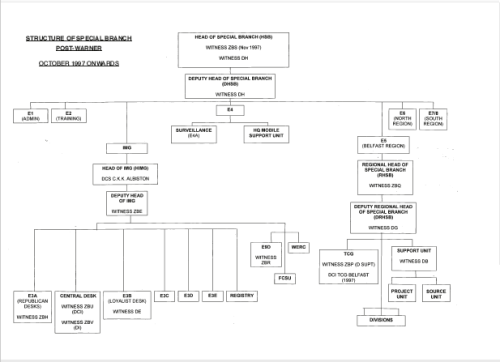
RUC SBRUC SB2


How MI5 Operated During The Troubles

For as long as I can remember I have advised fellow reporters to fully read the reports of government inquiries, especially those dealing with security issues thrown up by the Troubles.

I do that because invariably there are little, and sometimes, sizeable and valuable diamonds of information hidden in interminable pages of dull text. But you have to read it all to find them. I usually take my own advice but here I must admit to one occasion when I ignored my own counsel.

When LVF leader Billy Wright was shot dead in 1997 in the Maze prison, there was suspicion about how a killing like this, by the INLA, in one of the most secure prisons in Europe was possible. Amid allegations of collusion and suggestions that Wright’s death conveniently removed one of the most effective Loyalist critics of the peace process, controversy dogged the killing.

An LVF guard of honour at Billy Wright’s wake

Eventually, in 2005 the British government agreed to set up an inquiry into the incident, headed by Lord MacLean, a Scottish judge; Andrew Coyle, an English academic and expert on prisons and a retired Anglican Bishop, John Oliver.

The report was published in 2010 and I must admit I did not read it. Recently, while researching another topic I rectified that mistake and came across the most detailed account of how MI5 – and the other security agencies – went about their business during the Troubles.

I thought my readers might find it informative and instructive. It is likely that some of this structure has since been dismantled or at the very least scaled down since 2010 (alert readers will note the widespread use of the past tense in descriptions of MI5 structures and activity). Nonetheless something very similar is possibly still in place.

One point worthy of note. It is clear from the MacLean inquiry that MI5, not the RUC Special Branch or military intelligence, had prime responsibility for monitoring the intentions of the leaderships in various violent groups. As far the Provos go, this means that MI5 would have been responsible for dealing with the peace process. Interesting.

This is what the MacLean report says in this regard:

The Service’s agent-running operation was small compared with those of the SB and the Army, and was primarily concerned with strategic issues, such as the plans and intentions of the leadership of paramilitary organisations, whereas the RUC and the Army concentrated on tactical intelligence to protect the public and their own forces on the ground.

Enjoy:

The Security Service

5.143 The Security Service’s primary statutory function is to protect national security, and in particular to deal with threats from terrorism. This was the case in 1997 as it is today, but there was a fundamental difference between the manner in which the Service fulfilled this role in relation to terrorism in Northern Ireland in 1997 and the manner in which it operated in the rest of the UK. Outside Northern Ireland the Service had the lead responsibility for gathering intelligence about all threats to national security, including threats from republican and loyalist paramilitary groups, and for directing intelligence operations to counter those threats. Within Northern Ireland, on the other hand, this lead responsibility rested with the RUC, and in particular SB.

T2 and T5

5.144 The role and structure of the Security Service in Northern Ireland is discussed later in this section, but it is first necessary to summarise certain aspects of the wider structure and functioning of the Service and its relationship with the Security Service operations in Northern Ireland. The role of investigating and countering threats from Irish paramilitary groups, whether republican or loyalist, rested with T Branch based in London. Desk Officers of the section known as T2 dealt with Irish terrorist activity threatening Great Britain, and Desk Officers of section T5 handled threats with an overseas connection. None of these officers had any responsibility for investigating terrorist activity within Northern Ireland. The organisation was hierarchical, with teams, groups, sections and a directorate. Much routine work was carried out at team level, but sensitive or difficult decisions were referred upwards, in some cases to the Director General.

5.145 Intelligence was received from sources, both human and technical, from surveillance and from external partners such as SB in police forces in Great Britain and foreign security services. All available intelligence was drawn together and analysed as part of a continuous dynamic process, and, since the Service had no executive powers, the prevention or disruption of terrorist activity took place with substantial operational support and assistance from external partners, in particular the law enforcement agencies. Desk Officers produced regular summaries of their investigations and conclusions, which were shared with partner organisations on a ‘need to know’ basis, with particular care taken to ensure source protection. T2 and T5 depended very considerably on intelligence from the RUC and from the Service AsGp in Northern Ireland. Desk Officers in London liaised regularly with RUC SB E3, but sometimes also with officers in the SB Regions in Northern Ireland. Records were kept primarily in hard copy filing systems, but there were also electronic databases.

T8

5.146 Sources or agents were recruited and run in order to meet the Service’s intelligence requirements. As far as Northern Ireland was concerned, the Service’s priorities and intelligence requirements were set out by T2 and T5 and by the AsGp in Northern Ireland, and the agent-running section was known as T8. This section recruited agents, handled them and provided ongoing support. The work was based in London, but there was also an agent-running outstation in Northern Ireland. The Service’s agent-running operation was small compared with those of the SB and the Army, and was primarily concerned with strategic issues, such as the plans and intentions of the leadership of paramilitary organisations, whereas the RUC and the Army concentrated on tactical intelligence to protect the public and their own forces on the ground. T8 sought the authorisation of SB whenever it planned to recruit and run agents based in Northern Ireland, in recognition of the lead role of the RUC. On some occasions joint recruitment and source handling arrangements were put in place.

5.147 Specialist officers in T8 had the responsibility for identifying and assessing possible candidates for recruitment as agents. The case officer in a section made proposals to a senior manager, bearing in mind in particular the likely intelligence dividend, and measures that could be taken to mitigate risk to the potential agent. If recruitment took place, the reliability of the agent had to be established before he or she was allocated an identification symbol on the authority of a senior manager. The Security Service database of agents was restricted to a very small number of staff.

5.148 Agents were tasked and met as frequently as the case demanded, and a written account of all meetings and telephone conversations was made, using a pre-printed form known as a contact note. Intelligence obtained from an agent was then issued as a Source Report, which concealed the identity of the agent, and differentiated between factual information received from the agent and any comment which the Agent Handler added. Agent intelligence was distributed to internal Security Service customers including AsGp in Northern Ireland, to RUC SB and to the Metropolitan Police SB as appropriate. Intelligence with major policy implications was issued to a wider readership in Whitehall and the NIO. There was a continuous process of reviewing the intelligence received from each agent, and assessing its usefulness and reliability. The risks and benefits of meeting an agent were evaluated, and the number of NIIRs issued as a result of the agent’s reporting was recorded.

‘A’ Branch

5.149 The planning and mounting of covert technical intelligence-gathering operations was undertaken by the department known as ‘A’ Branch, based in London. This Branch dealt with such operations throughout the UK, and carried out a detailed analysis of all applications for such work, ensuring that resources were allocated to the highest priorities. ‘A’ Branch also operated in Northern Ireland on behalf of the RUC.

The Security Service in Northern Ireland

5.150 Because of the lead role in Northern Ireland of the RUC SB for gathering and exploiting intelligence on republican and loyalist terrorist activity, the role of the Security Service was predominantly to provide strategic advice to Ministers on threats from paramilitary organisations. This meant that the structure of the Security Service in Northern Ireland differed from that of the Security Service in the rest of the UK.

Director and Co-ordinator of Intelligence

5.151 The most senior Security Service officer in Northern Ireland was the DCI. He was responsible, under the PS of the NIO, for delivering high-level policy direction and advice relating to intelligence activity in Northern Ireland, and for providing support on intelligence matters to the SOSNI, and to his/her two other principal security advisers, the Chief Constable of the RUC and the General Officer Commanding (GOC) Northern Ireland. The DCI had no operational responsibilities, but was concerned with the provision of an intelligence-reporting service to Ministers and officials in the NIO and in Whitehall, principally through reports prepared by his staff in the AsGp. He also gave advice on the authorisation of warrants under the Interception of Communications Act 1985 and the Intelligence Services Act 1994. He was himself a member of the key committees responsible for security policy and intelligence matters: the SPM, the PEC and the IRC, of which he was Chairman (see 5.88 to 5.90).

Director and Co-ordinator of Intelligence’s Representative at the Royal Ulster Constabulary

5.152 The DCI had a representative at RUC HQ (known to the Inquiry as DCI Rep Knock), whose primary responsibility was the processing of all applications for warrants for technical surveillance on behalf of the RUC. Most applications originated from the RUC, but there were some from other intelligence agencies, such as HM Customs & Excise. There were many kinds of intrusive surveillance, and the first question which DCI Rep Knock’s office would ask in response to a request was about the feasibility of the proposal, then about the proportionality and necessity of carrying it out. If a request was granted, the responsibility for installing the device rested with ‘A’ Branch operations staff. Some requests were not granted, on grounds of operational justification or failure to reach an appropriate threshold of necessity, and even if a warrant was granted, in some cases the operation did not proceed.

5.153 DCI Rep Knock also acted as a liaison officer between the Security Service and the RUC. In Northern Ireland this involved the circulation to the RUC of NIIRs produced by AsGp. This function and the way in which it was carried out comes in for particular and detailed scrutiny in Chapter 15 in relation to the conflicting evidence heard by the Inquiry about the NIIR which incorporated a warning of the INLA death threat to Billy Wright if he were moved to HMP Maze H Block 6, and if he and his supporters were co-located with the INLA prisoners. DCI Rep Knock’s liaison role between the Security Service and the RUC also worked in another, very different way: the Service Desk Officers in London were customers for RUC intelligence, looking for leads about terrorist activity in Great Britain. DCI Rep Knock facilitated exchanges between the Desk Officers of the Security Service and of the RUC, with contact made by secure telephone, telegram or face-to-face meetings.
Director and Co-ordinator of Intelligence’s Representative with the Army

5.154 The DCI also had a representative attached to Military Headquarters (HQ NI), to ensure that the DCI’s views were represented at HQ NI, and that he could be kept informed of developments in Army policy relating to intelligence gathering.

The Assessments Group

5.155 AsGp consisted of Desk Officers in the Security Service who worked for the DCI. It was headed by an officer of the rank of Assistant Director (known to the Inquiry as Witness HAG), and comprised a small team of intelligence analysts. They received information from a number of different intelligence and security agencies, including RUC SB, and including intelligence from human sources and eavesdropping operations. AsGp was organised in a series of sections, and focused on different threats within Northern Ireland. The Republican Desk Officers (represented at the Inquiry by Witness DO2) focused on organisations such as the PIRA and the INLA, whereas the Loyalist Desk Officers (represented at the Inquiry by Witness DO1) focused on the various loyalist paramilitary groups. AsGp provided a wide range of strategic intelligence reports and assessments for government readership and policy-makers outside the intelligence community, including the SOSNI, Ministers and officials in the NIO, 10 Downing Street, the Cabinet Office, and recipients further afield, for example in the government’s embassies in Dublin and Washington.

5.156 AsGp acted as a focus for strategic intelligence and sought to ensure that the Northern Ireland intelligence community as a whole produced shared and agreed assessments for government. Its primary output was in the form of NIIRs which were generally designed for a political and/or security readership.

5.157 In the period 1996–98 there were three kinds of NIIR: a single-subject report, an assessment NIIR, and a monthly intelligence report. The first would deal with one particular subject, with interpretation and comment from the Security Service, based on intelligence which came from one particular source, or in some cases on two or three reports from a range of sources. Assessment NIIRs provided an overall assessment of a paramilitary group, of a threat or of particular issues or events. These were usually based on a wider range of sources. Monthly NIIRs reviewed the events and intelligence over the preceding month, and included an intelligence assessment and outlook. The main focus of AsGp’s concern was with strategic intelligence, for example in regard to ceasefires, breaches of ceasefires or involvement of different paramilitary groups in the political Peace Process. The Security Service was not involved in producing threat assessments, as this was the role of the RUC.

The Intelligence Management Group

5.158 The IMG was part of the structure of RUC SB, set up in response to the Warner Report, as has been set out in the section of this Chapter dealing with SB. Its relevance here is that it led to the establishment of ESSOs at RUC SB HQ, who helped with the analysis and distribution of RUC intelligence. It was originally intended that such embedded analysts should be appointed both to the SB HQ and to the Regions. In fact the Regional appointments did not take place. Witness HAG told the Inquiry that, following the secondment of Security Service staff to SB HQ, there was some increase in the flow of product, but more importantly an improvement in the quality of the reports that were issued and the nature of the assessment that the RUC was capable of achieving.

Agent Running

5.159 Agent running in Northern Ireland by the Security Service was conducted by an outstation of T8, working closely with RUC SB and with the Army. It reported directly to a senior manager at T8 in London. As in the case of T8’s activities in London, the outstation’s purpose was to obtain information to meet intelligence requirements for which the Service had the main responsibility, that is to say strategic intelligence. It was not intended that the Service’s intelligence gathering should be concerned with tactical matters, but if such tactical information was acquired as a by-product of the strategic operations, this was passed to the RUC for information or action.

The Security Service’s Relationship with Other Organisations and Committees in Northern Ireland

The Northern Ireland Office

5.160 The Service’s relationship with the NIO in Northern Ireland was principally as the supplier of assessed strategic intelligence, through the DCI, reporting directly to the SOSNI and the PS. Briefings were available for readers of NIIRs, to ensure that they understood the process of collection, investigation and assessment of intelligence which lay behind the reports. AsGp needed to understand the political context in Northern Ireland, and by 1997 liaison groups had been established to ensure that the intelligence relevant to the political and security situation was seen by key NIO officials, and that AsGp was aware of the thinking and requirements of the NIO.

The Northern Ireland Prison Service

5.161 The Security Service had very few dealings with the NIPS. Monthly and some other NIIRs produced by AsGp were delivered on a read-and-return basis to senior members of the NIPS. A member of AsGp sometimes represented the DCI at the PLG meetings.

The Security Policy Meeting

5.162 For details of the SPM see 5.88. The particular involvement of the Security Service in this meeting was that the DCI was invited to give his assessment of the security situation, having consulted previously with colleagues in the RUC and the Army.

Province Executive Committee

5.163 For details of the PEC see 5.89. The Security Service input at this meeting was that the DCI provided an update on political and security issues and there would be a briefing from the Army.

Intelligence Review Committee

5.164 For details of the IRC see 5.90. This was a meeting at which the lead role fell to the DCI. It set monthly Priority Intelligence Requirements (PIRs) and AsGp produced draft PIRs for consideration by the IRC, taking into account strategic requirements set by the Joint Intelligence Committee (JIC) (see 5.165) as well as the short- and medium-term requirements which were known to those operating in Northern Ireland.

Joint Intelligence Committee and Current Intelligence Groups

5.165 These were UK Government bodies. The JIC was based in the Cabinet Office, and was responsible for providing Ministers with regular intelligence assessments on a wide range of matters relating to security, defence and foreign affairs, including republican and loyalist paramilitary activity. The Current Intelligence Groups (CIG) was a preliminary meeting which helped set the agenda for the JIC. Both were attended by Security Service representatives. The Cabinet Office collated contributions from various sources, including the Service Desk Officers in London and AsGp in Northern Ireland. Following the CIG, the Service representative prepared a brief for the senior Service member who subsequently attended the JIC meeting, usually the Director General or his Deputy or the Director of T Branch. Irish-related JIC reports were then distributed to a restricted list of recipients, including Ministers.

The MRF File – Part Five: Is This Botched MRF Operation Evidence That Downing Street Endorsed Collusion With Loyalists?


By James Kinchin-White and Ed Moloney

OFFICIAL PAPERS FROM 1971 SHOW THE HEATH CABINET AGREED A POTENTIAL INTELLIGENCE RELATIONSHIP WITH ‘PROTESTANT VIGILANTES’ – ‘CIVIL DEFENCE’ GROUPS COULD BE ‘TOLERATED’ – DEALINGS WOULD BE ‘UNOFFICIAL & LOCAL’

At 10:30 a.m. on October 6th, 1971 the most senior members of the British cabinet, headed by prime minister, Ted Heath met at Downing Street with only one item on the agenda: the deteriorating security and political situation in Northern Ireland. To underline the gravity of the situation facing the British, only those with a stake in the crisis or its possible consequences were invited. Prime Minister Heath presided of course; the ministers present were the real makers and shakers in the British government: the Home Secretary Reginald Maudling; Foreign Secretary Sir Alec Douglas Home; the Chancellor of the Exchequer, Anthony Barber; Lord President of the Council, William Whitelaw and the Defence Secretary, Lord Carrington.

British prime minister Ted Heath outside 10 Downing Street

Together they made up a group known as GEN 47, in effect a Cabinet sub-committee whose specific responsibility was Northern Ireland policy. The meeting that October morning was the fifth held since the committee was formed. The two most senior officers in the British Army responsible for the security situation in Northern Ireland were also at the table: the Chief of the General Staff, General Sir Michael Carver, who was the head of the British Army, and the GOC in NI, Lt-General Sir Harry Tuzo. Alongside them sat the key officials dealing with the crisis, including future MI5 chief, Howard Smith who was the UK representative in Belfast, and the Cabinet Secretary, Sir Burke Trend.

22nd March 1972: Brian Faulkner, the last Stormont Prime Minister of Northern Ireland arriving at Downing Street for talks with Edward Heath. (Photo by Central Press/Getty Images)

Two months before, on the advice and urging of the Stormont prime minister, Brian Faulkner, the British Army had rounded up hundreds of alleged IRA suspects from Nationalist areas of the North with a view to interning them. Faulkner had assured the British that internment had worked when he was Home Affairs minister in 1956 and it would work again. Internment had killed off the IRA’s Border campaign and it would do the same to the new Provisionals. He was wrong. The British Army had moved against the IRA before intelligence on the new Provisional organisation was fit for purpose – a strategem credited by the late Brendan Hughes to Gerry Adams in confidential interviews for ‘A Secret History of the IRA’. Adams had advocated an intensification of bombings in the early months of 1971, thereby causing a clamor for action from angry Unionists and an intemperate response from the British. And the operation was so one-sided, completely ignoring Loyalist violence, that the effect was to alienate almost the entire Catholic population, leading to resignations from public office and withdrawals from public bodies. The SDLP, Britain’s sole hope of Nationalist moderation, was swept along by the wave of anger and vowed not to engage the British until internment was ended. Worst of all the violence had not abated, as was evident daily, especially in Belfast where shootings, bombings, killings and attacks on the military and police had escalated alarmingly. The purpose of the meeting was to agree on the cabinet’s attitude towards Faulkner, who ministers were painfully aware was the only person standing between the Stormont government and the perilous, uncharted waters of direct rule. If the Unionist prime minister was in consequence hoping for a sympathetic hearing, he was to be disappointed. Heath’s opening remarks and the subsequent account of the meeting were peppered with phrases like, ‘…if Mr Faulkner could be persuaded….’; ‘It would be desirable to press Mr Faulkner to….’; ‘Mr Faulkner should be asked…’; ‘Mr Faulkner should be pressed…’, ‘Mr Faulkner should be told….’, and so on.

Riots exploded in Nationalist areas in the wake of internment

The polite Whitehall mandarinese employed by Heath and his ministers could not disguise a not so subtle subtext which must have deeply unsettled the Unionist leader: ‘You are running out of time, so you better listen to what we say.’ Heath’s prime concern was evident in his opening words:

…the crisis in Northern Ireland continued to overshadow the work of the government in many fields and threatened to jeopardise the success of economic and defence policies and the approach to Europe. A concerted Northern Ireland policy, with its objects clearly defined in an order of priority, was now needed, based on the best reconciliation that could be made between conflicting considerations.

Britain’s vital national interests were being threatened by the deteriorating situation in Northern Ireland and big decisions would soon have to be taken, not least about Brian Faulkner’s future Of particular concern to Heath was that the UK’s imminent accession to the EEC was on a knife edge. Parliament was bitterly divided and Heath would need the eight Unionist votes in the House of Commons to ensure success. But for that consideration it is possible that the GEN 47 meeting that morning would have been considering the arrangements for direct rule and Brian Faulkner would have been out of a job. Instead it became an occasion to strong arm the Unionist leader.

Smiling faces disguised a tough message from Heath to the Unionist prime minister Brian Faulkner

Direct rule would eventually be imposed in March 1972, six weeks after Heath won his EEC vote at Westminster. The margin of his victory in the Commons? Eight votes. Back in October 1971, the choice was simple. Opt to eliminate the IRA with a military offensive and implicitly back the Unionists and the Union – but at the cost of deepening Nationalist alienation, angering the government in Dublin and alienating European allies; or try to persuade Faulkner to include moderate Nationalists/Republicans in government, a course which might pull the sting from the IRA’s tail and satisfy Britain’s critics in Dublin and Brussels. It is clear where the cabinet’s heart lay, if only by the number of words devoted to the latter option and the list of demands that would be presented to Faulkner when he met his British counterparts. The clinching argument? Perhaps this:

‘If Mr Faulkner could be persuaded to broaden his government to include “non-militant” Republicans, support for the terrorist campaign might be undermined by political action, rendering more severe military measures unnecessary.’

There were more demands on Faulkner: Would he appoint more Catholics to public posts? The reform programme needed monitoring, would he help to do that? And the internment policy needed to be fine tuned; the appeals procedure required improvement and clarification; accommodation at Long Kesh had to be improved albeit at Stormont’s expense not Westminster’s. And the RUC was slow in handing over intelligence acquired during interrogations to the military; could that be speeded up? A law confiscating social security payments to punish civil disobedience in protest at internment had embarrassed the British government at home and abroad, and such matters should be the subject of prior consultation in the future. And so on. It is difficult to read the GEN 47 document and not conclude that British ministers had exhausted their patience with the Unionist leader and that it was only a matter of time before direct rule had to be imposed. The Cabinet meeting of October 6th was the preamble to cutting the cord with Unionism as it had existed since 1921. Britain had not occupied Ireland for the best part of seven centuries nor created an empire which stained the globe red for some 200 years by not knowing when it was to her advantage and in her interests to abandon a chieftain or turn against a maharajah, no matter how loyal or useful such subjects had been in the past. And so Brian Faulkner’s destiny was set that October mid-morning.

In the summer of 1972 the UDA took to the streets of Belfast in force

But even as the British readied themselves to discard traditional Unionism, the Heath cabinet tacked back, for reasons that even now are not clear. Self-interest clearly dictated the move, but whether this was motivated by security needs or political necessity born of the knowledge that Stormont would soon be dissolved and Unionist anger would have to be appeased, can only be guessed at. After listing security requirements like stepping up recruitment to the UDR, increased use of the RUC Reserve, speeding up terrorist trials and cratering/humping Border roads, the Cabinet meeting advanced this extraordinary proposal, which reads: So at this Cabinet meeting, whose record has been retrieved from the Kew archive (see below), the British government set in motion the process of hanging their erstwhile ally, Brian Faulkner out to dry while turning to the Loyalist ‘vigilantes’, as the Cabinet report called them, then beginning to organise and mobilise in Northern Ireland for assistance, deciding that they could be ‘tolerated’ and even approached for assistance with ‘intelligence’, presumably on the IRA. All done ‘unofficially’, of course and at a purely local level.
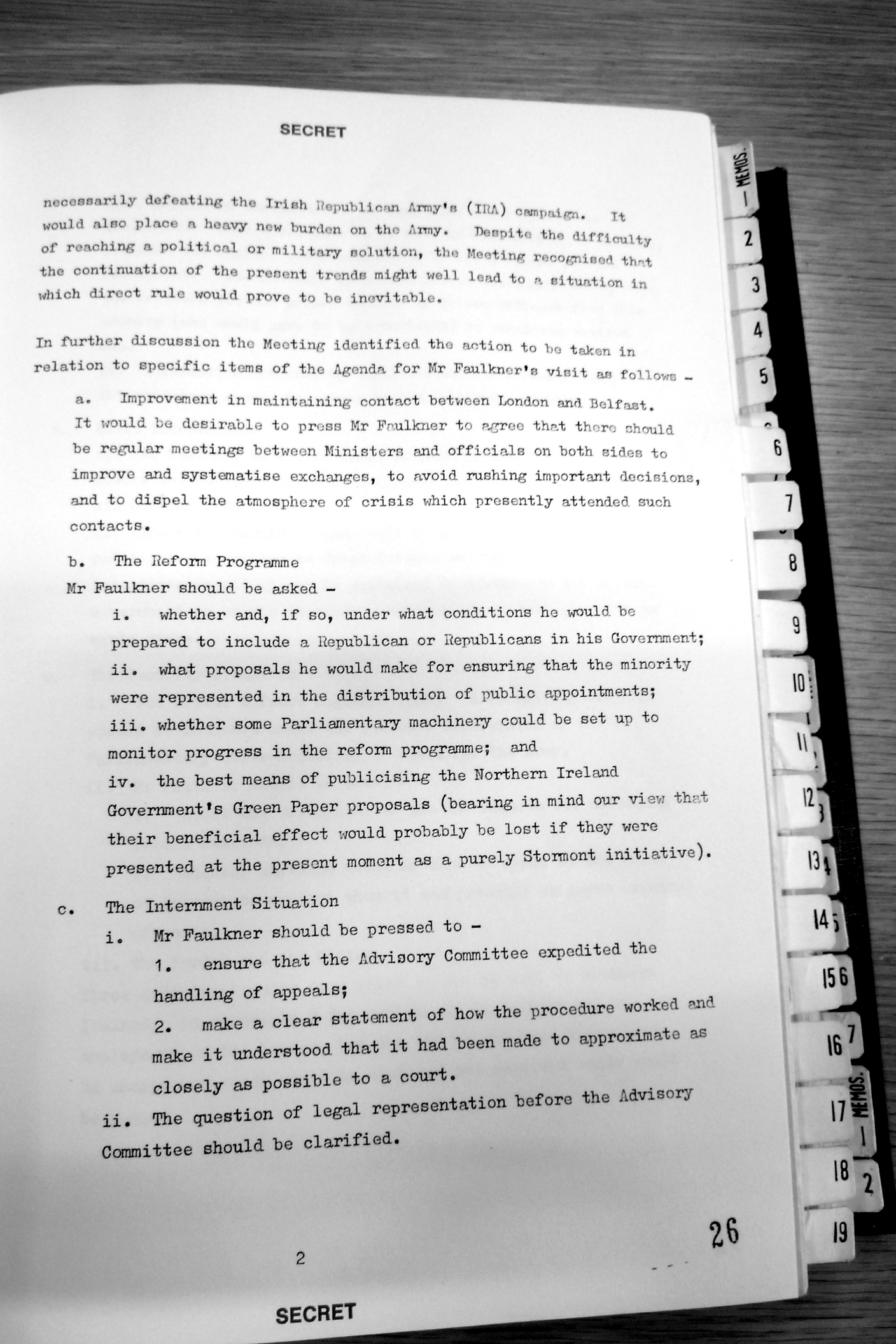
THE FULL TEXT OF THE GEN 47 REPORT ON UK CABINET MEETING OCT 6, 1971

So what happened to this proposal? Why was it made? And from where did it emanate? It is easier to suggest an answer to the second and third questions than the first. The story begins a month before GEN 47 met, when, in early September 1971, the GOC, Lt-General Tuzo met with members of the Ulster Special Constabulary Association (USCA), at their request, one of a series of meetings the former part-time policemen cum paramilitaries held with British and Unionist leaders during this turbulent, post-internment period. The USCA was comprised of former “‘B’ Men”, as everyone in Northern Ireland called them, who had been angered at the British government’s decision in 1970 to disband the force. In their place, two new bodies, the RUC Reserve and the Ulster Defence Regiment, would be created, into whose ranks Catholics would be welcomed. The ‘B’ Specials had been in existence for as long as the state of Northern Ireland and were created as a reserve force to be called up for active duty if and when the threat from the IRA was considered serious by the Unionist government. The ‘B’ men were mobilised in 1922 and again during the 1956-1962 IRA Border campaign. Whatever about the IRA campaign from 1922 onwards, most observers credited lack of Catholic support for the IRA’s failure in the Border campaign, but the USCA firmly believed – and boasted – that they alone had defeated the IRA. Membership was exclusively Protestant and having been drawn in no small part from the ranks of Carson’s Ulster Volunteers at inception, its rank and file were considered fierce Loyalists whose sectarian sympathies and hostility to Catholics were defining features. Many if not most Catholics regarded the ‘B’ men as Unionism’s armed wing and feared/hated them accordingly.
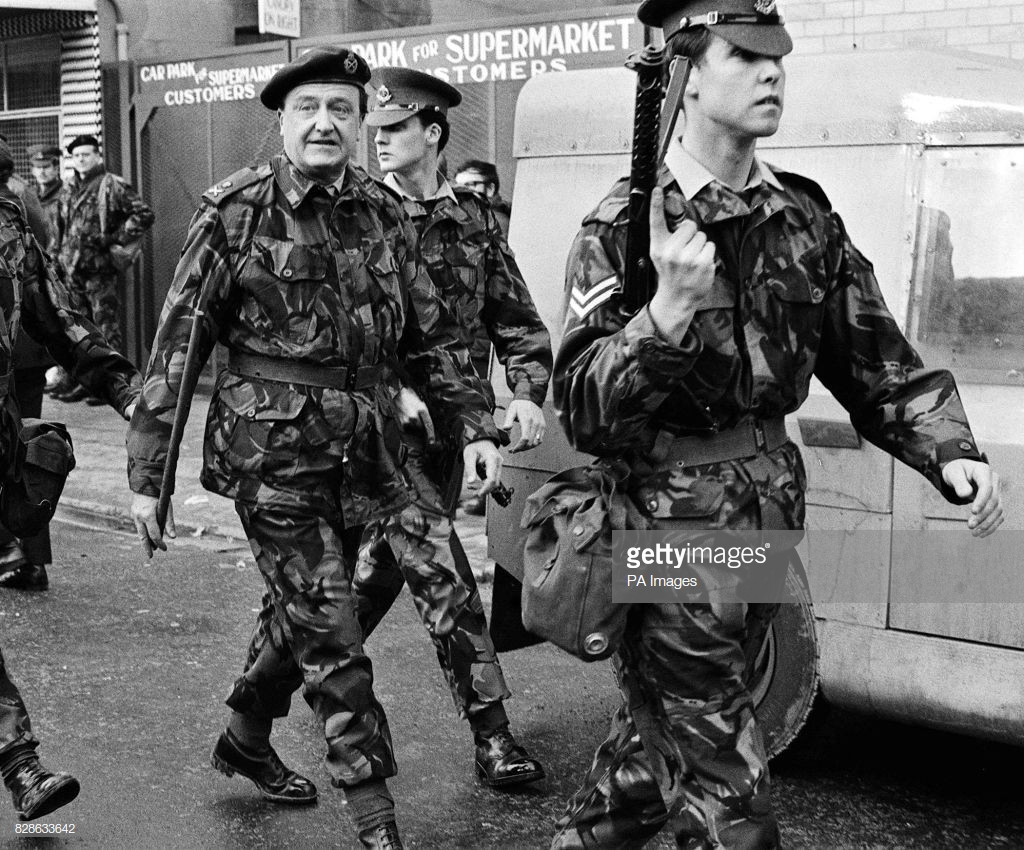
Lieut. General Sir Harry Tuzo

British Army GOC, General Sir Harry Tuzo – his response to the GEN 47 project was not recorded but he is the probable author of the proposal for an intelligence relationship with ‘Protestant Civil Defence’ groups

It is important to note what was going on when Tuzo met the USCA. Internment had just happened but was widely judged not just a political disaster but a security failure. It was directed solely at Republicans and civil rights leaders but it had failed to shut down the IRA, principally because British intelligence on the new Provisionals was so dated. So, in September 1971, it is likely that Tuzo would have been open to any suggestions that could rectify this alarming intelligence deficit. We do not know what the USCA said to Tuzo but we can guess. In April 1980, to commemorate the 10th anniversary of the disbandment of the ‘B’ men, the USCA published a 70 page pamphlet extolling the virtues of the Special Constabulary. The pamphlet’s principal claim was that its members’ special local knowledge and military skills would have been effective tools against the IRA but these had been squandered thanks to the decision to disband the force. This extract from the pamphlet tells a story in terms that the USCA had probably repeated to Tuzo:

They were no worse trained than the average British soldier, they numbered in their ranks many ex Servicemen, and their instructors included many of the finest instructors who had ever attended the military small arms schools at Hythe and Netherhaven. They were not armed with sophisticated modern firearms, but they were proficient in the use of the obsolete and obsolescent British military small arms with which they were issued. It was their proud boast that they had defeated on many occasions Army marksmen in annual competitions at Ballykinlar. They had no electronic or communication equipment, they had no armoured cars and their transport was more often than not their own private cars, they had no protective clothing, but they did have definite advantages over the modern soldier now patrolling Ulster’s streets and ditches. They possessed absolute confidence in their superiority over the IRA, and they were sure in the knowledge that the IRA recognised that superiority and feared it, but above all their roots were firmly bedded in Ulster soil giving them a native wit, intelligence and local knowledge which no amount of training or education could acquire. In any initiative taken they enjoyed the full support of the local community, something which militarily, is impossible to achieve. There is no doubt that given proper tasking and leadership from within themselves, the Ulster Special Constabulary would have so inhibited the movement of the IRA that the number of murders committed by any terrorist or paramilitary group would not have been as high as it is, the destruction of urban areas would not have been as great, and this campaign of terror would not have lasted for ten years.

It is not difficult to imagine General Tuzo, in the aftermath of a mostly failed internment operation against the Provisional IRA, listening to a presentation like this and thinking to himself that it might be no bad thing for the British Army to have access to assistance from people like these former ‘B’ Specials. He might even have been tempted to echo this claim made in the same pamphlet:

How often has it been said in Ulster homes, in Army messes, and even in the corridors of Westminster, that the disbanding of the Ulster Special Constabulary was a mistake.

B Specials in training – the force was mobilised against the IRA in 1922 and again in 1956

There is another reason to suppose that Tuzo was the author of this proposal at the GEN 47 meeting. At the time that he agreed to connect with the USCA, Tuzo brusquely dismissed a similar request from a group called the Catholic Ex-Servicemen’s Association (CESA), saying that he did not have the time to meet them. Although now largely forgotten, the CESA was, briefly, an important player on the Nationalist wing of the Troubles stage in the very early years. Comprised of Catholics who had served in the British Army, CESA attracted at its peak thousands of members who volunteered to protect Catholic areas in Belfast and elsewhere that were under threat from Loyalist paramilitaries and the British Army. Although separate from the Provisional IRA – and in some ways even unfriendly to Republicans – many Unionists and not a few British military leaders regarded CESA in the same hostile light as they did the IRA. In May 1972, for instance, the MRF shot dead a CESA member, Patrick McVeigh as he manned a barricade in west Belfast. And documents retrieved from the Kew archive reveal that the British often regarded CESA as indistinguishable from the IRA. (You can read much more about the origins and history of CESA on this Treason Felony blog post.) Tuzo’s refusal to meet CESA while agreeing to sit down with the USCA was a pretty blatant act of political favoritism, bigotry even, and GEN 47 implicitly acknowledged that by singling out the need to avoid such partisanship in the future dealings in such matters, a message clearly directed at the GOC:

There could be no discrimination between Protestant and Roman Catholic vigilantes.

This part of the GEN 47 report was both a rap on Tuzo’s knuckles and an implicit admission that the GOC was the probable author of the broader proposal for an intelligence relationship with Loyalist groups. It is also important to place the GEN 47 proposal in the context of events in the wider world of Northern Ireland Loyalism in the autumn of 1971. Against a background of the initial failure of internment and the upsurge of violence thereafter – sixty violent deaths in the five months after August 9th, compared to 31 in the seven months prior – alarmed and angry Unionists intensified their calls for a ‘Third Force’, in effect a sort of re-born ‘B’ Specials-type outfit. The new Ulster Defence Regiment was distrusted and disliked because it had been formed to replace the beloved ‘B’ men, and because places were reserved for Catholics who were, at least initially, joining up. How could Catholics defend Ulster, asked angry Loyalists? In early September, the USCA pledged its membership to such a force and later invited ‘all able-bodied’ men to register for a re-formed special constabulary. At the same time Ian Paisley and former Unionist Home Affairs minister, Bill Craig – the pair now established as Faulkner’s strongest Unionist critics – held a rally in east Belfast demanding the creation of a new ‘Third Force’ to defeat the IRA. (The British Army and the RUC were the first and second forces, the new body of Loyalists would be the third.)

Ian Paisley (left) and Bill Craig (far right)

The crowd, which gathered at Sydenham, mid-way between the Harland and Wolff shipyard and the Shorts aircraft factory, was estimated at 20,000 strong. Afterwards a deputation from the shipyard and the aircraft factory met Tuzo at Thiepval barracks to press home the demand. So the GOC had now heard the same message from two sets of Unionism’s hard men. Paisley then held rallies around the countryside to urge Protestants willing to serve in the new ‘Third Force’ to hand in their names. The USCA met Faulkner around the same time to press home the demand for a ‘Third Force’ and one of Faulkner’s more populist ministers, John Taylor announced his support for such a body (in a not unrelated act a few months later, the Official IRA came close to assassinating him). At another rally, this time in the Unionist heartland of Portadown, Co Armagh, Ian Paisley unveiled a name for the new force: ‘Ulster Loyalist Civil Defence Corps‘. The next day Bill Craig endorsed it. Faulkner was under pressure from Unionist hardliners, not a few of whom were in his own party’s ranks, but conceding the demand for a new Third Force was a bridge too far for the British. Home Secretary, Reginald Maudling, who had ultimate responsibility for Northern Ireland prior to direct rule, declared his opposition to the idea and said that anyone who tried to set up such a body would be stopped by the government in London. But before Maudling’s statement, the British Ministry of Defence announced plans to allow the Ulster Defence Regiment to create units that would allow  part-time members to serve close to their homes. As concessions go, this one hardly rated. By the time the GEN 47 committee met, there was real pressure on the British to placate the growing Loyalist clamour for action against the IRA. The Heath cabinet also knew that Stormont would soon be put on ice and that there would certainly be an angry, even violent response from hardline Loyalists. Some might even turn their guns on the British. So granting a concession like the intelligence aid suggested by GEN 47 might take some of the sting out of what was always going to be a difficult, even violent change. This is a story replete with questions but short on answers. The key question is whether the GEN 47 decision was ever implemented and if so by whom and how? Another comes a close second: if the proposal was followed up, which groups were chosen by the British Army as suitable partners in such an enterprise? The obvious candidates were groups like the USCA and the plethora of similar but small groups that would spring up a few months later when direct rule was imposed and the Stormont parliament mothballed. But there was another organisation that formally took its place on the Loyalist stage in that turbulent month of September 1971, an outfit that very soon would become the loudest voice of Loyalism and one of the most violent. It would have been extraordinary had the emergence of this group not been on Tuzo’s mind as he sat at the Cabinet table for the GEN 47 meeting. According to most dependable accounts, the Ulster Defence Association (UDA) was conceived at a meeting held in mid-May, 1971 of defence or vigilante groups drawn from various Protestant parts of the city. The gathering was held at a school canteen at the Loyalist end of North Howard Street, which linked the Nationalist Falls Road and the Loyalist Shankill Road, as Belfast’s two most infamous streets almost crosscut into the city centre. Alarmed at the growth of IRA violence, the meeting had been convened to examine the possibility of merging the various groups in a single, strong organisation. The gathering ended with an agreement to do just that; the name chosen was the Ulster Defence Association (UDA), a structure and leadership was put together but it was not until September that year, that the new group showed itself publicly. The UDA will take its place in the history of the Troubles as second only to the Ulster Volunteer Force (UVF) as the most violent of the Loyalist paramilitaries. But in its first couple of years of life, when admissions of murder were few and far between – and when the RUC preferred to call the random killing of Catholics ‘motiveless murders’ – the UDA was better known for staging huge marches and demonstrations in Belfast and other Loyalist areas, designed to show the British what resistance they could face if hardy came to hardy. Marches/protests, as well unofficial roadblocks and night-time patrols – which the UDA organised in their areas – were what ‘civil defence’ groups would do.

Would the GEN 47 proposal have allowed an ‘intelligence relationship’ between these soldiers and the Loyalists marching past them?

Coincidentally or not, the UDA’s emergence corresponded with the growing call from the Unionist heartland for a ‘Third Force’; but the question remains, did this new group qualify as a ‘vigilante’  or ‘unofficial civil defence’ group in the eyes of GEN 47 and the British military. Could or would the British Army reach out to the UDA for unofficial intelligence assistance in the way now apparently possible for other groups such as the USCA? On one reading, the answer might be yes. For instance, Sidney Elliott and W.D. Flackes in their indispensable guide to the Troubles, ‘Northern Ireland – A Political Directory, 1968-1999, reflect a widely held media and academic view of the UDA at the time of its birth that places it in the same category as the USCA and arguably qualifies it for GEN 47’s criterion for ‘civil defence’. Opinions like this would both reflect and reinforce official positions in government:

The UDA was launched in September 1971 as the umbrella body for loyalist vigilante groups, many of which called themselves ‘defence associations’. In the growing violence, they sprang up in Protestant areas of Belfast and in estates in adjoining areas, including Lisburn, Newtownabbey and Dundonald. The new body adopted the motto ‘Law before violence’, and soon became a formidable force on the ground in loyalist districts, in many of which it was considered a replacement for the disbanded B Specials.

On the other hand, the UDA was soon wading in blood and that would – or should – have placed it in a different category. However when the GEN 47 committee convened in London, the UDA had been responsible for just 4 deaths (including two UDA men killed by their own bomb). And because of a policy never to claim killings, unlike the IRA which invariably admitted its violence, it was never clear when the UDA had murdered people. The following year the UDA killed 72 people – one every five days and the reality that lay behind this particular ‘civil defence’ group was bloodily apparent. But there were few claims of responsibility made for sectarian murder in those early days. The authorities might know, and the UDA itself certainly knew – but the world was fed a version in which the killers went unnamed. Inside Northern Ireland, there were few illusions; most Catholics, and certainly a large number of Protestants knew full well what was happening but officially and, sadly, in large sections of the media, fiction became fact or at most disputed fact. In 1973 the UDA invented a cover name – the Ulster Freedom Fighters (UFF) – giving birth to a group which did not exist in any meaningful way; that the British went along with this fiction by proscribing the UFF but leaving the UDA untouched (until 1992 when arguably it no longer mattered) was revealing of both intentions and attitude. (Incidentally, within two years the USCA, along with other groups like the Orange Volunteers and Down Orange Welfare would join the UDA – and the illegal UVF/Red Hand Commando – in the Ulster Army Council, to co-ordinate activity against the Sunningdale power-sharing agreement of 1973, which included the Ulster Workers Council (UWC) strike that brought it down. The distinctions between the various groups was, to say the least, blurred in their own eyes.) But we do not know whether the GEN 47 decision ushered in intelligence assistance from the UDA to the British military, just as we do not know what, in general, the implications were of this Cabinet sub-committee meeting. It is beyond dispute, however, that when GEN 47 met at Downing Street, the UDA was capable of bringing many thousands of angry Loyalists on the streets of Belfast – and that political consideration, arguably, is what would have been foremost in the minds of ministers, soldiers and officials seated around the Cabinet table. After all, it was such people who kept Northern Ireland running for the British.

UDA LEADER DAVY PAYNE DOES THE MRF A BIG FAVOUR

And there the matter may have rested except for the discovery of an intriguing set of British Army log sheets compiled over two days, May 26th and 27th, 1972 – eight months after that GEN 47 meeting at Downing Street – at two British Army control rooms, one at the headquarters of 39 Brigade in Belfast, and the other at British Army headquarters (HQNI) at Thiepval barracks in Lisburn, Co Antrim. The log sheets have been released into the public domain by the Kew archive.

General Frank Kitson, head of 39 Brigade in 1972 and believed to be architect of the Mobile Reaction Force. He was transferred to a post in the UK in April 1972, just before the events described in this post took place.

Both sets of log sheets describe a confrontation between a three-man, plain-clothes MRF unit – two sergeants and a lance-corporal – in a civilian car and a large Loyalist crowd on the Shankill Road which had mistaken the soldiers for IRA gunmen. It ended with the MRF team badly roughed up by an angry Loyalist crowd who also stole some of their equipment and classified paperwork, notably the MRF’s ‘Red Folder’ which contained detailed of the MRF’s personnel, code words, rendezvous points and so. The speed and efficiency with which the bulk of the stolen material was returned to the MRF and the role played in that retrieval by one of the Troubles most violent and notorious Loyalist paramilitary leaders – described in military reports as ‘a contact of the SF’ (Security Forces) – suggests that the GEN 47 proposal, or something like it, may have borne fruit. GEN 47 had raised the possibility that Protestant ‘vigilantes’ or ‘civil defence’ group could give intelligence ‘assistance’ to the British Army. Do the events described in these log sheets constitute the sort of ‘assistance’ envisaged? The various elements of this story will be referred to by their Serial numbers listed in the first column of the log sheets which are reproduced in chronological order below. First the log sheets compiled at HQNI, at Thiepval barracks, on the basis of information radioed in by Kitson’s 39 Brigade (It is interesting to note that in the Action column of the log sheets, the following very senior military personnel were informed about the incident: the officer in charge of Intelligence Operations, the Commander of Land Forces, the GOC, Sir Harry Tuzo and the Army’s public relations department. This was clearly a serious incident.) The account, dated May 26th, 1972, and beginning at 13:46, starts at Serial 22, and continues into the second log sheet. It describes how the motorised MRF patrol notices ‘4 yobboes’ loading military uniforms into a car and gave pursuit to the Crumlin Road/Shankill Road area. This account has the incident happening ‘near Coleraine’, which appears to be a mistake, possible caused by poor radio communications; other log sheets have the incident starting in Belfast city centre. The ‘yobboes’ car stops in Jaffa Street, the MRF approach it but it drives off again and heads to Upper Charleville Street. The MRF car cuts it off and when one of the soldiers approached the car, two of the ‘yobboes’ produced pistols and one of the MRF unit fires a single shot from his 9mm pistol. When a crowd of some 150 Loyalists then confront the MRF patrol the soldiers call the RUC for help but the police refuse to intervene. The three MRF soldiers are then beaten up by the crowd; Sgt Williams (who earlier played a major part in another controversial MRF operation) is badly injured, Sgt Hope and L Cpl Kinlock escape with slight injuries. But Sgt Williams has had his pistol taken and the MRF’s Red Folder is lost. This message is timed at 13:46. Just twenty-four minutes later, Serial 23,  39 Brigade informs HQNI that ‘RED FOLDER’ had been recovered. Just twelve minutes later, according to Serial 32, 39 Brigade tells Thiepval HQ that while Sgt Williams’ pistol is still missing, a ‘blue bag’, described as holding a ‘cosmetic outfit’ – presumably disguises – which was also stolen, is back in military possession along with the MRF’s ‘Red Folder’. Both the bag and the folder were ‘handed in by contact of SF’. SF presumably stands for security forces. So a contact of either the British Army or RUC recovered this valuable and secret document from the angry Loyalist crowd and ensured that it was returned to its proper owners. So who was this ‘contact of the SF (security forces)’? According to Serial 33, a message from 39 Brigade at 15:59, the ‘MRF folder, was lost for some time, handed to Flax St (British Army post) by David Payne 34 Brussell St associate of Frank Quigley’. (‘Brussell St’ is actually Brussels Street.) The log sheets following these words were compiled  in the control room of 39 Brigade and they describe, but in much greater detail, the incident as outlined in the HQNI log sheets reproduced above. They were based on messages transmitted by soldiers or units on the ground to 39 Brigade’s control room. For  reasons probably due to poor radio reception, the location of the incident is misspelled as ‘Cargill’ or ‘Upper Cargill’ Street; the accurate location was Upper Charleville Street. Serial 32 gives 12:32 on May 26th as the starting point of the incident when a message is sent from the MRF patrol seeking assistance; ‘aggro developing’ is the terse report. Serial 35, a message from the MRF, says the undercover patrol spotted four men in a Ford Cortina buying a large quantity of ‘mil eqpt’ from a city centre store. They were followed onto the Shankill where one of the four was seen to produce a gun. ‘A chase started culminating in aggro in UPPER CARGILL ST’. Serial 41, a report from a patrol of soldiers from the Royal Regiment of Wales (RRW), said the MRF car had been recovered along with two of their three pistols. Serial 44, another report from RRW, said the MRF had opened fire and ‘Crowd of 150 being pacified. 3 mil men now out of car, negotiations in hand to recover car’. Serial 45 is a lengthy message to 39 Brigade from the MRF which adds significant detail to the account, including the contents of the MRF’s Red Folder. The message also notes that when the RUC arrived on the scene, they were less than helpful: ‘They were asked to assist, extricate the MRF men from the area but they allegedly refused’. The message continues:
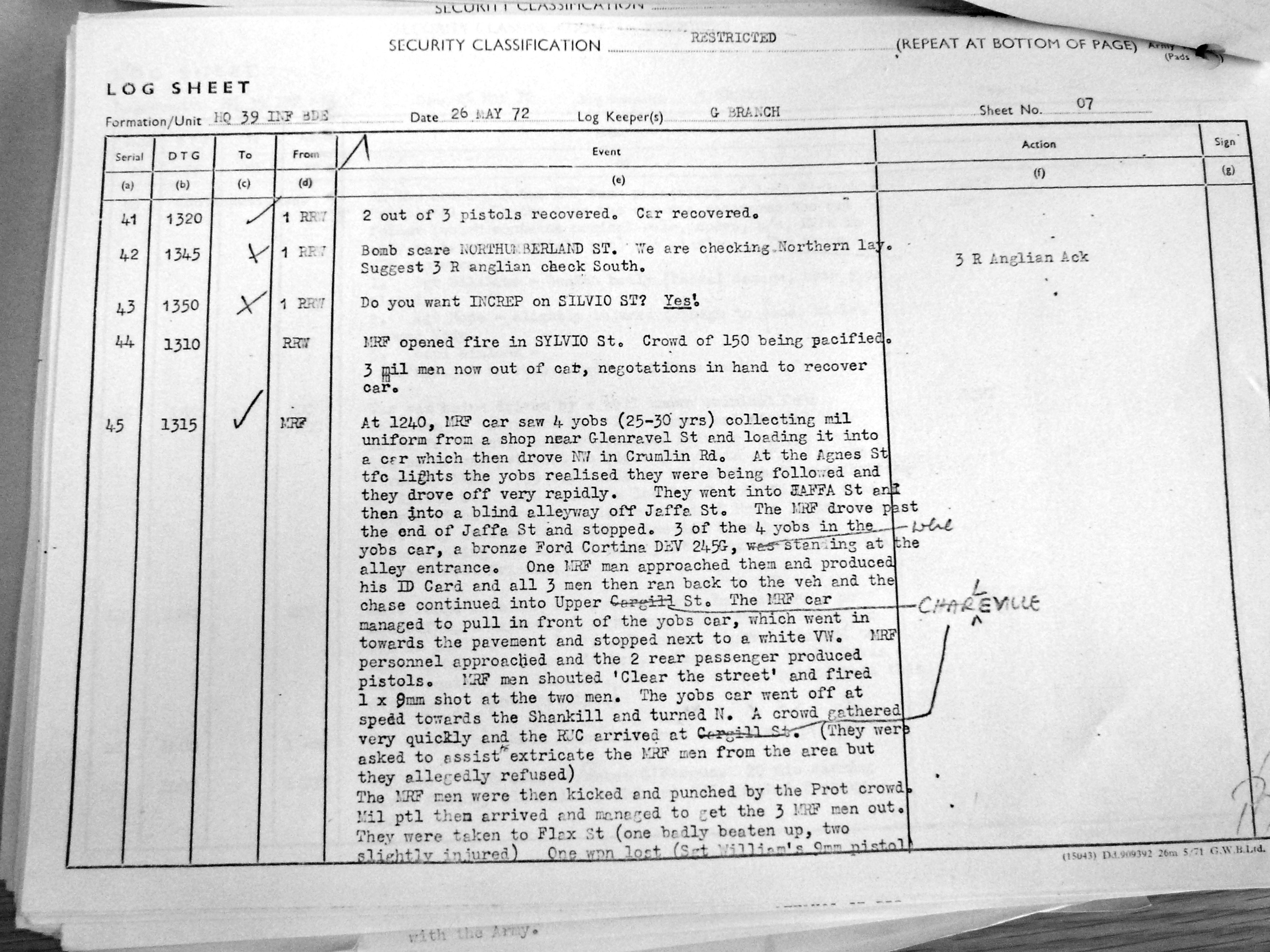
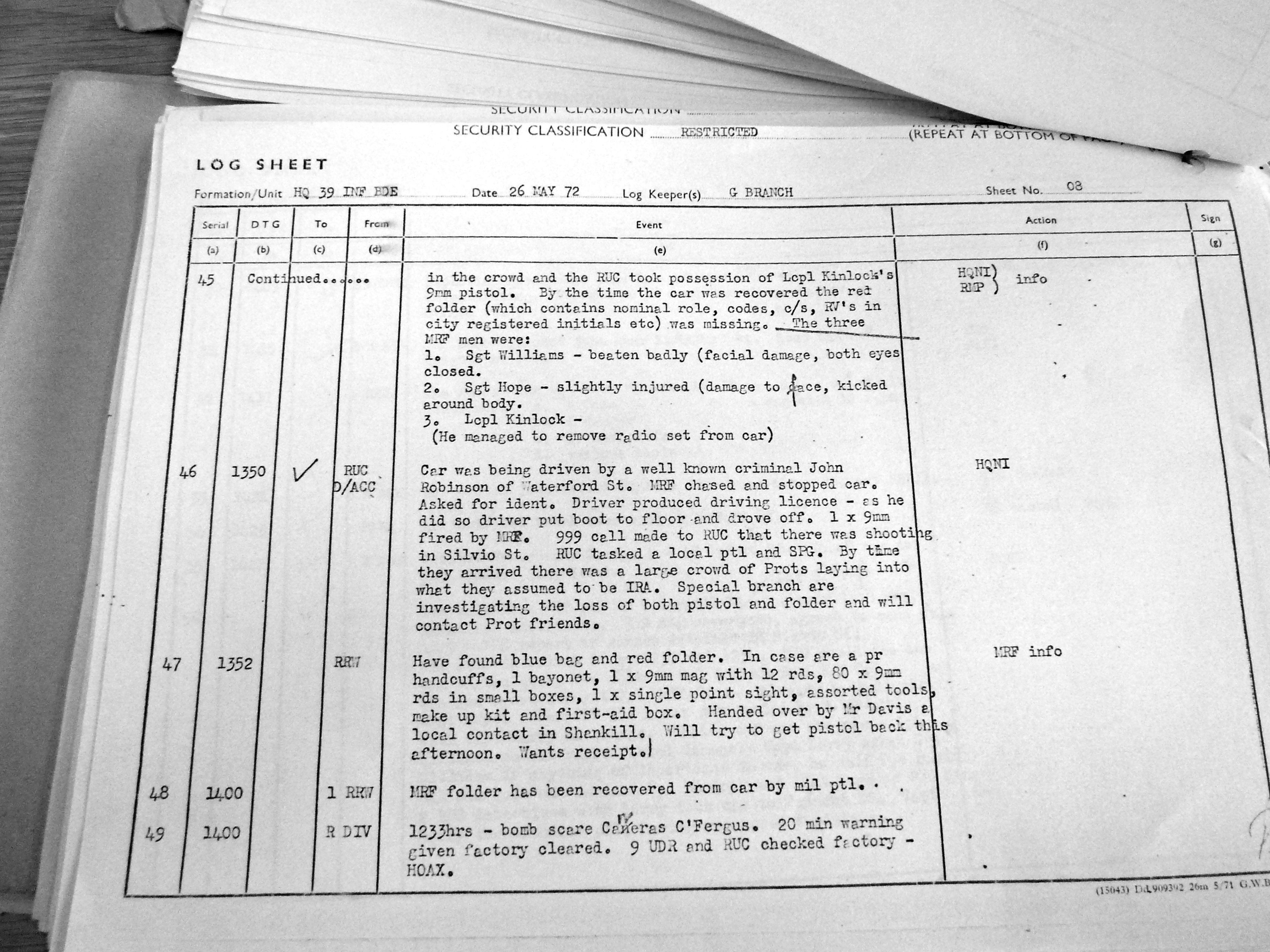
The MRF men were then kicked and punched by the Prot crowd. Mil ptl then arrived and managed to get the 3 MRF men out. They were taken to Flax St (one badly beaten up, two slightly inured) One wpn lost (Sgt Williams’ 9mm pistol) in the crowd and the RUC took possession of Lcpl Kinlock’s 9 mm pistol. By the time the car was recovered the red folder (which contains nominal role, codes, c/s, RV’s in city registered initials etc) was missing.

Serial 46, a message from the RUC to 39 Brigade, adds more detail of the incident and ends with this revealing addition:

‘Special branch are investigating the loss of both pistol and folder and will contact Prot friends’.

Just two minutes later, at 13:52, too soon for the RUC to have contacted their ‘Prot friends’, the RRW contacts 39 Brigade with the message that the blue bag and red folder lost by the MRF have been recovered and were ‘handed over by Mr Davis a local contact in Shankill’, who offered to try to recover the missing MRF pistol. ‘Mr Davis’ seems to be a misspelling/mishearing of Davy Payne. Serial 56 is a detailed report from RRW outlining their role in the rescue of the three MRF soldiers. The following day, May 27th, 1972, 39 Brigade had two entries concerning the previous day’s drama on the Shankill, both from RRW based in Flax Street in Ardoyne. Serial 59 reads:
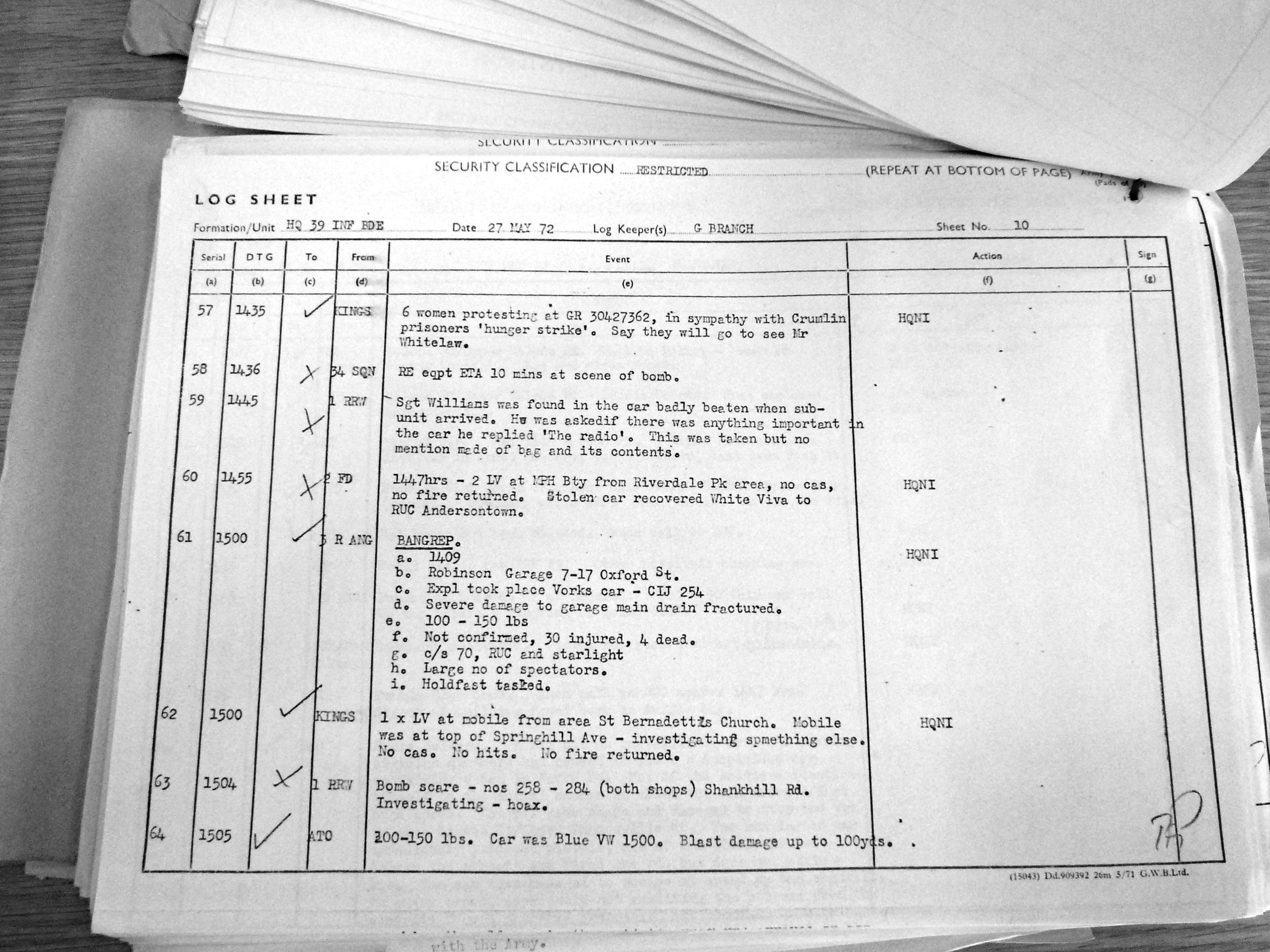
Sgt Williams was found in the car badly beaten when sub-unit arrived. He was asked if there was anything important in the car he replied “the radio”. This was taken but no mention made of bag and its contents.

Serial 83 sees the RRW clearing up any confusion about who handed in the MRF bag and red folder to the military at Flax Street. An earlier message had named him as ‘Mr Davis’ but this message sets the record straight, although the surname is misspelt:

ref MRF incident – name of person who handed in the folder – Mr DAVID PANE of 34 Brussel Street. Under the heading Action, HQNI added: ‘Suspected UVF, member of SPC. Associate of Frank Quigley.

So, eight months after the British cabinet decided that Loyalist vigilante groups could not only be tolerated but ‘might be allowed to assist the Army with intelligence’, a known member of the UVF helps the MRF, the most secret military unit deployed against the IRA at the time, to recover secret documents and equipment lost in the course of a botched operation. HQNI, i.e. Thiepval barracks mistakenly described Payne as a member of the UVF, which he had been until the UDA appeared on the scene. By May, 1972 Payne was a senior member of the UDA in North Belfast. Not only that but Davy Payne is clearly not a walk-in; he was described in log sheets variously as ‘a contact of the SF’ (security forces) and ‘a local contact in Shankill’ by the Royal Regiment of Wales, while the RUC Special Branch assures Brigadier Kitson that they ‘…..are investigating the loss of both pistol and folder and will contact Prot friends’. Was Payne one of those friends?
UDA leader Davy Payne in a photograph taken in the 1970’s when his killing spree was at its peak

It is worth noting that the apparent relationship between the RRW and Davy Payne could fall into the ‘purely unofficial and essentially local basis’ for intelligence co-operation between the military of Loyalist ‘vigilantes’ prescribed by Ted Heath’s Gen 47 meeting of the previous October. So who was this Davy Payne? Those in the media who had the job of covering his activities as a Loyalist paramilitary activist knew him to be one of the most  violent and psychopathic killers to tread Northern Ireland’s violent stage during the Troubles. He began his paramilitary life as an early member of the UVF and after the arrest and jailing of Gusty Spence for the 1966 Malvern Street murders he went with the rest of the organisation into Tara, the bizarre Loyalist ‘doomsday’ outfit led by William McGrath, an evangelical leader and notorious pedophile who was later jailed for abusing boys at the Kincora home where he was a warden. When, in September/October 1971, the UVF left Tara, allegedly when McGrath asked it to murder a rival in the group, Payne left with them. The UDA emerged publicly in September 1971 and some time after that he joined the UDA and rose through the ranks, earning a place on its inner council and the rank of North Belfast brigadier. When Davy Payne died in 2003, Irish Times diarist, Kevin Myers penned this memorable profile of the UDA killer. The article describes in disturbing detail how Payne murdered two Catholics stopped at random on the Shankill road. One was the singer, Rosemary McCartney, the other was her boyfriend, Patrick O’Neill. They were killed on July 22nd, 1972, barely two months after the same Davy Payne had returned the MRF’s missing documents and equipment to the unit’s presumably grateful commanders, in an act of ‘intelligence’ co-operation very possibly enabled a few months earlier by Ted Heath’s GEN 47 cabinet committee:

A few days ago, a certain gentleman made a discovery of interest to us all: whether or not the devil exists. For last Wednesday the loyalist terrorist Davy Payne was buried. He was a uniquely evil man, and if I could have done anything to hasten his end, frankly, I would have. Payne was the beast from hell, and the sooner he was returned to his natural homeland, the better.

An older Davy Payne poses with UDA Supreme Commander, Andy Tyrie

Payne was one of the earliest members of the Ulster Defence Association, when it was still a rabble, with its masks and combat jackets and ludicrous semi-military titles: one in 10 of its members seemed to be brigadiers, and one in three were “lootenant colonels” (so much for what they understood of “Britishness”). Curiously, almost none were corporals or privates.

What Payne brought to this lumpen, clownish rabble was his astonishing readiness to kill. For most people, the taking of human life involves crossing a threshold of some kind or other. Not Payne. And it says something about the culture of violent loyalism that this creature rapidly became esteemed solely because of his unhesitating willingness to take human life.

The security policies of the British and Stormont Governments of the time – 1971-72 – in effect allowed Payne to roam free North and West Belfast, finding his victims; and he found them in large numbers. He is said to have invented the term “Romper Room” (after a children’s television programme of the time) to describe places where Catholics would be beaten before being murdered. Thus the term “romper”, to give a severe beating, entered the diseased argot of the Troubles.

In July 1972, a UDA roadblock – operating quite openly, and tolerated by the authorities in a quite scandalous and delinquent dereliction of their moral and legal duty – stopped a car carrying a young Catholic couple, Rose McCartney and Patrick O’Neill through the Shankill area. Rose was from the Falls, he from Ardoyne, and they were taking a shortcut through a loyalist area. Like so many Catholics who did so, they were to pay for their imprudence with their lives.

The UDA men took them to one of their headquarters, where they were separated. Patrick was beaten and burnt with cigarette-ends. Rose was merely questioned. The man supervising both interrogations was Davy Payne. He was masked, so they couldn’t have identified him.

A victim of a Loyalist death squad found dumped in an alleyway

Patrick had a reputation for being something of a messer, but his conduct during his final ordeal was, I’m told, extremely dignified. Rose was asked to identify any IRA men in Iris Street, where she lived. She said she didn’t know any. But the UDA was aware that a prominent IRA man lived a couple of doors away from her.

The UDA had found a membership card for a traditional music club in her bag. Payne was fascinated. Was she really a singer, he asked. She was, aye. Prove it, he said. Go on prove it. How, she asked. By singing, he said.

I don’t know what song she sang: but the last song I’d heard her sing was My Lagan Love, just the week before in her club. Maybe she sang that. The loyalists solemnly sat around in their masks, listening to her. They liked her voice and congratulated her on it. But it didn’t save her. Payne was the UDA commander in the area, and he insisted that she die, firstly because she hadn’t named the local IRA man, and secondly, because he’d never killed a woman.

They brought Paddy and Rose together. Both were blindfolded. They were offered a cigarette each, and they lit up. Rose reached over and touched Paddy’s hand, which had been broken during torture. He recoiled. “Did they hurt you?” she cried. “No,” he lied, “I didn’t want you to burn yourself on my cigarette.” The two were put into the back seat of a car, and Payne shot them both. Other UDA men involved in the interrogation then took turns to shoot them, both for the honour of killing a woman, and also to bind them all into the one conspiracy. One of that number later told me about the events of the night.

Rose wasn’t the last woman Payne killed. A year later he and Johnny White came across SDLP Senator Paddy Wilson and his Protestant girlfriend Irene Andrews in his parked car on the Hightown Road in North Belfast. The UDA men went berserk, stabbing Paddy 32 times, and Irene 16. Over the coming years, White and Payne were repeatedly questioned by the police about these killings. One day White cracked and confessed, but Payne never did.

Irene Andrews and Paddy Wilson – stabbed to death by Davy Payne

At about this time, I was visiting a garage owned by Joe, a Protestant convert to Catholicism – a deadly crime in loyalist eyes. He told me that a suspicious car had been cruising around, and was now parked up the road. I checked it, and sitting inside was Davy Payne. I told him I hoped he wasn’t targeting Joe. He asked me what the f— I was doing, messing around with a Protestant who’d thrown in his lot with the Taigs? Getting my car fixed, I told him. And now that I’d seen him, Davy Payne, checking Joe out, I said, he clearly couldn’t kill him.

“Mebbe not,” he sniffed. He slid his spectacles down on to the bridge of his nose, and peered menacingly over the rim at me – a characteristic gesture of his.

“You know, I’ve never killed a journalist. Not yet, anyway.” And now you won’t.

Davy Payne often liked to torture his victims before killing them. His specialty was to give victims repeated electrical shocks via a box-shaped device he had acquired from which wires ran attached to electrodes. These would be fixed to sensitive parts of the victim’s body and a current created by turning a handle on the box. Payne rose to leadership of the UDA in North Belfast where one of his underlings was Brian Nelson, who later gained notoriety as the UDA’s intelligence chief and spy for the British Army’s agent-running body in Northern Ireland, the Force Research Unit (FRU).

Brian Nelson

In 1973, Nelson was arrested along with two other UDA members as they were bundling a Catholic man, Gerry Higgins into a car and to an almost certain death. Higgins had been kidnapped earlier that day and tortured in a local drinking club; he was probably being taken away to be shot when he was saved. It is believed that a device similar to Payne’s electrical box was used on him. Payne himself may even have been involved in the torture. As Nelson and his colleagues struggled with Higgins they were spotted by a passing patrol from the Light Infantry, then under the command of the Coldstream Guards regiment, who rescued him and arrested Nelson and his colleagues. Before he was handed over to the RUC for processing and eventual trial, Nelson was held in military custody and interrogated by an intelligence officer from the Coldstream Guards, a Captain Anthony Pollen, who was shot dead by the IRA in Derry, a year or so later. This unusual procedure was sanctioned by no less than the leadership of 39 Brigade. When Nelson had served his jail term, he rejoined the UDA on the instructions of the Force Research Unit and became one of the most controversial double agents run by the British Army during the Troubles. CONCLUSION: SOME QUESTIONS AND OBSERVATIONS We don’t know if the proposal for an intelligence-based relationship between Loyalist/Protestant ‘vigilante’ groups and the British security forces, as suggested by Ted Heath’s Cabinet committee, GEN 47, in October 1971, was actually put in place. But we do now have compelling evidence that in principle a relationship with Loyalist ‘civil defence groups’ or ‘vigilantes’, centered on intelligence, was suggested and approved at the highest level of the British government. GEN 47 said ‘vigilante’ type groups could be tolerated, and they were. The UDA for instance was not proscribed until 1992 but its fictional armed wing, the Ulster Freedom Fighters, was, even though it never existed except on paper, something that would have been well known to the police and army. The only other group from this period that was banned was the Red Hand Commando, which was linked to the UVF, which had been outlawed in the 1960’s. We do not know what the intelligence assistance referred to in GEN 47 meant or was intended to mean. Was it a one-sided relationship or was there give and take on both sides? What sort of intelligence would have been involved? How was the relationship organised and run? Would such activity be confined to information or were other intelligence operations, such as dirty tricks involved? GEN 47 implicitly envisaged the intelligence assistance to be a one-way street, i.e. from Loyalist vigilantes to the British Army. Was this realistic? In practice would this arrangement only be workable if the flow of information went in both directions? Did Davy Payne’s retrieval of MRF documents and equipment constitute evidence that the GEN 47 decision had not only been implemented but that it authorised British Army dealings with killers? Did Payne’s retrieval of the MRF’s red bag constitute the sort of ‘intelligence assistance’ contemplated by GEN 47? Or was Payne merely looking after his own interests when he returned the MRF material, building up brownie points with people who one day might try to put him behind bars, or worse? Why did the British Army describe Payne as ‘a contact of the SF’ (security forces)? If groups like the UDA, and their close cousins the UVF, were excluded, then which groups were part of this arrangement? And what precautions were taken to ensure that sensitive intelligence stayed within those groups and did not leak? Why did the leadership of 39 Brigade authorise an intelligence officer from the Coldstream Guards to question Brian Nelson after his arrest, out of sight and sound of the RUC? What was the relationship between Davy Payne, Brian Nelson and the British Army? Finally, the most serious and disturbing question of all. Is GEN 47 the moment when collusion began between the British and Loyalists in Northern Ireland? All these questions require answers.

Quote

Why Drew Harris is not to be trusted — seftonblog

Peter Sefton adds his voice to those expressing reservations about Drew Harris who was recently appointed Garda Commissioner:

Readers of this blog will have read my previous articles about the murders of my parents and my attempt to obtain justice for them. During this campaign I have engaged, inter alia , the RUC, the PSNI, the HET , the Police Ombudsman and others. A recurring theme, like “Blackpool” through a stick of rock , has […]

via Why Drew Harris is not to be trusted — seftonblog

Dolours Price Was Under Covert Military Surveillance Just Weeks After McConville Disappearance & Before London Bombs

Here are some interesting British Army documents retrieved from the Kew archive which, like many documents from that source, produce more questions than answers.

The documents are log sheets compiled in the control room of the British Army’s 3 Brigade in the mid-morning of 21st January, 1973. 3 Brigade was responsible at that time for military operations in the Border area, especially in south Armagh which was a Provisional IRA redoubt in the early 1970’s and for much of the Troubles.

The log sheets record how a car driven by Dolours (misspelled Dolores) Price and  a man called Joseph Murphy from the Falls Road was stopped at the Dublin Road, British Army checkpoint at the Newry border at 11:05 a.m., identified and then tailed by an undercover British Army unit. The car was traveling northwards.

The car holding Dolours Price and Joseph Murphy was held at the checkpoint for fifty minutes and released at 11:55 a.m. by which time a covert car, code named C/S C2 had arrived in the area, signalling a readiness to follow the pair.

Dolours Price, pictured in 1970’s

The military surveillance team followed them into Newry by car and then by foot into Newry town where Price and Murphy had parked outside a house  in Church Street. It was now 12:55 pm.

In response to a query concerning the occupants of the house, a message from the Royal Hampshire regiment identified the occupants as Sheila White and Mary McClure.

Price and Murphy stayed in the house until around 1 pm. By 13:40 the car containing the pair had left Newry and reached reached Banbridge where it crossed into 39 Brigade’s area of responsibility.

The 3 Brigade log sheets then stop recording radio messages. Instead messages sent by the covert British Army car were received and logged by 39 Brigade and those log sheets have not been released by the Kew archive. So we do not know how this operation concluded.

The possible significance of this operation is that this covert surveillance of Dolours Price happened within weeks, possibly a few days, of the IRA’s disappearing of Jean McConville, and some six weeks or so before Dolours Price led an IRA bombing team to London.

A coincidence or something more tortuous?


SF’s Candidate For Phoenix Park Has Drunk Deep Of The Adams’ Kool-Aid

Many thanks to S. for this tip off…..

As most readers of this blog will be aware, Sinn Fein this weekend chose Euro-MP, Liadh Ni Riada as their candidate to fight Michael D this October for the right to sleep in the Aras for the next seven years.

I heard an RTE radio interview with her recently and was quite impressed. She sounded intelligent and refreshingly un-Stepford Wife-like.

Later I realised that the interviewer had not asked her the questions that perform for SF members the same function as a button does on a robot; press it and the robot goes into a pre-programmed mode. So the impression I got of her may have been somewhat misleading.

Liadh O Riada (l) and SF leader Mary Lou McDonald pose for the press after O Riada was selected as candidate for the presidency

That button is, of course, any question about Gerry Adams’ near three decade career as a local and national leader of the Provisional IRA.

Back in November 2013, after she had been selected as a Sinn Fein Euro candidate, she gave an interview to the Irish Daily Mail’s Jason O’Toole who, being the proficient reporter that he is, did press the robot’s button.

I doubt whether Liadh ni Riada’s answers would be any different if the same questions put to her in 2013 were asked of her today. Even though Gerry Adams has stepped down from the leadership, it seems that no Sinn Feiner has the courage, if not to tell the truth about Adams, then to at least avoid telling intelligence-insulting lies about his life.

Gerry Adams is Sinn Fein’s Stalin. When will the party gather up the courage and produce its Krushchev?

Until that happens Sinn Fein must expect a sceptical response when the party insists that Mary Lou is her own boss.

This is how The Cedar Lounge Revolution reported the exchange back in November 2013:

Liadh Ní Riada

She has been chosen as Sinn Féin’s candidate for the new Europe South constituency which is expected to include most of Munster and part of south Leinster. Currently Sinn Féin’s Irish language development officer, Liadh says that she fully supports party leader Gerry Adams. As well as stating that she believes Adams’ declaration that he was not in the IRA — which most people find incredulous — Liadh also says that she believes the Sinn Féin leader had nothing to do with the brutal murder of Jean McConville, despite the fact he has been accused of ordering her death by former IRA members Bernard Hughes and Dolours Price.

‘It’s very easy to throw accusations and I don’t see any grounding or any basis for that and obviously I support Gerry 100 per cent. ‘It’s terribly unfair that they focus on these things with no basis and yet they don’t focus on all the good work he’s done for the Good Friday peace process. ‘It’s a terribly unbalanced, prejudiced view, which I think is completely without basis.’ She also doesn’t buy into the view that Adams has been damaged by the revelations about how he didn’t report his brother Liam to the police for sexually abusing his daughter Áine for some years after he first became aware of it. Liadh says that nobody ‘in their right mind would be supportive of any abuse or cover up’. She adds: ‘As far as I know, he was acting on his niece’s best interests. ‘It’s a family private matter and again putting it out in the public like that I think it’s again distracting from some of the good works that Gerry does. ‘He consistently tops the polls. He has 100 per cent support from the party. So it’s a no-brainer in that sense for me.’

Michael Bettaney, The MI5 Spy Who Supposedly Helped The IRA Is Dead

I didn’t realise until I read today, courtesy of the Irish Republican Education Forum, that Michael Bettaney, the MI5 double agent, i.e. who worked secretly for the Soviet Union (and was betrayed by a British spy in the Russian ranks) had died last month.

Bettaney is alleged to have passed on details about MI5’s operations in Northern Ireland to the IRA after his arrest, while on remand, an assertion repeated in the following article in The Weekly Worker. The man I was told he talked to in jail was the late Brian Keenan, the IRA’s Quarter-Master in the Provos’ early days, who was then serving a lengthy term for IRA bombing offences in Britain.

True or not I cannot be sure, but Bettaney did work in the North for MI5 and supposedly ran agents there, so the story could be soundly based. Nor did I realise that he had led such an interesting life, both before and after his jail term.

Anyway here is the quite fascinatig article from The Weekly Worker detailing Bettaney’s career in MI5 and his subsequent conversion to Marxism. Enjoy:

A man of contradictions

Michael Bettaney (Malkin) February 13 1950-August 16 2018

06.09.2018

Won by our side

We first got to know Michael Bettaney in the mid-1980s. After an Old Bailey trial, mainly held in camera, he had just been convicted under section 1 of the Official Secrets Act. Michael stood charged with attempting to pass damaging information on to the Soviet Union. Lord Lane handed him a 23-year sentence (apparently there were those in government pressing for an even longer stretch).

This was during the miners’ Great Strike and the ongoing armed struggle in the Six Counties of Northern Ireland. There were hundreds of political prisoners in British jails. Our organisation had a policy of sending them books, copies of The Leninist and exchanging letters. Various comrades were assigned to, or volunteered, for this work, one of them being Marion Johnstone. She entered into a mammoth correspondence with Michael and eventually began visiting him in Swaleside prison on the Isle of Sheppey. Being something of a diarist, Marion records exactly 444 such visits – two a week.

Michael Bettaney

Michael was born in 1950 to working class parents in Fenton, Stoke-on-Trent. With their help and encouragement, he excelled at school and won himself a place at Oxford University. He attended Pembroke College and studied English. Michael had an enduring passion for languages. He mastered German, French, Latin and Old English. In prison he taught himself Russian – mainly by listening to Radio Moscow. Later in life he learnt various Polish words and phrases. He wanted to make the migrant bus drivers feel welcome in his adopted home town of Ware.

At university he seems to have aped the politics and drinking habits of his more boorish upper class peers. According to the official account, he affected an admiration for Adolf Hitler and sung the ‘Horst Wessel song’ in college bars and local pubs. There was much throwing of food and breaking of glass. Think Black Cygnets, Piers Gaveston Society, Bullingdon Club and Oxford University Conservative Association.

The secret services have long had a record of recruiting suitably reactionary Oxbridge toffs. However, what they were looking for in the early 1970s were spooks with a working class background who could mix with the hoi polloi … and be fast-tracked up the chain of command. Michael Bettaney fitted the bill perfectly. After undergoing a thorough vetting, he was given a job-offer by MI5.

After spending a year in West Germany, MI5 assigned him to Northern Ireland. Michael ran a clutch of well-placed MI5 informants. He told how he had to watch in silence, hidden in a cupboard, while one of his grasses was kneecapped by an IRA punishment squad. He also survived a car bomb. But Northern Ireland changed him for the better. The unbreakable resistance of the nationalist population, the cynical connivance of British state forces with loyalist assassins, the heroism and self-sacrifice of IRA volunteers – all made a lasting impression.

Promoted, his next assignment was at a desk in MI5’s department F. That involved counterespionage – basically monitoring KGB agents … and their assets, real and imagined, in the Labour Party, the trade unions, CND and, of course, the ‘official’ Communist Party. Department F recorded each and every donation made to the Morning Star, instructed agents, blackmailed and secretly raided CPGB district offices (where membership details were held). Other leftwing organisations were watched, but did not rate of much importance.

Michael had to study Marxism – the motto in department F being ‘know your enemy’. Unlike most of his colleagues he did not find this a crashing bore. The British road to socialism, the programme of the ‘official’ CPGB, had him laughing. However, the writings of Marx, Engels and Lenin – they were a different matter entirely. Profound, gripping and persuasive. He began to think of himself as a Marxist.

Given Margaret Thatcher, Ronald Reagan and the ratcheting up of cold war missile rhetoric, it is, I suppose, no surprise that Michael decided to follow in the footsteps of Kim Philby, Anthony Blunt, Donald Maclean and Guy Burgess. There were few illusions in the Soviet Union of Leonard Brezhnev, but Michael believed he could serve the cause of world peace … if he operated as a double agent.

Incidentally, it is worth noting that Michael developed a considerable admiration for Hillel Ticktin and his work on the Soviet Union. He kept a framed picture of him in his ‘Marxist corner’ at home.

Michael photographed a wide range of highly compromising documents at MI5’s London HQ. Meanwhile, he delivered a suitably cryptic message for the Soviet embassy’s KGB staff. It required them to make contact with him using standard spycraft techniques: pins on escalators, numbered steps, etc.

The story of Michael behaving completely incompetently, being hopelessly drunk and stuffing MI5 documents through the letterbox of the Soviet embassy, was, needless to say, pure invention. The same goes for the story of a confused general, Arkady Gouk – first secretary at the Soviet embassy and head of the KGB’s British section – going round to MI5 and handing back the documents. Obvious fabrication.

The British secret services had their double agent in the KGB and did not want to blow his cover. It was Oleg Gordievsky who informed MI6 that there was yet another mole in the British secret service. Michael found himself under investigation and was presented with a stark choice: either put a bullet through your head or give a full confession. Over a bottle of whisky he told all.

Before his trial, on remand, he sought out IRA prisoners to tell them about the MI5 agents in their movement. He passed on similar information to Arthur Scargill and the National Union of Mineworkers. Names were given …. but evidently to no effect.

Once sentenced, Michael was always category A. Initially that meant solitary confinement … and no TV, no radio, no writing paper. His exercise yard was covered with overhead wire mesh to prevent a helicopter rescue. His toilet paper was of the soft kind – other prisoners had to make do with the old-fashioned, shiny rolls. No surreptitious messages were to be ferreted out.

Doubtless, he expected to be exchanged for a British spy in the Soviet Union and end up in a comfortable little Moscow flat – apparently, the view of the British secret services too. But, of course, with Mikhail Gorbachev, and then Boris Yeltsin, the Soviet Union tumbled towards a chaotic collapse. Michael had to adjust to serving a long, long sentence.

That prospect did not particularly worry him. Although he was extraordinarily sociable, he could easily cope with solitude. A Catholic from his young teens, Michael was part monk, part communist partisan. The prison authorities noted how determined he was to remain mentally and physically fit. He studied hard and exercised hard. The pictures that I have seen of him dating from these times – taken surreptitiously, of course – show him lean and self-possessed.

Over time the prison regime relaxed somewhat. Writing material, a radio, Christmas vodka … even a cellmate (one, a none-too-intelligent guardsman, was sent in to spy on the spy – Michael fed him nonsense and he was soon transferred out).

Because of Marion’s letters, because of The Leninist, because of the collapse of bureaucratic socialism in the Soviet Union and eastern Europe, Michael came towards our point of view. He wrote for our press under the name, ‘Michael Malkin’. His articles, letters and reviews were always very well written, though sometimes they were flawed by a hyper-revolutionism. Eg, he had absolutely no time for former government minister Tony Benn.

After serving two-thirds of his sentence – 15 years and six months – Michael was released on parole. This is when I first met him in person. We worked together producing and posting out the Weekly Worker, we drank a few beers together once or twice a week, we even contemplated writing Fantastic reality – my book on religion – as a joint effort.

Not that I ever really knew Michael. Though I always liked and admired him, I have to admit that I always found him totally enigmatic. He was a social chameleon. Michael could talk to anyone, in any way, at any time. Having blended in with the Oxford of his youth, he could just as easily charm prison wardens … and me. Nonetheless, serving 15 years and six months surely speaks for itself. He had the steel of conviction.

Upon his release in 1998, Michael moved in with Marion. Both an odd couple and ideal partners – some day a playwright or a novelist will tell their unlikely tale.

Despite writing for the Weekly Worker, Michael became a thoroughgoing localist. He worked at the corner newsagent, helped the old and infirm, became a beater for pheasant shoots and got to know all and sundry. He proudly proclaimed himself a Marxist until his death, but he was also a committed Catholic. We parted company over … who knows what – he clearly wanted to leave our ranks. Nonetheless, I shall always regard Michael as a friend and comrade.

In later years his Catholicism became far more important than his Marxism. He regularly attended mass. Father John, the priest officiating at his funeral service, assured us all that we would meet Michael in heaven – along with John Paul II and all the other Catholic bishops and saints. For my part, if the Christian doctrine is true, I hope to meet Michael in the fires of hell – the company is better there.

Jack Conrad

Bob Woodward’s ‘Dull And Shallow’ Book On Trump

This is worth reading. Take my word for it. The title is ‘Dupe Throat – Bob Woodward’s self-parody’.

What Will Irish-America Make Of ‘The Ferryman’?

The Ferryman‘, written by British playwright Jez Butterworth is set in Northern Ireland in 1981 during the Republican hunger strikes of that year, and deals with a Co. Armagh family’s trauma when the body of a relative, shot dead by the IRA and hidden in a local bog – he is one of the ‘disappeared’ – is discovered.

I have my own views on this play but they are based on what I have read about a production I have not seen and so I will remain silent, and let others who have seen it do the talking, or rather writing.

The Ferryman‘ was greeted with rave reviews when it premiered in the West End last May, and is due to open on Broadway next month – directed by Sam Mendes – when, doubtless, given the social, class and general anglophiliac background (not to mention ignorance of the conflict in Northern Ireland) of New Yorkers who can spend $150 a head or more on an evening in the Great White Way, we can expect much the same.

‘The Ferryman’ playwright, Jez Butterworth, Laura Donnelly (who appears in the play) and director Sam Mendes

I have posted two conflicting reviews below, one which appeared in The New York Times when ‘The Ferryman‘ was first staged in London, and beneath it a scathing critique by Guardian/Observer writer Sean O’Hagan whose views on the play can be summed up in one sentence:

What I had witnessed, and in part enjoyed, was a play that revealed more about English attitudes to Ireland than it did about Northern Ireland.

O’Hagan is also offended by the Irish stereotypes conjured up by Butterworth – obsession with the past and, of course, over-consumption of alcohol being only two – and one wonders what sort of reception the production would receive if similar caricatures or stereotypes featured in a play about African-Americans or Jews.

I’d bet the mortgage it wouldn’t come within sniffing distance of a Broadway theatre.

nytimes.com

Review: ‘The Ferryman’ in Jez Butterworth’s Northern Ireland

Paddy Considine, center, gives Sophia Ally a lift during the play “The Ferryman.”CreditCreditJohan Persson

LONDON — It’s a mighty full house that’s presided over by Quinn Carney, the divided Irish hero of Jez Butterworth’s “The Ferryman,” which burst open at the Royal Court Theater here on Wednesday night, where its run is already sold out. (It moves to the West End in June.) The fiercely gripping play in which Quinn, a father of seven, appears is every bit as crowded.

And I mean teeming — with characters, plot, secrets, confessions, clashes political and sexual, betrayals, murders, ballads, poems, dancing, drinking, wrestling and the wails of banshees, whose reality is not to be doubted. The terrific cast — led by Paddy Considine and directed with a racing pulse by Sam Mendes — numbers 21, and that’s not counting the baby, the rabbit and the goose. Like everything else in “The Ferryman,” those nonspeaking performers are indisputably alive.

Set in rural Northern Ireland in 1981, this latest offering from the author of “Jerusalem” also overflows with storytelling vitality, the kind that so holds the attention that three and a quarter hours seem to pass in the blink of an eye, albeit a bloodied and black one. Consider yourself well warned when a little girl, gleefully awaiting an oft-told tale by an ancient relative, chirps excitedly: “I love this one! It’s so violent!”

That scene exudes the hearthside warmth of a classic, bustling domestic comedy in which an extended family lives in contented close quarters and everybody chips in to help. Of course, in this clan, even the little ones swear like sailors on a bender.

And the yarns spun by old Aunt Maggie Far Away (Brid Brennan), who spends much of her time in a wordless trance that might be mistaken for senility, feature the dismemberment of faerie warriors and are steeped in an erotic longing for the golden lad she once loved from a distance, now long disappeared. “I swear to Christ,” she says sweetly to the little ones gathered at her feet, “I could have ridden that boy from here to Connemara.”

Like much of “The Ferryman,” Ms. Brennan’s character (right down to her name) would seem to be drawn with an exaggeration that borders on parody. But as he demonstrated in his astonishing “Jerusalem,” seen on Broadway in 2011, Mr. Butterworth specializes in making what might be too much from anybody else feel somehow exactly right.

Life as he portrays it is so expansive, only myth and melodrama can accommodate its dimensions. And under the expert guidance of Mr. Mendes, an acclaimed film director (“American Beauty,” “Skyfall”) returning to the stage with avid conviction, “The Ferryman” embraces and absorbs explosive contradictions of story and sensibility.

The play begins with a stark, sinister scene that scarcely prepares us for the richness of what follows. We’re on a grimy back street of Derry, where Father Horrigan (Gerard Horan), a country priest, has been dragged for a meeting with the notorious Mr. Muldoon (Stuart Graham), a lean man of elegant menace.

It seems the bound corpse of one of Horrigan’s parishioners, missing for a decade, has been found in a bog, and Muldoon wants the good father to carry the news to the dead man’s brother. That’s Quinn, whom we meet at home in the next scene, dancing wildly in the wee hours to the Rolling Stones with a woman we assume is his wife or a lover.

She’s not. Caitlin Carney (Laura Donnelly) is Quinn’s sister-in-law and the wife of the dead man. Don’t trust your first assumptions as you watch this play; don’t entirely discount them either.

Quinn’s household includes his bedridden wife, Mary (Genevieve O’Reilly); a married aunt and uncle, both called Pat (Dearbhla Malloy and Des McAleer); Caitlin’s teenage son, Oslin (Rob Malone); and a slow-witted handyman, Tom Kettle (John Hodgkinson), who was taken in as a child after being abandoned by his parents, who were (and this is crucial) British.

It is harvest day. There’s to be toiling in the fields and the kitchen, and drinking and feasting after. It would all be perfectly jolly, except for our niggling awareness of the shadows cast, by that opening scene with Mr. Malloy and by news of the fatal hunger strikes of Irish Republican Army prisoners in the Maze prison. That darkness thrums like a bass line.

“The Ferryman,” as you may have inferred, is Mr. Butterworth’s contribution to the literature of the conflict known as the Troubles, and on one level, it recalls Sean O’Casey’s epochal dramas of civil war from the 1920s. But Mr. Butterworth is digging beyond the tensions of political factionalism to uncover more atavistic impulses.

Like “Jerusalem,” which probed the British yearning for a lost mythic grandeur, “The Ferryman” portrays a people in thrall to millenniums of history, in ways they’re not always aware of. On the one hand, there’s the embittered Aunt Pat, who as a girl witnessed the death of her brother during the Easter Rebellion and can’t stop talking about it; on the other, there’s the fey Aunt Maggie, with her gossamer-spun stories of elfin wars and lost loves.

Uncle Pat is the most long-winded of the family raconteurs, with daily events inspiring detailed accounts of tediously similar happenings of years gone by. He is also a devoted reader of Virgil, whose “Aeneid,” and its account of its hero’s visit to the shores of the underworld, gives “The Ferryman” its title.

The specter of death never leaves the stage in this production, which has been designed with radiant verisimilitude by a crack team that includes Rob Howell (sets and costumes), Peter Mumford (lighting) and Nick Powell (sound). Yet it feels as if the show’s every molecule vibrates with bounteous life.

After “The Ferryman” ends — probably well after — you may start to disassemble it in your mind, and realize how many of the conventions of old-fashioned melodrama it honors. But you won’t be capable of such dispassion while you’re watching it.

In the play’s second act, a harvest dinner is interrupted by a collective, bacchanalian urge to dance. Suddenly, this extended family is on its feet and stepping high, moving from country jigs to free-form frenzy.

Everyone onstage is as caught up in the sensory sweep of the music as the audience has been in Mr. Butterworth’s galloping narrative. That there’s a mortal chill in the festivities, and a premonition of dark endings to come, makes the fire of the moment burn all the brighter.

The Ferryman
Royal Court Theater


theguardian.com

Critics loved The Ferryman. But I’m from Northern Ireland, and it doesn’t ring true | Opinion

Sean O’Hagan

Early in the summer of 1981, when the IRA hunger strike had already claimed the deaths of four republican prisoners, I travelled home from London to Armagh. My parents had not long moved from the estate where I grew up to my late grandparents’ house three miles south of the town. Even though we no longer lived in the hub of the nationalist community, I was utterly unprepared for the atmosphere that hung over the place, a sense of disbelief, communal grief and simmering tension unlike anything I had ever experienced there.

Back in London, listening to the nightly news reports on the hunger strikes, I felt a sense of dislocation, of not belonging, that was profound. It was exacerbated not just by the intransigence of the prime minister, Margaret Thatcher, but by the bewilderment of many of my English friends, whose knowledge of Anglo-Irish history was, to say the least, cursory. Though the notion of blood sacrifice for a cause seemed almost beyond my own comprehension, I was torn by conflicting emotions, by complex bonds of community and place, by the gulf between who I was and where I was.

If that is an extreme example of cultural dislocation, it is nevertheless apparent, from my experience, that no matter how long an Irish person has lived in England there are moments when their Irishness – their otherness – is made apparent in often uneasy ways. I felt that uneasiness several times last month, as I sat in a packed and expectant Gielgud theatre in London on the opening night of The Ferryman, director Sam Mendes’s ambitious production of Jez Butterworth’s new play. The glittery audience, primed by almost universally ecstatic reviews, rose in rapturous applause at the end, carried along by the play’s extraordinary energy and the gritty cut-and-thrust of Northern Irish banter from the cast of almost 20 actors.

No one else seemed to mind the cliches and the stereotypes of Irishness abounding here: the relentless drinking, the references to fairies, the Irish dancing, the dodgy priest, the spinster aunts – or the sense that the play ties itself in knots tackling ideas of place, loyalty and community. Butterworth and Mendes fill the stage with noise, movement, songs and stories, but once that bravura energy had subsided, I was left with that familiar sense of unease, of dislocation. What I had witnessed, and in part enjoyed, was a play that revealed more about English attitudes to Ireland than it did about Northern Ireland.

The Ferryman, for all its ebullience, is essentially about a mysterious absence and the infecting nature of the silence that ensues. It is set on a farm in rural Armagh in 1981. At its heart, two mysteries intertwine: the fate of Seamus Carney, a young man “disappeared” by the IRA on New Year’s Day, 1972, and the unspoken love that has grown in his absence between his brother, Quinn Carney (Paddy Considine), and Seamus’s wife, Caitlin Carney (Laura Donnelly). Caitlin and her troubled 14-year-old son, Oisin, live under the same roof as Quinn, his ailing wife, Mary (Genevieve O’Reilly), and their six children. So too do Quinn’s uncle Pat and his aunts, Patricia and Maggie, the one a staunch and bitter Irish republican, the other a more gentle soul whose long silences are broken by voluble gusts of remembering and prophecy.

This is fertile territory for Butterworth, whose previous play, Jerusalem, evoked ancient English myth and archetype through the modern outlaw figure of Johnny “Rooster” Byron, an outsider whose amorality was cloaked in rich, self-mythologising storytelling. More pertinently, given the setting, it is fertile territory in which to explore the remarkably underwritten collective psychology of the Troubles: the silences, secrets and complicity, tacit and otherwise, that attended 30 years of violence and more than 3,500 deaths. It is also a chance to shed light on the long shadows cast by the so-called “disappeared” of the Troubles, who, as Butterworth makes clear, often existed as suspended presences among their families and friends, even as knowledge of their murders was commonplace in their communities.

In this instance, Butterworth is drawing on the first-hand experience of Laura Donnelly, who plays Caitlin, and whose uncle was killed by the IRA in January 1981. Despite rumours that circulated about sightings of him, his body was accidentally uncovered in a bog across the border in May 1984. The vanishing at the heart of The Ferryman is, for Donnelly at least, a tangible one. In the play, the body of Caitlin’s long-missing husband, Seamus Carney, is found, perfectly preserved, in a bog across the border in Co Louth, with a bullet hole in his skull.

The complex nature of community loyalties during a time of violent political struggle is a central aspect of The Ferryman, played out on stage through the bonds and tensions of an extended family with ties to Irish republicanism, past and present. The play’s success would rest, I thought, on how deftly Butterworth captured the nuances of a place and its people, on the authenticity of accents and rhythms of speech, in the verbal jousting that can come across as caustic – to the point of combative – to an outsider. One of the most powerful scenes is when the teenage boys – Quinn’s sons and their more savvy cousins from Derry, who have come to help with the harvest – swap Troubles war stories. Fuelled by whiskey, Shane Corcoran breaks the Provisionals’ omerta by bragging about how he has acted as a lookout for the local Derry brigade of the IRA. The scene moves from the boastful to regretful to the recriminatory, each beat meticulously orchestrated.

There are several visceral interludes like this, but for me, the sense of uneasiness prevailed. Everything was overstated, turned up to the max; out came the inevitable roll call of characters-cum-caricatures: the compromised priest, the bitter republican aunt (shades of James Joyce’s Catholic aunt, Dante Riordan, from Portrait of the Artist…), the alcoholic with the heart of gold and the menacing IRA men, who, in this instance, moved from silently threatening to the point of caricature. Then there’s the drinking: not just the alcoholic uncle, but the whiskey-slugging dad, the sozzled teenage sons and – wait for it – the children allowed thimblefuls of Bushmills for breakfast. Comedic, for sure, but so close to a cultural stereotype as to be offensive.

My paddywhackery detector went leaping into the red at the first mention of banshees (for the uninitiated, an Irish female fairy spirit whose wail augurs death). Aunt Maggie Faraway hears them and we, in turn, hear their symbolism. Now, banshees have their place in Irish drama, but they belong to the often hokey world of Yeats, Lady Gregory and the Irish literary revival of the 19th/early 20th century. They do not belong in a play set in Northern Ireland in 1981, where the mention of banshees would more likely have referred to a post-punk group of the same name led by a young woman called Siouxsie. Indeed, the eldest Carney girl is in thrall to Adam Ant, while the young and cocky Shane Corcoran from Derry disrupts the general Oirishry by blasting out Teenage Kicks by the Undertones to the bewilderment of his country cousins – although by 1981, three years after its release, the song was already an anthem of escape throughout Northern Ireland. These details matter in a play that depends on the accurate evoking of a place and time.

Part of Butterworth’s stock in trade is the evoking of magic and myth, but the heightened tone that worked for Jerusalem does not quite convince here. The whole idea of a farming family in county Armagh in the 1980s celebrating the annual harvest as a semi-pagan ritual of feasting and drinking seems implausible to the point of unreal. The exhausted tropes of Irish mysticism seemed to have seeped into The Ferryman from other older dramas about a different pre-modern Ireland across the border.

Perhaps unsurprisingly, the IRA men are the most problematic characters, but not for the reasons you might expect. “There are no good guys or bad guys,” Sam Mendes said recently of The Ferryman, “it is only shades of grey.” This is patently not the case. The IRA characters are straight from central casting, with the commander, Muldoon, and his pair of henchmen played for maximum drama at the expense of nuance.

A great part of the IRA’s enduring power, as well as the tacit support they depended on, came from the fact that they were embedded in local communities. They weren’t strangers, but people you knew and had grown up with. I never quite understood, then, why Muldoon and his minders had been dispatched from Derry – nearly 70 miles away – to warn the Carney family that they should remain silent about the murder of Seamus Carney. Surely the issue would have been addressed by the local IRA, who would have sent someone to have a quiet word in Quinn’s ear? No need for the arrival of a godfather from Derry straight out of a Scorsese film. No need either for his minders to tell the local priest that his sister will be “disappeared” if he does not help them silence the Carneys. Please!

In Butterworth’s defence, Muldoon and Quinn have previous. They served time together in Long Kesh prison when Quinn was a committed republican foot soldier. Just how committed is revealed when Muldoon reminds Quinn of something he said just after the birth of his first son. “You looked me in the eye and said you’d watch that baby burn in a fire if it meant a free Ireland. And I thought: ‘That is what it takes. That is the cost of freedom.’” Now, I know the IRA are the baddies here, but would it not have served a drama that deals in silence, threat, complicity and its consequences to have them appear just a tad more psychologically complex? And does Quinn really believe his brother’s murder was revenge for his leaving the IRA?

Dramatically, too, I had difficulty with The Ferryman. Without revealing too much about the play’s inevitably violent denouement, it seemed overwrought and overplayed. When the heart-stopping drama of that visceral moment subsides, I was left wondering, not for the first time, why?

The single English character, Tom Kettle, a kind of holy fool, is also unbelievable. While it is interesting on one level to see the tired stereotype of the thick Paddy upended, Kettle seems more of a plot device than a rounded character. How do these too-broad brush strokes make their way into a play that, if it is to succeed at all, must rely on subtlety and attention to detail? One clue may be the Irish writers that Butterworth selfconsciously nods to: the metaphor of the ferryman is used in Brian Friel’s play, Wonderful Tennessee, while the Carney family name is taken from Tom Murphy’s early play, Whistle in the Dark, which is also set at harvest time. Seamus Heaney’s bog poems are in there, too: Tollund Man, The Grauballe Man and Punishment, which deals in a different way with the tensions of community and collusion.

Friel and Murphy belong to a generation of Irish playwrights for whom myth and magic still retained a sliver of their mythic power to unsettle. Butterworth is an English writer grappling not just with the complexities of Northern Ireland politics and culture at a pivotal time in its history, but also with the full weight of the Irish dramatic tradition. You can see why he feels the need to nod respectfully to his most obvious influences, even if they don’t quite fit.

What makes me most uneasy about The Ferryman, though, is the differences the play unconsciously highlights between Irish and English cultural sensibilities, between the Irish people’s idea of themselves and the English idea of them. I was uncomfortable at the gales of laughter that greeted every swear word uttered by the child characters, at the hilarity that ensued every time the uncle opened his bottle of Bushmills or a girl used the word “ride” as shorthand for sex. (Aunt Maggie Faraway, an elderly Catholic spinster, brought the house down with her use of the same word, which made me wonder if we had finally crossed into Father Ted territory.)

The attentiveness that ensued when Aunt Maggie sang a lovely Irish air – Yeats’s fairy ode, The Stolen Child – was equally mystifying. The notions of Ireland these stereotypes evoke – a wild, unfettered place of terminal boozing and unfettered romanticism – seemed to have somehow endured despite the Troubles, the Celtic Tiger, and even the sudden dramatic appearance in the English psyche of the DUP, who, believe me, are more alarming than those banshees. (If you want to measure the cultural chasm between Northern Ireland and the Britain to which it supposedly belongs, the pre-deal ignorance of the DUP’s existence might be a good place to start.)

Given that both Butterworth’s parents were part Irish Catholics, one wonders if he has that second-generation nostalgia for an Ireland that has been passed down to him rather than experienced first-hand. One wonders, too, how the play would be received by an audience in Dublin or Galway, or, more to the point, Armagh, Belfast or Derry.

Whatever, no one around me in the Gielgud theatre seemed bothered by the banshees or the boozing or the mad Irish dancing, nor by the dramatically heart-stopping, but utterly implausible, Tarantino-esque – or should that be McDongah-esque – denouement. Everyone rose to their feet as one to applaud. The critics too, have been amazingly reluctant to acknowledge these stereotypes. This may be to do with Butterworth’s – and Mendes’s – current cachet, but, to me, it betokens something else. This is what the (Northern) Irish are like, that ovation seemed to say, this is how they carry on, bless ’em.

I am not, by the way, disputing Butterworth’s right to write a play about Ireland and the Troubles. I would not go so far as the academic Terry Eagleton, who once noted that “English attitudes to the Irish are a bizarre mixture of affection, uneasiness, condescension and hostility”, but I could not help thinking that this was the sound of a mainly middle-class English audience having their cultural stereotypes confirmed rather than questioned.