‘Massacre At Ballymurphy’ – Watch The Documentary Here

For residents of the United States and other places that are not Ireland or Britain, this version of the documentary film shown on the UK Channel Four over the weekend has been made available to YouTube and can be watched here. For those who live in Ireland or Britain and missed the film, tough luck (or maybe invest in a VPN):

The MRF File – Part Four: The Thoughts Of Brigadier Frank Kitson

From James Kinchin-White and Ed Moloney

The following letter, written at the end of December 1971 by Howard Smith, the UK Representative to the NI government in Belfast prior to direct rule – and later the head of MI5 – to Philip Woodfield, the then head of the NI department in the Home Office, has a double value.

Howard Smith – Whitehall’s man in Belfast before Direct Rule, later head of MI5

First, it provides confirmation that the MRF was being constructed in the winter of 1971, which dovetails nicely with the theory that the MRF evolved out of the Bomb Squad.

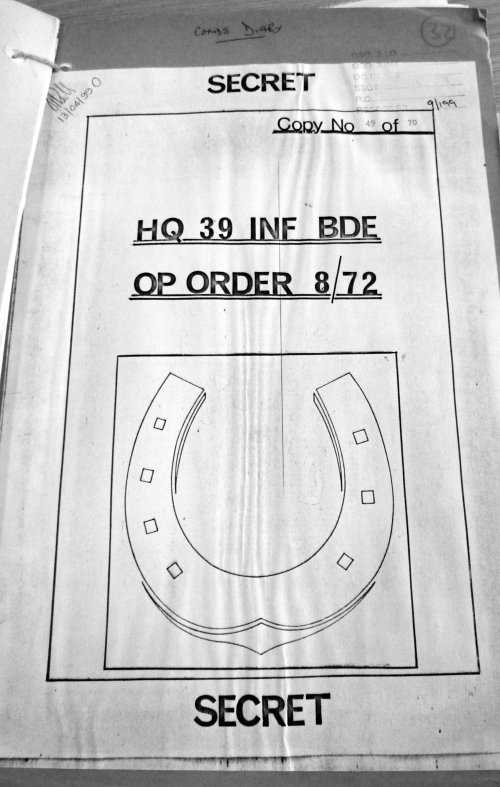
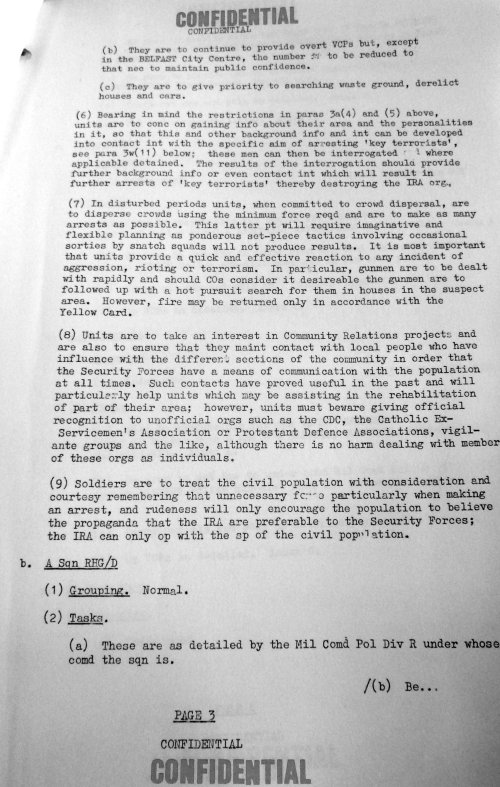
Second, the letter, dated December 4th, 1971, encloses a three and a bit page assessment of the situation in the North written by the British Army’s Belfast commander, Brigadier Frank Kitson which gives us an interesting insight into Kitson’s thoughts on the way forward for British strategists some five months or so after the introduction of internment.

On the MRF, Kitson wrote:

As you know we are taking steps….in terms of building up and developing the MRF and we are steadily improving the capability of Special Branch by setting up cells in each (RUC) Division manned by MIO/FINCO’s (Military Intelligence Officers/Field Intelligence Non-commissioned Officers) and by building up Special Branch records with Int Corps Section.

Just a few months before Kitson’s missive, the RUC Special Branch was a joke in the North’s security universe. The lists of names provided by the Branch to the military to be arrested on August 9th 1971 and interned, turned out to be hopelessly out of date, based largely on Special Branch records of activists involved in the Border campaign of 1956-62, and was politically biased, leaving out Loyalist extremists entirely while including civil rights leaders who had no or next to no paramilitary links.

It is arguable that by giving the Branch such a high profile in MRF operations, Kitson rescued the North’s secret policemen from the dustbin of history and propelled them to an eventual high profile role in the ultimate defeat of the IRA.

His motives can only be guessed at but perhaps he envisaged a day when the military would step back from the front lines to be replaced by the RUC. Or it may be that he borrowed heavily from his experience in Kenya where he was an Military Intelligence Officer attached to the Kenyan Special Branch and he had what he called a Field Intelligence Assistant (FIA) to assist him in the war against the Mau Mau.

On British policy in N.I., Kitson essentially argued that unless and until the British government had a coherent and unified political strategy in Northern Ireland, the British Army might not be able to assist and might even make matters worse.

Internment had initially been a failure – thanks to British mistakes in large measure – but in subsequent months the military had managed to make progress against the IRA, not least because the IRA was over-manned and the calibre of many of its volunteers left much to be desired.

But as things stood in the winter of 1971, the IRA, winnowed of inferior members, had become more efficient and dangerous (hence the need for the MRF); but the military could make no more progress unless the political policy parameters were agreed in Whitehall.

In this sense Kitson was arguing for any policy as long as it was agreed and everyone knew what it was. He posits the two alternatives as he saw them: a ‘Segregated’ policy which would essentially back the Unionists, and an ‘Integrated’ strategy which would be more pro-Nationalist.

But like a good and obedient soldier, the military man showed no preference himself.

Within two years mandarins like Howard Smith would be helping to usher in Direct Rule and paving the way for Sunningdale, arguably backing Kitson’s Integrated strategy.

But therein lies another tale.

Here is Smith’s letter and Kitson’s paper:


The MRF File – Part Three: The Beginnings, The Bomb Squad And The Mysterious Capt Watchus

By James Kinchin-White and Ed Moloney

Aside from the widely-held belief that the MRF was the brainchild of Brigadier Frank Kitson – the commander of the British Army in Belfast between September 1970 and April 1972 – and that it was largely modeled on the pseudo-gangs that he created to counter the Mau-Mau during the Kenyan uprising of the 1950’s, precious little is known about the genesis of the unit which was the precursor of undercover British military activity during the Troubles.

However a close study of documents now available from the British government’s archive at Kew in Surrey, makes it possible to put some flesh on the otherwise bare bones, enough perhaps to construct a working theory to explain the origins of the MRF.

THE BOMB SQUAD

In the spring and summer of 1971 the IRA started to intensify its commercial bombing campaign in Belfast, partly in the hope of forcing the British to introduce internment before intelligence on the nascent Provisionals had improved, but also in the knowledge that this would destabilise Unionist politics.

In one spectacular and provocative act that July the IRA orchestrated a series of explosions along the route of the annual Twelfth Orange parade in Belfast.

The bombs exploded during the night and the next day thousands of angry Orangemen were obliged to march past devastated streets and wrecked shops and businesses, helpless witnesses to the gravest threat to the NI state since its foundation.

As the summer lengthened and the bombings escalated, Unionist anger intensified, fueling demands for a crackdown on the IRA and strengthening political extremists like Ian Paisley and their working class Loyalist counterparts in the paramilitary groups. The pressure on the British Army to respond grew accordingly.

One of the first responses to this growing crisis was the creation of a mobile unit of plainclothes soldiers, in radio contact with British bases around Belfast, who patrolled the city in civilian cars in the hope of intercepting bombing teams either en route to targets or on their way home after delivering their deadly loads.

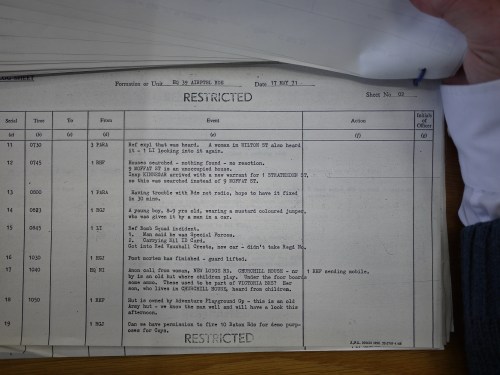
This unit was known as the Bomb Squad and a flavour of its modus operandi and membership can be gleaned from log sheet entries from the evening of May 16th and 17th, 1971. They were radioed in by soldiers from the Ist Bn Light Infantry.

The first reads:

Some one in the Bomb Squad slowed a patrol down using a pistol – more details to follow but a very dangerous practice.

Man got out of a white Vauxhall waved down a mobile. As the commander got out of the veh, man had his hand on a pistol in his belt – very luck (sic) not to get shot.

The log entry added:

Man had dark hair with a scots accent, grey suit white shirt

The second, the following night reads:

Ref Bomb Squad incident.

1. Man said he was Special Forces.

2. Carrying Mil ID Card.

Got into Red Vauxhall Cresta, new car – didn’t take Regd No.

Here are the relevant log sheets:

Log sheets from 39 Brigade – Kitson’s Brigade – are available for May 1971 through to July but not for the autumn months following the introduction of internment that August.

The available logs show a regular pattern of activity by the Bomb Squad in Belfast; sometimes the unit is at the scene of an explosion or violent incident arresting suspects, more often the regular military is radioing it with intelligence about suspicious cars or people.

It is important to understand what the Bomb Squad was not. It was not involved in defusing explosive devices; that task was left to the Army Technical Officer (ATO) who operated separately. The Bomb Squad’s job was to catch IRA bombers, or if that was not possible to make the IRA’s journey to targets more difficult and dangerous.

Here is an example of one of the Bomb Squad’s more pro-active operations which took place in Divis Flats on July 7th, 1971:

1 RGJ – Ref the 2 men arrested. Sniffer was clear but Bomb Squad are dealing as there is fairly good evidence against them. But since have arrested man with nail bomb in pocket in DIVIS on a balcony at WHITEHALL BLOCK. This is where the bombs (all nail) have been coming from. Total of 12 to date.

P1020163

More typically, the Bomb Squad would respond to radio messages from units on the ground. Here, for example, the Bomb Squad is alerted, on an unknown date in July, after traces of explosives were detected on the hands of three or four men at the scene of a bombing, referred to just as ‘Gilbbey’s explosion’.

The traces were detected using something called a ‘sniffa’ device, the suspects were arrested and taken to the nearest RUC station, followed closely by the Bomb Squad which presumably were present during the suspects’ interrogation:

1 RGJ (1st Btn Royal Green Jackets) – Four men detained at scene of Gilbbey’s explosion. Of these 3 have positive sniffa traces on their hand. They are being sent to Musgrave St – (ACTION) Bomb squad info.

On July 9th, 1971 – Log serials 58 to 60 – another routine operation takes place when the Bomb Squad is alerted about the location of an explosion at the RUC station at New Barnsley in Ballymurphy, suggesting, perhaps, that one of its patrols was in the area at the time and could give pursuit:

2 Para – Explosion. (ACTION) HQNI

1 LI – RUC Stn, New Barnsley, no cas. (ACTION) Bomb Squad infor.

2 Para – Blue 1100 responsible – the bomb was tossed into the compound. (ACTION) Clamp less AB.

‘Clamp less A & B’ was a standing order which instructed mobile patrols in the area to set up a roadblock.

The following morning, at 7:45 am on July 10th, an item from 1st Btn Light Infantry in the log sheet (serial 50) shows that the Bomb Squad was also involved in intelligence work:

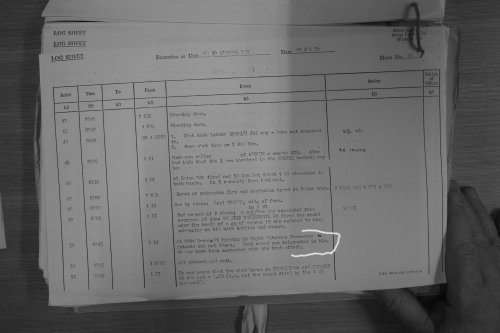
1LI At 0001 Havana St Plastic St Night Watchman Francesco Antonio was not there. Bomb squad are interested in him. He may have been connected with the bomb attack.

Which bomb attack aroused suspicion about Mr Antonio is not clear but a 50lb IRA bomb was detonated in a manhole in nearby Flax Street the night before and this may have focussed the Bomb Squad on the whereabouts of the the night watchman. Here is the log sheet:
On July 13th, 1971 the IRA planted a bomb at the British Homes Stores in central Belfast and the Bomb Squad was able to arrest two people on the scene who were from the New Lodge Road area (Serial 13).

Separately, the ATO reported in to describe the damage (Serial 16), thus confirming that the Bomb Squad and bomb disposal were organisationally unconnected.

First the Bomb Squad:

Bomb Squad – 2 People arrested British Home Stores John C Quigley 9c ALAMEIN House, Margaret O’Connor 19 ARLINGTON St wife of James O’Connor – (ACTION) HQNI informed

Then the ATO:

ATO – British Home Stores: 10-20 lbs – too much debris to tell means of initiation. Seat of explosive outside CASTLE INN. Extensive damage to windows. Moderate structural damage. Other stores affected. (ACTION) HQNI informed.

There are two more references to the Bomb Squad in the available 39 Brigade log sheets for 1971.

One, dated 23:15 pm, July 14th, from Ist Battalion, Light Infantry, reads:

1 LI – Explosion. North west of my location, Plastic Factory, North Havana St. Clamp less A & B – (ACTION) Bomb Squad info. CCI

The second, on the same date, but five minutes later, reads:

1 LI Co-op – Alliance Ave. Old Park Rd. Car suspect Whie VW CIA 702 one head light, last seen heading NS along Westland Rd, a red mini 9994 UZ seen in Dunkeld Gdns moving fast, by RUC – (ACTION) Bomb squad info. ATO tasked, HQNI info.
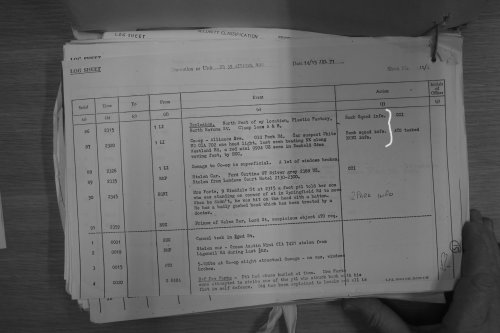
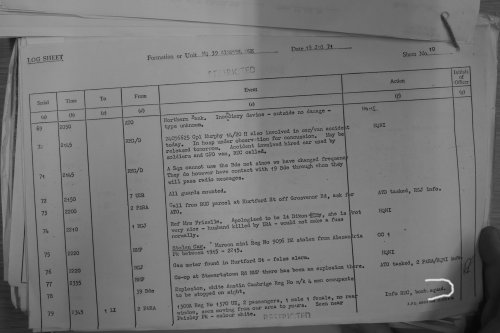
The last reference to the Bomb Squad in the available log sheets comes on July 19th, 1971, serial 79 at 23:45 pm, which reads:

To: 1 LI, From 2 PARA – 1300A Reg No 1370 UZ, 2 passengers, 1 male, 1 female, no rear window, seen moving from our area to yours. Seen near Paisley Pk – colour white – (ACTION) Info RUC, bomb squad

THE MRF

Ten months later, the available 39 Brigade log sheets make no mention at all of the Bomb Squad. Instead the MRF makes its first appearance, at least in the documents that are available from Kew for inspection.

From this we can say with a high level of confidence that in 1971 the British Army mobile unit tasked to catch IRA activists, especially bombers, was the Bomb Squad; a year later it was the MRF, although we know it did more than than chase suspected IRA bombing teams through the streets of Belfast. More of that later.

The MRF first appears on available 39 Brigade log sheets on May 31st 1972, although it is more than likely that the unit was operational some time before that.

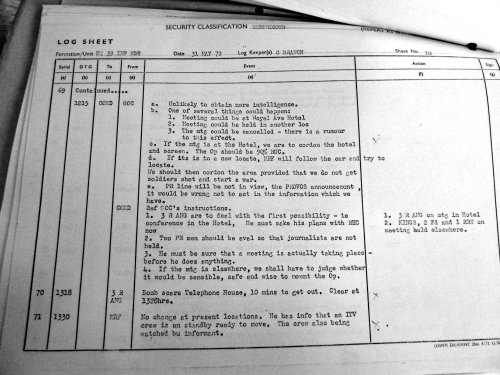
The occasion was an elaborate surveillance operation on the Royal Avenue Hotel on May 31st, 1972 which at various stages embraced not just the MRF but also the new Brigadier of 39 Brigade (Kitson had left at the end of April) and the GOC, General Harry Tuzo.

(Click here for archive footage of the Royal Avenue Hotel before and during the Troubles: https://digitalfilmarchive.net/media/super-8-stories-the-royal-avenue-570 )

The British Army had intelligence that the IRA was planning to hold a press conference in the hotel and the MRF was tasked to keep an eye on a Triumph Toleda car in the hotel car park which contained a man the military believed would attend the press conference.

The Army planned to cordon off the hotel and screen all those in attendance. Army PR people would arrive to identify bona fide journalists. The Europa hotel was also under surveillance in case there was a change of venue.

At one point the MRF tailed a suspicious car, thinking that perhaps the venue for the press conference had been changed to Casement Park or Ardoyne. They followed the car which took a circuitous route towards Lisburn and then was lost. The military suspected it might have been a decoy.

It is not entirely clear how the operation ended except there is no record in the logs of soldiers or RUC entering the Royal Avenue Hotel. At one point the GOC, General Tuzo intervened:

Here are the log sheets for the Royal Avenue Hotel operation:

CAPTAIN WATCHUS

We know that some time after the summer of 1971 the Bomb Squad no longer appeared in 39 Brigade log sheets and we know that sometime thereafter the MRF makes its first appearance. It was certainly active by May of 1972.

But is that enough evidence from this material to support the view that the MRF evolved out of the Bomb Squad? By itself the answer must be no.

But there is other evidence linking the two units and it comes in the shape of one Captain Arthur Herbert Watchus, known to his friends as ‘Sassy’.

Captain Watchus is one of those rare soldiers who manages to rise from the other ranks’ canteen, to the sergeants mess and then to the officers mess – an ordinary squaddie who climbs the greasy pole to join the officer class, in his case an officer in the Parachute regiment, army number: 22995768.

In March 1967, Sgt Major Watchus was promoted to 1st Lieutenant and his elevation was duly noted in the London Gazette:

By the time Arthur Watchus was posted to Northern Ireland he had earned another promotion, to Captain and it was as Captain Watchus that he makes his first appearance in the 39 Brigade log sheets.

At half-past midnight on July 13th, 1971, the day after the Twelfth and two nights after IRA bombs had blasted the route of that year’s Orange parade, Capt Watchus contacted HQNI – British Army headquarters at Thiepval barracks in Lisburn – to say that he had caught “two of the bombers” who were tackled by members of the bomb squad as they were laying the explosive charges.

“Will be cast iron case’, he announced:

So in the summer of 1971 Captain Watchus is a member of the Bomb Squad, possibly a senior member.

A year later Captain Watchus is still serving in Northern Ireland but now he enters the 39 Brigade log sheets under the label MRF.

The first entry, dated may 11th, 1972 suggests not only that he is a member of the MRF but a senior member, with sufficient authority to propose operations to Thiepval barracks. He may well be the MRF’s field commander:

Here is the full log:

Here are more log sheets detailing Captain Watchus’ interaction with the MRF. This one shows that he participated in the surveillance of the Royal Avenue Hotel:

Here is Captain Watchus monitoring an operation called JUMPING BEAN from the MRF operations room. JUMPING BEAN may well be a reference to the arrest of Louis Hammond, a British Army deserter who joined the Provisional IRA. He was arrested in May 1972 by the military and agreed to work as a double agent. Around a year later he was found shot and badly wounded, apparently by the IRA. Whatever the truth, Watchus’ role suggests he was a senior MRF figure.

So Captain Arthur Watchus provides real evidence of a link between the Bomb Squad and the MRF, and a strong pointer to the MRF’s origins.

‘No Stone Unturned’ – The Lawyers Speak Out To Irish-America, Blame PSNI For Arrests

PSNI CONCERN WAS IF FILM DAMAGED THEIR ABILITY TO RECRUIT AND MAINTAIN INFORMERS

This is an edited version of a statement issued to Irish-American activists by Niall Murphy, solicitor for film-makers Trevor Birney and Barry McCaffrey who were arrested at the weekend and questioned about the alleged theft of documents from the Police Ombudsman’s office in Belfast during the production of  ‘No Stone Unturned’, the expose of the 1994 Loughinsland killings.

The journalists were arrested and questioned by officers from the Durham police but lawyers for the two men insist the operation was really a PSNI affair.

Barry McCaffrey and Trevor Birney – their arrests was entirely a PSNI operation claims their lawyer

“….my view is that this was a wholehearted PSNI agenda. No doubts about that. Durham Police and the PSNI were keen to point to Durham’s independence. What should also be noted is that only three Durham Police officers were apparent on Friday, the Senior Investigating Officer Darren Ellis and two detectives asking pre-prepared questions in interview, reading from scripts.

“In addition to these 3 Durham officers the arrest and detention strategy involved well over 100 PSNI officers. There was at least 25-30 officers in attendance at each search location, the two homes and the business address and each Durham detective was attended by a PSNI detective in interview also.

“The senior co-ordinating sergeant supervising the interviews was a PSNI officer as was the custody sergeant who imposed restrictions on the liberty of the two journalists when granting bail. This same custody sergeant also refused to release tape recordings of the interviews in abject departure from ordinary practice.

“In my respectful opinion, this arrest and interview strategy was overwhelmingly directed and executed by officers of the PSNI.

“The arrests occurred on Friday 31 August and as Saturday 1st turned to Sunday 2nd September, Drew Harris assumed his powers as Garda Commissioner in the south. One train of thought might say that this was his parting gift.

The victims of the Loughinisland killings

“The irony is that the producers of the film, Trevor Birney and Alex Gibney had actually proactively sought out the senior command of the PSNI to TELL THEM that the film would be naming the names of the suspects. ACC Stephen Martin was the senior officer who reposed no concerns other than if the film intending EXPLICITLY revealing that any of the suspects were in fact informers, as that would impact the ability of the PSNI to recruit and maintain informers.

“It is obvious that the interests of the families of those murdered are of little or no concern.

“The Truth Cannot Be Arrested.  The film, as you know, premiered in New York on 30 September, (2017). A link was provided to the Police Ombudsman simultaneously with the British premiere in London a week later on 7 October (2017). As such, the Ombudsman had a full week to seek an injunction as did the killers and the police, as the details were widely circulated on social media. No such injunction was taken, nobody has issued libel proceedings (although the 12 month limit to issue proceedings doesn’t expire until 7 October) and press complaints lodged against newspapers were all dismissed.

“This arrest strategy is an utter farce solely directed at intimidating those who seek to expose state involvement in murder. Journalists today, NGO’s, lawyers and families tomorrow…

“‘A free press is the unsleeping guardian of every other right that free men prize; it is the most dangerous foe of tyranny’.

“Ironically this is a quote from Winston Churchill…”

Ludlow Family Defect To KRW Law Breakaway

In the first high profile client defection from KRW Law to the new law firm established by former KRW employees, the family of slain Co Louth forestry worker Seamus Ludlow have announced that they are hiring the new company to represent the family’s interests.

Ludlow family spokesman, Michael Donegan made the announcement on Facebook, saying that the new firm’s representative Gavin Booth would henceforth be the family solicitor:

As there have been no different views regarding our future legal representation, and since the general consensus within the Ludlow family has been that we should stay with Gavin Booth (seen here some time ago with Thomas Fox), it is now my duty to confirm that Gavin Booth will be our solicitor from this day forward.

It is understood that Mr Booth now works for the KRW rival.

Seamus Ludlow (47) was found shot to death in a country lane not far from his home near Dundalk, Co Louth in May 1976, sparking decades of speculation about who was responsible.

Suspects ranged from members of the British SAS to the IRA but in 1998 this reporter was able to disclose in The Sunday Tribune that his killers were a group of UDR soldiers and Red Hand Commandos (RHC), a particularly violent Loyalist group, who had wandered across the Border after a day’s drinking in search of an IRA leader to kill.

Unable to find him they came across Seamus Ludlow making his way home from a local bar, offered him a lift and then took him to the laneway where he was shot dead. His body was then thrown over a hedge. The killer, nicknamed ‘Mambo’ was a notorious RHC gunman.

The source for this account was a Comber, Co. Down man, Paul Hosking who had gone on the trip that day not realising how it would end. He told this reporter that in 1987 he had given a full account of that night’s tragedy to the RUC who had done nothing about it.

Equally, the family have accused the Irish police, an Garda Siochana of a smear campaign by erroneously blaming the local IRA for killing Ludlow, alleging he had been an informer.

The family are not alone in suspecting that the two police forces were trying to deflect attention away from the Red Hand Commando gunman because he was an agent of a branch of British intelligence.

The family say they were given promises of a commission of inquiry in the Garda investigation of the Ludlow murder but in November last year the Dublin High Court ruled against their bid to force the government to establish the inquiry.

Their legal efforts are continuing, now led not by KRW but by their new rivals.

The MRF File – Part Two: More Evidence On MRF’s Name, Some Conflicting

By James Kinchin-White and Ed Moloney

There are three references in the following official British Army reports and correspondence to the MRF’s name being the ‘Mobile Reaction Force’, and one which seemingly prefers the title, ‘Military Reaction Force’.

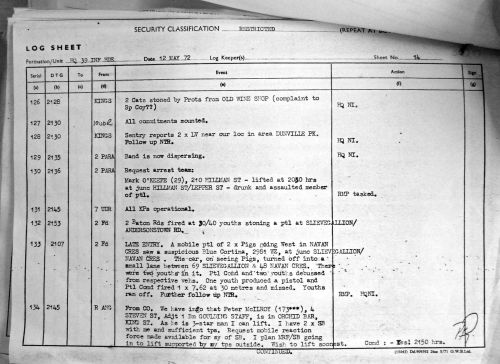
A separate Log Sheet of incidents compiled by the Royal Anglian Regiment on May 12th, 1972 also refers to the ‘Mobile Reaction Force’. The Anglians were based in Belfast, the MRF’s main operational area.

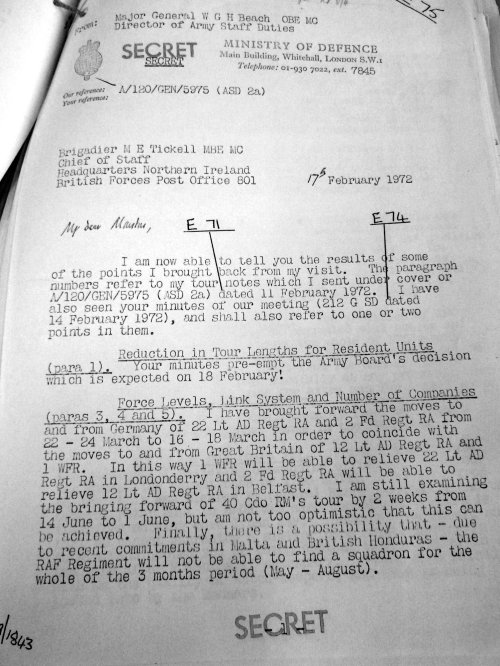
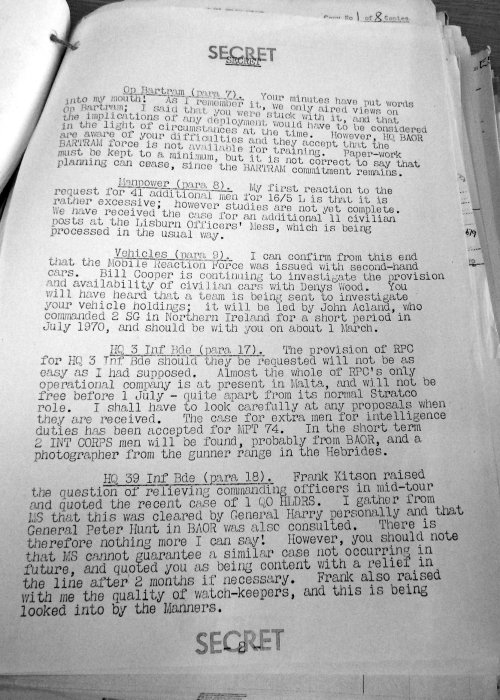
The first reference to ‘Mobile’ comes in a letter written by the Director of Army Staff Duties, Brigadier W G H Beach on February 17th, 1972 to Brigadier M E Tickell, the Chief of Staff at British Army HQ at Thiepval Barracks, Lisburn.

The correspondence came in the wake of a visit by Beach to British Army units, including the MRF, earlier that month.

The letter is a formal version of the ‘loose minute’, or draft which figured in the first post in this series on the MRF’s name and can be regarded as a confirmation of the term, Mobile Reaction Force, used in the ‘loose minute’.

The reference to ‘Military Reaction Force’, comes in a document outlining the composition and duties of regiments and units in the 39 Brigade (Belfast) area in August 1972. It appears this document was widely circulated in the Brigade area. It is reproduced in full towards the end of this post.

Our preference is to suggest that ‘Mobile’ is the correct term since it is the one used by the British Army’s top brass in confidential correspondence between themselves; the term ‘Military’ comes in a document that would have had a wide circulation in the 39 Brigade area and could well have been seen by elements not entirely trusted by the military’s higher echelons. Amongst these would have been Belfast-based UDR regiments.
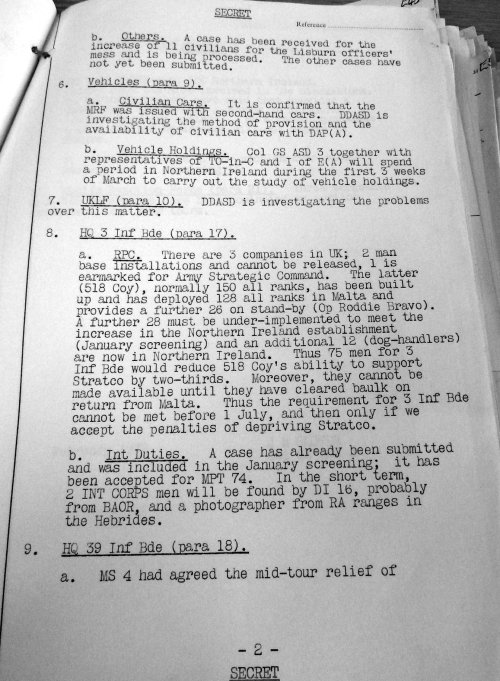
The first reference in this batch of documents to ‘Mobile’ comes at the end of the second page of the correspondence between Tickell and Beach, in which it is also revealed that the MRF recruited former SAS personnel to its ranks:

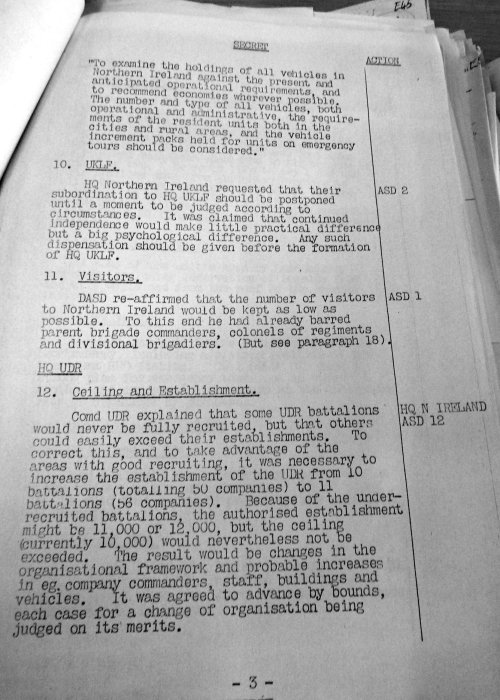
The second reference to ‘Mobile Reaction Force’ comes at the tail end of a six-page summary of the visit to British Army units by Maj-Gen Beach, the Director of Army Staff Duties on 8th and 9th February, 1972.

This document also has an intriguing reference to ‘Operation Four Square’, although it seems from the size of the operation – ’20 to 22′ infantry units –  that this is not the same as the ill-fated attempt of the same name by military intelligence to discern IRA activists through the forensic examination of dirty laundry which was interdicted by the Provos’ Belfast Brigade in November that year.

The reference to the MRF suggests that the unit’s headquarters were at Palace barracks, Hollywood and that the OC at the time was somewhat dissatisfied at the level of continuity in his commanders, i.e. they were being constantly changed.

Here is the six-page document:

Then there is this document which discusses the use of second hand cars by the ‘Mobile Reaction Force’:

These log sheets below, which catalogue events in the Royal Anglian Regiment’s operational area in Belfast, describe an incident in which the CO of the Anglians requested the assistance of the ‘mobile reaction force’ in the arrest of the Adjutant of the Official IRA’s 1st Battalion, one Peter McIlroy.

The idea was that the MRF soldiers, in plain clothes, would accompany two RUC Special Branch officers into the Orchid Bar in King Street where they would arrest McIlroy and send him off to Long Kesh.

Note the signature in right hand margin of the MRF’s commander approving the Royal Anglians’ request.

In the event the Special Branch men appear to have got cold feet. One stayed in his car and the other would not enter the bar, leaving the two MRF soldiers to search the club by themselves in vain for the Official IRA officer.

Here are the relevant extracts from the log sheets followed by the full logs themselves:

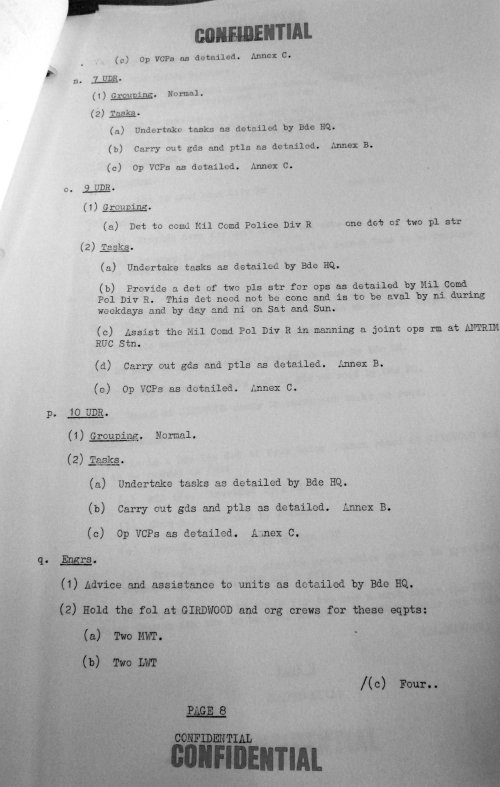
On page 7 of the following document, which is a summary of units and their duties in the 39 Brigade area (Belfast) dated August 1972, the MRF is referred to at the ‘Military Reaction Force’ and the following interesting detail is given about its role, relationship to RUC Special Branch and modus operandi:

The document also has this interesting detail on the British Army’s arrest policy in the summer of 1972. Loyalist activists could not be arrested or interned, even though sectarian murders were soaring, but republicans of various sorts were fair game:

Here is the full report:

‘No Stone Unturned’ Arrests Must Be Condemned And Resisted

The full background to the PSNI’s pursuit of television journalists Trevor Birney and Barry McCaffrey, using a proxy, in the form of the Durham police force, to arrest the men, has yet to be revealed.

But on its face, it seems the authorities are attempting to characterise as ‘theft’ the journalists’ acquisition of documents from the Police Ombudsman’s office in Belfast dealing with the 1994 Loughinisland massacre.

The television documentary on the Loughinisland killings that they produced,  ‘No Stone Unturned‘ – with Alex Gibney as director – was a masterpiece of investigative journalism which revealed a disturbing level of official participation in the cover-up cum incompetent police investigation of the UVF killing of six Catholics watching the World Cup in their local bar.

The documentary highlighted a shocking level of collusion between the local RUC and the killers which went undiscovered in the subsequent investigations, one of which was led by the Police Ombudsman’s office, then headed by different management.

Journalists come across documents all the time, including documents from government offices. Sometimes the leaks are authorised, just as often they are not. But I cannot recall an instance of a leak being described as ‘theft’.

The PSNI/Durham police portrayal of the documentary makers’ acquisition of Police Ombudsman documents as larceny means that Birney and McCaffrey could now be charged with theft, or at the least with receiving stolen goods?

Meanwhile the PSNI’s failure to pursue those in uniform who covered up the slaughter – as well as the killers and their accomplices – stands in stark contrast to this belligerent pursuit of the two film-makers.

This is a development that must be resisted by all journalists in Ireland, no matter what medium they work in. To charge or pursue the makers of ‘No Stone Unturned‘ for doing their jobs represents an unprecedented existential threat to Irish journalism in all its forms.

The truth of what happened in Loughinisland in 1994 took more than two decades to emerge. That it did so was due to the ability of the film-makers to persuade those with knowledge to share it with their viewers and the courage of their sources to reveal what they knew.

That they did so was a tribute not just to their reporting skills but to the bravery of their sources.

Make no mistake, this move by the PSNI is directed not just at journalists but also at their sources, perhaps especially their sources.

There are other Loughinislands yet to be uncovered, some the responsibility of the state, others committed by their enemies.

If journalists are to face the threat of prosecution for acquiring documents which those in power would prefer to keep hidden, then the truth will never be told about Northern Ireland’s tragic past. Instead anger and resentment will fuel the fires of bitterness and rancor.

The track record of Irish journalism in resisting official censorship – and its close cousin, self-censorship – is not, sadly, a good one. This is one test, however, that cannot and must not be flunked.

This pithy review of ‘No Stone Unturned’, from The Guardian, tells you all you need to know about why the PSNI have moved against the film-makers:

theguardian.com

No Stone Unturned review – a scrupulous documentary | Film

Wendy Ide

Alex Gibney does a thorough job of investigating an unsolved murder in 90s Northern Ireland

Aftermath of murder: a scene from the ‘forensic’ No Stone Unturned.

Prolific documentarian Alex Gibney turns his lens on to Northern Ireland, with a typically forensic examination of an unsolved mass murder. The six victims of the 1994 Loughinisland massacre were watching the World Cup in their local pub when a masked gunman burst in and sprayed bullets from a Czech-made automatic weapon. But despite the fact that, as Gibney’s research reveals, the police had a clear idea of suspects from the outset, and despite the fact that a getaway vehicle, a gun and a bag full of balaclavas was found, nobody was ever charged. What’s more, much of the evidence was later mislaid or destroyed. Scrupulously even-handed, the film explores collusion between police and paramilitaries and the decidedly unstable foundations underpinning the Northern Ireland peace process.

‘I, Dolours’ – Updated List Of Cinema Screenings, North & South

  1. Light House, Dublin
  2. Pálás, Galway
  3. IMC Dun Laoghaire
  4. IMC Tallaght
  5. IFI, Dublin
  6. Omniplex Cork
  7. QFT, Belfast
  8. Movie House Yorkgate, Belfast
  9. Movie House Dublin Road, Belfast
  10. Omniplex Downpatrick
  11. Omniplex Derry
  12. Omniplex Newry
  13. Omniplex Dungannon
  14. Omniplex Kennedy Centre, Belfast
  15. Brunswick Cinebowel, Derry
  16. Omniplex Dundalk
  17. Omniplex Limerick

Convulsions At KRW Law Firm……

UPDATE: I am told the numbers 6 and 200,000 figure prominently in this affair.

A little birdie tells me that things are not well at Belfast’s largest criminal law practice, KRW, headed by veteran advocate Kevin Winters.

According to one source, a senior figure left the firm on Friday when it was discovered that several lawyers were planning to jump ship to form a rival company.

And last week it emerged that the putative rivals were making efforts to persuade some longstanding clients to follow suit.

KRW, which began as Kevin R Winters in 2001 and then was incorporated as KRW Law in 2012, has overtaken Madden & Finucane as the largest criminal practice in the North. Earlier this year the company announced plans to expand in Dublin and London.

Prominent clients have included the family of the missing child Madelaine McCann and the convicted Lockerbie bomber, the late Abdelbaset Ali Mohmed Al Megrahi. KRW’s core business though remains in NI where the firm is the leading light in the lucrative Troubles legacy field.

It is too early to predict the outcome of the crisis now afflicting KRW but there is agreement that much will depend on the attitude of Sinn Fein, which wields tremendous influence in Belfast these days on clients’ choice of legal representatives.

A clue perhaps about the rebels’ ambitions, if not the Shinners’ intentions, may lie in the putative name for the new law firm: Phoenix Law.


The MRF File – Part One: What’s In A Name?

By James Kinchin-White and Ed Moloney

I first met James Kinchin-White in early 2010 when a contact in Belfast suggested he would make a good interviewee for the film I was then helping to make in Dublin, ‘Voices From The Grave’, based on the book of the same name, which in turn was based on the Boston College oral history interviews with IRA leader Brendan Hughes and UVF leader David Ervine.

James had been a serving soldier with the Royal Green Jackets in the lower Falls area in 1972 and when on patrol one day he briefly had Brendan Hughes in his gun sights. Hughes was peering around a street corner, taking the odd pot shot at troops with a revolver and James was just about to pull his trigger when an old lady got in his way. When he looked again Hughes had disappeared. Thus does fate weave its strange fabric.

We flew him over from Scotland and he gave a great interview.

Brendan Hughes’ brush with death happened a long time ago and to say that James now views his military service through more jaundiced eyes might be a bit of an understatement. To compensate, I suspect, for those days he decided he would devote himself to an exploration of the shelves of the British government’s archives at Kew in a bid to dig out the secrets of a conflict which had marked him, as it has everyone else it has touched.

When I heard of this plan I asked JKW, as I call him, if he would keep a special eye out for anything which might be helpful in our fight against the British and American governments’ effort to confiscate the oral history archive at Boston College. He agreed and thus was born a wonderfully fruitful if lop-sided relationship.

Lop-sided in the sense that he does all the hard work at Kew while I get to sit back and read and write about what he has found.

This article marks the beginning of an especially important, indeed unique piece of research carried out by James into the history, origin and activities of the MRF in Northern Ireland in the early months and years of the Troubles. Over the next week or two thebrokenelbow.com, with James in the driving seat, will publish a series of important, revelatory articles about this key feature of the early Troubles.

The MRF was, it is believed, created by General Sir Frank Kitson to counter, in particular, the  two IRA’s (Official and Provisional) who were intensifying their violence in the opening years of the 1970’s. The MRF was, it is believed, loosely based on the counter gangs Kitson had created in Kenya to oppose the Mau-Mau during their uprising against British colonial rule in the 1950’s.

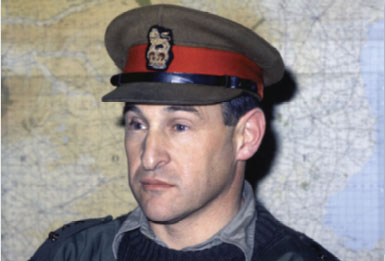
Brigadier Frank Kitson

By the early 1960’s Kitson’s experiences in Kenya, and later Malaya, were receiving international recognition. He was regarded as one of the leading lights in COIN, or counter-insurgency strategy and in 1962, as US involvement in Vietnam was ratcheting up, he was invited by the Rand Corporation, along with his French counterpart, David Galula – an inspiration for the movie Battle of Algiers –  to address a high level conference in Washington DC on tactics and strategy in post-colonial conflicts.

Kitson’s contribution dealt, inter alia, with Kenya and included: Turning a Mau Mau into a Counterrebel: The Carrot-and-Stick Approach; Trickery and Deception (the “Pseudogang”). It is not difficult to see in this approach the seeds of the MRF which specialised in recruiting IRA double agents known as ‘Freds’.

His two books, based on his experiences in Kenya and later Malaya -‘Gangs and Counter Gangs‘ and ‘Low Intensity Operations’ – also describe the military philosophy which inspired the MRF.

In June 1970, Kitson was promoted to Brigadier and in September that year was made commander of the British Army’s 39 Brigade, which covered Belfast at a time when the city was rapidly becoming the cockpit of the IRA’s war against the British. Kitson arrived in the city after the Falls curfew at a time when the IRA was intensifying its commercial bombing campaign in the city and beginning to expand in rural areas. He stayed until the end of April 1972, a few weeks before the first Provisional IRA ceasefire.

It was during these months that Kitson is thought to have developed and deployed the MRF concept.

JKW has unearthed a rich seam of new information about Kitson’s creation, its real name, its origins and structure, possible relationship with Loyalist paramilitaries and its violent history during the early stages of a violent convulsion that would last some three decades. In doing so he has made an important contribution to the history and understanding of this consequential chapter in the story of the Troubles.

What follows is the first article in the MRF File gathered by JKW. Enjoy.

♦                                 ♦                                    ♦                                 ♦                                ♦

In May 1973, a British official in the Ministry of Defence in Whitehall by the name of F M K Tuck, composed a memo about the activities of the MRF to his civil service colleagues in which he wrote the following:

As far as the general policy of making official comment on intelligence gathering and plain clothes operations is concerned, there seems to be considerable advantage in maintaining as much confusion as possible. There can be no useful purpose served for instance in defining the correct expansion of the initials MRF.

(You can read the full memo here)

And so was begun, or at least confirmed, a British policy of disinformation about the name of  one of its most controversial undercover military units to see service on the streets of Northern Ireland.

Down the years the initials MRF have been taken to mean variously ‘Military Reaction Force’, ‘Mobile Reconnaissance Force’ and ‘Military Reconnaissance Force’ by reporters and experts.

Eventually, on March 15th, 1994 came apparent confirmation of the true meaning of those mysterious initials. In a written parliamentary answer to a question tabled by the British Labour MP, Chris Mullin, this explanation was offered:

The Military Reaction Force was a small military unit which during the period 1971 to 1973, was responsible for carrying out essential surveillance tasks in Northern Ireland in those circumstances where soldiers in uniform and with Army vehicles would be too easily recognised.

And so the matter seemed settled. MRF stood for Military Reaction Force. That was the explanation given, for example, in the book Voices From The Grave.

Except that was lie. As was the claim that the MRF was involved exclusively in ‘essential surveillance tasks’; the MRF shot people and occasionally killed them as will be seen in other documents to be published on this site.

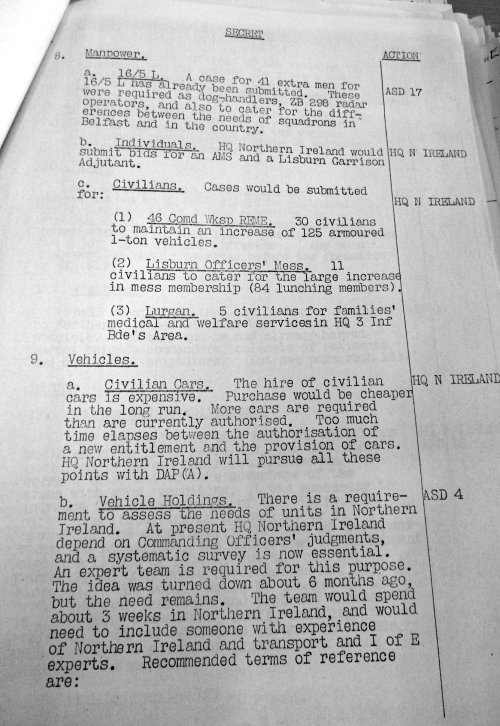
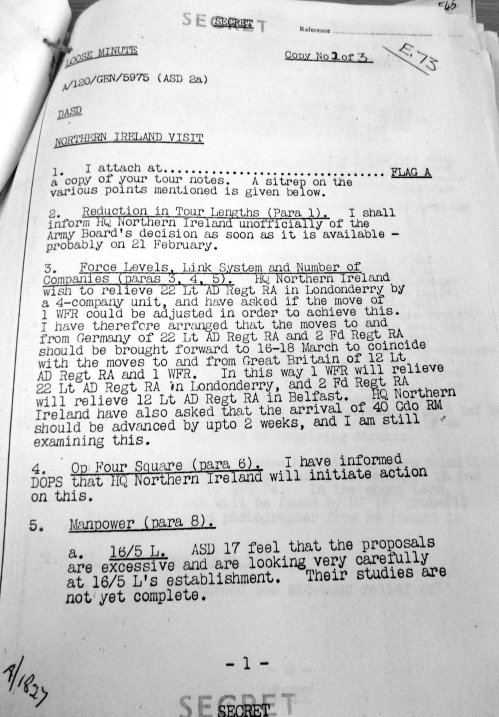
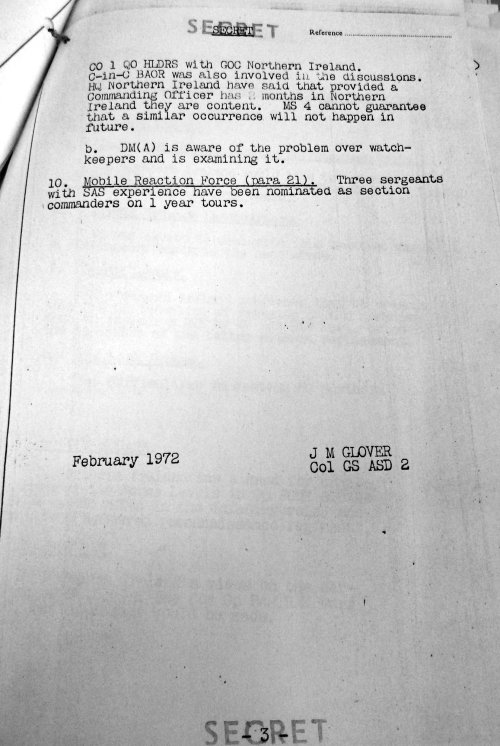
Evidence that at least the ‘Military Reaction Force’ claim was a lie comes in a ‘loose minute’ (jargon for an internal letter) prepared in the aftermath of a visit to Northern Ireland by one the British Army’s most senior officers, the Director of Army Strategic Defence (DDASD) , dated February 1972 and written by Colonel James Glover, then a senior member of staff at Army Strategic Defence.

The document was Glover’s effort to answer questions raised by his boss during his visit to Northern Ireland in Early February 1972.

Students of the Troubles will recognise his name. As Brigadier James Glover – and one of the British Army’s foremost experts on the IRA – he was the author of a controversial 1979 assessment of the organisation titled ‘Future Terrorist Trends‘, which predicted that the IRA had the ‘sinews of war’ to continue its campaign more or less indefinitely.

He later commented in a BBC television interview that in the context of his assessment of the IRA, “Gerry Adams was a man with whom we can do business'”.

The final sentence in his ‘loose minute’ reveals the real meaning of the initials MRF:

10. Mobile Reaction Force (para 21). Three sergeants with SAS experience have been nominated as section commanders on 1 year tours.

The document also suggests that the MRF derived the title ‘Mobile’ from its dependence on cars, in the MRF’s case second-hand cars, presumably because they were harder to trace. So it is not difficult to see where the term ‘Mobile’ came from; less obvious is why it was necessary or profitable to keep this a secret for quite so long.

But at least we now know. MRF stands for Mobile Reaction Force.

One more point of interest. It is clear from the document that the MRF’s Four Square Laundry operation, which you can read about here, had not been initiated by February 1972. By October that year the IRA, thanks to information provided by informers Seamus Wright and Kevin McKee, knew enough about the operation to ambush the MRF soldiers operating the bogus laundry van in West Belfast.