The ‘Self-Inflicted’ Death Of Maze Medical Officer Dr David Ross: ‘The Eleventh Hunger Striker’

The late IRA commander and leader of the 1980 prison fast for political status, Brendan Hughes called him ‘the eleventh hunger striker’, and believed that Dr David Ross, the Maze prison’s medical officer, had been so deeply affected by the deaths of the ten IRA prisoners on the second protest in 1981 that, five years later, he took his own life.

In sharp contrast, Hughes’ colleague, Bobby Sands, who was the first IRA prisoner to die on the 1981 hunger strike, disagreed. Dr Ross, he told Hughes, was ‘a mind manipulator’ and he did not trust him. Ever since, their argument has divided the IRA prison population of the day.

Hughes’ told the story of the two IRA prison leaders’ interaction about Dr Ross in his interviews with Anthony McIntyre for the Boston College oral history archive. The account was later published in ‘Voices From The Grave‘.

Support for Brendan Hughes’ verdict on Dr Ross has, however, now come from an unexpected source.

In an account of his career as the Maze prison’s Deputy Governor and Head of Security during much of the Troubles, Tom Murtagh ascribes Dr Ross’ suicide to the ordeal of shepherding ten republican prisoners to often painful and difficult deaths during the politically torrid year of 1981.

Murtagh also discloses that, by grisly coincidence, Dr Ross took his own life during a spate of suicides by prison staff at the jail in 1985/86.
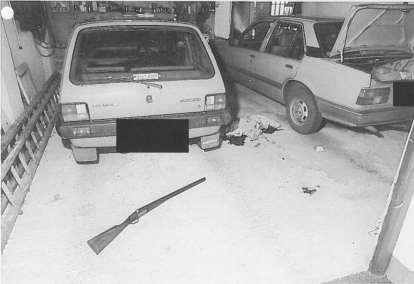
The suicide scene in the garage at Dr Ross’ home

According to the now retired senior prison official, by 1986 the Maze prison was an angry cockpit in which paramilitary prisoners, by now unofficially segregated in separate Republican and Loyalist Blocks and/or wings, were in a constant psychological and physical struggle with prison staff for control.

The picture he paints is of a jail that, in the years following the 1981 hunger strike settlement, gradually appeared to be falling under the sway of the inmates, and out of the charge of the staff.

By his account the warders were suffering the consequences; some sought escape in drink or feigned sickness to avoid work. Others were ‘turned’ by the paramilitary inmates and agreed to work for the IRA or their Loyalist equivalents. Some sought a more final solution, by taking their own lives, although Murtagh does not quantify the toll:

……it is clear that all staff working in the segregated wings were under immense psychological strain, the effects of which naturally varied from one individual to another. While many strived to cope, others just went sick causing further difficulty in an establishment that was already substantially understaffed. Others turned to alcohol. In 1985/ 1986 a number of The Maze staff took their own lives.

There is evidence that, by this stage, both Republican and Loyalist prisoners were having success in corrupting and recruiting prison officers. The extent of this is difficult to quantify in that the PIRA carefully protected these individuals by insisting that they appeared to be doing their job properly and remained above suspicion.

It must also be assumed that the Loyalists were also having success on this front as they became more confrontational and aggressive in their dealings with staff at all levels. A Block Governor described them as ‘constantly in your face, abusive and threatening, often for no other reason other than that they were getting away with it’.

Dr David Ross worked away, tending to the medical needs of prisoners and warders alike in the midst of this undeclared war. But when he decided to take his own life, on June 13th, 1986, Murtagh believed that what drove him to such a drastic and final act was not the strife in the H Blocks, but the mental scars left by the 1981 hunger strikes, five years earlier:

Though it is difficult to be sure what drove them (the suicidal warders) to such despair it seems reasonable to conclude that their work environment was a contributing factor. One of those who sadly died in such circumstances was the Medical Officer, Dr David Ross who had cared for the prisoners on both hunger-strikes and despite his efforts had to watch ten of them die. He was clearly affected by the experience and on 13th June 1986 he took his own life.

Murtagh’s story, told in the book, ‘The Maze Prison: A Hidden Story of Chaos, Anarchy and Politics‘, was published in February this year.

From the little that is known about his background, Dr Ross was born and reared in Ballymena, Co Antrim – the heart of Ian Paisley’s North Antrim Westminster constituency. He later became a GP in nearby Ballyclare.

His background and rearing would in all probability have been typical of many Unionists and Protestants of his generation. Distrust and abhorrence of Irish republican goals and violence, and those who advocated them, would have been in the political DNA of all those he mixed with, not least at the Maze prison.

All of which makes even more remarkable the evident human sympathy he was able to show, as Brendan Hughes attested, for the IRA prisoners in his charge.

He was 57 years old when, in the garage of his home in the northern suburbs of Belfast, he put the barrels of a shotgun to his stomach and then his neck and pulled the trigger. He died in the Royal Victoria Hospital four hours later.

An aerial view of the Maze prison/Long Kesh

The former Head of Security at one of Europe’s toughest and most dangerous jails, pens a portrait of Dr Ross that strikingly mirrors Hughes’ depiction of a caring and sympathetic physician. Describing Ross’ work during the second hunger strike, Murtagh wrote:

According to Hospital Chief Officer (Frank) Smith, David Ross hardly ever left the prison (day or night) throughout the months of the hunger-strike. Ross was a quiet spoken and caring man who maintained a constant dialogue with the hunger-strikers to ensure their comfort and care at all stages of their fast. His dedication was recognised by most of the prisoners…..

Murtagh quotes one of Dr Ross’ junior assistants, who is not named in the book, as echoing the view that the hunger strike had troubled the physician. Speaking of the impact the hunger strike had on warders and Dr Ross alike, the aide said:

When you are caring for these guys, getting to know them and their families and watching their grief, you are only human and you have your feelings. It had an impact on all of us. I know Dr Ross, who never seemed to leave the hospital, was badly affected by his experience with the hunger-strikers.

Several years ago thebrokenelbow.com made a request under the Freedom of Information Act to the Northern Ireland Office (NIO) for a copy of Dr Ross’ inquest file. A long silence followed. Eventually a more productive route was opened up to the Public Record Office in Belfast but even with generous and kind assistance from staff at the office, it took the best part of two years before the file was handed over.

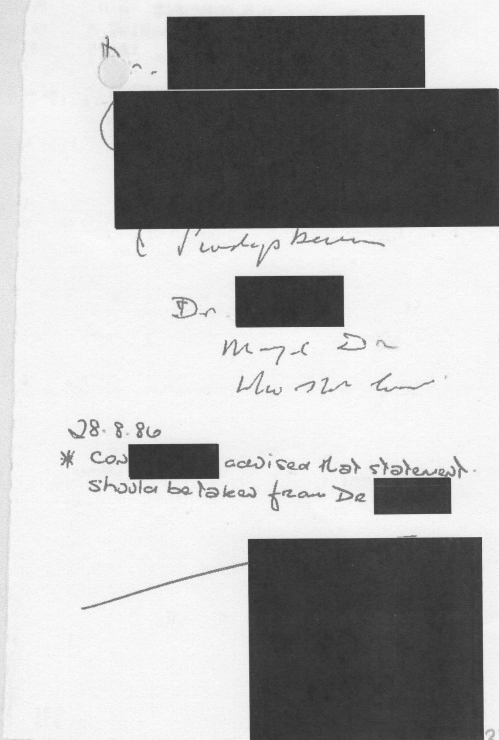
Much of the file has been redacted, notably the identity of witnesses who gave evidence and/or statements to the inquest. But the file does reveal that at the time of his death, the medic was receiving treatment from a psychiatrist for what the report called ‘recurrent depressive illness’. Another document suggests that this specialist was based at Belfast’s then major mental health institution, Purdysburn hospital.

According to the inquest file, the Maze medical officer was being treated with ‘anti-depressant and anxiolotic drugs’ for his depression, the last prescription for which was dated April 7th, 1986. Anxiolotic drugs are used to treat extreme anxiety.

That Dr Ross committed suicide is accepted by all those involved in investigating his case, although under Northern Ireland law, inquests do not deliver judgements which accord blame or responsibility for deaths; they merely investigate and inquire into the cause of deaths.

Northern Ireland inquests can however, deliver ‘Findings’ which implicitly and inevitably do ascribe some responsibility for deaths. Although the 58-page inquest report is redacted in places, sometimes heavily, and the names of some witnesses – including, it seems, the Purdysburn psychiatrist and his report – are blacked out, enough of the ‘Findings’ survive to explain what happened.

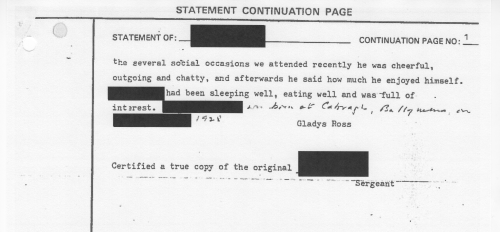
Much of the other witness statements have also been redacted, but again the task was done somewhat sloppily. For example, Dr Ross’ wife’s statement is redacted to hide her identity and relationship to her husband, but whoever was given the task, left her name, ‘Gladys Ross’, untouched as well one reference to ‘My husband…’.

According to witness statements collected by RUC officers and submitted to the coroner, James Elliot, there was little about Dr Ross’ behavior earlier that day, June 13th, 1986, to suggest that it would end so tragically.

Two prison officers, one a warder, the other a catering officer, interacted with the doctor on the morning of his death and saw nothing to cause concern.

One told investigating police officers:

(Dr Ross) appeared to be his normal efficient and busy self at no time did he give me the impression that he was under stress or preoccupied….During the past week I had dealings with Dr Ross at various times and found him to be his usual self.

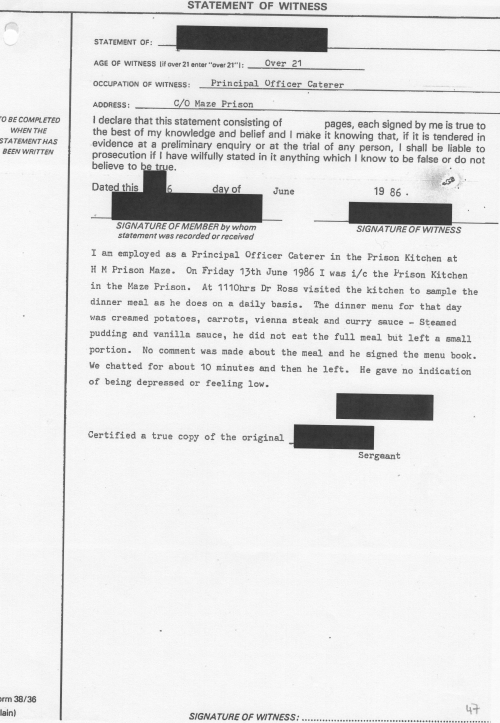
The catering officer said:

At 1110 hrs Dr Ross visited the kitchen to sample the dinner meal as he does on a daily basis The dinner menu for that day was creamed potatoes, carrots, vienna steak and curry sauce – steamed pudding and vanilla sauce, he did not eat the full meal but left a small portion. No comment was made about the meal and he signed the menu book. We chatted for about ten minutes and then he left. He gave no indication of being depressed or feeling low.

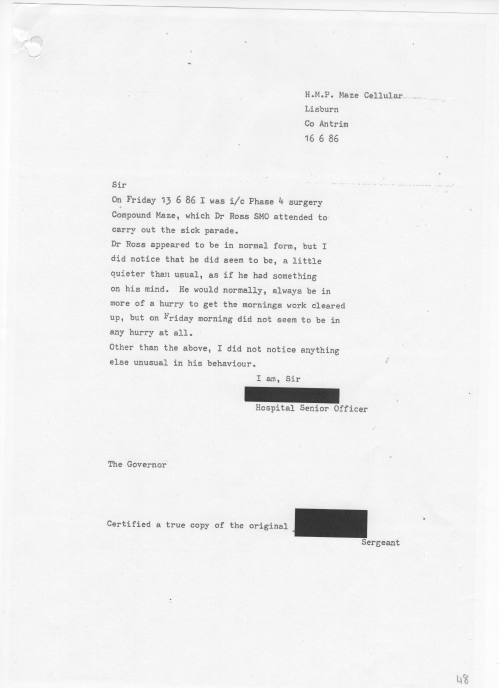
But another member of Dr Ross’ medical staff thought that not all was well with his boss:

On Friday 13 6 86 I was i/c Phase 4 surgery Compound Maze, which Dr Ross SMO attended to carry out the sick parade. Dr Ross appeared to be in normal form, but I did notice that he did seem to be a little quieter than usual, as if he had something on his mind. He would normally, always be in more of a hurry to get the morning’s work cleared up, but on Friday morning did not seem to be in any hurry at all. Other than the above, I did not notice anything else unusual in his behaviour.

Gladys Ross’ account chimes with that provided by the first two warders above. Her husband returned to their home in Templepatrick on the northern outskirts of Belfast at about 2 pm that day and there was nothing to portend the impending tragedy:

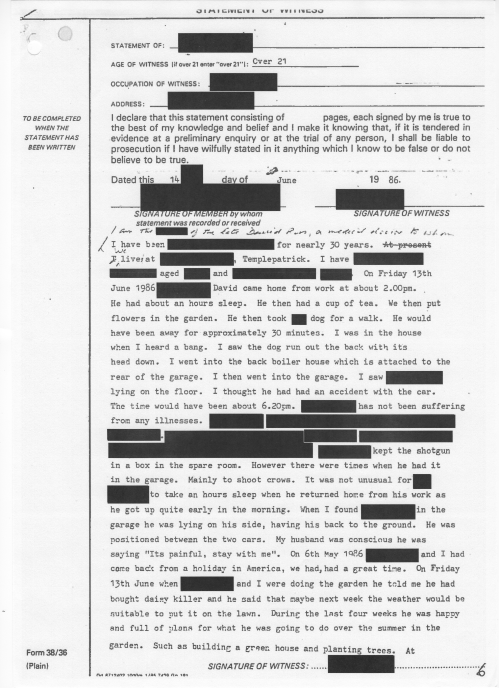
He had about an hours sleep. He then had a cup of tea. We then put flowers in the garden. He then took (redacted) dog for a walk. He would have been away for approximately 30 minutes. I was in the house when I heard a bang. I saw the dog run out the back with its head down. I went into the back boiler house which is attached to the rear of the garage. I then went into the garage. I saw (redacted) lying on the floor. I thought he had had an accident with the car. The time would have been about 6.20 pm. (Redacted) has not been suffering from any ilnnesses.

On 6th May 1986 (redacted) and I had come back from a holiday in America, we had a great time. On Friday 13th June when (redacted) and I were doing the garden he told me he had bought daisy killer and he said that maybe next week the weather would be suitable to put it on the lawn. During the last four weeks he was happy and full of plans for what he was going to do over the summer in the garden. Such as building a green house and planting trees. At the several social occasions we attended recently he was cheerful, outgoing and chatty, and afterwards he said how much he enjoyed himself. (Redacted) had been sleeping well, eating well and was full of interest.

The inquest did not call Dr Ross’ death ‘suicide’ but the meaning of the words chosen by the coroner was clear; the circumstances of Dr Ross’ death, he wrote, ‘were consistent with self-infliction’.

But what happened inside Dr Ross’ mind in the four hours or so between the Maze medical officer arriving home from a shift at the prison, apparently in a good mood and with no outward sign of mental distress, and his decision to put a double-barreled shotgun to his stomach and then his neck and pull the trigger remains a mystery.


What follows are the relevant documents in the story of Dr David Ross, beginning with extracts from Brendan Hughes’ interview with Anthony McIntyre, followed by facsimiles of the relevant inquest papers:

“But Sean was not the only one – Sean was the weakest … So all those weaknesses were there. After Sean asked me, I gave him a guarantee that I would not let him die. A few days later –now, I want to try and get the sequence correct here. Dr [David] Ross – he was the main doctor looking after the hunger strikers – came and informed me that Sean had only hours to live. It’s possible they were playing brinkmanship with me at this stage. And it’s possible that the cells were bugged and that they picked up what I had said to Sean. And they knew that if Sean went into a deep coma, that I would intervene. And that’s exactly what happened. Dr Ross came to me and told me that Sean would die within hours and he wanted permission … to take Sean to hospital. And this took place. There was a sudden rush of activity; prison orderlies took Sean on a stretcher up the wing. I was standing in the wing with Father Toner, Father Reid and Dr Ross … and I shouted up after Dr Ross, ‘Feed him.’ I had no guarantee at that point that anything was going to come from the British, no guarantee whatsoever. We all knew that they had offered us this deal but we had no guarantee that the deal would go through. We only had their word for it. The hunger strike was called off before the British document arrived. It was only later that night, I think; it was very late at night that Father Meagher and Bobby [Sands] arrived at my cell with the document.

Q. So is it fair to say that the hunger strike then did not end as a result of the document but the hunger strike ended prior to the document and it was in many respects the humanitarian decision on your part –you were bound by your word?

A. Yeah.”

“… a footnote to all this is that myself and Bobby had disagreements about the doctor who was in charge at the time of the hunger strikes. Bobby believed Dr Ross to be a mind-manipulator. I didn’t believe that. I believed him to be OK. But it’s important to remember that after the second hunger strike, Dr Ross blew himself away with a double-barrelled shotgun. He shot himself in the stomach and then blew his head off. I don’t know if it was to do with the hunger strikes [but] I believe it was. And I would sometimes refer to Dr Ross as the eleventh hunger striker, the eleventh victim of the hunger strike. I mean, anybody who could stand by and watch ten men die and not be affected … is a very, very ruthless man indeed … and I don’t believe that Ross was as ruthless as that. Bobby had no time for him, did not trust him, believed him to be, as I say, a mind-wrestler, trying to get inside people’s minds. But he used to sit on my bed for so long sometimes I would wish he’d go, [but] he would talk to me about fishing, about the mountains, the rivers and the streams. And for a man to bring in spring water every morning for the hunger strikers because he believed it to be much richer and would help the prisoners was not a ruthless man. That’s what he did, every morning he brought spring water in instead of the tap water that we had. And you know during a hunger strike it’s awful to drink salt and water. And I remember throwing it up, many’s a time throwing it up. But you had to try … the memory of that salt water and the sickness and … and the smell and watching your flesh. I mean, the body is a fantastic machine –it’ll eat off all the fat tissue first and then it starts eating away at the muscle to keep your brain alive. When that goes, all that’s left is your brain, and it starts to go as well. And that’s when the brain damage sets in. Your body needs glucose, and the last supply of glucose is in your brain.

INQUEST DOCUMENTS

Statement of Gladys Ross:
Witness list. No 5 appears to be the psychiatrist from Purdysburn hospital:Another reference to Purdysburn hospital:
Statement of Prison Hospital Warder:
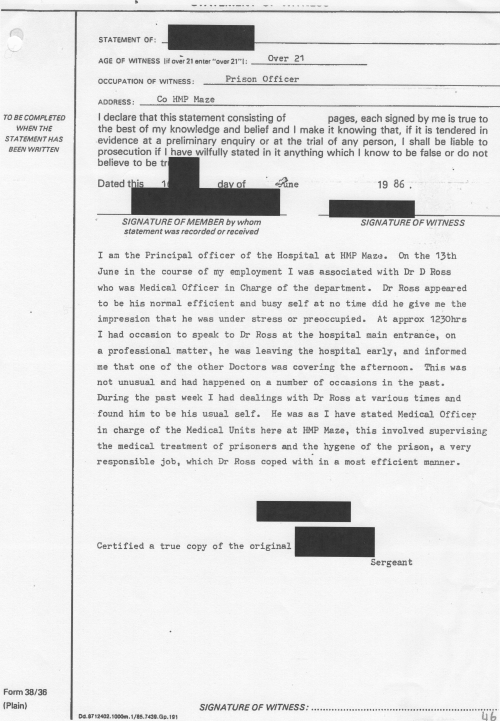
Statement of Catering Warder:
Statement of Prison Hospital Warder:
Inquest Findings:

The Lobby – Parts Three & Four


‘The Lobby’ – The Film The Israeli Government Would Like To Ban

What follows are parts one and two. Three and four will follow, hopefully in due course. The second part of the Al Jazeera documentary be seen by clicking on the link beneath part one:

https://electronicintifada.net/content/watch-film-israel-lobby-didnt-want-you-see/25876


Freddie Scappaticci And Those Animal Sex Pics

Freddie Scappaticci should have asked his FRU handlers to transfer him over here to New York if he wanted to gaze in legal safety at photos of animals and human beings, of both genders, enjoying sexual congress.

Freddie Scappaticci, far left, accompanies comrades at the funeral of another British agent in the IRA’s internal security unit, Brendan Davison

In the US such photos can be easily and legally accessed. Just type in ‘animal sex with people’ into the Google search box and then choose images.

It’s called the First Amendment.

Scap would have had a ball, so to speak, with no legal comeback.

Mind you, the charge does make you wonder. What is the Kenova team up to? The effect of this is to diminish and demean Britain’s No 1 spy in the IRA. Why? If I was Freddie, I’d be more than a little worried and maybe thinking ‘I’m about to be set up to save my handlers!’

In May’s Britain? Surely not!

We shall see.

The Other George H W Bush

The US media is full of laudatory pieces right now celebrating the life of George H W Bush, the 41st president of the United States who passed away at the weekend. The other side of the Bush story? Not so much….

Perhaps because of a need to remind their readers and viewers that there were American presidents other than Donald Trump, some of whose lies, greed and ignorance were quite trifling in comparison, only a very few outlets are paying attention to the seedier sides of the Bush family history or the scandals that beset their various life stories..

Instead most of the US media, print, social and electronic, are celebrating a ‘normal’ president, who could read and write, who got other people to tell his lies for him and had sufficient inherited wealth not to have to hustle his ass in the Kremlin.

Back in 2004, one of my favourite radical writers in this country, Dave Zirin took a critical look at the Bush saga, as he called it, and wrote this profile of the clan for Socialist Worker.

George H W Bush was VP to Ronald Reagan and then was elected himself to the White House, albeit for just a single term; his campaign will be remembered for the so-called Willie Horton TV ad, which exploited White racism with a claim that a Black convict had raped and murdered a white woman because he had been granted a weekend parole by his liberal Democratic opponent, Mass. governor Michael Dukakis.

His youngest son, also called George was elected President in 2000, also in controversial circumstances, amid allegations of ballot rigging and electoral malpractice in Florida.

The invasion of Iraq, under George Jnr’s watch, whose bloody consequences still reverberate, followed quickly afterwards. Justified on the concocted basis that Iraq dictator Saddam Hussein had a hand in the 9/11 attacks, the war in Iraq threw the Middle East into chaos and has resulted, arguably, in the rise of the Right throughout Europe and the Americas.

The full Bush family story, and the accumulation of its wealth, has a longer and equally controversial history. Here is Dave Zin’s account; you won’t see this in The New York Times:

THE GREAT myth about the United States is that we live in a “meritocracy,” where the “best and brightest” will rise to the top, and anyone can make it with intelligence and hard work. The slightest examination of the Bush family tree proves that all this is a lie.

The Bush saga — from George W. Bush in the White House today to the great grandfathers on both sides of the family — is the story of four generations amassing their fortunes and achieving the heights of power through the cronyest of crony capitalisms.

There are no think-tank theorists or college professors, no surgeons or artists among the Bush men. From root to branch, the Bush family’s rise to power and wealth has gone hand in hand with the fortunes of the oil industry and the military-industrial complex.

George H.W. Bush (right) and Gen. Norman Schwarzkopf in Saudi Arabia during the Gulf War

“[I]f presidential family connections were theme parks, Bush world would be a sight to behold,” writes Kevin Phillips, author of new book American Dynasty: Aristocracy, Fortune and the Politics of Deceit in the House of Bush. “Mideast banks tied to the CIA would crowd alongside Florida Savings and Loans that once laundered money for the Nicaraguan contras. Dozens of oil wells would run eternally without finding oil, thanks to periodic cash deposits by old men wearing Reagan-Bush buttons and smoking 20-dollar cigars.”

THE UGLY RISE OF THE HOUSE OF BUSH
To paraphrase Karl Marx, the Bushes truly came to us dripping from head to foot with blood and dirt. The Bushes claim an ancestry that goes back to British royalty. But the rotten modern house of Bush began with George W. Bush’s maternal great-grandfather, George H. Walker.

Walker was president of Wall Street-based W.A. Harriman & Co. He made his fortune as a war profiteer, working alongside the House of Morgan in purchasing billions in armaments for Britain and France during the First World War. In a foreshadowing of things to come, Walker got a taste for the emerging importance of oil as the engine of profits and war when he oversaw the rebuilding of the Baku oil fields after the war in the 1920s.

At his peak, Walker was the director of 17 corporations and maintained homes around the country — including a 10,000-acre hunting preserve in South Carolina, where according to his granddaughter: “We were waited on by the most wonderful Black servants.”

Dubya’s other great grandfather, Yale graduate Samuel Bush, was the president of the Ohio-based Buckeye Steel. Like Walker, Samuel Bush made his fortune during the First World War by producing material for small arms. Of course, it helped that Samuel became head of the Ordnance, Small Arms and Ammunition Section of the federal government’s War Industries Board in 1918.

Not unlike a virus, each generation has produced a deadlier strain of Bush. George W. Bush’s grandfather was Prescott Bush. He became his father-in-law’s heir apparent at the merged firm of Brown Brothers Harriman. Prescott Bush handled the “German work” for Brown Brothers in the 1930s, raking in a fortune by rearming Hitler’s Germany.

Brown Brothers set the pace for a 49 percent increase in U.S. investment in Germany during the 1930s — while investments declined throughout the rest of Europe. But this profiteering in the country that would become a U.S. enemy during the Second World War didn’t prevent Prescott from sitting on two boards that “covertly” provided material for the Manhattan Project to develop the atomic bomb.

Like other U.S. rulers who had kept a financial and political finger in Germany during the 1930s, Prescott Bush got in on the ground floor in Germany after its defeat in the Second World War. He helped the notorious Dulles brothers in establishing the OSS, the predecessor of the CIA — thus getting the Bush family into the spy business.

George H.W. Bush — Prescott’s son, and Dubya’s father — was born, in the words of former Texas Gov. Ann Richards, “with a silver foot in his mouth.” A Yale University alumnus like his father and grandfather, he gravitated to the oil industry through family connections and made a fortune.

Viewed as “intellectually light,” George Bush Sr. couldn’t win elected office before he became Ronald Reagan’s vice president — beyond a seat in Congress as representative of an oil-rich Texas district with the country’s highest number of Rolls Royces per person.

Instead, “Poppy” held just about every nonelected post that the Republican Party could arrange for him. He was chief of the Republican National Committee, head of the CIA, and U.S. Ambassador to the United Nations, where he was famous for writing “thank you notes” to political donors during sessions and debates.

After losing in the 1980 Republican Party presidential primaries to Reagan — during which Bush Sr. coined the phrase “voodoo economics” to describe Reagan’s proposals for tax cut giveaways to the rich — he joined the ticket and became vice president. During the Reagan presidency, his connections as both a former spymaster and an oil industry crony made him the point man for the administration’s funneling of dollars and weapons to Saddam Hussein’s regime in Iraq.

At the same time, Bush helped with the scandalous deal with Iraq’s archenemy Iran — where the U.S. illegally sold weapons and used the profits to support the brutal contra guerrillas fighting to overthrow the left-wing Sandinista government in Nicaragua. Bush managed to win the presidency in 1988.

He is best known as the “butcher of Baghdad,” responsible for the deaths of some 200,000 Iraqis during the first Gulf War in 1991 — which was dominated by the most intensive aerial bombardment in the history of war. After the war, Bush had an approval rating of nearly 90 percent.

But this support melted away in the face of the early 1990s recession, and Bush got only 37 percent of the popular vote in 1992, one of the lowest-ever results for a sitting president. His campaign wasn’t helped by a photo op where he appeared surprised by a supermarket’s scanner system — and the high price of milk.

HOW TO SUCCEED IN BUSINESS BY FAILING
Bush Sr. must wonder how his son, George W. Bush, did it — the idiot son who followed his father’s footsteps into the White House.

Dubya spent many years under the influence. This included the use of influence to avoid the Vietnam-era draft and get into the Texas Air National Guard — where Bush got himself transferred to Mississippi, and eventually chose not to show up at all.

Then Bush Jr. tried to use his family influence to make a fortune in oil. He should have been a colossal failure. His company Arbusto Energy — nicknamed Are-Busto in the industry — lost $3 million. Fortunately for him, a Cincinnati group that included a Yale classmate bought him out.

The son of the then-vice president became chair of the newly constituted Spectrum 7 Energy Corp. Yet once again, no success for Dubya. But as Britian’s Observer newspaper put it, “Whenever he struck a dry well, someone was always willing to fill it with money for him.” Harken Energy bought out Spectrum 7, and Bush was put on the board of directors and given 16 percent of the stock.

Asked why he wanted to buy a failed company, Harken’s founder said, “His name was George Bush.” Harken was also losing money hand over fist, yet it concealed its losses. Only a few weeks before the bad news broke and Harken’s share price tumbled, the fortunate George Bush Jr. sold off two-thirds of his stake for $848,000.

An internal Securities and Exchange Commission memo concluded that Bush had broken the law by trading on inside information, but no charges were filed. This, everyone insists, had nothing to do with the fact that his father was president of the United States. All records of SEC investigations into Bush’s insider trading and bankrupt companies are sealed — and unavailable to the public.

BLOOD ON BOTH THEIR HANDS
The story of the latter-day Bushes returns again and again to Iraq. As head of the CIA in the mid-1970s, George Bush Sr. inherited the agency’s covert history of support for Saddam Hussein’s rise to the top of the Iraqi regime.

As vice president under Ronald Reagan, one of his chief tasks was to oversee the administration’s support for Iraq. “It is increasingly clear that George Bush, largely operating behind the scenes through the 1980s, initiated and supported much of the financing, intelligence and military help that built Saddam’s Iraq into an aggressive power that the United States ultimately had to destroy,” said ABC News’ Ted Koppel in 1992.

Bush and other Reagan administration officials facilitated transfers of intelligence, military supplies and even the components for advanced chemical and biological weapons. When Saddam Hussein stepped out of line with the invasion of Kuwait, which threatened the flow of Middle East oil, Bush organized the first Gulf War.

After killing as many as 200,000 people during the seven-week war, Bush urged the Iraqi people to rise up against the regime. But when Kurds and Shiites did rebel, the Bush White House decided they were better off with Saddam’s Ba’ath Party in power — and allowed the regime to repress the rebellions. Thus, Bush Sr. bears direct responsibility for the recently discovered “mass graves of Iraqi Shiites” discovered by U.S. forces after Bush Jr.’s invasion.

Much has been made of the idea that Bush Jr. was “finishing the job” in Iraq that his father started. But it would be a mistake to see the second Gulf War as a matter of family revenge.

For one thing, scores of Democrats supported the war and occupation. The second Bush administration, backed up by a host of right-wing fanatics led by Donald Rumsfeld, is determined to remake the Middle East, and Iraq is the first stage.

It is true, however, that history has repeated itself — and another George Bush is responsible for the deaths of masses of Iraqis. Hopefully, like his father before him, the postwar scrutiny of the bloody invasion of Iraq will lead to Bush Jr.’s undoing, too.

THE SKULL AND BONES FANATICS
One Bush after another has attended Yale University, and each one has been a member of the elite and highly secretive Skull and Bones society. Fifteen Yale students — overwhelmingly men — are chosen every year. They come from “the best families” and are meant to stay connected in business and social circles throughout their lives.

Skull and Bones is fodder for conspiracy theorists alarmed that a “secret society” could claim so many of the country’s elite. Look at the society’s creepy practices, and you can understand why.

Initiates into Skull and Bones are brought into the “tomb,” a dark, windowless crypt in New Haven, with a roof that serves as a landing pad for the society’s private helicopter. They are sworn to silence and told that they must forever deny that they are members.

During initiation, the juniors wrestle in mud and are physically beaten — to represent their “death” to the world as they have known it. Then the initiates are given a new name as a member of “The Order.” At this point, the new members are introduced to the artifacts kept in the tomb — which include Nazi memorabilia, such as a set of Hitler’s silverware, dozens of skulls, and an assortment of coffins and skeletons.

Skull and Bones was the foundation of the OSS spy agency. There were so many secret society members in the OSS that Yale’s drinking tune — the “Whiffenpoof Song” — became the agency’s “unofficial” song as well.

Some of the world’s most famous and powerful men alive today are “bonesmen.” Among them is another politician, Massachusetts Sen. John Kerry — meaning that the 2004 presidential election could pit Skull vs. Bones.

What does this prove? Not that the world is run by a secret society, but that the political establishment in Washington is infested with the sons and daughters of the super-rich who spent their college years at Ivy League universities.

HAS THE RIGHT WING TAKEN OVER?
Has Washington been taken over by a shadowy right-wing cabal, with the Bush family as its head? That’s the logical conclusion of Kevin Phillips’ book American Dynasty — which provided the bulk of the information for this article.

Phillips, a former top adviser to the Nixon administration and respected figure in the Republican Party, is biting the hand that fed him — and revealing facts about how the U.S. government operates that are usually kept well hidden. But the picture that he draws of Washington isn’t wholly accurate.

Phillips essentially believes that the Bush dynasty has become a kind of “royalty” — based on hereditary — that usurped power in Washington. But this suggests that there was ever a more democratic system — and a group of politicians more responsive to the real interests of ordinary people in the U.S. — to be usurped.

Phillips fails to recognize how the rest of the Washington establishment — including the Democratic Party, the supposed “opposition” to the Republican power brokers — is organized around serving the same interests and maintaining the status quo.

Take the question of Iraq. During the eight years between the two Bush presidencies, Bill Clinton carried out a military and economic war on the country that was every bit as deadly.

Some 1 million Iraqis died between the two Gulf Wars because of United Nations economic sanctions backed up by the U.S. — which the Clinton administration continued without hesitation. In reality, Clinton’s shift toward “regime change” as the goal in Iraq paved the way for Bush Jr.’s more aggressive posture.

On other important issues, Clinton’s record is actually to the right of Bush Sr. Papa Bush may have wanted welfare “reform,” for example, but it took Bill Clinton and the Democrats to deliver on the disastrous law that threw millions of people deeper into poverty.

The Bush family may be one of the ugliest faces of the system. But they are only part of a political establishment in the U.S. that is committed to promoting the interests of the rich and powerful. Our struggle to stop Bush Jr. means challenging the whole corrupt setup in Washington and throughout the U.S.

First published on February 6, 2004.

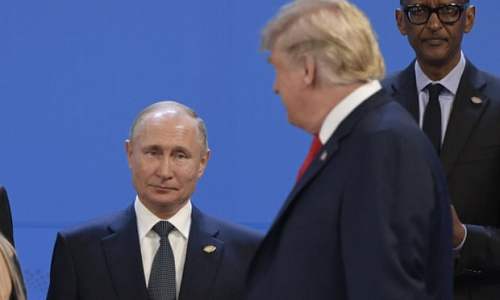
What Are Putin And Trump Thinking?

Bubble competition: What are Vlad and Donald thinking as they pass by during the G20 summit in Argentina? Best suggestion wins a lifetime subscription to thebrokenelbow.com!

Jean McConville, And The Morality Of Recruiting Informers

By James Kinchin-White and Ed Moloney

‘I can be a bad bastard if I feel like it. It’s my job’…….Intelligence Officer code-named ‘Kent’, the Gloucester Regiment, circa April 29, 1973

There is little doubt that most people inclined to be sceptical about the claim that Jean McConville worked as an informer against the IRA, are unconvinced because they have difficulty accepting that the British Army would stoop so low as to put the life of a widow with ten children in mortal danger.

Which raises the question of how low the British Army was actually prepared to stoop in its intelligence war against the Provos, especially in the early years of the Troubles when there was a premium on accurate information about the IRA and its activities.

In other words was the military’s intelligence war in Northern Ireland fought in accordance with a moral code of any sort? Were some potential informers off limits – like Jean McConville – or were there no limits?

Well, to judge from the following document plucked from the shelves of the British government’s own archives at Kew, Surrey, the answer is that more or less any vulnerable target with even a minimal amount of access to the IRA was fair game and that in the process of recruiting them as agents, the military was prepared to stoop pretty darned low.

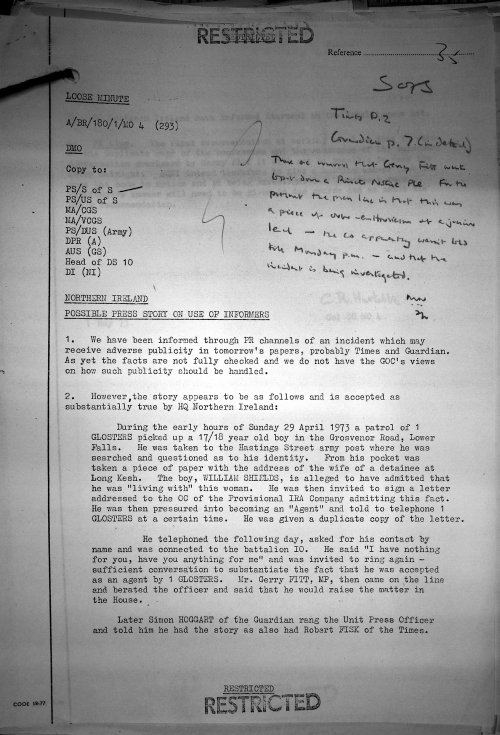
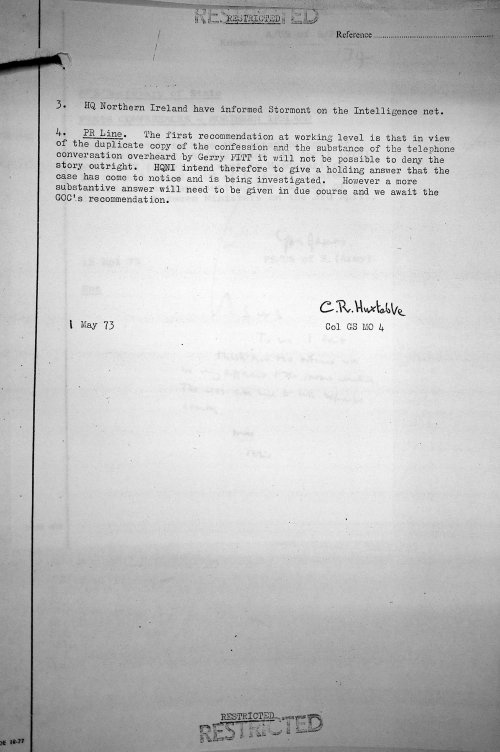
The document, a so-called ‘loose minute’ distributed to political, military and intelligence heads in Belfast on May 1st, 1973, describes the recruitment of a 17/18 year old boy as an informer by soldiers from the intelligence unit of the Gloucester Regiment, then based in the lower Falls/Divis Flats area of West Belfast.

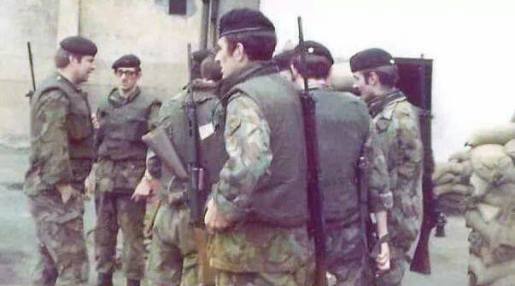
Gloucestershire Regiment (14)

Soldiers from the Gloucestershire Regiment

The recruitment effort backfired badly and the UK media got to know about it, causing consternation in military, political and intelligence circles in Belfast.

The boy, a hotel worker named as William Shields, was arrested in the lower Falls in the early hours of Sunday, April 29th, 1973 and then taken to Hastings Street Army base where he was blackmailed by the Gloucesters into becoming an agent.

The soldiers ‘extracted’ an admission from Shields that he was having sex with the wife of a Provisional IRA internee and that he was ‘living with the woman’. The Gloucester’s Battalion Intelligence Officer then got the boy to sign a letter to the OC of the local IRA admitting all this, and was then pressured to become an informer, on the basis that if he refused, the letter to the IRA would be delivered, with predictable consequences for young Shields.

Afterwards, Shields had the good sense to go to the then West Belfast MP, Gerry Fitt for help. Fitt, according to the British document, witnessed Shields phoning his handler in the Gloucester’s, thereby confirming the boy’s story. The West Belfast MP then got on the phone and informed the handler that he intended to raise the matter in the House of Commons.

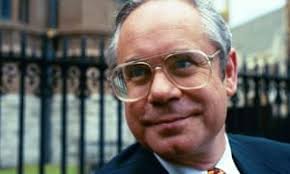
Fitt

Gerry Fitt, then West Belfast MP – listened in to phone call to Gloucester’s Intel Officer and threatened to raise boy’s case in parliament

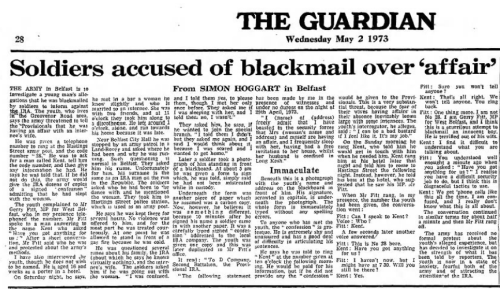
Gerry Fitt had alerted two Fleet Street reporters, Simon Hoggart of The Guardian and Robert Fisk of The Times who duly wrote up the story. Hoggart was present when Shields and Fitt phoned the Gloucester’s handler and his story, which led the back page of The Guardian on May 2nd, 1973, is reproduced below. Fisk also wrote about the incident but his article could not be located.

After Fitt’s phone conversation, the proverbial hit the fan, leading to the involvement of the then NI Secretary, William Whitelaw who was told by an unnamed official that:

‘…..the press line was that this was a piece of over-enthusiasm at a junior level’.

In other words, nothing to do with the Gloucester’s command. The blame would be carried by junior officers.

Simon Hoggart’s account is worth reading (see below), not least because he was a respected reporter, but also he had details in his account conspicuously absent, or at significant variance from the official report of young Shields’ attempted recruitment circulated, inter alia, to Willie Whitelaw’s office.

Hoggart

The late Simon Hoggart – wrote up the story for The Guardian

According to Hoggart, the boy was only 16, not 17 or 18 as the British document claims and was thus virtually still a child; the boy was also tricked into signing a forged admission of having sex with the IRA internee’s wife (which he denied had happened to Hoggart and Fitt), and the Gloucester’s Intelligence handler, who went by the code name ‘Kent’, threatened to give ‘dozens of copies’ of the boy’s alleged admission to the IRA, effectively delivering a death threat to the youngster.

The handler also told the boy, according to the account given to Hoggart:

‘I can be a bad bastard if I feel like it. It’s my job’.

So this under-age, innocent young lad was tricked, terrified and blackmailed into becoming a British Army agent and despatched down a path which, but for the intervention of Gerry Fitt and a couple of journalists, might very well have ended with his death.

As to what conclusions one can come to about whether Jean McConville’s own very evident vulnerability would have deterred someone like “Kent’ from considering her a candidate for recruitment, the reader can make up his or her own mind.

It is interesting to note that this was the Gloucester’s second recent tour in the lower Falls/Divis Flats area. They had first served a three month tour in that district between December 7th, 1971 and April 13th, 1972, about a year before the incident described above.

The regiment’s War Diary for that tour has been embargoed until 2059. Most other regimental War Diaries during the years of the Troubles have not been embargoed and some can even be purchased on eBay. Why is that?

P1060433P1060434

Stornophone

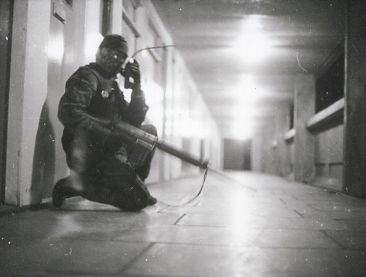
A soldier in the First Gloucesters Regiment uses a Stornophone-type radio in one of the corridors in Divis Flats in April 1972 – the First Gloucester’s War Diary of their tour in Divis from Dec 1971 to April 1972 has been embargoed until 2059

Evidence That The RUC Was Issued Portable Radios ‘Between 1967 and 1970’

When barrister Peter Sefton was studying for his Honours degree in law at Queen’s University Belfast between 1967 and 1971, some of his classmates were members of the RUC, ranging in rank from Constable to Head Constable (station chief) and when chatting with them, some raised a shared gripe.

Their working lives had been transformed, they said, when they were issued with small, hand-held radios, so that when they were out on foot patrol, their bosses could keep in touch with them and vice-versa.

But instead of making their lives easier, a common complaint was that no longer could they wander off, undetected, to a lady friend’s house, for instance, to while away a happy hour or so, out of the reach, so to speak, of their superiors. The radios meant that the boss was always tracking their movements.

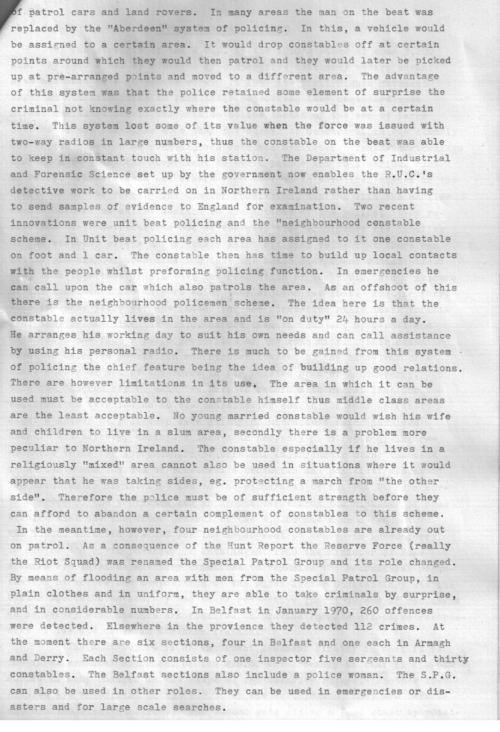
Peter can’t remember precisely when the radios were introduced, just that it was some time between 1967 and 1970, the year before he graduated. Why 1970? Well that was when he wrote an essay about life in the RUC in which he mentioned the radios. Remarkably, he kept the essay and this weekend he sent me a copy of  the relevant page which I have reproduced below.

Peter’s testimony provides compelling evidence that some time between 1967 and 1970, the RUC had been issued with portable radios of the sort allegedly provided to Jean McConville, who was accused of being an informer by the IRA, murdered and her remains buried in a secret grave in late 1972.

Peter has another reason to be believed in this matter. His father, James Sefton was an RUC Reservist, so policing was in the family – although the connection meant that the family was to be shattered by an unimaginable horror.

Both his parents were killed in an IRA booby-trap car bomb in June 1990; his father, who had retired by then and could not by any standard be described as ‘a legitimate target’, died instantly in the blast, which occurred outside their North Belfast home. His wife, Ellen, Peter’s mother, succumbed later in hospital.

For years, Peter has been campaigning for the truth behind his parents’ murder. Peter suspects British intelligence had foreknowledge of the plot to kill his parents because at least one informer was privy to the plans for the attack. Implicit in this belief is the suspicion that the agent’s handlers approved his parents’ murder.

Peter emailed me after the last posting on this blog dealing with the RUC’s acquisition of portable radios, some of which, according to a British Army document, had been loaned to the 3rd Batt Royal Anglian Regiment in the summer of 1972, then stationed in the lower Falls area.

He had something significant to add to the story.

The security forces’ use of portable radios is central to the allegation by the IRA in Divis at the time, that Jean McConville was working for the British Army. The late Brendan Hughes said one was found in an IRA search of her apartment, after which she admitted to being an agent.

A recent book, ‘Say Nothing‘, quotes a former RUC Special Branch officer as saying that such radios were not in use at the time of her abduction, in December 1972 and therefore the IRA claim was false. You can read about the controversy, here and here.

Peter Sefton’s testimony, based on a contemporary document, not only challenges that Special Branch assertion, it raises questions about why the RUC’s successors are so intent on challenging the plausibility of the ‘radio story’ in the McConville saga.

First the text of Peter’s email, followed by the page from his 1970 essay:

Ed
Belated happy Thanksgiving.

Re your articles on radios, I’m sure that the RUC were issued with “pocket radios” somewhere between 1967 and 1970. I know this for two reasons. In the Law Faculty we had a number of RUC officers getting their law degree whilst still serving. They ranged from constables to Head Constables. Some were disheartened at the introduction of the two way radio because, of an evening it had been their habit to rest a while in a house, perhaps that of a lady. Now the station was constantly in touch.
Additionally , I wrote an essay about the history of the RUC. I wrote it in 1970 and I recorded that the pocket/two-way radio was already in use.

I attach a copy of the relevant page. God knows why I could still find it.

Regards

P

o

RUC Also Had Portable Radios When Jean McConville Was Abducted

By James Kinchin-White and Ed Moloney

In his new book about the disappearing of Jean McConville, ‘Say Nothing‘, American writer and New Yorker journalist, Patrick Radden Keefe writes that a former RUC Special Branch officer told him that hand-held radios of the sort the late IRA leader, Brendan Hughes maintained was found in the Divis Flats apartment of Jean McConville in late 1972, were not in use by either branch of the security forces at the time.

In other words, since neither the British Army nor the RUC had access to such devices at the time, Jean McConville could not have have used one in her capacity as an alleged agent of the British military.

Jean McConville’s possession of the radio is a key part of the IRA allegation that she was a British army spy and the RUC claim to Keefe that such a device was not in use at the time serves to significantly undermine it.

If the radio was not in service in 1972, as Keefe’s RUC officer claimed, then the IRA must be suspected of inventing the story and McConville was thus innocent of the charge against her. It must mean that some other motive, ranging from base sectarianism (Jean McConville was an East Belfast Protestant) to local unpopularity, was the reason for her death.

As Keefe wrote:

‘There was also mystery relating to the detail of the radio itself. Some former police officers, like Trevor Campbell, maintained that neither the army or the police were using hand-held radios to communicate in those days, much less to communicate with informants’.

If, on the other hand, the radio was in service, it adds credibility to the IRA claim against Jean McConville. By no means does it prove she was a spy, merely that she could have been.

So the existence, or otherwise, of such a radio and its use by the security forces circa 1972 is crucial to the McConville narrative.

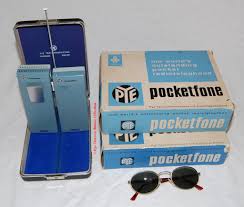
There is a plethora of evidence, much of it published on this blog, that the British military was using such radios – either Stornophones or the Pye Pocketfones which replaced them – between 1971 and late 1972, important elements of which Keefe either ignored or failed to detect. You can read that part of the story here.

But now evidence has been unearthed from the British government’s own archives at Kew, Surrey showing that the RUC was also using hand-held radios at this time.

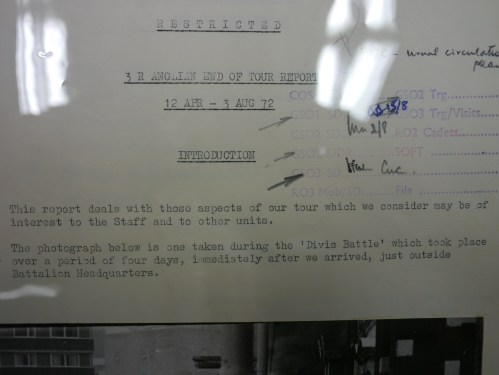
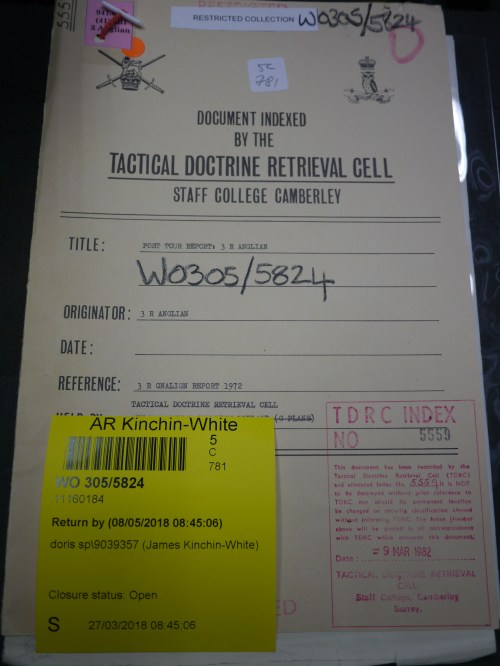
The evidence comes in an end of tour report by the 3rd Battalion, Royal Anglian Regiment which was based in the lower Falls and Divis Flats area between 12th April 1972 and August 3rd 1972.

The report was prepared for the British Army’s top brass and, significantly, was embargoed until 2017, an interdiction of some forty-five years. Normally, reports are embargoed for twenty years but there are exceptions, usually made, it is assumed, because the contents are still so sensitive.

For instance, War Diaries from 39 Brigade, i.e. Belfast, at the time when Brigadier Frank Kitson ran military operations, are embargoed for 100 years. Kitson is believed to have founded the controversial Mobile Reaction Force (MRF) unit during his time in NI.

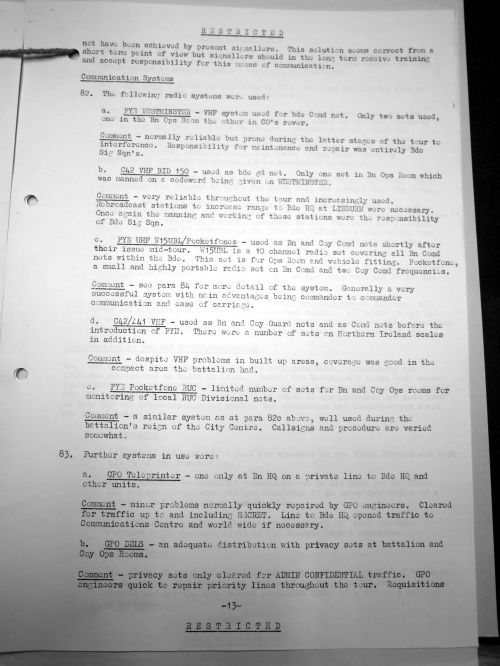
In a section describing the system of radio communications used by the Royal Anglians, the report has this to say, in paragraph 83 (e):

Pye Pocketfone RUC – limited number of sets for Bn and Coys Ops rooms for monitoring of local RUC Divisional nets.

Translated into plain language, this paragraph is saying that the RUC gave the Royal Anglians some of their own Pye Pocketfones so that they could communicate with senior RUC personnel.

Pye

The reason for this is that the British Army Pocketfones and the RUC Pocketfones were built to different specifications and operated on different frequency ranges; to make communication with the police possible, the Anglians needed RUC models. And so they were loaned some by the police.

Ergo, RUC personnel were using hand-held radios in 1972; Trevor Campbell was wrong and for reasons only he can explain, gave Patrick Keefe misleading information. What those reasons are is a different matter, but the affair does raise troubling questions.

(Interestingly, the report reveals that the Pye radios were issued to the Royal Anglians mid-tour, circa early July 1972, suggesting this was when they replaced the Stornophone as standard issue.)

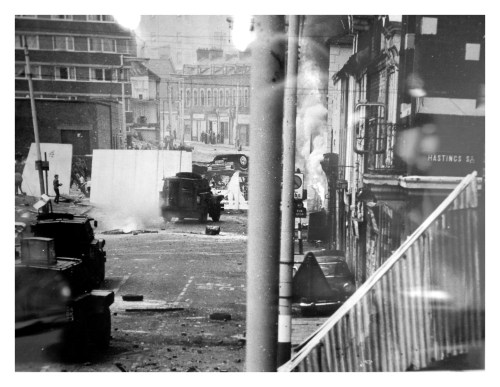
Beneath the following extract, the reader can see other evidence for this report’s bona fides along with an interesting photograph of a violent episode in the Divis area during the Royal Anglians’ tour of duty. It lasted for four days and was called the ‘Divis Battle’.

The Divis Battle

May’s Brexit Deal Will Copper-fasten Neo-Liberalism In The UK……

Canadian blogger Ian Welsh can always be counted on to spot an angle on a story that has passed by nearly everyone else. Here he has spotted a clause in Teresa May’s Brexit deal which will, if approved by the British parliament, copper-fasten neo-liberal economics in the UK and make any attempt by a Corbyn government to roll it back nigh impossible, without a greater break with the European powers:

What May’s Brexit Deal Tells Us About The EU and Britain’s Future

2018 November 16
by Ian Welsh

So, May has a Brexit deal. It’s a terrible deal, which makes the UK subject to many EU laws, and which doesn’t allow Britain to withdraw from the deal if the EU doesn’t want it to.

This has caused ministerial resignations, and Corbyn has come out against it.

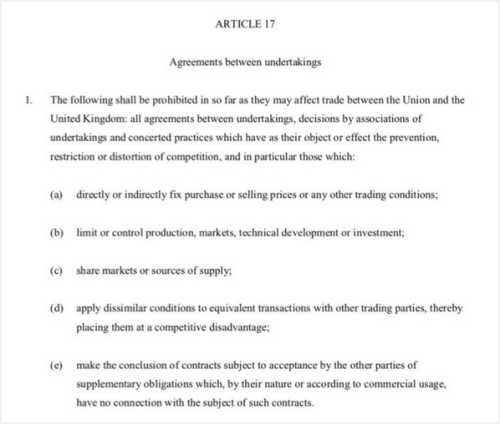
But the interesting part is what the EU and May have negotiated. This clause, for example:

Corbyn’s policies include straight up re-nationalization of the railways, regulation of housing prices and the government outright building vast numbers of flats, among many other similar policies.

In other words, Corbyn’s policies interfere with liberal market rules. They are, actually, forbidden by the EU, but on occasion exceptions are made.

Now, retaining privileged access to the EU market was going to require some rule taking, but May has chosen to take more rules that are “no socialism” and less rules that are “treat your people decently.”

What May has done is negotiate a deal which ties Corbyn’s hands: he can’t do his policies if he becomes Prime Minister, and he can’t leave the deal. (Well, in theory, and perhaps in practice.)

Of course, Britain can still leave the deal: parliament is supreme, and one parliament cannot tie the hands of another parliament. Nonetheless, doing so would be damaging to Britain’s relationship with the EU, to put it mildly.

These sorts of efforts to tie future government’s hands, so that they can’t not do neoliberal policies are common. The now-dead Canadian Chinese trade deal had a clause which required a 20 year withdrawal notice, for example. The Canadian-EU free trade deal forbids the Canadian government from many of these sorts of policies as well.

This is the great problem with the neoliberal world order: it is set up to force countries into a specific sort of economy, and to punish them if they resist or refuse. That would be somewhat ok, but only somewhat, if neoliberal economics worked, but they don’t.

What they do, instead, is impoverish large minorities, even pluralities, in countries which adopt them. Those pluralities then become demagogue bait (hello Trump.)

Meanwhile Macron has proposed an EU military, and Germany’s Merkel has said she supports the idea.

EU elites are absolutely convinced their way is best, and that anyone who is against it is wrong. They are not primarily concerned with democracy (the EU is run primarily by un-elected bureaucrats), and do not consider democratic legitimacy as primary. If people vote for the “wrong” thing, EU elites feel they have the right to over-ride that. They have overseen what amount to coups in both Greece and Italy in the past 10 years.

The funny thing is that orthodox neoliberal economic theory admits there will be losers to neoliberal policies and states that they must be compensated. The problem is that has never been done, and indeed, with accelerating austerity, the opposite has been done: at the same time as a plurality is impoverished, the social supports have been kicked out from under them.

Macron has been particularly pointed in this: gutting labor rights in the name of labor market flexibility.

Neoliberalism, in other words, creates the conditions of its own failure. It is failing around the world: in America (Trump does not believe in the mulilateral neoliberal order), in Europe, and so on.

Even in countries that “support” the EU, there are substantial minorities, pushing into plurality status, which don’t support it.

So Europe needs an army. Because Eurocrats know best, and since neoliberalism isn’t working for enough people that things like Brexit happen; that Italy is ignoring rules, that the East is boiling over with right wing xenophobia, well, force is going to be needed. A European military, with French nukes, is the core of a great power military. And soon countries won’t be able to leave.

That, at any rate, is where things are headed. We’ll see if the EU cracks up first.

In the meantime, May’s Brexit deal really is worse than no deal, and in should in no way be passed. In fact, if I were Corbyn, and it was passed, if I became PM I’d get rid of it. Because it either goes or he breaks substantially all of his most important electoral promises.

The EU is loathsome. I won’t say it’s done no good, but it’s now doing more harm than good (indeed it has been for at least a decade.) As with the US, since it is misusing its power, it needs to lose it. That process will be ugly, since a lot of those who are rising to challenge it are right wing assholes (because the left has abandoned sovereignty).

But you can’t fail pluralities of your population and stay stable without being a police state and holding yourself together with brutal force.

Those are the EU’s two most likely futures: brutal police state, or crackup.

Pity, but that’s what EUcrats, with their insistence on neoliberal rules and hatred of democracy have made damn near inevitable.