Ivor Bell Verdict – A Statement

Statement by Ed Moloney:

First of all, I would like to welcome the acquittal of Ivor Bell on charges connected to the murder and disappearance of Jean McConville. This marks the end of a nearly six-year ordeal for him and his family, during which his health has deteriorated seriously.

I now call on the authorities to drop all charges against others awaiting legal proceedings arising from the PSNI’s seizure of tapes from the Boston College archive. It is time to draw a line under this ill-conceived chapter in the North’s sorry history.

In the end Ivor Bell’s hearing – I hesitate to use the word trial – was held in secret and even the fact that it was a secret hearing kept hidden from the general public by an edict issued from the judge’s bench. Sadly, the media in Northern Ireland decided not to defy this ban on free speech, nor even to tell their readers and viewers that it was in place.

The motives of those who decided to pursue the Boston College archive have equally gone unexamined. Ostensibly, the PSNI moved against the archive in an attempt to secure justice for the family of Jean McConville, whose disappearance and killing by the IRA had been shamefully ignored for many years by the same forces of law and order.

But I have always suspected that a hidden motive for the action against the archive was to discourage others from following in our path with the result that interested parties involved in the Troubles – State and non-State – would lose control of the narrative of the past and would be denied their monopoly on the telling of our troubled past.

Killing off the Boston archive caused the stillbirth of many other attempts to launch independent excursions into the story of our 30-year Troubles. Allied to this effort, and a warning to others, has come a concerted effort to disparage the reputation and motives of those involved in the project. Others tempted to follow in our path were thus made aware of what could be said about them or done to them.

In that regard I note that one of the Crown witnesses, Kevin O’Neill, an academic from Boston College who replaced the indisposed college librarian, Bob O’Neill, told the court that the project, “was now held up as a model of how not to do oral history”.

If Dr O’Neill felt that way when he was asked by his superiors at the college at the outset of the project to examine and critique some of early interviews conducted by Dr Anthony McIntyre, then he kept his views very much to himself, despite his well known reservations about putting Sinn Fein, the IRA and its leadership under the microscope.

As for those who accused the Boston archive at the Bell hearing and outside it of political bias let me remind them that running in parallel with the Republican archive was one devoted to the UVF and Red Hand Commandos and, alas for only a short while, an archive devoted to the RUC.

At one point Boston College’s ambitions ran to an archive on the British Army and both the US State Department and the Northern Ireland Office saw in our work a possible model for dealing with one element of the past. That was until the PSNI and possibly others in the security world decided otherwise.

Those who have been lavish in their criticism of the Boston archive have said little or nothing about the reality that without our efforts, the family of Jean McConville would still know little or nothing about what happened to their mother or who was involved in ordering or carrying out her disappearance.

If the McConville family had been reliant on the PSNI or other intelligence agencies for information about their mother’s final days, they would be in for a long wait.

Finally, I wish to say a few words in defence of my republican researcher, Dr Anthony McIntyre. ‘Mackers’, as we all know him, is a hugely talented researcher and commentator and a man not known for keeping his views on many matters to himself.

Those in the media tempted to join in the disgraceful disparagement of him exhibited by certain lawyers at the Bell hearing should remember how often they have called at his door for interviews and how often they are admitted and provided with all they need.

This was a difficult project for any researcher and inevitably there were teething problems. But these were overcome and Mackers conducted sometimes lengthy series of interviews with nearly thirty republicans of various hues, the professional quality of which is evidenced by the fact that his work has provided the basis for one best-selling book and a prize-winning television documentary.

We had only one governing rule while the project was underway. That was to seek out the truth. Those who we knew dealt in lies and deceit were ignored. If we are to be criticised for that then we embrace that gladly.

ends


Sorry, Mr Simpson – We Need You To Tell All You Know About Finucane Murder

For instance, who was the guy involved in Pat Finucane’s killing who hanged himself? And why did he do it? Why are we learning about this key detail only now, thirty years afterwards? You have a responsibility to tell the full truth, the full story.

Here is what retired RUC cop Alan Simpson wrote about the Pat Finucane killing in the Belfast Telegraph. What he writes is a tease, like a high class stripper he only hints at what lies beneath the beguiling bulges, leaving the reader gasping for more. But the audience won’t leave the theatre until all is revealed.

Alan Simpson: An RUC detective colleague told me the Finucane murder would follow me to my grave… I don’t believe we’ve heard the last of it yet

Pat Finucane
Pat Finucane

When I joined the RUC in 1970, Northern Ireland had just experienced almost two years of civil unrest, but, like many, I felt it was but another episode in the troubled history of Ireland and would soon pass. How wrong I was.

Little did I realise that 30 years of bitter violence lay ahead, which would result in almost 3,700 deaths, with thousands more injured.

I was at the coal-face of anti-terror policing during most of those terrible years and it began for me when I was posted as a probationer constable to Tennent Street in north Belfast. The station was responsible for policing the Shankill, Ardoyne and Oldpark areas.

The reality of my posting was to prove that the Troubles were far from over as, during my first two years of uniformed service, I was the first officer at the scene of 12 sectarian murders. Most of these victims had been shot, but others had been savagely beaten to death.

The faces of these unfortunates were like something from a horror movie. It was clear that the hatred some people had for each other ran much deeper than I could ever have imagined.

In late 1972, I was accepted into the CID and gradually worked my way up the ladder, ending my service as a detective superintendent and deputy head of the CID for Belfast. At that stage, I had attended approximately 100 murder scenes and had faced down some of the most notorious terrorists, ranging from Martin Meehan of the IRA to Lenny Murphy, leader of the Shankill Butcher gang. I thought I had seen and heard everything.

But I was totally unprepared for the phone call I received at home on the evening of Sunday, February 12, 1989, informing me that leading solicitor Pat Finucane had been shot dead at his home.

I had known Mr Finucane from my many days at Belfast Crown Court and while it would have been unwise for him to be seen speaking to me in the crowded foyer, occasionally I would meet him in an isolated corridor and he would give me a friendly nod.

On arriving at the scene, it was cordoned off and I was led to the kitchen of the house by the local CID duty officer, where I saw Mr Finucane lying on his back. His face was a mass of bullet holes and powder burns and this indicated that the killer had stood over him and pumped bullets into his head from a distance not greater than 18 inches.

We also noted two bullet holes in the glass kitchen door; the gunman had downed his victim by first firing two shots through the door and into Mr Finucane’s body.

Retired policeman Alan Simpson

Several spent 9mm cartridges littered the floor, so the likely weapon was a Browning automatic. This was undoubtedly the work of a very professional assassin from either the UFF or UVF.

Geraldine Finucane, the victim’s wife, had been shot in the foot and was in hospital, but the rest of the family had isolated themselves from us by staying in the front lounge behind a closed door.

I had the scene photographed, videotaped and expertly examined by forensic scientists, in addition to Professor Marshall, the State Pathologist, after which we placed Mr Finucane in a body-bag and had him removed to the mortuary.

I then went to the nearby Antrim Road RUC station, where I summoned extra detectives to work on the case and set up an incident room.

Many observers have written about the case and I am correctly presented as the senior investigating officer, but this was just another killing to add to the list of murder investigations then under supervision by me.

However, I did realise that the murder of Mr Finucane was causing a political storm and hitting the news headlines worldwide, so, in reality, I dedicated myself more to his case.

Two days after the murder, I was surprised to receive a phone call from RUC HQ, advising me that the head of the CID for Northern Ireland, Assistant Chief Constable Wilfred Monahan, was on his way to visit the Finucane incident room. He stayed for about 15 minutes and I saw him back down to his car.

Before getting in, he turned to me and said, “Alan, if I were you, I wouldn’t get too deeply involved in this one.” He then closed his car door and was driven off.

I was quite stunned by his advice and not a little confused. Was he saying I had a lot of murders on my hands and Mr Finucane was a republican sympathiser unworthy of too much police time? Or was there some deeper meaning?

I returned to the incident room and continued with the investigation full steam ahead, but the following day I received another unexpected visitor from RUC HQ in the form of a Special Branch detective chief superintendent, who was deputy head of Special Branch for Northern Ireland. I thought he was going to offer me some vital information, but I simply briefed him and he left.

Almost from the moment I arrived at the scene of the murder of Pat Finucane, I sensed that there was a great deal of hostility towards the RUC from the family. I wasn’t in the least surprised as it was widely known they held strong republican views.

However, as the days wore on, the Press began to report that the family suspected some form of state involvement in the killing. It was not an idea that I took onboard easily, as I didn’t believe any state agency would be so stupid as to arrange such a killing. The ramifications for that, if true, would be disastrous and far-reaching.

My investigation ran for about six weeks and, as with so many other cases, it had to be shelved until some new information came to light.

The next significant event for me in the Pat Finucane case was the inquest into his killing, which was heard in September 1990. I was the sole police officer in attendance and, as anticipated, the courtroom was filled with members of the Finucane family and representatives from the world’s media.

After the formal evidence had been presented, such as the post-mortem examination report, I was called to the witness stand.

Junior barrister Seamus Treacy (now Lord Justice Treacy) represented the Finucane family. He cross-examined me at length and there was undoubtedly a suggestion of collusion in his questions.

I fielded his examination as best I could, but more in the interests of the reputation of the RUC, as by then I had a distinct unease about the whole case.

In short, I had a nagging feeling that there had, indeed, been dirty work afoot by the intelligence services.

I was starting to believe that I had given them too much credit by believing they would not be so stupid as to murder Pat Finucane by proxy — ie using a loyalist terror gang to carry out their dirty work.

The following year, the case was cracked wide open by two of the best detectives I had ever worked with: Detective Sergeant Johnston Brown and Detective Constable Trevor McIlwrath.

A well-known UFF assassin, Ken Barrett, had approached them, offering to give evidence and they had cleverly pulled him onto the punch by getting him to boast about his killings. These included the murder of Pat Finucane.

In due course, Barrett was convicted of the murder and sentenced to life imprisonment, but under the terms of the Good Friday Agreement he served only two years.

It was also established that UFF man William Stobie had provided the weapons for the murder. He was shot dead by the organisation, as they feared he would give evidence against them. A third man involved in the killing hanged himself from the goalposts of Glencairn playing fields.

One of the many things that stick in my mind from the Finucane case is that a close colleague told me it was a case that would follow me to my grave.

I don’t believe we’ve heard the last of it yet.

** Retired RUC Detective Superintendent Alan Simpson is the author of Duplicity and Deception (Brandon Books)

British Spying On Paisley

Interesting piece from about two years ago that appeared in Spinwatch. Tom Griffin writes that Clifford Smyth was accused by the DUP of passing insider party intel to the Northern Ireland Office. In fact he was passing DUP secrets to MI5.

Wednesday, 09 August 2017 14:45

Spying on Paisley: How MI5 used Tara to infiltrate the DUP

By

Ian Paisley

Ian Paisley

The DUP-Conservative alliance that emerged from the 2017 election might seem like a natural one given the long history of the ‘Orange card’ as a Tory expedient at Westminster. 

There is however an equally long record of conflict between the British establishment and the the particular strand of unionism represented by the DUP.

One significant episode in this story came to light in 1976, when DUP leader Ian Paisley complained in the Commons about the activities of intelligence officials at the Northern Ireland Office.

An affirmation has been made—I affirm this in the House tonight—that there is an attempt in this unit of psychological warfare to discredit and undermine the Loyalist leadership in the Province [1].

Paisley’s allegation was a credible one. The following year, the Sunday Times reported that the Northern Ireland Information Policy Co-ordinating Committee was involved in just such activities.

On the political front, we have discovered that, towards the end of 1974 a committee consisting of representatives from the Northern Ireland Office, the Army, and the Royal Ulster Constabulary met at Stormont Castle and discussed among other things, ways of discrediting politicians judged hostile to Government policy [2].

The IPCC had been established in part to get a grip on projects that were already being carried out by the Army. In 1990, the Ministry of Defence admitted that Army information officer Colin Wallace may have been authorised to carry out disinformation activities. The strongest assurance Minister Archie Hamilton could give the Commons was that ‘It has not since the mid 1970s been the policy to disseminate disinformation in Northern Ireland in ways designed to denigrate individuals and/or organisations or for propaganda purposes’ [3]

This was not the only occasion during 1976 when the DUP pushed back against what it saw as Whitehall operations against it.

Towards the end of the year, DUP member Clifford Smyth was expelled from the party, over alleged contacts with the Northern Ireland Office. He later recounted:

In November 1976 I had been called to a meeting in Ian Paisley’s Parsonage where I would be accused of passing on information to Merlyn Rees’s office at Stormont and of having compiled a document which made scandalous allegations about leading loyalist politicians. Ian Paisley was irate and the whole atmosphere was deeply hostile. Nothing had prepared me for this. I didn’t know what was going on. I was mystified but some of the information that I was aware of, had come from the lips of Ian Paisley’s paid employees. I felt there was little alternative but to take whatever was coming to me however unfair the situation might be [4]

Smyth denied the accusation, but in his later book on Paisley, he claims to have some heavily compromising information on the DUP. He states that in June 1976, the party secretary Peter Robinson told him that the DUP should form its own paramilitary force (something that would occur a decade later with the formation of Ulster Resistance) [5].

Smyth goes on to note that he had some experience of the paramilitary world, having been approached at one time to join the UVF [6]. This was probably a result of his role as intelligence officer of Tara, a shadowy group run by the paedophile William McGrath [7].

As with Clockwork Orange, there is evidence to substantiate DUP suspicions about official surveillance. If Smyth was not passing information to the authorities, someone else close to William McGrath was doing so at around the same time.

In his book The Kincora Scandal, journalist Chris Moore described how an army officer he called ‘James’ made contact with two individuals with information on Tara in the mid-1970s. One was ‘Sydney’ a politically astute and well-informed Tara member, the other was Roy Garland, a former member who was trying to expose William McGrath’s sexual proclivities [8].

When James put Garland’s allegations to the political advisor at HQ Northern Ireland, he was peremptorily ordered to break off contact with both sources. Contacts with Sidney, though not Garland, resumed following a meeting in 1976:

With approval from his authorities, James set off to a Belfast cemetery for the meeting and what he learned there was to make him the political advisor’s ‘blue-eyed boy’.Sidney informed James that certain political figures were seriously examining the possibility of UDI and in the short-term were planning an announcement to that effect [9].

The Historical Institutional Abuse Inquiry, which reported earlier this year, confirmed many of the details of this story. it made clear that ‘James’ was Captain Brian Gemmell, and that the political advisor was Ian Cameron of MI5. It confirms that Cameron and Gemmill discussed a second source as well as Garland [10]. This source is referred to as ‘an agent whose identity is known to the Inquiry’ suggesting that, unlike Garland, he was formally recruited by army intelligence [11].

The inquiry says very little else about this other source, but the evidence strongly suggests it was ‘Sidney’. MI5 documents disclosed to the inquiry show that an agent close to McGrath was debriefed following the exposure of the Kincora scandal in 1980. The agent admitted to MI5 officers that he had told McGrath of his relationship with them, possibly in 1976 [12].

The question that the HIA Inquiry never addressed is this: If MI5’s agent feared a threat to him in the aftermath of McGrath’s exposure in 1980, could his recruitment have given MI5 a motive to protect McGrath earlier?

If the agent was ‘Sidney’ he was himself a member of Tara, and one who claimed to have have heard that McGrath was working for MI5. This raises a number of other questions.

Did the HIA Inquiry ever seek to question Sidney about this, assuming he is still alive? Did the inquiry give Sidney an assurances in relation to the Official Secrets Act? What did Sidney tell MI5 about Tara’s activities, including its involvement in loyalist arms dealing and overseas paramilitary contacts?

Finally, there’s the issue of who exactly were the politicans plotting UDI that ‘Sidney’ was reporting on. Given the eclipse of William Craig’s Vanguard the previous year, the major force to the right of Ulster Unionism in 1976 was the DUP, which was indeed gearing up for a challenge to the British state, the United Unionist Action Council strike of 1977, backed by the UDA and other paramilitary groups. Was Sidney’s information instrumental in the strike’s failure?

This covert intelligence struggle between the NIO and the DUP, which seems to have spanned both Labour and Conservative Governments, may be one reason why neither side in the Tory-DUP deal was anxious to look too closely at the past activities of the state.

References

[1] Hansard, House of Commons Debates, 19 February 1976, vol 905, cc1653-64. <http://hansard.millbanksystems.com/commons/1976/feb/19/northern-ireland-office#S5CV0905P0_19760219_HOC_481>.

[2]David Blundy, The Army’s Secret War in Northern Ireland, Sunday Times, 13 March 1977

[3]Hansard, House of Commons, 30 January 1990, Written Answers to Questions, cc108-110. <https://publications.parliament.uk/pa/cm198990/cmhansrd/1990-01-30/Writtens-2.html#Writtens-2_sbhd19>.

[4]  Clifford Smyth, Dealing with my sexual brokenness, Belfast Telegraph, 20 July 2005. <http://www.belfasttelegraph.co.uk/imported/dealing-with-my-sexual-brokenness-28223912.html>

[5] Clifford Smyth, Ian Paisley: Voice of Protestant Ulster, Scottish Academic Press, 1987, p.106.

[6] Ibid. p.108.

[7] Chris Moore, The Kincora Scandal, Marino Books, 1996, p.73.

[8] Ibid. pp.16-139.

[9] Ibid. pp.142-143.

[10] Report of the Historical Institutional Abuse Inquiry, Chapter 28: Module 15 – Kincora Boys’ Home (Part 2), Ian Cameron, Roy Garland and Brian Gemmell, pp.42-46.<https://www.hiainquiry.org/sites/hiainquiry/files/media-files/Chapter%2028%20-%20Module%2015%20-%20Kincora%20Boys%E2%80%99%20Home%20%28Part%202%29.pdf>.

[11]  Report of the Historical Institutional Abuse Inquiry, Chapter 28: Module 15 – Kincora Boys’ Home (Part 2), The interaction between Brian Gemmell and Ian Cameron in 1976, p.66.<https://www.hiainquiry.org/sites/hiainquiry/files/media-files/Chapter%2028%20-%20Module%2015%20-%20Kincora%20Boys%E2%80%99%20Home%20%28Part%202%29.pdf>.

[12] The relevant MI5 reports are archived at Powerbase:

29 April 1980. <http://powerbase.info/images/2/2f/HIAInquiryMI5extract2.pdf>

1 May 1980. <http://powerbase.info/images/3/31/HIAInquiryMI5extract1.pdf>

See also my article: Loose ends from the Hart Inquiry – significant evidence from the RUC and MI5, Spinwatch, 27 February 2017.

Tom Griffin

Tom Griffin is a freelance journalist and researcher. He is a former editor of the Irish World newspaper, and is currently undertaking a Ph.D at the University of Bath. He was a contributor to Fight Back! OpenDemocracy’s book on the 2010 student protests, and a co-author of the Spinwatch pamphlet The Cold War on British Muslims. His website is at: http://www.tomgriffin.org


Gagged Ivor Bell Hearing To Open On Monday

The news conveyed in the headline above is news that, thanks to a judge, the people of Northern Ireland do not know, and are not allowed to know.

Last December, some nine months ago, former SDLP politician and barrister Adrian Colton, in his capacity as a High Court judge, ordered a veil of secrecy to be drawn over all and any aspects of the legal proceedings against former IRA Chief of Staff, Ivor Bell on charges connected to the 1972 disappearance and killing of Belfast housewife and mother-of-ten Jean McConville.

There are two theories in currency to explain Colton’s gagging order, which has not been defied by the Irish media.

The one favoured by most observers says it was done to protect Bell’s reputation following a court ruling that he was unfit to stand trial because of severe memory loss associated with a condition known as vascular dementia.

Colton ruled that the 82-year old was mentally unfit to take part in a normal criminal prosecution. Instead he ordered that he face a so-called ‘trial of the facts’, in which a jury will be asked to decide whether the facts of the case suggest guilt or innocence. He cannot face a prison sentence if found guilty.

The other explanation is that it was done to save the prosecuting authorities from the embarrassment that would follow from the disclosure that a key prosecution witness, the Boston College librarian Bob O’Neill, is himself suffering from serious memory loss and would not give crucial evidence confirming that the interviews given by participant ‘Z’ were actually given by Bell.

O’Neill lost the contract for ‘Z’, the only piece of paper which can identify by name this interviewee in the Boston project. His evidence would have enabled the court to claim that Bell was ‘Z’.

Without O’Neill’s testimony the whole case against Bell may collapse before it starts. Hence the embarrassment for the DPP’s office from a badly mishandled case which, in theory, could have been dealt with several years ago when both O’Neill and Bell were mentally fit and healthy.

There are however some suggestions in legal circles that another prosecution witness from the US is ready to take O’Neill’s place and can identify ‘Z’ as Ivor Bell. Who that could be is a mystery, not least to this writer as no-one outside of O’Neill, myself and the interviewer knew who the interviewees really were – and even then many were unknown to me.

The Day The British Cabinet Authorized Firing On Unarmed Crowds In NI – And Wanted Paisley To Lead The UDA

By James Kinchin White & Ed Moloney

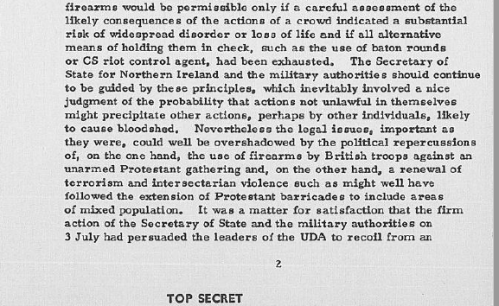
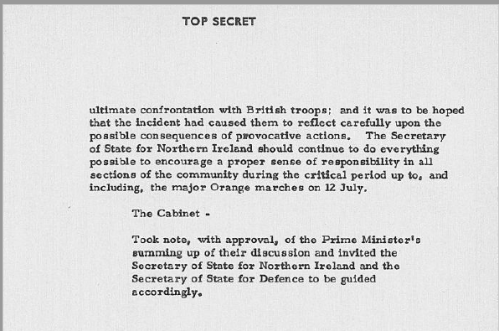
Some five months after British paratroopers killed fourteen unarmed civilians in Derry in January 1972, on what became known as Bloody Sunday, a British cabinet meeting authorised the use of firearms against ‘lawful gatherings’ where ‘serious breaches of the peace’ were liable but had not yet happened.

On one reading the Cabinet decision gave the green light to British troops to use firearms against civilians virtually at will. Arguably that policy had already been deployed in the Bogside in January that year.

The Cabinet meeting, which was held on July 6th 1972, at the start of a ceasefire called by the Provisional IRA, heard both Prime Minister Ted Heath, and NI Secretary William Whitelaw argue that there were circumstances in which troops could be, and were, authorised to open fire on unarmed civilians who were not, at that point, doing anything unlawful, but whose activities were judged to have potential consequences that might provoke others to engage in severe violence.

In other words if a gathering or meeting might lead to violence but hadn’t yet done so, troops could use firearms if no other methods were likely to succeed.

The same Cabinet meeting also expressed the hope that the DUP leader, Ian Paisley could emerge to give political leadership to the fledgling Ulster Defence Association (UDA), which was growing strong enough to impose a form of  ‘mob rule’ in Northern Ireland that ‘would paradoxically resemble in many respects an extreme left-wing regime’.

The background to the discussion of both issues at the Cabinet meeting was a series of confrontations organised by the UDA in protest at the British government’s refusal to dismantle barricades in Nationalist no-go areas, especially in Derry.

The largest and potentially the most volatile of these was at Ainsworth Avenue between the Shankill and Springfield Roads which saw the UDA mass hundreds of masked, uniformed and cudgel carrying supporters in a threat to extend Loyalist no-go areas into the neighbouring Catholic streets.

The confrontation was defused when the British Army negotiated a deal with the UDA which saw British troops and UDA members mounting joint patrols in the area. The British concern was that the UDA confrontations could lead to violence against Catholic civilians which in turn could endanger the IRA ceasefire.

Here is the British record of that Cabinet meeting:


Academic Withdraws Plagiarism Charge Against BBC’s ‘Troubles’ Series

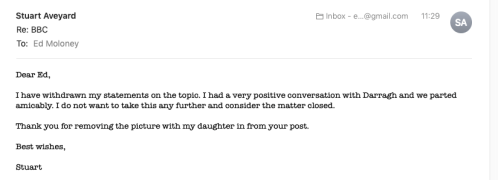
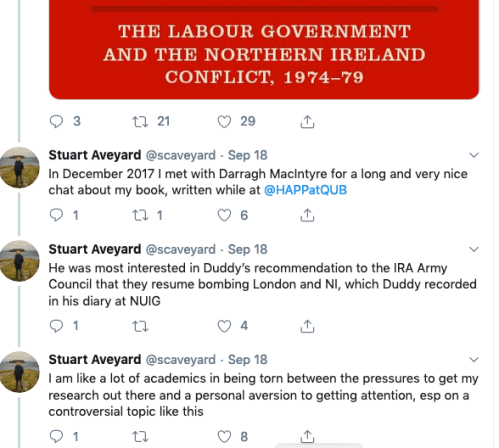
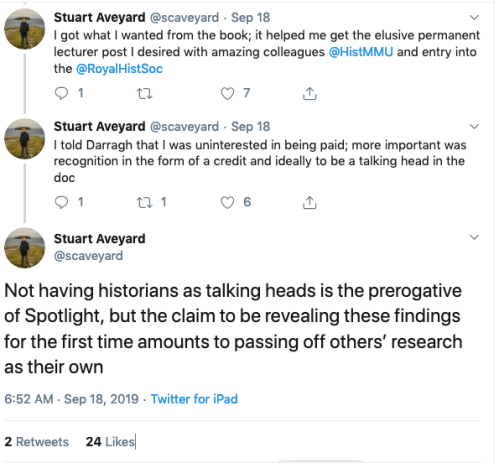
Stuart Aveyard, the academic historian who this week made a serious allegation of plagiarism against the BBC’s ‘A Secret History of the Troubles‘, television series – produced in Belfast by the Spotlight team – has withdrawn his claim following contact with the programme’s team in Belfast.

In a short email to thebrokenelbow.com, Aveyard wrote that following a discussion with Darragh MacIntyre, who presented the programme, he had decided to withdraw his claim:

MacIntyre also sent a detailed explanation of his dealings with Aveyard to thebrokenelbow.com in an email which was marked ‘Private and Confidential’. When asked if the email could be made public, and his explanation given a wider audience, he declined.


BBC ‘Troubles’ Series Hit With Plagiarism Charge

Having recently endured a somewhat similar experience with The New Yorker’s Patrick Keefe, over his account of the disappearance of Jean McConville, I have to say I feel deeply for ex-QUB academic, Stuart Aveyard over his complaint that his work was filched by the BBC for their headline-making series on the Troubles.

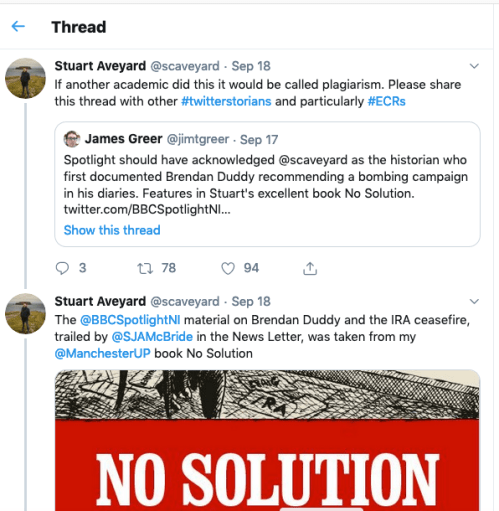
Aveyard researched diaries kept by Derry businessman Brendan Duddy who  played the role of intermediary between the IRA and the British during a mid-1970’s ceasefire, and discovered that Duddy had advised the IRA to intensify its economic bombing campaign so as to increase pressure on the British to deal with the IRA.

The discovery, which Aveyard wrote up in a book titled ‘No Solution’, casts doubt on Duddy’s carefully manicured image as an independent, unaligned man of peace who took no sides in the conflict, and it added significantly to what is known about this important phase in the Troubles.

But the revelations were presented on the BBC series to mark the 50th anniversary of the outbreak of the Troubles as the exclusive work of the ‘Spotlight’ team, headed by Jeremy Adams, when in fact Aveyard, who once worked at Queens University, Belfast had conducted the original research.

The BBC episode was headed up by Darragh MacIntyre who was assailed by Aveyard for plagiarism in a series of angry tweets on the internet.

While Aveyard’s accusations are hard to deflect, I have to say that I am also torn, because I like and admire Darragh MacIntyre. Nonetheless, when all is said and done, this was indisputably the theft of someone else’s work, it was wholly unwarranted but also I’d like to think, out of character.

Aveyard’s scholarship could have been properly credited, MacIntyre would have basked in reflective glory, and the BBC would still have had a scoop. Pressure from above, perhaps? Or worse still, bad judgement from above? Ormeau Avenue needs to explain and apologize to the academic. See tweets below:

Bad News For The Big Lad But A Good Day For The BBC

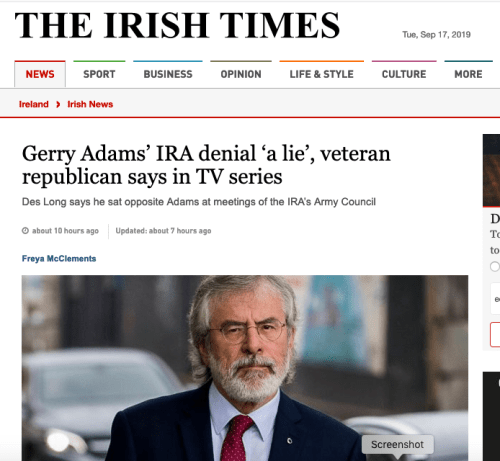
Des Long’s decision to call out Gerry Adams for lying about his membership of the IRA and revealing that he was at one point not just a member of the Army Council but its Chairman, comes at a bad time for the retired SF leader, but is good news for the BBC and for one of the production team involved in the TV series marking the 50th anniversary of the start of the Troubles.

Early next year, Adams’ legal team, headed by feared litigator Paul Tweed, will launch a libel action in the Dublin courts against BBC’s Spotlight current affairs programme and reporter Jennifer O’Leary, over a claim that Adams’ was defamed during a programme examining the assassination of IRA activist turned RUC Special Branch spy, Denis Donaldson.

Adams’ long time personal lawyer, the late Paddy McGrory always advised Adams never to sue over claims involving his alleged membership of the IRA on the grounds that there was too much evidence to the contrary and on the record, not least publicly available British documents dealing with the 1972 IRA ceasefire.

Paddy’s fear was that Adams would, as the alleged injured party, have to give evidence from the witness stand, his denials of IRA membership wouldn’t stand scrutiny and he would be judged a liar about everything else by most juries.

Now that a senior, former comrade has blown the whistle on him, Gerry could do worse than recall his old advisor’s sagacity.

As worrying for Adams is the possibility that Des Long’s candor will encourage others to follow suit.

The IRA And Sinn Fein During The Troubles

An academic view of the Provisionals during the Troubles. The author studied the subject from Canada and clearly comes from the controversy-free, mainstream academic school of thought:

The IRA and Sinn Féin during the Troubles:
two faces of the same organization

Arthur Nogacz
University of British Columbia
Political Science Department
The second half of the 20th century has seen many facets of republicanism in Ireland and Northern Ireland. It started with armed activism, which reached its violence peak in 1969-72, and then the decline of this approach and a heightened importance of political means. At all times, the Irish Republican Army (IRA) was at the center of the struggle.

On the political side was Sinn Féin, the Irish Republican Party. The IRA and Sinn Féin were founded at different times, and went through many formations, objectives and ideals before the 1950’s. Still, it was in the second half of the 1900’s that their differences diminished, and they became part of a unified nationalist front. From the early 50’s, the IRA and Sinn Féin, and later Provos and the new Sinn Féin, were under the same control, working as different branches of the same organization.
With the prominence of the IRA throughout the majority of the struggle, it is easy to assume that Sinn Féin was the secondary player in the relationship. Still, a shift of conscience and approach started in the second half of the 1970’s, and by the mid-1980’s Sinn Féin was a more reliable player than IRA itself, being an important political force in Northern Ireland politics. It gained power through the 80’s, which culminated into its acceptance into the peace process in the 1990’s. Sinn Féin reached its period of maximum influence until that point when it became a key player in the Belfast Agreement negotiations. It is safe to say that although the IRA and Sinn Féin saw their influence peak at different times, they were partners throughout the 30 years that led to the Good Friday Agreement, relying on each other as two branches of the Irish republican struggle.

The relationship before 1969

The Sinn Féin was founded in 1905 by Arthur Griffith (Laffan, 3). It had a nationalist purpose, to insert the “moral authority of the Irish nation” into the country’s politics (Griffith, 161). Its nationalist appeal was nothing new, as the Parliamentary Party (previously known as Home Rule Party) was the main nationalist group in Irish politics at the time (Laffan, 5).

The party’s rise to prominence and first contact with political violence came with the 1916 Easter Rising (Laffan, 43), organized by the Irish Volunteers, the organization that later became the Irish Republican Army (Durney, 8). Many Sinn Féin members were involved, and because of that the rebellion was dubbed by some “The Sinn Féin Rising” (Feeney, 56). After the insurrection, the party acknowledged its Republican ideals, and started advocating for the establishment of the Irish Republic.
The Republican movement grew quicly in the following years, and the Assembly of Ireland (Dáil Éireann) was established in 1918 by Sinn Féin MPs who were elected but did not take their seats in the British Parliament. The Volunteers became of official army of the republic, under the new name of Irish Republican Army. The IRA fought in the War of Independence until the Irish Government negotiated the 1921 Anglo-Irish Treaty.

The 1920’s saw internal splits in both Sinn Féin and IRA. The party did not support the treaty for it did not involve the whole of Ireland. Because of this, the pro-treaty side of the party split into the Cumann na nGaedheal in 1923 (Gallagher, 41). Sinn Féin members boycotted the Dáil, and did not take seats when elected. In 1926, the party leader Éamon de Valera led a group that was against the abstentionist policy, and created a new party, the Fianna Fáil. De Valera took most of Sinn Féin’s political influence with him (Coogan, 77-78), and over the next four decades, the biggest achievement Sinn Féin accomplished was to simply survive (Laffan 451).

The IRA also split after the war. The treaty was once more the issue at hand, and the anti-treaty side kept the name after the split in 1922. The next few decades were also mostly quiet for the IRA, until the second half of the 1950’s, which brought about many changes in the organization. One of these changes was the Border Campaign of 1956-62 (English, 73), which brought activity back to IRA. Another change was the increasing role of Marxism in the army. For a long time the IRA and to some extent Sinn Féin lacked a political theoretical base. In the early 1960’s a shift to the left was led by Roy Johnston, a member of both IRA and Sinn Féin. Johnston was the brain behind the National Liberation Strategy. This strategy called for catholic and protestant workers of Northern Ireland to fight under the same Republican banner, for a split within the workers’ ranks would only be good for capitalism. It also argued against the IRA to militarily defend one of the groups, which is one of the factors that would eventually lead to the 1969 split (Hanley and Millar).
In the mid-late 1950’s begins the connection between IRA and Sinn Féin that is studied by this essay. Although both organizations would suffer a split in 1969, the basis for the relationship started a decade earlier. It was in that period that the IRA decided to infiltrate and control Sinn Féin. This saw a growth of numbers in the party ranks, mostly by IRA members. The IRA gained control of the party by having Paddy McLogan, a long-time IRA commander, as the new leader of Sinn Féin (Laffan, 452). The party was a propaganda auxiliary of the IRA during the Border Campaign (Laffan, 452).

To say that 1969 was a major year for the Irish Nationalist struggle is an understatement. That was the year the Troubles started, with the Northern Ireland riots, and when the IRA split for the last time. Minor violence outbreaks were brewing earlier in the year. They were connected to the civil rights movement, which called for an end to the discrimination Catholics in Northern Ireland. In August, violence broke out throughout the country. The bigger riots were seen in Belfast, culminating in the death of 8 people, and the destruction of dozens of catholic families’ houses (Tonge, 39).

To this day the role of the IRA in the Riots is disputed. There seems to be an overall view that the IRA was poorly prepared to provide protection to the Catholic community and to republicans in general. Their supporters and part of their ranks blamed the IRA leadership for their unpreparedness (Report of Tribunal of Inquiry, no page), which eventually led to the split that took place in December of the same year.
The other factor that led to the split was abstentionism. Both IRA and Sinn Féin councils voted on the issue, but did not gain great majority (Laffan, 454). After that, the Provisional IRA stopped taking orders from Belfast. The same happened to Sinn Féin, which split between those who were to follow the official IRA, and those to follow the provisionals. After this point, the provisional Sinn Féin, which followed Provos, was a
completely different party. The only thing kept from the previous organization was its name (Laffan, 454).

Provos and the new Sinn Féin

The 1969 split generated two groups with different approaches. The Officials, also known as Red IRA, had their Leninist philosophy backed by heavy militarism. So much so that the excessive violence used by them between 1969 and 1972 put Sinn Féin’s political interests at risk (Patterson, 154). Provos had, at the time, a more lenient approach, which was not connected to communism. In 1972 the Officials saw much dissention within their membership, for big part did not want to keep the militarist streak going (Patterson, 158). It was at this point that Roy Johnston left the Red IRA for refusing to condone militarism, and joined the communist party. Soon the Officials would call for a ceasefire and stop its activities, at a time in which Provos was already the more supported organization, with the provisional Sinn Féin by its side.
The splits in 1969 and 1970 drew the PIRA and provisional Sinn Féin closer than ever before. They were both new organizations under a somewhat new leadership, but the IRA was clearly the leading figure at that point. The Provos council met before every Sinn Féin annual conference to direct future party activities (Laffen 456-6). The problem is that Sinn Féin was not very popular, and although nationalist talk did attract the Irish people, they were not ready to join the ranks and clearly support the cause (Bell, 49).

The 1970’s were the most violent period of the Troubles. After the Bloody Sunday incident of 1972, the Provisionals received a massive influx of new recruits. Because of that, Sinn Féin also saw a big growth in their ranks (Feeney 270-1). By 1973/4, Provos and the Provisional Sinn Féin were already regarded by the majority ofNorthern Irish people as the main body of the movement. To combat t hat, the opposing IRA and Sinn Féin made sure to be known as “the Officials”, but the strategy did not prove fruitful (Feeney, 252).

There was clearly much dissention among republicans in general over the means on how to lead the movement. Some believed violence was the only solution. Other saw that by 1972, after three years of intense conflict, nothing had really changed, and neither of the IRAs got their way. In this case, Sinn Féin was the connecting point for these people, as it gave them a political alternative to violence (Bell, 54).

By 1971, anti-imperialist talk was starting to take over the republican debate. Leaders of Provos and Sinn Féin were targeting Ireland as a whole, and supporting a unified country (Patterson, 155). Sinn Féin soon released its new policy, entitled Eire Nua, or New Ireland. Ó Brádaigh and Ó Conaill, the Dublin leadership of Sinn Féin, were the creators of the policy. It sought a federal all-Ireland republic (White). Although Eire Nua was proposed earlier in the decade, it still took a few years for it to gain the ideological and theoretical base needed to back it (Gallagher, 95).

The ceasefire of 1975 was the first time in which Sinn Féin had more exposition and a bigger role to play within the Republican struggle of the Troubles. The party gained significant importance in the community by setting up incident centers around Northern Ireland, so to communicate of any possible confrontation with the British officials (Taylor, 184). In addition to that, since the party was the organization that was currently representing the Republican struggle, the 1975 party’s Ard Fheis (high assembly), their annual conference, was used to call for a Republican policy which was actually IRA’s policy: British army should leave Northern Ireland, or the fighting would continue further (Feeney, 272). The ceasefire broke down in 1976 (Taylor, 156).

Although not officially, the leaderships of the IRA and Sinn Féin were at times in talks about a merger of the two organizations. In 1977, Seamus Towney, IRA’s chief of staff, was arrested in the possession of documents that detailed a possible merger and called for the party to come under the army at all levels by being radicalized and re-educated (Laffen 456-7). The merger ended up not occurring, but it opened ways for the start of the politicization of the struggle.

The late 1970’s were passing by, and the IRA was no closer to its objective of Irish unification. Republicans started to wonder whether bringing a stronger political facet to the organizations would not be beneficial. This process was accelerated with the 1981 hunger strikes (Laffen 457). The hunger strikes were at the end of five years-long protest against the British Government’s decision of abolishing the Special Category Status of political prisoners. This meant that paramilitary prisoners, mainly IRA activists, were to be treated as regular criminals rather than political ones (Malaugh, no page). During the strike, Bobby Sands, an imprisoned IRA member and hunger-striker was elected Member of Parliament. Sans ended up dying on strike, and for the first time, IRA was not connected only to murder, but also to martyrdom (Laffen 457). Over 100,000 people showed up to his funeral, in a matter of great national sympathy (English, 220). Sands’ seat was held, and the republicans gained two seats to the Dáil (Laffen, 457). From this moment on, republicans started to direct resources to electoral politics (O’Brien, 127), and contest all elections (Feeney 290).

The new strength of politics in the movement put the IRA and Sinn Féin on equal footing in the Republican struggle. A document released in the early 1980’s by the Sinn Féin Education Department states that “both the I.R.A. and Sinn Fein play different but convergent roles in the war of national liberation. The Irish Republican Army wages an armed campaign (…) (while) Sinn Féin maintains the propaganda war and is the public and political voice of the movement.” This translates the feelings of the leaders of both party and army after the success of the 1981 Hunger Strikes. The convergent importance of both military and political approaches was also famously mentioned by Danny Morrison, Sinn Féin’s publicity director, when he said the the 1981 Ard Fheis: “Who here really believes we can win the war through the ballot box? But will anyone here object if, with a ballot paper in this hand and an Armalite in the other, we take power in Ireland?”. This view became known as the Armalite and ballot box strategy, which shows the shift in activist republicanism from strictly military to equally political. 1983 saw the rise of Gerry Adams to the leadership of Sinn Féin, which started a period of growth in the importance given to electoral politics in the republican struggle and discussions over the abstentionist policy. Other than making gains in the Belfast City Council, Sinn Féin also elected Adams to Westminster with the party receiving over 100,000 votes (Murray and Tonge, 153). In that year’s Ard FheiI, the party voted positively on removing the ban on discussing abstentionism (Feeney 326). In 1985 a motion to end the policy failed, but in 1986, after the IRA had shown its support on lifting the ban, a new motion passed. This shows how important IRA’s input was to Sinn Féin.

The party was still careful on not generating a new split among its own ranks and IRA’s (Feeney, 331).

The late 1980’s and the beginning of the 1990’s were slow for the IRA. The peace process was talking over the national scene, and Sinn Féin’s new no-abstentionist policy was giving it more support around the country. In 1994 IRA called for a ceasefire, which was supposed to be held if Sinn Féin gained access to the peace negotiations (Tonge, 168). By this point, peace talks had fully taken over the lead from armed struggle, and Sinn Féin was trying to present itself as a regular party. Now that the party looked less like a front for the IRA, support in Northern Ireland doubled (Laffen, 460).

IRA’s ceasefire was called off in 1996 when the British Government did not allow Sinn Féin into the negotiations on the basis that the IRA had not yet surrendered its weapons. A quick wave of violence followed, with the Manchester and Dockland bombings. Soon Tony Blair’s Labour government allowed Sinn Féin into the negotiations on the sole basis of a ceasefire (Murray and Tonge, 193-4), which was called again in early 1997.

The Good Friday Agreement, which devolved partial governmental autonomy to Northern Ireland, was reached in April 1998. The ceasefire called by the IRA in 1997 still stands today, and Sinn Féin’s political influence grew enormously ever since. As of 2010, Sinn Féin is the second largest party in the Northern Ireland Assembly, and the second in Northern Ireland in number of seats in the British Parliament.

Conclusion

The thirty years of Troubles that culminated in the Belfast Agreement saw a very interesting partnership between the Provisional Irish Republican Army and Sinn Féin. The partnership started before 1969-70, with the organizations’ predecessors, but became clear and ideologically proximate after the splits. Although Gerry Adams, Sinn Féin’s leader, claims that the connection between the two organizations was very small, and that he was never part of the Army, history tells a different story.
This remarkable relationship provided two fronts for the Irish Republican Struggle. In one hand the armed front, and on the other the political. These two separate but convergent fronts played different roles at different times in the Troubles. In the first 15 years the IRA was the leading organization, backed by many with its armed approach to republicanism. The latter 15 years saw a shift in the power structure, led mostly by the lack of advances made by the IRA. This shift saw the political side taking over the relationship, increasing its support base, and ending in the peace talks.

This paper traced the timeline of the evolution of the partnership between the IRA and Sinn Féin. The proximity between the two allows for the argument that instead of being two separate organizations, they were simply part of a two-tiered approach to Irish Republicanism, as two branches of the same structure walking hand in hand over time, complementing one another and achieving partial success in the end.

Sources
Adams, Gerry. Before the Dawn: An Autobiography . New York: William Morrow and Company, 1996.
Bell, J. Bowyer. The IRA, 1968-2000: Analysis of a Secret Army. 7; 7. Vol. Portland, OR; London: Frank Cass, 2000.
Bell, J. Bowyer. The Secret Army: The IRA. New Brunswick, N.J., U.S.A: Transaction Publishers, 1997.
Coogan, Tim Pat. The IRA. London: Harper Collins Publishers, 2000.
Durney, James. The Volunteer: Uniforms, Weapons and History of the Irish Republican Army 1913-1997. Gaul House, 2004.
Economic Resistance. Republican Lecture Series no. 7. Sinn Fein Education Department, 1984.
English, Richard. Armed Struggle: The History of the IRA. London: Macmillan, 2003.
Feeney, Brian. Sinn Féin: A Hundred Turbulent Years. Dublin: O’Brien Press, 2002.
Ferriter, Diarmaid. Ambiguous Republic: Ireland in the 1970s. London: Profile, 2012.
Gallagher, Michael, Ph.D. Political Parties in the Republic of Ireland. Manchester: Manchester University Press, 1985.
Griffith, Arthur. The Resurrection of Hungary: A Parallel for Ireland. Dublin: James Duffy : M.H. Gill & Son : Sealy, Bryers & Walker, 1904.
Hanley, Brian and Scott Millar. The Lost Revolution: The Story of the Official IRA and the Workers’ Party. Penguin, 2010. Laffan, Michael.
The Resurrection of Ireland: The Sinn Féin Party, 1916-1923. New York, N.Y; Cambridge: Cambridge University Press, 1999.
Melaugh, Martin. The Hunger Strike of 1981 – A Chronology of Main Events. CAIN: Conflict Archive on the Internet. Retrieved March 16, 2015 at < http://cain.ulst.ac.uk/events/hstrike/chronology.htm&gt;.
Murray, Gerard, and Jonathan Tonge. Sinn Féin and the SDLP: From Alienation to Participation. New York: Palgrave Macmillan, 2005.
O’Brien, Brendan. The Long War: The IRA and Sinn Féin, 1985 to Today. Dublin: The O’Brien Press, 1993.
Patterson, Henry. The Politics of Illusion: A Political History of the IRA. London: Serif, 1997.
Taylor, Peter. Provos: The IRA and Sinn Fein. London: Bloomsbury, 1997.
Tonge, Jonathan. Northern Ireland: Conflict and Change. New York; Harlow: Prentice Hall, 2002.
Treacy, Matt, and Ebrary Academic Complete (Canada) Subscription Collection. The IRA 1956-69: Rethinking the Republic. New York; Manchester: Manchester University Press, 2011.
Violence and Civil Disturbances in Northern Ireland in 1969 – Report of Tribunal of Inquiry. Her Majesty’s Stationery Office, 1972.
White, Robert W. Ruairí Ó Brádaigh: The Life and Politics of an Irish Revolutionary. Bloomington: Indiana University Press, 2006.

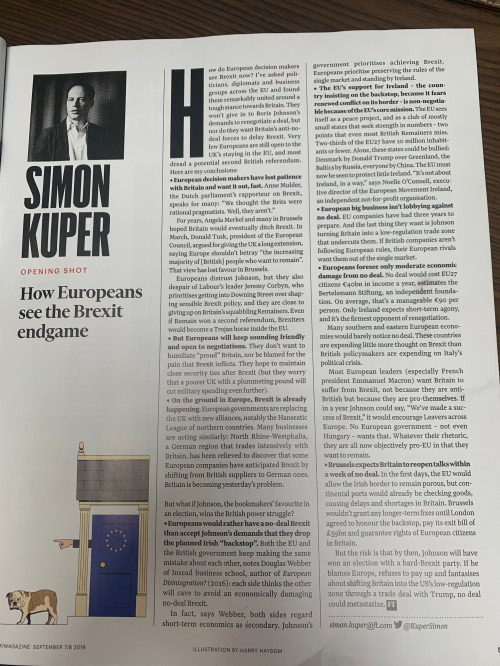
The Decline And Fall Of The British Empire, Part 25 (of 26)

Many thanks to HC for this tip-off. An interesting survey by Simon Kuper of The Financial Times of mainland European views on Brexit and the Brits. Not pleasant reading for BoJo and his merry band…..