At least in New York, where Democrat Senate leader, Chuck Shumer may face a primary challenge for his Senate seat, writes Mondoweiss founder Philip Weiss, from AOC who has called Israel ‘an apartheid state’, reflecting a growing grassroots anger at Israel’s treatment of Gaza in the Democratic Party.
The Belfast coroner today (May 11) ruled, in an historic verdict, that the ten people killed by paratroopers in Ballymurphy in August 1971 were innocents whose deaths had no justification. The ten died in the wake of an internment operation that was demanded by then Unionist premier, Brian Faulkner but opposed by the British Army’s top brass. Despite this opposition, the Generals’ soldiers then went on a rampage in the west Belfast housing estate. James Kinchin-White has dug deep into British files to find the evidence:
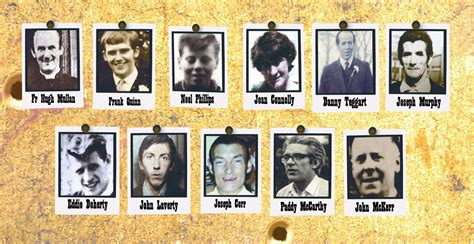
The ten Ballymurphy victims
On Tuesday 11 May 2021, when Coroner, Mrs Justice Siobhan Keegan presented her findings of the inquest into the death of ten people killed in Ballymurphy, Belfast between 9-11 August 1971, it was almost a half century since news first emerged of the shootings.
The events occurred during the first days after the introduction of Internment without trial which had been set to commence on the 10th of August 1971, but was moved forward 24hrs because the GOC feared there could be a leak from the RUC that would allow suspects to ‘escape across the border’.
The operation, code named Demetrius, involved the entire regular Army garrison in Northern Ireland, some 50 Companies of the part-time Ulster Defence Regiment (UDR) and members of the Royal Ulster Constabulary (RUC). The start time, known as H Hour in military parlance, was set for 0430hrs, 9th August 1971.
Between February and March there had been much discussion within the UK Cabinet about the use of such a measure even though the decision was legally devolved to the Northern Ireland parliament at Stormont. But, by 1971, as the security forces struggled to control civil disorder and inter-sectarian conflict the civil police force simply did not have the resources to mount an internment operation without the support of the Army. Indeed, if the operation was to proceed, the Army would require additional reinforcements of several battalions.
Thus, although Stormont had legitimate control over security policy, the Army was accountable to Westminster through the Ministry of Defence for the implementation of the policy. The Unionist Prime Minister, Brian Faulkner was, therefore, obliged to seek approval from Westminster for the use of military resources to support a civil police Internment operation.
Paratroopers in action in Belfast
Yet, in the first half of 1971, the UK government had their own problems. On the one hand, the Conservative government led by Edward (Ted) Heath, inherited a range of domestic labour and economic problems. But, at the same time, they were involved with the later stages of processing Britain’s application for entry into the European Community (EC). It is clear from Cabinet records, that PM Heath and his ministers were fearful of assuming greater responsibility for the administration of NI and at the same time, concerned about the impact, at home and abroad, that supporting Interment might have on the UK’s political reputation.
The UK was already a signatory to the European Convention on Human Rights (ECHR), but in order to proceed with internment, it would be necessary for the UK to derogate from the ECHR just at the point where it hoped to strengthen its ties with the European community. Consequently, Faulkner’s initial requests for Westminster’s approval to proceed with internment were declined.
Opposition to the proposal also came from the head of the Army, General Sir Michael Carver, Chief of the General Staff (CGS) and from Lieutenant General Sir Harry Tuzo, General Officer Commanding (GOC) Headquarters Northern Ireland (HQNI). Neither appears to have been against the idea of rounding up ‘hard core’ paramilitaries, and a range of preparations had been made should the Stormont proposal be accepted – but there had been no agreement on what to do with suspects after they were captured. Some headway was made to create hutted accommodation on the disused airfield at Long Kesh, but progress was delayed over arguments about funding. Carver and Tuzo were also concerned about the accuracy of the numbers of those identified by the RUC as candidates for detention – how many? And how did the police ‘arrive at these figures?’.
In the first week of August ’71, despite a deteriorating security situation with increasing shooting and bombing attacks by the IRA, the two senior soldiers reiterated their view that Internment could not be justified on military grounds. Nevertheless, on 5 August, Faulkner and his senior advisors, under mounting pressure from the Unionist party and the Protestant community, travelled to London to argue their case in a meeting at 10 Downing Street with the PM Heath, the Home Secretary, Reginald Maudling, and Foreign Secretary, Lord Carrington. The CGS and the GOC were invited to present their assessment, but the two soldiers were overruled though it was made clear that the decision to proceed ‘was a decision made by Stormont’.
British troops square up to a crowd in Ballymurphy
Despite their opposition, the CGS and GOC had ordered planning staff to prepare operational procedures to support such a decision if and when it was made. It would be on the backbone of existing military and police structures. HQNI’s three Army brigades, 39 Brigade (Belfast), 8 Brigade (Londonderry) and 19 Brigade (North Down and Armagh) had Tactical Areas of Responsibility (TAORs) closely defined on existing RUC police divisional boundaries. Operational orders were produced and units within each Brigade were issued with the same overall outline of the situation, their mission, and details of how their tasks would be executed:
SITUATION
The Provisional IRA believe that it is close to bringing down the STORMONT Govt. It has ordered a max effort – ‘one last great heave’ – to accomplish this. The Officials fear that the Provisionals may be successful and feel they cannot stand aloof in the final phase of militant terrorism and [exclude] themselves from the fruits of victory.
FRIENDLY FORCES
Sy [Security] Force activities over the past months have disrupted both factions of the IRA and isolated them from the [support] of the [general] public. Large scale sectarian rioting has been avoided but there is an increasing feeling of frustration and danger of Protestant backlash against the current campaign of bombing and shooting.
MISSION
To arrest, detain and [interrogate] those listed in the Detention Lists with a view to their internment.
EXECUTION
(1) General Outline: To seize simultaneously throughout NORTHERN IRELAND on D Day the max no [maximum number] of those on the Detention Lists. (2) A purely mil [military] op initially, assisted only by Special Branch (SB) and of which the other branches of the RUC are on no account to be aware at this stage. (3) Suspects are to be arrested, given not more than 20 mins to get dressed (under supervision) (6) Internment takes place in 3 stages: (a) Stage 1 – Arrest under Reg 10 of the Special Powers Act. Enquires carried out for 40 hours without further action. (b) Stage 2 – Detention under a detention order made by the STORMONT Govt. This is to be completed by the end of the first 48 hrs. (c) Stage 3 – Internment under a further order of the STORMONT Govt.
The Authority to arrest was provided to soldiers based on various regulations contained in The Civil Authorities (Special Powers) Act (Northern Ireland) 1922. In the 19 Brigade area, responsible for County Armagh, there were 141 names on the Detention List. Information included first and last name, date of birth, address, and occupation – information that would, due to its detail, appear to have been collated from either a census or electoral register rather than from police or military intelligence. There was also a list of 57 vehicles, complete with registration numbers, that were said to be ‘associated with the personalities in the target list – perhaps drawn from the NI vehicle licencing authority.
OPERATION LINKLATER
Described by 19 Brigade as a ‘Disruption Operation’, ‘Linklater’ was the code name given to a series of search operations designed to ‘disrupt the IRA’ while ‘providing reassurance’ to the public. A soldier who served with 2 Para in Ballymurphy during the period, has told the author that ‘Linklater’ was a ‘deception’ operation to allow his battalion to identify who lived in the housing estates in his battalion area so that relevant occupants can be added to the Internment lists so they can be questioned, basically, about their neighbours.
Relatives grieve at the funeral of a Ballymurphy victim
2 Para had begun their NI Emergency Tour on 22 April 1971 attached to 8 Brigade, Londonderry. They were redeployed to 39 Brigade in Belfast on 4 June where they were assigned to the South West Belfast TAOR that included the Ballymurphy estate. The 2 Para Post Tour Report provides some insights into the situation in which they found themselves:
On Intelligence: This is of the utmost importance and is at present poor. Any effort given to collecting information cannot be wasted. The urban terrorist who looks exactly the same as the remainder of the population can only be intercepted by luck or by previous information of his intentions.
On Operations: During all operations the importance of variety and deception cannot be overstressed.
It would seem then, that there are grounds for asserting that given the strategic level lack of faith in the Internment lists provided via the RUC/SB (which appear to have been based on extant socio-political data), and the absence of intelligence experienced by units on the ground, it is likely that operation Linklater was a deception device used to provide Army units with details about local residential occupancy. This information was then used to legitimize the detention of innocent people whom they could subject to interrogation in order to get low-level or corroborative information about suspects who lived in the area.
In doing so, the Army effectively created the firestorm of protest that followed the illegitimate arrest of many ordinary people, and in doing so were clearly culpable for creating the circumstances in which innocent people were gunned down and killed.
POSTCRIPT
At around 1:55pm today (GMT), the Coroner announced that all ten of the Ballymurphy victims who died between 9-11 August 1971 were innocent people, adding that there was no justification for their killing. Mrs Justice Keegan added that none of the deaths were properly investigated at the time.
Official IRA leader, Joe McCann was shot dead in his native Markets area of Belfast in April 1972 by paratroopers who were operating in a military environment in which regimental leaders were chafing at the rules set out for using deadly force against both IRA’s.
The Royal Anglian regiment was well known in West Belfast in the early 1970’s for their readiness to pull the trigger. In this extract from a document produced after one tour in that area, known as a post-tour report, dated August 19, 1972, the 1st Batt Royal Anglians admitted that only two per cent of the over 1800 bullets they had fired on their tour hit their intended target:
As the death toll from Army gunfire like that described above increased, and as Nationalist accusations of carelessness or malevolence rose in tandem, the military authorities introduced the Yellow Card which outlined the circumstances in which soldiers could open fire. But it wasn’t long before military units began to balk at the restrictions, limited though they were, on when soldiers could fatal shots.
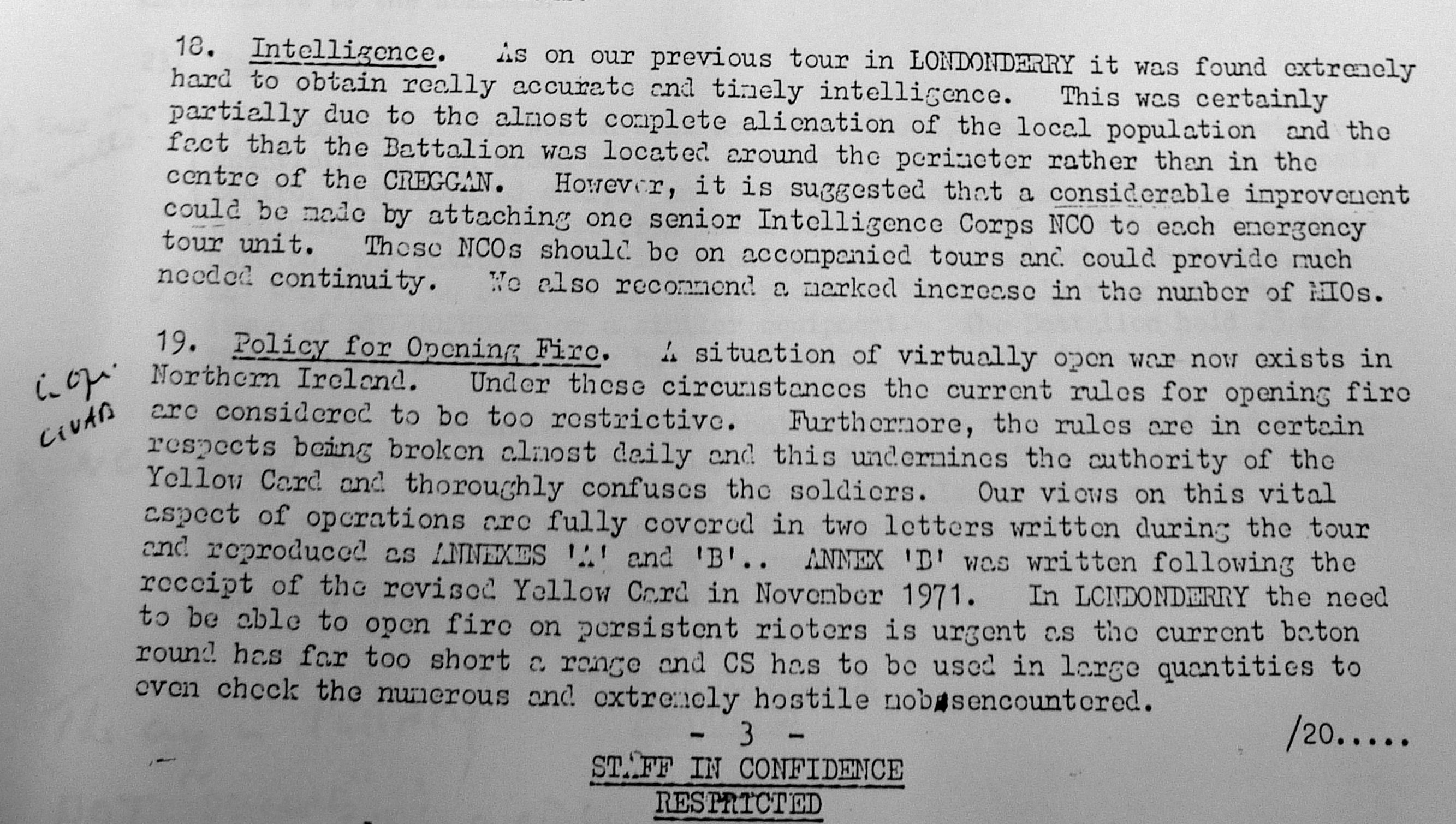
Here is an extract from a post-tour report of Derry’s Creggan district from the Coldstream Guards (the guys who wear those furry hats outside Buckingham Palace) admitting that the Yellow Card rules were being broken ‘almost daily’, undermining the Yellow Card’s authority and confusing the soldiers. The regiment also wanted to use live rounds on rioters because the rubber bullets did not have adequate range and instead CS gas had to be used:
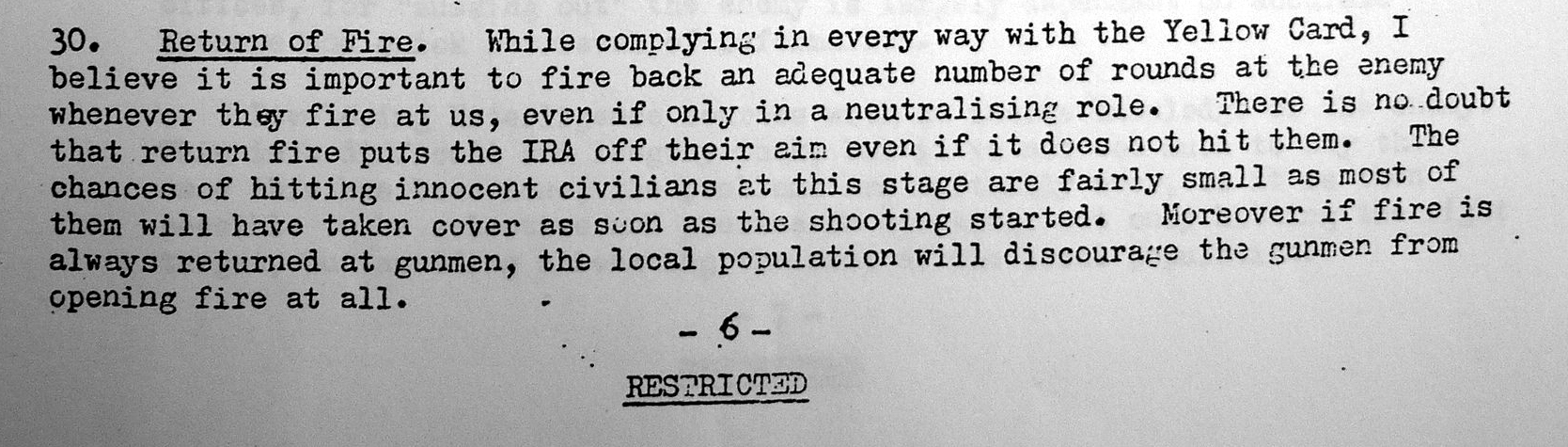
The 3rd Battalion Royal Green Jackets insisted, Yellow Card restrictions notwithstanding, that it was ‘important’ that soldiers be allowed to fire an ‘adequate’ number of bullets back at IRA snipers since ‘return fire puts the IRA off its aim’, and the chances of hitting innocent civilians were ‘fairly small’ since they would have taken cover when the gunfire began. What that would mean in practice is not difficult to determine:
The Royal Green Jackets also wanted to ease the procedure of identifying IRA snipers through the so-called ‘crack and thump’ method. ‘Crack’ and ‘thump’ is a technique for estimating the location and range of shots being fired. It has to do with the ‘crack’ being the sound of the shot that travels faster than the bullet – the ‘thump’ is the sound of the bullet strike. There is a formula based on the number of seconds between the two that can help estimate the distance the fire is coming from. That is then visually related to the terrain to identify a possible location at the estimated distance.
So 3 RGJ, regarded as the most elite regiment in the British Army, wanted to fire many more shots than implied in the Yellow Card rules and to ease the rules governing the choice of targets:
More tomorrow on how the Army’s top brass worked assiduously to undermine the rules governing the use of fatal gunfire.
It was on May 26, 1971, in the British House of Commons, when the Minister of State for Defence, Lord Balneil rose to his feet to answer the Labour spokesman on Northern Ireland, Kevin McNamara. His precise words were: ‘….warning shots are not resorted to by the Army. When the Army opens fire it is at a target and is designed to kill’.
Here, from the document archive assembled by the Department of Foreign Affairs in Dublin, is the record of the exchange. The pertinent section is in the second paragraph from the end:
I didn’t notice the media giving much coverage to this comment from the judge at last week’s trial and acquittal of two British soldiers for the murder of OIRA leader Joe McCann in 1972 – although I may be wrong.
This is what the judge, James O’Hara said about how the authorities treated the soldiers in the aftermath of McCann’s death:
‘At that time, in fact until late 1973, an understanding was in place between the RUC and the Army whereby the RUC did not arrest and question, or even take witness statements from, soldiers involved in shootings such as this one. This appalling practice was designed, at least in part, to protect soldiers from being prosecuted and in very large measure it succeeded.’
Doesn’t that qualify in effect as a licence to kill? And a conspiracy to pervert the course of justice? Appropriately, the judge described the practice as ‘appalling’.
You can hear it on this link. The debate, involving Anthony McIntyre, Richard O’Rawe and Peter Taylor starts at 05:16 and ends at 43:00 minutes. Sinn Fein’s Tom Hartley declined to take part (the row gives a whole new meaning to his nickname, ‘Tombstone Tom’!). Enjoy, if that’s the word.
In the wake of the acquittal of two retired British soldiers in the 1972 killing of Official IRA leader, Joe McCann and amid speculation of an amnesty for British security forces involved in Troubles-related incidents, James Kinchin-White, examines the military background to McCann slaying.
(Note documents at the bottom of this piece)
THE SITUATION – HQNI
When Ted Heath read the Northern Ireland situation report (SITREP) for April 14th 1972, he would learn that eighteen explosions and fourteen shootings occurred during the previous 24 hours. Three of the bomb attacks occurred in Belfast causing extensive damage to property. However, a fourth device, in Corporation Street, was neutralized by a soldier using an 84mm Carl Gustav anti-tank weapon – the first time the recoiless rifle had been used for this purpose in NI. A busy day then, described in the SITREP as having endured ‘a comparatively high level of terrorism’ conducted by the IRA.
However, if Friday 14 April was considered a bad day, things would begin to get much worse in Belfast on Saturday morning. The Brigade Operations Room (Ops Rm) had recorded 108 incidents on Friday. By the end of Saturday, there were 178 new entries in the log book.
THE STRATEGIC POLITICAL BACKGROUND
By late 1971 the situation in NI was increasingly troublesome for a British PM whose personal and political aspirations were mostly focused on mainland Europe. At the fifth meeting of the secret Cabinet sub-committee on NI – known as GEN 47 – Edward Heath acknowledged that the situation in NI was jeopardizing both economic and defence policy as well as Britain’ts attempt to join the European Community (EC). What was needed, he argued, as a priority, was the ‘best reconciliation between conflicting considerations. But the first priority should be the defeat of the gunman by military means.
Between October 1971 and February 1972, GEN 47 began to consider arrangements for the government of NI in the event that direct rule from Westminster was unavoidable. On 7 March 72 the Heath government accepted that a purely military solution to the ‘troubles’ was not achievable. Home Secretary Reginald Maudling noted the dangers involved in taking a ‘political initiative’ (the term used to describe and disguise Westminster’s assumption of control in NI), but accepted these were outweighed by the consequences of doing nothing.
By 14 March the Cabinet were in agreement that at the very least, Westminster would assume responsibility for law and order in Northern Ireland.
In due course, the proposals were rejected by the Unionist prime minister, Brian Falkner, and his cabinet and, on 28 March 1972, Stormont was formally prorogued and Westminster assumed full responsibility for the North’s government and administration.
HQNI DIVISIONAL OBJECTIVE
At the end of the first quarter of 1972, General Mike Carver, the head of the British Army or Chief of the General Staff (CGS), to give him his formal title, discussed the ‘desirability’ of attempting to ‘wean the Provisional IRA’ away from the Official IRA (OIRA), with the purpose of concentrating all efforts against the Officials. If, he continued, the OIRA could be discredited, isolated and disarmed, it would leave the security forces free to try the same tactics on the Provisionals, albeit at a slower pace.
Earlier, Carver had reported to Cabinet that the balance of IRA forces was shifting in favour of the Officials with their reduced emphasis on Marxism but increased tendency for militancy. This, he suggested, ‘reflected changes in the leadership’ of the Officials.
INTELLIGENCE
As Westminster moved closer to assuming responsibility for the government of Northern Ireland, the Joint Intelligence Committee (JIC) produced a ‘sombre’ assessment of likely reactions in Ireland. IRA strength in Belfast was estimated as 220 PIRA and 135 OIRA, but morale was low. It was further estimated that around 230 members of both factions were ‘on the run’ in the Republic. According to a 39 Brigade Intelligence Summary (INTSUM) for the period 5-11 April 1972, Joe McCann and nine other named members of Belfast’s OIRA, were believed to be among those ‘on the run’ living in the town of Omeath just inside the Republic.
THE TACTICAL SITUATION – 39th INFANTRY BRIGADE
The first major incident notified to 39 Brigade on 15 April occurred at around 0730hrs in the Ballymurphy area. A three-man plain clothes patrol from the Kings Own Scottish Borderers (KOSB) believed they identified two PIRA gunmen on the Whiterock Road. In the attempted arrest operation, both men – the Conway brothers – were shot, but turned out to be innocent civilians, victims of mistaken identity. (A full account is available on The Broken Elbow).
The incident would become one of the most controversial of the period and led to severe unrest among the Nationalist community. But it was the fatal shooting of Joe McCann at around three o’clock in the afternoon that attracted more attention. McCann had been shot by soldiers of the Parachute regiment who were operating under the command of 3rd Regiment Royal Horse Artillery (3RHA).
1 Para were the Brigade reserve battalion resident at Palace Barracks, Holywood. As the resident reserve, they were regularly required to augment the ‘emergency tour’ battalions operating in the city (emergency tours lasted for 4 months). It follows that the reserve troops would often operate in different places, possibly areas they were not familiar with. However, 1 Para had been reserve battalion for almost two years and would likely know the city reasonably well as they were within the final few weeks of a deployment that began on 21 September 1970.
Nevertheless, in an Assessment of the Operational Situation in March 1972, we learn that since the introduction of Internment in August 1971, the Army campaign against the IRA was based on ‘a major effort of attrition’ by 39 Brigade in Belfast. The tactics used in the two other brigade areas were, by contrast, based on ‘a containment’ operation.
THE RUC & SPECIAL BRANCH
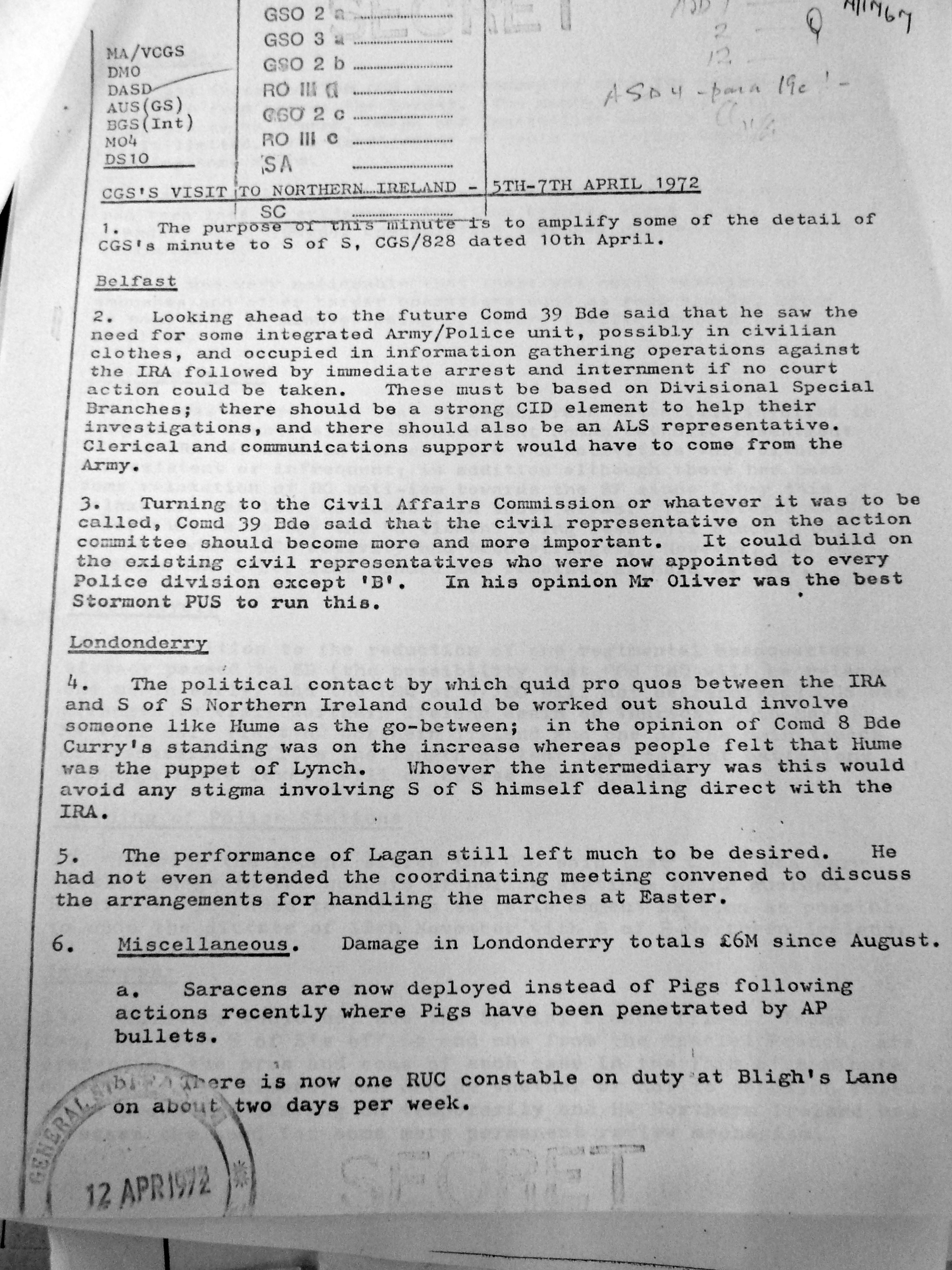
Following the report of the Hunt Committee (Oct 1969) the RUC became a non-retaliatory police service whose function was the preservation of law and order. Since the RUC was, at least in theory, a non-aggressive force, it required the consent and help of the general public to function. Where such consent and help are not present, the police required military support. It is from this premise that in any military concept of operations the Army was in support of the RUC. This statement is contradicted in a document produced in July 1972 which also reveals the extraordinary degree of uncertainty in government policy:
We consider that, under the extreme situation envisaged, the GOC should exercise operational control of the RUC for security operations. This would give him the power of direction over the Chief Constable, and D Int (Director of Intelligence) power of direction over Special Branch….We see no reason to change the GOC’s relationship with the new Governor from that existing at present with SSNI. However, we are not at all clear on the new position of SSNI, if indeed his Cabinet appointment is to continue.
The document makes an important distinction between the police, as ‘public’ servants independent of government, and Army personnel as ‘government’ servants. According to Graham Shillington, then RUC Chief Constable (CC):
The RUC in Belfast…is commanded by the Assistant CC (Belfast). Control is exercised through a sophisticated communications centre at Castlereagh. It is important however, to realize that, to a greater extent than is the case with the Army, the “man on the ground” has authority, and that the [Castlereagh] communications centre has a monitoring rather than command function. Every policeman is an independent law officer and is trained to use his own initiative.
Shillington’s statement (above) appears to be contradictory since ‘control is exercised through…Castlereagh, which has a monitoring rather than command function’. Nevertheless, on Special Branch (SB), Shillington’s report reveals its role is to collect and collate information about terrorists. But it is not concerned with taking criminals to court (that is a CID function). Liaison between SB and the Army is conducted through a Military Intelligence Officer (MIO) based at RUC Castlereagh and through Liaison Intelligence NCO’s (LINCOs) at RUC Divisional HQ’s where the Divisional Action Committee (DAC), chaired by the RUC divisional commander, is tasked with planning joint Army-RUC operations within the Division.
At the strategic level, Army-RUC relations were not good. In December 1971, the Chief of the General Staff provided a report on his recent visit to NI for the Secretary of State for Defence. On the RUC he said:
The force lacks leadership and direction and many of its senior officers are openly complaining of this. I suggest we appoint a Deputy Director of Operations (Police), who should be selected as a potential successor to the present Chief Constable (who should be given a ‘K’ in the Birthday Honours and in this way be encouraged to retire before too long).
Graham Shillington was knighted in the 1972 Birthday Honours list. He retired in November 1973.
It would appear then, that the circumstances leading to the death of Joe McCann on 15 April 1972, included either a planned or an opportunistic encounter between a two-man SB team traveling in the Markets area in an unmarked car, and a senior member of the Official IRA who had been believed to have been on the run.
Evidence found during the 2010 Historical Enquiries Team (HET) inquiry into the shooting indicates that the SB presence at the scene was indeed a simple coincidence. This evidence, attributed to an unknown RUC SB police officer was challenged during the trial due to its anonymity. But there are other factors that support this version of events and make it reasonable to assume that the entire incident developed from what was a routine a plain clothes police (SB) patrol, most likely tasked with gathering intelligence through observation. Moreover, HQNI had issued instructions that stated:
It is essential that all ranks know whenever members of the RUC are operating in their unit area in plain clothes…the RUC rules for opening fire when in civilian clothes are not as explicit as our own; basically, they only open fire in self-defence.
Precisely because the SB team found it necessary to ‘introduce’ themselves to what appears to have been an ad hoc military foot patrol there would, otherwise, have been no need for introductions if the MILOs, the LINCOs, the ACC, the DAC and Castlereagh’s sophisticated communications system were actually involved in a joint police and Army operation. No need for an ‘introduction’ if the Army had been aware, as they should have been, of the presence of a plain clothes RUC mobile patrol.
THE RULES OF ENGAGEMENT
Following the events of 30 January 1972 and in a preparatory response to the Widgery Report on Bloody Sunday, and on 10 April 1972, the CGS wrote:
Some damaging criticisms had been made about one individual soldier*, but it would be undesirable for the Ministry of Defence to institute disciplinary action. The MOD would let the Secretary of State for Northern Ireland have a brief on this case and on the orders contained in the Yellow Card including the reasons why it was not judged desirable for troops to fire warning shots.
Shooting training is directly linked to the rules of engagement and a special close quarter battle range was constructed at Hythe training area. However, this did not become available until January 1972 and was initially available for units about to be sent to NI. The soldiers involved in the McCann shooting had been in NI since September 1970.
In February 1972 the CO of 1st Battalion the Coldstream Guards submitted his NI Post Tour Report (PTR) to Army Strategic Command for the period 17 October 1971 to 18 February 1972. On the issue of ‘Policy for Opening Fire’ he had this to say:
A situation of virtually open war now exists in Northern Ireland. Under these circumstances the current rules for opening fire are considered to be too restrictive. Furthermore, the rules are in certain respects being broken almost daily and this undermines the authority of the Yellow Card and thoroughly confuses the soldiers.
The original Yellow Card at article 11, provides for circumstances in which a soldier may open fire against a person who, although they are not at present attacking, has ‘in your sight’, killed or seriously injured a person whom it is your duty to protect. As the conflict intensified and the Army began to take significant casualties, this statement was understood more as to apply when a soldier is informed that the suspect has killed or seriously injured a person and where there is no other way of stopping the suspect. The Army is not an ‘individual’ entity in the sense that ‘orders and information’ are conveyed during the battle, and the soldier is obliged to act according to the information he receives.
This Coldstream Guards statement was frequently reiterated in several PTR’s of the period. Although the PTR’s were not released by the MOD until October 2017, the authorities can hardly claim they were unaware of the issues nor of the opinion of senior tactical commanders.
THE SHOOTING
An RUC Liaison Officer informed HQNI that Joe McCann was pronounced dead on arrival at the Royal Victoria Hospital (RVH) at 1508hrs. He had been shot near the junction of Joy Street and Hamilton Street in the city’s Markets area. 39 Brigade had reported that he had been shot by soldiers from 1 Para who were conducting a random foot patrol. The report described McCann as the CO 1st Battalion Officials and that he had recently been said to be on the General Staff HQ Officials in Dublin.
Further information from 39 Brigade revealed that McCann was being followed by RUC SB and that the policemen had ‘made themselves known to the [1 Para] patrol’ before attempting to arrest McCann who then ran off. Eight shots were fired at him by the patrol and he died as a result of GSW (gun shot wound) to the stomach.
COMMAND & CONTROL (C2)
Following his appointment as Secretary of State for NI (SSNI), Willie Whitelaw arranged his initial working week in Belfast for Monday, Tuesday and Wednesday morning of each week, returning to London on Wednesday afternoon to participate in Thursdays cabinet meetings at Westminster
However, as a direct prelude to the assumption of responsibility for the government and administration of Northern Ireland by Westminster, control over the coordination of all security operations, including those conducted by or involving the RUC, was handed to the GOC NI with effect from 24 March 1972.
Nevertheless, the directive on the GOC’s changing job description, while restating the GOC’s responsibility to the Chief of the General Staff, also noted that the new Secretary of State (SSNI) was responsible for security policy and law and order. In effect, the SSNI had replaced Stormont authority, but in doing so did little to alter the dual responsibility of the GOC (previously Westminster and Stormont, now Westminster and the NIO).
SUMMARY
Despite the beliefs held by all concerned on 15 April 1972, neither the Conway brothers nor Joe McCann deserved to be shot. In a strict interpretation of the Rules of Engagement, none of the three men were armed, none posed an immediate threat and as far as can be determined, there were no witnesses able to identify them as having killed or seriously injured any other person. The criteria for opening fire had not been met.
Nevertheless, in both shootings, soldiers at the scene had been briefed over time to believe that the suspects they encountered that day had in fact been involved in the murder of fellow soldiers. In the Conways case, it was a simple case of mistaken identity. For Joe McCann on the other hand, he was a wanted man, with a ‘three star’ classification (most wanted) who was strongly believed to have been involved in the deaths of up to 13 members of the security forces.
There is little doubt however, that the chaotic circumstances revealed in this paper, represent a material contribution to the fate of the young republican leader. Culpability lies within the inadequate training arrangements for troops in those early years, with inadequate coordination, ineffective and ambiguous rules and a breakdown of established procedure.
A proper investigation conducted at the time of events would almost certainly have revealed these extraordinary circumstances where the Yellow Card, an instrument designed to ensure that culpability would always reside with the individual, was not fit for purpose – an outdated Colonial-ear instrument in which the only major difference was the colour of the paper.
The absurdity of Command-and-Control arrangements is best summed up with a comparison of the two events described in the paper. On the same day, during the same military campaign, in the same city, involving the same Army, the same regulations, the same structures and the same procedures, two things happened:
First, two innocent men were shot and wounded by a plain clothes Army patrol in West Belfast. Second, a young Republican leader, though unarmed, but suspected of involvement in several killings was confronted by a uniformed Army patrol, working in unplanned conjunction with two plain clothes Police officers, reacted to an immediate dilemma by opening fire, on a fleeing suspect resulting in his death.
Almost half a century later we now know that the leader of the plain-clothes Army patrol which shot the victims of mistaken identify was awarded the Military Cross. He was an officer.
Two of the three soldiers who opened fire on the IRA leader found themselves in Court charged with murder. They were just squaddies.
QUESTIONS
Elaborate Command and Control arrangements intended to manage operational relationships between the RUC and the Army were not invoked on the day of the shooting. Why not? Were soldiers aware of the ‘authority’ of SB officers? Did they react in relation to this ‘authority’?
Strategic level Command and Control arrangements were in a state of flux at the time of the shooting due to the assumption of responsibility for NI by Westminster. The newly appointed SSNI was not fully established in NI at the time of the shooting. The GOC had just been given added responsibility for the coordination of RUC involvement in security operations – had an effective handover taken place? Who was actually in charge?
The SSNI, William Whitelaw, appeared to interpret the rules of engagement in a similar manner to the soldiers when he apologised for the death of McCann, but stated ‘he should have been shot in the legs’.
Were the 1 Para patrol deployed by 1 Para or by 3 RHA? – all log entries on the shooting came to 39 Brigade from 3 RHA and to HQNI from 39 Brigade. Who briefed the patrol?
At the point of the shooting, who actually had ‘authority’?
There is only one way to settle the disputed claim over where Bobby Sands wanted to be buried. Sinn Fein has produced the text – but not a copy – of a ‘comm’ from the dead hunger striker saying that he was now content to be buried in Milltown. This was issued by a former low level SF press officer in the party’s Dublin office turned party councillor. That it was not issued by someone in the North, like Danny Morrison, who had daily interactions with Sands and other senior prisoners during the protest, may or may not be a matter of significance. There is only one way to settle the matter. Sinn Fein must a) produce the original comm and b) submit it to a reputable forensic expert who can accurately date the document. I notice that Sinn Fein are not disputing the claim, at least so far, that Sands’ wishes not to be buried in a shroud but in a blanket symbolic of his prison protest were apparently ignored.







 The Broken Elbow
You must be logged in to post a comment.