Boston College Archive

My apologies first of all to all and sundry for my lamentable absence from this blog. First I had horrendous problems with our internet connection and no sooner had they been fixed that I learned that someone in the British security set up had slapped subpoenas on the two participants in the IRA part of the paramilitary oral history archive I had helped to create at Boston College.

Needless to say this latter event has consumed a great deal of my time recently and because of legal constraints I am unable to say all that I would like to say. Suffice it for now to observe that this is yet another example of lazy policemen trying to live off other people’s work. The offence which they are seemingly interested in happened forty years ago and they showed as little interest in the event just after it happened as they did in the intervening years, despite the plethora of evidence and material to follow up that has been available for at least the last decade – and that doesn’t take into account the secret intelligence which was no doubt available on both sides of the Border.

But it is only now, after they learned of the possible existence of ready-made evidence that the police have chosen to move. If I came away with one conviction about the forces of law and order from all my years watching the police at work in Belfast, it was not that they were corrupt or politically biased, although there was never any shortage of evidence for both, it is that policemen are as work-shy and indolent as it possible to be.

In the meantime this recent item on Boston public television is well worth watching. It can be accessed here.

Osama Bin Laden & Pakistan – the Bernie Madoff Connection

With the White House daily changing key elements of its account of the killing of Osama Bin Laden – he turned out not to be armed, did not use his wife as a shield against Navy Seal bullets and she wasn’t killed (so it was always a shoot-to-kill mission and Osama was not a gutless coward) – it might be prudent to also take the charges of duplicity and double-dealing being leveled at Pakistan with a large spoonful of salt.

(UPDATE: The White House is now saying that there was no firefight in the house where Osama Bin Laden, a son and a courier were shot dead by commandos. The only shots fired at the soldiers came from another courier killed at a guest house elsewhere in the compound. It seems clear that even though the soldiers had only a 60-80% certainty that the Al Qaeda leader was hiding in the complex they were intent on killing everyone they encountered there.)

An old colleague from Northern Ireland, Toby Harnden, who wrote one of the best books yet on the IRA in South Armagh and is now the US editor of The Daily Telegraph, has listed ten questions about the operation in Abbottabad which he thinks throw doubt on the authorized explanation and instead support the theory that Bin Laden was betrayed by someone in his compound. The story put out by Obama’s people, the central feature of which was that months-long tracking of one of his couriers led to the Al Qaeda chief, is designed, Toby suggests, to throw everyone off the scent.

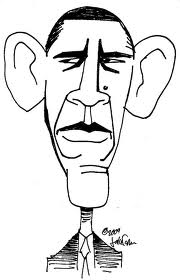
Obama and Osama

I’m not entirely persuaded. For instance he asks why Obama did not just blast the compound with missiles instead of mounting a risky helicopter assault? His answer is that it was done this way so the informer would live to spend the $25 million reward money.

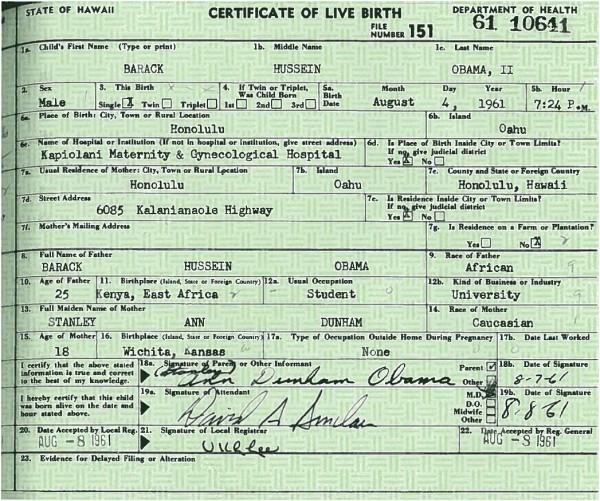
Well, if a source inside the compound was working for the Americans couldn’t they have warned him instead to arrange to be elsewhere at the time the missiles struck? And if missiles were used and the compound obliterated what proof would there be that Bin Laden was dead? It would be like Obama’s birth certificate all over again, but worse. There would be no office in Hawaii that could gallop to the rescue with the requisite long-form proof.

But I have had experience myself of this sort of intelligence trickery and feel that Toby’s questions are therefore worthy of consideration. Over the years I also have learned the wisdom of Izzy Stone’s old dictum: “All governments lie”.

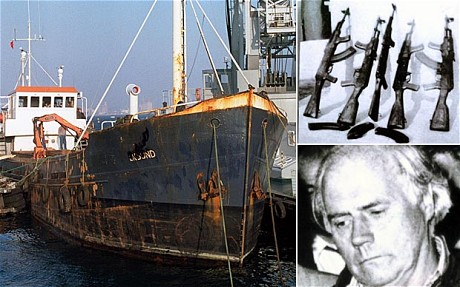
When the Libyan arms ship, the Eksund was captured off the French coast in 1987, stuffed to the gunwales with weapons for the IRA, the British put out the story that the discovery was entirely accidental. The Eksund’s rudder had malfunctioned, we were told, the boat drifted and attracted the suspicious attention of the French customs service which boarded the boat where, lo and behold, they discovered Gaddafi’s arsenal.

The Eksund at dock in France. The ship's captain Adrian Hopkins is pictured, bottom left

In fact we now know that the British had known about the Libyan smuggling operation for some time, tipped off at a senior level within the IRA and had been following the Eksund almost from the moment it left Tripoli harbor. The cover story was concocted – and likely the rudder sabotaged – to protect the British source inside the IRA.

The fact that Osama Bin Laden had been living under the noses of the Pakistani government in a lavishly protected compound within walking distance of the local equivalent of West Point or Sandhurst is being taken as evidence of the Pakistanis’ duplicity, pretending to be America’s ally while subsidizing the Taliban and turning a blind eye to Al Qaeda.

Toby asks this question, which implicitly suggests that the truth is otherwise:

The notion that the Pakistani government, or an important element of it, did not know about the raid strains credulity. Why send in helicopters, across Pakistani airspace and spend 38 minutes on the ground with the very real risk that Pakistani forces might suspect a terrorist attack and come and check it out? A highly possible outcome of such recklessness would be a firefight between SEALs and Pakistani troops or police.

Again there are holes in this hypothesis, two large ones in particular. The Americans could have kept the mission secret from the Pakistanis until the moment the helicopters landed, but once the commandos were in the compound they could have been informed and told to stay away. And since the Americans were in the compound for some forty minutes there was plenty of time to get that message through to the Pakistani authorities and therefore to obviate any risk of an armed clash between them.

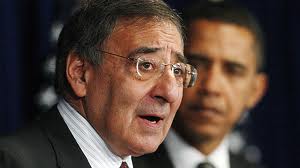
CIA chief Leon Panetta

The authorised version of the raid on the other hand, particularly that put about by CIA chief Leon Panetta, paints the Pakistan government as a feeble, untrustworthy but essentially helpless tool of the Americans, unable to prevent the US riding roughshod, John Wayne-style, over local sensitivities as the country’s national sovereignty and pride was sullied by American troops behaving as if they were in North Carolina and not on Pakistani soil.

Coming after Pakistan’s recent failure to bring an alleged CIA agent to justice for killing two of its citizens and the massive civilian death toll wreaked by Obama’s Predator Drones in the country’s border region with Afghanistan – events which have unsurprisingly angered many Pakistanis, especially those of a more fundamentalist Islamic bent – it seems that hiding Pakistan’s alleged co-operation with Washington in the way Toby suggests would actually cause the government much more trouble. Why do that when the effect could be to destabilize a secretly helpful ally?

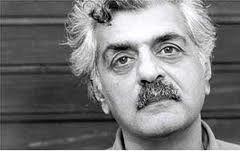
However, Toby is not the only commentator whose judgement I would respect to suggest that the Pakistanis may indeed have had a hand in Osama’s death. Tariq Ali, whose writings on his native land are always entertaining and informative (his family and social connections with Pakistan’s elite are impressive), had a piece in the London Review of Books earlier this week saying just that.

Tariq Ali

He wrote: “The only interesting question is who betrayed (Osama’s) whereabouts and why. The leak could only have come from the ISI and, if this is the case, which I’m convinced it is, then General Kayani, the military boss of the country, must have green-lighted the decision. What pressure was put on him will come out sooner or later.”

And he goes on to give what to me is the most believable explanation yet why Pakistan would want to shelter Bin Laden and keep his whereabout hidden from the Americans.

The event took me back to a conversation I had a few years ago.

In 2006 on my way back from Lahore I encountered an acquaintance from my youth. Shamefacedly he confessed that he was a senior intelligence officer on his way to a European conference to discuss better ways of combating terrorism. The following conversation…….ensued:

‘Is OBL still alive?’

He didn’t reply.

‘When you don’t reply,’ I said, ‘I’ll assume the answer is yes.’

I repeated the question.

He didn’t reply.

‘Do you know where he is?’

He burst out laughing.
‘I don’t, and even if I did, do you think I’d tell you?’

‘No, but I thought I’d ask anyway. Does anyone else know where he is?’

He shrugged his shoulders.

I insisted: ‘Nothing in our wonderful country is ever a secret. Someone must know.’

‘Three people know. Possibly four. You can guess who they are.’

I could.

‘And Washington?’

‘They don’t want him alive.’

‘And your boys can’t kill him?’

‘Listen friend, why should we kill the goose that lays the golden eggs?’

This makes a lot of sense. The Americans give the Pakistanis $3 billion every year, most of which goes to the military, at least ostensibly. They do that because of the threat posed by the Taliban and Al Qaeda. Kill or hand over Al Qaeda’s leader and the air might well go out of the Taliban’s balloon. If the war in Afghanistan diminishes or ends as a consequence then Pakistan can kiss goodbye to its annual US largesse and to the large slice that is likely creamed off the top. In a country where only a tiny percentage of the population pays income tax and the elite thrives on corruption and graft, giving Bin Laden to the Americans would be irrational.

But who knows whether any of this has any basis? Probably not, but experience has taught me to treat everything that is said or written in the immediate aftermath of events like the operation in Abbottabad with a healthy degree of scepticism. The full or proper truth about such matters always takes time to emerge, not least because there’s always someone whose interests would be threatened otherwise. How long did it take, for instance, for the full story of the IRA’s 1981 hunger strike to emerge and isn’t it striking, now that it has, how different that episode now looks?

At the same time there is something offensive about the superior way so many in the mainstream American media are dumping on the Pakistanis over the Bin Laden hideout, sneering patronizingly on cable TV shows that the authorities were bound to know given that Bin Laden was living in such a heavily guarded compound, so close to Pakistan’s West Point in a town so heavily populated with retired military types.

It is not that the logic is faulty. Those are valid reasons for suspecting that the heads of Pakistani intelligence knew all there was to know about the Bin Laden sanctuary and that he may have been living there under their protection. It’s more the near racist arrogance that is annoying, the assumption that of course such a thing would never happen in America, that a wrong-doer of such notoriety couldn’t possibly hide in plain sight in the US. It’s only in countries like Pakistan that such things happen and we all know why, nudge-nudge, wink-wink.

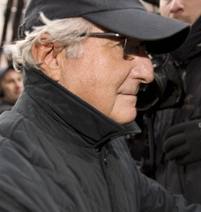
Except that’s not quite correct, is it? Remember Bernie Madoff, the Wall Street stock broker and hedge fund fraudster who operated a vast Ponzi scheme for the best part of forty years before he was caught. Admittedly he didn’t kill 3,000 people in a couple of hours or persuade his followers to fly planes into skyscrapers as Bin Laden did but he ruined and impoverished thousands of lives in a scam that cost some $50 billion, the most expensive swindle in American financial history.

So many people knew about Madoff’s fraud or strongly suspected it over the years yet nothing happened. Boston-based investor Harry Markopolos, for example, got onto Madoff‘s scam in the late 1990’s when he reverse engineered his financial performance and found such perfection to be an impossibility. He reported Madoff to the Securities and Exchange Commission, which supposedly regulates the financial markets five times between May 2000 and April 2008 but there was no follow up. Not a thing.

Major banks in Wall Street, like JPMorgan Chase strongly suspected something was badly amiss yet sat on their collective hands. “I am not a banker but I know that $100 billion going in and out of a bank account is something that should alert you to something”, Madoff told the Financial Times in a 2011 interview from prison. “JPMorgan got all the financial statements.”

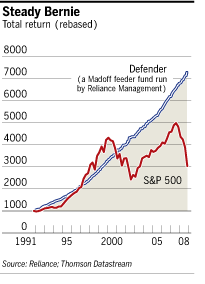
All any potential investor had to do was to compare Madoff’s performance against the markets to see that such staggeringly good results made no sense at

Madoff's performance is in blue, the S&P in red - an impossible perfection (click to enlarge)

all. The major Wall Street investment banks and derivative firms all avoided him like the plague because “they didn’t think his number were for real”. Madoff’s operation stank and the insiders all knew it.

And the reason Madoff survived, right in the heart of Wall Street, surrounded by Wall Street executives? Well basically the same reason, if Tariq Ali is correct, that the Pakistani military establishment covered up for Osama Bin Laden for so long. Too many people were making lots and lots of money out of him. Why kill or blow the whistle on the goose that lays all those beautiful golden eggs?

Libya and the West: Deja Vu All Over Again

By grotesque happenstance I had just finished re-reading Ruth First’s groundbreaking account of the Libya that was inherited and refashioned by Gaddafi – “Libya – The Elusive Revolution” – as news came through that NATO airstrikes, possibly the work of one of Barack Obama’s predator drones, had killed Gaddafi’s youngest son, Seif al-Arab and three of his grandchildren, all reportedly under twelve years of age.

Seif al-Arab Gaddafi, the youngest son of the Libyan leader and a victim of a NATO missile strike

And then I had just completed the first edit of this post when the news broke that Obama had killed Osama bin Laden at a compound not far from the Pakistan capital Islamabad, apparently with no foreknowledge on the part of the Pakistanis and with a degree of contempt for Pakistani sovereignty that can only serve to destabilise the government there and vindicate those who followed the al Qaeda leader’s violently anti-American gospel.

Imagine how Americans would react if Mexican special forces landed outside Los Angeles, invaded a compound to kill a cocaine king hiding out there, didn’t tell the FBI a word about their plans and afterwards, as jubilant Mexican crowds waved flags and cheered in downtown Mexico City, the country’s president went on TV to boast of the deed and house-trained Mexican journalists went on air to bad mouth American co-operation in the war against drug cartels. How long would the US government survive?

So my first thought was really a question: and they wonder why people hate them enough to fly planes into their skyscrapers? My second thought was, I confess, on the conspiratorial side. Was it possible, I wondered, that American military planners had hoped for a double whammy here, wipe out Gaddafi on Saturday and Osama on Sunday to send a message of US military hegemony throughout the Middle East and Muslim world? Who knows.

The effort to remove the Al Qaeda leader was clearly a spectacular success that will strengthen Obama’s chances of re-election in 2012 and weaken domestic opposition to his plans to cut back government spending on the poor and sick. The bid to kill Gaddafi didn’t however go at all as well.

If confirmation was needed that Western intervention in Libya is really about regime change, installing a more reliable pro-Western government in Tripoli and exacting revenge on Gaddafi for his years of troublemaking and much less about protecting rebellious civilians from the Libyan leader’s vengeful retribution this effort to liquidate him was surely it.

NATO has now denied that its forces deliberately singled out the Libyan leader and claimed instead that their target was a military one, a command and control centre housed in the same building. Gaddafi’s family was an incidental target according to this version, but there’s a distinct flavor of the Mandy Rice-Davies in that response: “They would say that, wouldn’t they?”

The UN resolution authorizing military action limits NATO to protecting civilians and does not permit regime change or assassination bids on the Libyan leader or his family. If NATO had admitted Gaddafi was the target the mission in Libya would have been rendered illegal, hence the need for what many will see as the plausible but unprovable lie.

But the leadership rhetoric and military thinking emanating from Washington, London and Paris has been increasingly focussed on the goal of killing Gaddafi or coming so close to doing so it would scare him out of office. Take as an example this quote from Admiral Mike Mullen, chairman of the US Joint Chiefs of Staff, given to Reuters just after the use of predators was authorized: “Ultimately, he said, ‘Gaddafi’s gotta go’, and coalition actions ‘are going to continue to put the squeeze on him until he’s gone.’”

This weekend’s assassination bid on Gaddafi is the second strike against the Libyan leader in a week. His compound in Tripoli was targeted in late April and an office where he and his aides sometimes worked was destroyed. Western determination to remove Gaddafi seems absolute and in sharp contrast to the mild response to the murderous repression of protesters in Syria, whose brutal government’s survival is in the interests of America’s ally, Israel, or in Bahrain, where Saudi concerns dictate almost complete American passivity in the face of that regime’s murderous crushing of its citizens.

Hardly surprising then that many will see that self-interest and hypocrisy more than consideration for her citizens’ democratic wellbeing characterize the West’s disposition to the Arab Awakening in Libya. But then as far as this North African State is concerned it was ever thus. Which brings me back to Ruth First and her examination of the Libya that Gaddafi and his fellow ‘Free Officers’ took over in September 1969.

I first came across “Libya – The Elusive Revolution” in 1975, just after I had spent two years living and teaching at the University of Tripoli. The country had a great effect upon me and intrigued by the little history and politics I had learned, I wanted to know more. But we were expatriates in a country whose people and media were, for language reasons, virtually inaccessible. Our view of Libya was, to say the least, opaque.

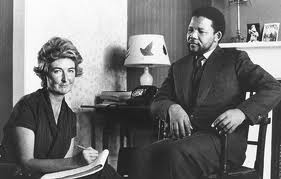
Ruth First and a young Nelson Mandela

Understandably the locals who did speak English, whether at the college or out at the farm where I lived, were very careful about what they said to foreigners and sometimes, as I learned on one occasion, with good reason. Consequently we had to rely on fellow expats for most of our information about Libya, Gaddafi and the politics of the place and a lot of that came filtered through ignorance, prejudice and plain stupidity.

So when I came across Ruth First’s account, which was published the year before I departed Libya, it was really an eye-opener. Much of what I had seen, heard or experienced while living there now made more sense and when I finally put her book down it was with a feeling of disappointment that I hadn’t known all this when I was living there, when it counted. The experience of life in Libya would have been richer.

But first a few words about Ruth First. Her parents were Latvian Jews who had emigrated to South Africa at the turn of the last century and they were founder members of the South African Communist Party. Ruth also joined the Party and at university in Witwatersrand she shared classes with a young Nelson Mandela and Eduardo Mondlane, a founder member of FRELIMO, the Mozambique liberation movement.

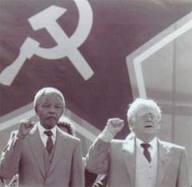
The South African Communist Party and the African National Congress went on to make an alliance against apartheid and together created the ANC’s military wing, Umkhonto we Sizwe, the Spear of the Nation. In 1949 Ruth First married a fellow Party member, the legendary Joe Slovo, the son of Jewish emigres from Lithuania who went on to become a leading light in the ANC (their union is a reminder of the progressive and radical tradition, pre-Israel, pre-1967, pre-neocons, pre-Bibi of so many Jewish political activists).

Joe Slovo and Nelson Mandela give a clenched fist salute under the hammer and sickle

Ruth First was immersed in anti-apartheid agitation and in 1963, when the South African authorities moved against and imprisoned ANC leaders such as Mandela, she was interned. After release she sought sanctuary abroad, mostly in Britain where she became an academic and latterly in Mozambique where she combined academic work with activism against apartheid.

In 1982 the South African police decided she was so much a thorn in their flesh that she had to die. A parcel bomb was sent to her office at the university in Maputo and she was killed instantly when she opened it. Her life story was made into a film, A World Apart which was written by her daughter Shawn Slovo. Another daughter, Gillian Slovo is a celebrated novelist.

Her study of Libya then is strongly influenced by her politics. Not in a propagandist way but by setting the country’s history and development against a background of the burgeoning Cold War, of Western colonial interests, both economic and strategic, which sometimes clashed and competed but often merged for mutually beneficial gain.

Not everyone will find this sort of approach readable or even acceptable. But in the case of Libya there really is very little choice because the place has been a plaything for foreign powers and interests for most of its existence and no attempt to understand Gaddafi or his present predicament is possible without knowing what is was that brought him to power.

The conditions that led to the coup that he and his fellow “Free” officers engineered have their direct roots in the politics of the Middle East and Cold War Europe in the aftermath of the Second World War.

Italy had succeeded the Ottoman Empire as Libya’s occupying power in 1911 and held the country until 1943 when the British defeated Rommel’s Afrika Corps at El Alamein. After the final German surrender the victorious allies, principally Britain, the US and France, with Italy accorded a bit player role, carved up the country in accordance with their Cold War and late colonial interests.

The Italian occupation of Libya was, as First described it, “the most severe….experienced by an Arab country in modern times” and this was especially so when Mussolini’s fascists came to power. Libya was deemed to be part of mainland Italy, as it virtually had been in the days of the Roman Empire, and ambitious plans were laid to resettle the country. Two hundred thousand hectares of land on arable coastal strip were confiscated and made available to some 90,000 Italian settlers who would, the plans envisaged, make up 10% of the population by 1938.

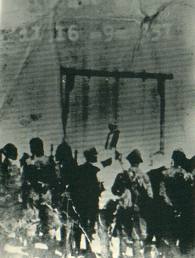
There was Libyan resistance to all this led by Omar Mukhtar, a Bedouin leader from the east of Libya, who fought a guerrilla war from desert oasis bases (and whose struggle was immortalized in the movie ‘Lion of the Desert’ starring Anthony Quinn). Italian reprisals were savage. Estimates of the number of Libyans killed

Omar Mukhtar, the Bedouin guerrilla leader was hanged by the Italians in 1931

by the Italians during the occupation range from 250,000 to 300,000 and this out of a population of no more than one million. Tens of thousands were imprisoned in concentration camps where they died of hunger and disease and between 1930 and 1931 alone, the Italians executed by hanging or firing squad 12,000 in the eastern province of Cyrenaica where, coincidentally, the current rebellion has its genesis.

It was really left to Britain and to a lesser extent France to shape Libya’s postwar fate. The Americans were players as well, but later in the game. Britain’s hold on Suez and therefore Egypt was weakening as the 1940’s came to an end. Egypt had gained nominal independence from Britain in 1922 and even though Egypt’s freedom to determine her own foreign policy was secured in 1936, Britain retained control of the Suez canal and therefore the flow of oil and commerce to and from the far east.

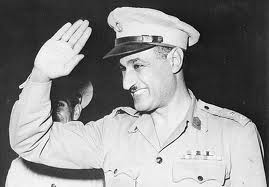
In the post-war years Egypt struck an even more assertive pose over Suez and growing but frustrated demands that it be returned entirely to Egyptian control helped fuel Nasser’s army officer-led revolution and overthrow of the monarchy in 1952. So having bases and influence in Libya, within striking distance of Suez at a time when Soviet influence in Nasser’s Egypt was on the rise was imperative to Britain.

Gamal Abdel Nasser, the Egyptian leader and role model for Gaddafi

France had its North and Central African colonies to worry about: Algeria, which shares a south-western border with Libya; Tunisia, to Libya’s immediate west and Chad and Niger (the latter subsequently found to be a rich source of uranium), both with borders in the deep south of Libya. France sought influence and a presence in the deep south of Libya, in the province known as Fezzan in large part to stem any possibility of rebellion or foreign challenge to her control of, or influence over these colonies or soon-to-be former colonies.

The immediate post-war years were the age of ‘The Big Four’ in global diplomacy. The Soviet Union, the United States, Britain and France each demanded a say in the shaping of the new world although in practice it was usually the Soviets versus the rest, as the Cold War imposed the new reality. Post-Nazi Germany had been carved up into zones of influence, one for each of the victorious allies, and the same approach was tried in Libya, the former colony of another Axis power, but with less success.

The Western allies were determined to deny the Soviet Union a foothold in North Africa and this sometimes led to comical about-turns. All the powers agreed that at some point Libya would have to be given independence; what was at issue is who would have the ear of Libya’s rulers when that day dawned.

At first the Americans, eager to gain friends and influence in post war Italy, suggested that Libya be returned to her former imperial master for a decade under United Nations trusteeship, after which she would be granted independence. But when the Italian Communist Party began to grow in strength and popularity and the Soviets, seeing a perfect chance to gain influence in Libya through a proxy, seconded that proposal the Americans quickly went into reverse gear.

After the Korean War erupted in 1950, the Pentagon began to realise that Libya had strategic value. As First put it: “United States military planners resolved that the bases in Libya were not only useful but indispensable….(and) would keep the Soviet Union out of the Mediterranean”. In the immediate post-war years the US had spent $100 million dollars on the airbase at Wheelus near Tripoli but then decided to run it down. When the Korean War began she again reversed gear and poured more money and men into the base, then America’s first airbase in Africa.

King Idris, in the years before Gaddafi's coup

But what to do with Libya? The nearest Libya had to a monarch was Muhammed Idris bin Muhammad al-Mahdi as-Senussi, better known as King Idris, although his influence really did not extend much beyond his capital in Benghazi. He was also the head of an Islamic religious sect known as the Sanusi. Both the British and the Italians recognized him as the Emir of Cyrenaica in 1920 and later as the Emir of Tripolitania but when the Italians launched a military offensive in 1922 he fled Libya and sought refuge in Egypt as Omar Mukhtar’s guerrilla war intensified. When the Second World War came to North Africa, Idris made an alliance with the British against the Axis and after Germany’s defeat their partnership survived and prospered as Idris sought London’s favors and protection, giving the British in return the greatest influence over Libya’s putative new ruler of all the Western allies.

In the context of contemporary events it is important to note that Idris was essentially the leader of a sect and tribe which had its base in Cyrenaica with its capital in Benghazi. His ties to the western part of Libya were weak. Even when Libya was made independent and Idris elevated to the throne he chose to live in a palace in Tobruk, close to the border with Egypt and almost as far away from Tripoli as it was possible to get. Over the years resistance to Gaddafi’s hold on Libya has often been financed or led by members or supporters of the Idris clan, the rebellion against Gaddafi that began last February had its genesis in Idris’

The flag of King Idris' Libya has been adopted by the antiGaddafi rebels

capital, Benghazi and the rebels have chosen as their flag, the standard of Idris’ Libya. They have also made alliance with the same Western powers who put and kept Idris on the throne. Coincidence perhaps, but interesting nonetheless.

It was the British in close alliance with the French who decided that independence for Libya was the best way to keep “the Russian camel’s nose out of the Libyan tent”, as Ruth First put it. To do that Libya’s future was handed nominally to the United Nations to decide and in 1949 a resolution was passed at the General Assembly granting independence which would come into effect as early as possible in 1952.

It was not anti-imperial fervor or concern that the Libyan people should enjoy the fruits of national self-determination which persuaded the United States to back Britain and France in this project but cold, hard self-interest in the ideological and political-cum-military war against the Soviet Union.

The State Department official in charge of the Libyan desk, and America’s first ambassador in Tripoli, Henry Serrano Villard, writing post facto, set out the rationale, quoted at length in First’s book:

It may be worth noting that if Libya has passed under any form of United Nations trusteeship, it would have been impossible for the Territory to play a part in the defence arrangements of the free world. Under the UN trusteeship system the administrator of a trust territory cannot establish military bases; only in the case of a strategic trusteeship as in the former Japanese islands of the Pacific are fortifications allowed; and a ‘strategic trusteeship’ is subject to veto in the Security Council.

(But) as an independent entity Libya could freely enter into treaties and arrangements with the Western powers looking towards the defence of the Mediterranean and North Africa. This is exactly what the Soviet Union feared and what Libya did. The strategic sector of African seacoast which had proved so important in the mechanized war of the desert was coming into its own as a place of equal importance in the air age.

So the British with American support chose the route to Libyan independence via the United Nations. The French, worried about Algeria and her other colonies, put up some resistance and preferred a plan to give the three provinces, Tripolitania, Cyrenaica and Fezzan independence at some unstated date far off in the future. First wrote: “(France) was still fearful of the chain reaction in North Africa to the establishment of a new independent state….” But the British and Americans got their way.

To the untutored eye it looked as if the victorious Western powers had, as those who had fought a war to defeat fascist tyranny were expected to do, agreed to bestow a generous measure of self-determination, a democratic form of government and even a constitutional monarchy based on the British model to this most sadly abused Arab state. But that was for public consumption and anti-Soviet propaganda. The reality was that Libyan independence was to be a sham and Idris would be a puppet of the British and, through them, the Americans.

The game was given away, much to the horror of the newly appointed UN Commissioner in Libya, Adrian Pelt, when it was discovered that the British had negotiated the terms of a defence treaty with Idris long before independence was a reality, a treaty that was technically illegal and likely to scandalize world opinion and hobble Idris’ government before it took office should it become public knowledge.

So Pelt secured the agreement of the British that they should defer formal agreement of the treaty and even pretend to start negotiations only after independence arrived, although a separate deal with Idris that was confined to Cyrenaica was already in place and served as a model for the wider treaty.

As Ruth First wrote: “Anglo-American policy saw Libya as less a country or state than a strategic position for a series of military bases.” Britain got unlimited, exclusive and uninterrupted use of Libyan territory for military aircraft, was allowed to base its Tenth Armoured Division in the country, had an air base south of Tobruk and an RAF detachment was stationed at Idris airport in Tripoli to facilitate the strategic air corridor to East Africa, the Indian Ocean and the Far East.

The agreement was to last, initially, for twenty years and could be renegotiated when it expired. In return Britain made a contribution to Idris’ budget. This was the crux of the arrangement. In the 1940’s and early 1950’s Libya was one of the poorest nations on earth, eighty per cent of its population were nomads and its largest industry was the recycling of scrap metal from tanks and artillery pieces abandoned by the Axis and allies in the desert during the Second World War. As the Chinese would say the deal between Idris and the British was “an unequal treaty”, a document the King had little choice but to sign.

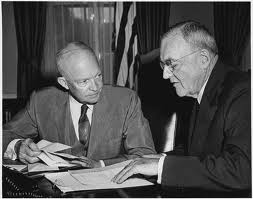
The Americans negotiated a similar arrangement for the use of the former Italian airbase at Wheelus outside Tripoli. Wheelus was integrated into Strategic Air Command and John Foster Dulles, Eisenhower’s fiercely anti-Communist

John Foster Dulles with Ike - flew to Libya to inspect America's new airbase

Secretary of State personally inspected the new acquisition which became a primary training base for NATO forces as well as providing American B-52 nuclear bombers access to southern Russia via Turkey and to key parts of Africa. In 1956 Wheelus became the headquarters of the Seventeenth Air Force.

Western interest in Libya was born out of a strategic necessity to confront the Soviet Union in the Mediterranean and the Middle East. With the development of intercontinental ballistic missile capacity, Libya’s value as a base for bombers diminished with the passage of time but in 1955 oil was discovered and quickly replaced defence as the focus of Western interests in this part of North Africa.

Nonetheless, Britain, America, France and in a minor way Italy all  had reason to regard Libya as a legitimate battleground in the historic conflict, ‘the great game’ against the Soviet Union and international Communism. But as the Western powers staked out their ground in Benghazi, Tripoli and Fezzan, the rest of the Arab world was throwing off the shackles of colonialism or embracing pan-nationalism in the struggle against Israel and her American ally and by so doing helped write King Idris’ death sentence.

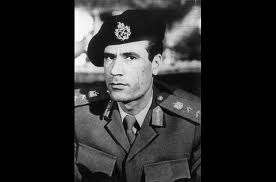
The young Gaddafi led the coup of 'Free' army officers against the pro-Western Idris regime

As Ruth First noted: “The price (of Libyan independence) was a state heavily committed to the West. This was to be the fundamental cause of the coup d’etat which overturned the monarchy” in 1969, a coup led by Muammar Gaddafi and his fellow “free” officers in the Libyan army. It is surely no accident that the same foreign forces, America, Britain, France and Italy have returned to extract their payback.

The American Right: A Case Study in Lunacy

You might remember back in January the political controversy that raged in the wake of the gun attack on Arizona Congresswoman Gabrielle Giffords at an open air constituency clinic outside a shopping mall in Tucson. Nineteen people were wounded by a lone gunman, Jared Loughner, six of whom were killed, the youngest a nine-year old girl, and afterwards there was a good deal of talk that he might have been inspired by right-wing, hate-filled hysteria of the sort available, and at that time reaching a new pitch of intensity on Fox News and talk radio.

There was some basis for this thinking. Loughner had made whacky anti-federal government statements of the sort popular in Tea Party and libertarian circles; attacks and threats against Democrats were ratcheting up (Giffords herself had warned in a TV interview of the consequences of such violent rhetoric) and mainstream figures like Sarah Palin, Rush Limbaugh and Fox’s Glenn Beck had been busy feeding the right-wing’s insatiable appetite for conspiracy theories and addiction to gun violence as the way to confound them.

But the prospect of having to confront the great unacknowledged reality of American life, that one of the two major political traditions in the country was significantly if not largely under the sway of nutballs and psychotics, horrified the mainstream media. After all, having to admit that Grandma might be going a little nutty is one thing but being obliged to concede that insanity is rampant on father’s side of your DNA is an entirely different matter.

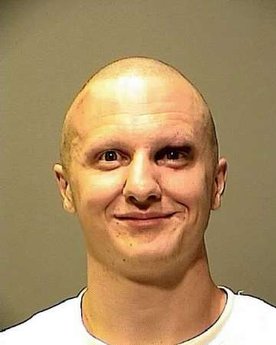
But not to worry. Deliverance was on its way and within a few days it arrived in the form of Jared Loughner’s mug shot which clearly showed that the gunman was as mad as a hatter. The sigh of relief from America’s newsrooms was almost audible. Loughner’s violence couldn’t have been political, they sang in chorus, because he was clearly, visibly insane.

Jared Loughner - so crazy he couldn't possibly be right-wing

No doubt about it. The guy was as loopy as they come. But that seemed to me to rather miss the point which is that Loughner was and is no less certifiable than much of the American right-wing. A philosophy that can see ‘death panels’ in proposals to extend health coverage to more people, that is convinced that Barack Obama is a Muslim Marxist, or that Sharia law is about to be imposed nationwide and that Al Qaeda is sending pregnant Muslim woman to America so their offspring can be reared as citizens and ‘sleeper’ human bombs – so-called ‘terror babies’ – is every bit as deranged as someone, like Loughner, who believes that the government uses mind control to brainwash people by controlling grammar.

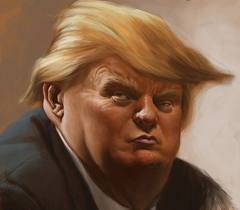
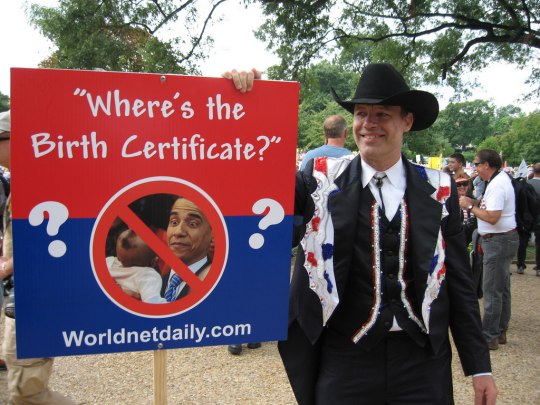
If more proof for this central, almost defining aspect of Conservative American politics is necessary it can be found by the bucket-load in the aftermath of Barack Obama’s decision to make his long-form birth certificate publicly available earlier this week. The birther phenomenon, the conviction that Obama was born in Kenya, is not a US citizen and therefore ineligible for the White House, is itself evidence of mental instability but the fact that the latest, and most shameless champion of this bit of lunacy, Donald Trump, was riding so high in the opinion polls indicates that political dementia in Conservative America is at epidemic proportions.

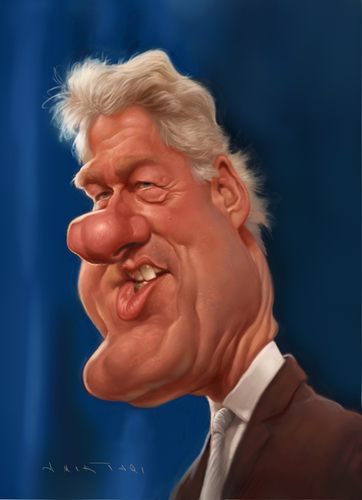
(While there can be little doubt that much of the birthers’ bile is fueled by racism and their irritation that an African-American sits in the Oval Office, it is worth bearing in mind that right-wing dementia of this sort first became visible during the presidency of Bill Clinton. Clinton was white and a good ol’ boy from the South, where the anti-Obama lunacy is strongest yet the right-wing leveled charges against Clinton that they have not dared to make against Obama – at least yet. The gravest accusation against Clinton was that he had been responsible for murdering as many as fifty people who might have been about to testify against him or his wife Hillary.)

One symptom of madness is the inability of the lunatic to recognize their own illness and so it is with the birthers. Their refusal to accept the evidence of Obama’s US citizenship, mirrored by the reluctance of mainstream Conservative politicians to bury the issue for once and all, was to be expected but it is only when you actually read what they are now saying that you can properly realise how truly and irredeemably mad these people are and, by extension, how malign are American politics.

Take for example this website, which calls itself “The Patriot Update – A Free Press for the Conservative Revolution”, a Tea party-inclined outfit by the look of it. It starts its coverage of Obama’s birth certificate by saying: “Of course we’d love to put this issue behind us and move onto the important issues facing our nation, but questions still remain.” Of course. And those questions?

Well first there is the fact that the certificate did not reveal the juicy and embarrassing details that followers of “The Patriot Update” expected, like Obama being a Muslim because his father was one, or him being misdescribed as “Caucasian” because his mother was one. The absence of all this is points to dirty work at the White House and an effort to buy time. As “The Patriot Update” put it: “….makes you wonder why this went on so long”.

And what could that reason possibly be? Well of course it was to give Obama the time and opportunity to fabricate the birth certificate. What else could it be? And the evidence? There’s three bits, and here they are:

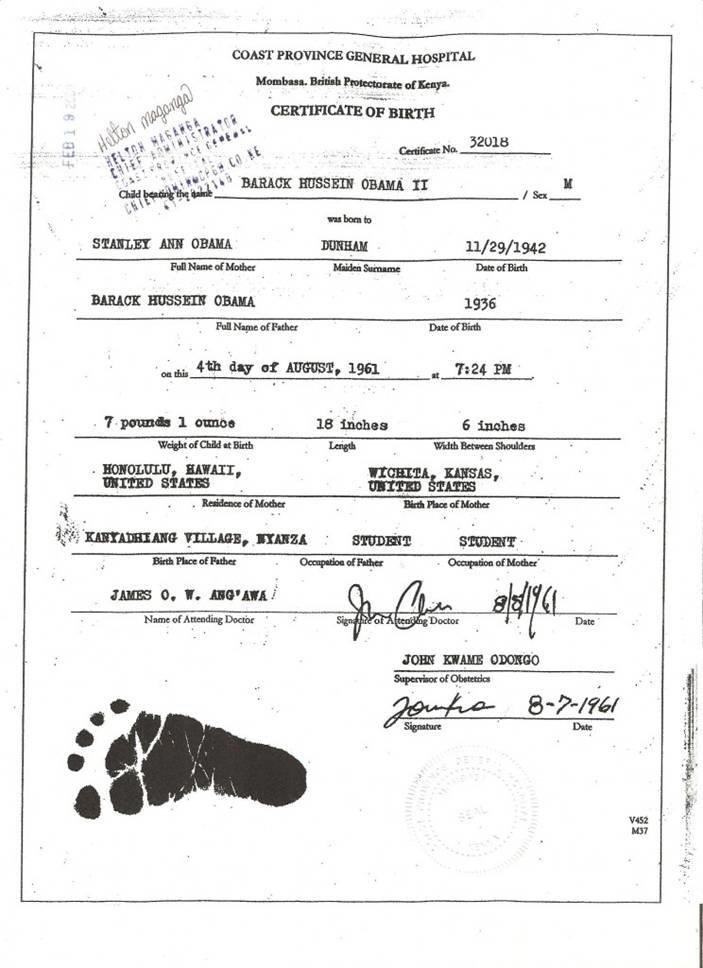
• Supposedly the original document was in a bound volume (as reflected by the curvature of the left hand side of the certificate), why is the green patterned background of the document’s safety paper seem to be so seamless?

• Why, if Obama was born on August 4, 1961, was the “Date Accepted by Local Reg.” four days later on August 8, 1961?

• The certificate says “African” for Obama’s father’s race when the term used in the 1960’s was “Negro”.

So there you are. No doubt about it, the birth certificate is a fake, Obama is an impostor, and America still faces the threat of ‘death panels’ and a Marxist Muslim plot to impose Sharia law.

Less than 24 hours after “The Patriot Update” posted all this nonsense, no less than 1,064 of its readers had left their comments, enough of them to remove any doubt at all that the only difference between them and Jared Loughner is that he went out and did what they only fantasize about doing. Here are some examples. Read them, remember that people like these nowadays dictate or profoundly shape the policies of America’s second largest political party, and weep.

Len says:

April 28, 2011 at 6:48 am

”We do not have time for this kind of silliness,” Obama said. “We’ve got better stuff to do. I’ve got better stuff to do. We’ve got big problems to solve.” THIS IS A GRAVE SECURITY ISSUE THAT THIS PRESIDENT AND MANY PEOPLE PLAYED DOWN, THAT WITH THE THREAT OF SHARIA LAW & MUSLIM BROTHERHOOD INFILTRATING POLITICS TO SUBVERT & OVERTHROW CONSTITUTIONAL LAW & GOVERNMENT, IT IS CRITICAL THAT WE HAVE CONSTITUTIONALLY A U.S. NATURAL BORN CITIZEN! What is the matter with us, where is our common sense? Where is the FBI, CIA, our Internal Security to investigate these things?

Obama's 'Kenyan birth certificate'

LD Gray says:

April 28, 2011 at 7:47 am

Is anyone going to prove the Kenyan birth certifate as being a “fake?” The Kenyan birth certificate has an ink impression of his foot – and the President of Kenya said construction of a monument of Obama is underway at Coast Provincial Hospital in Mombasa – where Obama’s Grandmother said she witnessed his birth. His mother was swimming in the ocean when she had cramps and went to Coastal. Check it out on Google: Coastal Providence hospital birthplace of obama -http://artemis360.com/obama/obamas-real-birthplace.php
– that is if Obama hasn’t had the site removed – you can view his Kenyan birth certificate and zoom in by clicking on it.

UncleRickets says:

April 28, 2011 at 8:30 am

The big O cannot be trusted. He says one thing and does another. Proclaims to be a Christian but says nothing of the Resurrection Day (Easter). This birth Certificate is not real. It is a fabrication. He wants to put this silliness behind him because people with resources (Trump) brought it up and he doesn’t want anyone with those resources digging any deeper. When this is all said and done we will have put a Muslim, Kenyan in the highest office of the United States. The reason Congress doesn’t want it to come out is that they would be the laughing stocks of the world. Actions speak louder than words. This president doesn’t act like an American!

JACK3889 says:

April 28, 2011 at 9:18 am

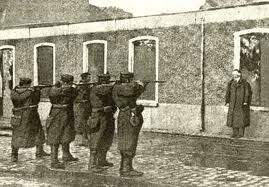
THE PENALTY FOR SUBVERSION AND TREASON IS DEATH FOR ALL COLLABORATORS. ANY VOLUNTEERS FOR THE FIRING SQUADS. LOL

PriklyPete says:

April 28, 2011 at 10:42 am

I’ll volunteer and furnish the bullets and guns!

Ron says:

April 28, 2011 at 12:42 pm

right on dude

Miss Vi says:

April 28, 2011 at 1:02 pm

Count me in – my guns are loaded!!

patriot4life says:

April 28, 2011 at 9:05 am

This MANCHURIAN SCUM BAG IS A TOTAL FRAUD!!..PERIOD!!. I HATE THIS MARXIST AND EVERYTHING HE STANDS FOR!!..PERIOD!!!!. HOW DID OUR AWESOME COUNTRY GET LIKE THIS WITHUOT COOPERATION FROM BOTH PARTIES ?.. THIS IS SICKENING!!… IMPEACH OBAMA NOW!!!!!.

Donna Eyman says:

April 28, 2011 at 11:49 am

Obama was born with the name Barry Soroeto, so this is definetely a fake. I am outraged that no one seems to be seeing this obvious play on our emotions. His pattern is totally unConstitutional so when are people going to start doing something about it and quite smiling and agreeing?

just myrtle says:

April 28, 2011 at 1:07 pm

It makes not the teeniest, weeniest difference what can be proved against this man, he is America’s King of Kings and he will remain just that. He is a liberal radical Muslim and he has a houseful of political radical liberal muslims to keep him where he is. Enough to have him impeached and tried for treason has already been proved and nothing has been done. There is only one thing that I know of that will stop him, “THE COMING OF JESUS CHRIST OUR SAVIOUR AND THE SON OF GOD”.These radical libersl do not believe in GOD AND HIS SON JESUS CHRIST but to all Christians there is no greater truth or power in the world.

Haters Gonna Hate says:

April 28, 2011 at 10:12 am

I know right, for some reason liberal candidates don’t seem to get scrutinized as harshly as their conservative counterparts. I mean when Bush was asked about his war record, he produced TONS of information, no more questions. The liberal a-holes need to go away. I wish we could hand our whole country over to the major US corporations who then could choose our congress and president. I bet they would get it right! And F..k panda bears, they are not American, quit funding the zoos! Zoos are are a major problem in the US, just in my city alone millions are spent on animals that don’t make money for any businesses, just there for amusement. First windmills are stopping the world from turning, now OBAMA is telling me to get a prostate exam, what next? God Bless Dick Cheney.

Mark says:

April 28, 2011 at 11:03 am

OK, so he finally released his birth certificate. He’s had over two years to hire someone to forge a document that looks real and even if it is, his eligibility is still in question. According to the Constitution, both parents have to be natural citizens of the U.S. His father was may have been naturalized, but was certainly not born here. This seems to be a point that everyone is missing and that’s why he’s taken so long to release it.

Dixie Lee Eubank says:

April 28, 2011 at 11:28 am

I just want to know if Obama think we’re all as stupid as he is. It’s got to be a fake. If not, then why the delay in showing it. Of course, I agree with a lot of the comments. We just need to get that man out of office and try to straighten out all the mess he’s made. His birth certificate is the least of our problems.
Don’t all of those people in Washington realize that all we would have to do, is get rid of Welfare, food stamps and send all the illegas back to were they came from and we would be a rich country. They have just let it get out of hand.

Libya and Gaza: Double Standards in Conflict Reporting at The New York Times

Hats off to The New York Times for being one of the first, if not the first, to report last Friday that Col. Gaddafi’s forces in Libya have been firing cluster bombs into residential neighborhoods of Misurata, the sole city in western Libya still in rebel hands, thereby escalating the possibility of major civilian carnage.

Deployment of the weapon, along with ground-to-ground rockets, represents a significant intensification in the two-month old crisis in Libya sparked by the so-called Arab Spring of democratic rebellions that have surged through the Middle East.

The Libyan uprising, however, is the only one of these insurrections that has seen direct Western military involvement and it was the apparent threat to civilian life of the sort reported this weekend by the NYTimes and other media outlets that brought that about. Following an allegedly bloodcurdling threat from Gaddafi in early March to exact revenge against the citizens of Benghazi, the eastern city that has been the epicenter of the revolt, the United Nations Security Council authorised the use of force to protect civilians.

Justifying US involvement in the NATO-led bombing campaign against Gaddafi’s forces that followed, President Barack Obama said: “If we waited one more day, Benghazi . . . could suffer a massacre that would have reverberated across the region and stained the conscience of the world.’’

Cluster bombs: a devastating weapon when used against civiians

Gaddafi’s use of cluster bombs clearly increases the danger to Libya’s civilian population. The munitions, which contain many smaller, shrapnel-packed bomblets are designed to shower wide areas with deadly explosives. On the battlefield they can cut down scores of soldiers at a time but in heavily populated urban neighborhoods the weapon can kill and maim on a massive scale. As The NYTimes put it, describing the deployment of the weapon along with rockets:

Both of these so-called indiscriminate weapons, which strike areas with a dense succession of high-explosive munitions, by their nature cannot be fired precisely. When fired into populated areas, they place civilians at grave risk.

The dangers were evident beside one of the impact craters on Friday (in Misurata), where eight people had been killed while standing in a bread-line. Where a crowd had assembled for food, bits of human flesh had been blasted against a cinder-block wall.

The NYTimes’ report came just as other media outlets, such as The Boston Globe, were beginning to offer a platform to more skeptical analyses of the rationale for war in Libya. These pointed out that not only did Gaddafi not threaten a civilian massacre in Benghazi – this claim was made instead by rebels – he had offered an amnesty to those who threw their weapons away and even offered rebels an escape route to Egypt. The use of cluster bombs, however, tilts the balance the other way, strengthening the view that Gaddafi is prepared to kill his own people in order to survive.

Nonetheless cynics will be suspicious about this report and its timing. After all, it comes as the Western-led effort in the oil-rich North African state is badly running out of steam and disagreements over tactics and strategy are rife amongst the NATO allies. Gaddafi has also taken advantage of confusion in his enemy’s camp and has forced the rebels to flee from eastern cities they had captured. With the rebels’ rag tag army once more on the run, NATO and its political leadership are facing a humiliating setback at the hands of one of the Arab world’s most eccentric leaders.

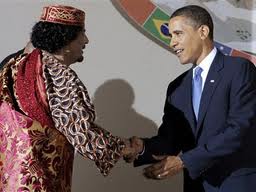
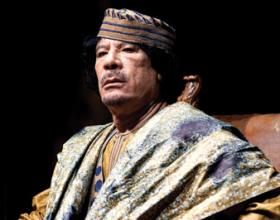
Gaddafi and Obama in happier days

By coincidence or not, the three Western leaders spearheading the NATO campaign, Barack Obama, Britain’s David Cameron and France’s Nicolas Sarkozy, put their names to an Op-Ed which appeared this weekend in major US and European newspapers that appeared to admit for the first time that the aim of the operation was now not just to protect civilian lives but to effect the ousting of the Libyan dictator.

Prior to this Obama, for one, was keen to rule out any charge that he and his allies planned to overthrow Gaddafi. “Broadening our military mission to include regime change would be a mistake”, he told the American public last month. It was a stance dictated by the knowledge that doing otherwise would not go down well in the Arab world. It was one thing to drop bombs on Arab cities in the name of humanitarian exigency, but, in the context of Bush’s war in Iraq, an entirely different matter when the goal was to get rid of a government. In the wake of a growing stalemate in Libya, however, that had changed. Now, the trio of war leaders said in their Op-Ed: “Colonel Gaddafi must go, and go for good”.

The cynic will say that the curtain has now been pulled aside to reveal the real motives behind the NATO campaign, for which the expression of humanitarian concern was a convenient cover. The real goal was to extract payback from an Arab leader who was a real thorn in the West’s flesh not that long ago, whether by cocking a snook at the Reagan White House, funding and arming groups like the IRA which came close to assassinating a British prime minister or stirring up trouble in a host of Arab and African countries whose leaders were allies of the West.

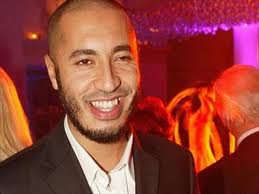
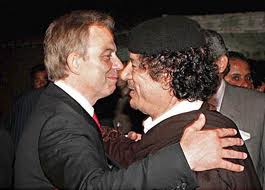
Muammar and Tony: the former British PM is on the payroll, says Gaddafis son, Saif

According to this scenario this was too good an opportunity to settle some old scores, notwithstanding Gaddafi’s humbling, not to say embarrassing efforts to ingratiate himself with the West in recent years (his new pals included Tony Blair, who was on the family payroll according to Gaddafi’s son Saif, and Silvio Berlusconi who is said to have got the idea of hosting his now infamous “bunga-bunga parties” from Gaddafi). That Libya also produces the highest grade oil of any Arab state and that the people who are slated to take over from Gaddafi will likely be grateful to the West in all the most suitable and appropriate ways is a bonus, and a big one at that.

Muammar and Silvio: Gaddafi "introduced Italian leader to bunga-bunga parties"

All of this may well be true but to suggest, as some might, that The New York Times story is therefore a very timely and convenient excuse for NATO to escalate the war against Gaddafi would be a good deal more credible if the story itself was dodgy and on the level of say Judith Miller’s notorious aluminum tubes report, a piece of fiction which helped the Bush White House raise the spectre of a nuclear-armed Saddam Hussein to justify the Iraq war while staining The NYTimes’ reputation, some say indelibly.

But that doesn’t seem to be the case. The NYTimes reporter, CJ Chivers was able to examine and photograph remnants of three mortars fired last week at Misurata, each filled with twenty-one “submunitions”, i.e. smaller bombs designed to kill people and penetrate armor. He was also able to trace the bombs to their Spanish manufacturer, Instalaza and quoted Human Rights Watch, the New York-based advocacy group which verified that cluster bombs were being used by the Libyan government forces.

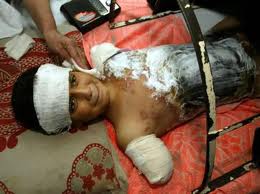
A young Iraqi victim of American cluster bombs

For good measure, Chivers noted that the United States is not amongst the countries who have signed a Convention barring their use, implying therefore that any attempt by America to make a human rights issue out of all this would sound hypocritical to say the least. (US forces also used the weapon in Iraq, causing sometimes terrible civilian casualties) He also spoke to eye witnesses who had been nearby when the cluster mortars landed and exploded. So all in all a solid, well-reported piece of journalism and an article of which The New York Times can be justifiably proud.

I mention all of this by way of contrast and the contrast is to the same paper’s coverage of the Israeli invasion of Gaza in December 2008 and January 2009, a military operation that was code named Operation Cast Lead and whose principal victims were also civilians. According to Palestinians sources quoted in the Goldstone Report between 1390 and 1440 people were killed by the Israeli Defence Forces (IDF) during that two or three week-long incursion and the vast majority, perhaps as many as 75 per cent, were ordinary, non-involved Gaza citizens. Over 100 women were killed and possibly as many as 350 of the fatalities were children. The Israelis have starkly different numbers which claim that the bulk of the dead were militants or combatants but have failed to produce evidence to back up their figures.

The civilian death toll was perhaps not on the same scale that Barack Obama seemed to suggest would have happened in Benghazi but for the intervention of the US and her allies but nonetheless it was large enough to suggest that the aim of the operation was less to punish the Hamas activists who were firing rockets into Israel and more to teach the population of Gaza a brutal lesson for voting Hamas into power and/or continuing to give them support.

The disparity between civilian and military casualties was large enough by itself to warrant the suspicion that this or something like it was the real mission goal and so was the choice of weaponry employed by the Israelis in Gaza’s packed, built up areas where the average population density is some 4,500 people per square kilometer.

The scale of civilian killings in Gaza was sufficiently large to inflame international public opinion and to oblige the United Nations to launch an investigation into Operation Cast Lead. The results of that investigation, the Goldstone Report, have damaged, possibly beyond repair, Israel’s already tarnished reputation for disrespecting the rights of Palestinian Arabs.

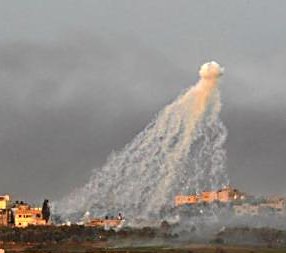
There is little doubt that the most controversial and disturbing weapon deployed in Gaza by Israel was white phosphorous (WP), a substance that is used conventionally to generate smoke and provide cover for troop movements. For that reason it is not a banned weapon. But using it in densely populated urban areas is an entirely different matter. Israel claimed it used WP legally, to give her soldiers a smokescreen but on the ground, in the tightly packed streets of Gaza it killed, maimed and terrified civilians.

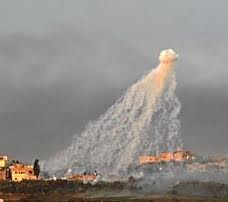
An unforgettable image of Israels incursion into Gaza: a white phosphorous shell explodes above a Palestinian neighborhood

WP is used in two ways. Encased into artillery shells, it can be fired at ground targets like normal ordnance or it can be fused to explode in mid-air, showering down multiple streams of deep-yellow colored phosphorous embers. The chemical ignites when exposed to oxygen and can only be doused, but not extinguished by a covering of dirt of sand.

The effect of white phosphorous raining down on Gaza’s civilian population was devastating. Doctors interviewed by the Goldstone team spoke of horrifying burn injuries to its victims. WP sticks to the flesh and will burn until all the phosphorous is exhausted. In some cases victims were treated only to return the next day with wounds that were smoking with remnants of WP still burning deep into tissue and sometimes into the bone.

Medical staff learned that the only effective way to treat WP victims was to cut away large portions of flesh around the affected area. Some had limbs amputated, others were burned to death. Although there is little doubt that many more Gazans were killed by conventional weapons the gruesome, indiscriminate cruelty of white phosphorous marked it out as a truly horrifying and repellant weapon.

This is what is like to be on the receiving end of a white phosphorous shell

The Goldstone team indicted Israel for its use of the weapon, saying it had breached Articles 18 and 19 of the Fourth Geneva Convention which declare hospitals off-limits during wartime and parts of Protocol One of the Convention, effectively saying that Israel had undertaken military operations while disregarding the consequences for civilians. The Convention bars the use of WP against civilians and while Goldstone didn’t charge Israel with deliberately flouting the law, the report did say that the IDF was “systematically reckless” in its use of the weapon in built-up areas. One member of the Goldstone mission, former Irish Army officer, Colonel Desmond Travers has estimated that some 3,500 white phosphorous shells, containing around 400,000 individual wedges of the chemical were fired by the IDF during the incursion of Gaza.

Specifically, Goldstone’s people found that WP shells had been fired at the United Nations Relief and Works Agency at a time when the UN complex was being used to shelter some 700 civilians – one shell landed near a large oil tank and disaster was averted only by brave and speedy action on the part of staff members – and that the same weapon had been used against two hospitals, the Al Quds in Gaza city and the Al Wafa in the east of the city. The Goldstone report also chronicled the case of the Abu Halima family, about whose harrowing fate it had this to say:

On 4 January 2009, the bombardment reportedly increased as Israeli troops moved into and took control of al-Atatra neighbourhood. The Abu Halima family was sheltering in the home of Muhammad Sa’ad Abu Halima and Sabah Abu Halima in Sifaya village. The house has two floors; the ground floor is used for storage and the living quarters are on the upper floor. According to Sabah Abu Halima, 16 members of her immediate family were sheltering on the upper floor.

In the afternoon, after hearing that a shell had hit the adjacent house of Sabah Abu Halima’s brother-in-law, most of the family moved from the bedroom into a hallway in the middle of the upper floor, where they thought they would be better protected. At around 4.30 p.m., a white phosphorous shell came through the ceiling into the room where they were sheltering.

According to family members who survived, there was intense fire and white smoke in the room, the walls of which were glowing red. Five members of the family died immediately or within a short period: Muhammad Sa’ad Abu Halima (aged 45) and four of his children, sons Abd al-Rahim Sa’ad (aged 14), Zaid (aged 12) and Hamza (aged 8), and daughter Shahid (aged 18 months). Muhammad Sa’ad and Abd al-Rahim Sa’ad were decapitated, the others burnt to death. Five members of the family escaped and suffered various degrees of burns: Sabah Abu Halima, her sons Youssef (aged 16) and Ali (aged 4), daughter-in-law Ghada (aged 21), and Ghada’s daughter Farah (aged 2).

One horrifying consequence of a white phosphorous attack

So how did The New York Times cover the deployment of white phosphorous by the IDF in Gaza? Again by way of contrast, the best way to start answering that question is perhaps to look at how one its European rivals covered the same story. The paper in question is The Times of London. Now this is a paper that is part of Rupert Murdoch’s stable and the people at The New York Times tend to look down their collective noses at anything published by News International. After all,  many of Murdoch’s publications do have a reputation for tabloid-like trashiness, a scant respect for the facts and little in the way of ethical standards: take a look, for instance, at the phone hacking scandal currently embroiling The News of the World in London.

Not all of Murdoch’s children are brats, however, and The Times can sometimes rise majestically to the occasion. Its coverage of Israel’s deployment of white phosphorous was one such instance. The paper’s first story appeared on January 5th under the headline ‘Israel rains fire on Gaza with phosphorous shells’ and two days later, on January 8th, followed that up with a story about the horrifying injuries caused by WP, while noting that the IDF’s official denials that the weapon was in use and identifying the shells as being of US origin: “There is also evidence that the rounds have injured Palestinian civilians, causing severe burns. The use of white phosphorous against civilians is prohibited under international law”. Another story on January 12th provided more detailed evidence of widespread civilian casualties caused by the weapon.

On January 15th, The Times reported that the UNWRA complex in Gaza had been hit by white phosphorous shells and that the UN General Secretary, Ban Ki-Moon had protested to the Israeli government (a counter claim by Israeli PM, Ehud Olmert that his forces had been forced to reply to Hamas attacks was not supported by Goldstone). It continued in terms that left little doubt the paper believed the Israelis to be liars: “The Israeli military has denied using white phosphorous shells in the Gaza offensive, although an investigation by The Times has revealed that dozens of Palestinians in Gaza have sustained serious injuries from the substance, which burns at extremely high temperatures.”

So how did The New York Times compare to its British equivalent? I did a search of the paper’s website and archive and trawled Lexis-Nexis for references in the paper to white phosphorous during Operation Cast Lead. In total there were just five reports and with the exception of the last article, filed after the Israelis had withdrawn from Gaza, the NYT’s references to WP were perfunctory, repeated IDF and Israeli government explanations for its use and made little if any mention of the death and injury caused to Gazan civilians.

The first was a story on January 11th by Ethan Bronner, the Jerusalem bureau chief for the NYT since March 2008. Although the subject had been well reported by The Times of London and other European newspapers up to a week beforehand, Bronner devoted just one sentence to WP in a report that led with Israel’s warnings to Gaza residents about a planned escalation of its incursion. Although Bronner also reported signs of growing international criticism of Israeli tactics and the dangers posed to Gazan civilians, the reference to WP was a meager one that carried echoes of the IDF’s line on its use. He wrote: “Human rights groups are also concerned about the Israeli use of white phosphorous, which creates smoke on a battlefield, at low altitudes or crowded areas, because it can burn like a kind of napalm.”

The second report came on January 16th, five days later and dealt with the shelling of the UNWRA complex. The article dwelt on Israeli doubts about the UN’s neutrality and complaints about its “institutional bias”, carried the IDF claim that its shelling was in response to Hamas fire and devoted just two paragraphs in a 1600 word article to the use of White Phosphorus.

Bylined Isabel Kershner, the story had this to say about the weapon:

Citing agency representatives who were present during the attack, Mr Gunness (a UNWRA spokesman) said three white phosphorous shells had hit the compound, causing fires that raged for hours, an allegation to which the Israeli military did not respond.

White phosphorous is a standard, legal weapon in armies, long used as a way to light up an area or to create a thick white smoke to obscure troop movements. While using it against civilians, or in an area where many civilians are likely to be affected, can be a violation of international law, Israel has denied using the substance improperly. On Wednesday, Hamas fired a phosphorous mortar shell into Israel, but no-one was hurt.

On January 22nd, the day after Israel withdrew from Gaza, The New York Times carried two pieces on WP, one by Ethan Bronner and Alan Cowell which reported that Israel had established a military investigation “to look into the issue” of alleged misuse of WP following allegations reported in what an IDF spokesman called “the foreign press”. It was the first admission by the paper that Israel’s use of white phosphorous had angered and incensed international opinion.

A second piece, solely by Ethan Bronner, finally put a human face to the consequences of white phosphorous use and reported on the ordeal of the Abu Halima family. Five members of the family, four children and their father, had perished in a WP attack over two weeks earlier and the incident had been widely reported, both in The Times of London and other European outlets, but it was only now that The New York Times was giving the story any coverage.

Ethan Bronner

Bronner quoted Sabah Abu Halima, the surviving widow, at length and also doctors who had treated survivors and had seen the horrific injuries up close. One doctor said that in a few cases the damage done by WP was so acute that “seemingly limited burns led to the patients’ deaths.” Sabah Abu Halima’s grief was so profound, she said she wanted to see Israel’s foreign minister and president “burn like my children burned”.

It was a good piece of reporting that well reflected the horrors visited upon Palestinian civilians by Israeli white phosphorous. But it came far too late, like the horse that bolted the stable. It also smacked of catch up by the Gray Lady, as if someone in the New York HQ had realized that the paper really ought to say something about the matter given the level of international concern over Israel’s behavior in Gaza. But by this stage the horse had galloped several fields away.

It could be said in the paper’s defense that The New York Times was hampered, as was all the media, by Israeli government restrictions on media access to the Gaza war zone. Reporters like Ethan Bronner and Isabel Kershner couldn’t actually report from the ground, could not see the evidence or lack thereof for themselves and couldn’t get to speak to victims like Sabah Abu Halima, much less look into her eyes as she voiced her allegations. All their reports, bar the second Bronner piece on January 22nd, carried the Jerusalem dateline. Only when the IDF had evacuated could Ethan Bronner get into Gaza to speak to Palestinians.

That all sounds reasonable except for one thing. Like the NYT, The Times of London’s reports were all datelined Jersualem and for its detailed coverage of events on the ground in Gaza the paper seemingly relied on local stringers. And it managed to report in considerable detail both the use of WP and the devastating injuries being caused. So what about The New York Times? Did the paper have someone on the ground in Gaza and if so, why didn’t its coverage match its English counterpart?

Well yes, the paper did have someone on the ground in Gaza. Her name was Taghreed El-Khodary, a Palestinian journalist and she was the paper’s local correspondent, able to go places and speak to people inaccessible to Bronner and Kershner. On January 19th, 2009, she featured in a lengthy readers’ Q&A session reported in the Lede blog on the NYT website where she was asked about evidence that she had seen about the use of WP. She replied, inter alia: “I could find evidence of the use of white phosphorus bombs……As a result, we wrote about the use of the phosphorus. Israel used white phosphorus in densely populated areas.”

Taghreed El-Khodary

Ms El-Khodary may well have written about white phosphorous but if so, her reports about its use, the evidence she had found and her assertion that the weapon was used in “densely populated areas” never appeared in her paper, at least no edition available in any archive that I could search.

In all of this, it may entirely be a coincidence that the NYT’s Jerusalem bureau chief Ethan Bronner has what many would see as a major conflict of interest. He is married to an Israeli citizen and his son is a soldier in the Israeli army. Philip Weiss in his Mondoweiss blog reported on The New York Times response when Bronner’s background became known: “When it broke the news last year, Electronic Intifada said that it was a conflict of interest; and the newspaper’s public editor concurred; he said that Bronner should be reassigned to some other beat. The Times’ executive editor, Bill Keller, has kept Bronner in Jerusalem, presumably hoping that the issue dies down and no one says anything about it.” (Taghreed El-Khodary resigned when the NYT refused to reassign Bronner and spoke of her “disappointment” at the paper’s decision). The NYT’s other Jerusalem-based correspondent Isabel Kershner is an Israeli citizen.

Perhaps it is unfair to suggest that such considerations would or could affect how a journalist covers a particular story or how a newspaper should regard his or her stories. But put it this way. If CJ Chivers was a Libyan citizen, or was married to one, and had a son who was fighting for the rebels in Benghazi and all this was known to the world, would The New York Times have been just as quick to publish his story about Gaddafi’s use of cluster bombs, just as confident that it could weather the inevitable controversy?

Martin McGuinness, Informers, the Media and Why Dissident Republicans Still Kill People

This is one of those weeks when I am glad to be in New York and not Belfast. I’ll explain why further down, but it’s not for the reasons that you think.

Last weekend, dissident republicans, i.e. anti-Provisional ones, killed a young member of the Police Service of Northern Ireland (PSNI) in Omagh, Co. Tyrone, using a bomb that was a standard IRA weapon when the Troubles were raging. It was nicknamed by those who developed and used the device ‘an up and under’, an appellation derived from the way it was placed.

Dissident IRA bomb killed policeman in Omagh, Co. Tyrone

An “up and under” was a small bomb, usually packed into a Tupperware-style container that was attached to the underside of a car, usually just beneath the driver’s seat, assuming the driver was the target, and designed to explode while the car was in motion.

It was affixed to the bodywork by a strong magnet and detonated by a mercury tilt switch, essentially a small tube partially filled with mercury that would flow from one end of the tube to the other, thereby completing an electrical circuit, whenever the car was driven on to a gradient.

Once it was flowing, the electric current would detonate a fuse which in turn would set off the main charge. It was the easiest device to place and it took just a few furtive moments to begin the process of hurling someone into eternity. All the bomber had to do was crouch down, slip the package underneath the car and then up into the seat well. Hence the nickname.

The Provisional IRA, whose resourceful engineering department devised this and many other weapons during the Troubles, used this sort of bomb repeatedly. Not only was it an effective weapon that invariably killed but it required little in the way of investment: a few ounces of explosive, some basic intelligence work, one person and a getaway car with driver. One additional bonus was that the hardest bit, placing the bomb, could be done in the middle of the night when the risks of being caught were minimal.

It also terrified those who were its potential targets, mainly RUC officers and members of the Ulster Defence Regiment but also politicians, judges, prosecutors and civil servants whose every day would have to begin with an undignified but possibly life-saving search of the underneath of their vehicles. The bomb was the ultimate psychological weapon, a constant reminder from the Provos to the security establishment that there was a war going on which might tomorrow morning claim their lives, or at least their legs.

Most the weapon’s victims were policemen or UDR soldiers killed as they drove to work in the mornings but there were more prominent casualties as well. John McMichael, the talented UDA leader, was one, killed in the driveway of his Lisburn,

John McMichael, the UDA commander killed by an IRA up and under" bomb

Co. Antrim home by an “up and under” device. His killing, it was widely believed at the time, was carried out by the IRA in retaliation for the assassination bid on Gerry Adams, shot as he was being driven through the centre of Belfast after a court appearance in March 1984.

McMichael was the UDA’s military commander at the time and since he was spotted scouting the courthouse a few minutes before Adams was ambushed, it was assumed, not unreasonably, that he had something to do with it. The Provos bided their time and killed McMichael in December 1987 over three years later.

The timing of McMichael’s death may also have had something to do with an internal inquiry he had launched into fellow UDA member Jim Craig who was

Jim Craig, UDA traitor killed by his own people

killed by his own people a year later. Craig was a UDA traitor and as corrupt as they come. He had been passing on information to the IRA and INLA for some time and was believed, for instance, to have told the IRA where they could best kill Lennie Murphy, the leader of the notorious Shankill Butchers gang who was gunned down by an IRA squad in 1982. Revenge for trying to kill Gerry Adams was certainly one motive for blowing McMichael to pieces but so was the desire to preserve a valuable asset in the UDA.

(The Adams’ shooting had an interesting sequel. The late Tommy Little, who some years later succeeded Andy Tyrie as Supreme Commander of the UDA, told

Tommy Little, learned about the 'top men's agreement'.

me that later on the day of the Adams’ shooting an angry Joe Haughey rang the UDA’s headquarters on the Newtownards Road demanding to know what had happened to ‘the top men’s agreement’. Haughey was an IRA leader from the Unity Flats area, incidentally, who was later charged with, but acquitted of killing Mary Travers, the daughter of Belfast magistrate Tom Travers a few weeks after the attempt on Adams’ life. So why was an IRA commander making angry phone calls to the guys who had just tried to kill his boss? How come he even had their number?

Tommy made some inquiries and discovered that ‘the top men’s agreement’ was just that, a deal between the leaders of the IRA, UDA and UVF that while their respective ‘grunts’ were fair game, none of their leaders would ever be touched. It apparently had been struck sometime in the mid-1970‘s when Belfast’s sectarian slaughter was at its height. Such were the ethical rules of Northern Ireland’s dirty little war: kill the other ranks whenever and wherever you can, but we officer-types are off-bounds! Anyway the Adams’ assassination effort marked the end of the ‘top men’s agreement’, although it is remarkable how many of the ‘top men’ nonetheless came through it all with nary a scrape.)

Gerry Adams (centre, wearing glasses) - John McMichael was killed in retaliation for bid on his life

UDA and IRA had 'top men's agreement' to safeguard their leaders from attack

Nor was the IRA the only republican organisation to use “up and under” bombs. Their most famous victim was the Tory MP, Airey Neave who was killed in 1979 when just such a device placed by the INLA exploded under his car as he was driving up the ramp from the underground car park at the House of Commons in Westminster. The bomb blew off both his legs and he died an hour later in hospital from massive

Airey Neave with Margaret Thatcher

shock and loss of blood. Neave had masterminded Margaret Thatcher’s successful bid for the leadership of the British Conservatives and was slated to be her NI Secretary, which would have been good news for Unionists since he was an avid supporter of their cause.

I mention all this to demonstrate that the sort of bomb which killed Ronan Kerr has been around for decades and there is absolutely nothing new or particularly innovative about their use. But what did I read in the following Monday’s Irish Times but this:

British and Irish security and intelligence sources are increasingly concerned at the technical capacity of dissident republican groups following Saturday’s murder of Constable Ronan Kerr in an under-car explosion in Co Tyrone.

They believe the dissidents are becoming increasingly sophisticated in their bomb-making capability, while the PSNI has described as ‘substantial’ the device that killed Constable Kerr, a 25-year-old Catholic, in Omagh.

The PSNI, Garda and MI5 fear the dissidents are using under-car bombs that are miniature and more difficult to detect.

Reading that brought me back with a jolt to the days when it was often my job to write up such incidents. My abiding memory of that time was that the media, both Irish and British, often felt free, some seemed compelled, to write the most exaggerated, loosely sourced nonsense about such events. The effect was to to paint groups like the IRA in the most lurid of colors so as to emphasize how utterly beyond the pale they were.

In more recent times, both pre and post the St Andrews’ Agreement, there has been a small industry working away with energy and skill to do the same sort of thing with the dissidents, except in their case it is to inflate the perceived threat that they represent.

Before the St Andrews’ Agreement it was mostly Sinn Fein who were in this business and from their viewpoint it made sense. The more they could persuade everyone that only they stood between a fragile peace and a return to the bad old days of the Troubles, the easier it was to extract political concessions from the British and Irish governments and the easier it was to persuade the authorities on both sides of the Border to turn a blind eye to their various, uh, money-raising ventures, like armed robberies and tiger kidnappings on the grounds that such things were necessary to keep the hard men happy and on board.

Post the St Andrews’ Agreement a number of groups have had a vested interest in over-egging the dissident pudding. Some, like this bunch of London-based neocons, are in the business worldwide and especially in the Middle East, of exaggerating terrorist threats but is it not hard to work out either that, in these straitened days, both the PSNI and MI5 have much to gain if we are all led to believe that the dissidents are really, really bad news.

The PSNI and MI5 are, in Northern Ireland, primarily in the anti-terrorist business so the more terrorists they make us think there are and the more fearsome they seem to be, the greater the amount of money, manpower, prestige and bureaucratic clout that will come their way. There are also those, in both these two organisations and in the wider political world, who hope that in such ways Sinn Fein might be persuaded to embrace its Four Courts moment and take the offensive against erstwhile comrades, an event that would, like its Dublin counterpart in 1922, finally seal the peace process beyond any doubt or chance of retreat.

Don’t get me wrong. I am not going the other way and minimising the threat posed by dissidents. Clearly they are capable of killing people. It’s just that compared to the Provos and what it was really like during the Troubles, even in the final years, the dissidents are a faint shadow, a mouse beside an elephant in comparison and they just don’t merit the hysterical, exaggeration-laden coverage of the last few days. I’ve seen reports, for instance, that the dissident groups have 600 members between them. In the name of God, that’s more than the Provos had in their ranks in the 1980’s when they nearly wiped our Mrs Thatcher’s entire Cabinet!

Nor am I necessarily getting over-exercised about the behaviour of the PSNI and MI5. It is an immutable law of organisations that they overstate the need for their own existence. In such ways not only do they get to keep their jobs but they get better and bigger ones. I don’t like nor approve of what they do, but neither am I surprised. And as for nudging the Provos to their Four Courts moment, what would you expect?

What really bugs me, and brought me back in this instance with a jolt to the days when I had to report similar events, is that it is no business of the media to indulge these organisations and interests in the way reflected in that Irish Times report. Of course, reporters must give an account of what such people have to say, making clear these are only claims, and balance the report by putting what happened in context. But no more than that.

To highlight what I am trying to say here, that Irish Times report could just as easily have read:

Dissident republicans kill first security force member in two whole years using booby trap bomb technology developed thirty years ago and inherited from Provisional IRA campaign. Security experts believe dissidents have sourced a supply of smaller Tupperware containers. Attack highlights patchy and fitful pattern of violent activity from dissident groups better noted for incompetence, political confusion and propensity to steal money sent from American sympathisers for prisoners’ families.

The reason why reports like the one in the Irish Times that I have just lampooned bug me is that I know that the reporters are fully aware of all this yet it doesn’t stop them. I can’t speak on a first-hand basis for the situation nowadays but when I used to observe this sort of reporting in situ, I was overwhelmingly aware of the real, albeit unspoken reason and I doubt if it has changed that much.

It was as if the journalists were saying:

OK, I strongly suspect we’re being fed mostly bullshit. But if I don’t go along with it I’ll be accused of not taking the threat seriously which means people might think that I secretly sympathise with those responsible because I don’t want to make them look bad. So rather than be labelled ‘a sneakin’ regarder’, I’ll go along with all the hyperbole and that way I’ll keep my job.

That sort of reasoning is part of what I call the Section 31 syndrome, a nasty leftover from the official censorship and its more insidious cousin, self-censorship that was ushered in by the Irish Republic’s broadcasting law of the 1970’s. The law forbad radio and television outlets from broadcasting the voices of members of certain proscribed groups. The IRA and SInn Fein were the principal targets but it had a chilling effect generally on coverage of the Troubles that lasted for many, many years.

The official censorship filtered into the print media and brought Ireland into an ice age of self-censorship that for many reporters was all about professional survival. Journalists were terrified of being labeled a fellow traveler of the IRA while timidity and mediocrity thrived. In my view Section 31 needlessly perpetuated the Troubles because it inhibited real understanding of what was going on. Simple reportage of the “Last night a bomb exploded….” variety almost entirely replaced efforts to explain what persuaded otherwise normal people to do things as extreme as planting the bombs.

The law was repealed at the outset of the peace process but the truth is that by that stage it was unnecessary to do such things by law; the media were perfectly capable of censoring themselves without any urging from the State. They still are and that this sort of behaviour lingers on in the coverage of bombings like that at the weekend is profoundly depressing and for me a reminder of why I was so happy to leave it all behind. And it’s why this week I’m glad I’m here and not there.

On a slightly different tack the killing of Ronan Kerr has brought the Provos a little closer to their Four Courts moment and that’s important because it helps to explain why the dissidents exist and are so intent on keeping a war alive that everyone else regards, correctly, as a lost cause.

The move came from Martin McGuinness who had these words to say to the media in the aftermath of the bomb:

I would say, and I am standing up to be counted, give the information to the police, give it to the Garda in the south if you have it, give it to the PSNI [Police Service of Northern Ireland] in the north.

My message is very, very simple: those who are perpetrating these acts, those who are killing our people, need to be apprehended.

These are people who are pledged to destroy the peace and destroy a peace process that many of us have invested much of our adult lives in trying to bring about.

That’s a step up from McGuinness’ comments when dissidents last killed security force members, two soldiers shot dead in March 2009 at an military barracks in Co. Antrim and a PSNI member shot dead in Co. Armagh. That time he called the perpetrators “traitors”. He was roundly criticized by other, non-Provo republicans, and even by some Provos, for his choice of words and that he has gone a stage further this time and called on people to inform is surely significant. It will also spur the dissidents to more violence.

A measure of how significant his words are can be judged by watching, by way of sharp contrast, this extract from a TV interview that McGuinness gave when he was Northern Commander of the IRA and men and women under his command did a good deal more than plant “up and unders” beneath policemen’s cars. “Death”, he agreed with interviewer Peter Taylor, was the fate reserved for those who betrayed the IRA.

Martin McGuinness knows a thing or two about informers. He was centrally involved in the celebrated, not to say infamous case of the Derry informer Frank Hegarty about which you can read more here. The affair ended with Hegarty’s death and a more than lingering belief amongst some at the IRA’s highest reaches that perhaps the wrong informer had been killed.

He also played a part in the more tragic death of IRA informer Caroline Moreland, a 34 year old woman from West Belfast whose offence was, so I have been told, to betray an arms dump containing a single rifle. (Maybe if she had just said that it was an act of anticipatory decommissioning she would have lived. But she didn’t.)

She was killed in July 1994 just a month before the first peace process, IRA ceasefire was called. When the Army Council met to decide, inter alia, whether to confirm her death sentence, IRA and Sinn Fein leaders were faced with a dilemma. Her offence was relatively minor and the war was about to end, so what the hell, maybe she should be spared. But if the leadership let her live then it would have sowed suspicion in the ranks of those in the IRA who still believed the leadership line that the peace process was merely a tactical device to wrong foot the Brits and not a plot to go constitutional. The dissidents-in-waiting, if you like, would have been needlessly alarmed.

And so poor Caroline Moreland was given the thumbs down by those seven men in a room. There was a brief discussion on how to handle her killing. One person suggested that she be disappeared, that is killed, her body dumped in a secret grave and lies told to her family about what had really happened. Who came up with the idea? Well, put it this way, it wasn’t Gerry Adams.

The idea was dismissed by one figure on the Council, someone who was aware that the whole issue of the disappeared of the 1970’s might well return to haunt him and that it would be foolish to add to that problem. And who was that? Well let’s just say it wasn’t Martin McGuinness.

The point about all this history telling is this. Gerry Adams and Martin McGuinness played roles in the development and selling of the peace process that was a little akin to Mutt and Jeff, the good cop, bad cop routine. Adams was the good cop, whose role was to interact with John Hume and be the public face of diplomacy in dealings with governments, the White House and so on. McGuinness’ role, a suitable one since he had the active service record and Adams didn’t, was to be the bad cop, to reassure the IRA grassroots that there would be no sell out while he was running Northern Command and that if Martin backed the peace process then there was nothing to be worried about.

And it worked perfectly, well almost so. Dissident opposition to the Adams-McGuinness strategy did emerge but it came in two waves and because of that the strategy triumphed. The first was led by people like Michael McKevitt, the IRA Quarter-Master General who was close enough to events and the major players to

Micky McKevitt, the first IRA dissident

get suspicious early on about the real deal that was coming down the pike. But his effort to overthrow Adams was frustrated and then when he broke off to form the Real IRA and made common cause with the INLA and the Continuity IRA against the Adams-McGuinness strategy, the venture was torpedoed by the Omagh bomb.

The next wave came many years later and really didn’t gather steam until the Provos agreed to accept and recognise the PSNI in the wake of the St Andrews’ Agreement which brought them into government with Ian Paisley and the DUP. The people involved in this wave were those who had ignored McKevitt’s warnings, and went along with the leadership’s claim that he was just an ambitious malcontent. They chose to stay within the bosom of the Provos, preferring to believe Martin McGuinness’s soothing words rather than the reality unfolding all around them. But when Martin & Co. agreed to back the PSNI they could deny the reality no longer.

Their determination to go back to war appears therefore to be fueled less by any sophisticated plan to destabilize Sinn Fein or the peace deal and more by their anger at being misled and tricked by the Provo leadership, especially the bad cop, Martin McGuinness. They were always wary of Gerry Adams. He was ever the crafty politician, never to be trusted. But Martin was one of their own. How could he lie so treacherously, they cried?

And so their anger at McGuinness is expressed in the killing of Ronan Kerr. Except that’s not the full truth either. The people they’re really angry at are themselves, for being so stupid, except they won’t admit as much. That’s why they’ll keep on planting “up and unders” and why others like Ronan Kerr will die. And it is why they’re not really a threat and why the peace process will likely survive everything they throw at it.

Gaddafi and the CIA – a short history

The disclosure this week that Barack Obama had authorized the deployment of CIA agents in Libya comes at a bad moment for the US and its allies in their efforts to depose the country’s leader, Muammar Gaddafi.

Obama authorizes deployment of CIA

For the second time in as many weeks the rag-tag army of Libyan rebels is fleeing eastwards in the face of Gaddafi’s more numerous and better trained soldiers, highlighting some uncomfortable realities for NATO’s commanders. The rebels are by themselves incapable of dislodging Gaddafi. The allies’ no-fly zone, cruise missile strikes and bombing missions may be sufficient to deny Gaddafi a victory over his rebel opponents but it cannot assure success for the rebels.

Libyan rebels flee once more

Slowly but surely Obama and his French and British allies are being sucked into direct involvement in yet another project to secure regime change in a Muslim country. The next stage will be to give the rebels sophisticated weapons in the hope this can reverse their decline. The rebels will have to be trained of course, the training must take place in Libya and the trainers will have to be protected, in Libya, by NATO soldiers. Slowly but surely the prohibition against “boots on the ground” will be erased. If, as seems very possible, the acquisition of modern weaponry fails to transform the rebels’ fortunes the only remaining option will be to send NATO troops in against Gaddafi. Failure to remove Gaddafi means a humiliating defeat for Obama and his allies and in the end NATO may have little alternative but to fight on Libyan soil.

But the rebels cannot be armed until the Americans and Europeans know exactly who they are dealing with. Who leads them and do the rebels, as some reports suggest, have al Qaeda or other jihadist sympathizers in their ranks? Does Obama risk arming America’s most committed enemies in the rush to overthrow Gaddafi?

Although the rebels’ capital Benghazi has been swarming with foreign media and press for weeks, it is only recently that journalists began looking for answers to those vital questions.

While names and faces of a few top figures are now known, the identities of much of the leadership of the rebel Transitional National Council, as well as who chose them, how they were chosen and why, remain shrouded in mystery. As a Guardian report put it: “Most of their names are kept secret. They often meet in hiding – at times in a church in Benghazi, on other occasions as far away as Tobruk. Some members of what amounts to the government of revolutionary Libya are not seen at all. They are just voices down a phone line.”

There is though one singular exception. We now know the name of the rebels’ military commander although the significance of his presence and his lengthy history in the annals of covert US opposition to Gaddafi has so far escaped the

Khalifa Heftir - the CIA's man in Benghazi

mainstream media. In the middle of March, Khalifa Heftir arrived in Benghazi from his home near Washington DC to a hero’s welcome from rebel supporters but it is likely that his safe arrival was greeted with as much joy and relief in Washington. The CIA’s man in the Libyan opposition was now in the saddle.

Heftir’s history as a former officer in Gaddafi’s military turned CIA-backed opponent of the Libyan regime goes back nearly twenty-five years and while a number of media outlets noted his return to Libya none, so far, have mentioned his CIA backstory. The Daily Mail in Britain, for instance, reported Heftir’s return on March 19th, saying that the former Libyan army officer had “recently returned from exile in America” to give the rebel force some “tactical coherence” without mentioning the background that had provided him with these talents.

A McClatchy Newspapers’ report on March 27th said that the new military leader of the Libyan opposition had spent the last two decades living in suburban Virginia and that he was the third military leader of the chaos-plagued rebel force in a month. The bureau quoted a friend as saying he “was unsure exactly what Heftir did to support himself” in America but that he had been motivated by his hatred of Gaddafi and sense of responsibility to Libya to return to lead the rebellion.

The New Yorker’s John Lee Anderson, writing in the magazine’s April 4th issue, refers to Heftir, whose name is sometimes spelled Haftar, Hefter or Huftur, as living, until recently, as an exile in the US, and that he was one of two competing military chiefs vying for control of the rebel force. Unlike his rival, General Abdel Fateh Younis, wrote Anderson, Heftir, “elicits widespread admiration in Benghazi, but he, too, has kept out of sight, evidently at a secret Army camp where he is preparing elite troops for battle”.

Khalifa Heftir is mobbed by supporters in Benghazi

President Obama’s motives in ordering the bombing of Gaddafi’s forces may well have been driven by humanitarian concerns but the appointment of Khalifa Heftir to lead the armed uprising in the oil-rich North African republic, is a reminder that there is a long and tangled history of secret American efforts to oust the Libyan ruler.

Heftir’s elevation also signals that Obama’s intervention in Libya is now not just about saving civilian lives but is aimed at removing Gaddafi from power, a mission begun a quarter of a century before by a President regarded as an American Conservative icon and supposedly the polar opposite, politically, of the White House’s current resident.

The story of Khalifa Heftir’s entanglement with the CIA begins with the election to the White House of Ronald Reagan in 1980 amid gradually worsening relations with Gaddafi’s Libya and a growing obsession on the part of Reagan and his allies with removing the Libyan leader.

Reagan was obsessed with overthrowing Gaddafi - will Obama fulfill his dream?

A year before Reagan’s election a Libyan mob, imitating Iranian revolutionaries, burned down the US embassy in Tripoli and diplomatic relations were suspended. Two years later the Libyan embassy in Washington was closed down while US and Libyan jets skirmished over the Gulf of Sidra, which Gaddafi claimed to be part of Libya’s territorial waters.

Later in 1981 American press reports claimed that Libyan hit squads had been sent to the US to assassinate Reagan, shots were fired at the US ambassador to France while the ambassador to Italy was withdrawn after a plot to kidnap him was uncovered. After explosives were found in musical equipment at a US embassy sponsored dance in Khartoum, Sudan, Reagan ordered a travel ban and ordered all Americans out of Libya.

In 1983 there were more air skirmishes off the Libyan coast; two years later five US citizens were killed by bombs planted at Rome and Vienna airports and US officials blamed Libya. The worst clashes came in 1986, beginning with more air skirmishes over the Gulf of Sidra and the destruction of Libyan SAM sites by American missiles. In April a bomb exploded at the LaBelle nightclub in Berlin, a bar frequented by off-duty American servicemen. Three people were killed, two of whom were US soldiers and of the 200 wounded, sixty were American citizens. President Reagan blamed Libya and on April 15th, some 100 US aircraft, many flying out of bases in the UK, bombed Libyan bases and military complexes. The Libyans said that 70 people were killed in the attacks which also targeted Gaddafi’s compound in Tripoli, killing his adopted infant daughter, Hana. One account claimed that nine of the jets had been directed to blast Gaddafi’s compound in a clear attempt to kill him.

By the mid-1980’s, the Reagan administration and the CIA believed that Gaddafi was supporting terrorist groups or helping fellow radical states throughout the globe. In a November 3rd, 1985 article for the Washington Post, Bob Woodward listed the countries where Gaddafi was said by the White House to be active. They included Chad, Tunisia, Sudan, Iran, Syria, Ethiopia, Nicaragua, the Philippines, Guatemala, El Salvador, Chile, Colombia, the Dominican Republic, Lebanon and Iraq. Gaddafi was also supporting the IRA in Northern Ireland and significantly stepped up supplies of arms and cash to the group after a British policewoman was shot dead and diplomats expelled following a confrontation and lengthy siege at the Libyan embassy in London in 1984.

In May 1984, less than a month after the London embassy siege, gunmen launched rocket and gun attacks against the Tripoli army barracks where Gaddafi’s family compound was located. The initial assault was repulsed and most of the insurgents killed when Libyan tanks shelled the building overlooking the barracks where the gunmen had taken refuge. It was though the most serious challenge to Gaddafi’s hold on power in Libya, made all the more threatening by the fact that it had happened on his doorstep.

The attack was claimed by a group calling itself the National Front for the Salvation of Libya (NFSL), composed of anti-Gaddafi exiles, some of them supporters of the Idris monarchy overthrown in the 1969 revolution. Claims that the NFSL was at that time supported by US intelligence derive some support from a leak to American newspapers a few days before the attack in Tripoli that President Reagan had recently signed a new directive authorizing US agencies to “take the offensive” against international terrorism by mounting retaliatory or pre-emptive attacks. But the Americans were, at this stage, not directly involved in supporting the exile group’s activities.

The NFSL was getting aid mostly from Saudi Arabia whose ruling family despised Gaddafi after he had accused them of defiling holy Islamic sites in their country but also from Egypt and Tunisia in whose internal affairs Gaddafi had meddled. Sudan was another sponsor. Gaddafi had tried to foment an uprising against its pro-Western leadership and in response Sudan supplied the NFSL with bases from which the May 1984 attack was planned.

The Sudanese, according to one account, kept the CIA informed of the plot. CIA Director, William Casey, was heartened by the attack even though it had failed and renewed his efforts to persuade Reagan to authorize specific covert action against the Libyan leader. Casey is said to have remarked: “It proves for the first time that Libyans are willing to die to get rid of that bastard” (p. 85). From thereon the NFSL was put on the CIA’s payroll.

It was after the unsuccessful effort to kill Gaddafi in his Tripoli compound that Reagan took the intelligence offensive. Bob Woodward revealed Reagan’s move, first in the Washington Post (November 3rd, 1985) and then in his account of Reagan’s secret wars in his book Veil, published in 1987. A secret presidential directive, which Woodward was able to quote, signaled that the exile groups like NFSL would be an important weapon wielded in this campaign against the Libyan leader: “…the exile groups, if supported to a substantial degree, could soon begin an intermittent campaign of sabotage and violence which could prompt further challenges to Qaddafi’s authority.”

The Reagan directive had listed ten options for action against Gaddafi, which ranged from regime change to economic sanctions, although it was obvious that the operation could only be judged a success if Gaddafi was dislodged: “…no course of action short of stimulating Qaddafi’s fall will bring any significant and enduring change in Libyan policies”, the document read.

The former French colony of Chad on Libya’s southern border had already been a major battleground in the war between Reagan and Gaddafi and after the 1984 bid to kill the Libyan dictator it assumed even greater importance. Chad had gained independence from France in 1960 but its history for many years thereafter has been one of coups and civil wars, often sponsored by foreign powers using Chad as an arena for their rivalry.

Libyan interest and activity in Chad pre-dated Gaddafi’s 1969 revolution and centered on a piece of land in Northern Chad called the Aouzou Strip which is rich in uranium and other rare minerals. Gaddafi formed an alliance with the government of Goukouni Wedeye who allowed the Libyans to occupy the strip but in 1982 Wedeye was overthrown by Hissene Habre who was backed by the CIA and by French troops.

Hebre’s was a brutal regime. During the eight years of his leadership some 40,000 people were estimated to have died in detention or executed. Human Rights Watch observed: “Under President Reagan, the United States gave covert CIA paramilitary support to help install Habre in order, according to secretary of state, Alexander Haig, to ‘bloody Gadafi’s nose’”. Bob Woodward wrote in Veil that the Chadian coup was William Casey’s first covert operation as head of the CIA.

During the years following Habre’s coup, Gaddafi’s army and the forces of the Chad government, the CIA and French intelligence clashed repeatedly. In March 1987 a force of some 600-700 Libyan soldiers under the command of General Khalifa Haftir was captured and imprisoned. Gaddafi disowned Heftir, presumably in anger at his capture, and the former Libyan General then defected to the major Libyan opposition group, the NFSL.

A Congressional Research Service report of December 1996 named Heftir as the head of the NFSL’s military wing, the Libyan National Army. After he joined the exile group, the CRS report added, Heftir began “preparing an army to march on Libya”. The NFSL, the CSR said, is in exile “with many of its members in the United States.”

In 1990 French troops helped to oust Habre and installed Idriss Debry to replace him. According to one account the French had grown weary of Habre’s genocidal policies while the new resident in the White House, George H W Bush did not have the same interest as Reagan had in using Chad as a proxy to damage Gaddafi even though the Libyan leader formed an alliance with Debry.

A New York Times report of May 1991 shed more light on the CIA’s sponsorship of Heftir’s men. “They were trained” it said, “by American intelligence officials in sabotage and other guerilla skills, officials said, at a base near Ndjamena, the Chadian capital. The plan to use the exiles fit neatly into the Reagan administration’s eagerness to topple Colonel Qaddafi”.

Following the fall of Habre, Gaddafi demanded that the new government hand over Heftir’s men but instead Debry allowed the Americans to fly them to Zaire. There Libyan officials were given access to the men and about half agreed to return to Libya. The remainder refused, saying they feared for their lives if they went back home. When US financial aid offered to Zaire for giving the rebels refuge failed to materialise they were expelled and sent to Kenya.

Eventually the Kenyans said the men were no longer welcome and the United States agreed to bring them to America where they were admitted to the US refugee programme. A State Department spokesman said the men would have “access to normal resettlement assistance, including English-language and vocational training and, if necessary, financial and medical assistance.” According to one report the remnants of Heftir’s army were dispersed to all fifty states.

That was not, however, the end of the Libyan National Army. In March 1996, Heftir returned to Libya and took part in an uprising against Gaddafi. Details of what happened are scant but the Washington Post reported from Egypt on March 26th that travelers from Libya had spoken of “unrest today in Jabal Akhdar mountains of eastern Libya and said armed rebels may have joined escaped prisoners in an uprising against the government….and that its leader is Col. Khalifa Haftar, of a contra-style group based in the United States called the Libyan National Army, the travelers said.”

The report continued: “The travelers, whose accounts could not be confirmed independently, said they heard that the death toll had risen to 23 in five days of fighting between security forces and rebels, including men who escaped from Benghazi prison thursday and then fled into the eastern mountains.”

What part the CIA played in the failed uprising and whether the then US president, Bill Clinton had given the operation his approval are not known. By coincidence or not, three months later, Gaddafi’s forces killed some 1200 political prisoners being held in Benghazi’s Abu Simal jail. It was the arrest of the lawyer representing many of the prisoners’ families that sparked the February 17th uprising against Gaddafi and with it, the return of Khalifa Heftir.

Brian Moore RIP

Brian Moore, aka Cormac, who drew cartoons in An Phoblacht-Republican News for over thirty years

I have just learned that Brian Moore, better known as the cartoonist Cormac, died recently in Belfast and reading some of the obits that appeared on the web and elsewhere, it struck me that his role in the development of republican, that is Provo republican, politics was not really given proper recognition by the various writers. He played a small part, for sure, but nonetheless an important one in its way in bringing about the leadership changes in the IRA and Sinn Fein that led us to where we are now.

He was originally a member of one of those Trotskyite groups – don’t ask me which one, but I have a notion it was an offshoot of the post-QUB, Peoples Democracy – which believed that national liberation struggles were more important than class ones, that supporting the Viet Cong and Che Guevara was more relevant than organising in the local Ford plant or giving out leaflets during strikes. In Ireland that meant backing the Provos and so it was that Brian Moore volunteered his services as cartoonist for Republican News and later An Phoblacht-Republican News (AP-RN).

As a cartoonist Brian Moore was strongly influenced by the American underground comix tradition of the late 1960’s and early 1970’s which was especially rich in the San Francisco area. That was no accident since San Francisco was at the centre of the Sixties counterculture ferment which was defined by political radicalism, disdain for mainstream values and liberal attitudes towards sex and drug use, all themes that were meat and drink in the world of underground comix.

The comix were mostly self-published and although they had small circulations the cultural influence of publications like Zap Comix and characters like Fritz the Cat or the Fabulous Furry Freak Brothers was immense and stretched way beyond the west coast. One of the best of the underground cartoonists was Robert Crumb whose work and that of Brian Moore are strikingly similar. Two of Crumb’s creations, Mr Natural and Keep on Truckin’ could easily have jumped out of a Brian Moore cartoon in AP/RN or vice-versa.

Mr Natural, a character created by San Francisco cartoonist Robert Crumb, and an inspiration for Cormac

Keep on Truckin', another Robert Crumb cartoon

It was Danny Morrison who as editor in the mid-1970’s brought Brian Moore into Republican News, the Provisional weekly that was set up by the Belfast Brigade of the IRA in 1970 under the direction of Jimmy Steele and Hugh McAteer, the latter a former Chief of Staff, the former an early Provo icon and veteran of the Thirties and Forties campaigns.

The early Republican News was almost a caricature of the early Provisionals and faithfully reflected the devout Catholicism and fierce anti-Communism of the new IRA’s founders. One of its first editorials railed against erstwhile comrades in the Official IRA, explaining the reasons why people of the calibre of Steele and McAteer had broken with them to set up the Provisional IRA in terms that Joe McCarthy would have been proud of: “Gradually into executive posts both in the IRA and Sinn Fein, the Red agents infiltrated and soon these men became the policy makers”. Its first editor later became a leader in the Tridentine Mass movement which was dedicated to returning the Catholic church to Latin rituals and the dogmas and attitudes of pre-Vatican II Catholicism.

By the time Brian Moore joined Republican News, both Steele and McAteer were dead and the IRA in Belfast was moving leftwards under the direction of Gerry Adams, Ivor Bell and Brendan Hughes whose influence was enormously significant even though all three men were in Long Kesh at the time, either as internees or jailed because of escape attempts from internment.

The IRA had just ended a long, debilitating ceasefire which had caused huge dissension within the organisation. The camp led by Adams, Bell and Hughes – then the IRA’s Young Turks – opposed the ceasefire, arguing that the leadership in Dublin had been tricked by the British into believing that withdrawal was on the cards. Instead, they said, the British had used the lengthy ceasefire to build up intelligence on the IRA and to refine their anti-terrorist strategy, notably by criminalising the IRA, which almost resulted in its defeat.

Danny Morrison, editor of Republican News, on a visit to Long Kesh, circa 1981

Danny Morrison had at first supported the 1974-75 ceasefire but was talked round by Adams and then became an enthusiastic convert to the anti-leadership cause. Adams & Co. were agitating to take over the IRA and the centerpiece of their argument was the conviction that a quick military victory was no longer possible, that the war against the British was going to be a long one and to survive that length of time, the IRA would need to become politically relevant to those from whom it drew support. That necessitated both that the IRA move leftwards and that it get involved politically, two ideas that not only would have been anathema to Jimmy Steele and Hugh McAteer and their confreres but contained within them the mustard seeds of the peace process.

Under Morrison’s editorship, Republican News became the vehicle for this agenda. Gerry Adams and like-minded IRA prisoners were given columns in the paper. Adams chose the Brownie byline (for a detailed explanation, see Voices From the Grave) to protect his anonymity as he pushed his programme, although everyone knew it was him, but others also wrote influential columns, not least Bobby Sands under the nom de plume, Marcella.

Hiring Brian Moore was an inspired move by Morrison and along with allowing the late John McGuffin, a friend and colleague of Moore’s, free rein to write The Brigadier column, an often hilarious send up of the British Army’s officer class, these moves helped make Republican News one of the most attractive and interesting political papers in Western Europe. The Cormac cartoon though was its distinctive feature and as Danny Morrison noted in his obituary of Moore it was often the first thing that readers would turn to.

The contrast represented by Morrison’s Republican News with the staid leadership that had led the IRA into the ceasefire disaster, old men with politics to match, could not have been greater. They were yesterday’s men, out of touch and out of date, whereas Adams & Co., as symbolised by their newspaper, were tomorrow’s young, vibrant and relevant hope for Irish republicans, people who were brimming with ideas and enthusiasm. In the world of political propaganda, hiring Brian Moore and transforming RN was the equivalent of ditching Thompson machine guns for Armalite rifles.

It was no accident either that when Gerry Adams made his move in the late 1970’s to consolidate the take over of the IRA that he and his allies had been long planning, they chose the organisation’s newspapers as a major battleground. In those days RN’s circulation was confined to the North; the IRA’s Southern supporters were sold An Phoblacht (The Republic) which was produced in Dublin and strongly reflected the views of the anti-Adams Southern leadership.

Adams’ victory, and his readiness to wade in the gutter to achieve it, was signaled when, after a fierce battle that involved badly smearing AP’s editor Gerry O’Hare, the two papers were fused. Any doubt as to who had won were settled when the first edition of the re-christened An Phoblacht-Republican News appeared. It was Republican News, in content, style and politics, with a slightly different name; An Phoblacht had been swallowed up and was no more. In this bitter little battle Brian Moore and Cormac had played a not insignificant role.

But what goes around, comes around. I doubt very much whether Danny Morrison’s observation remained correct throughout time and that when AP-RN moved into what can only be described as its Pyongyang Times phase, when pro-peace process political correctness became the stifling order of the day, people still as enthusiastically turned to the Cormac cartoon.

The truth is that, at the end, his cartoons became infected with the same malady, faithfully drawn to conform to that week’s orthodoxy. The cartoon chosen by AP-RN to accompany his obituary was typical of this, celebrating Stormont, once the symbol of partition and a prime target for destruction by the IRA, but now the Holy Grail partly because Sinn Feiners sit in its chamber but mostly because Unionists don’t like that. The cartoon is also, interestingly, a measure of how much sectarianism is now part of the Provo culture. In fact AP-RN became so dull that it is no longer sold as a newspaper, hawked as it once was, door-to-door by volunteers and is now only available on the web where it is read by an ever dwindling audience.

The politically correct Cormac cartoon chosen by AP-RN for Brian Moore's obituary

A Cormac cartoon from the time of the 1981 hunger strikes. More typical of the body of his work.

There was, though, another aspect of Brian Moore’s life that is worth remembering and that was as songwriter and performer for the Men of No Property, an eclectic group which produced original pro-IRA music and songs in the early 1970’s. Two of Moore’s creations, the self-explanatory England’s Vietnam and Jesus and Jesse, the story of Jesus Christ and Jesse James meeting in the Belfast of the early 1970’s, have become classics and also relics of what now seems to be a long-lost age. Their music is still on sale here. Here are those two songs for you to savour:

England’s Vietnam

Jesus and Jesse

David Cameron Makes His Bones in Libya, NeoCon-style

Whenever a national leader justifies aggressive military action against others by invoking the phrase “humanitarian crisis” – as Barack Obama did to explain why a no-fly zone was being imposed on Libya – the most appropriate reaction may not be “to reach for my revolver”, to quote a long-forgotten German playwright, however tempting that might be. But stretching out a hand for a zinc bucket to hurl into sounds like a pretty good alternative.
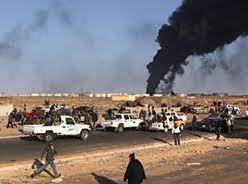
No fly zone declared


This is not to deny that Libya does indeed face a potential calamity. The embattled Col. Gaddafi, his family, tribe and assorted associates and hangers-on are facing political, financial and possibly physical extinction at the hands of rebels – whose precise political orientation remains a mystery despite a heavy media presence in their strongholds – and clearly they will fight, and fight dirty, to make sure that does not happen.

But this is not the first time that an oppressive regime has threatened its own people, or other countries’ people, with slaughter and that fact serves to highlight the embedded dishonesty and hypocrisy of the joint Obama-Cameron-Sarkozy venture. If the prospect of a “humanitarian crisis” was an honest reason for military intervention then the three national leaders would be pretty much doing nothing else every day except issuing threats or organizing military sorties into other peoples’ countries.

They would be telling the leaders of Bahrain, Syria, Saudi Arabia and Yemen, for instance, to lay off their pro-democracy protesters; they’d impose a no-fly zone over Zimbabwe or otherwise threaten to rein in Robert Mugabe, toss Cruise missiles at the Burmese military dictators and long ago have sent legions of the Green Berets, the SAS and the French Foreign Legion into Darfur.

But they didn’t, and they wouldn’t have dreamed of doing it. No more than they would have ordered a no-fly zone in the Middle East in December 2008 when Israel invaded Gaza during Operation Cast Lead and rained white phosphorous
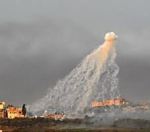
Western silence when Israel rained white phosphorous on Gaza

down on the heads of Palestinian children with murderous consequences for scores. Not only did that not happen but the newly-elected Obama, vacationing in Hawaii at the time, could not be persuaded to utter even one word of condemnation or disapproval.

To be fair to the US president, however, this is one military adventure which the Americans appear to have been the most reluctant to join. The lead has been taken instead by French president, Nicolas Sarkozy and British prime minister, David Cameron who heads a coalition Tory-Liberal Democrat government in London. The two Europeans had been pressing for action against Gaddafi for more than a week before Obama, apparently also urged to travel down this road by Hillary Clinton, finally gave in.

Sarkozy’s reasons for joining this anti-Gaddafi expedition have, according to one persuasive account, much to do with the confluence of two uncomfortable realities and very little with the catastrophe that inaction could bring to the unfortunate Libyans.

One is the impending French presidential election, due next April or May, and the other is his awful standing in the opinion polls. The latest of these showed
Pandering to Le Pen's National front did Sarkozy little good

him trailing behind the Socialists and the quasi-fascist, anti-immigrant National Front founded by Jean-Marie Le Pen. In a bid to fend off the challenge from the extreme right, Sarkozy last year decided to join Le Pen’s people in the gutter and ordered the expulsion of France’s Roma population.

Pandering to French xenophobia made little difference and now Sarkozy faces the real prospect of entering the history books as a one-term president. But as Margaret Thatcher discovered in the Falklands, as did George W Bush after the invasion of Iraq, nothing does quite as much good for a politician’s re-election prospects – particularly when you’re third in the polls – than a war, especially one your people believe you are leading.

For reasons that perhaps hark back to the days of “Freedom Fries” and the contrast that the sight of a French leader eager to fight a war alongside America
Sarkozy - no more "Freedom Fries"

makes, the US media have placed Sarkozy in the “no-fly zone” limelight. To be sure Sarkozy was the first to give official recognition to the Libyan rebels and French jets did fly the first missions over Benghazi but to focus on this risks missing one of the big stories of the Libyan adventure: the role of neocons in shaping British prime minister David Cameron’s enthusiastic support for the Libyan escapade.

And there is no doubting Cameron’s passion for this North African adventure. He was the first to call for a no-fly zone (as well as the arming of the rebels), in early March well ahead of Sarkozy who initially opposed the idea. Even when NATO turned him down and the Russians and Chinese promised to veto any attempt at the United Nations to dislodge the Libyan leader by force, he
David Cameron with 'neocon Rex' Tony Blair

persisted. When he ducked a question in the House of Commons over whether he would wait for a UN resolution on Libya before committing Britain to a no-fly zone it raised the intriguing possibility that Cameron might be ready to go down the same path traveled by Tony Blair in 2003 when he and Bush cut a secret deal to go to war in Iraq without the UN’s approval.

And Cameron’s ministers have let it slip that, notwithstanding that the terms of the UN resolution do not authorize regime change, getting rid of Gaddafi and even killing him is very high on the British agenda.

His Defence Secretary, Liam Fox let it slip that the Libyan dictator could be targeted by Cruise missiles while his Chancellor, (like Timothy Geithner but with much more clout) George Osborne refused to rule out British troops being deployed on Libyan soil to overthrow him, telling a British television show only

Dave and Barry share a joke - but does Obama really know about his friend's friends?

that it was not planned “at this stage”. Should there be any doubt what the real intentions are, it is worth remembering that it was a British submarine that targeted Gaddafi’s compound in Tripoli with a missile strike shortly after the no-fly zone was authorised (the same compound, incidentally, bombed by Reagan in 1986 in a raid that killed Gaddafi’s adopted daughter).

So there seems reason to believe that in Cameron’s mind at least, the Libyan intervention is less a humanitarian intervention intended to relieve the hard-pressed rebels and avoid the slaughter of civilians and more a war whose aim is to overthrow the Gaddafi government and to achieve regime change.

David Cameron, like many British Tories, has some compelling reasons to get rid of Gaddafi although commercial motives such as access to Libyan oil and enhancing trade links are not among them. Cameron’s predecessor, Tony Blair long ago took care of Britain’s interests in that regard, secretly offering in 2005 to hand over Libyan dissidents hiding out in London (yes, the same ones whose friends in Libya the West is now so eager to protect) to Gaddafi and almost certain death (and later freeing the Lockerbie bomber) just at the time that Libyan oilfields were made available for public auction (by a remarkable coincidence by the time the hammer fell, BP and Shell had beaten out their US rivals and secured rights to all of Libya’s oil and natural gas resources).

Another reason could be Gaddafi’s nearly two decade-long sponsorship of the Provisional IRA. Over the years Libya gave the IRA many millions of dollars and tons of sophisticated weaponry, including ample supplies of the powerful explosive Semtex. By so doing the Libyan leader nourished a group that
Gaddafi gave the IRA weapons to use against Britain

otherwise would have posed a much less formidable threat to Britain. Getting payback for all those years spent helping out Irish terrorists who killed the Queen’s cousin, Lord Mountbatten and nearly wiped out the Thatcher Cabinet would certainly give Cameron and his colleagues much satisfaction but is insufficient by itself to explain the eagerness to attach Gaddafi’s scalp to their belt.

The clue to what is really going on in the Cameron cabinet can be found in the phrase that many believe describes their real but officially unstated aim: “regime change”. Consider these words to be published in the forthcoming issue of The Weekly Standard: “The only way this crisis will end – the only way we and our allies can achieve our objectives in Libya – is to remove Qaddafi from power. Containment won’t suffice. We must make ‘rollback’ the international strategy.”
British neocons want to do this to.........
....this guy

The Weekly Standard is, of course, the house magazine of the American neoconservative movement and the author of these words is the writer and think tanker, Max Boot. Although Boot dislikes the epithet, he is one of America’s foremost neocons. In fact there is hardly a neocon project of any significance in recent years that has not had Max Boot’s name attached to it at some stage or other, from the Project for a New American Century and the invasion of Iraq through to unquestioning fealty to Israel and particularly the Likud party.

And remember also that key defining document produced by American neoconservatism back in 1996, ‘Clean Break’, advice to Israeli’s incoming Likud premier, Benjamin  Netanyahu that a policy which embraced military force to topple unfriendly Arab regimes could ‘transcend’ the Arab-Israeli conflict, i.e. make an accommodation with Palestinians unnecessary. It is view heartily endorsed by the Atlanticists who populate the ranks of Britain’s neocons.

One of the most stubborn popular myths about neoconservatism is that it is a uniquely American phenomenon and given the baleful consequences that the doctrine had for the Bush White House, never mind the rest of the world, that is hardly surprising.

But neoconservatism’s roots do not belong in America and not even in the West Side of Manhattan, at least according to some in Cameron’s circle. The roots actually belong in Britain and, according to one of the doctrine’s leading
The Earl of Castlereagh - a founder of modern neoconservatism?

apostles, specifically in the British Tory party at the dawn of the nineteenth century when the doctrine of intervention in other countries’ affairs was legitimized, beginning with the effort to throw Napoleon off France’s imperial throne, and the basis laid for largely unopposed British colonial expansion during the rest of the century.

The claim, incidentally, is a necessary reminder that neoconservatism is just a fancy name for old-fashioned, interest-driven imperialism, justified in the nineteenth century in the name of bringing “civilization” to the rest of the world and nowadays to spread “democracy”.

Well, it looks as if Britain’s nineteenth century neocons have made a comeback and have a real, pivotal influence in Cameron’s Cabinet. The prime minister himself is not formally a neocon but he has surrounded himself with neocons,  given them key posts in government and has allowed his policies to be framed with significant input from neocon think tanks.

Consider the openly neocon members of Cameron’s Cabinet, nearly all of them members of the so-called Notting Hill set, a group of young ambitious Tories

Goerge Osborne as a young buck at Oxford - never had a proper job before politics

who spearheaded Cameron’s rise to the top of the Tory party. The leading figure is George Osborne, the Chancellor of the Exchequer whose economic policies will determine whether or not Cameron gets re-elected in 2014 or 2015. He is a crucial figure in Cameron’s government and has the prime minister’s ear every day. Back in 2003 when Bush and Blair were about to invade Iraq, Osborne – a member of the Anglo-Irish aristocracy – declared himself a “signed-up, card-carrying Bush fan” and told the House of Commons that he had been won over by the “excellent neoconservative case” for war.

The next most important figure is Cameron’s Education Secretary, Michael Gove who, when he is not advocating no fly zones in Libya, is busy constructing Britain’s version of charter schools. A former leader writer for the Times, Gove is the zealot who traces the origins of

Michael Gove - a key member of Cameron's 'Notting Hill set'

neoconservatism to a couple of early nineteenth century Tory Foreign Secretaries, George Canning and Robert Stewart, aka Viscount Castlereagh. An uncritical fan of Israel who barely bothers to disguise his contempt for all things Palestinian and Arab, Gove once compared Donald Rumsfeld to the sheriff played by Gary Cooper in High Noon.

More junior Tories make up the rest of Cameron’s neocon set. They include Greg Hands, George Osborne’s Private Parliamentary Secretary (PPS), the House of Commons’ version of a public school fag. Hands holds joint US and UK citizenship and returned to America in 2008 so he could vote for the McCain-Palin ticket. Culture Minister, Ed Vaizey is also a neocon as is Nicholas Boles, PPS to the Schools Minister.

So two of Cameron’s most important Cabinet colleagues, and close personal friends, are declared neocons and a group of junior, talented and up and coming government figures are with them. Others in Cameron’s Cabinet are “liberal interventionists”, like the Foreign Secretary William Hague. A cynic might observe that “liberal interventionists” are to neocons what call girls are to hookers. They’re in the same business but one is more honest than the other about what they do.

The founder, nay inspiration of the liberal interventionists is Bush’s old pal, Tony Blair, about whom Michael Gove once wrote an article titled, would you believe, “I can’t fight my feelings any more: I love Tony”. That was on the eve of the Iraq war. Guardian reporter Richard Seymour, whose insightful writing informs much of this post, once observed: “…for many Tories, Blair is neocon Rex.” So wherever he turns, Cameron is confronted by neocon influence or its surrogate, Blairism.

As with their American counterparts, many of these Cameronian neocons are leading figures in a bewildering array of overlapping Think Tanks and front groups and it is here that perhaps the greatest influence on Cameron can be seen.

Prime amongst these is Policy Exchange (PE), a conservative think tank based in Westminster which was founded by Michael Gove, now Cameron’s Education

Nicholas Boles, another Cameron ally and founder of Policy Exchange

Secretary, and Nicholas Boles who was until 2007 Policy Exchange’s Director and later Cameron’s head of policy. The Daily Telegraph, whose former editor Charles Moore is now PE’s chairman, called Policy Exchange “the largest, but also the most influential think tank on the right” while the New Statesman termed it David Cameron’s “favourite think tank”.

In the final years of Tony Blair’s premiership the Notting Hill set would meet at Policy Exchange’s offices to discuss the future of their party and out of that was born the idea that he should make a bid for the leadership. The measure of the think tank’s influence on Cameron and the regard with which he held it was on view in June 2005 when he chose a Policy Exchange event to launch his bid for the top job. When he succeeded, the think tank’s star rose along with him. Money flowed in from the City of London and with its income rising tenfold, Policy Exchange’s research staff grew by a factor of seven.

A key figure in Policy Exchange, and in shaping Cameron’s political direction during his premeirship, is its Research Director on security issues, Dean Godson, a former feature and leader writer for the Daily Telegraph and author of a celebrated if controversial biography of the Northern Ireland Unionist leader, David Trimble.*

Godson’s familial links to the neocon cause are impressive. His father Joseph, a Polish Jew who emigrated to America in 1926 at age 13, was a neoconservative before there were neoconservatives. A member of the American Communist Party he became disillusioned with Stalin at a very early stage and, skipping the Trotskyite phase, moved rightwards, joined the State department in 1950 and was stationed in London where he allegedly played a significant role meddling in the British Labour party’s internal politics much to the detriment of leftist figures like Nye Bevan, the father of British socialised medicine.

His other son Roy, based in Washington, is an expert in the shady business of counter intelligence/black propaganda and served on Reagan’s National Security Council where he helped Ollie North funnel Iranian cash to the Contras in Nicaragua.

Dean Godson’s two passions in life are Israel and Ireland, or to be more specific the cause of Likud and Ulster Unionism whose twin fates he saw threatened by the temptations of dialogue with untrustworthy terrorist adversaries, the PLO and the IRA, in the search for peace and political accommodation.

His friend David Frum, a Bush speechwriter famous, or infamous, for coining the phrase “axis of evil”, once wrote of the many anguished phone calls he would receive from Godson about the peace processes in Israel and Ireland during the 1990’s: “Dean kept pointing out….(that) they all shared a dangerous defect. They were attempts to make peace with terrorist adversaries who were not sincerely committed to peace”. (After the IRA called off its war and decommissioned its arsenals – thereby inconveniently demolishing Godson’s conspiracy theory – British neocons have instead turned to IRA dissidents as the next great threat, but less than convincingly)

Godson joined Policy Exchange when his benefactor Conrad Black lost control of the Daily Telegraph. The new editor, Martin Newland let Godson and Black’s wife and fellow writer, Barbara Amiel go because of their strident politics, as he later explained: “I soon came to recognise that (the Daily Telegraph was) speaking a language on geopolitical events and even domestic events that was dictated too much from across the Atlantic. It’s OK to be pro-Israel, but not to be unbelievably pro-Likud, it’s OK to be pro-American but not look as if you’re taking instructions from Washington. Dean Godson and Barbara Amiel were key departures.” Conrad Black once called Palestinians “vile and primitive” while Barbara Amiel, in one of her pieces, compared Arabs to “animals”.

At Policy Exchange, Godson’s singular contribution has been, according to his many critics, to fan the flames of British Islamaphobia under the guise of confronting Muslim extremism and his methods have sometimes brought the think tank into unwelcome controversy.

In 2007 PE published ‘The Hijacking of British Islam’ which purported to show that extremist Muslim literature which, inter alia, advocated the stoning of adulterers and the beheading of apostates, was on sale in twenty-five per cent of British mosques. A BBC investigation revealed however that a number of receipts allegedly issued by mosques for the literature had been forged on PC’s or were written by the same hand.
Dean Godson (right) being grilled by the BBC's Jeremy Paxman over allegations of forgery in a Policy Exchange report on British Muslims

None of this seems to have deterred David Cameron however. In February this year he chose his first speech on terrorism as prime minister to announce the failure of British multiculturalism, echoing Germany’s Angela Merkel, and the need for a tougher stance on Muslim groups allegedly promoting extremism. Government contacts with and financial support for such groups would be re-examined and, if necessary, withheld, he declared. The speech was a feather in the cap for Dean Godson and Policy Exchange; it was also a notable triumph for the Tory party’s neoconservatives and clear evidence that Cameron was open to persuasion on other issues.

Key figures in Policy Exchange also populate the ranks of the Cambridge-based, British branch of the Henry Jackson Society (HJS), set up in the midst of the Iraq war and so-named after the fiercely pro-Israel, anti-Communist Senator from Washington State, the late Henry ‘Scoop’ Jackson, a figure regarded as something between patron saint and founding father of the American neoconservative movement.

Signatories to the HJS’s statement of neocon principles include Cameron allies and Policy Exchange founders, Michael Gove and Nicholas Boles as well as George Osborne’s “fag”, Greg Hands. Some of its researchers, like Martyn Frampton, have inherited Godson’s obsession with the dangers of talking to terrorists and Frampton has also been to the fore in projecting the tiny, heavily infiltrated and mostly corrupt IRA dissident groups as a new and major threat to peace in Ireland.

The corollary of such alarmism of course is the need for extra anti-terrorist resources, unceasing vigilance (not to mention paranoia) and, ultimately, the military strength to tackle not just the terrorists but those abroad who may sponsor and fund them, whether they be of the Irish or Muslim variety. While many British neocons have warmly welcomed David Cameron’s support for intervention in Libya they also express dismay at his unaltered plans to run down Britain’s military strength. Neoconservatism and the military state, like love and regret, go hand in hand.

The Henry Jackson Society has been anything but shy advocating the invasion of Libya and the overthrow of Gaddafi. Type “Libya” into its website search bar and more than sixty articles and references appear, virtually all of them antagonistic to the Libyan leader or urging extreme action against him. One article written by HJS’s Global Security and Terrorism director George Grant and published recently in Rupert Murdoch’s Wall Street Journal was headlined “Put the Mad Dog Down”.

As the situation in Libya deteriorated it set up an emergency “Committee for a Democratic Libya”, headed by the subject of Dean Godson’s autobiographical magnum opus, David, now Lord Trimble, the former NI Unionist leader who expressed himself in favour of supplying the rebels with military equipment and the services of unspecified “experts”. Libya, he told its inaugural meeting, “is the sort of situation where it would be utterly wrong for us to hang back”.

Activists in the Henry Jackson Society can also be found at the International Center for the Study of Radicalisation (ICSR) based at King’s College London. Its publicly stated brief is to “educate the public in relation to diplomacy and strategy, public administration and policy, security and counter-terrorism and international conflict resolution.”

Its real function, fueling Islamaphobia, soon becomes apparent when you examine the biographies of just two of its research staff. One is an alleged Jihadist apostate called Shiraz Maher who doubles as a Senior Fellow at Policy Exchange. He claims that he was once a member of the extremist Hizb ut-Tahrir group but became disillusioned and quit. He now preaches a virulent anti-Islam gospel given credibility by his purported past history (the neocons’ Irish equivalent is Sean O’Callaghan, a former IRA leader and admitted spy for the Irish police and the British intelligence service, MI5).

Former Islamist Shiraz Maher......
....and Sean O'Callaghan, an IRA informer. Both apostates, and useful to the neocon cause

During Israel’s Operation Cast Lead, Maher wrote that British Muslims have a choice: “…between Hamas, a terrorist group committed to destroying a sovereign state and its people – and Israel, the region’s only democracy which is responding to that threat.”

The other is Alexander Meleagrou-Hitchens. Yes, you guessed it, the son of Christopher Hitchens, former Trot and post-9/11 convert in all but name to the neoconservative cause. The apple did not fall far from the tree. Also a Senior Fellow at Policy Exchange and a

Alexander Meleagrou-Hitchens - the apple fell not far from the tree

blogger for the Henry Jackson Society, Hitchens junior shares all of his father’s detestation of things Islamic and then some, as Strathclyde Sociology professor, David Miller observed in an August 2010 profile: “He has no truck with the idea that U.S., U.K., or Israeli foreign policy or human rights abuses contribute to terrorism. ‘It is the ideology of Islamism,’ he writes, ‘which is the primary root cause of jihadist terror.’ This puts him at odds even with the British intelligence agencies. Even they have acknowledged that the invasion of Iraq exacerbated opposition to the U.K.”

This then is the British neoconservative network that surrounds David Cameron. Iraq-style regime change is undeniably their goal with Muammar Gaddafi playing the role of Saddam Hussein. The Iraq invasion was based on the lie of weapons of mass-destruction (WMD) but it is the specter of a failed state that is being used by neocons to justify the action against Libya. As one of them wrote, the war between Gaddafi and his rebels could “create an Afghanistan on our doorstep….a source of terrorism and piracy”.

Perhaps, but there’s a large element of the self-fulfilling prophecy at the core of neoconservative thinking. It is worth remembering that Afghanistan became a failed state in the first place because of foreign intervention, first by the Russians and then the Americans. Had Afghanistan been left alone there would have been no Al Qaeda training camps, no 9/11. The Bush-Blair invasion of Iraq has likewise left the region more unstable than it was before, more susceptible to Iranian influence than could ever have been imagined in Sadam Hussein’s day.

Obama is going down a road these two men travelled before him

The debacle of Iraq had sounded, many thought, the death knell of neoconservatism but the Arab Spring and the Libyan crisis have revived it. That, and the neocon clique that surrounds David Cameron. US president Barack Obama now finds himself attached to a project that many would have more readily associated with his predecessor. He can only hope that his foray into Libya will have a happier ending than the Bush-Cheney expedition to Iraq. If not he will have, in no small way, his British ally to thank as well as that ally’s neocon friends. Remember what the man, no friend of the neocons, said: “History repeats itself, first as tragedy, second as farce.”

*In the interests of full disclosure I should say that I know Dean Godson quite well and while our respective views of the world, and the Irish peace process, are poles apart, I like him and enjoy his company. I once spoke at a Policy Exchange debate on the NI peace process and found myself, gratifyingly I should add, in the minority. But he was, as always, a gracious and generous host.

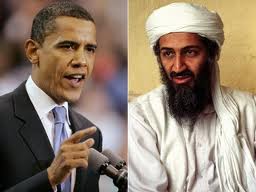
The Nuking of Barack Obama

With Japan teetering on the edge of a nuclear catastrophe potentially many times worse than Chernobyl, its government incapable of interacting candidly with its

A reactor on the edge of meltdown

own people and the Tokyo Electric Power Company (TEPCO), which owns and runs the Fukushima reactor, a case study in Keystone Cop-like incompetence, many are looking to America for guidance and help and in particular to President Barack Obama for a lead.

The folks at TEPCO search for a lead

As the Japanese nuclear crisis faces its second week, Obama has announced a comprehensive safety review at all 104 reactors in the US. But just what is the track record of America’s 44th president in dealing with nuclear safety issues and the nuclear industry; how resolute will he be in the face of industry lobbying? It would be re-assuring to be able to say that in this case at least, the soaring rhetoric has been matched by action. But sadly, the answer is that it provides yet another metaphor for the Obama presidency and style of politics – he can talk the talk like no other politician in the hemisphere; the problem begins and stays with the walking part.
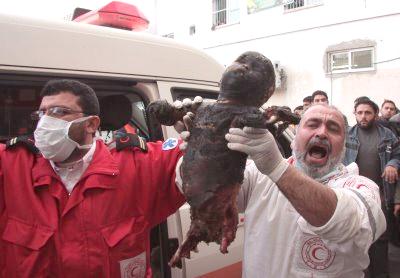
Obama’s connections to the nuclear industry surfaced briefly during the battle for the Democratic nomination with Hillary Clinton in the Spring of 2008 and then promptly disappeared. This was a pity because the story really told us all that we needed to know and have come to know about Obama in the White House, which is that what he says he will do when he is searching for votes and what he actually does do once he has got them are often two very different things. It also told us that, despite his campaign slogan of ‘Change’, Obama was no different from any other American politician; his vote could be bought and sold like a pig at market.

The story began on December 1st, 2005 when Exelon, an Illinois-based utility company and America’s largest single producer of nuclear energy (20% of all nuclear-generated electrical power) disclosed that traces of tritium, a radioactive byproduct of nuclear reactors, had been discovered in the water table at its Braidwood plant, some fifty miles southwest of Chicago. Within days tritium was found in wells nearby that provide drinking water to locals and Exelon admitted that the radioactive element had been present in millions of gallons of water that had leaked from the plant years before but the leakage had not been reported.

Now tritium, while a radioactive element, is not the most dangerous substance than can be released from a nuclear reactor. Unlike say Uranium 235 or Plutonium, being in the presence of tritium is not inherently dangerous – those old-fashioned watches with faces that glowed in the dark did so because tritium was painted on the numerals – and it is only when it is ingested in food or liquid that it can do harm. Clearly a lot of tritium had been released from Exelon’s plant and how much harm it may have done was an unanswered question compounded by the alarming realisation locally that other far more dangerous substances may have been released without anyone’s knowledge, except of course Exelon’s.

As Joseph Cosgrove who lived and worked in the nearby hamlet of Godley, Ill, told the Los Angeles Times in 2008: “We want people to be notified. Think about

Safe to drink?

it. They had releases and no one was told. How would you like to turn on the tap and (have to) think, ‘Should I drink this?’”

Cue the arrival of a white knight in the genial form of Illinois’ newest Senator, Barack Obama, elected just a year or so before the tritium leakage was disclosed and, since his electrifying keynote speech at the 2004 Democratic Convention, a rising star in the Democratic party and already touted by some as a future White House runner.

The existing law governing radioactive discharges from nuclear plants stipulated a requirement on the owners’ part to report leakages to state and local authorities only if they amounted to an “emergency”. So Senator Obama proposed a new law, called the Nuclear Release Notice Act of 2006, which stipulated that nuclear plants “shall immediately” notify officials at local, state and federal level of any accidental release of radioactive material that exceeded “allowable limits for normal operation”.

To objections from the nuclear industry that tritium posed not such a great health threat, Obama responded, according to the New York Times:

“This legislation is not about whether tritium is safe, or at what concentration or level it poses a threat. This legislation is about ensuring that nearby residents know whether they may have been exposed to any level of radiation generated at a nuclear power plant as a result of an unplanned, accidental or unintentional incident.”

It looked as though Senator Obama was going to do the rare thing in American politics, take a stand on behalf of ordinary people even if that was at the expense of corporate interests. Until that is the nuclear industry started cozying up to the Democrats. By 2006/2007, George W Bush’s unpopularity was at its peak and it was clear that any Republican candidate running for the White House in 2008 would likely take the blame for Bush’s follies and lose badly.

Traditionally, the nuclear lobby had always donated most heavily to the GOP but from 2006 onwards, as the result of the 2008 presidential race became more predictable, nuclear’s money went Democratic. When the race got underway the Los Angeles Times estimated that for every dollar that the nuclear industry gave to Republicans, it donated $3.50 to Democrats.

In the case of one of the leading Democratic contenders, Barack Obama, the nuclear industry’s bet paid off handsomely. Exelon and the nuclear lobby, the Nuclear Energy Institute, opposed Obama’s Bill and within a few months their lobbying helped gut the legislation.

Out went that requirement to “immediately” notify the authorities of any nuclear leakage and in its place the Nuclear Regulatory Commission was asked to “consider” public notification in the light of the findings of a special task force set up to examine the tritium discharges. Predictably, that task force reported that “existing reporting requirements for abnormal spills and leaks are at a level that is risk-informed and appropriate”. The Obama Bill was also re-written – the words apparently chosen by Exelon – to make it clear that State and local authorities would not be able to exercise regulatory oversight of nuclear reactors.

The one concession made by the nuclear industry was agreement that plants would “voluntarily” report leakages from now on. But as David Lochbaum of the Union of Concerned Scientists told the New York Times: “…because it is all voluntary who’s to say where things will be in a few years from now?”

Joe Cosgrove, who had campaigned for Obama’s Bill, now complained in the media that the Illinois Senator was bending to the pressure: “Senator Obama’s staff was sending us copies of the Bill to review, and we could see it weakening with each successive draft. The teeth were just taken out of it”.

So why did Barack Obama water down his Bill and allow the nuclear industry to remove its heart and soul? Answer: they gave him lots of money.

Since 2003, when Obama started his run for the US Senate, Exelon employees and bosses had, by February 2008, contributed $227,000 to his Senate and White House bids. That’s a New York Times’ estimate. The Los Angeles Times claimed that $190,000 of that sum was for Obama’s White House campaign. Two of Exelon’s top executives, Frank M Clark, executive vice-president, and John W Rogers, a director, raised funds for Obama while John W Rowe, the chairman of both Exelon and the lobbying group, the Nuclear Energy Institute, was also a donor to his campaign. In addition, Obama’s key aide and adviser, David Axelrod had also worked as a consultant for Exelon.

In the event neither Exelon nor the nuclear industry need have worried. Although Obama had re-written and watered down his Bill, the Senate, which remained under GOP control in 2006, still found reason to object and stalled it. Obama re-introduced the legislation in 2007 but it went nowhere.

Obama took over $225,000 in campaign donation from Exelon staff

This did not stop Obama from claiming just the opposite. On the campaign trail in the winter of 2007/2008, he boasted about the Bill, telling voters in the Iowa primary that it was “the only legislation that I’ve passed. I just did that last year.” Not true but Obama’s claim went largely unchallenged. His main opponent, Hillary Clinton was in no position to exploit the slip, if such it was. Obama was the number one recipient of nuclear cash but Hillary came a close second.

Obama’s promise to the voters of Illinois went the same way as his presidential campaign pledges to, inter alia, offer a public option in health reform, to protect whistleblowers from prosecution, march alongside union members if their collective bargaining rights were threatened, end the Bush tax cuts to the rich and close down Guantanamo prison camp – abandoned in the face of powerful or wealthy opposition.

His current energy proposals include a $36 billion subsidy to the nuclear industry so it can build more reactors. When the policy was drawn up nuclear power looked preferable to oil and carbon-based fuels as a source for energy. The disaster in Japan is a timely reminder that nuclear energy is every bit as unappealing as conventional sources and that a major re-assessment of the Obama energy plan is now imperative. But in the light of the president’s interaction with Exelon, it might not be prudent to bet the mortgage that this will happen.