St Patrick’s Day – Bah! Humbug!

Yuck!

I was going to write an angry piece about Irish-Americans and how each St Patrick’s Day they happily indulge, for the amusement of the rest of America, every demeaning, insulting and degrading stereotype of the Irish invented since the Famine. Would African-Americans so easily paint their lips white and put on a minstrel show? Would Chinese-Americans typecast themselves so quickly as Fu-Manchu or Charlie Chan? I think not. Anyway that was before I read this excellent piece on Salon.com by Aine Greaney which says everything I wanted to say and does so much better than I could.

More Yuck!

Beyond words!

Peter King Redux

I am grateful to Mark Devenport, political editor of the BBC in Belfast for this information. Congressman Peter King is hosting a St Patrick’s Day breakfast in Washington tomorrow (Wednesday, March 16th) and his two principal guests are Peter Robinson, the First Minister in Northern Ireland’s power-sharing government and Martin McGuinness, his deputy.

Robinson was for many years deputy to the Rev Ian Paisley, leader of the Democratic Unionist Party, NI’s extreme Unionist  grouping and for many years an opponent of all things Catholic and Irish. Martin McGuinness is number two to Gerry Adams, effectively the deputy leader of Sinn Fein, the IRA’s political wing.

Doubtless tomorrow’s breakfast will be heralded as another celebration of Northern Ireland’s transition from some forty years of bloodshed and terrorism to peace and political co-operation – which undoubtedly is the case.

But in the light of the controversy over Peter King’s hearings into purported American Muslim radicalization and his perceived hypocrisy given his own past as a cheerleader for IRA terrorism in Ireland, it is worth noting that not too long ago his two guests wore very different hats.

McGuinness was Chief of Staff of the IRA, that is its head honcho, from 1978 (when he took over from Gerry Adams) until 1982.

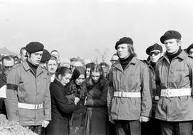
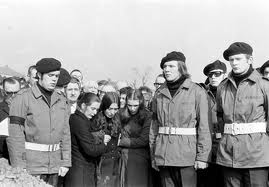
Martin McGuinness (extreme right) wearing the IRA's uniform at a paramilitary funeral in the early 1970's.

From 1984 until very recently he was the IRA’s Northern Commander, effectively its military leader responsible for directing the IRA’s day-to-day war against the British, which meant that he endorsed or organised every bombing, shooting, killing and other acts of what Peter King would regard as ‘terrorism’ if it was to happen in America rather than Northern Ireland. He was also the Chairman of the IRA’s Army Council, its supreme decision-making body, effectively the IRA chief diplomat and ambassador in dealings with outside bodies, such as the British and Irish governments.

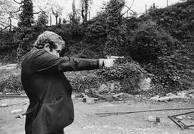
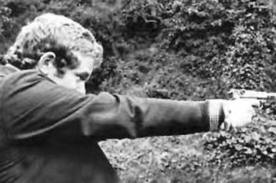
Martin McGuinness fires a pistol

Peter Robinson was not always a politician who preached peaceful methods. His boss, Ian Paisley, has a long history of involvement in shady Loyalist paramilitary groupings, starting with the Ulster Volunteer Force (UVF) back in the 1960’s when the group killed the first of what would be 3,000 plus victims of the Troubles. As Paisley’s deputy Robinson was often the man in charge of the important details. Paisley and Robinson’s most celebrated expedition into the world of terrorism came in the late 1980’s and early 1990’s, not long after the Anglo-Irish Agreement which gave the Dublin government a say in Northern Ireland’s affairs.

Amidst outrage from Loyalists and Protestants, Paisley and Robinson set up a paramilitary group called Ulster Resistance which linked up with the two major Loyalist groups, the Ulster Defence Association (estimated to have killed at least 300 people in the Troubles) and the UVF (death toll, at least 480). In its very first action, an armed group of Ulster Resistance members crossed the Border and invaded Clontibret in Co. Monaghan. Shots were fired but the group, with one exception, fled when the Irish police arrived on the scene. The sole Ulster Resistance member left behind was Peter Robinson who was arrested and charged. He later pleaded guilty to taking part in an unlawful assembly.

Ulster Resistance’s claim to fame, or infamy, came when French police arrested some of it leaders in a Paris hotel as they were negotiating a second arms deal with representatives of the apartheid government in South Africa. Using its extensive contacts in Shorts missile factory in East Belfast, Ulster Resistance had already traded missile secrets for weapons and grenades. The latter were used in Michael Stone’s famous attack on IRA mourners in a West Belfast cemetery in 1988 which killed three people. The second deal apparently involved passing over details of Shorts Blowpipe missile system, weaons that were at the centre of the Iran-Contra scandal.

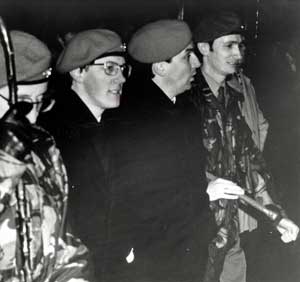
Peter Robinson (second left, wearing glasses) parades with Ulster Resistance members involved in the South African missile secrets-for-arms deal

When Peter King, Peter Robinson and Martin McGuinness break bread tomorrow in DC, doubtless they will inwardly congratulate themselves on how far their respective careers in politics have taken them. The rest of us might well reflect on another reality, that as Peter King organises his second hearing on American Muslim support for terrorism, but for their ambivalence, at least, towards terrorism or their outright support for it, none of them would be even be in Washington, never mind seated around this particular breakfast table.

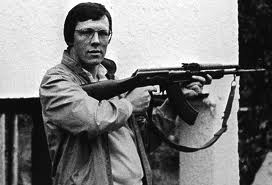
Peter Robinson totes an AK-47 during a trip to Israel, then a close ally of South Africa

Peter King

As he prepares to open Congressional hearings into the alleged ‘radicalization’ of American Muslims this week, Rep. Peter King has not been having it all his own way – in fact he’s been having a terrible time of it.

His problem is that the US media has finally caught up with his past as a cheerleader for the Provisional IRA back in the 1980’s and 1990’s when he and Noraid were inseparable and when he was on first name terms with and a house guest of many in the IRA’s national and Belfast leaderships.

And they are drawing a-pretty-hard-to-avoid conclusion – which is that with his background and history, the Republican Congressman for Long Island is pushing the definition of the word hypocrisy to new limits by pursuing others for their purported ambivalence towards terrorism.

Two of America’s premier newspapers, the Washington Post and the New York Times featured substantial pieces that led with and dwelt extensively on King’s past as an uncritical supporter of the IRA and advocate of armed struggle. As effective, and possibly more so, was a biting piece by Jon Stewart on Comedy Channel’s Daily Show. Here’s a link to the segment. Irish viewers will not be able to watch it unless they use a US proxy IP address. There is also this piece on MSNBC, a cable network popular amongst American liberals and progressives.

Also interesting to note is that some in the Irish-American community have protested at King’s plan. Particularly effective was this piece on the Irish Central website by Irish-American writer Brian Dooley who highlights the potential effect of Peter King’s Congressional hearings on the Muslim community in America, noting that the precedent was set amongst the Irish community in Britain during the 1970’s at the height of the IRA’s bombing campaign – which is that they were all wrongly tarred with the IRA brush and suffered terribly for it. What Peter King would have roundly, and rightly in the view of many, condemned in Britain he now threatens to bring to America.

Islamophobia is at a new and scary peak in America, as the video below of a recent Tea Party protest at an Islamic function in California demonstrates, even though the 9/11 attacks happened a decade ago.

The reasons are not hard to fathom. First of all there’s an audience for it. This is a deeply and at time frighteningly racist country and in Muslims, White racists are able to indulge both their hatred for non-Whites and for non-Christians – the same engines that fueled and drove the Klu Klux Klan. The Tea Party is emerging as the leader in that field.

Second, a number of skilled and articulate rabble rousers have discovered that a lucrative living can be made whipping up these fears. Take a look at this recent piece in the New York Times and you’ll see what I mean. There’s now a small industry of hate-mongers who thrive off fear and distrust of Islam. To them Peter King’s hearings mean money in the bank.

Third, there’s a political dividend. Politics in America have, historically, often been characterised by the exploitation of ignorance, bigotry and fear, especially in White middle America – and particularly in that big bit in the middle between the East and West coasts. Blacks, Irish, immigrants, Jews, anarchists, socialists, communists, Russians, Chinese and Mexicans have all been at one time or another the focus of an invariably ill-founded, irrational but powerful phobia. Since 9/11 the Muslims have gone to the top of the list and replaced the Red Tide and the Yellow Peril as the biggest imagined threat facing America.

Invariably it has been the Right, that is the Republican Party, that has cranked this engine and the electoral payoff can be substantial. It is why GOP leaders have refused to condemn those who say that Barack Obama is a Muslim or that he was really born in Kenya and therefore not entitled to be in the White House. It’s ugly stuff but since one in five Americans believe this nonsense, the GOP does nothing to discourage it. And it is why Peter King is holding his hearings. Liberals will denounce him, the media will mock him but he knows that out there in the boondocks they are cheering him on.

Nonetheless, the re-emergence of these old links to the IRA are embarrassing to Peter King and his response has been both utterly predictable and supremely dishonest – he has wrapped the peace process around himself as protection and justification for what he did. This is what he told the Washington Post:

‘ “I [wanted] a peace agreement, a working agreement, where the nationalist community would feel their rights would be respected,” King said in an interview at his Capitol Hill office. “I felt that the IRA, in the context of Irish history, and Sinn Fein were a legitimate force that had to be recognized and you wouldn’t have peace without them. Listen, I think I’m one of the people who brought about peace in Ireland.” ’

The facts, sadly for him, do not support any of this. He first came to Belfast in 1980 just when the first hunger strike, the one led by Brendan Hughes, was reaching a climax and was radicalised by what he saw and experienced. He came back for the second hunger strike and it was then he met the family of Bobby Sands family, in particular his sister Bernadette and her then partner, now husband Micky McKevitt. He would visit them on every trip he made and often stayed in their home in Louth. When he was elected to Congress virtually the first thing he did was to jump on a plane to Ireland to host a celebratory dinner with Bernadette and Micky – and this was all at a time when McKevitt was masterminding the smuggling of Col Gaddafi’s Semtex and AK-47’s from Tripoli. In Belfast, King’s best friends were Anto’ Murray and his wife, the formidable Lucy. McKevitt was the IRA’s QMG and Anto Murray was Belfast Operations Officer.

The point of this story is that King’s closest contacts in the IRA in these years were the military men, people who had never been nor would ever want be in Sinn Fein, activists who would have little truck either with the peace process. King told me himself that he didn’t meet Gerry Adams, the architect of the peace process, until 1984, four years after his love affair with the Provos began.

By the time the process got seriously underway in secret, circa 1987/1988, King had been supporting the IRA for seven or eight years and if his real ambition during these years was to contrive a peace agreement he did a remarkably successful job disguising it. By the time the process became public in 1992, his liaison was a dozen years old. When the US got officially involved, King’s role was fairly minor, ferrying the odd message from Adams to Clinton. In fact he probably gained more than he contributed, as it enabled him to refresh a rather soiled image. As he told me back in 2005: “Gerry Adams made me respectable.” I’m afraid Peter King’s re-writing of his own history just doesn’t wash.

Nonetheless, his hearings will go ahead amid fears that they could whip up a McCarthyite-style hysteria against American Muslims. There is one group of people whose silence during all of this build up has been pronounced. Peter King owes the Provos a lot; in fact it is no exaggeration to say that his political career would have been stillborn and he wouldn’t now be a Congressman, much less the Chairman of the House Committee on Homeland Security without their support back in 1985 when he was chosen to lead the St Patrick’s Day parade in New York city, an event that gave him sufficient profile for higher office.

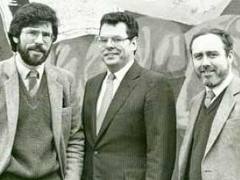
Peter King with friends in Belfast. So far Gerry Adams has stayed silent on his planned Congressional hearings on Muslim extremism

If they were to speak out their words would have an effect. But so far they have stayed silent. Until they break that silence we can only believe that Peter King’s plans cause them no problems even if their former ally helps to foment a campaign of hate against American Muslims every bit as toxic and harmful as that which engulfed the Irish in Britain some thirty years ago.

Musings on the Irish General Election

Thanks to the Cedar Lounge for this link. It’s an RTE radio documentary called ‘Dogfight: Conor and Charlie’, that zeros in on one constituency, Dublin South-West during the recent general election campaign and the re-election bid of the area’s two former Fianna Fail TD’s, Conor Lenihan and Charlie O’Connor. Lenihan is the scion of a distinguished Fianna Fail family. His brother Brian was the finance minister in the FF-Greens coalition and the point man for the economic meltdown; his late father, also called Brian, was Charles Haughey’s ill-fated Tanaiste, and his aunt is Mary O’Rourke, a three time minister in Fianna Fail administrations.

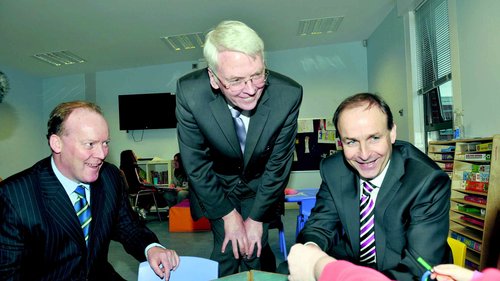
Conor Lenihan, Charlie O'Connor and new FF leader Micheal Martin in happier days

It is a great piece of radio and is required listening because it graphically illustrates why the general election went the way it did. What comes across as Lenihan and O’Connor separately canvass housing estates in places like Tallaght, is the sheer venom of so many of the voters towards Fianna Fail. The verbal abuse directed at the two men, the sheer anger at what the Fianna Fail government did to the Irish economy and the damage done by people like Brian Lenihan to ordinary lives is extraordinary. There are a couple of instances in the documentary where the two, soon to be ex-TD’s, are lucky to escape physical violence on the doorstep.

That anger became quantifiable on February 26th. Between them Lenihan and O’Connor barely ended up with half a quota and the contrast with 2007 could not be greater. Four years ago Lenihan topped the poll, exceeding the quota on first preference votes and O’Connor was not far behind. This time O’Connor outpolled Lenihan (evidence, surely, that being a brother of the finance minister did him only harm) while Labour and Sinn Fein took their seats, improving their share of the first preference votes respectively by 81% and 41%.

The documentary gives colour and atmosphere to the wider message coming from the general election result, which is that it was not a judgement about other parties’ policies, ideas and competence as alternatives but overwhelmingly an opportunity, grasped eagerly by the voters, to give Fianna Fail a severe kicking. Fine Gael, Labour and the independents, notably the left-wing ones, all benefited enormously from this revenge factor in the voters’ minds and so did Sinn Fein. In fact one of the striking features of the documentary was how some of the angriest voters saw voting for Sinn Fein as the best way of doing the most damage to Fianna Fail.

In that respect Fianna Fail’s tactic of leafletting constituencies with warnings that Sinn Fein’s vote could increase unless the party faithful answered the call on election day badly backfired since it served only to alert voters that this was the outcome most feared by FF.

Protest vote or not the results were translated into bums on seats in the Dail chamber and in that department, Sinn Fein saw its group of TD’s more than triple to fourteen even if the first preference vote rose by less than 45%. This was the result that Sinn Fein had hoped for and expected in 2007 but had it come about then, the Provos would almost certainly be political toast now. With fourteen seats under its belt in 2007, Sinn Fein would, in all likelihood, have taken the place of the Green Party in coalition with Fianna Fail and now would probably be in the same place as that party: utterly destroyed and without a single TD to its name.

With a result like that four years ago, the Shinners would have been able to boast that the peace process strategy had reached its medium term goal, even if the holy grail of Irish unity was still out of reach. That goal was to have SF bums nestling on chairs around cabinet tables in both parts of Ireland and a voice in the formulation of all-Ireland policies in each jurisdiction.

The chief architect of the process on the Republican side, Gerry Adams would have hailed this as a vindication of the decision to dump armed struggle and the IRA – and of all that preceded and enabled this, especially the controversial offers, deals and non-deals that accompanied six of the ten deaths during the 1981 hunger strike and the consequent foray into electoral politics.

Sinn Fein’s surprisingly poor showing in 2007 deprived Adams of that triumph but fortuitously so, as it turned out. However, luck, one of the biggest housing bubbles in economic history, the Anglo-Irish Bank and the most stupid, incompetent and possibly corrupt Fianna Fail government in the history of the State combined in the period since then to give Sinn Fein a second chance.

It seems pretty clear that for Sinn Fein to achieve in 2015 or 2016 what it failed to obtain four years ago, a certain set of conditions would have to exist. The major prerequisite would be that in four or five years time the Irish economy is every bit as damaged and derelict as it is now. That’s a distinct possibility but the downside for Sinn Fein is that if this were so then emigration would in all likelihood have returned to the distressing levels last seen in the early 1980’s and many of those leaving Ireland’s shores would be natural SF voters and therefore no longer available to the party (hence, I suspect, the reason for SF’s demand that emigrants be given the vote).

Another set of requirements would be that the recently elected Fine Gael-Labour coalition would be every bit as venal and bungling as Fianna Fail was, that when the next general election is called the voters are as angry as they were last month and, last but not least, that Sinn Fein has shown itself as a talented and inspirational opposition. Again, all three of those preconditions are by no means impossible, but neither are they anywhere near certain.

Then there would be the question of whether Sinn Fein should aim, as it did in 2007, to be the junior partner in the post 2015/2016 coalition government or the senior one. Since the election campaign would be focussed on attacking the FG-Labour government, coalition with either of those parties would be automatically ruled out (just as FG could not now contemplate a partnership with Fianna Fail).

That means that if Sinn Fein wants to be in government in four or five years time, its likely partner, possibly the only one available, will be Fianna Fail. Here’s where it starts to get tricky for SF. If Sinn Fein’s support is going to grow in the next four or five years it will in the main be at the expense of Fianna Fail yet it will need Fianna Fail to have recovered a lot of the support lost in the recent election for such a government to be viable. How to balance those competing demands will be a challenge.

If Sinn Fein’s participation in the next government is dependent upon Fianna Fail’s recovery, where then would SF’s extra votes come from except from the many independents who were elected last month, or the Labour party? The other option would be to set out to absorb as much of Fianna Fail’s support as possible, effectively replacing it as the Republican party of Ireland, and then cobble together a coalition from the remnants of FF and the scattering of independents.

What matters here is that in either scenario, aiming to be the junior or senior partner in the next coalition government, Sinn Fein would have to grow and develop – and be led – like a normal political party. The problem for Sinn Fein is that it is not a normal political party. It came to life as an offshoot of the IRA and it continues to behave, particularly in the way it handles its internal affairs, as an offshoot of the IRA, where obedience to an all-controlling leadership comes before all else.

The symptoms of this were visible in the years after the 2007 electoral setback with a series of resignations from party ranks in both parts of Ireland – perhaps twenty in all – and most damagingly in Dublin. Perhaps the most telling of these was the defection of Dublin councillor Killian Forde to the Labour Party in January 2010, a rising star who many predicted would go far. He chose his words carefully when he resigned but their import was unmistakable:

“The leadership of the party appeared to not recognise or were unwilling to accept that changes are long overdue. These changes were essential to transform the party into one that values discussions, accommodates dissent and promotes merit over loyalty and obedience. It is only logical that if you disagree with the direction of the party and are unable to change it there is no option but to leave.”

He didn’t put a name to the problem but we all know who he was talking about. Last week Gerry Adams was chosen as leader of the new, expanded Sinn Fein group in the Dail, replacing the dull but dependable Caoimhghín Ó Caoláin. He was picked for the job in the same way as Sadam Hussein was in Iraq, Hosni Mubarak in Egypt and Josef Stalin in Soviet Russia, with no rival or dissent worthy of the name and success absolutely assured. His selection has to be ratified by the Sinn Fein Ard Comhairle and it surely will be, as all his wishes have been.

Gerry Adams - President of SF since 1983 and now leader of the party in the Dail.

In assuming leadership of the Dail party, Gerry Adams may well have missed one of those opportunities that the great leaders recognise when they come along, that for the good of the party and the project for which they have struggled, it is time to stand aside for newer, younger and fresher blood.

Now it may be that Gerry Adams does see the reality of his situation and that when the new Dail sits, he will be leader in name only, that in practice he will let the Pearse Doherty’s shine and get their way in charting the party’s direction and shaping its decisions. If he does then Sinn Fein will have a betting chance of growing and, more importantly, attracting talented and ambitious people to its ranks and by so doing significantly improve the chances that it will end up in power in 2015 or 2016.

But it’s hard to teach an old dog new tricks. Even harder when there’s a great temptation to see the election result, and his own performance in Louth, as a massive vote of confidence in the way he goes about politics. Gerry Adams’ problem, as Killian Forde implied, is that he sees little difference in leading Sinn Fein and leading the IRA.

Surviving at the top of the IRA, as he did for so many years, required being on constant guard against dissent and brooking no disobedience of, or divergence from the leadership strategy, no matter how trivial, for fear that it will bloom and grow into a significant and even life-threatening challenge. (If you don’t believe this is how he ran the IRA, go ask Ruairi O Bradaigh, Ivor Bell or Micky McKevitt) That may be an acceptable style of leadership for an armed group waging a revolutionary war – or for a revolutionary leader intent on leading his army in a completely new direction – but it’s fatal for a political party in a democratic, parliamentary system.

It means, inter alia, that there’s a natural tendency for such leaders to surround themselves with untalented sycophants, valued mostly for their trustworthiness and dependability, or carpetbaggers who stare lovingly into their eyes and murmur compliments about standing on the shoulders of giants. These are precisely the sort of people who are not needed in a party that wants to flourish and expand.

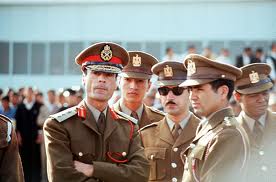
In two years time, Gerry Adams will have been leader of Sinn Fein for thirty years. I can’t think of any European or Western party with a leader who’s been in office even half as long as he has. But over in North Africa there is one leader just as unwilling as he is to pass on the reins of power to others. Muammar Gaddafi, long time patron and sometime paymaster of the IRA, has been ruling Libya for forty years and is, as I write, stubbornly – and violently – resisting efforts to dislodge him from office. The two men’s lives intersected constantly over the last four decades and it looks like they will continue to do so till the bitter end.

Muammar and Me

بلدي مغامرة مثيرة في الشعبية الاشتراكية العظمى الجماهيرية العربية الليبية

(My Excellent Adventure in the Great Socialist Peoples’  Libyan Arab Jamahiriya)
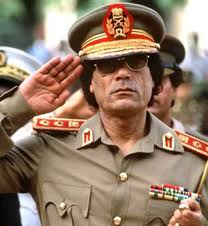
The advert was tiny and it was tucked down by the Bunion cartoon, at the bottom of one of the back pages of the Belfast Telegraph, the ones usually filled with classified ads. ‘English Teachers required for University of Tripoli, Libyan Arab Republic’. it read. ‘Graduates with minimum two years experience at secondary level. Annual salary 5,000 Libyan dinars.’ A quick call to the foreign exchange department of the Ulster Bank: “What’s a Libyan dinar worth”, I asked. “Three pounds” came back the answer. Three pounds! You mean this job pays fifteen thousand pounds a year! So miracles can happen.

It was the summer of 1973 and life was miserable. Two years before I had graduated from Queen’s University in Belfast with a degree in Economics and Politics and little idea of what I was going to do with my life. Out of financial desperation I had drifted into teaching. It wasn’t something I wanted to do and I quickly discovered that I hated it. Since then my personal motto has always been: “Those who can, do; those who can’t, teach”. (Yes, I know that’s horribly unfair to teachers and as I’m married to one – a very good one, incidentally – I’m not allowed to forget how inaccurate and bigoted that statement is. Sorry, but it’s how I feel.) Anyway having become a teacher by default, I was determined to avoid teaching kids, something I knew I’d really, really hate, so I aimed at the tech college level where I thought the students, being older, would be more motivated, more fun to be with. They weren’t.

My first job was at Newtownards Tech College, teaching general studies to apprentice electricians, carpenters and bricklayers although with a surname like mine I’ll never know how I got it. This was Newtownards after all, east of Belfast and as Orange a town as could be found anywhere in the North. The nearest Catholic population of any size was miles away in Portaferry, perched at the end of the Ards peninsula as if they had been pushed there, out of sight, out of mind. If they had been edged any further away from Newtownards they’d have fallen into the sea. I don’t know why I was hired but my suspicion always was that the English accent confused the heck out of the selection panel.

My boss rejoiced in the name, Cecil Maquigg, an elder in his local Presbyterian kirk and a part-time RUC Reservist. The IRA was firing the first shots of its war when I started teaching there and Cecil was out every night, proudly walking the streets of Newtownards to protect it from the republican visigoths. An upright man, who rarely smiled, Cecil put the ‘d’ into dour and the ‘a’ into anally retentive. I am not sure he knew what to make of his newest recruit but he was polite if distant and left me to my own devices most of the time.

The students were a different matter though. It was in their DNA, an ability to sniff out a fenian (or an imagined one, as in my case) from 200 yards. No problem with the accent with these kids; if a guy has got a fenian name then he is one, end of story. If I say that on the Monday morning after Bloody Sunday, I walked into the first class of the day to discover ‘Thirteen – nil!’ chalked in large letters on the board, you’ll get a taste of what it was like to teach there. My next job, at Larne tech, was marginally worse. Bernadette McAliskey once coined the wonderful phrase, ‘Keeping his head lower than a Larne Taig’ to describe a friend who was trying avoid unwelcome attention. After a year in Larne, I knew exactly what she meant.

The two experiences were not entirely awful. I met some nice people, all Protestants, and gained a valuable insight into that community, one that would serve me well when I began life as a journalist. What really made life so wretched was poverty. When I finished at Queen’s I owed £2,000 in bank loans, an enormous sum in those days. This was 1973 don’t forget and to put that into context a teacher at my level earned an annual salary of about £1,100 a year. So I owed nearly two years pay and it looked as if it would take years to clear the debt, scrimping and scraping in the meantime to keep body and soul attached.

The little advert down by the Bunion advert was therefore a potential life-saver. I could pay off all my debts in a few months and by the end of a year I’d have a little nest egg. If I could get two years out of it, life would be changed beyond recognition. So I wrote off for an application, filled it in and a few days later was summoned to a semi-detached house off the Cregagh Road in east Belfast for an interview with a curious Englishman called Dennis Philcox.

I use the word interview but that’s a generous word to describe what happened. Dennis, a voluble, balding man in his early middle age who sprayed more than spoke sentences, was married to a little mouse of a woman from Iceland called Helga who rarely, if ever, opened her mouth. It soon became clear that the only thing on Dennis’ mind was filling his quota of recruits and as long as you had the bare requirements there’d be a job for you. (I later learned that he and a partner already on site in Tripoli were on a finders’ fee for the University, so the more they hired, the more they got paid). He told me that he’d spent his life in ‘teffel’, as he called it, hoped I’d enjoy it too and wondered how quickly I could quit my job and get over to Tripoli. ‘Teffel?’ I asked, a little stunned at the speed of events and not exactly sure what I was getting into. ‘Yes, Teaching English as a Foreign Language, T-E-F-L’, he explained. “Well, I’d have to give a month’s notice. That’s in my contract”. “Great”, he replied, “welcome aboard”. That was it. I was on my way to Libya.

This was my entree to the world of TEFL, and to the community of people who spent their lives traveling from one Arab country to another teaching English to schoolchildren, college kids, oil executives, army officers, the wives of rich businessmen and so on. They’d typically spend two or three years in Saudi before moving to Kuwait or Dubai or Bahrain and so on. Mostly they were single, addicted to the itinerant life and entranced by the Arab world. Oil-rich Libya had been on the circuit for a couple of decades but since the revolution led by a young Colonel called Muammar Gaddafi old certitudes had been shattered.

It wasn’t until I arrived in Tripoli that I began asking the obvious questions. What on earth was the University of Tripoli doing hiring teachers via display ads down by the Bunion cartoon in the Belfast Telegraph? And how come I had got a job, and a lavishly well-paid one to boot, for which I was not even remotely qualified; after all I hadn’t even heard of TEFL until I met Dennis Philcox much less know how to do it.

The answers to those question lay in the complex history and politics of Libya and to the fact that the young Colonel Gaddafi had upended all those comfortable certainties which in the past had ensured that Belfast would be the last place on earth where Libya would seek its English teachers. These events had already interacted with the lives of the two dozen or so teachers hired  by Dennis Philcox and they would interact in a wider and more far-reaching way with the politics and history of Ireland for the next several decades.

Ireland and Libya had one thing in common and that was an unhappy history as someone else’s colony and while Libya’s experience was every bit as miserable as Ireland’s, Libya could justifiably claim that hers was much, much longer. Libya was first occupied by the Roman Empire in 167 BC and ever since then one foreign power or another had taken the place over to enrich and empower themselves. After the Romans came the Moslems, then the Turks followed by the Italians who at first ruled via a local puppet monarchy, the Idris family, until Mussolini appeared on the scene, dispensed with the Idris clan and after a guerrilla war against Libyan partisans which cost many tens of thousands of Arab lives (a story captured in the movie, Lion of the Desert starring Anthony Quinn), absorbed Libya fully into Italy.

What attracted these early foreign interlopers to Libya was its coastal strip. The soil is rich and the Mediterranean climate balmy for ten months of the year. The combination made the Libyan coastal strip Rome’s bread basket and so enriched
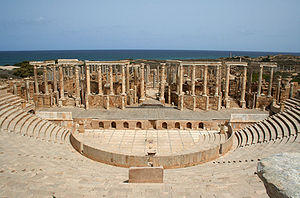
The ampitheatre at Leptis Magna, a Roman city west of Tripoli

Roman merchants that they were able to build two large cities on either side of what is now Tripoli (the ruins are spectacular by the way). The Turks came for the same reason, as well as the strategic advantage afforded by Libya’s geography, and so did the Italians, who shipped over thousands of farmers who, in shades of Ireland’s Plantation, stole land away from the locals to turn into vast olive farms.

The Italians were of course ejected after the Second World War and the victorious powers, America, Britain and France divided the country up into spheres of influence and installed the Idris family back onto the throne. The American sphere was in the west, around Tripoli where a huge airbase, Wheelus, was built. The French took the south, mostly scrabble hard desert but strategically important since it abutted on the French colonies of Chad and Niger, while the British took the east, around Benghazi and the scene of Montgomery’s victory at Tobruk over Rommel, conveniently close to Egypt and the Suez canal, which Britain was determined to hold.

The British used the adjoining desert as a military training ground. Veterans of the conflict in Northern Ireland will remember that after Operation Motorman in 1972 the British imported a fleet of Saladin and Saracen armoured cars to ferry their troops around the streets of Belfast and Derry. The vehicles stood out because instead of a dull shade of khaki like other British vehicles, these had been painted a bright sand yellow and the reason for that was that they had come directly from these training grounds around Benghazi.

By this time oil had been discovered in Libya. Not just any old oil but stuff that was so pure that it was said that it could be poured straight from the ground into a motor car’s engine. That meant it needed very little refining and was more than ordinarily profitable for oil companies. So Libya’s abundantly fertile coastal strip was replaced by oil as the motive for foreign interference and for the best part of a quarter century the post-war settlement prospered: the Idris family ran the place and cut deals with oil companies that enriched them both while the British, Americans and French supplied the Libyan elite with its needs and exercised huge cultural and political influence over the country. The Libyan masses though were left mostly untouched by this enormous natural bounty, as they had since the days of the Roman Empire. (Question: What did the Romans ever do for the Libyans? Answer: Nothing) By 1958, the United Nations calculated that Libya was the third poorest country in the world.

And then along came Gamal Abdel Nasser. Along with officer colleagues in the Egyptian army, Nasser overthrew the pro-British monarch King Farouk in 1952 and in 1956, on a platform of pan-Arab solidarity, social and economic reform and opposition to foreign interference in the region, he was elected President of Egypt. That year Nasser electrified the Arab world when he nationalised the Suez Canal, edging its two largest shareholders, Britain and France into a conspiracy with Israel to invade Egypt and recapture the Canal. The adventure failed, thanks largely to American disapproval (a stand that nowadays seems like it could have happened on another planet) while the debacle of Suez marked the final and undeniable sunset of the British empire. The Suez Canal had long symbolised Western interference in, and domination of the Arab world and Nasser’s move made him an Arab hero and a role model for a young Libyan army officer called Muammar Gaddafi.

Gaddafi’s revolution was modeled entirely on Nasser’s and in many ways was a facsimile. Gaddafi overthrew a pro-Western puppet monarch, just as Nasser had, and he and his fellow revolutionaries shared Nasser’s enthusiasm for radical

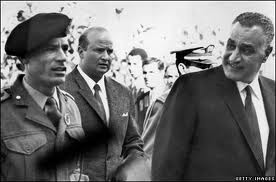
A young Muammar Gaddafi with his hero, Gamal Abdel Nasser of Egypt

social and economic reform. They were also pan-Arabists and Gaddafi’s Libya applied almost immediately for membership of Nasser’s United Arab Republic, the ill-fated union of Egypt, Syria and Iraq. They were also determined to get pay back from the European powers who had colonised or exploited Libya for so long – and that’s where Dennis Philcox and his ad in the Belfast Telegraph enters the story.

Gaddafi and his co-revolutionaries made expulsion of Western oil companies and their governments a major and early priority. By 1973, BP and other foreign companies had been nationalised and oil production was firmly in the hands of the Libyans. The Americans had been forced to close the airbase at Wheelus (in 1974 you could still climb into the cockpits of abandoned American jets lying scattered around the base), the French had been chased out of the south and the British had emptied their military bases and training grounds around Benghazi.

Through the British Council, the British had also supplied the bulk of Libya’s English teachers but in 1972 Gaddafi cancelled their contract. The British Council was an arm of the Foreign Office, and regarded by the Libyans in the same light as the British Army, but it had long been viewed in the Arab world, and elsewhere, as a convenient cover for spies and that was another reason for kicking them out. (The notion that the British used teachers as spies was not, as I learned, that far-fetched. One non-British Council teacher in the agricultural department at the university one night confessed to me in his cups that MI6 had asked to see him during his vacation breaks so that he could be debriefed on a huge Gaddafi-inspired project to irrigate and farm part of the eastern desert. He agreed to help them.)

So that’s why Dennis Philcox was running around recruiting teachers for Libya

Gaddafi and fellow revolutionaries determined to rid Libya of Western influence

although it didn’t quite explain why he had come to Belfast of all places to do so. Strictly speaking Belfast should have been last on his list. The Belfast accent is about as far away from RP, as the TEFL pros call it, as you could get. RP stands for Received Pronunciation, or, if you prefer, a BBC accent and the idea that young Arabs were being taught English by people with such coarse, incomprehensible enunciation horrified and outraged those few British Council leftovers still working out the remnants of their contracts when we arrived in Tripoli.

No, the reason Dennis had set up a base in Belfast had more to do with Nasser, the Suez Canal and Gaddafi’s desire to tweak the noses of the old imperial powers, especially the Brits, than it had with any teaching skills or fluency in English. Dennis had come to Belfast, unwittingly or otherwise, I do not know, to provide camouflage for the Libyans so that they could install an agent of the Provisional IRA in Tripoli, an ambassador if you prefer because that is how he was treated, to liaise with them over weapons and financial assistance for the IRA’s war in the North. That agent wasn’t in our particular group but he was one of dozens of Irish teachers recruited, North and South, at that time, so many that one would not stand out and therefore would less likely come to the attention of MI6 or other agencies that kept a wary eye on Gaddafi’s dealings.

I have written extensively elsewhere about that liaison between the IRA and Gaddafi, how the agent, a small, elf-like man from a town in Co. Monaghan who was known to the Libyans as ‘Mister Eddie’, would teach English to the children of Libyan Army officers by day but at night retire to his villa in Tripoli’s embassy district where he would dine off exquisitely embossed plates confiscated from King Idris’ palace and discuss the war in Ireland with his contact from Libyan intelligence.
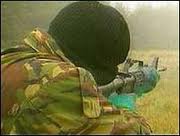
IRA man fires a rifle supplied by Gaddafi

I have also written about the last dramatic chapter in that liaison which culminated in the capture of the gun-running ship, the Eksund in 1987 and how that event transformed the IRA’s fortunes, closing off for good any lingering hopes of military victory, but planting the suspicion of high-level betrayal and the seeds of a bitter split in the IRA while accelerating the infant peace process. This is not the place to rehearse all that history but to make a broader point about the Gaddafi-IRA relationship.

The striking aspect of their association is the extent to which the stories of the Provos and Muammar Gaddafi have run on parallel tracks, more or less, throughout the years of their existence, beginning with their genesis. They started out in life at more or less at the same time: Gaddafi’s revolution happened on September 1st, 1969 while the Provos effectively came into being a fortnight earlier, on August 15th, 1969 when the inability of the disarmed/unarmed IRA to defend Catholic homes from Loyalist petrol bombs inspired a revolt and split in the ranks. Gaddafi threw off the yoke of a monarch he regarded as a puppet of the West while the Provos rejected a leadership seen as being just as out of touch with the needs of their people.

They both then shared years of commitment to revolution and a conviction that only violence and armed struggle could achieve their aims, Gaddafi through funding and arming anti-imperialist insurrections throughout Europe and Africa and the Provos by bombing and shooting, by killing and destroying.

Both then shared an existence marked by failure, isolation and near defeat followed by re-assessment and a rejection of their old ways. Gaddafi’s volte-face came about thanks to international sanctions imposed in the wake of the Lockerbie bombing and other incidents and culminated in two highly symbolic acts, both designed to signal a radical change in direction. Only one is really known about. That was Gaddafi’s surrender in 2004 to George W Bush’s demand that he dismantle his ‘weapons of mass destruction’, as overt a genuflection towards Washington as it was possible to make.

The other act, which happened years before, is less well known. When the IRA

Semtex explosive - Gaddafi's gift to the IRA

made the arrangements for the arms shipments of the 1980’s, Joe Cahill, who had been chief of staff when the relationship with Gaddafi began, accepted a Libyan insistence that the real identities of the IRA personnel involved in the operation, from leaders like ‘Slab’ Murphy and Micky McKevitt through to the foot soldiers who had been sent to Libya to train in the weaponry, be recorded by the Libyans. Each man was obliged to fill out a form detailing exactly who they were which was then handed over to Libyan intelligence. When Gaddafi began to repair relations with Britain in the early to mid 1990’s he handed over those details to MI6 as a sign of his bona fides along with the manifest of weapons shipped from his armories, a concession that facilitated the demand during the peace process that the IRA decommission its weapons. Muammar did the dirt on his old mates, in other words, to save his skin.

The Provos faced defeat and isolation at a much earlier stage than Gaddafi and while it was the 1981 hunger strikes and the subsequent foray into electoral politics that stimulated, at least amongst the leadership around Gerry Adams, a re-assessment and eventual renunciation of armed struggle and their old ways, both they and Gaddafi ended up in the same place, as friends and allies of those they had hitherto spent their lives and expending their energies trying to destroy.

Consider some of the links Gaddafi is said to have forged in recent years. According to the Washington-based Politico website, the grand-daddy of the neocon hawks, Richard Perle, aka ‘the Dark Prince’ and one of those who agitated behind the scenes for the invasion of Iraq, became a Gaddafi adviser and frequent visitor to his desert tent beginning in 2006. Perle was working on behalf of the Boston-based consultancy firm, Monitor and debriefed VP Dick Cheney on his chats with the Libyan leader. Also recruited by Monitor as Gaddafi confidantes were the ‘end of history’ neocon icon, Francis Fukuyama and arch neocon, Bernard Lewis, said by some to be the single most persuasive influence on George Bush’s decision to invade Iraq. By their friends shall ye know them.
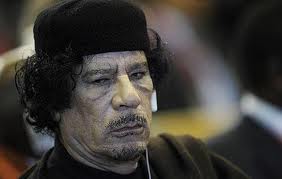
Gaddafi - the former revolutionary, ravaged by forty years of power and corruption, counted US neocons amongst his confidantes at the end of his reign.

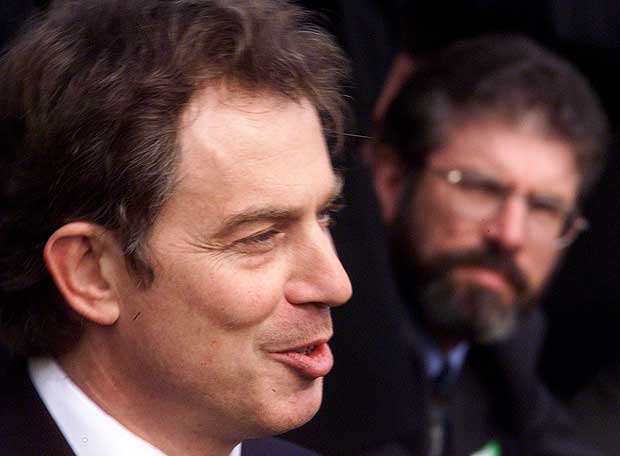
Last June, Gaddafi’s son, Saif al-Islam Gaddafi revealed the identity of another intriguing recruit to his father’s stable of advisers, telling The Daily Mail that Tony Blair had become ‘a personal family friend’ of the Libyan leader and that the two men were now on first name terms. Saif said that Blair, who is also an advisor to the Wall Street bankers J P Morgan and reportedly within sight of acquiring a personal fortune of some £20 million, had become a consultant to Libya’s sovereign wealth fund which has assets of around $65 billion and had visited the country ‘many, many times’ since quitting as prime minister. Their relationship prospered, he said, when Blair negotiated the release of the Lockerbie bomber in return for a lucrative oil contract awarded to BP.
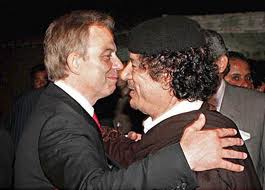
Tony and Muammar

Blair denied the Mail story but Saif Gaddafi was adamant: ‘Tony Blair has an excellent relationship with my father”, he insisted. “For us, he is a personal family friend. I first met him around four years ago at Number 10. Since then I’ve met him several times in Libya where he stays with my father…….He’s an adviser to the LIA, the Libyan Investment Authority. He has some consultancy role.’

The facts are much less clear cut when it comes to the relationship between Gerry Adams and Tony Blair but given revelations from Blair’s chief of staff, Jonathan Powell that he and his prime minister helped draft IRA statements at key moments during the decade-long peace process, and that Blair’s strategy of boosting Sinn Fein with concessions during negotiations, no matter the collateral damage done to the Unionist leader David Trimble or Sinn Fein’s Nationalist rivals, John Hume’s

Tony and Gerry

SDLP, helped make it the dominant Nationalist party in the North, questions about the ties between them – was Blair an adviser or just a helper? – will be debated long after both men are dead. It could hardly be otherwise. You could say that Tony Blair destroyed the centre ground of NI politics in his quest to boost the Sinn Fein leader and you can’t get more buddy-buddy than that.

Whatever the truth there’s no doubt that in the case of Gerry Adams – and with Gaddafi until recently – their respective political turnarounds brought respectability, success and a new sense of security – as well as a new and surprising set of friends.

The fortunes and life stories of the Provos and Gaddafi may have travelled on parallel tracks for most of the past forty years but no longer, or so it seems. As I write this, Gaddafi faces extinction in Libya while, thanks to those pesky bankers, Adams is enjoying something of a revival in fortunes with a good result in the recent Irish general election. Will their paths now diverge? Who knows, but bear in mind what Chou En-Lai once said about the lessons learned from the French revolution – it’s far too early to tell.

As for me I had a ball in Libya. I spent two years there teaching in the language laboratory (the accent again doing me a favour) and I met some great Arab students, none more memorable than Juhanah, a Palestinian girl with perfect English whose family had twice been driven from their homes by Israelis, in 1948 from their farm near what became Tel Aviv and in 1967 from their home in West Jerusalem. Her father, a Cambridge educated philologist and as sophisticated a man as you could meet on a long day’s walk, had been obliged to take a low ranking job in a Libyan ministry to keep his family fed and clothed, taking orders from bullying oafs.

I lived in a villa on a farm cum fruit orchard that had once been owned by Italian colons but was now back in Libyan hands that was within driving distance of

Happy Days!

empty, silvery Mediterranean beaches where many an afternoon was spent snorkeling, swimming and sunning. These were the early years of Gaddafi’s revolution. No wall-sized portraits of the dear leader stared down at you from street corners and the oil money went where it should, to the building of new apartment blocks, schools and hospitals and the wallets of ordinary Libyans.

Life was good. Booze flowed like oil from the desert wells (the Libyans turned a blind eye as the European and American expats brewed home-made beer or distilled ‘Flash’ with skills honed in the Glens of Antrim or the woods of Kentucky) while government subsidies on food meant that at night, as the cicadas sang their entrancing song, we barbecued whole sirloins or fillets of beef bought at the same price as stewing meat and feasted like kings. We were young, we were single and, for the first time in our lives, we had money in our pockets. I paid off all my debt, came home with enough money to buy a house and the energy and drive to make teaching a thing of the past.

I will always have a great affection for Libya but I hope Muammar goes to where all the hypocrites and tyrants should go. If he does, I’m sure he won’t want for company. And if he waits long enough he just might be joined by some old friends.

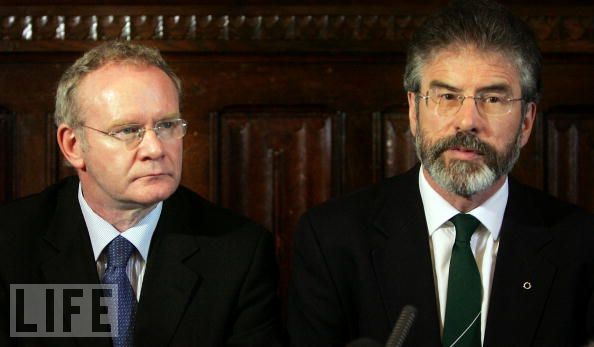
Micheál Martin, Gerry Adams and Martin McGuinness

Not too long ago anyone who publicly doubted the honesty and integrity of Sinn Fein leader Gerry Adams was, in some quarters south of the Irish border, risking the sort of response usually reserved for child molesters and war criminals. Few could be more withering and condemnatory, especially behind one’s back, than Fianna Fail, although to be fair the Department of Foreign Affairs always gave them a run for their money.

I am of course speaking of the days of the peace process, especially pre-Northern Bank robbery, when to suggest that Gerry Adams was anything less than a fountainhead of truth and candour was on a par with concocting a breakfast recipe that featured fattened Protestant babies in the main course.

Now it may have been the case that people like the then Taoiseach Bertie Ahern and his Northern point man Martin Mansergh truly believed that Adams was being sincere and straight in his peace process dealings but I seriously, seriously doubt it. Something as difficult as getting the IRA to end its war on the terms that were finally accepted was not the sort of project that could be steered to success without a considerable amount of falsification and dissembling. And Bertie and Martin would have known that very well.

So when Gerry Adams or his nom de guerre, P O’Neill, would routinely assure the troops that IRA decommissioning was just not on the cards, my hunch is that Bertie and Martin would look at each other and wink. They would, or should have known via Garda Special Branch that this was nonsense and that plans to do just this were already being laid just as they knew that Adams was aware that decommissioning was the price he’d have to pay to get Unionists to share power with him.

But they would also have been acutely conscious of another peace process reality: lying to and deceiving the Provo grassroots in this way was the only assured route to eventual success. It kept the IRA rank and file content and quiet, lulled into a false sense of security until it was too late for them to do anything about it. In the same way, Bertie and Martin would, I suspect, have grinned and borne it whenever Adams or P O’Neill denied that the IRA robbed this or that bank, knowing this would also keep the grassroots bamboozled, convinced that their leaders were trustworthy, had once again successfully hoodwinked the Irish government and that the IRA would never go away.

Bernadette McAliskey once compared the peace process to pushing a fly down the neck of a wine bottle. Eventually a point would be reached when there was no traction left and the fly would fall, helpless, to the bottom of the bottle where it would drown in the dregs. Mendacity was the stick that pushed the fly down the neck of the bottle.

In fact it would be no exaggeration to say that the ability of Gerry Adams to lie and fool so expertly was the peace process’ most valuable asset. Had Adams been straight and honest with his people about where the IRA was going to end up, he would have been found long before 2005 in a ditch somewhere in South Armagh, trussed up like a Christmas turkey with several bullet-shaped holes in his skull. Without his talent for dissimulation we would never have got to 2005 when the IRA, finally divested of its Semtex and AK-47’s, declared its war against Britain to be over.

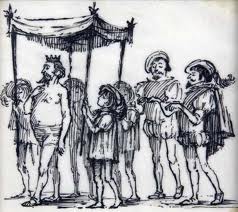
The corollary of all this was that a special venom was reserved by the Irish state for anyone in the media who dared suggest that the Sinn Fein leadership had less than a monopoly on the truth. Everyone knows the fable of the Emperor’s new clothes, how a child shames the crowd into admitting the truth, that the Emperor parading in front of them supposedly clothed in finery is actually stark naked. There is a special Irish version of the story with a very different ending. When the child cries out ‘the Emperor is naked’, the crowd reacts by turning on the child and beating it to death.

It is, of course, the job of government to lie and deceive or to connive at others’ lies in the pursuit of implementing policy. And many will say that telling lies in the quest for peace in Northern Ireland was not only excusable but laudable. But journalists are not politicians, or at least they shouldn’t be. They – we – have a special duty to the truth, even if that causes discomfort or difficulty. Whenever I was assailed by government officials, or more often by fellow hacks, for writing stories deemed ‘unhelpful’ to the peace process my response was simple: if this process cannot survive one of my stories then it’s doomed no matter what I write or do not write. Joining in the deception, either by commission or omission, wouldn’t make a jot of difference except to devalue the trade of journalism, to render it a useless and unconvincing charade.

So, I have to say that when I heard that the new Fianna Fail leader Micheál Martin had challenged Gerry Adams to tell the truth about his past membership of the IRA, to “come clean” about his “baggage from the past” as he put it, I have to confess that I laughed out loud and long. “There is a fundamental problem for Gerry when he continues to deny his membership of the IRA”, said the bold Micheál, “because every time he talks in this debate during the election about honesty . . . it jars very much with his own position about the past.” Indeed it does Micheál but you didn’t have that problem back in 1998, did you?

Micheál Martin was not only a minister in the Fianna Fail cabinet from 1997 onwards, during the key years of the peace process when there a special premium on Adams not telling the truth, but he is a former Minister of Foreign Affairs whose civil servants not only helped Adams hone to perfection his  dissembling skills but often led the charge, employing a special sense of viciousness, against anyone who questioned the Sinn Fein leader’s honesty.

Micheál Martin, more than most people, has known for a very long time that, in relation to Northern matters, Adams and the truth have often been strangers and the fact that he chose this time to let us all in on the secret is a sure indication that in the forthcoming election the Fianna Fail party is headed down the toilet. Truth suddenly acquires virtue, one could say, when political destruction stares you in the face. There was a sense of desperation about what he said, as well as artifice, and I suspect the Irish voter picked up on it.

There was however one line in Micheál Martin’s statement that especially drew my attention and it was this: “Martin McGuinness doesn’t have a problem admitting his membership in the past but I think there is a huge problem for Gerry Adams in a credibility sense.”

Actually not entirely true, Mr Martin. Not only not the full truth but also unfair to Mr Adams. It’s unfair to Gerry Adams because in the narrative of Provo dishonesty peddled by the likes of Micheál Martin, the Sinn Fein leader is depicted as the singular voice of skullduggery in Sinn Fein whereas in fact Martin McGuinness has lied ever bit as flagrantly about his IRA history as Gerry Adams and, I strongly suspect, would have lied as comprehensively but for a few inconvenient pieces of newspaper and television archive.

The Martin McGuinness that I came to know as a journalist covering the Northern Ireland beat was rarely far from the very top of the IRA pyramid. In the mid to late 1970’s he was the IRA’s first Northern Commander, appointed to the job when on Adams’ advice a separate Northern Command was created whose effect, if not purpose, was to take power away from Southern IRA leaders. He then became Chief of Staff and held that post until 1982 when others on the Army Council insisted that he had to give it up if he wanted to run as a Sinn Fein candidate in the elections to Jim Prior’s Assembly.

He always hankered to get the job back and for years afterwards a vicious feud simmered beneath the surface between him and Kevin McKenna who took over the post and held it until he was succeeded by ‘Slab’ Murphy. McGuinness re-entered the military picture in a serious way in the mid-1980’s when, in preparation for the arrival of Libyan weaponry and the launching of the IRA’s version of the ‘Tet offensive’, he was again made Northern Commander with the special job of distributing Col. Gaddafi’s guns to the units on the ground. The task that he performed was done in such a way that it brought him into conflict with Michael McKeviit, then the QMG. McKevitt came to suspect that for whatever reason, McGuinness gave more weapons to units that were most likely to lose them, usually through the efforts of informers.

When the peace process got under way he played two key roles. One as the IRA’s (or at least Gerry Adams’) secret contact man via people like Derry businessman Brendan Duddy with British intelligence and the Northern Ireland Office; the other as Chairman of the Army Council, traditionally the IRA’s chief diplomat and representative in discussions with outside individuals and bodies. When the media would describe McGuinness as the ‘Sinn Fein negotiator’ during peace process talks they got it wrong. He was actually there representing the Army Council, as their official ambassador.

So in all the years between the mid-1970’s and 2005, Martin McGuinness was there at the very top of the IRA or thereabouts, playing a crucial role in both its military and political side.

But what does Martin McGuinness himself say about what he was doing during this period?

Well the answer to this question can be found in the report of the Saville Tribunal into Bloody Sunday, to be specific in the transcript of witness cross-examinations, pages 140-141 of day 391’s business. McGuinness was being questioned by Christopher Clarke QC, counsel for the Tribunal about the “Green Book’, which contains the IRA’s manual, statement of aims and constitution and this is how it reads:

Q. It may well be, sir, you had already left the IRA by the time this document in the form that we have it, came into existence. When did you leave the IRA?

A. Here we go again, on another trawl through the Martin McGuinness fixation.

Q. No, it is not at all, sir, not at all. May I just explain to you, because you have been very concerned, understandably, to be treated in the same way as the soldiers, and it is precisely the same question, word for word, as was asked, I think, of some seven or eight soldiers.

A. Were they asked when they left the British Army?

Q. Yes, simply because it was thought to be relevant to the way in which other people had reacted to what had happened on Bloody Sunday. You do not have to answer my question or any of them, I ask them, and I will not ask them twice, it is for the Tribunal to say whether you should answer them or not: I ask again, when did you leave the IRA, if you did?

A. I left the IRA in the early part of the 1970s.

So during all those years when we thought that Martin McGuinness was Northern Commander (twice), Chief of Staff and then Chairman of the Army Council, he was really a civilian with no connection at all to the IRA. How could he be anything else since he told the Saville Tribunal under oath that he had left the organisation in the ‘early’ 1970’s?

I can almost hear the readers’ response: “Sure, that’s bullshit but at least he admits he was in the IRA, if only for a bit!” And that’s true and it’s more than Gerry Adams has ever acknowledged. But why lie about the three decades or so after the ‘early’ 1970’s and not about the two or three years before it? Is it because there’s more to hide in the later years or because he screwed up in those early years, admitting things about his association with the IRA that he regretted later and which the wilier Adams would never have? And if he had not said or done those things would he too, like Adams, now be swearing to the world that he had never, ever been in the IRA?

Martin McGuinness at an early IRA funeral in Derry

There’s this for instance, something that falls into the rush of blood to the head category, a statement he made from the dock in Green Street courthouse, Dublin in 1973 when he was convicted of IRA membership:

“We have fought against the killing of our people. I am a member of Oglaigh na Eireann (IRA) and very, very proud of it.”

That’s something Mr Adams would never have said.

Then there’s this video of an appearance at an IRA press conference in Derry in June 1972, perhaps an example of McGuinness succumbing to the lure of the klieg lights. He is flanked by IRA Chief of Staff, Sean Macstiofain, Belfast Commander Seamus Twomey and Army Council member Daithi O Connail, and the purpose of press conference was to put forward an IRA ceasefire proposal to the new NI Secretary, Willie Whitelaw. There’s an even more famous television interview, broadcast on ITV but sadly not available on YouTube, in which a youthful McGuinness admits being the Derry Commander of the IRA. Again the shrewder Gerry Adams would have steered well clear of such exposure.

After blatant admissions like these it would be impossible for Martin McGuinness to deny he had been in the IRA in the ‘early’ 1970’s. But after that, in the subsequent three decades, he never made a similar mistake or engaged in such embarrassing frankness ever again and, thankfully from his viewpoint, it was so much easier therefore to resort to the lie.

There’s another part of the story of Adams, McGuinness and the peace process that is vital to an understanding of this period. For sure, Gerry Adams dissembled the IRA into decommissioning its weapons and ending its war with the British but he didn’t do this alone. He couldn’t have achieved it without McGuinness’ help for while Gerry was the Provos’ political leader, he never had the trust of the IRA rank and file that Martin had. The reason was simple: Martin had a military track record and Gerry didn’t. Martin had done the business and Gerry hadn’t. So when Martin would give substance to Gerry’s assurances that all was well, as in this video, it gave the whole project a crucial credibility.

In the days before my book ‘A Secret History of the IRA’ was published in the autumn of 2001, Martin McGuinness toured newspaper and television offices in Dublin and London to talk about it to editors and senior journalists. His purpose was simple, to blacken my name and label me a dissident fellow-traveller. It was partly an effort to do the book down and partly an exercise in intimidation, carrying with it the implied threat that any journalist treating my book sympathetically or seriously risked the same treatment. He even went to see my editor in the Sunday Tribune, Matt Cooper. Matt asked him did he believe Gerry Adams when he denied ever being in the IRA? “Yes” replied McGuinness, not missing a beat. “He looked me straight in the eye when he said it”, recalled Cooper.

Martin and Gerry

The Death of a Newspaper

The announcement last week that Tony O’Reilly had sent the bailiffs into the Sunday Tribune was a bit like hearing of the death of an old ailing friend; you had been expecting it for a long time but even so, the shock is still intense, the sadness real.

The Sunday Tribune was so much part of my life in Irish journalism that it really does feel like a limb has been chopped off (not that you would notice the difference these days!).

The paper was born out of the old Hibernia weekly magazine that had been run for years out of a Dickensian suite of offices near Dublin’s Custom House by John Mulcahy and his wife Nuala in their uniquely paternal but often inspirational way. They gave me my first proper job in journalism – for which I will always be grateful – and since I was there at the death of Hibernia, I can claim, I think, to have played a small part in the conception, if not birth, of the Tribune.

The Mulcahy’s had the good luck to come into ownership of Hibernia at the start of the Northern Troubles and they made the magazine’s name with a consistent record of investigative journalism on that side of the Border, burrowing into places where the mainstream press did not have the nous nor, as government-imposed and media self-censorship began to bite, the courage to delve. To its eternal credit Hibernia earned the wrath of Conor Cruise O’Brien in the flush of his Section 31 days; he took a hissy fit one day and condemned it as a cross between the good wine guide and Republican News. Mulcahy thought it a wonderful compliment.

Sadly it was the North that also brought Hibernia to its knees. An article by the late, great Jack Holland about the involvement of the Royal Ulster Constabulary alongside Loyalist paramilitaries in the intimidation and forced movement of hundreds of Catholic families from the Rathcoole area of north Belfast in 1972 spelled disaster for the magazine. Jack had named a couple of senior RUC officers as being in charge of the local police, and therefore responsible for what happened during those terrible days but unfortunately he got his information from a Constabulary gazette that was out of date. The cops sued, it was an open and shut case and that was the end of Hibernia.

(In a last desperate effort to get some dirt on the policemen, Mulcahy gave me two weeks off in the early part of 1980 to dig into the story for any evidence that they had been somehow involved. They weren’t, but my burrowing took me to the Twinbrook housing estate on the fringe of West Belfast where many of the Rathcoole refugees had been rehoused. One of the families I interviewed was called Sands and they told me that yes, the RUC had stood idly by watching, while they were forced by armed thugs to flee their home and their eldest boy, who was called Bobby, was so angry that afterwards he had joined the IRA and was now languishing in the H Blocks of Long Kesh. We’d soon hear a lot more about him.)

With Hibernia out of business, Mulcahy launched the Sunday Tribune later the same year with Conor Brady (originally editor of the Garda Review and later the Irish Times) as his editor. But then the Midas syndrome, the conviction that some businessmen develop that they can do no wrong or ever fail in commercial matters, intervened. The Tribune was doing well, its journalism was much admired and it was moving towards profitability when one of Mulcahy’s partners, Hugh McLaughlin insisted on launching a new daily paper, the Daily News which was a (deservedly) disastrous flop. When it failed the Sunday Tribune was brought crashing down alongside it.

In stepped Vincent Browne to buy the title and relaunch the paper. Sunday Tribune Mark II, the real Trib, was born.

If there is one man who made me the journalist I later became it was Vincent. By the time I first encountered him, in 1979, he was already a legend. He’d cut his reporting teeth for the Irish Press group and later the Irish Independent covering the North in the very early days of the Troubles. He was the very first to talent spot Gerry Adams, then working his way up through the ranks of the IRA’s Belfast Brigade, and he penetrated the strange world of Northern Loyalism, something very few other southern journalists were able or willing to do.

One story, an interview with a youngish Ian Paisley caused a sensation when the Protestant leader effectively (albeit only temporarily) abandoned his Unionist politics and conceded that if Articles 2 and 3 of the Irish constitution were scrapped (they laid claim on the territory of Northern Ireland), he’d favour closer relations with the South. Changing the constitution in this way thereafter became a priority, even an obsession for the Department of Foreign Affairs in Dublin. They finally got their way in the wake of the Good Friday Agreement.

By 1968 he had already started one magazine, the monthly Nusight (which propelled that complex being, Kevin Myers into journalism) and then in 1977 he launched Magill magazine which had so many high points over the years  (the Arms Trial issues come to mind) that you couldn’t count them.

Two qualities marked Browne out as a truly exceptional editor and journalist: one was a real love for the skill of reportage, that is the ability to firstly identify where the story was and then to get at it and finally write it up in an attractive, readable yet penetrating fashion, and the second was his gift for spotting other journalistic talent. Some of Ireland’s most talented reporters and writers, from Colm Toibin (former Magill editor) to Paddy Agnew to Gene Kerrigan (Magill columnist) amongst many, many others, got their start with Vincent and I believe it is for this that he should be best remembered. He watered the garden of Irish journalism (often with more than the stuff that comes out of taps) and planted many of its seeds. Inasmuch as the garden has blossomed, it is in no small measure down to Vincent.

Vincent also gave me a start by commissioning a series of articles on the North in 1979. With those pieces in my portfolio I was able to persuade John Mulcahy to give me employment (landing a job with Hibernia was the equivalent then of waking up in Heaven) and the rest is history. I briefly rejoined Magill a couple of years later before moving to D’Olier Street and when the Irish Times and myself fell out in 1986, I was hired by Vincent as the Sunday Tribune’s Northern editor. I stayed there until 2001, outlasting him incidentally by nearly a decade. He could be extraordinarily kind and generous – he and his delightful wife Jean, once put me up for weeks in Dublin while I house-searched for my new family – and he always paid well if he was getting good work from you.

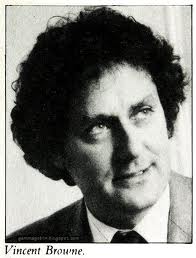
Vincent in his heyday

There was however another side to Vincent, as those who had dealings with him knew only too well. He could never make a friend without falling out with them, often in a tirade of angry insults and abuse. He had high standards to be sure and couldn’t abide it when others failed to meet them, as they often did. There’s nothing wrong with that but Vincent could be so unimaginably cruel to people who otherwise worshipped him that these confrontations often ended with the victim in tears, vowing eternal hatred for the man.

His editorial meetings on a Tuesday morning were such exercises in terror that I always found an excuse to skip them. That was the great advantage of working in Belfast, a hundred miles away; there was always a breaking story to cover or the plea that making the journey there and back would lose me a full working day.

I attended only a handful of them and they were truly awful affairs. The staff would filter into Vincent’s office with about as much enthusiasm as a condemned man facing the gallows. The bravest among them would take seats at the big editorial table while the rest hugged the wall as if praying that they would merge with the paintwork and go unnoticed. There was a good reason for that; Vincent would always descend upon one poor soul and rage about how pitiful their story that weekend had been. Even though the humiliation was heart-rending to witness, the rest of us would breathe a sigh of relief, quickly tempered by a horrifying thought: “Would it be my turn next week?”

Being stationed in Belfast meant that our paths rarely crossed and for that reason I probably stayed friends with Vincent longer than most. But inevitably the day of our falling out arrived. We quarreled about many things but at the root of our dispute was a fundamental difference about where the North, and specifically the IRA, was going.

Like most in the Southern media, Vincent had failed to spot the burgeoning peace process and by the early 1990’s he was openly advocating the re-introduction of internment to deal with the Provos. By contrast I was writing about the potentially huge ideological changes, and likely compromises to come, that were happening within the leadership of Sinn Fein and, therefore, the IRA. But as far as Vincent was concerned I might as well have been filing my copy from Mars, so out of touch with reality, so accommodating to the men of violence was my coverage.

We dueled furiously over ersatz issues and finally a fax arrived one summer afternoon. I was being transferred to work in the Dublin office. How quickly could I report for duty, he demanded? I replied ‘Whenever you wish’ and heard nothing more. He had obviously been hoping that I would object and refuse, and that would be a firing offence. In reality he wanted me nowhere near the Dublin office. And so it went on until deus ex machina-like, everything changed.

For that I have to thanks Vincent’s other failing, the fact that he was a lousy businessman. Like Hugh McLaughlin he was infected with the Midas virus and in the early 1990’s, as the Sunday paper was consolidating itself, he started the Dublin Tribune, a giveaway that was meant to form the beginnings of a new daily paper.

Now anyone who knows anything about the newspaper business can tell you that you produce freesheets with nothing more ambitious than two men and a dog; anything more and it becomes a sure money loser. But Vincent knew better and before too long there were more reporters working for the giveaway Dublin Tribune than were employed in the money-making parent publication. Admittedly the journalism was great and once again Vincent discovered some great writing talent – it was edited by the lovely Michael Hand and Rory Godson and, inter alia, included amongst its stars Ed O’Loughlin, listed for a Booker prize in 2009 for his novel ‘Not Untrue & Not Unkind’ – but it was a commercial disaster and a drain on the Sunday Tribune.

Finally the board moved against Vincent and, in 1994, he was sacked. The Trib then became part of the Independent stable, bought by Tony O’Reilly we were told, to stave off a broader challenge to his titles from Rupert Murdoch’s empire.The Sunday Tribune never made Tony O’Reilly a penny, as far as I know, and it was always a mystery why he kept it going, especially since the rationale for buying it had long since been undermined by the Sunday Times’ success in Ireland. The only surprise in the move to put the paper into receivership is that it took so long to happen.

I cannot say that I have a word of complaint about O’Reilly’s management of the Sunday Tribune. They stood bravely by me when Scotland Yard attempted to destroy my career and always allowed me a complete free hand in my coverage of the North, especially during the controversial years of the peace process when the Irish media were sharply divided into the (larger) ‘helpful to the process, i.e. ask no questions’ camp and the (much smaller) ‘unhelpful, i.e. ask too many awkward questions’  bunch, of which I am proud to say I was a founder member.

But the Sunday Tribune for me will always be Vincent Browne’s newspaper. I will miss it just as I miss our friendship.

Any takers?

Al Jazeera again

Well, the lack of access to Al Jazeera in the US is now a mainstream story. Must be because the New York Times has finally caught up with it! Sarcasm aside, one has to concede that it takes the Grey Lady to force the cable companies out in the open.

Al Jazeera update

Apparently quite a few people have had the same thoughts as myself about the non-availability of Al Jazeera English in the US. The Huffington Post has a piece posted today covering much of the same territory and here is a link you can use to demand that your local cable company starts providing AJE coverage. Use it.

Why can’t I watch Al Jazeera?

Is it too much to hope that one outcome of the convulsions currently gripping the Arab world will be that American cable television viewers can now get to watch Al Jazeera’s coverage of events in that crucial part of the world? Probably, but anticipating disappointment should never deter one from doing the right thing.

So, in that spirit I’d like to endorse Jeff Jarvis’ call on his Buzz Machine blog for American cable companies to add the Qatar-based broadcaster to their channel lineups. Jeff writes:

What the Gulf War was to CNN, the people’s revolutions of the Middle East are to Al Jazeera English. But in the U.S., in a sad vestige of the era of Freedom Fries, hardly anyone can watch the channel on cable TV. Cable companies: Add Al Jazeera English NOW!

It is downright un-American to still refuse to carry it. Vital, world-changing news is occurring in the Middle East and no one–not the xenophobic or celebrity-obsessed or cut-to-the-bone American media–can bring the perspective, insight, and on-the-scene reporting Al Jazeera English can.

The recent momentous events in the region, first in Tunisia and now in Egypt, have served to highlight just how woefully out-of-touch, uninformed and, in too many cases, inherently biased the major US news channels are, stuck in a Bush-era time warp and terrified of airing any image of the Arab world that deviates too far from the jihadist stereotype.

Cairo in turmoil

Phillip Weiss made a similar point in an excellent piece on Salon at the weekend:

I’d thought this is what (Obama) wanted for the Arab world: democracy! But the market dropped, and the cable shows teem with mistrust of the Arab street. The talking heads can’t stop going about the Islamists. Chris Matthews cried out against the Muslim Brotherhood and shouted, Who is our guy here?– as if the U.S. has a role to play on the streets. While his guest Marc Ginsberg, a former ambassador to Morocco whose work seems to be dedicated to finding the few good Arabs out there, said that forces outside Egypt are funding the revolt– an insulting statement, given the homegrown flavor of everything we’ve seen; and when Matthews pressed him, Ginsberg said, Hamas… Iran.

Matthews’s other interpreter was Howard Fineman. Why aren’t there more Arab-Americans on US television?

I suspect Phillip knows the answer only too well,  that the reason there aren’t more Arab-Americans on US television is the same reason none of the cable companies will touch Al Jazeera. Partly it’s to do with the pro-Israel bias of the American media but it is also because by this point the American television-viewing public has a facile notion about the Middle East fixed immovably in its collective mind; Arab equals terrorist.

The media is in large measure responsible for that simplistic thought and having helped to create it, is now imprisoned by it. To challenge the idea by interviewing Arab pundits and treating them as normal, intelligent and even insightful human beings risks the accusation of harboring secret sympathy for terrorism – such journalists in Ireland were called ‘sneaking regarders’ – or at the very least of being soft on it and that prospect is enough to terrify most in the media into acquiescence. That’s how self-censorship works, as I know only too well from my years in Belfast.

The media got their cue from America’s political establishment. The network was labelled an Al Qaeda front by the Bush White House – Defence Secretary Donald Rumsfeld set the tone by calling it “vicious, inaccurate and inexcusable” after it aired Osama Bin Laden videos – while right-wing commentators have assailed it as ‘Terror TV’ and campaigned to keep it off the cable networks.

America’s political and military leaderships have also given violent, bloody form to their hatred of the station. In November 2001, just after the American invasion of Afghanistan, a US missile strike destroyed Al Jazeera’s Kabul office. Eighteen months or so later, Al Jazeera reporter Tareq Ayyoub was killed by an American missile as he reported from the rooftop of the station’s office even though, as a protective measure, the network had, as it had done with its Kabul office, provided the State Department with its co-ordinates some time before.

In November 2005 the Daily Mirror in Britain reported that George Bush and Tony Blair had discussed bombing Al Jazeera’s headquarters in Doha, Qatar the year before during a major offensive by US Marines on the Iraqi city of Fallujah. The paper said it had a leaked memo from 10 Downing Street laying out the discussion but the account was denied by the White House. The story got little play in the US media.

Between them, rhetorical and physical hostility to Al Jazeera have been enough to ensure that the network has become a media ‘untouchable’ in America. According to a superb piece about the network in the online magazine Guernica, posted in 2008, around 120 million people “from Jerusalem to Jakarta to Germany” can tune in to the network’s English language service but unless you live in Burlington, Vermont or Northeast Ohio – both places with significant Arab populations – you cannot get Al Jazeera in America. According to Guernica:

Comcast, Charter, Time Warner, Dish Network and DirecTV (were offered the network but) all passed.

None would say why, but it is not hard to imagine that the same fear that keeps Arab-Americans off the major networks was and still is at work in the minds of the cable companies. Right now, the only way to get Al Jazeera, aside from YouTube videos, is to log on to their English language live stream on the internet but when a big story is happening, as in the past few days or so, and demand is high the service can be very hard to get.

Which is a great pity because the US networks are making a pretty poor fist of explaining what has been happening in Egypt. As Phillip Weiss noted, they keep tripping up over their preconceptions and prejudices about the Arab world. One recurrent theme, and not just on Fox News, has been that a) the Muslim Brotherhood could well seize power if Mubarak falls, (b) the Muslim Brotherhood are Eqypt’s Al Qaeda and therefore (c) what is happening in Egypt might well be a very bad thing.

Blogger and Nation reporter, James North said it well:

All of a sudden, middle-aged American men in suits who couldn’t find their way, unaided, from Cairo’s Ramses Station down Talaat Harb to Midan Tahrir, are posing as experts, appearing on U.S. television to insinuate that the Muslim Brotherhood is violent and extremist.

Fortunately, the Brothers have an English-language website.  Scroll down it to the lower left and you will see the feature: “MB vs. Qaeda.”  This segment is one more sign of the organization’s decades-long commitment to nonviolence, even though over the years the Mubarak regime has arrested and tortured thousands of its members.

If you go to the Muslim Brotherhood’s website (you need to scroll down) you can read this in a report on the recent attacks on Christians in Egypt by Muslim extremists of the Al Qaeda variety:

In a statement the Muslim Brotherhood vehemently opposed both the attack and threat calling on all Muslims to unite and protect the holy places of all the monotheistic religions, stressing it was a religious duty. It emphasized that Islam was a religion which promoted only peace and tolerance. The MB described the attack as criminal and heinous.

Hardly the words of jihadist terrorists or sentiments of which Osama bin Laden would approve yet this crucial part of the story, that the Egyptian Muslim Brotherhood is actually quite a moderate force within its spectrum, has flown right over the heads of the major networks, albeit with one or two notable exceptions like PBS’ NewsHour.

There is an irony in all of this and it is that Al Jazeera’s name for radical, anti-western coverage has been inflated beyond reason. The network is really the Middle East’s version of something that lies between the BBC and CNN – many of whose veteran reporters and producers not coincidentally provide a large slice of its staff – and can be every bit as mainstream, tedious and boring. In this regard it is salutary to recall that in its early, pre-9/11 days, Al Jazeera was often accused of being the voice of America in the Arab world. But it happens to do a very good job of reporting the story in its part of the world, a far better one than the US networks. That’s why we should be allowed to watch it.