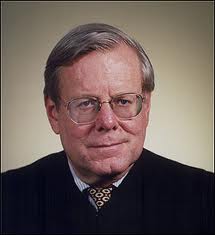
Barra McGrory, Paddy McGrory And Supergrasses

Barra McGrory

This is one of those posts in which I don’t really need or want to write much myself or do anything more than reproduce a couple of articles and let them speak for themselves.

Last week a type of trial that I had thought belonged to the past and had been buried alongside everything else we want to forget from the Troubles, made its way back into the headlines and what was striking about the headlines was they could have been taken from any newspaper circa 1982 to 1984.

The trial was of a number of alleged UVF members arraigned on the word of two supergrasses, brothers as it turned out, and it collapsed in the same way and for the same reason as similar trials did in the 1980’s, which is that the brothers were such self-serving liars that no judge, not even one presiding over a Diplock court, could convict on their evidence. The only thing that was different from the 1980’s was that the terminology used by the state has been updated; back in the 1980’s the RUC called the witnesses ‘converted terrorists’, but now the PSNI has rechristened them ‘assisting offenders’. To everyone else, however, they will always be supergrasses.

I don’t know why the PSNI has resorted to this despicable and discredited tactic but I strongly suspect that there may be a element within the police which wants to re-run the RUC’s failed plays to see if this time, now that the Provos have been sidelined and neutralised, they can succeed. It may also have something to do with the influence of English cops at the top of the PSNI, characters who know little if anything of Northern Ireland’s troubled past but have their eyes on ending their careers in glory.Who knows?

But what struck me in the aftermath of this modern day supergrass fiasco was the defence of the tactic mounted by the North’s new Director of Public Prosecutions, Barra McGrory. Time for disclosure. I have known Barra, his mother and sisters for more years than I care to recall and I regard them as good friends. But it was his father Paddy, or PJ as some called him, who was the special McGrory family member for me.

Paddy McGrory

Paddy was more than a friend, he was also a sort of mentor, in that he guided me through the strange world of the Northern Irish courts, solicitors, barristers and judges and the equally bizarre universe of Irish Republicanism, two subjects on which he was both entertaining and instructive. We worked together on so many stories, he the media savvy but always utterly principled lawyer, me the story-hungry, eager-to-learn reporter that I like to think we forged a unique and productive partnership that occasionally struck fear in the hearts of prosecutors. I learned from him that there was no place more rich in stories and valuable insights than the courts and the extraordinary people who inhabit them.

I don’t think I ever got over his death. I still miss him terribly and yearn for the opportunity to pick up the phone to talk endlessly about whatever was on my mind, as we often did. I wish he was around to talk to right now, for reasons that need no explanation to regular readers of this blog.

You can watch him here, being interviewed in the wake of the Gibraltar inquest in 1988. Paddy starts to speak at about 1:50 minutes in.

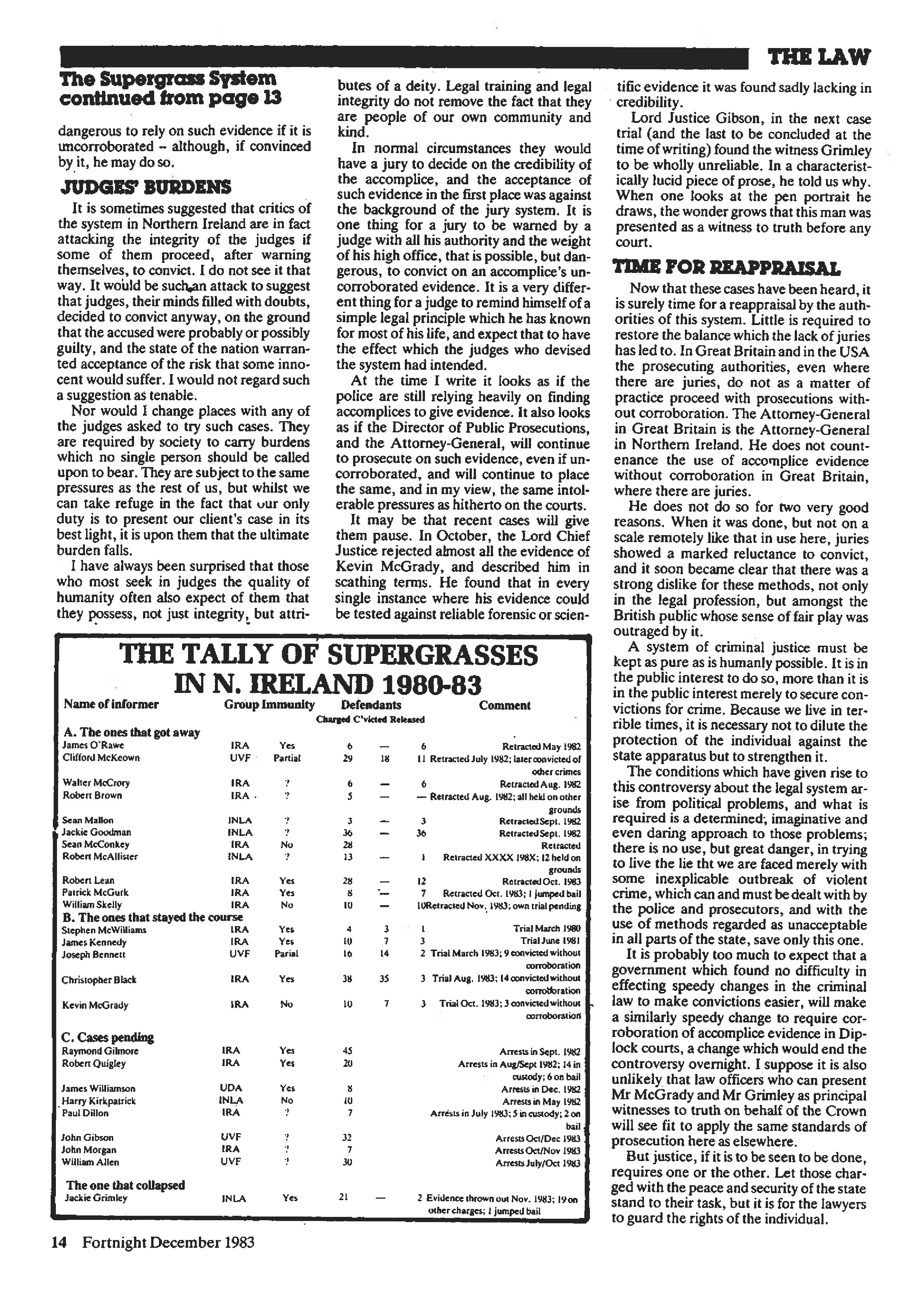
Anyway here are Barra McGrory’s remarks as reported by the BBC’s Vincent Kearney this week and below that is an article that Paddy, his father wrote on the same subject for Fortnight magazine in the winter of 1983. As I wrote in the introduction, I won’t make any comments. I sort of think the two pieces speak for themselves. Enjoy.

PPS ‘carefully considered supergrass case’

By Vincent Keaney, BBC NI Home Affairs Correspondent

Unreliable and ravaged with alcohol and drugs.

That was how a judge last week described the two main prosecution witnesses at the end of the loyalist supergrass trial last week.

Mr Justice Gillen acquitted 12 men of all charges against them, including nine who were charged with the murder of leading UDA member Tommy English.

In his judgement, the judge demolished the credibility of Robert and Ian Stewart, two self-confessed UVF members who admitted their involvement in the murder and agreed to give evidence against their alleged accomplices.

In return, they each had their sentences reduced by 19 years and are now living at a secret address outside Northern Ireland, with assumed names.

Mr Justice Gillen said the two men had lied to the police and the court and that their evidence had been “contradicted by independent evidence on many occasions”

His comments led to widespread criticism of the decision to take the case to court and calls for an end to that kind of trial.

In his first broadcast interview since the trial, the Director of Public Prosecutions has defended the use of the Serious Organised Crime and Police Act 2005, which allows evidence from “assisting offenders” to be used in court.

Barra McGrory QC said the decision to prosecute those on trial had been taken after an extensive debriefing of Robert and Ian Stewart by experienced police officers.

They then recommended that the prosecution and PPS lawyers examined the material they provided before taking the case to court.

So why had the discrepancies in their evidence highlighted by Mr Justice Gillen not been identified by those who carried out the debriefing?

“The difference is that Mr Justice Gillen was able to come to those conclusions after extensive cross-examination by no less than nine different legal teams poring over the material,” Mr McGrory told the BBC.

“That is the function of the trial court.

“The risk here is that the prosecutor might seek to circumvent the function of the trial court by conducting what is really a trial within a trial, in order to come to the decision as to whether or not to prosecute.

“That is not our function. If that was our function, this would be a totalitarian state without the benefit of an independent judiciary.

“Nevertheless, I do accept that there is a basis for being extremely careful in the weighing up of evidence in every case, and particularly in a case such as this, but I am certainly satisfied that there was a very careful consideration of the material in this case.”

The PPS is conducting a review of the evidence given by the Stewart brothers to establish whether they breached the terms of the agreement that resulted in their sentences being reduced by 19 years.

If the conclusion is that they knowingly failed to provide the assistance, their reduced sentences could be reviewed.

The PPS director also defended the cost of the case, which it is estimated could be around £20m.

“In general, I have to say that I would be very concerned about a practice on behalf of the prosecution that would factor in the potential cost of a case in the decision, as to whether or not it is legally justifiable to take the case to court.

“That would set a very dangerous precedent and I don’t think that would be in the public interest.”

Mr McGrory denied that last week’s acquittals and the criticism from the trial judge were major embarrassments for the service he leads and the police, and said they did not discredit the legislation that made the trial possible.

As a newly qualified lawyer during the 1980s, he witnessed the collapse of the original “supergrass” system, which produced 100s of convictions, the majority of which were later overturned.

The PPS director said the 2005 SOCPA legislation was entirely different because there was greater transparency about the criminal backgrounds of the offending witnesses, and what they received in return for their evidence.

“The lesson that has to be learnt from this case is that very great care has to be taken in the evaluation of evidence of this kind.

“That is not to say there is no merit in accomplice evidence, but the greater the scale, the greater the care that has to be taken.”

I asked if he had any concerns that last week’s judgement may have fatally undermined the 2005 legislation and jeopardise similar trials in future.

“No, I don’t,” he replied. “Mr Justice Gillen was very careful to say his concerns were the particular witnesses in the particular circumstances of this case, that that was not to say that the procedure wasn’t a valid procedure.

“Far be it for me to say that there should never be another such case again. What I do have to say is that when there is such a case coming before the prosecution service that it will be very carefully evaluated.”

Analysis: Vincent Kearney

I understand that in order to declare the agreement null and void, the PPS would have to prove that the Stewart brothers knowingly failed to provide the assistance they promised.

In his judgement on Wednesday, Mr Justice Gillen branded the brothers liars and said they weren’t intelligent individuals, but he didn’t say they had done this knowingly and he didn’t say they had breached the terms of their agreement.

We also know that there are a number of trials based on this same legislation due to come to court this year, so the PPS may be reluctant to act in a way that could discourage other more plausible witnesses from coming forward.

ACLU Intervenes In Boston College Subpoenas Case

Boston College Subpoenas Would “Transform Interviewers and Interviewees Into Informers” and Liable to Execution by IRA – ACLU Amicus Brief

The two people at the center of the controversial Boston College Tapes case, former Belfast Project Director and journalist, Ed Moloney and IRA interviewer and academic, Anthony McIntyre, today welcomed the intervention of the Massachusetts affiliate of the American Civil Liberties Union (“ACLUM”) in support of their appeal before the United States Court of Appeals for the First Circuit, which is due to hear their appeal in early April.

In its extensive and hard-hitting amicus brief, ACLUM confirmed that the interviewers for the oral history project on the Troubles in Northern Ireland run by Boston College could face an IRA death penalty if the US government’s bid to force the handover of interview materials was to succeed. The ACLUM’s amicus brief was prepared independently without input from the Appellants or their attorneys.

Noting that the killing of suspected informers by paramilitary groups has continued in Northern Ireland despite the Good Friday Agreement and that IRA rules forbid the disclosure of it secrets by members, the ACLUM, said: “The forced turnover of interview materials will convert the interviewees and their interviewers into informants…..in the name of solving a 40-year-old murder, the Government risks subjecting multiple participants in the Belfast Project to the ultimate retaliation.”

ACLUM also raised concerns that the District Court’s denial of a motion to intervene filed by the two men “will have a detrimental effect on the First Amendment activities of academics, as well as on others who gather information of legitimate public concern for dissemination to the public.”  The ACLUM argues that it believe that “the academics who gathered that information under a pledge of confidentiality should be permitted to intervene and participate in the outcome of the case.”

ACLUM is also concerned that if the tapes are released, it may make it “more difficult for all those who hold confidential information about individuals — an increasingly common event in the modern digital age — to have a right to be heard in opposition to efforts by public or private parties to compel the disclosure of such information.”

Alluding to the dangers of the UK government seeking confidential archives outside its jurisdiction, ACLUM further raised concerns about the U.S. government’s argument that “governments who are parties to Mutual Law Assistance Treaties should have greater rights than United States federal and local law enforcement authorities to subpoena documents without judicial review.”

The ACLUM dismissed the Government’s argument that Moloney and McIntyre had undermined their claim of risk to their personal safety when they decided to publicize the fact that the subpoenas had been issued as “reminiscent of an argument that might have been made by Joseph K’s accusers in Kafka’s The Trial. A witness’s decision to fight the government’s behind-closed-doors decisions affecting the witness’s welfare is not grounds, in this country at least, to impeach the witness’s motives for applying to the court for relief.”

Calling police efforts over the past forty years to solve the murder at the center of the subpoenas – that of alleged British Army spy Jean McConville in 1972 – a “non-investigation”, while charting in detail police refusal to co-operate in inquiries into their own collusion with Loyalist death squads, the ACLUM raised the possibility that the real purpose of the subpoenas is to embarrass the Sinn Fein president, Gerry Adams who is alleged to have ordered Mrs McConville’s death. It added that the “PSNI/RUC’s self-inflicted wound, their sorry record of non-performance over more than 40 years, does not justify an invasion of academic freedom and the likely destruction of much of this valuable historic research.”

“Academic freedom should not pay the price for the constable’s incompetence. This saga of non-performance by the police does not justify a chilling invasion of the Belfast Project’s oral history efforts”.

The U.S. Government’s efforts to deny Moloney and McIntyre intervention in the case would, if applied to MLAT’s with other countries, deny US citizens the legal safeguards they enjoy at the hands of domestic law enforcement agencies, the ACLUM said, and prevent their intervention to challenge executive decisions in such controversial, bizarre and disturbing cases as:

Russia’s prosecution of a dead man, Sergei Magnitsky, who died in prison after torture;
The Chinese government’s prosecution of Nobel Prize winner, Liu Xiaobo;
The arrests and prosecution of US non-governmental organizations by the Egyptian government;
The justification of sexual harassment at work by a Russian judge on the grounds that otherwise “we would have no children”.

Calling the District court’s decision to prevent Moloney and McIntyre from defending the pledges of confidentiality they gave interviewees for the Belfast Project “an alarming and unprecedented infringement on First Amendment interests”, the ACLUM described their interests in protecting the confidentiality pledge, “a textbook case for intervention”.

ACLU Brief

RTE Exposes Shenanigans And Falsehoods At Boston College

STATEMENT ON BOSTON COLLEGE FROM ED MOLONEY

Ed Moloney, the former director of the Belfast Project, the paramilitary oral history archive at Boston College, has today called on the college to withdraw allegations that he and his researchers had any responsibility for subpoenas being served against the archive by the U.S. Attorney’s office on behalf of the Police Service of Northern Ireland (PSNI). These subpoenas are currently being challenged in the federal appeal court.

Mr. Moloney spoke following today’s disclosure on RTE, the Irish national broadcaster, that Boston College spokesman Jack Dunn had falsely alleged that Moloney had been the sole financial beneficiary from ‘Voices From The Grave’, a book based on interviews from the oral history archive and that Moloney had been driven by the prospect of profits from the book to ignore warnings that the archive was legally vulnerable.

The RTE broadcast can be accessed here:
http://www.rte.ie/news/player.html?thisweek#programme=This%20Week

“Jack Dunn has admitted that he made this allegation without knowing or checking the facts and that senior academics at the college had hidden their financial involvement in the book from him and the college. Dunn has issued a series of allegations against me and my colleagues, Anthony McIntyre and Wilson McArthur, since this affair began, not least that we ignored repeated warnings about the danger of legal action against the archive. We have strenuously denied these claims. Since it is now evident that Mr Dunn is in the habit of making unchecked and unverified allegations and that his credibility has now been fatally damaged, we now say that the college should withdraw all these claims and issue an unreserved apology to us. We have said from the outset that we embarked on the project on the basis of promises from the college that the interviews would be legally safe. We told the truth.”

Today’s RTE interview arose from remarks made by Dunn on RTE television and in the Boston College student newspaper The Heights. On RTE TV, he said: “I think quite frankly that Mr Moloney was so excited about this project and quite frankly so eager to write a book from which he could profit that he chose to ignore the obvious statements that were made to him including a contract he had signed expressing the limitations of confidentiality.”

In The Heights, he said: “…..Moloney was the sole person to profit monetarily from the book.”

Both these claims are demonstrably false and the fact that Mr Dunn is now blaming the student newspaper for publishing the latter quote is contemptible.

Mr Moloney said: “I have provided RTE with emails that show these claims to be utterly false. One from Prof. Tom Hachey to my agent in Dublin makes it clear that the book was published with the enthusiastic approval and encouragement of both himself and Dr Bob O’Neill, the two academics most closely associated with the Belfast project. The college always wanted publications from the archive and at one stage we resisted efforts by Prof Hachey to dilute our confidentiality agreement with the interviewees so that interviews could be published while the interviewees were still alive.”

“Dunn’s assertion that my ‘selfish’ act in publishing the book was responsible for the subpoenas is thus demonstrated to be false. Boston College wanted this book to be published as much as anyone involved and Hachey’s email shows that.

“The emails, which are available to the media on request, show that Hachey proposed that his Center for Irish Programs and O’Neill’s Burns Library would receive fifty per cent of the royalties which would be used for college purposes. I agreed to that suggestion. In the event, however, both men asked me to transfer their share to their personal accounts. Financial records are available to support this.”

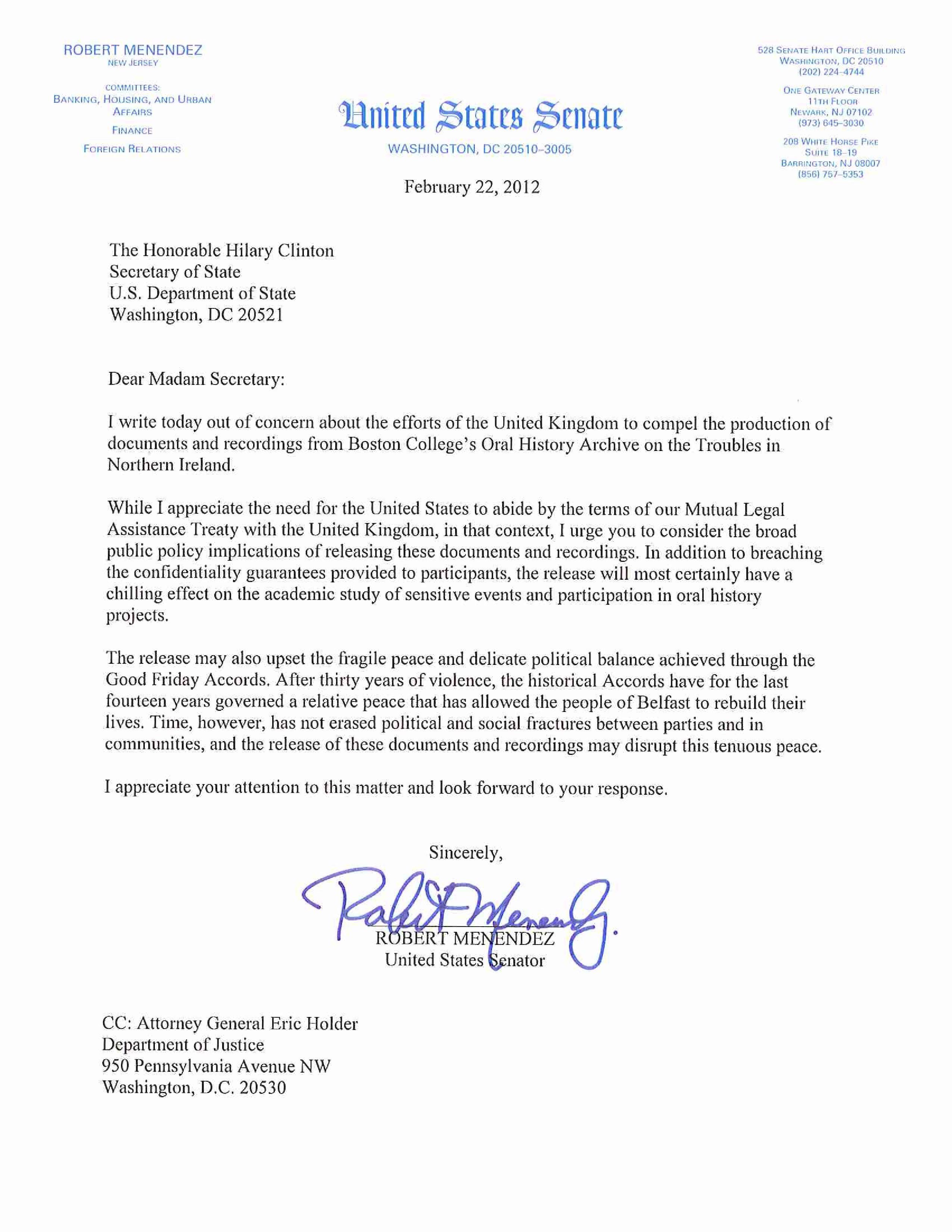
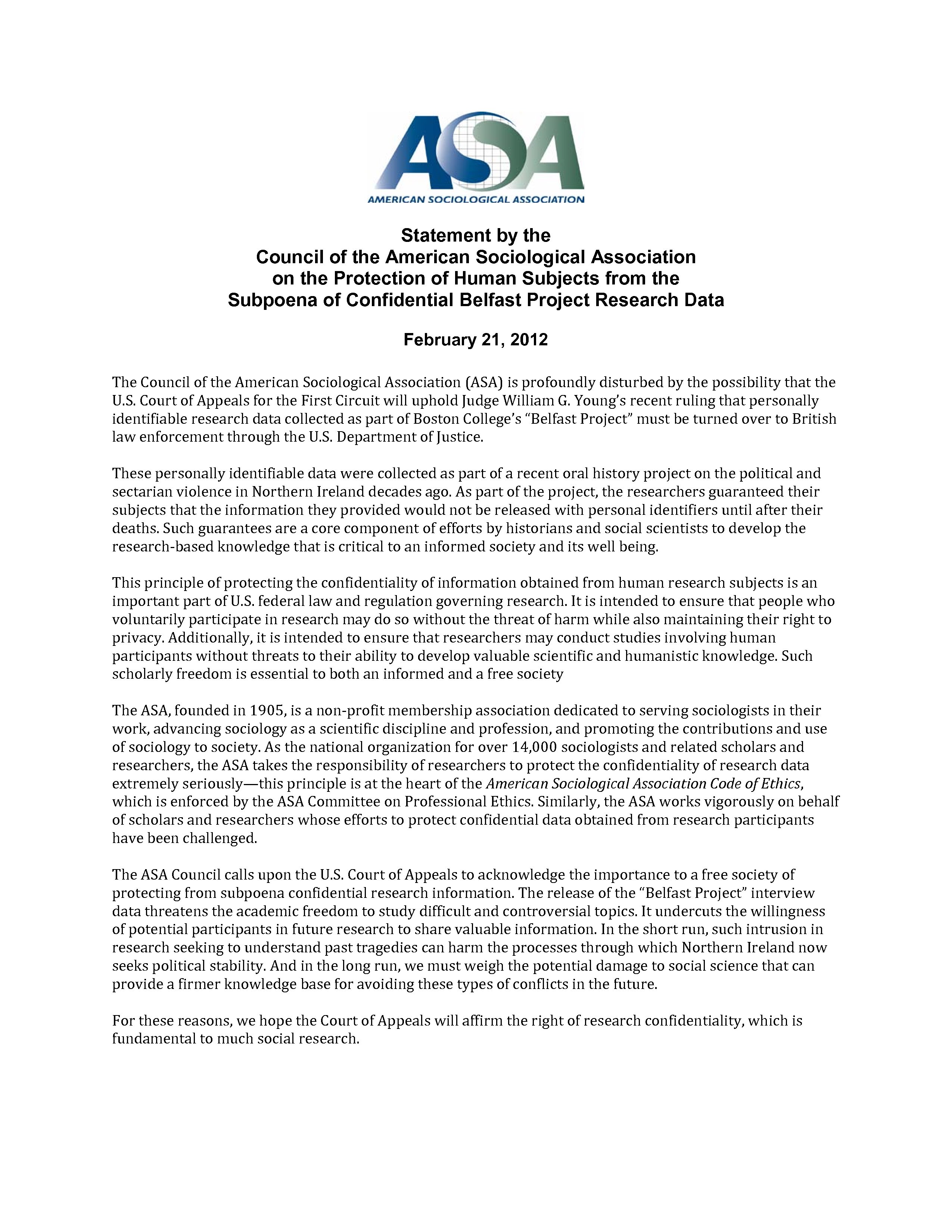
Two Great Statements On Boston College Subpoenas

One is a letter to Hillary Clinton from New Jersey Senator, Robert Menendez which came due to the great persistence of Helen McClafferty. Well done Helen and many thanks!

The other is a heartwarming statement from the American Sociological Association. Our thanks to Sally Hillsman, Bob White and their colleagues!

Boston College: A Dramatic Climbdown Or A Sham Appeal?

They say that even a broken clock is right twice a day. Boston attorney Theodore Folkman, aka  ‘Ted’, is doing well to be right once in a blue moon but this time I have to admit he is right. Boston College did not include Dolours Price in its appeal because the deadline to do so had expired but for other, as yet unexplained but guessable reasons.

Theodore points out that the clock began ticking towards the real deadline for Dolours Price’s interviews on December 27th, when a court order was made relating to the handing over of her interviews with Boston College, and not December 16th when the district court ruled in favor of the US attorney’s subpoenas in respect of the interviews themselves.

Since there still remains plenty of time before the deadline on Dolours Price interviews expires the question arises, why did Boston College not include her interviews in their planned appeal? And why is the college not challenging the core issue, the right of colleges to conduct confidential research, but choosing instead to argue the esoteric point that the District Court “incorrectly applied its own review standard” when determining which interviews should be surrendered?

A clue to the answer, simply, can be found in a quaint piece of political folklore that is played out every July 13th in the Co. Down village of Scarva in Northern Ireland. It is called ‘The Sham Fight At Scarva’ and every year Loyalists from all over the North gather to watch the re-enactment of the Battle of the Boyne which established Protestant rule in Ireland for the next two and a bit centuries and laid the basis, at least in part, for the conflict that has raged in Northern Ireland for too many years to count.

A bewigged King William, the Protestant hero from Holland invited by English aristocrats to assume the throne of England, sits astride a white horse in a field just outside the village. Dressed in seventeenth century garb, conveniently colored in shades of orange, he clashes wooden swords with Catholic King James, clad in green just in case there’s any doubt which side he is on. The battle ends the same way every year and as it ended way back in 1690, with King Billy giving King James a hiding to the cheers of the assembled Orangemen and their families. Nobody expects any other outcome, but that’s not the point of the exercise. It is an empty ritual meant to impress and perhaps reassure the faithful but with no meaning beyond what you see.

That’s what Boston College’s appeal amounts to as well. A gesture meant to impress – in its case to impress an audience growing increasingly restless at its indifference to the future of academic research – but otherwise an utterly meaningless ritual whose outcome is essentially predetermined.

Let me explain.

The first thing to bear in mind is that there were two subpoenas served on Boston College. The first, in May 2011, applied to Dolours Price’s interviews with the college (also Brendan Hughes but that’s not relevant here). The second, in August that year, sought any other interviews that touched on the IRA’s ‘disappearance’ of Jean McConville in 1972. The two sets of subpoenas were dealt with separately by Judge William Young in the Boston Federal District Court although often during the same sittings.

He handed down his substantive decision on Dolours Price on December 16th, 2011, refusing Boston College’s motion to quash the subpoena issued against her interviews. Eleven days later, on December 27th, he issued an order to Boston College to hand her interviews over to the court.

The same judgement on December 16th ruled against the efforts to quash the August, 2011 subpoenas served on the rest of the archive but this part of the action was treated differently from Dolours Price’s interviews. Dealing with these subpoenas, which demanded all the other interviews that made mention of Jean McConville, meant someone had to go through the entire archive of IRA interviews to determine which was relevant and which was not.

Boston College asked for an in camera review of the entire IRA archive in order to accomplish that and when the judge granted it, on December 22nd, BC declared this to be a famous victory. Now in camera reviews are pretty standard in First Amendment cases so Boston College didn’t really have much to boast about. But that didn’t stop it.

To cut a long and, to be frank, squalid story short the court ended up having to review the non-Dolours Price part of the IRA archive itself and Judge Young and his various clerks spent the New Year holidays reading these interviews. On January 20th, 2012, Young issued an order against seven of the interviews.

After the December 16th ruling against Boston College’s effort to quash the subpoenas, the college let it be known that it would not appeal that decision. The deadline for doing so expired last week, actually on the same day the ACLU in Massachusetts filed notice of an amicus brief. So Boston College cannot and will not, no matter what impression has been created by the announcement on Tuesday evening, appeal Judge Young’s substantive judgement against the effort to quash the subpoenas.

Since it hailed the in camera review of the non-Dolours Price interviews as a great victory, BC has decided to base its appeal instead on the seven interviews chosen by Judge Young for surrender to the PSNI. For reasons that eventually will become clear – and embarrassingly so for many people caught up in this story – BC could have included Dolours Price interviews in the appeal on the same basis as the other seven but chose not to.

All that remains, like the convicted man quibbling over the means of his own execution, is for Boston College to find issue with which of those seven interviews should or should not be handed over; which of them qualify as satisfying the demands of the subpoenas and which do not. In other words BC will help to decide which of its interviewees, to whom it pledged confidentiality unto death, should get the chop and which should not. If that qualifies as an appeal within the normal meaning of the word then I am the King of Siam.

As I say, for reason I cannot yet explain, BC could have asked for Dolours Price’s interviews to be vetted in the same way, but did not.

That is what this appeal is about. BC is not appealing to uphold the principle behind their original legal action, i.e. to defend academic freedom and the right of places of learning to conduct confidential research but really to give the appearance and illusion of appealing – and hoping this gets its critics off its back – while not really doing so.

It will be interesting to watch BC’s attorneys in action during the appeal. Will they go through each of the interviews in the courtroom, arguing that this one’s involvement or knowledge meets the requirements of the subpoenas while that one does not? If so, then not only will BC break the confidentiality pledge in open court but it will have crossed that sacred line that divides us all in such matters and joined the police and prosecutors in deciding who is worthy of indictment and therefore conviction and who is not. Is this what constitutes defending academic freedom? Or they might just throw the whole matter into the laps of the appeal judges and let them decide, in which case what is the point of the exercise?

Either way, just like the Sham Fight At Scarva, we all know what the outcome will be. Some interviewees will be sold down the river and the principle of academic freedom abandoned. How cynical and contemptible is that?

So to get to the point. The opening paragraph of our statement should have read thus: “We would like to welcome Boston College’s decision to lodge an appeal against the subpoenas served against seven of our interviewees but regret and deplore that that for reasons that defy common sense the college omitted the interviews of Dolours Price.”

Eamonn McCann On The RUC Revenge Factor In The Boston College Saga

Required reading on Alex Cockburn’s Counterpunch website for followers of the burgeoning Boston College scandal. Derry writer and political activist, Eamonn McCann has a close look at the role of ex-RUC detective, Norman Baxter, former SAS soldier Tim Collins, a private security outfit training the Afghanistan government’s intelligence services, a former senior investigator with the Northern Ireland Historical Enquiries Team (HET) and the Boston College subpoenas. Fascinating stuff which can be accessed here.

A Conversation With Fr. Joe McCullough

Regular readers of this blog will recall that about three weeks ago, I featured an article based on the 1972 murder of a 17-year-old North Belfast Catholic, Patrick McCullough who was gunned down by Loyalists, apparently members of the UVF, in June 1972 near his home close by the Westland Road interface, then as now one of Belfast’s most dangerous spots. What brought my attention to that case was a very touching letter that a younger brother, Fr. Joe McCullough had written to the Irish Times.

His brother’s murder is still unsolved some forty years on, he wrote, and the recent trial of people found guilty of killing black teenager Stephen Lawrence in London, whose murder had originally gone un-investigated thanks to rampant racism in the ranks of the Metropolitan police, brought his own brother’s death back to him. His point was that the same sort of racism that infected the police in London also affected the Royal Ulster Constabulary in Belfast although in their case institutional anti-Catholic bias explained their indifference to murders like that of his brother. And perhaps also sympathy with the killers who, after all, were targeting members of the community from which the IRA sprang.

Fr. Joe’s point was twofold. An expression of dismay and disappointment at the efforts of the Police Service of Northern Ireland (PSNI) and the Historical Enquiries Team (HET) whose response to his concerns over his brother’s unresolved murder he described as ‘abysmal’. And a demand that the conduct of the RUC in investigating or rather not investigating killings like that of his brother ought to be officially scrutinised, in much the same way as the Met was probed in the wake of Stephen Lawrence’s death.

The contrast between the HET’s cavalier treatment of Patrick McCullough’s death and the resources and energy being poured into the pursuit of Boston College’s oral history archive was stark and persuaded me to take up Patrick McCullough’s case. Patrick McCullough was just an ordinary Belfast Catholic, one of scores who were being picked off weekly by Loyalists back in those days. But he and people like him carry no political clout and their cases will write no headlines nor make or destroy careers.

The Boston College probe, however, could lead to the political disgrace of Gerry Adams, long an enemy and target of the more redneck ex-RUC types by enmeshing him in the disappearance of Jean McConville, who was kidnapped and shot dead after apparently admitting her role as a British Army agent in Divis Flats. She was killed six months after Patrick McCullough but the contrast in subsequent treatment – subpoenas and the weight of the US government mobilised for her case while Patrick McCullough’s languishes in inactivity – is surely instructive about the truth recovery system that the British and their political allies in the power sharing government have adopted.

Anyway, I thought it would be useful and instructive to talk to Fr. Joe in a little more detail about himself, his family, the death of his brother and the lessons we can draw from it all.

Fr. Joe is a member of the Kiltegan Fathers, or more properly St Patrick’s Missionary Society, a Co Wicklow based missionary order which was founded in 1932 and is particularly active in Africa, South America and the Caribbean. Apparently there is a strong link between the Holy Family parish of North Belfast and the Kiltegan Fathers; eight men from Holy Family joined the order at the same time he did.

There were fifteen in his family, nine boys and six girls and Patrick was the first-born and therefore special in the eyes of his parents and his siblings. They lived in Marsden Gardens which overlooks Belfast Waterworks, an area that was in the midst of the most violent part of Belfast when the Troubles broke out.

The McCullough’s were a respectable, church-going, hard-working family. Their father, George, ran a small painting and decorating firm, was hired as the first housing officer for the Newington Housing Association and he was also clerk of works for the Belfast Education Board. He was also a devout Catholic, a past president of the St Vincent de Paul Society and National President of the Catholic Young Men’s Society of Ireland. His children all did well in life and are working in either the legal profession, civil service, the Church, medicine, journalism, business or teaching. Their mother, Cassie devoted her life, as Irish mothers do, to her children.

They are precisely the sort of people who give society an essential stability and, as Fr. Joe tells it, the story of how the family was treated by the authorities since Patrick was killed provides a case study in how conflicts like that in Northern Ireland start and are sustained for so long. Alienate people like the McCullough’s, as the RUC and the British Army did over the years and now as the PSNI and HET has, and you have a recipe for endless strife.

Fr. Joe joined the Kiltegan Fathers in 1984 and was ordained in 1991 but he didn’t always want to be a missionary priest. When he left school, he studied theatre at the London Guildhall School of Acting via the Maura Brown School in Belfast but decided eventually that the footlights were not for him although he continued his education, picking up two Masters degrees en route. While in North Belfast as a youngster he had contact with the Kiltegan Fathers – “I met some of those guys and they impressed me with their stories and what they were doing in Africa” – and so he took the metaphorical bus to Wicklow. He has spent most of his life with the society working in South Africa but returned recently after his father died and his mother fell ill, and now works as a chaplain at a cancer hospital as part of a palliative care team for young cancer victims near London.

The sudden death of his oldest brother Patrick has clearly never left him. “He was born on 17th of August, 1955. He was an interesting boy, but he had been born with spina bifida. He had to have this huge operation at eight months and he could have died under the knife. It was a kind of a miracle that he survived it. In 1969 when only 14 he nearly drowned when his younger brother Gerard, drowned when the family were on holiday at a caravan park at Ballyhalbert on the Co Down coast. Then he was cruelly cheated of a second chance at life when three years later he was killed by loyalists”.

According to an excellent report by Irish News reporter Sharon O’Neill, Patrick McCullough was chatting with his girlfriend and some other friends at a street corner on Atlantic Avenue when gunmen fired from a passing car – a drive-by killing in American urban parlance. He was hit in the heart and died almost immediately.

“I was seven when it happened. I remember it very starkly. Half the family were on holiday in Cushendall, Co Antrim with my mother. She had us down there with the younger half of my family. My father was in Belfast because Patrick had just started working in the Irish News as a trainee compositor, his first job. My mother had gone up to Belfast, there was kind of trouble around so she had left us with other family members & my eldest sister and her friends at our holiday house in Cushendall. Now the previous week I remember Patrick visiting us, he was all excited about his new job. He had brought us gifts of beach wear and beach sandals which he’d bought with his first paycheck.

“Then on the…he was killed on the Friday, 23rd of June and in the early hours of the morning we were all awoken by family relatives, and at the time they didn’t say anything to us, we were just packed into cars and we were taken first of all to cousins of mine in Glenarm around the coast and then on to Belfast. It was a Saturday morning when we arrived at our house on the Cavehill Road and my memory is being taken to a relative who told us that our brother had died and then being taken to…my mother was very anxious to see us and when she did see us, she was in a very fragile state. She was in hospital and she was sedated but my memory is that she was released, she’d just been released and of course she got hugely emotional when she met her children, you know. My memory is of her just breaking down.

“As far as the police goes they didn’t meet us, they didn’t even come to meet my family. There were no explanations. My father did tell me that nobody came afterwards to explain what was being done, why he was killed. Certainly in relation to the investigation, it was non-existent. I was recently talking to a police friend of mine here in London about the whole thing. Who was the senior investigating officer? Were there witnesses? Did they take witness statements? Was the scene forensicsed at all? These are questions that were raised.

“Before that I made a submission, an oral submission to the Patten Commission in Ballycastle on these points that I make in my letter about the lack of an inquiry. I don’t think it was Lord Patten himself but a former Boston police officer, a lady (Kathleen O’Toole). When I gave my submission, she was there and it was quite an emotional place because there were all types of people there who had been affected. There were people from the army, the police, relatives and then I was there. I brought up the points about lack of investigation.

“Now after the Patten Commission I went back to South Africa. Then at the time the Historical Enquiries Team was set up I wrote to the Chief Constable, I think it was Hugh Orde. I got a letter back from one of his…a secretary or whoever saying that they had received the letter and they would be handing it on to the Historical Enquiries Team. Now I got a letter from the HET saying they had received this and they were looking into it and they would contact me. But I never heard anything from them. That was maybe around 2005 that I wrote to them. I remember being quite angry when the letter came back. It was topped and tailed, standard sort of letter. I just lost confidence in the whole thing. I have heard nothing since from either the PSNI or the HET.

“I also sent my letter to the Irish News. They contacted me last week while I was on holiday and they wanted to make a story of the letter. Anyway I contacted my brother James who is a barrister in Dublin and he said: ‘Well, what’s the point? Because they’ve lost the forensics, there’s no confidence in the HET’. And my brother James was very close to his brother Patrick and he was at the scene that night, I believe, and it had a profound effect upon him.

“Patrick was the first-born and special to my parents. He was such a special kid. I just remember him being so loving, so gentle, so protective, so funny and humorous. I think when he died it had such a profound effect on my parents. They never recovered from it and I suppose it had a profound effect upon all of us, you know. But there was absolutely no support (from the authorities). The only support we got, the only thing that kept us together was the local parish priest, Fr. McGarry, Patrick McGarry, a hero of a man. He was in the thick of it there in North Belfast and as my brother James said at my father’s funeral, he was holding the line for the Catholics.

“You know the Army came to the house not long after his death. What were they there for? What did they come to our house for? Why did they come into the street in Saracens in the early hours of the morning? I believe they came to try to plant stuff. They came into the house, my father remonstrated with them and only that the priest was contacted and he came right away and insisted that they get out. There were senior Army officers there. Their given reason was that they were searching the street for arms, there was activity somewhere. As far as I know they only searched our house. It wasn’t that long after his funeral, that’s for sure. This happened perhaps a week or ten days after his death.

“Thinking back later, you know, were they trying to somehow suggest he was involved in the paramilitaries? Maybe plant something in the house? To justify his death, that he was somehow involved. I draw a clear distinction between innocent, non-combatant victims. There was a huge effort on the part of the security forces in a lot of these cases I believe to somehow imply that they were involved and that therefore they were legitimate targets.

“And, as I was saying to my brother James and we were just talking about it last week, it was very clear to my parents, the attitude of the police and the army was, ‘You raise your head about this, you stir a fuss about this and you’ll be shot too. You’ll all lose your lives.’ And the fear, the fear was awful. My father had to get one brother to New Zealand, Jim down to his aunt in Co. Wicklow in a convent, to get them away from all that. The harassment from the security forces afterwards was constant even for myself. My memories of going to school and being stopped by the UDR. There was one occasion I was going to school, I was lifted by the UDR, searched, spreadeagled. I was only a teenager and they dropped me off in a staunchly Protestant area in the knowledge that I would be in danger there.

“One of the problems is that the evidence in his case was allegedly destroyed. I wrote in my letter that it was a fire that destroyed his file but James reminded me it was some police barracks in Ballynafeigh (in South Belfast) and it was bombed and the written records were apparently destroyed in the bomb. How was that possible? Usually there’s not much fire in a bomb.

“The Historical Enquiries Team is a disaster. It is the police investigating the police. It’s retired police officers who are going to stick to their own. It’s ridiculous. How can they be any way balanced or not prejudiced? I mean it just will not do. The HET will not do in my view. What brought it up for me again was the Stephen Lawrence case but the British state turned a blind eye because we’re just Catholics? Or they’ll say it was a war and was a different situation. The police are supposed to reflect how a state is. You need someone who is independent to come in and take a close look at all this, the ethos and behaviour of the RUC.”

Fr. Joe’s letter was published in the Irish Times on January 16th and the HET’s full-time press officer must have spotted it and pressed the button marked, ‘We better do something about this otherwise we’ll really look bad’. Two weeks ago, the HET contacted him and said they would be willing to meet him in London to discuss “their information” on Patrick’s murder.

Fr. Joe continues the story in an email message sent at the weekend: “They also informed me they had sent a letter to me in London (in) July 2011. Not true. I received no such letter. I asked the nature of their information since we were informed no such info (sic) existed. This officer proceeded to quote over the phone info from what I believed to be information from the pathologists report. He seemed to think this was forensic evidence and I had reason to disagree with him on a number of issues.

“He then informed me that he had a very positive response from all the other families he was dealing with and that he never experienced sectarianism in (the) RUC/PSNI. I informed him he ‘hadn’t a clue, no idea and not the first notion of what I was talking about in relation to the experience of my family and many others like us’.”

So there we are. The Historical Enquiries Team, charged with the most delicate and sensitive of post-Good Friday Agreement tasks, pronounces the RUC free of institutional sectarianism, a sweeping judgement that flies in the face of the daily experience of many thousands of Northern Catholics and families like that of Patrick McCullough’s over the entire history of the Northern Ireland state.

This is the unit that is supposed to be investigating some thirty or so years of killings, a significant number of which were carried out with the active collusion of  RUC officers, especially in the Special Branch, and many others that took place with the passive co-operation or at best indifference of the police force charged with maintaining law and order impartially.

If there was no sectarianism in the RUC, why did the Troubles start in the first place? Did we imagine those television pictures of RUC men wielding batons against civil rights marchers in Derry like the Alabama State troopers on Edmund Pettus Bridge? Did we imagine the RUC roaring through the Falls in August 1969, howling Loyalist mobs on their heels, firing Browning machine guns into public housing projects? If what we saw in those and subsequent years was not institutional sectarianism, then what is?

If there was no sectarianism in the RUC what kept the Provisional IRA going for some forty years, what was the fuel that kept its fire going? If there was no sectarianism why was it necessary to draft in Lord Patten and a panel of international experts to recommend root and branch reform of the force in order to copper fasten the Good Friday Agreement and secure final IRA decommissioning? Why was it necessary to change the RUC’s name? Why was it necessary to impose quotas to increase Catholic numbers? Why was it necessary to abolish units like the Special Branch?

There’s another thing. This is an HET officer talking to a Catholic priest whose brother was killed in a state whose police force, as far as he and his family were concerned, basically didn’t give a damn about who killed his brother or why and whose military possibly conspired to malign his memory and reputation, when they weren’t arresting and dumping his siblings in hostile areas where they could be torn to pieces.

And he tells the priest that, in his experience, there was no sectarianism in the RUC  – effectively dismissing the priest’s life experience as meaningless and that of thousands many more Nationalists who lived through the Troubles in Northern Ireland. This was an extraordinary thing to tell Fr. Joe, a remark so full of insensitivity not to say arrogance that it’s hard to know where to begin. In my experience when people say or do such things it is usually because they know there will be no comeback from his bosses, because they think the same way too. He is merely expressing a consensus, reflecting a police canteen ethos that has clearly seeped into the HET’s soul; it’s what they all agree about in the PSNI canteen. The RUC were decent cops; the problem was the terrorists, especially the IRA ones.

So how can a unit like the HET which eats and drinks such views daily and has amongst its investigating officers people who have prejudged a crucial issue like the institutionalised sectarianism of the RUC be trusted to properly investigate killings which a large section of the population of Northern Ireland believes happened with the connivance, approval or insouciance of the RUC? “Quis custodiet ipsos custodes? ” Go figure.

The HET’s press person was quick to spot Fr. Joe’s letter to the Irish Times and pressed one button. But she entirely forgot to press the one next to it marked: “Is there something else we forgot to do, because if we have, then we’ve really fucked up?”

In her Irish News piece describing the killing of Patrick McCullough, Sharon O’Neill had this to say about the identity of those who shot the teenager dead. “Although no-one admitted responsibility”, she wrote, “it is believed the UVF was behind the murder and further inquiries by the Irish News have established that the identity of the killers was well known, yet not one person was arrested or charged.”

The Historical Enquiries Team is supposed to be investigating unresolved killings in chronological order, starting in 1969 and moving forwards to 1998. Since the Jean McConville disappearance happened in December 1972 and that case now absorbs much of their resources and funds, one can presume that the HET has had a look at Patrick McCullough’s case some time ago and finding it fallow ground decided to move on.

But what about Sharon O’Neill’s intriguing information about the killers’ identity? I happen to know that the HET does trawl through newspaper reports of killings to ask journalists about what they had written because last June or July, not long after they served subpoenas on Boston College, one of their detectives traced me to New York to ask me about a killing carried out by the British Army’s Mobile Reconnaisance Force (MRF) back in the early 1970’s, a drive-by shooting I had written about in Hibernia magazine. The victim was a Catholic vigilante called Patrick McVeigh but I had written that locals suspected the real target was someone else, a prominent member of the Belfast IRA.

Could I help the HET, the English detective asked, and name the intended victim for them? Hmmmm! My mind whirred suspiciously. How convenient would it be for the HET if or when the day comes when I refuse to assist them verify the Boston College tapes for evidential purposes that they would be able to say, ‘Well Mr Moloney had no difficulty helping us out last year, so why not now’? I wouldn’t have helped anyway but I took some satisfaction in sending him off with a flea in his ear.

Leaving that aside the purpose of this story is to show that if the HET is capable of delving back into the dusty archives of the long deceased Hibernia to dig out obscure stories written by journalists who no longer live in Ireland then surely it would have no difficulty tracing Sharon O’Neill’s piece about the Patrick McCullough killing.

After all it was published in the still extant Irish News and appeared in September 2003, not that long ago and Sharon O’Neill appears on the TV news in Belfast most nights of the week. It took me less than a minute of searching on Google to find it so presumably the HET could do the same. And having found the article it would take another five minutes at most to discover where Sharon now worked, locate the phone number of Ulster Television, dial it and ask the woman herself if she could provide those names to Dave Cox and his lads.

So last week I rang Sharon and asked her if the HET had done just that:

Me: “Have you ever been approached by the PSNI or the HET about that reference in your article to the fact that the names of the killers were well known?”

S O’N: “No. Never. I would remember that. Definitely not.”

Well, Sharon, I guess that like Fr Joe McCullough, that after they read this post someone from the HET just might be calling you any day soon to ask you a question they should have asked years ago. By no means am I suggesting you help them, in fact I hope you don’t, because we are journalists after all, not policemen; it is not our job. But the HET most definitely has a responsibility to ask you the question and they haven’t. It is such an obvious lead that to neglect it in such a way must call into doubt the sincerity of the HET’s recent assurances to Fr. Joe McCullough.

Nice one, HET. Nice one.

Why The World Needs More Chris Bray’s

As avid followers of the Boston College subpoenas saga will know, there has been one guy on this story from the outset whose reports have become required reading. Chris Bray, a PhD student at UCLA first began blogging about the case on a history site called Cliopatria back last May or June when the story first broke and has doggedly followed it ever since, more recently on his own blog.

Chris Bray is living proof that conventional journalism is dead and that if you want the real scéal then you’re far better off consulting the web and blogs like his. I’ve never met him and don’t know whether I ever will; I don’t think we’ve ever talked although we have shared thoughts and ideas by email. But I’ve come to regard him as being a lot like that little kid in the story of the Emperor’s New Clothes, you know the one who steps out and, to the horror of the crowd, pronounces the King to be stark naked.

That was what journalism is supposed to be about and it is what always attracted me to the job. But there’s a price tag attached to playing the role of that kid. Far better and much more profitable to be one of the outraged crowd; that way you never get in any difficulty, you’ll always have a job and there will always be food on the table.

When I was covering the Troubles on a daily basis I liked to think of myself as that little kid but I ended up instead full of loathing for the crowd, which is why, I guess, I now live in New York and not Belfast. I used to joke that in the Irish version of that story the crowd would turn on the little kid and beat him to death, except it was never really that funny. I hope that doesn’t happen to Chris, becoming angry and cynical like me, or having his head metaphorically bashed in.

Anyway Chris Bray has just written another piece which marks him out as America’s version of that little kid, or at least one of them for, unlike Ireland, there are many kids here like him – all on the web and so few in the mainstream media I couldn’t count them – who happily say the King is stark naked. I’m not saying there aren’t any like that in Ireland, just so few of them.

Anyway Chris has this knack of cutting through the crap and in this story about the Irish Times’ coverage of Barra McGrory’s recent speech he does it superbly well. Incidentally, I had reason to speak to another Belfast reporter the day after Barra McGrory’s talk and I asked what impact it was having. “What speech?”, came the reply. This is Chris at his best, savour and enjoy!

A Reply to Hachey & O’Neill of Boston College

On January 19th, The Irish Times published an oped piece that was supposed to have been a response to Chris Bray’s swingeing critique of Boston College’s cowardice over the PSNI/US Department of Justice subpoenas seeking the surrender of interviews from the Belfast Project oral history archive.

Penned by Prof. Tom Hachey and Dr Bob O’Neill, the two key people in the Belfast Project on the BC side, the article in fact evaded Bray’s criticism and instead homed in former project director Ed Moloney and IRA researcher Anthony McIntyre. They set Moloney up for a contempt of court charge while putting McIntyre in the gun sights of enemies in Ireland by blaming him for the fact that the college had handed over the entire Republican archive for the court to review. You can read their poisonous piece here.

We asked the Irish Times for the right to reply under a joint byline but because the Hachey-O’Neill article was technically their reply to Chris Bray, we were told the debate had ended. So instead we have decided to reproduce that article on our respective blogs. Here it is:


It is an astounding abdication of responsibility that the trustees of Boston College, through their employees, Robert K. O’Neill, the Burns Librarian, and Professor Thomas E. Hachey should seek to lay culpability at the door of their researcher Anthony McIntyre for the Boston College tapes debacle while wrongfully accusing Ed Moloney of contempt of court.


At the same time they ignore the egregious hypocrisy of the PSNI, which has chosen not to pursue former RUC officers who allowed double agents in the IRA and UVF to murder at will and whose actions both threaten the lives of BC’s researchers and the well-being of the peace process in Northern Ireland. Nor do they take the US Attorney General to task for ignoring his obligation under international treaties not to assist in the pursuit of offenses preceding the Good Friday Agreement.


Messrs Hachey and O’Neill’s disgraceful disowning of responsibility is only matched by the naivety of the college’s legal strategy which collapsed ignominiously just a day after their article appeared in this newspaper. They wrote last Thursday that Boston College had declined to appeal Judge Young’s decision ordering the release of the Dolours Price interviews, in the “hope” that the rest of the archived material they had relinquished to him for review would not have to be released to the PSNI.


Yet by the following evening Judge Young announced that no less than seven other interviews would, if the stay and appeal secured by ourselves failed, be handed over to the PSNI. What a triumph! What a tribute to Boston College’s cunning legal master plan! Remember also that the same legal strategy involved an offer by Boston College to hand over the UVF archive to the court even though this information is not responsive to the subpoenas, and no-one has ever associated that group with the disappearance of Jean McConville.


And so Boston College, to its eternal shame, declined the opportunity to appeal and left it to their researchers to fight their battles for them, with none of the resources or opportunities that Boston College has at its disposal. Now that its legal strategy has collapsed might Boston College now attempt to retrieve its name and appeal the latest order commanding the release of confidential materials?


The slur against Anthony McIntyre is nothing less than shameful. The facts are these: the first subpoena, in May 2011, had asked for Brendan Hughes and Dolours Price’s interviews; a second subpoena seeking other interviews that mentioned Jean McConville was served in August, 2011; five months later, on December 20, 2011, Judge Young ordered Boston College to review those other interviews and hand over the relevant ones.


Boston College’s response? The Court was informed that its Burns Librarian, Dr. O’Neill had not read all the interviews and could not help. Really? A library which has had custody of an important and sensitive archive since 2001 and in all that time had not made itself familiar with its contents!


At that point the judge suggested that Boston College instead approach Dr. McIntyre for assistance. He declined, but on grounds of principle, replying: “I cannot on ethical grounds engage in any activity that would lead me to assist in a process of morphing my research into evidence gathering.” How much better it would have been had Boston College asserted the same reasons.


The Boston College representatives also disingenuously allege that Ed Moloney suggested that Boston College “defy the court” and “pre-emptively burn the transcripts.”


Ed Moloney suggested no such thing, and never encouraged the college to risk contempt of court by proposing that archived interviews under subpoena be destroyed. Rather, the suggestion was that, after this case has concluded, the College must close down or destroy the archives if it is neither willing nor able to protect the participants from future invasions. The only items threatened with “burning” are the sources that Boston College promised to protect.


One could go on about Boston College’s lamentable legal strategy throughout this sorry affair. After the first subpoena was issued, Boston College was warned that a second one was possible and that they should make strenuous efforts to secure the archive. They ignored the advice, instead giving out assurances on the basis of advice from “practiced lawyers … (and) … people formally schooled in international law” that no further subpoena was likely.


When the second one arrived in August 2011, the college partly relied on the absurd suggestion that it did not know “whether the tapes and transcripts it holds are ‘easily searchable’ by any currently available computer-assisted or other means” such that the second subpoenas would impose an unreasonable burden on Boston College. That argument drew the deserved scorn of the US assistant Attorney who replied: “Such a response, from a chaired historian and the director of a distinguished college library, begs credulity. The task of searching this material would be fairly straightforward for a first year paralegal, much less a tenured historian and a library director.”


It is only due to the order suspending Judge Young’s decision that we secured on appeal to the First Circuit Court of Appeals that the Belfast Project interviews are not already in the hands of the PSNI. If this matter had been left to Boston College they would have been in Belfast long before this and their interviewees, to whom they gave the most solemn promises of confidentiality, would have been utterly betrayed. We, at least, will fight as long as we can to prevent that happening.


Harvey Silverglate Gets To The Core Of Boston College Subpoena Scandal

I can’t sing the praises of this article too loudly. Written by Harvey Silverglate, a Cambridge, Mass. based attorney and journalist, with assistance from Daniel Shwartz, this article, which can be read on the Forbes.com site here, gets to the issues of this case so far unexplored by the media, notably the behavior of Judge William Young, the negative effect on source protection that his barring myself and Anthony McIntyre from the case has had, the effect his decisions will have on limiting future legal remedies if we lose the appeal in March – a ruling which heavily favors the US government and PSNI – and the failure of the judge to raise the whole contentious issue of the Allison Morris/Ciaran Barnes episode and the unexplained failure of the PSNI to follow up their February 2010 articles. And finally, of course, the utterly disastrous impact Judge Young’s decision, if not overturned by a higher court, will have on academic freedom in the United States.

I personally hope the folk at Boston College, whose challenge on behalf of that freedom ended at the first hurdle, read this and hang their heads in shame. There are faults in the piece. He misspells my name (as I did his briefly!) and confuses the Irish police with the Northern Irish police but these are minor errors. It is a great article, amongst the best yet written and I hope it presages real concern about this case amongst American civil libertarians. It certainly ought to. Here it is:

Harvey Silverglate

Boston College Researchers Drink with the IRA, and Academics Everywhere Get the Hangover

The Belfast Project was supposed to recount history, not make it. But thanks to a federal court in Boston, the Project’s good faith attempt to gather historical evidence may create a precedent detrimental both to academic freedom and to historians’ ongoing efforts to inform the future about the past.

The Belfast Project began in 2001 at Boston College—the brainchild of ex-IRA member Anthony McIntyre and journalist Ed Maloney—as an attempt to get to the bottom of “The Troubles” in Northern Ireland. The violence had slowed down considerably by then, and in July 2005, the IRA made a public commitment to disarmament and complete nonviolence. Through extensive interviews with former IRA members, McIntyre and Maloney would attempt to encapsulate the past, and to construct enough narratives of it to prevent a single “victor’s story” from conquering all the others.

In order to solicit the most candid narratives possible, the researchers instinctively – but perhaps erroneously, it turns out – promised to keep the interviews under seal until the subjects die. Academics —like the institutions that foster them — often take the long view, and if a couple of decades are necessary to allow for the truth to eventually surface, then so be it.

Problems, however, arose when one of the research subjects – former IRA member Dolours Price – was reported by an Irish newspaper to have admitted to driving Jean McConville, a mother of ten and suspected collaborator whose body was found in 2003, to her eventual killers in 1972. Irish police suspect that Ms. Price knows something further about the murder of Ms. McConville, and may have confessed her involvement to the Boston College researchers.

Members of the Irish police asked the State Department to intervene, and the Department of Justice, acting on behalf of the Irish authorities pursuant to treaty, demanded that the school turn over the tapes. Boston College initially fought the subpoena in court, but on December 16th, Boston federal district judge William Young upheld it, and ordered Boston College to turn over the tapes concerning Ms. Price.

Oddly, Boston College did not itself appeal the adverse lower court ruling, but McIntyre and Maloney, who Judge Young inexplicably had denied formal admission to the litigation because, he said, Boston College could itself adequately argue for a scholar’s privilege, filled the vacuum and filed their own notice of appeal with the U.S. Court of Appeals for the First Circuit. They argued that certain revelations in the tapes could endanger their lives—and the appellate court temporarily stayed Judge Young’s enforcement of the subpoena pending its resolution of the complex but vital issues. Oral arguments on the matter are scheduled for March.

Burns Library, Boston College - home of the Belfast Project archive

Moreover, on January 20th, two months before oral arguments on the appeal will take place, Judge Young ordered BC to transfer seven more interview subjects’ transcripts over to the feds for transmission to the requesting Irish government, with the caveat that the transfer must take place within a mere three days of the appellate court’s eventual decision. A cynic would say that Judge Young’s refusal to allow the two scholars to join Boston College and intervene in the case, followed by his allowing a mere three days after the appellate court’s resolution of the issue before the materials would have to be surrendered, were indicative of his intent to get the materials into the government’s hands before the scholars might take the matter to the Supreme Court – a rush to judgment, so to speak, rather than a slow and deliberative process to resolve a profoundly important First Amendment issue.

Taken together, Judge Young’s two decisions represent a significant blow to academic freedom that could forever chill groundbreaking and important research. And, in a legal arena where there is considerable room for the wise invocation of judicial discretion, the decision is an unnecessarily severe and rushed one, destructive of important long-term societal interests.

Judge William Young - "(His) two decisions represent a significant blow to academic freedom that could forever chill groundbreaking and important research."

While Judge Young’s more lengthy December 16th decision focusses primarily on the United States’ treaty with Ireland (the treaty that leads to mutual cooperation in criminal matters), he does spend a few pages discussing academic freedom. Young recognizes that there is relatively little case law discussing the specific rights of professors to confidentiality in their delicate research; however, to his credit, Young recognizes that as academicians engage in behavior similar to that of journalists—they gather information and then disseminate it to the public, often exposing something either overlooked or deliberately covered up—the law would seem to protect them in much the same fashion it protects reporters. Young states that “the research of both journalists and academics raise similar concerns about chilling speech,” and that therefore “academicians engaged in pre-publication research should be accorded protection commensurate with that which the law provides for journalists” (internal citations omitted). So far, so good.

As any follower of the news already knows, despite the “heightened scrutiny” necessary when demanding materials from a journalist, reporters are sometimes told that the law compels them to give up their sources, or the as-yet unpublished information provided by their confidential sources, or else face certain consequences, including Draconian fines and even possible jail time for contempt of court. But there is a high threshold for a court’s taking such drastic action: as Judge Young admits in his opinion, in order to compel a journalist to give up his materials, a court must be convinced, first, that the material in question is “non-frivolous” and “directly relevant” to an ongoing investigation, and, second, that the materials are not “readily available from a less sensitive source.”

The “thresholds” may not seem like much at first glance. Surely frivolity is in the eye of the beholder (and a murder investigation is usually non-frivolous) as is “ready availability.” But courts that recognize and honor the importance of free speech view the subpoenaing of journalists as an absolute last resort, the final recourse when all other possible modalities for the state’s carrying out its vital functions have been exhausted.

Judge Young, however, dispatches the two threshold questions seemingly with a shrug. While he reasonably suspects that the “subpoenae are…relevant to a nonfrivolous criminal inquiry,” he simply states, while providing no proof or discussion, that the information sought is not “readily available from a less sensitive source.” Judge Young’s only proof of such a claim is his citation of a New York Times article that “publicly released statements by Belfast Project interviewee Brendan Hughes [now deceased] include a statement that he admitted his affiliation with the Irish Republican Army for the first time only because of his personal trust in Project interviewer Anthony McIntyre.” Judge Young then moves on from the issue, taking at face value that it is enough that one interviewee has made public statements celebrating the confidentiality of the oral history project, and that there are no other resources available from which the government could glean the information.

Brendan Hughes & Gerry Adams in younger, happier days as Long Kesh internees

Such a declaration is difficult to understand. Surely, the revelation that started the investigation would be a place to start. Dolours Price allegedly admitted to participating in the McConville murder, and yet there is no recitation in Judge Young’s opinion about Irish authorities’ efforts to dig up information or witnesses confirming and expanding upon this alleged admission.

There is no discussion of the Irish police investigation, or any other avenues that may not have been exhausted. Judge Young made little attempt to find out that, in the interests of justice, there was absolutely no alternative to subpoenaing academic research. He simply quoted the New York Times and moved on. Holding a hearing to take evidence on this crucial question would, of course, have taken time and effort, but the profundity of the academic freedom interest surely would have justified such additional exertions.

Judge Young’s truncated inquiry and terse response to the scholars’ and the college’s pleas are important; in the interests of protecting freedom of scholarly inquiry, the extraordinary step of subpoenaing confidential academic research must be avoided if at all possible, a step to be taken only in the most exigent of situations and as a last resort. Academics play an important role in society for the enlightenment of current and future generations; they are not mere detectives bedecked in tweed and working for governments.

Judge Young has rendered a profound disservice to the interests of academic freedom and of history itself. But his follow-up decision, published January 20th, adds insult to injury. In his January 20th decision, Judge Young orders Boston College to turn over additional transcripts from seven interview subjects within three days of the Court of Appeals’ ruling. As the Supreme Court obviously will not be able to agree to hear the case within three days of the appellate court’s decision, Judge Young has ensured that the scholars will be involved in a frantic rush to try to obtain further review, or at least a further delay from either the Court of Appeals or the Supreme Court, in the event they lose on the issue in the Court of Appeals for the 1st Circuit. After all, once the tapes have been turned over, there will be no live legal issue to pursue up to the Supreme Court. This important question would be, as the lawyers say, moot.

Academics are not used to standing up to courts—we are unaware of any cases where an academic has chosen to sit in a jail cell rather than give up his or her informants or research. But reporters take the drastic step of almost welcoming jail sentences for a reason; if they do not make it tremendously inconvenient, and embarrassing, for the government to seek information from them, then investigative journalism would not exist, for confidentiality would be impossible. The Belfast Project could have become a paradigm-setting blow in favor of academic freedom: instead, it has been an opportunity for the federal district court and the Department of Justice to do the inadequately examined bidding of a foreign government to water down academic freedom, all in the name of assisting a forty year old investigation in Ireland.