The Astonishing Story Of Ciaran Barnes’ N.I. Press Awards

It’s all here, in Mark McGregor’s blog. What on earth has gone wrong with the media in Northern Ireland?

Barack Obama, The Great Deceiver

From one of my favourite blogs, Naked Capitalism, here is a great piece on Barack Obama. If Mitt Romney defeats him in November, the disillusionment with the apostle of “change you can believe in” described below in sometimes painful detail will have played a crucial part. Read and enjoy and please click on the links:

Barack Obama swept into office on a tide of giddy enthusiasm. His “Hope and Change” was a pledge to reverse Bush era policies, including socialism for the rich, adventurism in the Middle East, and attacks on civil liberties. He announced his intention to serve as a transformational leader, invoking Abraham Lincoln, FDR and Ronald Reagan as role models. Despite the frigid temperatures, people poured into Washington, DC to hear his inauguration speech, wanting to be part of a remarkable passage.

It wasn’t simply that Obama was the first black president, but also that the economic devastation of the financial crisis opened up a historic opportunity to remake the social contract, to punish the reckless and greedy, no matter how lofty, and to build new foundations and safeguards for ordinary citizens. Obama, with his youthful vigor, his technocratic command of policy details, his “no drama” steadiness, his mastery of oratory, seemed uniquely suited to this time of need. His personal history of repeatedly breaking new ground fed optimism that he could do so for the nation as a whole.

Those times of heady promise are now a cruel memory. Again and again, Obama has shown his true colors. It isn’t simply that Obama lied. Politicians lie. But there are norms for political lying. The depth and dependability of Obama’s misrepresentations constitute a difference in kind.

His pattern of grand promises producing at-best-in-name only and at worst outright bait and switch was well established by his 2008 campaign. Some close observers pointed out his past legerdemain, for instance, his misleading account of his years in New York, his record of fronting for finance and real estate interests in Chicago, his promise to bring a state-wide health care program to Illinois, which in the end was walked back to a mere study. And there were more decisive tells in 2008: the high level of Wall Street funding for his campaign, the inclusion of neoliberal “Chicago boys” in his economics team, his reversal on FISA after promising to filibuster it, which gave retroactive immunity to telecoms for aiding and abetting illegal wiretapping, and his whipping for TARP.

Obama didn’t make compromises necessary to lead effectively. He entered office with majorities in both houses and a country eager for a new direction. He has repudiated or retraded every pledge he made. He promised transformational leadership, and instead emulated Wall Street, devising complex programs that to sell average Americans short and reap his funders handsome rewards in the process. Rather than elevate his fellow citizens, Obama’s transactional focus and neoliberal philosophy have kicked the struggling middle class down the road greased by the right.

The ugly facts about how Obama has governed are beyond dispute. Numerous writers have set forth well documented bills of particulars against him, including “‘Lucy’ Obama and His ‘Charlie Brown’ Progressives” to “21 reasons why I will not vote for Obama in 2012” or “Obama’s Scandal List” (304 items long in 2009). And that’s before you get to the even longer list of despairing or outraged assessments on specific policy beats, such as this blog’s criticism of his coddling of the financial services industry, his failure to address festering problems in the housing market, his long-standing commitment to cutting Social Security and Medicare, and his refusal to address widening income inequality.

But even when you put aside the relentless propagandizing of the Democratic hackocracy and they way Obama has systematically neutered critics on the left, a mystery remains: why has his image remained largely immune to his performance? An insightful article in Australia’s The Age in January 2008 anticipated that Obama could not live up to his transformational promises even if he had made an earnest effort. It compared him to a high flying tech stock that would be hit by a sharp correction, and warned that the self-referential, messianic campaign would have to deal the disappointment that would come with trying to implementing the vision.

Yet puzzlingly, Obama retains a peculiar ability to elicit Pavlovian responses from many of his followers. Recall the press frenzy over the assassination of Osama bin Laden, who for years had been irrelevant to the operations of Al Qaeda. Contrast this reaction with the lack of widespread outrage over the fact that the Administration has bestowed on it the right to hit any American “suspect” the same way. Similarly, the beatification of Obama for his support of gay marriage gives him more credit than he deserves for a cold, political calculation. Obama can see that his opposition is virtually unchanged by this endorsement and he’ll win some serious funding. As Lambert points out:

The whole thing is also distressing because of the authoritarian followership involved. The one time anybody not in Obama’s charmed circle “made him do it” none of the doers claims credit for an amazing, generation-long triumph of courage and organizing skill (and, I might add, in the main, non-violent); the whole story is about Obama’s “evolution” instead of the house-by-house and family-by-family success of “coming out.” Gag me with a spoon.

Similarly, many of Obama’s betrayals go underreported. Obama promised to back labor and reneged. He vowed to support a card check bill that would facilitate the formation of unions at specific workplaces. After failing to act on it before the Democrats lost their filibuster-proof Senate majority, Obama simply declared it too difficult to pass, meaning not worthy of his time or political capital. He also pledged to the give 40,000 TSA employees the same bargaining rights as other Federal workers. Instead, after considerable delay, they were granted improved rights, but still less than those of other government employees.

Comparing the content of Obama’s actions with how they are presented to the public is key to understanding his distinctive skills as President. Obama, who sees the Great Communicator, Ronald Reagan, as his most important role model, is the Great Deceiver.

In many ways, Obama has simply taken the Reagan playbook to the next level. Reagan first and foremost was an actor, and succeeded in projecting sincerity, firmness of purpose, and idealism about America….in selling a story line developed and honed over the preceding decade by well-funded right wing think tanks and Madison Avenue marketers. But Republicans have been straightforward about their love of policies that favor the wealthy, their hatred of labor, their belief in American military dominance. Reagan was effective in promoting the idea that freedom was tantamount to economic choice. But democracy and the unrestricted operation of markets are in fact at odds, as we now know all too well. Many areas of commerce have advantages to scale, so successful operators will come to wield financial power, which they can turn into political clout.

It would be easier to come to grips with Obama if he could be more easily compared to past executives, whether actual or fictional. Obama’s intelligence and willingness to delve into details of policy issues resonate with the modern idealization of expertise, even when technocratically oriented Administrations have not fared well, at least for ordinary Americans. Famously, the “best and the brightest” of the Kennedy-Johnson era and Rubinite/Hamilton Project wonkery each paved the road to bad outcomes (the escalation of the Vietnam war, and the finance-friendly policies that produced the crisis, respectively).

At the same time, Obama is a stellar student of the best of Madison Avenue phrasemaking (don’t “signature strikes” sound innocuous?) and impressively polished even when off Teleprompter. Consider how Tom Engelhardt struggles to reconcile Obama’s veneer with his actions:

He has few constraints (except those he’s internalized). No one can stop him or countermand his orders. He has a bevy of lawyers at his beck and call to explain the “legality” of his actions. And if he cares to, he can send a robot assassin to kill you, whoever you are, no matter where you may be on planet Earth.

He sounds like a typical villain from a James Bond novel. You know, the kind who captures Bond, tells him his fiendish plan for dominating the planet, ties him up for some no less fiendish torture, and then leaves him behind to gum up the works.

As it happens, though, he’s the president of the United State, a nice guy with a charismatic wife and two lovely kids.

How could this be?

Engelhardt depicts a malevolent leader without using that word. It is hard to see a policy of drone strikes that have and will continue to kill innocents, a continuation of extraordinary renditions, and assassinations of American citizens merely suspected of terrorism, in any other light.

But his actions are detrimental not only for their overweening, super-hero-like force, but more often, for serving vested interests by being deliberately weak, badly watered down versions of real reforms (and correspondingly, notice how often Obama maintains he was boxed in by intransigent Republicans, when in fact they serve as convenient scapegoats for what he wanted to do anyhow?)

And by taking as much debate and energy as the genuine remedies, they prevent the topic from being revisited for years, if not decades. The frequently criticized Dodd Frank is one example, but the poster child is Obamacare. The program manages the difficult feat of worsening the fundamental problem of our health care system, which is bad incentives and resulting out-of-control costs. It enriched Big Pharma and the insurers rather than bringing them to heel. The result will be overpriced insurance that covers little. We’re seeing that start now as the FDA is looking into make a number of widely used drugs, such as high blood pressure and cholesterol medications, over the counter, which would mean they would not be covered by health care policies.

Readers of this blog are likely to argue that they have a jaded view of Obama, but still regard him as preferable to Romney. But they seem to fail to appreciate another layer of Obama’s deception, that his charm and unflappable demeanor mask his ruthlessness. It’s no accident that he chose Rahm Emanuel as his initial chief of staff, an enforcer and by all accounts one of the members of what was an unusually tight inner team. The Democrats are now indistinguishable from the Republicans in their mastery of Rovian playing on identity politics. Obama has also proven adept at neutralizing well positioned actual or potential threats, such as David Petraeus, Elizabeth Warren, and Eric Schneiderman.

Glen Ford, in “Why Barack Obama is the More Effective Evil” stresses that Obama gets what he wants and that makes him dangerous. Key extracts:

Let me say from the very beginning that we at Black Agenda Report do not think that Barack Obama is the Lesser Evil. He is the more Effective Evil….

They [Wall Street] invested in Obama to protect them from harm, as a hedge against the risk of systemic disaster caused by their own predations..They had vetted Obama, thoroughly, before he even set foot in the U.S. Senate in 2004.

He protected their interests, there, helping shield corporations from class action suits, and voting against caps on credit card Interest. He was their guy back then – and some of us were saying so, back then…

I have no doubt that New Gingrich and Republicans in general have worse intentions for the future of my people – of Black people – than Michelle Obama’s husband does. But, that doesn’t matter. Black people are not going to roll over for whatever nightmarish Apocalypse the sick mind of Newt Gingrich would like to bring about. But, they have already rolled over for Obama’s economic Apocalypse in Black America. There was been very little resistance. Which is just another way of saying that Obama has successfully blunted any retribution by organized African America against the corporate powers that have devastated and destabilized Black America in ways that have little precedence in modern times…

The real Obama was the initiator of this Austerity nightmare – a nightmare scripted on Wall Street, which provided the core of Obama’s policy team from the very beginning…

The real Obama retained Bush’s Secretary of War, because he was determined to re-package the imperial enterprise and expand the scope and theaters of war…

He would make merciless and totally unprovoked war against Libya – and then tell Congress there had been no war at all, and it was none of their business, anyway. And he got away with it.

Now, that is the Most Effective Evil war mongering imaginable. Don’t you dare call him a Lesser Evil. Obama is Awesomely Evil.

And remember, Obama has embraced deficit hawkery and has made “reforming” Social Security and Medicare a top priority for his next term.

Ford is right. Defending Obama as “the lesser of two evils” isn’t merely letting him off the hook for his betrayals. Those who take that position are actively enabling his conduct. They are part of the problem.

The success of gay rights activists shows how you effect change, and it isn’t primarily through the ballot box. Just like the successful program of the radical right launched in the the 1970s, these battles are fought on a much broader front, with national political change a lagging indicator of shifts in social tectonic plates. This a not a battle but a crusade, and takes more guts and tenacity than showing up and voting, or giving money to preferred candidates.

If you want this country to be different, you can’t just wish for it or expect voting to effect change. You need to be part of making it happen. And that was perhaps the greatest of Obama’s deceptions, that by listening to his seductive rhetoric, your passivity made you part of something greater and was tantamount to supporting change. That’s true only in the spiritual realm, not in the imperfect arena of here and now. Glenn Greenwald warned (emphasis his):

Obama is still a highly effective politician capable of this level of exploitation: exploiting people’s hopes and desires. When you combine that with the desire to believe — to feel once again that he will uplift people’s lives and that the hope one placed in him was justified and not misguided: nobody wants to feel like they were successfully defrauded — it’s an easy trick to repeat…that it’s a grand Manichean battle between Our Great Leader and Their Evil Villain — and there will be plenty of endorphins pumping through people’s brains. There will be enough to drown a large country.

Groups that have has a lasting impact on the social order – the Populists, the original Progressives, suffragettes, labor, blacks – organized outside the party system; indeed, when they were brought in the tent, they became less effective. The public has been told, again and again, the only choice is to hold your nose and select one of the two parties. It’s time we recognize that that myth no longer serves us.

Those of us who care about decency, the rule of law, constraints on corporate power, civil rights, and economic protections for the downtrodden have become complacent, and we are now reaping the bitter harvest of our neglect. Many of these protections seemed so fundamental that there has been a tremendous amount of denial over the speed at which they are being stripped from us. But these gains were not granted freely or easily by those in authority. They came about as a result of long, persistent, difficult campaigns. If we want to preserve the rights previous generations fought hard to win, we have to make this battle our own.

Boston College’s Shameful Sham Appeal

As Chris Bray writes here, Boston College has lodged its plea with the First Circuit Appeal court and he points out that the college have unceremoniously dumped Dolours Price, choosing to interpret two controversial newspaper articles in the Irish News and Sunday Life back in February 2010 as evidence that she had relinquished her protection of confidentiality and therefore any need for Boston College to resist the PSNI/Department of Justice subpoenas seeking her interviews.

UPDATE – I am informed that legally this might be a controversial and invalid claim for Boston College to have made. I will update more when the situation clarifies.

UPDATED AGAIN – Chris Bray has addressed the issue of the legal standing of Boston College’s claim that Dolours Price relinquished her protection of confidentiality when she allegedly gave an interview to the Irish News in Belfast in February 2010. He effectively concludes that Boston College’s claim is spurious. You can read his piece here.

Here is my take on that issue and the general matter of this so-called appeal by Boston College.

Boston College’s lawyer says that Dolours Price made “public statements”admitting that she had given interviews to Boston College and that this indicated that she was no longer prepared to protect the confidentiality of her interviews.

My question is a simple one: exactly which statements are these? As far as I know Dolours Price has made no public statement about her involvement with BC and has never been quoted saying that to anyone anywhere, to journalist, lawyer, newspaper or whoever.

The only reference to her having a connection to Boston College came in a Belfast Sunday tabloid article that appeared in February 2010. The article, in the Sunday Life, had this to say: “Price, who has made taped confessions of her role in the abductions to academics at Boston University (sic), will relay this information to ICLVR (Independent Commission for the Location of Victims’ Remains) investigators later this week.”

That is all there is. A bald statement (which manages to name the wrong university) based on what? Where are Dolours Price’s quotes? Where is the evidence for this claim? Where does this information come from? The reporter, Ciaran Barnes, does not say, even though he claims to have listened to tapes stored in the vaults at Boston College. It seems to me quite extraordinary that in a legal case as important as this that claims are being made about what Dolours Price said with absolutely no evidence to back them up.

BC’s lawyer goes on to say: “(Dolours Price) provided much of the information about her role in the IRA and the disappearances of individuals, including Jean McConville, in public interviews”.

Excuse me, but exactly which public interviews were these? If the reader wishes to check here or here, not one IRA action allegedly ascribed to Dolours Price in those two articles is backed up by as much as a single quote from the woman herself, not as much as one word!

The two articles allege that Dolours Price made admissions about Jean McConville’s disappearance and cite taped interviews she made as the source. So, where are the quotes from these taped interviews, supposedly made by her in conversations with Anthony McIntyre? If she told McIntyre these things then why not quote her? A simple question to ask, a simple demand to make and most journalists would regard their work as unworthy of publication if it wasn’t backed up by such quotes or equivalent convincing evidence. But the single defining and damning feature of the newspaper articles upon which this whole subpoena saga has been based (and which in turn Boston College’s lawyer bases his and the college’s desertion and abandonment of Dolours Price) is that there is not a single quote anywhere to back anything up, not a shred of evidence that she said anything to McIntyre about Jean McConville or anyone else “disappeared” by the IRA in the early 1970’s.

If the New York Times or the Boston Globe or indeed any decent newspaper with standards were presented with such stories their editors would correctly reject them as being a series of unsubstantiated assertions and they would be spiked. Yet here we have a protracted and expensive legal process which could have devastating consequences for many of those involved which is based upon newspaper articles that carry no quotes nor any evidence of any meaningful sort to back up what they publish. If it wasn’t so serious it would be laughable!

Boston College’s written brief to the appeal court badly needs to be put in context and we should remember a very important feature of this action: that Boston College is appealing against a judgement which it did most to bring about in the first place and that the one thing that it is not doing is to challenge the district court’s substantive judgement that the interviews in the Belfast Project archive should be handed over to the PSNI in Belfast.

Boston College announced this “appeal” in late February after weeks of unrelenting media criticism for fleeing the field of battle in the wake of the District Court decision against us last December, leaving myself and researcher Anthony McIntyre to struggle on alone against huge odds. Here was a prestigious and enormously wealthy college abandoning its former researchers and research subjects to a lonely battle whose worst outcome could be devastating for them. With barely a shrug BC had ditched its promise to stand by its pledge of confidentiality given a decade earlier to the researchers in Belfast. By February there was a whiff of rotten cabbage about Boston College. As public relations disasters go, this was as bad as it could get.

So when the college announced in February that it was now going to appeal Judge Young’s decision in the District Court, the initial reaction was euphoric. One email to myself from a supporter captured the mood: “Yahoo!”, it read. That mood lasted about twenty-four hours. It became depressingly clear that BC had no intention of appealing Judge Young’s decision to hand over the interviews. The college’s appeal would be limited to the scope of Young’s decision since the venerable judge had decided that even though some interviewees had barely mentioned Jean McConville, the reason for the subpoenas in the first place, their interviews should nonetheless be handed over. And in the case of those who had given McConville greater mention, all of their interviews, including interviews entirely unconnected to the alleged British Army spy, should be handed over.

So what appeared to be a major U-turn by BC soon turned out to be much less. A cynic might even say that the move was a classic piece of public relations trickery, designed to deflect media criticism while really doing very little in terms of significance. I compared BC’s “appeal” to a condemned man arguing with the hangman over the length of rope he planned to use on the gallows.

At the same time there is no doubt that Judge Young’s decision was an outrageous one and if BC’s “appeal” succeeds in diluting it then so much the better. But the irony of all this is that if BC’s academic staff had played with anything like a straight bat during the hearings in front of Young, the judge would not have been able to make the decision he made and BC would not have had to take it to the appeal court.

Here’s why. When Young ruled back last December that the interviews should be handed over to the PSNI, he asked Boston College to review the interviews in the archive and come back to him with those that made reference to Jean McConville. Had Boston College acted on this, they could have minimized the damage to the archive by limiting the portions to be surrendered.

But instead Burns Librarian, Bob O’Neill, who has charge of the archive made an astonishing claim to the judge. He had never read the interviews, he said, so he wouldn’t know where to start or which interviews to read. So sorry, your honour, Bob O’Neill cannot help the court. I will be careful in my language here but let’s say the truth and this claim by O’Neill are complete strangers and if myself or Anthony McIntyre had made such a claim we’d probably end up on a perjury charge. I know that O’Neill did not tell the truth because over the years he and myself had many discussions about the contents of interviews and I have emails from him discussing interviews that he has read. For him to claim that he was so unfamiliar with the interviews that he couldn’t help the court is simply not true.

(It is arguable that had O’Neill been telling the truth his behavior would be worthy of even greater condemnation. This was the librarian in charge of a sensitive and important archive which had cost his college several hundred thousand dollars and he says he hasn’t read a single interview! The skeptical reader could be forgiven that the proof of his lie is that Boston College didn’t instantly sack him after such a startling and damaging admission!)

Someone, we don’t quite know who, then had the idea of asking Anthony McIntyre if he could help the court. To his credit, McIntyre refused to take refuge in a lie but took a principled decision not to help Judge Young, saying that while he respected the court, he had no intention of becoming an evidence gatherer for the PSNI.

As a result, the entire archive was then handed over to Judge Young who, along with his clerks, spent the Christmas holidays trawling through interviews that Boston College had promised its researchers and research subjects would remain confidential. Not one to look a gift horse in the mouth Judge Young can hardly be blamed for deciding to hand over as much and as many of the interviews as he could. And all because Bob O’Neill told a lie.

A couple of weeks later, Tom Hachey and Bob O’Neill wrote up their account of the Boston College subpoena affair in the Irish Times and this is what they wrote about this episode: “No one knows more about the contents of the interviews of former IRA members than the interviewer himself, Anthony McIntyre, who declined the court’s request to disclose which of the interviews were potentially responsive, thereby requiring Boston College to provide all the IRA interviews to the court for its review.”

I have often compared Boston College’s behaviour during this wretched affair to that of Bush, Cheney, Rumsfeld and their Generals when the news broke about US-sponsored torture at Abu Ghraib prison in Iraq. Just as Bush & Co passed the blame for a policy they had devised and designed on to the shoulders of grunts working shifts at Abu Ghraib, so Boston College has done the same to Anthony McIntyre and myself. This affair of the appeal-that-need-not-have-been is perhaps the best example of that approach in action. And still the stench of rotten cabbage hangs around Chestnut Hill.

US Journalists Weigh In On Boston College

Two of America’s pre-eminent lobbying groups for journalistic rights have joined the fight against the PSNI/US government attempt to confiscate confidential Troubles-related interviews stored at Boston College. One is the Committee to Protect Journalists whose history and activities are chronicled here and here. The other is the Reporters Committee for Freedom of the Press, which can be read about here and here.

My grateful thanks go out to both organisations. The CPJ played a huge role back in 1999 in frustrating the RUC’s attempt to confiscate my interview notes with Billy Stobie, the UDA Quarter-Master who informed his Special Branch handlers of the UDA plot to assassinate Belfast attorney, Pat Finucane. The SB, of course, sat on their hands, allowing the UDA to kill Finucane. The RUC’s successors in the PSNI have continued the tradition of turning blind eyes and deaf ears to crimes committed by or with the assistance of their forebears. Equally British PM David Cameron has no qualms about allowing the PSNI to rummage around in Boston College’s archives while refusing anyone permission to go near MI5, FRU and RUC Special Branch records on the Finucane killing.

I owed CPJ a great debt of thanks back then as I do now and I also want to thank the Reporters Committee for their support. Here are articles that appeared recently on their blogs.

First the Committee to Protect Journalists:

The Reporters Committee:

So, What Has Been Happening In Libya?

An interesting piece from gulfnews.com about Libya six months after the rebellion which ousted Col. Muammar Gaddafi from power and led to his death. Libya has more or less dropped out of the news and the focus of Western media attention has shifted to Syria. From this account it seems that the West, having accomplished the downfall of Gaddafi and secured control of the country’s oil supplies, has decided to leave Libya to its fate, allowing the country to disintegrate into tribal and regional conflict. Wasn’t this all supposed to have been about restoring democracy and the rule of law to Libya, returning dignity and prosperity to its people? The fragmenting of Libya, its removal as an obstacle to Western ambitions in that part of the Middle East carries a message the people of Syria may want to heed.

The Free Dictionary: To bring back into existence or use; reestablish: restore law and order.

Please Sign Boston College Petition

At last, rank and file professors at Boston College have had enough. They have demanded an independent inquiry into the way the college’s leadership funded, organised and oversaw the Belfast Project oral history archive on the Troubles. Such an inquiry is necessary to get to the bottom of the college’s disgraceful handling of the PSNI subpoenas. They have also launched a petition which can be seen and signed here demanding action by the college authorities and have asked members of the public in Ireland and Britain to put their names to it. So far, the powers that be at Boston College have ignored their own staff and are refusing to hold an inquiry. Sort of makes you think they might have something to hide. If you put your names to this petition it will make it harder for them to continue doing that.

Image

More On Roy Greenslade

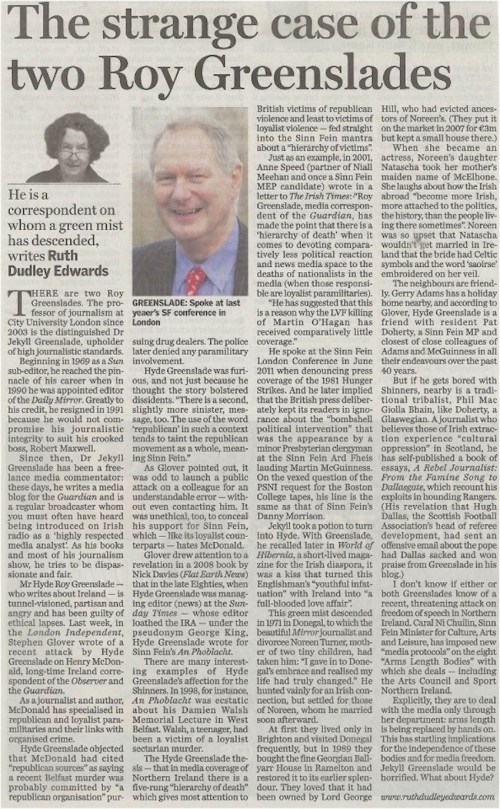
Ruth Dudley Edwards has written this cutting assessment of Guardian blogger, academic journalist and Sinn Fein confidante, Roy Greenslade.

The intro to the piece says he is a correspondent upon whom a green mist has descended. Personally, my problem with characters like Greenslade is not that mists have descended upon them, whether green, red or blue, but that they are dishonest about it happening. There is absolutely nothing wrong with journalists holding political views; the error is in not declaring them when writing about the subject. In Greenslade’s case his sin lies in not admitting his sympathy for Sinn Fein when he writes about the party or matters which concern it and in case of any misunderstanding by readers my opinion of this would be the same, and often was at a time when it was unpopular and even career threatening to say so, if it was Eoghan Harris writing about the North.

A reader, Sean Gallagher has written in to say that SF MP, Pat ‘Smiler’ Doherty is the uncle of Roy’s wife. Can anyone confirm this?

RDE3

BC subpoenas are legally dumb and dumber

Editorial | By Ed Moloney | March 14th, 2012

Slowly, but inexorably, the penny is dropping, both here in the United States as well as back in Ireland.

The Boston College subpoenas seeking access to oral history interviews with former IRA activists on behalf of the police in Northern Ireland are about the dumbest things that have ever happened in the long relationship between the United States, Britain and Ireland.

The difficulty is not how to describe why they are so dumb, but in counting the ways in which they are so dumb.

First of all, this is not the way in which to heal a conflict like that in the North of Ireland.

Over 3,000 people died and tens of thousands were scarred, physically and mentally, by a war that was undoubtedly one of the longest and most violent, if not the most violent in Irish history.

But the war has now ended, peace reigns and there is a desperate need for dealing with the past in a way that solidifies that peace and ensures an untroubled future.

The British have chosen a way that does the opposite. The Boston College subpoenas symbolize an approach to this issue based on revenge and the view that alleged combatants in that war should be dragged before the courts, convicted and jailed.

To do this, they created a special police unit, the Historical Enquiries Team (HET), put it under the control of the Police Service of Northern Ireland (PSNI) and authorized it to dig up evidence to support criminal prosecutions.

The emphasis in this approach is on retribution and punishment. Yet anyone who has had dealings with victims of the violence in Northern Ireland knows full well that most just want to know what happened to their loved ones. Who killed their father, brother, son, mother, sister, wife? Why did they do it, and did their loved one suffer?

There are exceptions of course but most I have had dealings with seek the truth, not revenge, and I strongly suspect they are in the majority.

What they want most of all is a proper truth recovery process. South Africa provided one model, a truth and reconciliation commission in which perpetrators were offered an amnesty in return for full candor about their deeds.

They could have chosen the British version and opted to scratch away at barely closed wounds but did not, knowing that to do so would mean that South Africa could never put the past behind it, that the past would continue to haunt the present and the future with catastrophic consequences for all South Africans.

The second way in which the Boston College subpoenas are dumb is because they are so politically stupid. Ostensibly, the subpoenas are in pursuit of the perpetrators of the murder of Jean McConville, but anyone who is familiar with the case knows that it is really about getting Gerry Adams who is alleged to have given the order to “disappear” Mrs McConville, an accused spy for the British Army.

Whatever one may think of Gerry Adams and his misguided efforts to deny any past association with the IRA, the reality is that Northern Ireland would not now be enjoying peace without his efforts.

He may have been less than straightforward with his IRA comrades; he may even have been duplicitous and furtive in his dealings with them, or

have exaggerated the political benefits of the Good Friday Agreement, but the stark truth is that he did bring this awful war, this endless bloodshed, to an end. I doubt that anyone else could have.

Yet the logic of the Boston College subpoenas is to drag him before the criminal or civil courts and stain him with the McConville murder. So the architect of a peace process centered on compromise ends his political life arraigned or sued for murder courtesy of the same government with whom he compromised. And this is supposed to cement the peace in Northern Ireland?

What message does that send to IRA dissidents who have long accused Adams and his colleagues of naivety in their dealings with the British? What they will say is this: “You trusted the Brits, Gerry. You accepted their deal and their terms and now look what they are doing to you? Once they had you where they wanted you to be, they stuck the knife into you.”

And this is supposed to strengthen the peace in Northern Ireland? If this is the logic behind the Boston College subpoenas then truly the lunatics are now running the asylum.

There will be those, of course, who will say that if Gerry Adams did order Jean McConville’s “disappearance” then he deserves to be prosecuted. In a normal society, one ruled by a normal government, that would be a difficult argument to answer. But Northern Ireland is not, even with the peace process, a normal society and nowhere is this more evident than in the administration of justice.

The plain, undeniable fact is that there are double standards in the way justice is doled out in Northern Ireland.

As myself and researcher Anthony McIntyre were battling in the Boston courts against the PSNI subpoenas last fall, the British prime minister, David Cameron, summoned the family of slain Belfast attorney, Patrick Finucane to Downing Street. Finucane had been shot dead by loyalist gunmen in 1989 but it is now widely accepted that British intelligence and the police in Northern Ireland, the Royal Ulster Constabulary (RUC), had foreknowledge of the murder plot and allowed it to happen. Finucane was a legal thorn in their flesh and what better way to remove it than by way of loyalist bullets?

Such was the concern about this level of collusion in an attorney’s murder, not least here in the United States, that Cameron’s predecessor, Tony Blair, was obliged to announce that there would be a public inquiry into Pat Finucane’s slaying and we would all get to know just what part the RUC and British spooks had played in this dirty deed.

But Cameron’s summoning of the Finucane family was not to tell them of a date for the beginning of this inquiry, but to inform them that he was withdrawing Tony Blair’s promise. There would be no inquiry into Finucane’s death.

So those who say that the PSNI has a right to rummage through Boston College’s files for the names of the killers of Jean McConville must also justify the denial of that same right to Pat Finucane’s family to scour the files of MI5 and the RUC Special Branch for the names of those who colluded with his killers?

Pat Finucane was a high profile victim of the Troubles in Northern Ireland, but not so Patrick McCullough. Who is Patrick McCullough, I can almost hear the reader ask? Well, he was a 17-year-old Catholic boy, just starting his first job in life, when he was shot dead in a loyalist drive-by shooting near his North Belfast home.

Patrick died in June 1972, six months before Jean McConville was “disappeared” by the IRA. No-one has ever been held accountable for his killing and, unlike Jean McConville, there has been next to no publicity about his killing. He was his parents’ first-born and most loved child, the first of fifteen children when his life was suddenly and brutally ended. His mother and father never recovered from his death, and their loss was every bit as tragic and wrong as that suffered by Jean McConville’s family.

I learned about Patrick McCullough’s death from a poignant letter his younger brother, Fr. James McCullough, a member of the missionary Kiltegan Fathers, wrote recently to the Irish Times newspaper seeking an inquiry into official indifference towards his brother’s killing. I contacted the priest to talk about his experience.

When his brother was killed, the police never once visited the family home to tell them what was happening in the investigation. The only visit the family had from the security forces was shortly after the funeral when their home was raided by the British army. Fr. McCullough suspects that their purpose was to plant weapons in the home so as to justify his brother’s murder.

When the British government set up the Historical Enquiries Team, Fr. McCullough wrote to the then PSNI Chef Constable, Sir Hugh Orde. His letter was forwarded to the HET which wrote to him saying they would be in touch. That was in 2006. Since then, neither Fr. McCullough nor any of his family have heard a word from the HET or the PSNI. He described his treatment at the hands of the PSNI and the HET as “abysmal.”

The killers of Patrick McCullough are well known. An investigation in 2003 by the Belfast newspaper, the Irish News, discovered their identity while noting that no-one had ever been arrested or charged. Recently, the reporter who wrote the story confirmed to me that neither the HET, nor the PSNI, had ever contacted her to discover their names. There have been no subpoenas for Patrick McCullough.

The silence from the police lasted until Fr. McCullough’s letter appeared in the Irish Times. Then, suddenly, he was phoned by an HET investigator who offered a meeting. When Fr. McCullough complained about the indifference shown by the RUC towards his brother, the HET man replied, according to Fr. McCullough: “……that he had never experienced sectarianism in the RUC or PSNI.”

On the HET’s promotional video, the unit’s commander, former Scotland Yard detective Dave Cox, addressed the issue of how the HET dealt with allegations of police collusion in murders in this way: “Most times we are able to actually answer and dispel those worries.”

In other words, it never really happened.

This is the last and most compelling reason why the Boston College subpoenas are not only dumb, but morally wrong. The HET is not a fit and proper body to deal with Northern Ireland’s past because it operates double standards. And Attorney General Eric Holder and the Department of Justice should not be helping these people do their dirty work in Boston.

It is up to Irish America to make sure Holder gets that message.

Boston College: The Irish News & Sunday Life Revisited

The US Attorney, Carmen Ortiz has just filed her reply to the briefs presented by our lawyers, Eamonn Dornan and Jim Cotter as well as the brief prepared by the American Civil Liberties Union of Massachusetts and on first reading one thing jumped out at me: the US government is finally admitting that one crucial justification for the original subpoenas against Boston College back in May, 2011 was false.

This was the claim that way back in February 2010, Sunday Life reporter Ciaran Barnes had been able to listen to Dolours Price’s interview with Boston College researcher, Anthony McIntyre in which she allegedly admitted her role in the disappearance of Jean McConville and three other people killed by the IRA in 1972.

This was a crucial claim because if true it meant that someone at Boston College, either myself or Anthony McIntyre or Bob O’Neill, the librarian on the BC campus, must have breached the confidentiality pledge given to Dolours Price and therefore we could no longer claim that pledge as protection against the subpoena.

This is what the affidavit prepared by Ortiz’s office back in July 2011 had to say about this:

“Ms. Price’s interviews by Boston College were the subject of news reports published in Northern Ireland in 2010, in which Ms. Price admitted her involvement in the murder and“disappearances” of at least four persons whom the IRA targeted: Jean McConville, Joe Lynskey, Seamus Wright, and Kevin McKee……..Moreover, according to one news report, the reporter was permitted to listen to portions of Ms. Price’s Boston College interviews.” (page 4)

So, according to US Attorney, Dolours Price had admitted all this in her interviews with Boston College and these tapes were then made available to Ciaran Barnes who wrote his report based on them.

As regular readers of this blog will know, we have strenuously denied all of this from the outset and in a series of articles, here, here and here, have attempted to demonstrate that the information in Barnes’ article actually came from a taped interview with Dolours Price made by Allison Morris of the Irish News.

In a deal with the Price family, the Irish News tempered its subsequent report but then Morris passed the tape onto Barnes who exercised no such restraint and compounded all this by dishonestly suggesting that the tape he had listened to came from Boston College. It was, of course, a device to protect Allison Morris and to hide the fact that the deal her editor had cut with the Price family had been betrayed.

We now know, thanks to a piece Morris penned in the Irish News, that the PSNI made no attempt to investigate this matter until June 2011, a month after our exposure of the Morris-Barnes deception. By that time, of course, Morris was able to tell the PSNI that she no longer had the tape in her possession. Quelle surprise!

Nonetheless, the tardy PSNI action was an admission that the basis for the first subpoenas served on Boston College was a lie. What has yet to be explained is why the PSNI did not approach either the Irish News or the Sunday Life back in February 2010 when their articles on Dolours Price were published. Was that just a one-off blunder by the PSNI or part of a pattern of preferential treatment to local newspapers whose political support is vital to the PSNI?

This is what Ms Ortiz has to say about the PSNI’s Keystone Cops act in her recently filed brief:

“……nowhere in the US-UK Mutual Legal Assistance Treaty….does it authorize the court to assess whether the authorities in the U.K. sought interviews of Ms. Price from news reporting sources in that country. Moreover, even if U.K. authorities had made such an inquiry, it is clear from appellants’ own affidavits that the Belfast Project interviews were singular, were possessed only by Boston College, and could not have been obtained from news reporting sources in the U.K.”

The first part of that statement amounts to an implicit admission that the PSNI had fallen down on its job by ignoring the Irish News and Sunday Life reports in February 2010. The second part would have more validity had the PSNI tried way back in February 2010 to obtain Allison Morris’ tape but failed. The truth is that news reporting sources were available to the PSNI but they chose to ignore them.

The US Attorney’s office in Massachusetts has now revised the original account of this episode but, tellingly, failed to explain the major differences between the original claims and what Ms Ortiz’ office now says happened.

Here is the revised version of that episode:

“Price’s interviews with Boston College were revealed in news reports published in Northern Ireland in 2010, in which Price admitted her involvement in the murder and “disappearances” of at least four persons whom the IRA targeted, including Jean McConville. Price also told at least one reporter that she had been interviewed by ‘academics at Boston University.'” (pages 6-7)

Notice the differences: no mention of anyone listening to Boston College’s tapes, merely an acknowledgement, and nothing more than that, that Dolours Price had told the Irish News that she had been interviewed by Boston College and, on one reading, a subtle suggestion that the alleged admissions of involvement in these disappearances were really made in the Irish News and Sunday Life reports. More, much more on this to come and if I was Allison Morris or Ciaran Barnes I would pay especial attention to this.

Roy Greenslime Outed In Independent

Roy Greenslade’s disgracefully dishonest career as a Sinn Fein shill masquerading as journalist, academic and media commentator was comprehensively exposed today by Stephen Glover writing in the Independent.

The delicious details can be read here.

Followers of this blog will know that I have written before about Greenslade’s other life as a secret correspondent for An Phoblacht/Republican News but Glover adds more recent details about Greenslime’s covert existence as a cheerleader for the Provo leadership: that he spoke last June at a Sinn Fein conference on the 1981 hunger strike (we can be sure there was no mention of Richard O’Rawe there!), has written under his own name for An Phoblacht (now that it’s safe to do so in these days of IRA ceasefires), has a holiday home in Co. Donegal (presumably adjacent to Costa del Provo) and counts Pat ‘Smiler’ Doherty, former IRA Director of Intelligence, as a friend.

Why does he never reveal these very relevant details when he writes in the Guardian about matters Irish, Republican and Sinn Fein? It’s called disclosure Roy. Responsible journalists are supposed to disclose a conflict of interest when they have one, as you do when it comes to writing about Irish politics. You have a dog in the fight, as they say in this country, and your readers deserve to know that.