The Three-Headed Dog That Kills Babies – And The Irish Angle On The Newtown Massacre That Niall O’Dowd Won’t Be Writing About

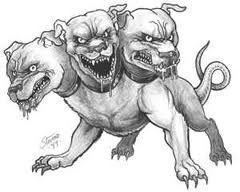
In Greek and Roman mythology, Cereberus is the three headed dog that guards the gates of Hell, and prevents those who have crossed the River Styx ever returning to safety.

Cereberus - The Three-Headed Dog That Guards The Gates Of Hell

Cereberus – The Three-Headed Dog That Guards The Gates Of Hell

Cereberus, or to give it its proper name Cereberus Capital Management,  is also the name of a multi-billion dollar private investment company that made a tidy little profit out of the slaughter at Newtown, Ct. When the crazed son of an equally insane “prepper” – an apocalyptic offshoot of American right-wing survivalism which preaches the need to prepare for societal breakdown – killed twenty children between 6 and 7 years old, and seven adults, six of them teachers and one his mother, he was using some of Cereberus’ best products.

But you wouldn’t know that Cereberus is the company that makes the Bushmaster M4 carbine that was the principal weapon used in the attack or that it also made the bullets that destroyed the schoolkids’ little bodies (so many bullets tore into the children that the pathologist showed their parents photos to identify them by rather than expose them to the real thing) . You won’t know that because so far the media has not mentioned the company at all even though it makes millions every year from selling the M4, and even though ultimate responsibility for the bloodshed in Connecticut arguably rests at its door. Some things are sacred after all.

Cereberus is a private investment company that, in the words of its chairman, former Vice-President Dan Quayle (yes, the idiot who couldn’t spell potato), “is truly sector agnostic”. That means it doesn’t care what product the company  that it wants to buy makes as long as he and his buddies can make a buck out of its. Like Mitt Romney’s Bain Capital, Cereberus is in the same eithics-free business of buying ailing companies cheap, making them over – usually by cutting workforces – and selling them off at a tidy profit. So morality doesn’t come into the equation at all, just dollar bills.

Cereberus has had investments in all these industries: Pharmaceuticals, Paper, Government Services, Real Estate, Retail, Transportation, Manufacture of Cars, Personnel management, Financial Services and Entertainment.

But it is probably best known in the arcane world of private investment by buying heavily into the unfashionable firearms business, rapidly becoming what the New York Times called “the most powerful and mysterious force in the American commercial gun industry.” It bought Remington Arms in 2007, a company that began in 1816 by producing flintlock rifles and was the oldest independent arms manufacturer in America until Cereberus appeared on the scene, and then it acquired DPMS Panther Arms. But its defining investment was the Maine firearms company Bushmaster which specialised in the production of so-called long guns, especially semi-automatics like the M4 Carbine, now forever to be linked to the carnage at an elementary school in western Connecticut.

Cereberus grouped these acquisitions together under the umbrella of a new conglomerate called Freedom Group – names like this are red lights in America, usually signaling the opposite of what is suggested – and it has grown to the point that in 2010 it sold 1.2 million long guns and 2.6 billion rounds of ammunition. It is estimated that the Freedom Group controls some 20 to 30 per cent of the firearms market in the U.S.

When Cereberus began its buying spree of firearms manufacturers the conspiracy obsessed world of gun freaks invented all sorts of theories to explain who the mysterious and largely anonymous Cereberus was and what the company’s motives were. The most extreme of these was that the liberal financier George Soros was behind the group and aimed to buy up America’s firearms industry so as to close it down. The rumours got so intense that Freedom Group was obliged to issue a public statement proclaiming that the company’s “owners and investors involved are strong supporters of the Second Amendment“.

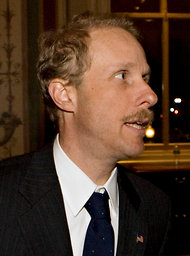
Cereberus founder and CEO. Steve Feinberg. How well does he sleep at night?

Cereberus Founder And CEO. Steve Feinberg. How Well Does He Sleep At Night?

Headquartered in ritzy Park Avenue in Manhattan, Cereberus’ founder is New Yorker, Steve Feinberg, a publicity-shy veteran of Wall Street finance. He began his business life with Drexel Burnham, the investment company founded by the notorious and subsequently convicted inside dealer, Michael Milliken, one of the shadiest characters ever to emerge from the canyons of New York’s financial district, and then joined with a friend to found Cereberus.

A big-game hunter (does he use the M4 to shoot elephants, one wonders?), Feinberg has brought former politicians like Quayle and ex-Treasury Secretary John Snow into the company to be its publicly acceptable face. He and his wife are heavy contributors to the Republican party. If the move to ban semi-automatic weapons gathers pace, expect Feinberg and Cereberus to call in some favors in Congress. But the big unanswered question in the meantime is this: how well does Steve Feinberg sleep at night?

*          *          *          *          *          *          *          *          *          *          *         *          *

Meanwhile, as readers of Niall O’Dowd’s Irish Central website are all too aware, hardly a US story breaks than the boul’ Niall and his staff are immediately scouring for the Irish-American angle, and with the Newtown massacre it has been no different.

But here’s one Irish angle on the slaughter in Connecticut that I don’t think Mr O’Dowd will be highlighting. The Bushmaster M4 carbine has another name. It’s called the AR-15. Does that sound familiar to my Irish readers at all? The AR-15 is of course the Armalite rifle and until Col Gaddafi started shipping over hundreds of AK-47’s to the IRA in the late 1980’s, the Armalite was the Provos favorite and deadliest weapon. And believe me it didn’t matter that it wasn’t fully automatic; firing rapid single shots was just ideal for urban guerrilla warfare.

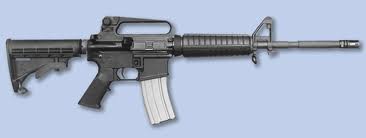
The Bushmaster M4 Carbine, used at Newtwon, aka the AR-15 or Armalite rifle

The Bushmaster M4 Carbine, used at Newtwon, aka the AR-15 or Armalite rifle

The former IRA leader in Belfast, Brendan Hughes told the story to researchers at Boston College how the Armalite was introduced to the conflict in Ireland. His commander at the time, Gerry Adams ordered him to travel to New York to buy quantities of the weapon and smuggle them back via the Queen Elizabeth II liner. When the weapons arrived in Belfast the IRA was for a while better armed than its adversaries in the British Army.

So celebrated was the Armalite in IRA culture that songs were sung about the weapon:

And here is a publicity film that the Armalite’s original owners produced back in the 1960’s. This is about the AR-10, a predecessor of the Ar-15:

Newtown School Shooting – How American Gun Culture Is Systemic

UPDATE  December 16th

MEANINGLESS DRIVEL FROM OBAMA AT NEWTOWN

In the coming weeks, I’ll use whatever power this office holds to engage my fellow citizens, from law enforcement, to mental health professionals, to parents and educators, in an effort aimed at preventing more tragedies like this, because what choice do we have? We can’t accept events like this as routine.

Obama had the opportunity at the inter-faith service at Newtown, Ct. last night to seize the initiative on the issue of gun insanity and announce some really meaningful initiative that would put the gun loonies in the NRA and their allies in the outer reaches of America’s equally lunatic right-wing on the defensive. There will be some who say it would be wrong to use highly-charged emotions in such a way and those who would say it would be wrong, nay immoral not to do so considering the issue that is being debated. I am firmly, immovably in the latter camp, as any sane person should be. Obama could, for instance, have announced that he would ask Congress to re-institute the ban on automatic weapons. That would have put the Right on the spot. But he didn’t. All he offered was his office’s best efforts to change things and a conversation with those most directly involved. How utterly, utterly pathetic. How Obama’ish. The inevitable thought occurs: was he more concerned keeping the Republicans on board for the fiscal cliff debate, more concerned to get them trade a few percentage points in tax rates for the wealthy for the swingeing cuts in medicare, social securty etc that everyone suspects he is planning? Before the election his aides leaked that he had held a dinner with notable Presidential historians to ask them what he could do to make his presidency go down in history. Well it looks as if he has just done that; his presidency will go down as the “what might have been, could have been presidency”. Some legacy.

*          *            *            *             *           *             *            *             *               *

I was watching the coverage of the Connecticut school slaughter on MSNBC late last night when something happened that demonstrated how deeply embedded the gun culture is in American society. MSNBC is  a liberal, even progressive cable channel, a sort of antidote to Fox News and as you might expect a good deal of the coverage was devoted to the prospects of gun control in the wake of this disaster and President Obama’s weepy performance in the White House.

As a perceptive piece in the New York Times pointed out this morning, the financial and electoral clout of the National Rifle Association combined with the fevered rantings of the American Right have almost made the phrase “gun control” redundant in the national conversation. Instead “gun rights” dominates the discussion and the curbs have melted away. The result is that you can, in most States, buy the most advanced and deadly weapons over the counter as restrictions have been rolled back under administrations of both stripes.

I remember my shock when a few years ago I went into Gander Mountain, an outdoor pursuits megastore, in Binghamton in upstate New York and found myself wandering curiously to the back of the store where the guns were sold. There were scores and scores of them, all sorts, handguns, rifles, automatics, single shots and so on. But pride of place was reserved for a weapon that I have to say took my breath away when I saw it.

Veteran observers of the Troubles in Northern Ireland will recall that there was no weapon in the IRA’s arsenal that was more coveted than the Barrett Light Fifty, a massive automatic sniper’s and anti-aircraft rifle that fired a huge .50mm slug with unerring accuracy for over a mile. The IRA expended considerable resources acquiring several of the weapons on the American black market and eventually smuggled three into Ireland. One was sent to Belfast where it was betrayed almost immediately and two were sent to South Armagh where they were used in the killing of several soldiers. The last British soldier killed in the IRA’s war, L Cpl Stephen Restorick was felled by a bullet from a Barrett Light Fifty.

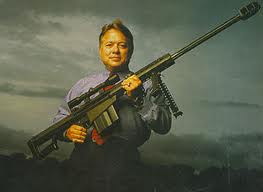
Ken Barrett, owner of the company that produces the Barrett Light Fifty advocates unrestricted ownership of his deadly weapon in America.

Ken Barrett, owner of the company that produces the Barrett Light Fifty advocates unrestricted ownership of his deadly weapon in America.

Anyway there at the back of the store in Binghamton was the Barrett Light Fifty’s close cousin. I can’t remember the brand name but it too was a huge weapon, fired a similar sized bullet over a similar distance and I am sure the IRA would have been very happy to have acquired such a deadly weapon during the Troubles. It was a gun made for killing not target practice as the manufacturer claimed. It was on sale for, I think, around $2,000 or $3,000. I asked the assistant how easy it would be to buy it. “If you’ve you’ve got a driving license and your credit card clears you can take it away now”, he replied. No checks on my criminal or mental health background.

Weapons like the Barrett Light Fifty were banned from public sale in America during the Clinton presidency  but since George ‘Dubya’ Bush’s time the restriction was lifted and despite some talk from Obama about reimposing it nothing has happened, as with so much of this President’s spiel. On MSNBC last night, re-banning automatic weapons scarcely rated a mention; instead it was about trying to stop people with psychiatric problems from buying guns and this because the shooter at Newtown had a history of mental instability (no-one on the programme seemed to have registered the fact that it was his (apparently sane) mother who bought the guns he used to kill her and twenty-six other people).

Anyway the conversation prattled on and then came the commercial break. I kid you not but the following advert, presumably timed for the Christmas market, was the first to be aired and I just thought the connection it illustrated between guns, happiness and making money in America showed just how deeply embedded this sickness is, and it is a sickness, and how hard it is going to be to change things for the better.

Dublin Government Told British Of Threat To Pat Finucane Two Months Before He Was Killed

UPDATED 14.05 EST

STATEMENT BY ED MOLONEY ON THE DE SILVA REPORT – Dec 12th 2012

In his report on the murder of Pat Finucane, Sir Desmond de Silva has this to say in relation to the RUC’s role in encouraging the UDA to target the solicitor (Par 73):

“The critical issue, in my view, was to determine whether RUC officers had been involved in inciting loyalists in custody to attack Patrick Finucane. Allegations that RUC officers had incited loyalists in this manner were first expressed privately by the Ambassador of the Government of Ireland to the Cabinet Secretary on 13 February 1989, the day after Patrick Finucane’s murder.”
In December 1998 I was the Northern Editor of the Sunday Tribune newspaper. During that month I had lunch with the late Tommy Lyttle, then the West Belfast Commander of the UDA. During the lunch he told me that RUC detectives at Castlereagh interrogation centre had recently suggested to one of his colleagues during an interrogation session that the UDA ought to consider killing three “IRA lawyers”, Pat Finucane, Oliver Kelly and P J McGrory. Tommy Lyttle’s words were that the RUC man had said that the UDA was wasting its time killing Catholics when there were real targets like these lawyers available.

Since Tommy Lyttle is now dead, as are the three lawyers at the centre of the story, I feel I am free to talk openly about this incident.

As a journalist covering a beat like the violence in Northern Ireland it was inevitable that from time to time I would come across evidence that suggested someone’s life could be in danger. While protecting source confidentiality has always been the highest priority to me I never hesitated in such circumstances to pass on a warning in such a way that the source is not revealed and the threatened person is able to take the proper precautions.

At the same time one had to be careful about how this was done. Motives can be be misinterpreted, actions misunderstood and the consequences could be dangerous both for yourself and your source. But there was no doubt in my mind that the three solicitors had to be warned. When a paramilitary figure as senior as Tommy Lyttle mentions such a possibility it had to be taken seriously.

Of the three lawyers, I was closest to Paddy McGrory who I regarded as a friend as much as a very valuable legal contact. I decided to tell him of the threat knowing that he would pass it on to the other two in a suitably discrete fashion. Shortly after my lunch with Tommy Lyttle, I went to his home and told him that the RUC was encouraging UDA gunmen to kill the three solicitors and that in my view he should take the warning very seriously indeed.

Paddy later  told me that he had contacted the office of the then Taoiseach, Charles Haughey to tell him of the threat and that the Irish government in turn contacted the Northern Ireland Office to insist that security be stepped up at his home. This was done apparently under some protest from the NIO. What precautions, if any, were taken in regard to Oliver Kelly and Pat Finucane I do not know. Mr Haughey’s involvement in the affair and the NIO’s role in upping security precautions at Paddy McGrory’s home are checkable facts.

The Irish government was therefore aware of the UDA threat to Pat Finucane as well as the other lawyers some two months before the UDA struck and because of Mr Haughey’s intervention the British government was also aware of the threat long before Pat Finucane was killed. Sir Desmond de SIlva is therefore mistaken, or was misinformed. The British government was made aware by the Irish government of the UDA’s threat to lawyers long before February 12th, 1989.

The Cairo Gang, The Force Research Unit, Murder In Ireland……..And Rupert Murdoch

Corrected 14.40 EST

Correction – December 27th 2012 – The Force Research Unit member we identified as Peter Charles Jones from the two photos taken of the unit was in fact a soldier called Kevin Dodds. He was/is a friend of another well known special forces soldier, Charles Pettifer, a former member of the SAS who married Tiggy Legge Bourke, friend of the late Lady Diana Spencer and nanny to her two sons. Dodds and Pettifer, according to our sources, went into business together after military service and set up a risk assessment company (business-speak for private detectives). However as you can see here, Pettifer has since moved up in the world, literally.

Meanwhile the former SAS soldier turned thriller writer known as Andy McNab was obviously indulging in some sly humour at the expense of the former FRU member when he wrote the novel described below (cue tipsy laughter at the bar in the Green Hut):
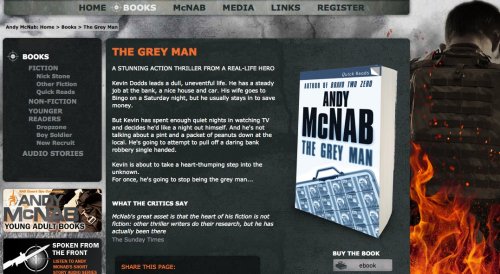
'Kevin Dodds' becomes an Andy McNab character

‘Kevin Dodds’ becomes an Andy McNab character

Correction – December 28th, 2012

We are now able to correctly identify Peter Charles Jones, the FRU agent who was the first to handle ‘Steaknife’, the code name given to possibly the most valuable double agent in the IRA during these Troubles, Freddie Scappaticci. We had mixed him up with Kevin Dodds, an understandable mistake since he was sitting only two spots away from Jones. The cutout below from the FRU group portrait, which we now believe was taken circa 1987/88, shows Jones circled in white, sitting at the very left of the bottom row of FRU officers. Dodds, wearing a red jacket and sporting red hair, is two seats to his left, the viewer’s right.
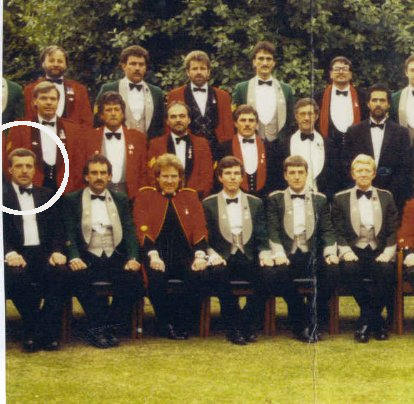
Peter Charles Jones, first handler of Steaknife, circled in white.

Peter Charles Jones, first handler of Steaknife, circled in white.

By Ed Moloney and Bob Mitchell

It has to be one of the most evocative photographs of the Anglo-Irish War of 1919-1921. A group of British intelligence officers, mostly military men, pose for a group shot in a Dublin street, cigarettes drooping from the mouths of some, a grim, determined look on their faces.
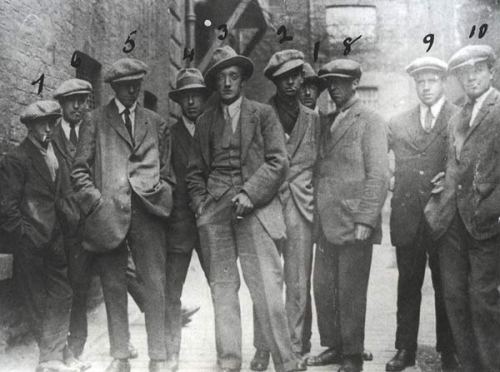
The Cairo Gang - A Special British Intelligence Unit Formed To Wipe Out The IRA In 1921 But Targeted By Michael Collins On Bloody Sunday 1921

The Cairo Gang – A Special British Intelligence Unit Formed To Wipe Out The IRA In 1920 But Targeted By Michael Collins On Bloody Sunday 1920

One character stands out. His is one of the few faces that is in full view thanks to the way his hat is tilted backwards and to one side. His right hand is thrust into his trouser pocket as if clutching a hidden pistol, the other holds a cigarette and he is slouched in a way that conveys confidence and even a touch of arrogance. The rest of the group seem to defer to him; he stands at their centre, the others are mostly half a step behind him. He could be their leader. But it is the eyes that draw the beholder. There is something cold, indifferent and quite scary about them.

This is the so-called Cairo Gang, an elite band of spies brought over under cover to Dublin in the summer and early autumn of 1920 to infiltrate and destroy the IRA which, under the leadership of its intelligence chief Michael Collins, seemed always to be half a step ahead of the British administration in Dublin Castle.

The adjective ‘so-called’ is chosen deliberately because the name Cairo Gang, which one account says was derived from a cafe on Grafton Street where they would meet their bosses from Dublin Castle, was not used at the time. Collins’ men apparently called them “the special gang”. It is not even certain that this is a photograph of that gang or that its members have been correctly identified but it long ago entered the accepted legend of Irish history that it is.

Whatever the truth of all that there was no doubt that Michael Collins still had an edge on his adversaries in British intelligence, thanks in no small way to the number of agents he had placed in and around Dublin Castle. Aware that the British were about to cast a net around his operation he struck first.

Early on the morning of Sunday, November 21st, 1920 over 100 armed IRA members visited addresses around Dublin intent on assassinating the Cairo Gang and other military figures. Their efforts met with mixed results as some targets were absent when Collins’ men arrived. But enough were at home to make the day a success for the IRA’s chief of intelligence – and to usher Michael Collins into Irish folklore.
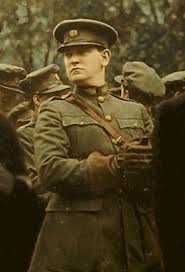
Michael Collins - Bloody Sunday Confirmed His Image As A Counter Intelligence Wizard

Michael Collins – Bloody Sunday Confirmed His Image As A Counter Intelligence Wizard

That afternoon an angry and vengeful squad of British Black & Tans invaded Croke Park and opened fired on the crowd watching a GAA football game between Dublin and Tipperary and in the evening three IRA prisoners, all senior figures, were killed by their captors at Dublin Castle as they allegedly tried to escape. By the end of the day fourteen British soldiers were dead as were seventeen GAA fans, players, civilians and IRA members. The day became known, inevitably, as Bloody Sunday.

Amongst those killed by Collins’ men that day was that man with the cold, scary eyes in the photo of the Cairo Gang. Now, accounts vary about his identity but one names him as Lieutenant Donald Lewis MacLean, who was born in London but whose family hailed from Scotland. One Nationalist account extravagantly described him as “the chief of intelligence at Dublin Castle”, which given his lowly rank just could not have been true.

But there seems little doubt that he was a British military spy and very probably a member of the Cairo Gang. The London Gazette of June 21st 1920 records his transfer to Dublin: “Lt. D. L. MacLean, late Serv. Bn., Rif. Brig., to be temp. Lt. whilst specially empld. 11th June 1920.” The phrase “specially employed” suggests exactly the sort of activities for which the Cairo Gang was then being fashioned to conduct in Ireland.

The fascinating aspect of Lt. MacLean’s life story and his role in the Cairo Gang is that it is almost possible to draw a straight line between his narrative and the events and circumstances which have led to this week’s publication of a British sponsored report on the 1989 assassination of Belfast lawyer Pat Finucane.
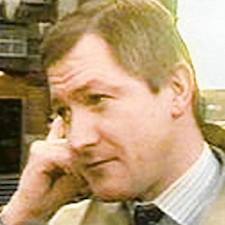
Pat Finucane

Pat Finucane – FRU Agent Brian Nelson Organised His Murder By The UDA

Pat Finucane was shot dead by the Ulster Defence Association (UDA) but the moving force behind his death was a secret agent working for a special British Army intelligence unit. The agent was Brian Nelson, a north Belfast Loyalist who had been recruited to burrow into the UDA’s intelligence section and tasked to supply intelligence which the UDA could use to kill IRA members; by the time of Finucane’s death Nelson was its head. The British Army unit that hired him was designated the Force Research Unit or the FRU as everyone called it.
Brian Nelson

Brian Nelson, UDA Double Agent For FRU, Behind Murder Of Pat Finucane

The FRU was in a direct line of descent from another military intelligence unit called the Military Reaction Force or MRF created to battle the modern IRA. The MRF was the brainchild in 1971 of the British Army’s first Brigade Commander of the Troubles in Belfast, General Sir Frank Kitson, as he eventually became. Kitson was a counter insurgency expert and theorist who had seen service against the Mau Mau in Kenya, against Eoka in Cyprus, against Communist guerrillas in Malaya and on behalf of the local Sultan in Oman. In 1963 he was one of a group of counter insurgency experts invited to Washington by the Rand Corporation to give advice on how the US should wage the war in Vietnam, then being expanded by President John F Kennedy.

Both the MRF and the FRU originated from or were variants on Kitson’s theory of Counter Gangs, the idea that armed groups could be subverted by activists drawn from their ranks and turned against former comrades. He ended his military career as Commander of Land Forces in the UK and chief aide-de-camp to the British Queen. He was clearly a man highly regarded by his political masters.
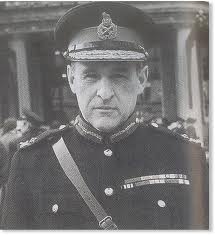
General Sir FRank Kitson - Force Research Unit Was Derived From His Counter Gang Ideas

General Sir Frank Kitson – Force Research Unit Was Derived From His Counter Gang Ideas

Kitson had also been a commander of one of the three Royal Green Jackets (RGJ) battalions, which together formed arguably the most influential and powerful regiment in the British Army. The Green Jackets were created in 1958 from the merger of three infantry regiments whose histories date back to the Peninsula Wars and before and their officer corps has consistently been over-represented at the highest echelons of the modern British Army. In 1966 the regiment had the prefix Royal added to their name, an indication of its growing sway in the military establishment.

One of the regiments that made up the RGJ was called The Rifle Brigade and it was the Rifle Brigade which Frank Kitson joined when he first became an officer in the British Army just after World War II. And the Rifle Brigade was the unit to which Lt. Donald MacLean belonged when he was seconded to the Cairo Gang in 1920. A mere twenty-five years or so separates the death of Lt. MacLean and the beginning of Frank Kitson’s life in the British Army, a blink of an eye in the span of Anglo-Irish history. It is in this sense that a straight line joins them; the Force Research Unit, and before it the MRF, were the Cairo Gangs of the modern Irish Troubles linked by common membership of the same British regiment.

Like the Cairo gang, the members of FRU had a fondness for posing for group photos although in their case the FRU was not bashful about doing so with weapons in their hands; no suggestive bulges in the trouser pockets for the Force Research Unit!

The following photos of the FRU are all available on the web and have been for some considerable time but it is now possible to identify some of those who feature in them and describe what they did and what part they played in the story of the Troubles and beyond.

The first photo is a portrait of the FRU’s NCO’s, that is non-commissioned officers below the rank of Regimental Sergeant Major aka Warrant Officer Class One (WO1) and it appears to have been taken in 1982 or 1983. From deduction it is seems likely that this photo was taken at a mess night in the Sergeants’ Mess – that is a formal dinner with drinks (usually lots of those) – to which the FRU’s commanding officer (CO), as would be the custom, was invited even though the Sgts Mess would normally not be one of his haunts (more about him below). He would normally be the only officer present at such occasions.
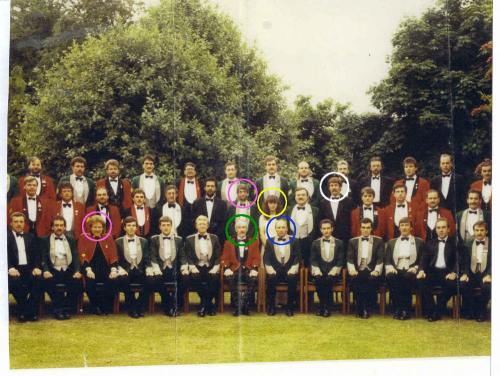
The Force Research Unit - Photographed  Circa 1982 At A Sergeants Mess Evening WIth Commanding Officer Col Gordon Kerr

The Force Research Unit – Photographed Circa 1982 At A Sergeants Mess Evening WIth Commanding Officer Col Gordon Kerr – ‘Colonel J’ – Circled In Blue

There are forty-one FRU members in the photo, and all but the CO are NCO’s. It is possible from this photo to estimate the total strength of the FRU by comparing it to other similar intelligence organisations such as the SAS and calculating how many officers served with the unit. In the SAS the ratio of officers to NCO’s is around the 1 to 12 level and if the FRU followed that pattern that means there were possibly three or four other officers in the FRU making the unit’s total number well below fifty, not far off the entire operational strength of its major adversary, the Provisional IRA.

The FRU’s NCO’s are wearing what is known as mess or dress uniforms and each one is peculiar to their parent regiment. Members of the FRU were seconded from other regiments to which they would eventually return when their service with the unit had ended. Each regiment takes a pride in its own distinctive mess uniform and some can be quite colourful.

The dreariest suit belongs to the SAS, a standard ‘black tie’ outfit complete with old-fashioned wing collar on their shirts; this may not be their standard mess uniform but an effort to keep their real ensemble a secret even from fellow soldiers. They are dressed incognito in a get up that might be more suitable for an undertaker although some might actually consider such a colour scheme appropriate for the SAS. There are seven FRU members wearing this outfit in the portrait which means that the FRU may have had seven SAS members seconded to it in the early 1980’s.

The white-haired man wearing a red dinner jacket with black lapels and tartan trousers  – the Mess uniform of the Royal Highland Fusiliers – whose head is encircled in green is the FRU’s Regimental Sergeant Major (RSM) the highest rank an NCO can reach. Just above that rank in the military totem pole is a Lieutenant. Immediately to his left, to the right as the reader sees it, and circled in blue is the famous “Colonel J” the commander of the FRU.

He is the RSM’s guest and chief and so he is seated next to him. His real name was Gordon Kerr, his parent regiment was the the Gordon Highlanders and he was last heard of in Bejing where he was the military attache at the British Embassy. “Colonel J” gave exculpatory evidence at the trial of Brian Nelson, the UDA intelligence chief and FRU agent who was at the centre of the plot to kill Pat Finucane. Nelson, he claimed, had been recruited to save lives, a claim that was greeted with scepticism in many parts of Northern Ireland.

Circled in yellow is the only woman in the FRU at that time. She is called Margaret Walshaw, known by her colleagues as ‘Mags’, and she was one of Brian Nelson’s handlers and therefore played a key role in his activities, including the murder of Pat Finucane.

There are two FRU members circled in purple and their stories are also of particular interest. The character at the very left of the front row, with red hair, is Peter Charles Jones who began working for British military intelligence in Northern Ireland back in 1976 (see correction, Dcember 28th above). One of the first double agents he handled is also the most famous IRA spy of the Troubles – and possibly the most damaging. Jones was the first handler for Freddie Scappaticci, known as ‘Scap’ to his IRA comrades, whose FRU moniker was Steaknife (that was his proper codename, not Stakeknife which was adopted to avoid legal action against a FRU whistle blower by the British Ministry of Defence).

There is another more engaging photo of Jones below but the man himself is not at all shy about his history with the FRU. On his Linkedin page he freely admits his membership of the FRU, where he was a “Det Commander’, between 1976 and 1984 while FRU’s activities he describes as “Reconnaissance, Special Operations, Counterinsurgency”. “Det” incidentally is a throwback term to the FRU’s immediate predecessor, the 14th Intelligence Company which originally was divided into three detachments or “Dets”. During his service with the FRU he was awarded the Queens Gallantry Medal (1984) and the George Medal (1980). Jones is now a screenwriter but his profile does not say whether any of his work has been professionally produced. If it has been it would be fascinating to watch.

Freddie Scappaticci was a senior figure in the IRA’s counter espionage section, the internal security unit or the IRA’s spy catchers. Born out of the debate about the IRA’s future undertaken by Gerry Adams, Ivor Bell and Brendan Hughes in Long Kesh during the mid 1970’s, the internal security unit was given extraordinary powers to investigate the IRA at all and any levels to uncover RUC, British Army or MI5 agents.

In practice there was little that the unit did not know about the IRA’s affairs and so an agent inside the spy catchers would be of enormous value to the British. According to IRA sources, over the years several key members of the internal security unit were suspected of being informers. Not surprisingly the unit appears not to have been very effective; US sources with inside knowledge say that MI5 has in the past claimed that 30 per cent of the IRA was on the books of British intelligence by the time of the peace process. If true this raises the question of who was really running the organisation at the end. It may well have been people like Peter Jones.

The other FRU member circled in purple was Scappaticci’s other handler, David Moyles. Like Mags Walshaw who is standing beside him, Moyles latter applied for a commission – i.e. promotion to officer rank – and was successful.

The second FRU photo shows members of the unit in portrait pose as Starsky and Hutch wannabes with their vehicles, and is the real equivalent of the Cairo Gang picture. There are nine FRU members in the shot, toting their weapons, which in two cases are non standard issue shotguns; it is possible to infer from the photo that there were three members to each FRU team, a driver and two operatives. The figure circled in yellow is Peter Jones once again, Scappaticci’s original handler. Judging by the colour of the brick in the wall behind them, the photo may well have been taken at British Army headquarters at Thiepval barracks, Lisburn, Co. Antrim.
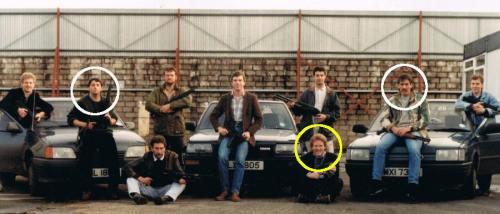
Members Of The FRU Pose With Weapons Beside Their Cars

Members Of The FRU Pose With Weapons Beside Their Cars

The next set of photos divide that portrait photo into two halves. The first one shows Ian Hurst, who used the name Martin Ingram in his early dealings with journalists, circled in white. Hurst has played the role of the FRU whistleblower who slowly but surely leaked the identity of Steaknife/Freddie Scappaticci to the media. Hurst met and married a girl from Co Donegal (he was stationed in nearby Derry with the FRU for a while) and this appears to have accelerated his disenchantment with the FRU over the use of Scappaticci and other aspects of their operations.
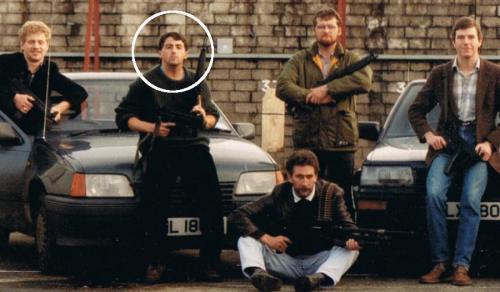
Ian Hurst aka Martin Ingram Is Circled In White

Ian Hurst aka Martin Ingram Is Circled In White

A chirpy Mancunian, Hurst claims to have discovered Steaknife and his activities by chance; he was on duty when the FRU office was phoned by the RUC who had arrested Scappaticci for drunken driving and ‘Scap’ was cashing in his get out of jail card. Scappaticci’s role with the FRU appears to have involved protecting real informers by sacrificing innocent IRA members many of who died lonely, terrifying deaths sometimes after petrifying interrogations. Morally outraged at all this, Hurst decided to get the Steaknife story into the public domain. There is no doubt at all that his revelations added to public concern over the Pat Finucane killing; if what Hurst was saying about how the FRU did its business was correct then the allegation the unit helped to get Finucane killed became all the more credible.

In the process he earned the enmity of one former FRU colleague in particular (although there is little doubt he would not win any popularity contest with the remainder of his former associates). That particular adversary is the second character circled in white both in the portrait pic and in the second enlarged half. His name is Philip Campbell-Smith and by the looks of him not someone you would like to cross and then encounter in a badly-lit alleyway on a dark night.
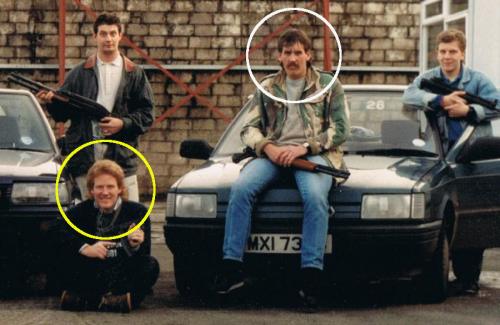
Phiip Campbell Smith, circled in white and Peter Charles Jones, Freddie Scappaticci's handler, circled in yellow

Phiiip Campbell-Smith, Circled In White And Peter Charles Jones, Freddie Scappaticci’s Handler, Circled In Yellow

Hurst did cross him. Campbell-Smith was reportedly arrested by the Stevens inquiry, set up to investigate leakages of intelligence to Loyalists, for allegedly intimidating Hurst when he declared his willingness to tell Stevens all he knew about the FRU’s activities. Campbell-Smith however was in no position to criticise others for publicising the unit’s deeds. Using the pen name Rob Lewis he published an account of the FRU’s activities, ‘Fishers of Men’, the unit’s official motto. The Amazon blurb reads: “Through the author’s own experiences, the story of an essential instrument in the fight against terrorism, that of covert intelligence gathering, is told.”

In February 2011, Campbell-Smith and three other men – all of them private investigators of one sort or another – pleaded guilty to “blagging” charges. “Blagging” means obtaining confidential information by deception or by impersonating someone else. In their case they had “blagged” information from banks, Interpol, the Criminal Records Bureau and the Driver and Vehicle Licensing Agency (DVLA) in Britain and sold it to lawyers. Campbell Smith got an eight month jail term.

The conclusion of the case meant that even more sensational charges against Campbell-Smith could be made public, charges that brought these former FRU operatives to the heart of the hacking scandal that has enveloped Rupert Murdoch and the Cameron Conservative-Lib Dem coalition government in a mire of corruption and wrongdoing.

The hacking scandal was investigated by a senior judge, Lord Leveson who held public hearings in which characters in the drama were cross-examined. One of his witnesses was none other than Ian Hurst who alleged that his computer had been hacked in 2006 on the orders of Rupert Murdoch’s News of the World which wanted to know what he was telling journalists about Steaknife.
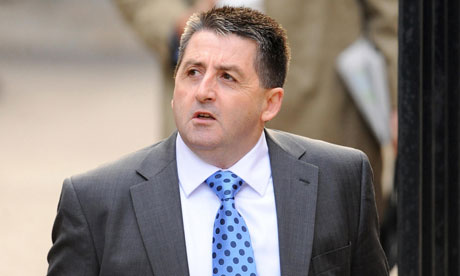
FRU Member Ian Hurst Pictured In February 2012, Told Leveson Inquiry His Computer Had Been Hacked On Orders Of Murdoch's News Of The World

FRU Member Ian Hurst, Pictured In February 2012, Told The Leveson Inquiry His Computer Had Been Hacked On Orders Of Murdoch’s News Of The World

The hacker, who could only be identified as ‘X’ because of reporting restrictions, inserted a trojan virus into his email system which then copied his emails and other material back to the hacker. The BBC Panorama programme investigated Hurst’s claims and discovered that Campbell-Smith was working for Jonathan Rees, a private investigator who had been contracted by Alex Marunchak, a senior executive at the News of the World, at that point edited by Andy Coulson who was subsequently made David Cameron’s director of communications when the Conservative leader became British prime minister.

Hurst secretly tape-recording an exchange with ‘X’ in which he claimed to be in contact with Coulson and had his number on his rolodex. MI5 discovered that Hurst’s computer had been hacked but failed to tell him. The full story can be read here.

After the “blagging” trial ended the identity of ‘X’ could finally be revealed. It was none other than Philip Campbell-Smith.
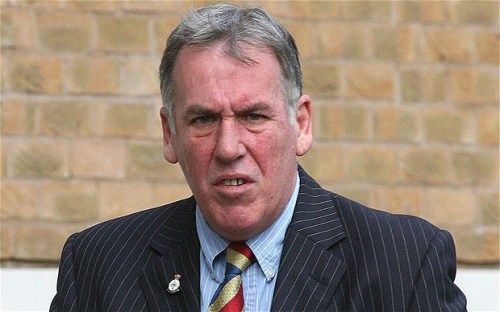
Philip Campbell-Smith, Hacked Ian Hurst's Computer - Sentenced To Eight Months Jail For Blagging Offences

Philip Campbell-Smith, Pictured In 2012, Hacked Ian Hurst’s Computer – He Was Sentenced To Eight Months Jail For Blagging Offences

So that is the story of the FRU, a unit that makes the Cairo Gang look tame and well-behaved. Its track record of direct and indirect involvement in murder, the endless lies and cover up’s, the deceptions and dirty tricks all culminating in FRU veterans hacking computers for Rupert Murdoch must be one of the most sordid tales in the history of British intelligence.

Little wonder then, that David Cameron, or behind him the shadowy figures who really rule Whitehall, refused to hold a proper public inquiry into the killing of Pat Finucane.

UDA Plot To Assassinate Gerry Adams – Some Background Revisited

UPDATED DECEMBER 7th

It remains to be seen just which UDA plot to kill the Sinn Fein President Gerry Adams it was that leading UK barrister Sir Desmond de Silva was referring to when he sent a message to the Louth TD this week warning him that details of the plot would be revealed in his 500-page report into the UDA’s killing of Belfast solicitor, Pat Finucane which is due to be published in the coming days.

Sir Desmond de Silva - told Gerry Adams his report who detail UDA death plot

Sir Desmond de Silva – told Gerry Adams his report would detail UDA death plot

De Silva’s private, and remarkably speedy inquiry into the Finucane murder was the response of British prime minister David Cameron to nearly two decades of calls for a full, sworn public inquiry into a scandal that nearly everyone knows, especially the British government, enmeshes MI5, British military intelligence and the RUC Special Branch in a series of murders carried out mostly in Belfast in the 1980’s by Loyalists, acting as a classic counter gang of the sort pioneered by that swami of counter insurgency black arts, General Sir Frank Kitson.

Pat Finucane - the de Silva report is David Cameron's answer to demands for a public inquiry into his murder

Pat Finucane – the de Silva report is David Cameron’s answer to demands for a public inquiry into his murder

Cameron’s decision outraged the Finucane family who had been summoned to Downing Street in the expectation that the prime minister was about to tell them details of the public inquiry they had long asked for and which his predecessor, Tony Blair had promised would happen.

Instead, Cameron’s offer of a secret review of the evidence by de Silva not only caused Finucane’s widow Geraldine and his children to stalk out of Downing Street in anger but it brought instant and widespread claims of a cover up contrived to protect the British intelligence establishment from a series of public revelations that would be bound to lead to demands for criminal action against some of Britain’s most senior spies.

Geraldine Finucane, stormed out of Downing Street

Geraldine Finucane, stormed out of Downing Street

It remains to be seen what de Silva has to say in his report but do not be surprised if it fails to satisfy the critics.

On the plot against Adams we can though be sure that it will figure UDA intelligence chief and British Army agent Brian Nelson. Readers’ memories might need to be refreshed about Mr Nelson. He was a former soldier who twice worked as a double agent for the British in Belfast. His first career as a spy came to an unhappy end when he was convicted of using a blowtorch to remove the body hair of an unfortunate Catholic civilian who had fallen into the UDA’s hands. The man’s luck changed dramatically when Nelson was spotted by a passing army patrol escorting the traumatised Catholic out of a drinking club presumably en route to a bullet in the back of the head and he was rescued.

Brian Nelson - blow torched Catholics and became British Army's top Loyalist spy

Brian Nelson – blow torched Catholics and became British Army’s top Loyalist spy

After a spell in jail, Nelson went to work in Germany but while there, in the mid-1980’s, the British Army decided that its intelligence arm in Northern Ireland – an outfit called the Force Research Unit – should use Loyalists to kill Republican activists, especially members of the Provisional IRA.

The problem with the Loyalist groups was that they found it hard to kick the habit of killing ordinary Catholics. It was, after all, what they had always done; they had been doing it since the start of the Troubles, and before that way back into the 19th century, and – crucially – it was also so much easier to do. Killing an IRA member on the other hand was not only more dangerous – they might shoot back for instance – but it required a great deal of research and homework, neither of which were exactly the metier of groups like the Ulster Defence Association (UDA).

Being aware of this, the FRU decided to make life easier for the UDA and hit upon the idea of re-recruiting Brian Nelson, bringing him back from Germany and after providing him with first class intelligence on the Provos and the INLA send him into the UDA. The UDA would have the best possible intelligence on the IRA available in an instant from Brian Nelson’s cardboard box which was stocked with goodies plucked from the FRU files. They correctly calculated that Nelson’s rise in the UDA would then be meteoric and with skillful handling, the UDA would become an efficient killing machine, able to spread terror in the IRA’s ranks at the bidding of British military intelligence. And so Brian Nelson became the UDA’s intelligence chief.

It sounded too good to be true and it was. To begin with the UDA didn’t actually kill that many top level IRA men and all too often, when sent out to kill a target in a house, would open fire at anyone who was unfortunate enough to look like the target. It also has emerged, as the years have gone by,  that Nelson was used just as much to ensure that the UDA didn’t by chance kill IRA members who were also on the FRU’s books. If an IRA man working for the British was targeted by the UDA not only would the FRU know beforehand but they could steer the Loyalists elsewhere or take other precautions.

Even so, the UDA would get very irate whenever they were accused of killing ordinary Catholics when, thanks to Brian Nelson’s cardboard box, they knew they had hit a Provo. When Loughlin Maginn, a Co Down Provo was shot dead and the UDA was condemned for killing an innocent man, their patience broke. They leaked to the media scores of photo montages of IRA suspects from Brian Nelson’s files and all hell broke loose. The British were obliged to send in Sir John Stevens, soon to be head of Scotland Yard, to investigate the whole affair and despite the FRU’s best efforts to cover up Brian Nelson’s activities the whole sordid business came to light.

Aside from the fact that the UDA just wasn’t that very good at killing IRA men even with Brian Nelson’s assistance, the British Army put up a defense for their behavior which doubtless we will see trotted out again in the de Silva report. It was that Nelson had been recruited to steer the UDA away from killing ordinary Catholics and to target IRA men instead. And when the FRU knew which IRA men were to be killed they would inform the RUC who would warn the targets and save their lives. It was a load of tosh of course – with two exceptions (more below), Stevens wasn’t able to find a single intended IRA victim whose life had been saved. The truth was that Nelson had been recruited to kill IRA members the British wanted killed and save those they didn’t want killed. But as I say, don’t be surprised if Sir Desmond breathes life back into this hoary old canard.

In a deal with the British legal authorities, Brian Nelson agreed to plead guilty to a series of offences – but not murder – and in January 1992 he received a 10 year jail term. The great caution the British took to ensure none of their secrets spilled out in court was evident in the fact that Nelson was prosecuted by two QC’s in the Crown Court, one from the local DPP’s office, the other from the Attorney-General’s office in London, who was there presumably to keep a watchful eye on proceedings. Nelson was released a few years later, was looked after by his former FRU handlers but died in 2003. His legacy though lives on.

I covered the Nelson trial – although it was really more a hearing – and the star witness was a man called ‘Colonel J’, who was the commander of the Force Research Unit who had agreed to testify on Nelson’s behalf about what a useful and caring agent he had been. Trotting out the life-saver lie, ‘Colonel J’, claimed that Nelson’s work for FRU had saved no less than 217 lives.

Very few journalists have uncovered more about the Brian Nelson affair than John Ware from BBC Panorama, who also wrote up a great deal of material in The Daily Telegraph newspaper of all publications. In a March 29th, 1998 report in that newspaper, he had this to say about ‘Colonel J’s’ claim:

“Yet officers from Special Branch have testified under oath that in only two instances did they receive information from the Force Research Unit that was sufficiently specific to enable any kind of preventive action to be taken. In one of those two cases, the intended victim was Gerry Adams. Nelson said his handlers told him the assassination of Adams would have been totally counter-productive . . . Adams and his supporters [in the Sinn Fein leadership] were committed to following the political path’. In all other cases, the intelligence received by Special Branch from the Force Research Unit had been ‘diluted, losing significance and value’, said an inquiry report to the Director of Public Prosecutions.”

John Ware - BBC man wrote more than most about Brian Nelson

John Ware – BBC man wrote more than most about Brian Nelson

The claim that Brian Nelson had saved Gerry Adams’ life also figured in ‘Colonel J’s’ evidence at Brian Nelson’s hearing cum trial. I covered the Nelson court appearance for The Sunday Tribune and I have to say that ‘Colonel J’s’ claim, for reasons later substantiated by John Ware, made complete sense to me.

The trial took place in 1992 and we were then at the evident beginning of a journey that two years later would produce an IRA ceasefire and eventually the Good Friday Agreement. Although many details of what had happened in the years leading up to all this were sketchy, the period when the FRU were keen to save Gerry Adams’ life coincided with Sinn Fein’s talks with the SDLP and it was obvious that something important was happening beneath the surface. Quite what, journalists like myself didn’t know but you could be sure that the FRU and their masters in MI5 certainly did.

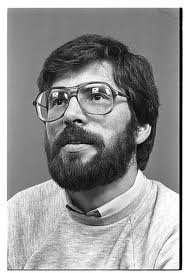
Gerry Adams, photographed around the time of the UDA plot against his life

Gerry Adams, photographed around the time of the UDA plot against his life

I have always regarded court hearings as the journalistic version of Ali Baba’s cave, a place brimmed full of stories if you look hard enough. For me the story to find during those few days was the background to the attempt the UDA had made on Gerry Adams’ life; what were the details, what happened and how was the Sinn Fein leader’s life saved. My source for that story is still alive so I cannot name him but suffice it to say he was a member of one of the various legal teams involved in the Brian Nelson hearing. And he had access to the statements that Nelson had made to Sir John Stevens’ inquiry.

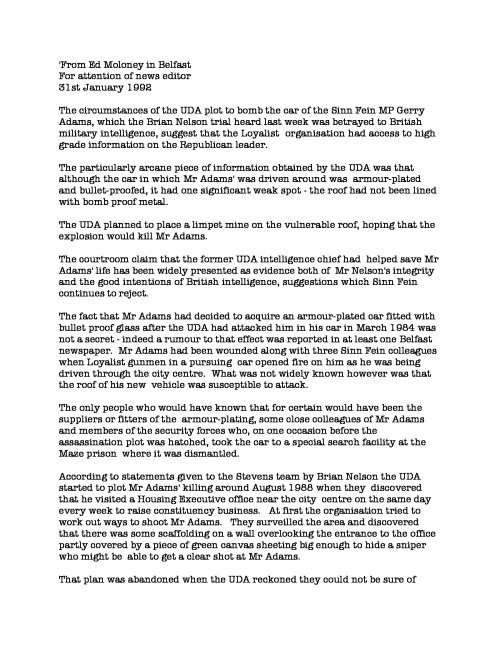
This is the story that I filed that week for The Sunday Tribune. I do not know if it is the same incident that the de Silva report will deal with but it is in the same general time frame. De Silva mentions May 1987 whereas my source said this particular plot happened in 1988, a year or so later. Anyhow, I have no doubt this plot existed and this is how it was described to me:

AdamsNelson01AdamsNelson2AdamsNelson3

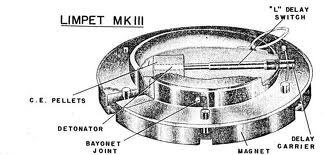
Limpet mine - probably more sophistcated that anything the UDA could produce

Limpet mine – probably more sophistcated that anything the UDA could produce

Now all this is very delicate territory for Gerry Adams and I can well understand why the Sinn Fein leader and his supporters bristle with indignation whenever this issue is raised. The idea that British military intelligence would want to ensure the safety and survival of the man who was the public face of the IRA is in their view tantamount to calling the man a collaborator, even though it isn’t.

But the fact remains that the British, at least the intelligent ones, then believed Adams wanted to end the IRA’s war and bring Sinn Fein into constitutional politics, and they were correct for this is exactly what has happened. They would have been mad therefore if they had not wanted to ensure that Adams was not killed by a UDA limpet mine. To do otherwise would have been in conflict with their own strategic interests. That this also coincided with Gerry Adams’ interests, in preserving his own life and implementing the peace strategy, is proof of nothing else but that.

And anyway that’s not the question. This plot happened in 1988. Pat Finucane was killed in 1989, a year later. We know that the FRU supplied Nelson with the photo of Pat Finucane that his killers used to identify him and that they were aware that Nelson had cased the Finucane home on behalf of the killers. So they knew a murder plot was underway. We also know now that the West Belfast UDA Quarter-Master and RUC agent Billy Stobie claimed to have forewarned his Special Branch handlers about some sort of assassination bid on the day Finucane was killed. Between all this, there was enough there to step in and stop the Finucane killing but that didn’t happen. So, the really intriguing question may be this: why did the British intervene to save Gerry Adams’ life but allow Pat Finucane to die?

We may never know the answer to that question – and I promise to eat this computer if Sir Desmond de Silva supplies the answer – but not long afterwards I wrote a piece that got me into a lot of trouble. I wrote that the real target that day, or at least another target, was not so much Pat Finucane as his brother Seamus, who often dined with his brother’s family on Sundays, the day of the UDA attack. All sorts of people complained about what I had written, not least Seamus, but I refused to back down.

Tommy Lyttle - said Seamus Finucane was also a target

UDA boss, Tommy Lyttle – said Seamus Finucane was also a target

I wouldn’t budge because the man who told me that was Brian Nelson’s boss in the UDA, former Shankill Commander and then Supreme Commander of the UDA, Tommy Lyttle who is now dead. He said that the assassins were hoping to find Seamus in the house and it was why one of the gunmen ran around the house and upstairs while his colleague pumped bullets into Pat Finucane. He was looking for Seamus. And I believed him, not least because what he said made sense. (Tommy Lyttle also told me and other reporters that the idea of killing Pat Finucane was first planted in UDA heads by RUC detectives interrogating key UDA hitmen in Castlereagh police station. Lyttle added that they also named solicitors Oliver Kelly and PJ McGrory as other lawyers the UDA should kill).  Nonetheless independent evidence to support this part of the late UDA’s commander’s account has not yet emerged (maybe the de Silva report will have it, but I would not hold my breath) and until it does, the jury is out.

The story did however make a certain sense to me because I knew that Seamus Finucane was a member of the IRA’s Belfast Brigade and that in itself made him a high grade target. But years later I learned more which made the attack, and the theory that Pat Finucane was not the UDA’s only intended victim, even more coherent and credible.

The peace process strategy was opposed at various levels in the IRA during its early, fragile years and nowhere was it more strongly challenged that at the level of the Belfast Brigade, then commanded by Brian Gillen. As long as Belfast held out, those in the IRA and Sinn Fein leadership who wanted to end up with something like the Good Friday Agreement would be stymied. Belfast was where the Provos had come into existence and it was where the IRA’s war had been fought with greatest ferocity. The city was Northern Ireland’s Moscow; whoever controlled Belfast controlled everything. And Seamus Finucane was then an ally of Belfast’s most powerful IRA leader, Brian Gillen, and in his own right a formidable voice made stronger by virtue of the Finucane name, one that resonated strongly in the ranks of the Belfast Provisionals.

Gillen and his colleagues on Brigade staff would later combine with Provisional leaders like Michael McKevitt against the Adams strategy and very nearly toppled the Sinn Fein leader. Later, however, Gillen abandoned McKevitt and joined the pro-Adams Army Council. But at the time of Pat Finucane’s death, Seamus Finucane was a key anti-peace process player.

Seamus Finucane

Seamus Finucane

That made sense of the murder of Pat Finucane. The FRU was not only facilitating the removal of a lawyer who was a thorn in the flesh of the British but they were using Brian Nelson to target and possibly eradicate, in the shape of Pat Finucane’s brother, an key ally of others who stood in the way of a peace process they thoroughly approved of. In other words the reason why the FRU (and MI5 and RUC Special Branch) acted to save Gerry Adams’ life may be the same reason they allowed Pat Finucane to be killed, and with him his brother Seamus – to save the peace process.
I have to emphasise that this is only a theory and in the nature of such things and the subject matter it is impossible to substantiate. But it accords with what I know about those involved and the issues that were at play. It also makes a great deal of sense.

There is though one other unanswered question which so far I have not seen or read asked anywhere much less answered. If the FRU had an agent at such a high level in the UDA as Brian Nelson why wouldn’t they also have someone with similar clout in the other Loyalist group, the UVF, which was equally adept at the game of killing political enemies? And is it just an accident that during the same years that saw the UDA start assassinating and attacking known IRA figures with a new enthusiasm and accuracy, the UVF’s intelligence on the IRA and success of its attacks also underwent a remarkable improvement? Or was that just a coincidence?

Law Journal to Supreme Court: Correct The Mischief Done By The First Circuit In Boston College Case

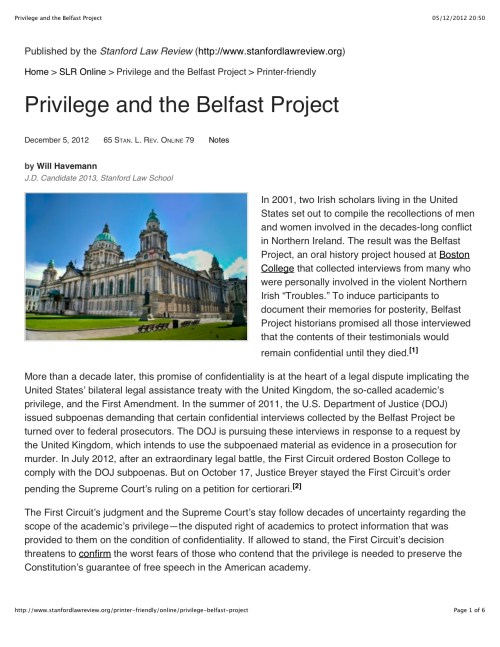
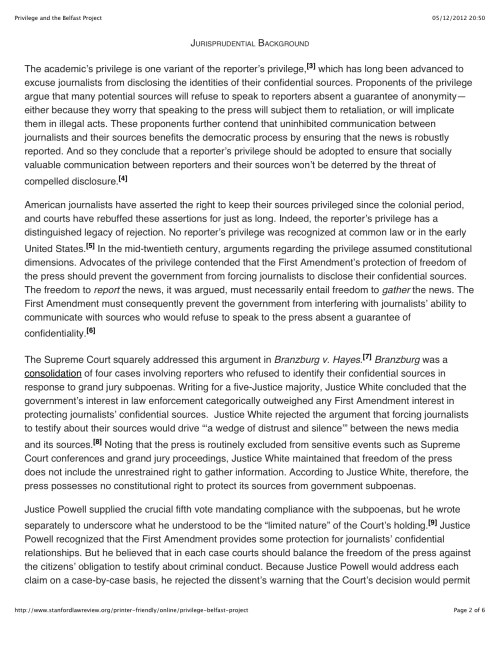
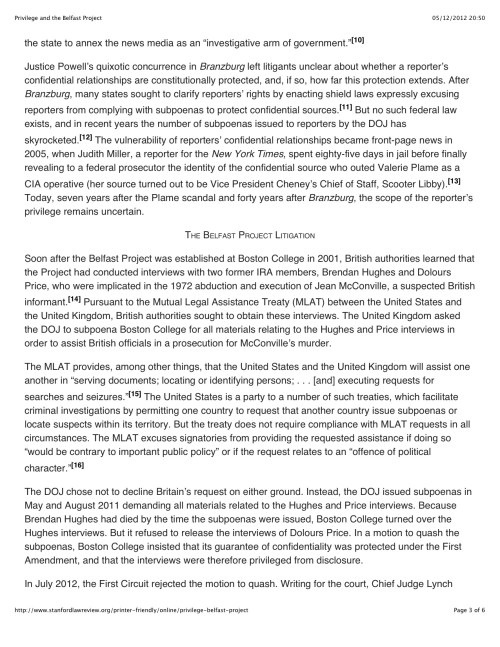
There is a brilliant article in the current issue of the Stanford Law Review, one of the most prestigious in America. Its past editors have included one Chief Justice of the Supreme Court, William Rehnquist and one Supreme Court Justice, Sandra Day O’Connor and a host of federal district judges, appeal judges and legal luminaries. An article like this, prominently featured in the December 5th edition, is not something to be ignored.

As a legal journal you would expect it to be abstruse and it is, but the killer punch comes in the final paragraph, an easily understandable mighty swipe at the appeal court in Boston which upheld the PSNI/US Department of Justice effort to get their paws on the IRA oral history archive at Boston College. It reads: “…..by overlooking the considerable interests supporting the Belfast Project’s confidentiality guarantee, the First Circuit erred both as a matter of precedent and of policy. At least one Supreme Court Justice has signaled a willingness to correct the mischief done by the First Circuit, and to clarify an area of First Amendment law where the Court’s guidance is sorely needed. The rest of the Court should take note.”

The full text is below. Read, savor and enjoy.

Privilege and the Belfast Project1

Privilege and the Belfast Project2Privilege and the Belfast Project3Privilege and the Belfast Project4Privilege and the Belfast Project5Privilege and the Belfast Project6

The Truth About General Petraeus

I have to admit at the outset that I know next to nothing about the American military or the people in charge of it and to be honest I am kind of happy to leave it like that. From the safe distance of Europe, I always regarded the men who lead that army as part loony, part scary and part comic, like characters out Dr Strangelove. Now that I live somewhat closer to them I see no reason to change my mind. They are people I would not like to get any closer to than a movie screen.

However I do know one or two things about the media and accordingly I was always suspicious of the adoration and uncritical praise the US media heaped upon the now scandal-ridden General Petraeus. As others have commented in the last day or so, long before Paula Broadwell unzipped the general’s trousers the media had been queuing up to give him blow-jobs.

There are three features which characterize all countries’ media and America is no exception:

One is the preference of media folk to hunt in packs or herds, in the sense that if you get a story wrong it sure helps that everyone else in the business has as well. It’s called perfect cover. But its really pernicious effect is that everyone, more or less, has the same story or at least the same approach to and explanation for the story. The herd instinct in the media imposes uniformity.

The second is an overpowering hunger for access. By access I mean the willingness of people, especially people in power, to talk to them. Gaining access is the emblem of success and it is what keeps editors’ smiling at the reporters who have it and glowering at those who don’t. Access brings a badge of respectability (meaning that the reporter is deemed trustworthy) and stories. The fact that the stories generated by access are invariably worthless pap doesn’t matter because it’s the fact that pap was produced by access that really counts. Access brings its own constraints however. Gaining it is one thing but the real trick is keeping it and the only way to do that is to keep on writing or broadcasting in the way that pleases the access donor. In other words, step out of line, question the donor’s veracity or motives, or in any other way annoy the donor and access can be withdrawn. Your editor won’t care why it was withdrawn, just that now you don’t have it but your competitors do – and needless to say the subsequent implications for career prospects are pretty obvious. Controlling access is the single most powerful weapon that can be used to manage the media. It keeps all those people on MSNBC, CBS and CNN, not to mention the NYTimes, the Washington Post and so on in line.

The third universal characteristic of the media is cowardice. That means that very, very few journalists have the cojones to engage in the sort of reportage that means breaking away from the herd and endangering your access. Doing that gets you a bad name amongst your colleagues, seriously pisses off your boss and can destroy your career. (It is the reason, in my experience, why those who get to management positions in news organizations are often the most mediocre)

This is not the time and place for an essay on the state of the modern media but it is arguable that the highly corporate nature of the business in America has intensified the effect  of these three factors in this country and accelerated the decline of conventional media (but benefited social media alternatives). This is not to say that the same factors are absent elsewhere. In fact I would argue that the smallness of the media in Ireland, in contrast to America, also intensified the unhealthy consequences of all this.

Anyway to get back to Petraeus, I had always suspected that these factors were present in spades with him if only because when I see and hear the media collectively having orgasms over an individual as they did with him for so many years, then every suspicious fibre in my body quivers.

It has taken Petraeus’ fall to bring this story out and it makes good reading and watching (a possible fourth characteristic of the media is that they are pretty vengeful when exposed as fools and suckers). Although he is most definitely not in that category, there is this article by Michael Hastings who single handedly brought down another military idol, Stanley McChrystal. He points out that Petraeus’s two claims to military genius – the Sunni Awakening in Iraq and the counter insurgency strategy in Afghanistan – were both frauds and that the man’s track record in those two countries points to an uncaring willingness to use brutal violence.

The other is an interview that Hollywood director Oliver Stone gave to CNN last night. Stone makes the same points but adds that Petraeus has, as much as Obama, been responsible for the vast expansion of drone deployment by the CIA in Pakistan, Afghanistan and elsewhere in the Arab/Muslim world. He says, correctly in my view, that this may well be the result of putting a military man in charge of the CIA. The consequences of that, the deaths of innocents, many of them children, and the anger and alienation that will one day revisit America, is perhaps the best reason to greet Petraeus’ disgrace and departure with joy and relief. And in the future to take the media’s praise of a general, or anybody else, with a bag of salt.


A Note To Irish-America: Make Sure Promises Are Kept

The aftermath of Barack Obama’s re-election to the White House has brought speedy speculation about changes the victorious Democrat will make to his second-term Cabinet. According to The New York Times today, Hillary Clinton is likely to leave her job as Secretary of State (amid speculation she will prepare a run for the presidency in 2016) and the favorite to replace her is Massachusetts Democratic Senator John Kerry, who was an unsuccessful White House contender in 2004. Attorney-General Eric Holder, who has stubbornly pushed the PSNI subpoenas through the federal courts, looks like he will stay however.

It is far to early to take this speculation seriously, but should it come to pass then John Kerry should be reminded by Irish-America of the stand that he took on the PSNI demand for interviews from the Boston College archive way back in January 2012. Should he end up in Foggy Bottom the hope must be that he will put his most welcome words into action if he has the power so to do.

In this regard, Irish-America could do worse than follow the famous example set by the Skibbereen Eagle in August 1914, on the eve of war, when West Cork’s most celebrated newspaper told Kaiser Wilhelm that: “The Skibbereen Eagle has its eye on you”.

New York Times, November 7th, 2012:

“The most prominent members of his cabinet will leave soon. Secretary of State Hillary Rodham Clinton and Treasury Secretary Timothy F. Geithner long ago said they would depart after the first term, and Defense Secretary Leon E. Panetta, previously the head of the Central Intelligence Agency, has signaled that he wants to return to California in the coming year. Also expected to depart is David Plouffe, one of the president’s closest confidants…..


“…….A front-runner for secretary of state appears to be Senator John Kerry, Democrat of Massachusetts, and Democrats said worries about losing his Senate seat to the Republicans in a special election had diminished with Tuesday’s victories. Another candidate has been Susan E. Rice, the ambassador to the United Nations, but she has been a target of Republicans since she provided the administration’s initial accounts, which proved to be wrong, of the September terrorist attack on the diplomatic outpost in Benghazi, Libya.

“While no one in the White House blames her, “she’s crippled,” said one adviser who asked not to be named discussing personnel matters. Another possible candidate, Thomas E. Donilon, the national security adviser, has told Mr. Obama he wants to stay in his current position, according to a White House official.

“Attorney General Eric H. Holder Jr., once expected to leave, now seems more likely to stay for a while.”


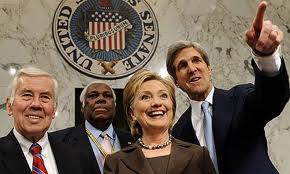
Hillary Clinton flanked by two supporters of the campaign to stop the PSNI subpoenas served on Boston College. To her left is her possible successor, Sen. John Kerry. To her right is Sen. Richard Lugar, ousted by the Tea Party in Indiana.


January 23, 2012

The Honorable Hillary Clinton

Secretary of State

Department of State

Washington, DC 20521

Dear Madam Secretary:

I write today with concern about the ongoing court efforts on behalf of the United Kingdom to obtain documents and recordings from Boston College’s Oral History Archive on the Troubles in Northern Ireland.

I know you’ll understand that this matter is of interest to me for a number of reasons. First, it has a profound impact on Boston College, a highly respected university in Massachusetts, as well as implications for the confidentiality of other research projects of this nature. More broadly, as Chairman of the Senate Foreign Relations Committee, I am obviously concerned about the impact that it may have on the continued success of the Northern Ireland peace process.

It is possible that some former parties to the conflict may perceive the effort by the U.K. authorities to obtain this information as contravening the spirit of the Good Friday Accords. I am proud of the role our government – and the Clinton Administration specifically – played to bring about that fragile peace. I am equally impressed by the courage and tenacity of the people of Belfast to rebuild their lives and their city. It would be a tragedy if this process were to upset the delicate balance that has kept the peace and allowed for so much progress in the past fourteen years.

Given my deep concern, I spoke to Attorney General Holder about this matter late last year. I fully recognize that the United Kingdom has invoked the provisions of our Mutual Legal Assistance Treaty and that this is clearly a factor which affects our flexibility dealing with such a request. Nonetheless, given the close relationship we have with the United Kingdom and the deep and enduring interest all of us share in seeing a lasting peace in Northern Ireland, I would urge you to work with the British authorities to reconsider the path they have chosen and revoke their request.

I would like to thank you in advance for your attention to this matter.

Sincerely,

John F. Kerry

Cc: The Honorable Eric Holder, Attorney General


The Arrest Of Padraig Wilson – Some Thoughts, Some Questions

If I was in the leadership of Sinn Fein there is one question to which I would now be urgently trying to get an answer and it is this: who took the initiative that led to the arrest and charging of former senior IRA member Padraig Wilson who last week was arraigned on charges connected to the high profile IRA murder of East Belfast man Robert McCartney in January 2005?

There really are only two possible answers. It was either McCartney’s sisters and partner, who have campaigned tirelessly to obtain justice for their late brother, or it was the PSNI. If it was the former then the Adams-McGuinness leadership can rest a little easier. But if the PSNI was behind the arrest of Wilson, if it was their detectives who dreamed up the prosecution strategy and pushed it forward, then they have every reason to be very concerned for it signals a willingness and even a determination by the PSNI, notwithstanding the peace process, to pursue high level Provo apparatchiks for past offenses, a willingness even to pursue the top men themselves.

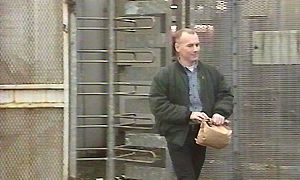
Padraig Wilson pins the Irish tricolour to the coffin of Kevin McCracken who was shot dead in the aftermath of Loyalist Michael Stone’s gun and grenade attack in Milltown cemetery in March 1988. In attendance are Sinn Fein official Tom Hartley (wearing spectacles) and, to his right, then IRA Northern Commander, Martin McGuinness

And with the legal fight to prevent the handover of the Boston College interviews still unresolved that is something that should cause the Sinn Fein leadership considerable pause for thought.

Sinn Fein’s pose on the Boston College tapes has been to ignore the dangers to their leaders, to Gerry Adams in particular, and to concentrate their ire against myself and Anthony McIntyre for compiling the archive. They have done this via proxies like Danny Morrison or Niall O’Dowd and that stance has confused and perplexed many in Irish-America. But if it turns out that it was the PSNI who pushed for the Padraig Wilson arrest then Irish-America’s concerns will have been justified, for it suggests the police may not be deterred by the rank or status of any individual if they decide to use the tapes in court.

That is an issue yet to be resolved but in the meantime there is no doubt that when the PSNI pursued Padraig Wilson they chose a man who was a key confidante of the Adams-McGuinness leadership, a fixer of serious problems ready to undertake the most delicate tasks on their behalf, and an IRA activist of the highest order.

Sentenced to 24 years for a car bombing offense in 1991, Wilson was IRA commander in the Maze prison during the critical years of the peace process and showed himself to be very supportive of a strategy that was causing much confusion and concern amongst the IRA’s rank and file, especially in regard to the possibility of the IRA decommissioning its weapons.

Throughout the years between the 1994 IRA ceasefire and the Good Friday Agreement four years later, the IRA stance on this question was, at least in public, unequivocal and was best captured in a 1996 statement from P O’Neill which told the world: “There will be no decommissioning either through the front or the back doors”.

But it was Wilson in a June 1998 interview who helped open the back door, telling The Financial Times: “I think a ‘voluntary’ decommissioning would be a natural development of the peace process once we get a sense that the arrangements envisaged in the agreement are beginning to function”.

I turned up to a Sinn Fein press conference on the morning that interview appeared and Gerry Adams’ aides furiously denied that Wilson’s remarks represented party policy (although I do remember that Richard McAuley wore a cynical grin as he peddled this line) and some even denounced Wilson for straying too far from the orthodoxy. I didn’t believe them partly because I had caught them out lying so many times by that point and also because I knew that the IRA leadership was riven with disputes over the decommissioning issue and that the Adams-McGuinness party was being accused at Army Council and IRA Executive level of trying to facilitate it in underhand ways.

As it turned out my skepticism was a prudent for this is exactly how decommissioning did happen a few years later. So here was an example of Wilson facilitating Provo policy in a classic Adams way, making a policy statement that was deniable to the rank and file but re-assuring to the other parties in the peace process dance, not least the British government. Padraig Wilson was turning out to be a loyal and dependable servant.

His importance to the leadership was recognized by the British who twice gave him leave from the Maze prison to attend crucial IRA Conventions, concessions that were unprecedented in the history of British-IRA interactions. The government was presumably motivated by a comfortable degree of confidence that he would support the Adams-McGuinness line and could help swing Convention delegates in their direction.

Padraig Wilson leaves the Maze prison for the last time

On the first occasion, in May 1998, he was let out for eight hours to attend the Convention that approved the recently brokered Good Friday Agreement. Calling the decision to free him “exceptional”, the Northern Ireland Office said it had been taken “in an effort to promote the agreement and to encourage the peace process.”

When Wilson was released in December 1999 under the terms of the Good Friday Agreement, the nature of his relationship with the IRA and Sinn Fein leadership and theirs with him was unmistakably clear: he loved them and they loved him back. Former Adjutant-General and soon to be Junior Minister in the Stormont power-sharing government, Gerry Kelly was at the gates of the Maze to greet his released colleague. Wilson’s first remarks to the waiting media were in glowing praise of his leaders:

Gerry Kelly praises Padraig Wilson’s leadership of IRA prisoners during the peace process negotiations

“It has been a very important period for us and a very interesting period. Nothing that has happened would have been possible without the leadership and commitment of our comrades in Sinn Fein and the republican structures, and we are very thankful for that. The very fact that I am here today a considerable number of years before the British government and others wanted me to be out is down to the working efforts of our comrades in the republican movement.”

Kelly repaid the compliment with the IRA leadership’s good housekeeping seal of approval of their former prison commander:

“I’d like to welcome him personally as a long term friend and a comrade and also to say his leadership, (and he’s been leader of the republican prisoners for some considerable time in the jail now), has been well appreciated both inside the jail and outside it. He has been a good leader in good times and bad.”

Notwithstanding his work for the burgeoning peace process, Padraig Wilson was soon back at the heart of the IRA, that is if the Colombians, British and Americans are to be believed. Some two years before Padraig Wilson’s release from jail, the IRA had begun a ‘cash-for-know-how’ relationship with the FARC guerrilla movement in Colombia in which the IRA allegedly passed on their skills in the manufacture and delivery of home made bombs and mortars to FARC which in return paid the IRA handsomely with large amounts of cash. The money, it is claimed, came from FARC’s dealings in the cocaine trade.

The Daily Telegraph made Wilson’s involvement in all this public in a May 2002 report written by the redoubtable Toby Harnden, author of the classic study of the IRA in South Armagh, Bandit Country. Describing Wilson as a “senior IRA leader and key ally of Gerry Adams”, Harnden, quoting Colombian, British and American sources in his report, said Wilson had traveled to Colombia using a false passport in April 2001, less than two years after his release from the Maze.

The report continued:

“Colombian intelligence documents say that Wilson entered Bogota, the capital, on Air France flight 422 on April 5 last year and flew on by Satena Airlines to San Vicente del Caguan in Farc territory. There he was met by guerrilla leaders. He returned to Paris on April 16 by the same route.

“A copy of an Irish passport bearing the name James Edward Walker and a photograph of Wilson has been passed to The Telegraph by Colombian intelligence.

“Wilson was accompanied on the flights by Niall Connolly, Sinn Fein’s representative in Cuba. Connolly, Monaghan and Martin McCauley were arrested on Aug 11 last year as they tried to leave Bogota for Paris.

“They are alleged to be leading IRA members and are in jail awaiting trial on charges of training Farc terrorists.

“The presence of such a high-ranking IRA man as Wilson in Colombia is powerful evidence that training activities were authorised by the terrorist group’s top leadership.

“A surveillance photograph of Wilson taken at San Vicente del Caguan airport was shown by the Colombian authorities at a House international relations committee hearing in Washington last month. Wilson, a former Sinn Fein worker, is a strong supporter and friend of Mr Adams, the president of Sinn Fein.”

For whatever reason Padraig Wilson escaped arrest in Colombia and returned back to Belfast where he continued to undertake delicate missions for the Sinn Fein and IRA leaderships, monitoring in particular possible media stories that could damage the likes of Gerry Adams. His official role in Sinn Fein was director of international affairs, a job once undertaken by Ted Howell who was perhaps the most important backroom Provo figure of this current leadership.

If the PSNI are to be believed, Padraig Wilson’s delicate diplomacy included intervening on the IRA’s behalf in a notorious rape case. That involved allegations from a close relative of the late Joe Cahill that she had been repeatedly assaulted by a senior IRA figure in West Belfast for many years while being forced to take part in an IRA “investigation” that was primarily concerned with discrediting her allegations. In mid October this year a judge in Belfast lifted reporting restrictions on the identities of people charged in connection with the affair. Amongst those charged with IRA membership and assisting in the management of an IRA meeting was Padraig Wilson.

The charges leveled against him last week in relation to the Robert McCartney killing are remarkably and perhaps significantly similar: IRA membership and addressing a meeting “to encourage support for the IRA”. A PSNI detective told the court that Robert McCartney’s five sisters and his partner had made witness statements accusing him of involvement in an IRA investigation following McCartney’s death.

Robert McCartney, stabbed to death by IRA members

The fatal stabbing of Robert McCartney, which followed a row in a city centre pub between him and several leading IRA members from the Markets and Short Strand areas, caused a major public relations crisis for Sinn Fein, especially in the United States and greatly intensified the pressure on the IRA to fully and finally decommission its weaponry.

What is not yet known is one crucial detail. Did the McCartney sisters go to the PSNI with the idea of implicating Wilson or did the PSNI come to them with the suggestion? If it was the former then the Wilson arrest can be safely regarded by the Sinn Fein leadership as a one-off event; if the latter then it means there could be more and worse to come.

Three of Robert McCartney’s sisters and his partner. Did they or the PSNI have the idea of implicating Padraig WIlson in their brother’s murder? That’s a question Sinn Fein needs to answer.

Padraig Wilson’s colleague Gerry Kelly appears at least to recognise the potential seriousness of the situation, telling the Associated Press: “This is a very serious situation and these charges need to be dropped and Padraic Wilson needs to be released immediately.” Any detectives involved in building a case against Wilson, he added, “need to be removed from policing before they inflict further damage on the peace process.”

There is one unexplained and intriguing aspect to the Padraig Wilson arrest which requires further investigation, assuming the media in Northern Ireland are still alive to the demands of normal journalism. When Marian Price was arrested and charged the British government quickly revoked her license saying that she will have to serve out the remainder of the prison term for the 1973 London bombing. Price had been granted an early release from her life sentence on health grounds and also claimed that she had been given a royal pardon but with the license revoked all bets are now off.

Padraig Wilson has had three strikes against him: his alleged involvement in the IRA’s Colombian adventure and two charges of IRA membership. So far there is no sign that the NI Secretary of State is of a mind to revoke his license and force him to serve out the remainder of his 24-year sentence. I wonder why?

Some (Cynical) Thoughts About Hurricane Sandy

Bloomberg addresses the media in the aftermath of Hurricane Sandy

People who know me are fully aware of how cynical I am and can be about a lot of things in life, especially when it comes to politics. So a few random thoughts here about the politics of Hurricane Sandy of the very cynical sort.

The first thing is that the storm has confirmed New York Mayor Mike Bloomberg as the repugnant jerk we always thought him to be. The billionaire founder and owner of the Bloomberg financial empire, the self-centered friend of Fifth and Park Avenues and the pal of some of Wall Street’s more execrable burghers, has emerged from Hurricane Sandy as the undisputed Mayor not of New York but Manhattan, that is the bit of city where under Bloomberg’s three-term mayoralty rents have become so high that it really has become off limits to all but the wealthy.

Listening to his press conferences in the days after the storm hit – which we were obliged to do on the radio but not the TV as our bit of the Bronx had lost all power – it was clear that his main and nearly only focus was on Manhattan. Now admittedly a huge chunk of the lower part of the island, from 34th Street on the west side and 42nd Street on the east, had lost power and people there were badly suffering but it has since become very evident that other boroughs, especially Staten Island and Long Island, were hit much harder.

But those areas barely rated a mention by Mayor Mike (incidentally National Public Radio’s New York station WNYC was guilty of the same sin, confirming through its specials on the aftermath of Sandy, its own obsession with Manhattan). Nor has he visited those parts of the city which he is also supposed to be mayor of, areas that were actually hit harder. We should have known earlier about the disasters in the outer boroughs and would have had the Bloomberg administration done its job – but that didn’t happen.

Staten Island, according to one report I read, accounted for half the city’s death toll of forty (as of Friday evening). In Long Island the devastation has been extreme with whole districts left homeless; in one area of the Rockaways some 130 homes were burned to the ground by a fire fanned by hurricane winds. Locals complain at the complete absence of FEMA and say that gas and food are rapidly running out. The weather is getting colder and another fierce winter storm is forecast for next week. There could be and probably will be many more deaths in the outer boroughs where residents are being told that power may be restored by mid-November if they are lucky. But Bloombie has not been seen once in either or any of those areas. But he has toured Manhattan. Several times. As I write this, CBS is reporting that power has been restored to most of lower Manhattan. Great! As for the boroughs? Suck it up.

When finally I got access to the internet, a three hour drive away from our home in the Bronx, I managed to look at a map of the blackouts on ConEd’s website there was one little spot in lower Manhattan where the power was on, a glittering sapphire in a sea of black velvet. No prizes for guessing where. Yes, you got it. The financial district, where Bloomberg’s pals hang out (in fact NYSE officials confirmed that although the market was closed on Monday & Tuesday they could have run the computerized dealings which nowadays account for most of the trading but decided not to [perhaps because it would have put a harsh focus on their privileged access to electricity!]).

A measure of the extent to which Bloomberg was out of touch with the feelings of New Yorkers came with his insistence that the annual marathon, scheduled for day six of the Sandy aftermath, should go ahead despite the fact that the runners would pass by spots where dead bodies had lain for two days or near streets where more were homeless than were housed.

Bloomberg said the marathon brought thousands of foreign runners and millions of dollars to the city but the residents of Staten Island and Long Beach said it was the worst of bad taste. (I don’t know what sort of people travel to places like New York for marathons but I did once encounter a woman who had run in the Los Angeles race. She was on the same flight to Belfast and I overheard part of her life history: she lived in Hollywood, Co Down (Northern Ireland’s equivalent of Fifth Avenue), her daddy was a retired Assistant Chief Constable in the Royal Ulster Constabulary and she herself was an up and coming barrister who was on first name terms, or so she said, with judges. )

It would be difficult to describe the outrage in the outer boroughs at Bloomberg but the fact that for several days the mayor seemed oblivious and even unsympathetic to the anger was an eloquent measure of how far out of touch, or uncaring, he was. There were two straws that broke the camel’s back and forced Bloomberg to cancel the race – and both illustrated his real attitude to non-Manhattan New York.

One was the disclosure that a generator capable of supplying power to 400 Sandy-devastated homes had been set aside for the post marathon entertainment of the runners – and this as thousands of his fellow citizens sat shivering in idling cars to keep warm knowing that when the gas ran out so would their luck. The other was that scores and scores of portaloos had been set up for the exclusive use of the runners. Now in parts of the city, especially high rise public projects, old folk had been marooned in buildings where the elevators no longer worked, where access to the street was via dangerous, unlit stairways and where lavatories had ceased to flush because power failures had stopped the flow of water. The marathon runners could use the portaloos but not these people.

The other cynical observation concerns Barack Obama who faces re-election this Tuesday. No sooner had the winds from Sandy died down than Obama was on a plane to New Jersey to spend time with a guy who is surely one of the more obnoxious pieces of work in American politics. I am talking about the loud mouthed, egotistical, blustering, far-right bully know as Governor Chris Christie.

The Odd Couple – Christie and Obama Empathize With Sandy Victims

The two of them fast became best buddies, with Christie, who has been an energetic campaigner for Mitt Romney, heaping effusive and even embarrassing praise at every possible media opportunity on a president everyone knows he really loathes. Endless photos of them appeared, the pair – one as tall and thin as a beanstalk, the other an over-ripe plum on legs – like new lovers on deserted if ravaged beaches on the Atlantic coast.

Now the conventional media take on this expedition to New Jersey says that the President was merely doing his job, offering as much humanitarian help as he could to the part of America hardest hit by the storm and Christie, knowing it would be churlish and even politically costly in this normally Democrat-leaning state, to act the begrudger. And it may well be that he was genuinely grateful for the unstinting help Obama had brought. Perhaps, but then……..

As for cynical old me, I couldn’t help contrasting all this with Obama’s absence from New York, where there were many more storm-related deaths and arguably destruction every bit as serious if not as widespread. New York is but a short hop from New Jersey, he could easily have made it and spent a few short hours sharing New Yorkers’ pain – but he didn’t. I think Homeland Security Secretary, Janet Napolitano (who?) has been here or will be but I can’t be sure.

So why did Obama choose to go to New Jersey but not to New York. Well, I think the answer lies in the election to be held next week. Christie may be an oaf but he is a talented and articulate one and an asset to the Romney campaign. If Romney could have counted on Christie to come out swinging against Obama after the storm alleging that the President had callously neglected New Jersey, that he didn’t care about fellow Americans, that would have been a powerful weapon to wield in the final days of what was always going to be a closely fought battle.

So, did Obama come to New Jersey in order to neutralize the threat a Hurricane Sandy-armed Christie presented to his re-election chances? I think that is a distinct possibility. I am not saying Obama didn’t care about the people of New Jersey because clearly he did – but he seems to have cared more about them than New Yorkers. As it was, the trip turned out even better than he could ever have imagined, with Christie falling over himself to heap tributes on Obama (an indication also, perhaps, that a Romney defeat would also suit him admirably!). Wouldn’t it be great to be a fly on the wall of the Romney strategy room?