Does The IRA Still Exist? Follow The Money For The Answer…..But Don’t Listen To Eoghan Harris!

I don’t know why or how but this story about new Garda Commissioner Noirin O’Sullivan refusing to answer ‘yes’ or ‘no’ to the question of whether the IRA still exists and is active in Ireland, passed me by. I only became aware of it when I noticed Eoghan Harris’ article in today’s Sunday Indo.

My first thought on reading his piece was that Harris had one hell of a nerve complaining about the media ignoring the story of a political party seeking office in Ireland while continuing to operate an armed wing. As he put it:

“Why is the fact that the party well poised to take State power may be secretly controlled by an armed criminal conspiracy not seen as a major news story?”

My, my! Aren’t Irish memories conveniently short? It wasn’t so long ago that Mr Harris’ comrades in the Workers Party (WP) were doing exactly the same as Sinn Fein is doing now, lying about the existence of its armed wing as they sought office. And I don’t recall him complaining at the time.

In fact the Workers Party, with the armed Official IRA (OIRA) still intact and running brothels with the UVF in Belfast and building site rackets alongside the UDA,  helped shore up Charlie Haughey’s second spell in government in 1982 when a deal was struck with the WP’s three TD’s. And the OIRA got involved in such dubious schemes with one main purpose: to raise money for the WP’s electoral efforts in the South – just as the Provisional IRA does for Sinn Fein.

And what about the media in those days? What did Irish journalism have to say about this sordid confection of political party and armed wing propping up an Irish government, or running brothels so that Prionsias de Rossa and his ilk could become TD’s? What did Eoghan Harris have to say about this deplorable state of affairs?

Well aside from one or two of us, myself and Vincent Browne in particular, my memory is that media behaved in exactly the same way as Mr Harris accuses it of behaving now when faced with a Sinn Fein that is being every bit as dishonest and devious about its armed wing. They turned a Nelson’s eye to the WP’s armed wing.

In fact it was worse than that. To write about the lie risked damaging your career – and even your health. I remember only too well the day I discovered that half an entire Northern Notebook had been censored by The Irish Times – removed in its entirety – because I dared write about the secret wing that Charlie Haughey’s new buddies were running. I learned about this only when I picked up the paper on that Saturday morning. The Irish Times had not even the courtesy – or was it courage? – to tell me.

The truth was that the Workers Party had infiltrated The Irish Times and much of the media – as well as semi-state bodies scattered throughout Ireland. The purpose was to bend them all in the direction of the WP’s ideology. And I don’t recall Mr Harris complaining about that!

Not only that but back in 1982 Harris ruled the news and current affairs section of RTE with an iron rod, inflicting a Stalinist-like purge of the station of any elements not considered reliable on the anti-Provo question, while advancing the careers of WP fellow travelers and imposing a WP analysis on the news stories of the day, especially those North of the Border.

When you think about it Harris is the last person in Ireland who should be lecturing the media about ethics or their refusal/reluctance to cover certain stories!

Manipulating the news and current affairs coverage of the national broadcaster to suit the ideology of a party of which you and many or your staff are secret members, is a far greater sin in my book. Irish journalism has still not recovered from the experience.

Those few journalists who did try to tell the truth about the WP were not only the target of venomous verbal attacks but came under physical threat as well.

I know that Browne was the subject of one very sinister threat while I learned from the UDA that two well known WP activists had tried to persuade the Loyalists that my job as Northern Editor of The Irish Times was really a front: I was actually an INLA intelligence officer. They wanted the UDA to kill me but thankfully the UDA knew me well enough to doubt the story and they checked it out.

(Incidentally I have always suspected that, via the same mechanism, the Official IRA/WP had a hand in assisting the UDA assassinations of Ronnie Bunting and Miriam Daly)

So when it comes to political parties seeking office while running an armed wing secretly in the background, the Sinn Fein/IRA nexus is not new and no-one knows that better than Eoghan Harris.

Nonetheless as it was then, so it is now a very legitimate question to ask. Organisations like the Provisional IRA and the Official IRA are, like their political fronts, essentially undemocratic and conspiratorial. The fear that should haunt most citizens is that once in power they will be reluctant to give it up. Elections are, in their minds, merely tactics by which power is achieved; they don’t really believe in them.

As for the continued existence of the Provisional IRA, the answer is obvious. Of course it still exists. There may not be the elaborate structures of old, the Northern and Southern Commands, the Brigades or the ASU’s but there is a skeleton organisation out there for sure.

I know for a fact that the IRA’s intelligence capability is still active, that a unit dedicated to collecting intel for the leadership, including presumably the SF leadership, exists.

We know the name of the man who heads it and the names of some of those who are active in it. And from the experience of colleagues and friends we know the sort of activity they have been engaged in. As the man said last May, ‘They haven’t gone away, you know!’ (Incidentally the strenuous efforts subsequently to remove his words from the internet are the equivalent of the bloody fingerprint left on the assassin’s knife)

An intelligence unit needs to be steered and directed, to get its marching orders and somewhere to deliver the actionable intelligence.  The logic of the unit’s existence is the presence of a leadership, an Army Council for instance. And where there is a head, a body is never far away.

There is though an even more compelling reason to believe the IRA still exists and has a leadership, even if only in skeleton form. That is the IRA’s money.

Back before the Northern Bank robbery the Irish Department of Justice estimated the IRA’s property portfolio at the €400 million mark and intelligence estimates suggested the IRA had businesses and homes not just in both parts of Ireland but in Europe, especially Portugal, and in the US and the Caribbean.

This was not a new practice for the IRA. The most senior republican in the organisation has a house in West Belfast which was originally bought and owned by the IRA and was gifted to him in the mid-1970’s by the then head of IRA finance in Belfast, a veteran republican who recently died. The house was in that veteran’s name – it is now in the name of the senior republican’s wife – but it really still belongs to the IRA.

There is more than one elected Sinn Fein politician who now enjoy the delights of a holiday home in places like the Algarve, people who would never have the wherewithal to buy such property themselves. And again the villa or apartment may be in their name but just let them dare sell it!

Now while the DoJ estimate was calculated before the 2008 property crash it was also made before the Northern Bank raid swelled the coffers even more, so the chances are that one way or another the IRA still has a very healthy portfolio of businesses, holiday homes and the like.

And with the property market gradually recovering, the portfolio will grow, making money available for the political wing to spend on elections and to reassure internal skeptics that if the peace process does collapse the wherewithal exists to replenish all those decommissioned weapons stocks.

But this is a pile of wealth that can never be liquidated and distributed amongst the rank and file. It was amassed by and for the IRA and belongs to the IRA. No individual can claim it. As long as that money is there it must be owned and administered by an organisation and that organisation is called the IRA.


‘…Sinn Fein Is Not Going To Transform The Lives Of The Majority Of Ordinary People….’

Three weeks ago Pearse Doherty, Sinn Fein rising star and rival for the party’s leadership should Gerry Adams ever step down – and don’t hold your breath on that one – penned an article for the Irish edition of The Sunday Times which seemed designed to calm nerves abroad, in the offices of Goldman Sachs for example as well as the European Central Bank, about what could or would happen should SF ever take power in the 26 Counties.

Would Sinn Fein set up a metaphorical guillotine in St Stephens Green to chop into tiny pieces all those promissory notes signed by previous Irish governments committing the Irish taxpayer to years or even decades of impoverishment so that speculators and bankers will get their interest-laden loans repaid?

Or will SF make the right noises to get elected and then perform a majestic U-turn once bums settle into the back seats of the ministerial Mercs or those oh-so comfortable Meelano office chairs in Government Buildings?

I am indebted to a friend, who shall remain nameless, for the following analysis of Pearse Doherty’s thoughts which came not from him but from someone on the same analytical wavelength. His friend, nay comrade, put into words very adroitly what anyone who has observed this party for any length of time instinctively knows.

Here are his thoughts:

“Once the froth evaporates, here’s what SF finance spokesperson and possible future leader, Pearse Doherty, says to the Sunday Times of March 8, which he knows is read by the people with money, who want to know the real intentions of SF. What’s notable is the declaration never to repudiate private bondholders debt, only renegotiate debt to public institutions. So the private speculators, and the existing arrangements for privatising the profit but socialising the losses, (know as the Wall Street solution) are safe. The last paragraph is the logical sequel to the earlier promise to leave the wealth of the speculators untouched: ‘….there are a lot of things we would like to do for individuals who are struggling out there, but we simply can’t do it. We can’t increase tax revenue… because it would be unfair on people and would hurt industry, it would hurt the economy and business.’

“A dig at the left, similar to what comes from Labour, is part of the dampening of expectations. There might be a few tweaks, but the substance of the status quo would remain untouched. Nor could it be, with no change in the balance of taxation, no wealth tax or implementation of the actual 12.5% rate of corporation tax on the profits of multinationals – as against the 2.5% they pay on average. Instead SF will move to reduce corporation tax in the North, mirroring a development strategy based on tax breaks to attract multinational inward investment and in effect an all island race to the bottom.

“This is also expressed in the way SF relates to political struggles. With the household tax they would not call for non payment, and the same now with the water charge. Why not? Would calling for non payment effect SF popularity or poll ratings? If anything, it would possibly improve them. But it would make SF an unsafe bet for big business, multinationals and the rich minority of Irish society that is doing well at present. For if you champion mass action and breaking the rules on one issue, what’s to stop that spreading? SF is looking to be a safe pair of hands on policy and in politics.

“How should the left relate to SF? I’m in favour of joint action to defend the rights and living standards of working class people, but without illusions. By their own declaration, SF is not going to transform the lives of the majority of ordinary people, even if they were the biggest group in a coalition government.”

Watch This Video And Be Frightened. Be Very Frightened……

It is a little known fact that international treaties can be and too often are the greatest threat to a country’s democratic life-style, decision-making and traditions.

Cobbled together by civil servants and lawyers, often in great secrecy and with no public oversight, they are invariably rubber-stamped by legislatures and only later when it is too late are their inherent dangers recognised.

In the past four years I have had personal experience of this. For example, the Mutual Legal Assistance Treaty, under whose terms the British state have confiscated interviews from Boston College, gives the British government the right to subvert rights that are guaranteed to American citizens under the US Constitution, for example the Fourth Amendment whose protection of requiring probable cause before court orders can be issued does not apply to the MLAT.

Equally, new UK guarantees on privacy can be brushed aside by the MLAT as though they never existed, as former Red Hand Commando leader, ‘Winky’ Rea is in the process of discovering in the Belfast courts, as the PSNI attempt to confiscate his BC interviews.

Bad enough as the MLAT is, it is though in the ha’penny place compared to a new international trade treaty currently being negotiated by the major Western capitalist powers.

Called the ‘Transatlantic Trade and Investment Partnership’ or TTIP as it is more widely known, the powers that this treaty gives corporations to subvert domestic governments and to brush aside democratic decisions makes the US Supreme Court’s decision to grant corporations the same status as human beings seem like a petty thing of no consequence – although others might argue that the Supreme Court decision and the TTIP are two faces of the same beast. (A similar treaty between the US and Pacific powers called the Trans-Pacific Partnership is also close to final negotiation. Between them the two treaties will encompass the entire planet.)

The video below is an explanation of the TTIP and its hidden dangers given by David Malone who runs an excellent blog called GOLEM XIV. He gives the clearest explanation that I have yet heard of a very complex and arcane subject. He calls his talk “The Death of Democracy” and once you have heard what he has to say I am sure you will agree that it is an appropriate title.

The TTIP is very close to becoming a reality. Be frightened. Be very frightened.


Britain Continues The War Against The IRA And Sinn Fein Stays Silent

The leaked story in today’s Sunday Telegraph reporting the British police’s intention to pursue six IRA activists who had been given so-called ‘comfort letters’ by the Blair government is another indication that the British are determined to continue waging war against the IRA despite the peace process and the reality that the Provisional movement has effectively accepted British rule in Northern Ireland.

This, along with the Cameron government’s expressed intention not to stand over the Blair letters to the so-called ‘On The Run’s’ or OTR’s – IRA suspects given promises of non-prosecution – and the pursuit of Ivor Bell, who will learn in a fortnight whether he will face charges in connection with the disappearance of Jean McConville, amount to a British default both from the spirit of the peace process and the commitments given during good faith negotiations with Sinn Fein and the IRA.

That the British intention to continue to pursue IRA suspects, try them in the courts and then imprison them amounts to an act of war against the IRA is undeniable in the context of the conflict since 1969.

Whereas the IRA’s campaign was characterised in the main by the shooting and bombing of British targets, the British response in the main took the form of trying to put as many IRA members as they could behind bars, using the police and the courts to do so (while the British also shot and killed many IRA members the greater part of their energies was spent trying to imprison them).

The fact that the IRA has completely abandoned violence against the British, has stopped shooting or bombing them and furthermore co-operated in the destruction of its arsenals while the British now trumpet their resolve to keep putting former IRA activists behind bars whenever they can, highlights an unspoken and unacknowledged reality: the IRA has ended its war against the British but the British have not ended their war against the IRA.

This would be completely uncontroversial had the Troubles in Northern Ireland ended in any way other than by a series of negotiated accords with each side making and giving concessions and no side claiming victory over the other.

This latter commitment was the defining principle of the peace process, the oil that greased the wheels: no-one came out and said ‘We Won!’ and by not doing so this enabled the already difficult process of making and demanding concessions to happen.

Implicitly and in an unspoken way, at least in public, the Troubles ended in a draw with every participant agreeing on ways of enabling each other to withdraw from the field of battle. It wasn’t easy and it took a long time to happen but without that agreement it probably never would have.

The fact that the British, or to be precise the Cameron government, are now flouting this principle amounts to a declaration of victory over the IRA and a hollowing out of the core of the peace process.

Had the Provos done something similar, for instance by announcing that the IRA was back in the business of acquiring weapons, how loud would be the cries of anger from London? And from Dublin? How grave would the resulting crisis be for the peace process? How quickly would Unionists have withdrawn from the GFA institutions?

But the Provos haven’t, and they won’t. And nor have they raised as much as a squeak in protest, at least in public, even though one very real consequence could be the abandoning of former comrades to jail time (except when their leader was briefly threatened with the same fate and that protest was quickly put down).

And ultimately it is this silence from Sinn Fein that is making it possible for the British to behave in this way. And by staying silent Sinn Fein is also admitting that the British are right; they won and to the victors go the spoils, including the right to put former adversaries behind bars, peace process or no peace process.


“Gerry Adams Increasingly Politically Toxic”: Washington Post Blog

An intriguing explanation for Gerry Adams’ “on-again, off-again” head to head with the US State Department during the St Patrick’  Day festivities in Wahington has come from Henry Farrell, author of the ‘Monkey Cage’ blog on the Washington Post’s online site – and it makes sense.

According to Farrell a combination of distaste at the persistent allegations that Adams ordered the disappearance of widowed mother-of-ten, Jean McConville – given added profile and credibility by this lengthy exposé in last week’s New Yorker magazine – along with the claim that he knew about the child abuse committed by his brother Liam but did nothing about it and what Farrell calls “a swirl of abuse” about rape and sexual abuse by IRA members, have transformed Adams in the eyes of Washington power brokers into “an increasingly controversial figure”.

Changed times indeed. You can read full the article below but first this piece of gossip. I understand that on the periphery of the Hillary Clinton lunch in New York hosted on Monday by Niall O’Dowd, the wannabe Irish ambassador for the next Clinton White House, Gerry Adams had a ten-minute tete-a-tete with Lloyd Blankfein, CEO of Goldman Sachs.

It would be sensible to presume that Blankfein wanted to get his own take on the leader of the political party which was about to be described as the greatest single threat to Ireland’s economic future by his Chief European economist, Kevin Daly.

The report, which warned that Sinn Fein in government could well take the same stance on Ireland’s debt as Podemos does in Spain and Syriza once promised in Greece, was published a day or so later so presumably Blankfein, whose Goldman Sachs empire was once memorably described by journalist Matt Taibi as “a great vampire squid wrapped around the face of humanity, relentlessly jamming its blood funnel into anything that smells like money,” did not have the opportunity to influence Daly’s report.

A pity for Sinn Fein because according to reliable sources Blankfein later told friends that he had been “….greatly impressed” by the Sinn Fein leader, “….and re-assured”.

So the banks of Ireland and Europe can breathe easily.

Anyway here is that Henry Farrell blog piece. Enjoy:

Monkey Cage

How the White House snubbed Irish politicians on St. Patrick’s Day
By Henry Farrell

March 18


St. Patrick’s Day celebrations (never St. Patty’s Day — take it from a native born Irishman) in Washington are usually uncontroversial. Irish politicians aren’t particularly sentimental about shamrocks, leprechauns, green beer and all the rest of it. They are, however, happy to take advantage of the occasion: They fly over to the United States in droves to lobby for Irish interests, and American politicians (who like a good photo opportunity) are willing to play along. Tuesday’s celebrations, however, were different. The Obama administration snubbed two major players in Irish politics — one accidentally, the other deliberately.

So what was the accident?

Vice President Biden is genuinely proud of his Irish roots, with a particular fondness for Irish poetry. He’s also widely and genuinely liked by Irish politicians. However, when welcoming the Irish delegation (led by Ireland’s taoiseach, or prime minister), he cracked a joke that is causing great unhappiness among one, somewhat unwilling group of Irish people — Ulster Unionists. When opening the door to the delegation, he joked that “if you’re wearing orange, you’re not welcome in here.” Orange is traditionally the color of Ulster Unionists, who have historically wanted to preserve the union with Britain, and have been strongly opposed to all strains of Irish nationalism and republicanism. However, the main Ulster Unionist party is now in an uneasy power sharing arrangement in Northern Ireland with Sinn Fein, the Irish republican party. They have expressed their anger at the joke, claiming that it was a disgraceful slur against their political tradition.

This may seem like a non-issue to most Americans. But symbols can be incredibly important in Northern Ireland. Richard Haass, the president of the Council on Foreign Relations, has done a lot of work promoting peace in Northern Ireland. As he notes in this video interview with Gideon Rose, symbolic issues like parades and flags are incredibly important, and incredibly divisive within Northern Ireland.

And what was the deliberate snub?

Gerry Adams, the leader of Sinn Fein, claims that U.S. leaders were unwilling to meet with him. Adams says that a meeting with the State Department was initially confirmed — but that he wasn’t invited to any high level meetings with the president or high officials, instead being consigned to the general reception with the hoi polloi. The United States hasn’t said anything about why Adams is being frozen out, but it likely has to do with Sinn Fein’s intransigence in a current stand-off over power sharing. Adams has also become an increasingly controversial figure. As an article published in last week’s New Yorker discusses at length, Adams has been accused of ordering the cold-blooded murder of a single mother at the height of the “Troubles” in Northern Ireland. He has also admitted that he knew that his brother, Liam Adams, was a child abuser, but did not reveal it to the police, and is in the midst of a swirl of allegations about rape and sexual abuse by IRA members. While Sinn Fein’s popularity hasn’t suffered as badly as you might think, Adams himself is increasingly politically toxic.

What consequences will these snubs have for Irish politics?

Northern Ireland’s political system is going through one of its periodic crises at the moment: The power-sharing arrangement is not working, because of disagreements about spending cuts. Many had hoped that the St. Patrick’s Day celebrations in Washington would offer an opportunity for the United States to bully and persuade the different parties to resolve their differences. This is now more complicated than was initially expected. The accidental snub is less important. Biden’s joke will probably do no more than to temporarily complicate negotiations. Ulster Unionists will find it moderately useful in pushing back against U.S. pressure to reach a deal. The more overt snub of Gerry Adams is more significant. It hasn’t been accompanied by any statement or explanation, and it’s less a complete refusal to meet than a downgrading of relations. But one plausible interpretation is that it is a signal from the United States to Sinn Fein, suggesting that Sinn Fein (and in particular, figures like Adams) will find a cold welcome in future unless they fully accommodate themselves to current politics, participate in power sharing, and properly resolve their past association with terrorism.
Henry Farrell is associate professor of political science and international affairs at George Washington University. He works on a variety of topics, including trust, the politics of the Internet and international and comparative political economy.


Irish Media & Niall O’Dowd Greet New Yorker Expose Of Gerry Adams With Embarrassed Silence

200px-Original_New_Yorker_cover

Yesterday (Monday 16th March) was the official publication date of The New Yorker issue that carries the 15,000 word exposé of Gerry Adams’ alleged part in the IRA disappearance of Jean McConville and the 1973 IRA bombing of London.

To readers of this blog especially in Ireland who may be unaware of The New Yorker’s place in the world, a word or two in explanation: The New Yorker is undoubtedly America’s premier weekly magazine with a subscription exceeding one million readers and a hard-earned reputation for credible, investigative long-form journalism, excellent reviews, cartoons and new fiction. Its subscribers include the nation’s decision-makers, movers and shakers, the most important members of American society.

You can be sure, for instance, that a copy of this week’s edition of the magazine will be on the desk of Barack Obama, Hillary Clinton, John Boehner, most US Senators, US Supreme Court judges and a majority of the higher echelon of Washington’s bureacracy and security leadership.

And this week America’s best & brightest will have read these words written by the author of “Where The Bodies Are Buried”, Patrick Redden Keefe about interviews given by Brendan Hughes and Dolours Price concerning Gerry Adams’ alleged involvement in the disappearance of Jean McConville:

Nevertheless, it’s hard to explain away the very specific, and similar, recollections that Hughes and Price shared about Jean McConville’s murder. When the journalist Darragh MacIntyre pressed Adams about McConville in a 2013 BBC documentary, “The Disappeared,” Adams, looking like a cornered animal, flashed a hostile grin and noted that Hughes and Price had “demons.”

Keefe’s 15,000 word article also demolishes Adams’ claim never to have had any connections with the IRA:

Several former I.R.A. volunteers confirmed to me that Adams was a member of the group, and a photograph taken at a Belfast funeral in 1970 captures him wearing the black beret that was an unofficial uniform of the organization.

And his article definitively links Adams to the planning of the 1973 bombing of London, the first attack by the Provisional IRA on the British capital:

According to both Dolours Price and Hughes, the meeting (to choose members of the bombing team) was run by Gerry Adams. Generally, the I.R.A. issued warnings before its bomb blasts, in order to minimize civilian casualties. But sometimes these warnings did not allow sufficient time for escape: in July, 1972, twenty bombs were detonated in a single day in Belfast, killing nine people, an episode that became known as Bloody Friday

“This could be a hanging job,” Adams told the group, explaining that if the perpetrators were caught they could be executed for treason. “If anyone doesn’t want to go, they should up and leave now.”
Were comments such as these to be made by an Irish journalist, Sinn Fein spokespeople would be queuing up to condemn the reporter’s motives, insinuating the existence of a hostile political or personal agenda while other journalists would be sharpening their knives to perform a similar exercise in their various columns.
This is exactly what happened last May in the wake of Gerry Adams’ arrest by the PSNI on matters not a million miles away from the subject matter of Mr Keefe’s impressive article. Leading the field in this type of onslaught back then were The Irish Times, The Irish News and the publications, online and print, produced from Niall O’Dowd’s stable.
So far The Irish Times has given the article two mentions but neither The Irish News nor Niall O’Dowd’s organs have given Mr Keefe’s work any mention at all – at least that I can find. Neither of those two publications has even mentioned the existence of The New Yorker article even though it has been available online for more than a week and has been the talk in journalistic and political circles in Ireland, Britain and America.
What we are witnessing is to be sure an embarrassed silence – embarrassed because Mr Keefe can hardly be accused of being a dissident republican, so better to say nothing. But it is more than that.It is depressing evidence of the success Sinn Fein has enjoyed in intimidating sections of the Irish media from discussing issues they should be discussing, especially since those doing the intimidation are doing so on behalf of people who are very likely to be members of the next government in Dublin (as well as Belfast).

The fact that The Irish Times has at least acknowledged Patrick Keefe’s journalism is to be welcomed; but such a pity that it took an outsider to open up issues that should have been the focus of that paper’s investigative resources long before this. The question that The Irish Times should be asking itself is this: ‘Why The New Yorker and not us?’

Issues such as the disappearing of widowed mothers, the deaths of six hunger strikers or a host of other dubious events in the IRA’s more recent history that defy or challenge normal explanation are unfortunately now regarded by too many in the Irish media as off-limits since to regard them any other way risks being branded as anti-peace process. And the treatment meted out to those who have tried to tell the truth about such issues, or even to explore them, serves as a chilling example of what could happen to them.
It is also the reason why the Irish media now expends so much more energy pursuing the various sex scandals in which Sinn Fein and the IRA have become embroiled. To be brutally blunt, it is safer. No-one can accuse you of being anti-peace process if you are fighting to expose the cover up of a pedophile rape. After all the Catholic Church went through the same examination and that wasn’t at all politically motivated – at least not obviously so.

In saying this I do not wish in any way to understate the gravity of rape, especially underage rape, nor the arguably more heinous offence of covering up and lying about it. Nor do I question in any way the validity of the media’s pursuit of those responsible for the coverup’s, nor the worthiness of their journalism.

But no-one died as a result of those scandals, at least that we know of. This is not an argument not to pursue SF/IRA rape cover-ups’, just to broaden the field of investigation. Like Patrick Keefe and The New Yorker just did. Over to you, Irish media (Niall O’Dowd excepted).

PSNI’s Double Standards On Investigating The Past Illustrated By Scappaticci Case. One Law For Boston Interviewees, Another For British Agents

This was a story carried by Ulster Television today. No comment from me is necessary because the implications are obvious. Note the ‘no comment’ from PSNI. And not a squeak from the British military:

IRA victim’s father calls for Scappaticci probe

A man whose son was murdered by the IRA in 1993 has called on Freddie Scappaticci to be investigated for his alleged involvement in the killing.

Frank Mulhern’s solicitor Kevin Winters, who is representing a number of victims’ families in civil cases against the alleged Army agent, the Ministry of Defence and the Chief Constable, is urging more people to come forward.

Joe Mulhern was just 22 years old when he was abducted by the IRA.He was accused of passing information to Special Branch, interrogated for 10 days, shot and his body dumped near Castlederg, Co Tyrone.

No-one has ever been charged or convicted of the murder.

Six weeks after he was buried his father Frank – who first spoke to UTV’s Insight programme in 2013 – said Freddie Scappaticci, who at the time was alleged to be a senior member of the IRA’s internal security unit, told him about his son’s murder.

Frank Mulhern said: “I asked him again how he died and Scap said that the first shot had hit my son in the back of the neck and he told the guy whoever shot him to shoot him again, so the second shot hit him on the back of the head and apparently that’s what killed him.”

Scappaticci was named in 2003 as the highest ranking Army agent working inside the IRA, a claim he consistently denies.

Frank Mulhern is convinced the security forces could have saved his son but chose to protect their spy codenamed ‘stakeknife’.

“It’s about time Scap was brought to court and that’s all I really want,” he said.

Frank Mulhern, together with a number of other families, are now taking a civil action against Freddie Scappaticci, the Ministry of Defence and the Chief Constable.

Their solicitor Kevin Winters believes all the abductions and killings allegedly linked to Scappaticci, along with the role of the state in protecting the agent from prosecution, need to be fully investigated.

Frank Mulhern continued: “The PSNI have files which could solve a lot of these murders but for one reason or another they’re not acting on them, probably because Freddie Scappaticci is involved.

“I say my prayers at night and one of the prayers includes Scap, that he is brought to court and charged or whatever. I mean all I want is my day in court with Freddie Scappaticci – I want absolutely nothing else.”

The PSNI said it would not be making any comment.

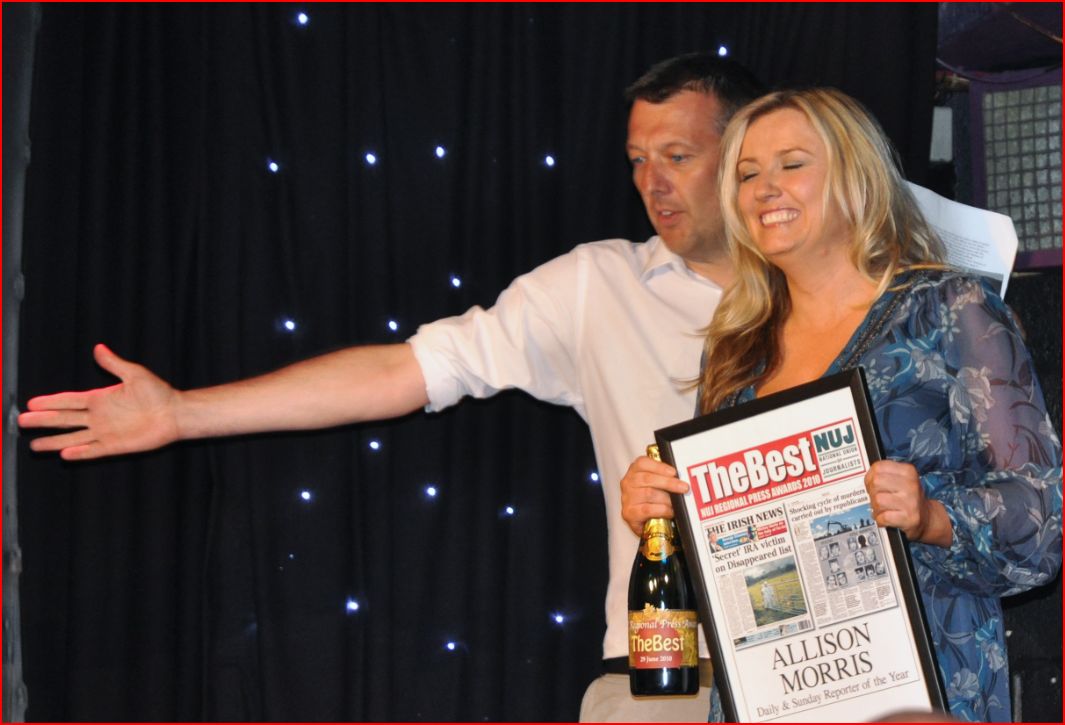
UK Press Watchdog Accepts Complaint Against Irish News & Allison Morris

The new British press watchdog set up in the wake of the phone hacking scandal involving newspapers owned by Rupert Murdoch has given the management of The Irish News fourteen days to resolve a complaint from myself that the paper breached its Editor’s Code of Practice in its coverage of the subpoena served against the former Loyalist activist Winston ‘Winky’ Rea.

Allison Morris on a happier day. She may not win an award for her 'Winky' Rea coverage however

Allison Morris on a happier day. She may not win an award for her ‘Winky’ Rea coverage however

The Independent Press Standards Organisation (IPSO) has written to The Irish News informing the newspaper that if it fails to resolve the matter to my satisfaction the IPSO can then formally consider the complaint. The IPSO can then choose to impose sanctions against The Irish News, if necessary.

The complaint arose out of a front page story written by Allison Morris claiming that ‘Winky’ Rea had told interviewers from the Boston College oral history project that he had been involved in planning the murder of Loyalist dissident, Frankie Curry and that this was one reason that PSNI detectives were seeking access to the tapes.

The Allison Morris story appeared two days before a court hearing in Belfast at which lawyers for Rea were planning to argue that the PSNI had no evidential basis for the subpoena. The Irish News’ story was picked up by at least one Sunday tabloid, The Sunday World thereby enhancing the possibility that the judge involved in the hearing could be influenced in his deliberations.

A complaint lodged with the IPSO against The Sunday World was turned down on the grounds that the newspaper is not a member of the regulatory system covered by the watchdog.

A complaint about Allison Morris’ Irish News’ article was made on two grounds. One was that the story was inaccurate and that if Morris had contacted myself, the former director of the project, she would have been told that there was no basis for her article. Morris failed to make any contact even though she has my email details.

The second ground concerned the failure of The Irish News to publish a letter from myself pointing out Morris’ failings.

The offending Irish News article is reproduced below along with my letter of complaint to the paper’s editor, Noel Doran.

serverIrishNewsLetter1IrishNewsLetter2

Greece’s Syriza – A Toothless Tiger?

The following article, taken from the World Socialist Web Site, challenges the consensus view of the Greek Syriza party which swept to power in the recent general election in that country on an anti-austerity platform. Far from being the radical, left-wing party portrayed in the media and by many on the left, argues Evel Ekonomakis, Syriza’s actual demands are modest and fall far short of challenging the system that causes Greece’s woes. He questions the party’s choice of allies and predicts that Syriza will backpedal on its pre-election promises (a prescient call given the weekend deal Greece agreed with the Eurozone).

The question for Ireland is whether its anti-austerity champion, Sinn Fein would behave any differently if it got into power in Dublin, a not inconceivable proposition in the light of some recent opinion polls. Given that SF’s political ideology is even less defined than its Greek counterpart and could best be described as chameleon-like – it changes according to what best suits the party – would a Sinn Fein-led government behave any differently from Syriza?

The Peculiar Socialism of Syriza

On January 25th, Syriza, the left-wing party of Alexis Tsipras, won the national elections. That evening, my friend “Karma” (his nickname), a Greek-American living in Athens, sent me this text message: “I went downtown for the victory speech, and was blown away. We’re NOT in Kansas any more! No more Carmina Burana: they played Pink Floyd, The Clash, Bella Ciao, Springsteen and Patti Smith!”

I texted Karma back, saying how glad I was but also expressed my fears Syriza, an acronym that means “Coalition of the Radical Left,” would backpedal on its pre-election promises. “Yup,” my friend soon replied, “we’re all hoping for the best but Syriza’s proclaimed goal is not to overthrow the status quo. Instead, it wants to bargain for a kinder, gentler form of impalement.”

Ours were minority views. In the week immediately following the victory, most people on the left rejoiced that better days had finally arrived to long-suffering Greece. By contrast, those with right-of-center sympathies sounded the alarm that the new government would tax businesses into oblivion (many even said “they’ll take our houses from us!”) and that the country would unceremoniously be kicked out of the European Union.

Similarly outside Greece: socialist voters across Europe are looking to Syriza to provide hope in a continent with more than its fair share of right-wing governments. For right-wingers, however, the pre-election promises made to the Greek people by Tsipras are socialist, even extremist—a view projected by Angela Merkel in Berlin and the Troika in Brussels and New York.

There are many things progressive people find endearing about Syriza and its leaders. Like their vows to support the numerous grassroots initiatives that sprung up since 2010, when the Troika put the screws on Greece: soup kitchens, supermarket baskets where people can donate canned food to the indigent, various socialist “Craig’s lists” offering all manner of goods and services free of charge. The laid-back dress code of Syriza ministers has also been praised here, as has their refusal to travel first class, or accept perks the ministers of previous governments enjoyed, including limos, chauffeurs and bodyguards.

Syriza came to power on the pledge that it would renounce the country’s 327 billion euro debt, kick out the Troika bailiffs and put an end to austerity that has plagued the country for the last five years. Ever since January 25th, the government has pledged to stop taxing the very poor, prohibit the confiscation of homes by banks, halt the privatisation of two ports in Greece, increase the minimum wage and rehire some public sector workers.

A wonderful, fresh new wind is blowing here. Just the other day, upon returning to his office in the parliament building from a lightning trip to Berlin to argue for kinder, gentler treatment, Prime Minister Tsipras found an envelope on his desk with 550 Euros in it—reimbursement for his airline ticket. “What’s this?” he asked his aides. When told, he returned the cash to the government’s coffers and instructed his people to put an end to such practices.

Many in Greece are equally impressed with Minister of Finance Yannis Varoufakis. Last week, a liberal blogger spotted him at 1:30 a.m. walking alone on Amalias Avenue near Syntagma Square, pulling a wheeled travel bag and talking on his hands-free kit. The social media immediately caught fire: “Be careful Yannis, we don’t have many like you!” and “What are you doing late at night with no security, man? Remember, you are our Minister of Finance!”

Everyone here knows Varoufakis is the scion of an extremely wealthy family (his father was president of Halivourgiki, Greece’s second-largest steel producer). Few hold his background against him. After all, as one blogger noted, “History is full of examples of rich people who betrayed their class and sided with the less fortunate, and Varoufakis has described himself as a Marxist.”

But let’s give Syriza a closer look. The first question that’s on the lips of many on the left is why it chose ANEL, or the Party of Independent Greeks, for its junior partner in government. ANEL includes extreme right-wingers, with some members having made explicitly anti-Semitic statements and expressed the wish for immigrants in Greece to “go back to their own countries”. Equally bizarre is Tsipras’ choice of Panagiotis Pavlopoulos for President of the Republic, announced on February 17, a center-right politician who served as Interior Minister between 2004 and 2009.

The odd make-up of the government is reflected in the way the ministers dress. While many refuse to wear ties, and some don’t even tuck in their shirts, others don three-piece suits.

Yannis Varoufakis has been shuttling back and forth between Athens, Berlin and Brussels, hands cupped asking for money. He’s prompted a great deal of speculation about his untucked shirt and lack of a tie. The Cuban revolutionaries wore combat fatigues, which was fine because they told all their creditors to buzz off. That made sense. This does not.

Syriza swept to power on Greek nationalist and anti-German rhetoric. How progressive is that? Not to mention that its demands—though laudable—are actually quite modest. All these self-described “radical leftists” have put on the European table is the request to spend less on interest and more on things like health care and aid to the destitute. Great stuff, but it isn’t socialism. If it is, then Barack Obama is a socialist, too.

For the past three years Varoufakis has spoken to diverse audiences ranging from anti-austerity demonstrators in Athens’ Syntagma Square, staff at the Federal Reserve Bank of New York, Green parliamentarians in the European parliament, Bloomberg analysts in London and New York, the House of Commons in London, and hedge funds in Manhattan and London’s City. The one group he has not spoken to are simple working people. This is odd, to say the least, for a self-proclaimed Marxist, even an erratic one.

He also adopted Merkelist propaganda in a recent interview addressed to the German public, when he said they “paid so much money to Greeks.” Quite the contrary, no money came to the Greek people; instead it went to usurers and the bankocracy. The average Greek, whose monthly income is well below that of most Europeans, was —and still is—compelled to pay interest rates needed to service loans that save no one but German, French, US, Chinese, and—yes—Greek bankers. Personally, my wife and I, who are fortunate enough to have jobs (we are both teachers) have been driven to the wall by all sorts of new taxes we can’t afford to pay. Our two young children have long ago gotten used to the fact their parents can’t buy them new clothes, or toys, or even go out once in a while to a restaurant together.

Many people who are to the left of Syriza—the KKE, or Communist Party of Greece, and Antarsia (this acronym spells “rebellion”), a conglomeration of Trotskyists—are highly critical of Varoufakis’ declarations that he does not want to replace capitalism with socialism. By his own admission, he is embarking upon a campaign for stabilizing the European socio-economic system to avoid the ascendency of right-wing Golden Dawn racist fanatics. He says he is adamantly against the disintegration of the Eurozone. His critics to the left accuse him of practicing a modern-day form of appeasement. They argue that fascism is born of capitalism in crisis and that you can’t save the system from the fascists because fascists aren’t anti-capitalists and pose no threat to capitalism.

Greece’s Minister of Finance has surprised supporters by saying he wants alliances “even with right-wingers”. He describes as “genuinely radical” his pursuit of a “modest agenda for stabilising a system that I despise”, and admits to “running the risk of surreptitiously lessening the sadness from ditching any hope of replacing capitalism in my lifetime by indulging a feeling of having become agreeable to the circles of polite society.”

Not surprisingly, many to the left of Syriza, but also increasing voices from within the party, bemoan the fact that an increasing number of mega-capitalists have recently come forward to say they support Tsipras’ new government—people like shipping and steel magnate George Angelopoulos and petroleum and banking tycoon Spiros Latsis.

Varoufakis claims he wants to save capitalism for “strategic purposes”, from itself. Nowhere does he mention what he, Tsipras and Syriza intend to do once they have “saved” capitalism. How sweet this must all sound to big businessmen and bankers in Athens, London, Berlin, Paris, Madrid and New York.

Will the new government in Athens move dynamically against Berlin and Brussels? Strange as it sounds, if Syriza has the guts to do so, it will have the support of the ultra-nationalist bigots. This in turn will blunt the Nazis and sharpen the left. If Tsipras’ government does not, the cannibals will return with a vengeance once it falls.

Is the real dilemma between capitalism and fascism, as Varoufakis suggests? Or does Greece, indeed the planet, desperately need a more humane, reasonable and responsible way of managing its human and natural resources?

Many people here are praying Syriza has opened a door no one can shut; they hope the new government in Athens will infect Europe with a new democratic ethos that will wipe away the unfair trade relations between southern Europe and the stronger powers in Berlin and Paris. But how will this alter the reality that the world is in a deep depression? How will this save us all from the sight of the smoke of our world burning, from another world war, or—which is more likely—a move towards a new, modern form of feudalism?

My friend Karma texted me yesterday: “Syriza,” he said, “was given the choice between capitalism and socialism. It chose capitalism, and it will be swept away by fascists.”

Evel Economakis
Athens, Greece
February 19, 2015

Pat Finucane – The Unanswered Questions

The following article was written by Belfast lawyer, Peter Madden, the long-time partner of the assassinated criminal solicitor, Pat Finucane. Together they founded and ran the well known Belfast legal firm Madden & Finucane. This article was delivered as a speech to mark the 26th anniversary of Pat Finucane’s death and is a forensic examination of the British government-ordered, de Silva review of the circumstances of his death at the hands of a Loyalist assassination squad at his north Belfast home on February 12th, 1989.

(I have linked the de Silva report above, so readers can access sections referred to by Mr Madden)

This is the photograph of Pat Finucane (right) which UDA intelligence chief and British Army agent Brian Nelson supplied to the UDA gang that shot the lawyer dead in his home in 1989. The figure on the left is the late Pat McGeown, a client and a senior figure in the IRA and Sinn Fein

This is the photograph of Pat Finucane (right) which UDA intelligence chief and British Army agent Brian Nelson supplied to the UDA gang that shot the lawyer dead in his home in 1989. The figure on the left is the late Pat McGeown, a client and a senior figure in the IRA and Sinn Fein

REVIEWING THE REVIEW
by Peter Madden
12 February 2015
This is an analysis of the de Silva Report dated 12 December 2012

Let me start by stating that, without doubt, the most important conclusion made by de Silva was that the FRU did not know that the UDA was targeting Pat Finucane. It is my view that this conclusion exonerates the FRU for any part in Pat’s murder. FRU is the Force Research Unit which was the British Army agent handling unit in existence at the time of the murder.

In paragraph 21.209 page 414 of Vol 1 de Silva states that

“…Having considered and analysed a great deal more evidence than was available to Justice Cory, I must respectfully differ with inferences he draws in relation to the FRU’s prior knowledge of the targeting of Patrick Finucane. I am firmly of the view that in this instance Nelson withheld critical information from his handlers.”

If FRU is believed by de Silva to have had no targeting information on Pat Finucane then there was no such information to pass up the chain of command to the very top. Ed Moloney gives a very good analysis of this in his online blog, Broken Elbow.

Nelson’s Journal gives an account of how Nelson passed all information from the UDA to his handlers in FRU including the targeting of Pat Finucane. Nelson shifts around a bit on different occasions about whether he passed on information or not but this issue alone should be enough to justify the establishment of a Public Inquiry because there is credible suspicion that Nelson did pass on such information to FRU. There are also allegations that FRU people were helping in the targeting of Pat.

The de Silva Review is one man’s analysis of a large amount of material. He has been selective. It is impossible to arrive at the truth unless this material is provided and analysed by others who have an interest in the issues. A public Inquiry with a number of interested parties would allow these interested parties to pursue their own theories and use the relevant material provided to make their own analysis.

There are concerns about the authenticity of much of the documentation he refers to in his report.

There is no indication in the Report as to how he validated the documents he examined.
This is one of the main objections to de Silva’s process. He has gone into minute detail by analysing the documents, particularly the Contact Forms and other intelligence documents without taking a view that some may not be genuine. He has then reached conclusions that may not be true.

More importantly he makes the assertion that he used the intelligence documents as a yardstick to test the validity of other material. He says that he had ” the advantage ” of having contemporaneous intelligence records. He doesn’t say how he knew they were “contemporaneous” and it would be difficult to know unless you ask questions.

At page 390 of volume 1 he states,

“As with all intelligence material, the above information is necessarily limited in its evidential value, though I have not seen any material to suggest there are any doubts as to the accuracy of this information.
Judge Cory, who published his report on 1 April 2004, examined material and he was assured that he was furnished with all information that might bear on the issues he was examining and on that basis he was satisfied that his review was as comprehensive as possible. However, as de Silva has stated in this report, Judge Cory did not get all the material he was assured he would get. He doesn’t say why Cory and Stephens didnt get this material.

In chapter 11 page 250 de Silva refers to new information that has just come to light but he doesn’t say what it is. He refers to Contact Forms ( CFs ) and the Security Service’s “compendium of leaks” published in 1989 but he doesn’t make it clear if this is what he means by new information. CFs were examined by Cory.

Interestingly, Judge Cory’s document review was similar to de Silva’s in that they both had no power to subpoena witnesses nor to require the production of documents and other material. At least Cory didn’t claim to find the truth about what happened because he was clear that conflicts of evidence, which he found, could only be resolved by examining witnesses in a Public Inquiry.
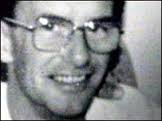
Brian Nelson, the late UDA intelligence chief and Force Research Unit agent. Just exactly when did he become a British military agent?

Brian Nelson, the late UDA intelligence chief and Force Research Unit agent. Just exactly when did he become a British military agent?

He set out the areas where he could not make any findings and stated that only a Public Inquiry, where documents and witnesses could be examined, could resolve the conflicts and arrive at conclusions. In other words, a review of documents, although useful, was not the end of the matter. Judge Cory’s task was to determine if there was a prima facie case that collusion existed.

Judge Cory’s report was a far shorter exercise resulting in 115 pages compared with de Silva of 800 pages.

de Silva took a view that the papers that he examined were authentic, which in my view makes it a fundamentally flawed process.

In terms of size, the Report is certainly formidable but he has given us is snippet upon snippet of carefully selected material. Unless all the material is examined ( or as much as is legally possible to examine), it is impossible to form a view.

He refers to many documents but annexes only a few. He has picked extracts from others. He doesn’t say why. He refers to certain documents and we are not permitted to read these documents in full, let alone challenge the contents. Nor were we entitled to examine any of the original documents. He refers to documents that we did not know existed. Basically, he has read the documents and come to his own conclusions about the content. He has referred to many documents that we have not seen as if he is the only person who can make sense of them and come to the truth about them. Some of these, as he says, he has redacted and annexed but most have just been referred to in footnotes. We don’t know what other material he has examined. Where is the rest of it?

In view of the fact that there exist over a million pages of documents, he has to be selective. However, we have not been told how he selected the material. There is no explanation for failing to disclose material. We don’t know how many pages of material exists. Over a million could mean closer to two million.

Documents can be verified. Authenticity can be verified. There is a forensic way of doing this. Documents have to be examined in the context and with other documents. You have to know what to look for. If we suspect that a document is forged, we can have the original examined by an expert in that field. If we think that the contents of a document are not credible, we can explore by cross examination, where interested members of the public can see and hear witnesses.
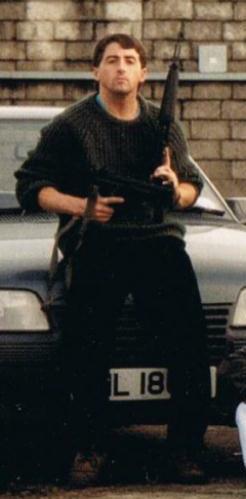
'Martin Ingram', real name Ian Hirst, a former FRU soldier maintains that 'Contact Forms' which clear the FRU of res[ponsibility in the Finucane murder were fabricated. De Silva refused to meet or question him.

‘Martin Ingram’, real name Ian Hirst, a former FRU soldier maintains that ‘Contact Forms’ which clear the FRU of res[ponsibility in the Finucane murder were fabricated. De Silva refused to meet or question him. This photo shows Ingram/Hirst in his FRU days.


There is an allegation by Ian Hurst ( aka Martin Ingram) that the Contact Forms (CFs) were forged. Ian Hurst was a member of FRU and a whistleblower. This has to be a starting point in any scrutiny of the bona fides of the documentation that was examined by this Review. It is incomprehensible that De Silva can come to a conclusion about this without a thorough examination of the documents and a proper examination of Ian Hurst, who he dismissed as a “Walter Mitty” character, and all those others involved. When you take into consideration that the FRU had a year to “sort out” the documents, this whole area needs examined. This was highlighted in John Ware’s Panorama programme. It took a threat to arrest the GOC General Waters to get Nelson’s intelligence material and the CFs weren’t produced to the Stevens team for nearly a year . Hurst said that the FRU had the material during this time and were doctoring it. As highlighted in Panorama, Stevens’ team thought that the documents were tampered with.

Hurst is no Walter Mitty character and I met him in Dublin a few years ago introduced by Greg Harkin. Hurst would be a crucial witness in a Public Inquiry but de Silva dismissed him without even seeing him.
This in itself raises the issue of the “cover-up” of the collusion. It is the accountability escape route. If, for example, there was incriminating material in the Nelson/FRU documents/ recordings/transcripts, there was plenty of time to get rid of it or change it. (p 410 – 415 Vol 1)

This goes to the heart of the matter.

The fact that the Stevens Investigation eventually got the FRU documentation and there was no reference to the targeting of Pat Finucane and no reference to Pat at all until the morning after the murder when Nelson phoned Margaret Walshaw, his handler. All this is very suspicious. At a Public Inquiry, Ian Hurst would not be the only witness on this issue as there are other FRU members including the commanding officers and those up the very short chain of command who could deal with this particular issue. Many of them made statements to the Stevens team.

It is inconceivable that this plot was not known to the FRU. They must have known about it and they must have known that Nelson would be in the thick of it, as chief Intelligence Officer and their only loyalist agent, according to de Silva. Questions would be asked about this at a Public Inquiry. It is just not believable that FRU did not know about the plot. It is believable that they knew about it through Nelson and it is believable that they helped Nelson with targeting Pat as they did with targeting other people and it is believable that they directed the murder and that they doctored the documentation to remove all reference to the targeting of Pat Finucane and to paint a benevolent picture of FRU’s links with Nelson.
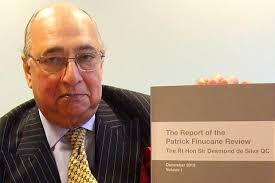
Sir Desmond de Silva, author of the Finucane Review. He is a member of the same club as members of the Tory establishment, including the late Margaret Thatcher

Sir Desmond de Silva, author of the Finucane Review. He is a member of the same exclusive gentlemen’s club, the Carlton, as members of the Tory establishment, including the late Margaret Thatcher and the current Mayor of London, Boris Johnson. The Carlton has an association with the British Conservative Party and its forebears going back to 1832.

There is also the important issue of how far up the chain of command did this plot go. The FRU had a chain of command directly to the top of government and there were very few links in the chain: agent – FRU handler – OC Det – OC FRU – CLF & GOC- Defence Minister – and then to the Joint Intelligence Committee chaired by Margaret Thatcher in London.

Due to the fact that, according to de Silva, Nelson was the British Army’s only loyalist agent, and that he reported to his handlers on a weekly basis, his weekly FRU reports could easily be dealt with at the weekly Joint Intelligence Committee meetings, in London chaired by Margaret Thatcher. It is inconceivable that Nelson was not a focus at these meetings. Nelson in his diary strongly suggests that Thatcher was a personal recipient of intelligence.

There are numerous inconsistencies in the report that cant be left on the shelf.

For example de Silva says FRU was founded in 1982 but other authors such as Mark Urban in “Big Boys Rules” quotes CLF Glover who says he established FRU in 1980 to form a ” triumvirate” with the 14th intelligence and SAS.

Cory says ” In 1985 Brian Nelson walked in off the street to offer his services to the British Army as an agent”. (page 24 Cory Report) whereas de Silva says, quoting Brian Fitzsimmons, [Nelson] “appears not to have become involved in paramilitary activity until May 1984, when he contacted the Army to offer his services as a source of intelligence (para 6.6 at page 99 de Silva Vol 1 ).

Brigadier Arundell David Leaky, on the other hand, a director of Military Operations in the Ministry of Defence who filed an affidavit in injunction proceedings says that “In 1983 Nelson offered his services to the Army as an agent in the UDA”. This document is not referred in de Silva report nor Cory but was published in the “Sunday Tribune” on 14 April 2002 in an article by Ed Moloney. This is an example of the limited nature of the de Silva process. He was limited by virtue of his terms of reference.

So what is the truth of the recruitment of Brian Nelson? And what is the truth about the formation of FRU?

Cory says, “At this time he [Nelson] was a member of the UDA and acting as an Intelligence Officer for that organisation in West Belfast.” (para 1.45 page 24 Cory Report) but De Silva says ” Despite his previous conviction for involvement in serious sectarian violence, the FRU tasked Nelson with rejoining the UDA ( quoting from Nelson’s journal). ( para he was 6.7 page 99 of de Silva Vol 1 )
So was he already in the UDA when he offered his services or was he ” tasked with re-joining the UDA ” after offering his services?

These are important issues because the suspicion is that he was a soldier and then a UDA sectarian killer and that these credentials made him a very good candidate for targeting uninvolved Catholics or republicans . Was this the continuation of the classic Kitsonian death squad? In other words a British military unit using local agents as killers whilst funding and supporting them and directing them.

There is a suspicion by many that Nelson never left the British army and when he went to Germany in 1985, it was not to get away from the UDA but to train with the British Army in Germany before his re- introduction in a more specialised system and when it is alleged he came back to Belfast from Germany in 1987 is it a coincidence that this coincided with a shipment of modern weaponry from South Africa to arm loyalists in a revived murder campaign against Catholics and republicans. There are many questions to be asked about this.
de Silva says that Nelson was not involved in the South African arms shipment in 1987, even though he accepts that Nelson travelled to South Africa in 1985 and discussed arms shipments to the North.

There is an interesting issue about Nelson’s trip to South Africa.
Judge Cory states that FRU paid Nelson’s expenses for the trip but de Silva doesn’t mention that at all in his report. I wonder why? The absence of this crucial bit of information from de Silva’s report is significant.

This is another example of de Silva exonerating FRU and thus the British Government, in the murders Catholics and republicans post 1987. Nelson remained in his targeting role up until his arrest in 1990.

This whole issue would be closely examined at a public inquiry where one document could lead to another and all interested parties would be entitled to examine all the documentation, as well as cross-examine relevant witnesses. None of that happened during the de Silva process.

There is so much information and misinformation in the public domain about Pat’s murder. There has to be public clarification. It can’t be allowed to be swept under the carpet by Cameron and de Silva.

This is just a short narrative of what I think are important areas that have not been properly examined in this review process and which cannot be examined properly until all the documentation is furnished, not just snippets and footnotes.

The following examples are some of the important areas that needs thorough examination in a public forum at a Public Inquiry where there is no hiding place:

the role of the RUC in Pat’s murder, from the death threats to solicitors from Castlereagh and the other holding centres of which Pat bore the brunt, to the RUC briefing by Jack Hermon to Douglas Hogg with false information about Pat’s family members. de Silva published what he says is intelligence material about this. The detail of the contact between the SB and FRU is crucial and requires a full public examination along with the connection between the RUC and the RUCSB.
He published what he calls intelligence which alleges that Pat laundered money for the IRA in the firm where we worked closely together for 10 years. I know this to be completely untrue but I don’t know who concocted it and questions need to be asked about that. He also published allegations that Pat was a finance officer and an intelligence officer in the IRA p 353 Vol 1. He cleverly makes it clear that there is no evidence that Pat was involved with the IRA but I think what is interesting about this is that de Silva published documents in Vol 2 of his report which allege just that. This is a cynical exercise in deception and there can be no excuse for it. He should not have published this material because there was no mechanism in his process for the family members, or me for that matter, to challenge it.
the fact that there was an RUC SB file on Pat which seems to have been packed with fact and fiction. Questions need to be asked about how false information got into this file.
This whole area needs explored as it will show that this intelligence information was faked beforehand to justify the murder and it had to be beforehand as some of it was briefed to Douglas Hogg in November 1988, when Hogg travelled to Belfast to meet the RUC hierarchy, according to de Silva.
the role of the FRU in its entirety and the calling of FRU witnesses to explain themselves and the role of the people in that chain of command.
There was a British army file on Pat and the word “PIRA” next to his name. de Silva accepts the British army explanation that this was only an administrative reference (whatever that means – he doesn’t say what it means) p 409/410 vol 1
In Chapter 15 there is a what is called Propaganda Initiatives by MI5 in which Pat was targeted and where de Silva implies that the targeting of Pat in this initiative was inadvertent. This needs examined because it is new. I never heard of it before the publication of this report.
The various death threats to Pat starting in 1981 which State agents knew about but they decided not to warn Pat about them. Things might have been different if warnings were given.
There is the inconsistency in Gordon Kerr’s role, see p 488 Vol 1 that refers to Cory’s analysis of Kerr’s testimony as misleading and also referred to the highly dubious numerical analysis. de Silva challenges Cory at pages 488/489 and goes into a lengthy analysis of the FRU documentation, again accepting their authenticity and says that his analysis takes him in a different direction to that of Cory p 491. In other words Cory got it wrong, according to de Silva. This requires a full examination at a Public Inquiry as there is a clear conflict between Cory and De Silva on this crucial issue of Kerr’s evidence at NELSON’s trial. Cory said that only a Public Inquiry could resolve this issue.
The role of government ministers who were cleared by de Silva on the basis that the paperwork showed that ministers were not included in the distribution lists of some intelligence reports. de Silva says at p 500 that Government Ministers were not on the distribution list for a particular report and this is just not believable and it is also convenient. He took the view that because he didn’t see any evidence of ministerial involvement that there wasn’t any.

At pages 56-60 of Nicholas Davies book ” Ten Thirty
Three” the author states that Margaret Thatcher was chairman of the Joint Intelligence Committee ( JIC ) which met weekly at Downing Street and she ordered a complete review of the security and intelligence set-up in NI ( after the Brighton bomb in 1984 ) and ” from that moment on Margaret Thatcher decided to become far more closely involved in the Irish question. The author states that in her memoir ” The Downing Street Years”, Thatcher said she played a vital role in co-ordinating the services through the powerful and influential Joint Intelligence Committee. The Joint Irish Section (JIS) was strengthened. Interestingly de Silva refers to about half dozen books in his Report including “The Downing Street Years” but not “Ten Thirty Three” which is remarkable since it is based on Nelson and FRU. The British Government took injunction proceedings against the author to stop publication and succeeded in preventing parts of his draft from getting into the final publication. Yet none of this is mentioned in the de Silva Report.

Another area to be examined at a Public Inquiry is the reference to a redacted statement of Alan Simpson who was the RUC officer in charge of the murder investigation where Simpson says two army personnel spent an hour in Pat’s house after the murder ( p 137 Vol 2 ) and although he says that he doesn’t think there was anything sinister in that and that it happens all the time, I think questions have to be asked about it.
Finally, I would like to comment on perception.

According to the Mail Online 25 September 2009,
Sir Desmond De Silva is a member of the Carlton Club, St James Street London. This club was bombed by the IRA on 25 June 1990. Lord Kaberry, who was injured in the attack, died in March 1991 aged 83. Douglas Hogg is a member of this club as is Margaret Thatcher, John Major and Boris Johnson and other Tory notables. Past members were Winston Churchill and Ted Heath. The club describes itself as the oldest, most elite, and most important of all Conservative clubs.” Membership of the club is by nomination and election only. He is also a member of the Naval and Military Club and Brooks club.

So there you have it. Cameron obviously cared little that there might be a perception that de Silva might be biased in some way. It’s unlikely that he would ever be selected to head a Public Inquiry into Pat’s murder due to this perceived bias.

I dont know how many times throughout this report de Silva refers to his ” full public account”. It is not a full account. It is definitely not a public account and it is so flawed in its failure to authenticate documentation that it is not anywhere near an account of the truth.

David Cameron made a statement in the House of Commons on 12 October 2011 that ” the really important thing .. is to open up and tell the truth” but the truth will have to wait for another day.