So, Who Was The Stasi Spy In The IRA – And Which IRA?

Avid readers of this blog, and there are some, will doubtless remember that I promised to return to Jerome aan de Wiel’s fascinating new book on the Stasi’s Irish activities, ‘East German Intelligence and Ireland, 1949-90’*, with some more interesting revelations culled from between its covers.

Alas, the recent PSNI/PPS and Boston College-led assault on the UVF part of the oral history archive meant I was otherwise occupied for a time and am only now able to return to the subject. For that please accept my apologies.

There are a number of stories of special interest in aan de Wiel’s book which I hope to deal with in time but for the following tale I am indebted to Liam O’Rourke who tipped me off to this gem.

Some of my older readers will remember that 1988 was a memorable year for many Troubles-related events, political and paramilitary. The Hume-Adams dialogue, a cover for Irish government contact with the Provos, began in January that year, but the IRA also launched its much truncated, post-Eksund offensive against the British with bomb and gun attacks in Britain and mainland Europe. March saw the Gibraltar shootings of three IRA members by the SAS and May witnessed the deaths of three RAF personnel killed by the IRA in the Netherlands. Inbetween there was a bomb attack on a British Army barracks in London.

We will probably never know if these were the sparks for the Stasi’s action but 1988 was the year in which the East German intelligence agency decided it was time to recruit an agent in the IRA, alongside a slew of agents in other European, Arab and international terrorist groups.

According to aan de Wiel, the decision to branch out in this way was taken some time in the 1980’s by the head of the Stasi, Erich Mielke. The head of the Stasi’s foreign intelligence wing, the legendary Marcus Wolf, later said that Mielke’s decision to recruit agents in foreign terrorist groups was taken so that they could be used as “behind-the-lines guerrilla forces for sabotage against the West”, a decision he didn’t exactly endorse.

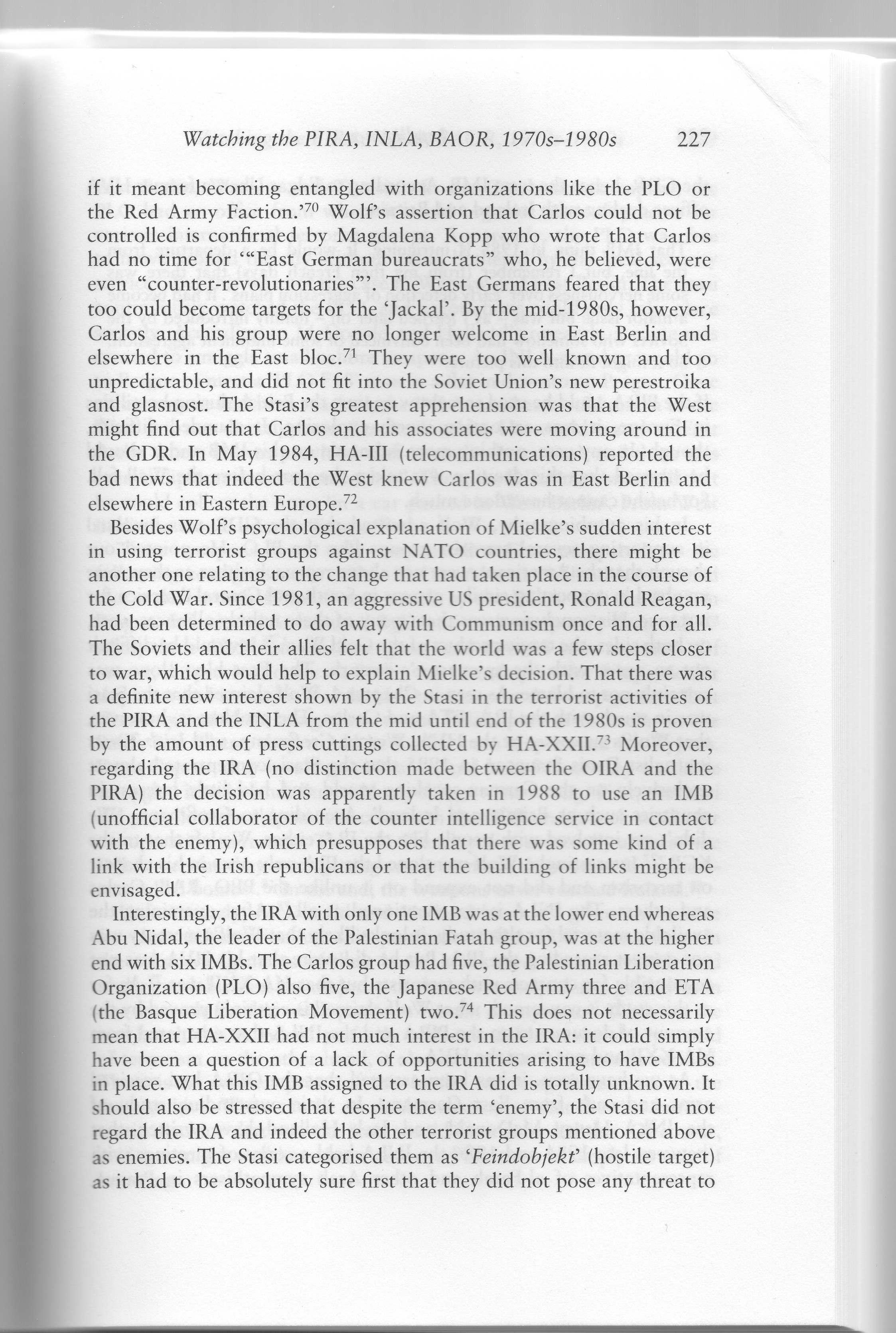
By the late 1980’s the Stasi had agents, or “inoffiziellen Mitarbeiter” – literally “unofficial employees” or “IMB’s” or plain informers – in the Abu Nidal-led Palestinian Fatah group (6 IMB’s), the ‘Carlos the Jackal’ group (5), the PLO (5), the Japanese Red Army (3) and ETA with two IMB’s. In 1988, the Stasi’s terrorism section, known as HA-XXII, was ordered to recruit agents in the IRA and succeeded in persuading one to work for them.

What exactly that agent’s brief was or how successful an informer he or she was – and especially his or her name – remains unknown. But since the GDR ceased to exist by 1990 the presumption has to be that the agent’s value was minimal. Even so, this was an intriguing development which demonstrated, inter alia, just how deeply and widely the IRA had been penetrated, i.e. how open to being seduced its members increasingly were. The long war, it seems, had a downside.

aan de Wiel says the Stasi made no distinction between the two IRA’s, Official or Provisional so the agent could have been a member of either. But common sense suggests that if the East Germans wanted someone to cause mischief or “sabotage against the West”, then the Provos would have been the better target. The Stasi and the East German Communist Party presumably had enough lines into the Officials and the Workers Party as it was.

Here then is the page in his book which deals with this episode:
stasiSo, what happened to the IRA agent when, just a year or so later the Berlin Wall fell and the GDR was no more?

We do not know but perhaps this section of aan de Wiel’s book (p. 284) gives a clue:

“On 31 August 1990, the East German State Committee for the Dissolution of the former MfS (Stasi) handed over the hostile target file (Feinobjektakte) on the PIRA to the Zollkriminalamt (ZKA, West German customs investigation bureau). What this file contained is anybody’s guess. Indeed, apart from a covering letter indicating the handing over of the file and a few blank sheets, one of them containing the Stasi’s registration number for the PIRA, XV 5414/85, there was nothing else. The file should be in the possession of the ZKA. It is unlikely that it will be made available for researchers soon as German security services have not released files to date.”

The odds are that the name of the IMB was contained in that file. And as Liam O’Rourke commented, it is just as likely that the name was passed on to the British, giving them another agent in the IRA to add to the burgeoning list of informers working for one or other branches of the British intelligence machine. But who knows?

* ‘East German Intelligence and Ireland, 1949-90 – Espionage, terrorism and Diplomacy’, by Jerome aan de Wiel. Published by Manchester University Press.

Read These Two Articles About Libya And Weep

A video released Sunday by the Islamic State appears to show the mass beheading of a group of 21 Coptic Christians, who are made to kneel beside the sea in what is identified as the coast near Tripoli, Libya.

It is the first time that the Islamic State, also known as ISIS or ISIL, has released an official video showing such a killing outside of the territory it controls in Syria and Iraq.

The footage begins with slow motion images of the Egyptian Christian hostages, who were kidnapped in Libya several weeks ago, walking single file along the sandy beach. The hostages are all wearing orange jumpsuits. Each one is led by a black-clad executioner who is grasping a knife. The only sound is that of the crashing waves. They are made to kneel, and then one by one they are beheaded.

The lead executioner, who wears a brown mask over his face, thrusts his dagger at the camera. “Oh people, recently you have seen us on the hills of as-Sham and Dabiq’s plain, chopping off the heads that have been carrying the cross for a long time,” he says in fluent English, using terms referring to localities in and around Syria. “And today, we are on the south of Rome, on the land of Islam, Libya, sending another message.”

The high-quality video, which bears the logo of Al Hayat, the official publishing arm of the Islamic State, is in stark contrast to the footage released in the past by affiliates of the group. The footage in those videos was shaky and grainy, suggesting an amateur production. By contrast, the five-minute clip released Sunday is professional and cinematic, and is filmed in the same style as previous Islamic State videos, including one that showed the mass beheading of captured Syrian soldiers last year.

The video suggests that at least some of the Islamic State’s franchises abroad are becoming ever more tightly linked with the central group. Stills of the Libya video appeared last week in Dabiq, the Islamic State’s official English-language magazine. And the footage released today was preceded by an announcement on the group’s official news media, which foreshadowed the release, saying: “A Message Signed with Blood to the Nation of the Cross.”


Policy Brief • September 2013


Lessons from Libya: How Not to Intervene

BOTTOM LINES

• The Conventional Wisdom Is Wrong. Libya’s 2011 uprising was never peaceful, but instead was armed and violent from the start. Muammar al-Qaddafi did not target civilians or resort to indiscriminate force. Although inspired by humanitarian impulse, NATO’s intervention did not aim mainly to protect civilians, but rather to overthrow Qaddafi’s regime, even at the expense of increasing the harm to Libyans.

• The Intervention Backfired. NATO’s action magnified the conflict’s duration about sixfold, and its death toll at least sevenfold, while also exacerbating human rights abuses, humanitarian suffering, Islamic radicalism, and weapons proliferation in Libya and its neighbors. If Libya was a “model intervention,” then it was a model of failure.

• Three Lessons. First, beware rebel propaganda that seeks intervention by falsely crying genocide. Second, avoid intervening on humanitarian grounds in ways that reward rebels and thus endanger civilians, unless the state is already targeting noncombatants. Third, resist the tendency of humanitarian intervention to morph into regime change, which amplifies the risk to civilians.

By Alan J. Kuperman

This policy brief is based on “A Model Humanitarian Intervention? Reassessing NATO’s Libya Campaign,” which appears in the Summer 2013 issue of Interna- tional Security.

A MODEL INTERVENTION?

Many commentators have praised NATO’s 2011 intervention in Libya as a humanitarian success for averting a bloodbath in that country’s second largest city, Benghazi, and helping eliminate the dictatorial regime of Muammar al-Qaddafi. These proponents accordingly claim that the intervention demonstrates how to successfully implement a humanitarian principle known as the responsibility to protect (R2P). Indeed, the top U.S. representatives to the transatlantic alliance declared that “NATO’s operation in Libya has rightly been hailed as a model intervention.” A more rigorous assessment, however, reveals that NATO’s intervention backfired: it increased the duration of Libya’s civil war by about six times and its death toll by at least seven times, while also exacerbating human rights abuses, humanitarian suffering, Islamic radicalism, and weapons proliferation in Libya and its neighbors. If this is a “model intervention,” then it is a model of failure.

FLAWED NARRATIVE

The conventional account of Libya’s conflict and NATO’s intervention is misleading in several key aspects. First, contrary to Western media reports, Qaddafi did not initiate Libya’s violence by targeting peaceful protesters. The United Nations and Amnesty International have documented that in all four Libyan cities initially consumed by civil conflict in mid-February 2011—Benghazi, Al Bayda, Tripoli, and Misurata—violence was actually initiated by the protesters. The government responded to the rebels militarily but never intentionally targeted civilians or resorted to “indiscriminate” force, as Western media claimed. Early press accounts exaggerated the death toll by a factor of ten, citing “more than 2,000 deaths” in Benghazi during the initial days of the

uprising, whereas Human Rights Watch (HRW) later documented only 233 deaths across all of Libya in that period.

Further evidence that Qaddafi avoided targeting civilians comes from the Libyan city that was most consumed by the early fighting, Misurata. HRW reports that of the 949 people wounded there in the rebellion’s initial seven weeks, only 30 were women or children, meaning that Qaddafi’s forces focused narrowly on combatants. During that same period, only 257 people were killed among the city’s population of 400,000—a fraction less than 0.0006—providing additional proof that the government avoided using force indiscriminately. Moreover, Qaddafi did not perpetrate a “bloodbath” in any of the cities that his forces recaptured from rebels prior to NATO inter- vention—including Ajdabiya, Bani Walid, Brega, Ras Lanuf, Zawiya, and much of Misurata—so there was virtually no risk of such an outcome if he had been permitted to recapture the last rebel stronghold of Benghazi.

The conventional wisdom is also wrong in asserting that NATO’s main goal in Libya was to protect civilians. Evidence reveals that NATO’s primary aim was to overthrow Qaddafi’s regime, even at the expense of increasing the harm to Libyans. NATO attacked Libyan forces indiscriminately, including some in retreat and others in Qaddafi’s hometown of Sirte, where they posed no threat to civilians. Moreover, NATO continued to aid the rebels even when they repeatedly rejected government cease-fire offers that could have ended the violence and spared civilians. Such military assistance included weapons, training, and covert deployment of hundreds of troops from Qatar, eventually enabling the rebels to capture and summarily execute Qaddafi and seize power in October 2011.

THE INTERVENTION BACKFIRED

The biggest misconception about NATO’s intervention is that it saved lives and benefited Libya and its neighbors. In reality, when NATO intervened in mid- March 2011, Qaddafi already had regained control of most of Libya, while the rebels were retreating rapidly toward Egypt. Thus, the conflict was about to end, barely six weeks after it started, at a toll of about 1,000 dead, including soldiers, rebels, and civilians caught in the crossfire. By intervening, NATO enabled the rebels to resume their attack, which prolonged the war for another seven months and caused at least 7,000 more deaths.

The best development in postwar Libya was the democratic election of July 2012, which brought to office a moderate, secular coalition government—a stark change from Qaddafi’s four-decade dictator- ship. Other developments, however, have been less encouraging. The victorious rebels perpetrated scores of reprisal killings and expelled 30,000 mostly black residents of Tawerga on grounds that some had been “mercenaries” for Qaddafi. HRW reported in 2012 that such abuses “appear to be so widespread and systematic that they may amount to crimes against humanity.” Ironically, such racial or ethnic violence had never occurred in Qaddafi’s Libya.

Radical Islamist groups, suppressed under Qaddafi, emerged as the fiercest rebels during the war and refused to disarm or submit to government authority afterward. Their persistent threat was highlighted by the September 2012 attack on U.S. facilities in Benghazi that killed Ambassador Christopher Stevens and three of his colleagues. Even more recently, in April 2013, a vehicle bomb destroyed half of the French em- bassy in the capital, Tripoli. In light of such insecurity, it is understandable that most Libyans responding to a postwar poll expressed nostalgia for a strong leader such as Qaddafi.

Among neighboring countries, Mali, which previously had been the region’s exceptional example of peace and democracy, has suffered the worst consequences from the intervention. After Qaddafi’s defeat, his ethnic Tuareg soldiers of Malian descent fled home and launched a rebellion in their country’s north, prompting the Malian army to overthrow the president. The rebellion soon was hijacked by local Islamist forces and al-Qaida, which together imposed

sharia and declared the vast north an independent country. By December 2012, the northern half of Mali had become “the largest territory controlled by Islamic extremists in the world,” according to the chairman of the U.S. Senate Subcommittee on Africa. This chaos also spurred massive displacement of hundreds of thousands of Malian civilians, which Amnesty International characterized as “Mali’s worst human rights situation in 50 years.”

Sophisticated weapons from Qaddafi’s arsenal—including up to 15,000 man-portable, surface-to-air missiles unaccounted for as of 2012—leaked to radical Islamists throughout the region. NATO’s intervention on behalf of Libya’s rebels also encouraged Syria’s formerly peaceful protesters to switch to violence in mid-2011, in hopes of attracting a similar intervention. The resulting escalation in Syria magnified that country’s killing rate by tenfold.

LESSONS

NATO’s intervention in Libya offers at least three im- portant lessons for implementing the responsibility to protect. First, potential interveners should beware both misinformation and rebel propaganda. If Western countries had accurately perceived Libya’s initial civil conflict—as Qaddafi using discriminate force against violent tribal, regional, and radical Islamist rebels—NATO would have been much less likely to launch its counterproductive intervention.

The second lesson is that humanitarian intervention can backfire by escalating rebellion. This is because some substate groups believe that by violently provoking state retaliation, they can attract such intervention

RELATED RESOURCES

to help achieve their political objectives, including regime change. The resulting escalation, however, magnifies the threat to noncombatants before any potential intervention can protect them. Thus, the prospect of humanitarian intervention, which is intended to protect civilians, may instead imperil them via a moral hazard dynamic. To mitigate this pathology, it is essential to avoid intervening on humanitarian grounds in ways that reward rebels, unless the state is targeting noncombatants.

A final lesson is that intervention initially motivated by the desire to protect civilians is prone to expanding its objective to include regime change, even if doing so magnifies the danger to civilians, contrary to the interveners’ original intent. That is partly because intervening states, when justifying their use of force to domestic and international audiences, demonize the regime of the country they are targeting. This demonization later inhibits the interveners from considering a negotiated settlement that would permit the regime or its leaders to retain some power, which typically would be the quickest way to end the violence and protect noncombatants. Such lessons from NATO’s use of force in Libya suggest the need for considerable caution and a comprehensive exploration of alternatives when contemplating if and how to conduct humanitarian military intervention.

Statements and views expressed in this policy brief are solely those of the author and do not imply endorsement by Harvard University, the Harvard Kennedy School, or the Belfer Center for Science and International Affairs.

Crawford, Timothy W., and Alan J. Kuperman, eds. Gambling on Humanitarian Intervention: Moral Hazard, Rebellion, and Civil War (New York: Routledge, 2006).

Kuperman, Alan J. “The Moral Hazard of Humanitarian Intervention: Lessons from the Balkans,” International Studies Quarterly, Vol. 52, No. 1 (March 2008), pp. 49–80.

Roberts, Hugh. “Who Said Gaddafi Had to Go?” London Review of Books, Vol. 33, No. 22 (November 2011), pp. 8–18.

UN Human Rights Council, nineteenth session, “Report of the International Commission of Inquiry on Libya,” A/HRC/19/68, ad- vance unedited version, March 2, 2012.

September 2013

ABOUT THE BELFER CENTER

The Belfer Center is the hub of the Harvard Kennedy School’s research, teaching, and training in international security affairs, environmental and resource issues, and science and technology policy.

The Center has a dual mission: (1) to provide leadership in advancing policy-relevant knowledge about the most important challenges of international security and other critical issues where science, technology, environmental policy, and international affairs intersect; and (2) to prepare future generations of leaders for these arenas. Center researchers not only conduct scholarly research, but also develop prescriptions for policy reform. Faculty and fellows analyze global challenges from nuclear proliferation and terrorism to climate change and energy policy.

ABOUT THE AUTHOR

Alan J. Kuperman is Associate Professor of Public Affairs in the Lyndon B. Johnson School of Public Affairs at the University of Texas, Austin. During 2013–14, he will be a Jennings Randolph Senior Fel- low at the U.S. Institute of Peace, in Washington, D.C.

ABOUT international security

International Security is America’s leading peer- reviewed journal of security affairs. It provides sophisticated analyses of contemporary, theoretical, and historical security issues. International Security is edited at Harvard Kennedy School’s Belfer Center for Science and International Affairs and is published by The MIT Press.

For more information about this publication, please contact the International Security editorial assistant at 617-495-1914.

3 responses to “Libya Revisited: The Follies, Lies And Crimes Of A Humanitarian Intervention”

  1. Galloway’s Valet

    When NATO member Turkey carried out savage atrocities against Kurds in south east Turkey not a word of condemnation was raised in the West. Tens of thousands were killed, atrocities were committed routinely. It was on a much greater scale than anything Milosevic could even dream of. Clinton poured in arms, Blair did the same, so did Germany, and the world looked the other way.
    Now we get lectures on ‘intervention’ and the ‘responsibility to protect’ from the architects of state terrorism. It’s beyond parody.

  2. Pingback: CIA’s Man In Libya Compared To Egypt’s Sisi | The Broken Elbow Edit
  3. Pingback: How Liberal Neocons Like Samantha Power Sent Libya To Hell In A Hand-basket! | The Broken Elbow Edit

Leave a Reply


  • Subscribe by Email

    Join 2,482 other followers


Billy Hutchinson Slams McGrory Over ‘Winky’ Rea Subpoena

The following is a statement issued by the progressive Unionist Party today.

‘McGrory sabotages efforts to ‘deal with the past’ PUP Leader Cllr Billy Hutchinson slams the DPP for his political witch hunt of Winston Rea.

PUP leader Billy Hutchinson

PUP leader Billy Hutchinson

The Progressive Unionist Party utterly condemns attempts by the DPP Barra McGrory to raid the Boston College history archive in a malicious and flagrantly political fishing expedition against Winston Churchill Rea.

Mr Rea, who as a representative of the PUP, made a very significant and widely acknowledged contribution to the peace process; from ceasefires to decommissioning and the political architecture which facilitated them in between.

Party Leader Cllr Billy Hutchinson slammed the effort, “This malicious abuse of process before the courts is just another in the long history of ‘balancing’ exercises where Loyalists have been singled out, not on merit but for the optics of appearing independent to a political audience. Internment, collective punishment, shoot to kill, historic investigations, the past is replete with instances where Loyalists have suffered punitive measures for the sake of appearance rather than requirement.

After the arrests of high profile Republicans relating to the Jean McConville investigation, Barra McGrory has abused his authority in an effort to appear, rather than to be, balanced. A previous subpoena request listed Winston Rea and a Republican in the very same circumstances. When that subpoena failed due to lack of evidence, the Republican’s name mysteriously disappeared and the token Loyalist required for public consumption remained. Unfortunately that Loyalist happened to be Winston Rea.”

He continued, “The distinct lack of evidence in this case is the starkest indication that the judicial process is being used in an exercise of political window dressing. Winston Rea’s rights under the ECHR are being subjected to the unfettered will of the DPP as he continues his overtly political agenda. We need not look to far back to be reminded of a mass supergrass show trial or the ‘On the Runs’ debacle. Perhaps if Winston Rea had been a Republican, he would have received a letter of comfort rather than an international subpoena.

Barra McGrory, North's DPP

Barra McGrory, North’s DPP

Had this material been deposited in a UK University, lack of evidence would have quashed the case long before it reached the eyes of a judge. International legal cooperation has allowed Winston Rea’s Human Rights to be subject to the whims of this DPP by virtue of legal loophole.

I would further caution that Barra McGrory’s efforts will lay waste to any hope of ‘dealing with the past.’ The Stormont House Agreement called for an oral history archive and an information recovery process. Both were to be underpinned by strict confidentiality, yet here the DPP seeks to run roughshod over a similar attempt to understand the past and the confidentiality that gave birth to it.

After this evidently politically motivated witch-hunt against Winston Rea, who is likely to engage in the structures envisaged by that Agreement? The understandable mood within Loyalism suggests no-one. But then that outcome was obvious to the DPP in his duty to consider the public interest. Thus, the deeper question arises – who does this serve?”

Cllr Hutchinson concluded, “With the DUP content to get their Stormont budget passed, is dealing with the past to be left to Sinn Fein’s revisionists and any other version of history suppressed by their stacked process? These questions are central to the success of any search for truth or recovery of information; the cabal of the First Minister, Deputy First Minister and DPP need to think long and hard about the implications of their answers.”

ENDS

Sunday World Joins Irish News In Race To The Bottom Over Rea Subpoena

“Bob Livingston told the New York Times that I was a bottom feeder. That’s true. But when I got down there, look what I found.” – Hustler publisher Larry Flynt on resignation of US House Speaker, Bob Livingston after Hustler exposed his extra-marital affairs during the Clinton-Lewinsky scandal.

Just when you thought that Allison Morris’ “make-it-up-and-screw-the-facts” style of journalism could not be bettered – or should that be worsened? – along comes Richard Sullivan of The Sunday World with a story that comes straight from the ‘Freddie Starr Ate My Hamster’ school of British/Irish tabloid sewage.

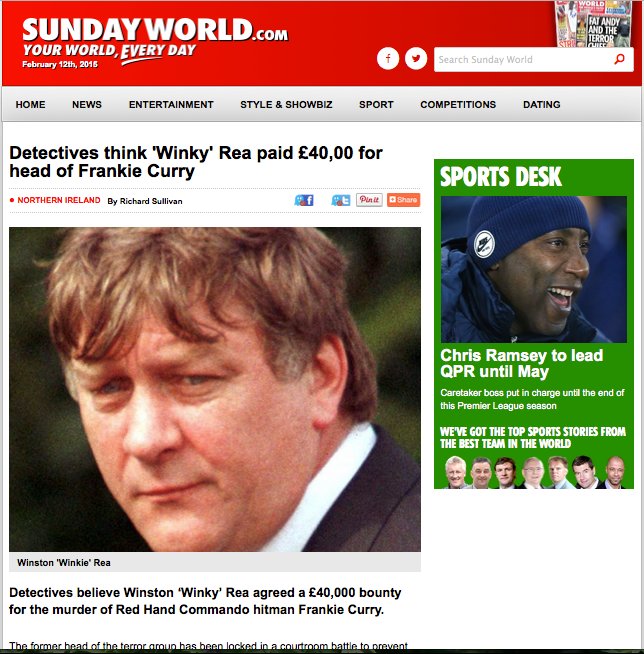
“Detectives Think ‘Winky’ Rea Paid £40,000 For Head Of Frankie Curry”, screamed the headline over a story about Rea’s court challenge to the PSNI’s effort to subpoena his interviews with the Boston College oral history archive. Notice that the headline is written in such a way that it suggests Rea wanted Curry’s actual head delivered to him, ISIS-style.

The story continued:

“…..detectives believe the  64-year-old, who is said to be in poor health, has detailed his alleged involvement in the killing as well as incriminating others. It is also thought his ‘confession’ reveals details of £40,000 in cash paid out to his killers.”

The only accurate part of that paragraph is the bit about Rea’s poor health. The rest, including I assume – or rather hope – the claim that detectives had fed this tripe to The Sunday World, can be filed away under the heading “Invented Stories”. Nonetheless, the PSNI should make their position clear: did this story come from its officers or not?

Winky

I have written the following email to the author of this garbage, one Richard Sullivan. We shall see what his response is:

Richard,
Winston ‘Winky’ Rea did not utter a single word in his interviews with Boston College (BC) about the demise of Frankie Curry. I know that because as the director of the project, it was part of my duties to read the interviews when they were recorded. You will have noticed, I hope, from my blog that I have written to the Irish News, whose reporter Allison Morris was the first to peddle this canard, pointing out their mistake and highlighting the fact that, like yourself, no-one bothered to ring me, the former director of the BC project to check out this story. My email is well known and my phone number would be as easy to obtain. Why on earth would you not take the simple precaution of talking to me first? Or do you just not care when you get stories wrong? I am now asking you formally to publish my correction and give it the same prominence as the original, flawed story. Thanking you in anticipation.

best regards

Ed Moloney

Irish News Refuses To Publish Letter Exposing Another Allison Morris Blooper

Regular readers of this blog will know that The Irish News reporter Allison Morris has figured more than once in these columns and usually not in the most flattering light. That had been because of her dishonest approach to the story of the Boston College oral history archive subpoenas, about which you can read here and here.

With the latest PSNI subpoena served on former Loyalist paramilitary Winston ‘Winky’ Rea, Allison was at it again in last Saturday’ Irish News with a story that was plucked either from the air or from a rather disagreeable part of her anatomy.

I reproduce the offending articles below but in summary Allison claimed that in his interviews with Boston College, ‘Winky’ had spilled the beans about the killing of renegade Loyalist Frankie Curry and because the murder happened after the Good Friday Agreement he would be liable for a lengthy prison term.

The timing of the article, saying that the PSNI would be pursuing this angle, was a critical part of the story. Rea’s lawyers were appearing in front of a judge the following Monday in an effort to persuade him that the PSNI was on a fishing expedition and here was a front page article linking him to a notorious murder which the judge in all likelihood would read.

Knowing that in fact Rea had not talked about this event at all I wrote a letter to the editor of The Irish News, Noel Doran correcting her account. Needless to say the letter has not been published but three paragraphs plucked from my letter, none of which address Ms Morris’ role in this affair, were added on to a news story today (Wednesday) about Winston Rea (see final Irish News piece below).

I reproduce the full letter below and serve notice on Mr Doran that this will not be the end of the matter.

Letter to the Editor
Dear Sir,
Last Saturday, February 7th, your correspondent Allison Morris wrote, and you published, an article claiming that Winston Rea, the alleged Loyalist leader, had spoken of the murder of Frankie Curry in interviews he gave to the Boston College oral history archive.

The effect of her article, published before Monday’s court hearing, was, arguably, to substantiate the Crown’s claim that the PSNI were investigating serious matters concerning Mr Rea and that this justified their efforts to obtain his interviews from Boston.

Ms Morris wrote: “A leading loyalist who made a taped confession as part of the controversial Boston College project has recorded details about the feud-related murder of bomb-maker Frankie Curry”.

And: “The Irish News understands that Rea openly discussed the internal process and build up that took place prior to Curry’s murder in his interview recorded almost 10 years ago.”

As the former director of the Boston College oral history project I am, like the interviewers, pledged never to reveal what interviewees said or spoke about in their interviews until the terms of their embargo have been fulfilled. But there is no bar on myself telling the world what is NOT in a person’s interview.

Accordingly, I can say with the utmost confidence, that not only does Mr Rea not discuss the late Mr Curry’s death in any way but his name does not even figure in his interviews.

I think I am entitled in these circumstances to query the bona fides of Allison Morris’ source for this fictional story, given the damage it has caused to Winston Rea. Can I suggest it is very possibly the same source who told Ms Morris’ close friend Ciaran Barnes back in 2010 that Dolours Price had discussed the disappearance of Jean McConville in her interview for the college archive, when she had not.

All Ms Morris had to do was pick up the phone or email and I would have happily confirmed all this for her. But she didn’t bother. After all, why let a few facts get in the way of a good story!

The attempt to obtain Winston Rea’s interviews, as will become clear with the passage of time, is nothing less than a cynical fishing expedition by the PSNI aimed at satisfying sectarian elements in the Irish-American community that they intend to balance their raid on IRA interviews at Boston College by bagging a ‘Prod’ in their net. Winston Rea is being pursued not in the interests of justice but to satisfy narrow political goals.

That, I suggest, more than disgracefully inaccurate speculation, should be the focus of your paper’s coverage of this topic.

Yours etc

Ed Moloney

New York, February 9th, 2015

serverserver (5)Irish News @ Winkie Rea

The ‘Monstrously Stupid’ PSNI

Tuesday, February 10, 2015

Damning a Peacemaker

The otherwordly quality of the PSNI’s new “investigation” into Winston “Winkie” Rea is captured neatly this week in a sentence from this RTE story: “An international request for the tapes said police have information that Rea was a member of the Red Hand Commando whose interviews would assist investigations into those crimes.”

Good Lord! The police have information that Winston “Winkie” Rea was a member of the Red Hand Commando!

Keep this to yourself, but I also have information that Winston Rea was a member of the Red Hand Commando — it’s on Wikipedia, which goes so far as to say he was its leader. Someone rush this new information to the PSNI right away, so they can investigate it.

Similar information on the origins and leadership of this obscure organization can be found in no more than many dozens of books and articles published in the last twenty years.

When books and news stories specifically describe Winston Rea, they reveal a warrior who turned firmly against political violence — a peacemaker in a serious and lasting way, and the son-in-law of another warrior who came to renounce war. “Winkie is an example of those who fought the war and those who started and continued to build the peace,” a unionist political leader told the Belfast Telegraph this week.

Pursuing Rea as a criminal, the PSNI appears to have used his presence in peace talks against him. One of the accusations laid out against Rea in recent court proceedings is that he “met with former British Prime Minister John Major in 1996” — in between the declaration of a loyalist ceasefire and the conclusion of the Good Friday Agreement — proving that he was a member of a paramilitary organization because he had the standing to negotiate on behalf on one. He met with government officials to end a war, your honor, so we know he’s a thug.

Rea was also a regular presence in the Castle Buildings in April of 1998, and this article from 2000 described him as “a member of the PUP’s Good Friday Agreement negotiating team.” So maybe that can be held against him too, and eventually charged as another crime.

Having made peace, Rea has worked to keep it. “There have been significant attempts by former paramilitaries, including Winston Rea and Jackie McDonald, to deglamorize conflicts to young people as a means of reducing their vulnerability to involvement,” reads one account.

This is the person the PSNI is now supposedly pursuing as a criminal, decades later. It may be a course permitted under the law — but it’s monstrously stupid policy, and a political course that spits in the face of an entire generation of serious people who found a way to stop killing each other. It really is a picture from Northern Ireland you thought you’d never see.

Questions Of ‘The Utmost Gravity’ For The PSNI And Prosecution Service

Yesterday in the Belfast High Court, a lawyer for the Police Service of Northern Ireland (PSNI) told a judge that the police require access to interviews allegedly given to a Boston College oral history archive by a former Loyalist prisoner, Winston Rea, because they are investigating offences of “the utmost gravity”.

But so grave are these offences, so vital is it to the well-being of Northern Ireland that they be cleared up, that the PSNI have sat on their hands for almost three years, doing absolutely nothing about them even though they could easily have begun proceedings to acquire the interviews years ago.

Only recently, in the last few months has the PSNI made any move for Mr Rea’s alleged interviews. Why?

Winston Rea revealed his involvement in the Boston College archive in an interview with Brian Rowan, a journalist with The Belfast Telegraph on January 3rd, 2012. That is three years ago. The PSNI have had all that time to lodge a request with the US Department of Justice to obtain the interviews but they did not. Why not?

The PSNI only applied for Mr Rea’s interviews in September 2014, some two years and nine months after the Loyalist disclosed his involvement in the Boston project. They have had nearly three years in which to pursue Mr Rea but only now have they moved against him. Why?

And what has Mr Rea disclosed publicly about the content of his alleged interviews? He told The Belfast Telegraph simply that he wanted his interviews returned to him. So did another Loyalist, William ‘Plum’ Smith who was hiring a lawyer to request his own interviews back.

This is what Mr Rea told Brian Rowan:

“If the (Smith) test case wins it becomes a domino effect for others wishing to have their material returned to them. If I was asked to make a contribution to further student education projects, unfortunately I would have to seriously consider it.”

That is the sum of what Winston Rea has said publicly about his alleged interviews with the Boston Project. Nothing at all about their alleged contents. Nothing to suggest that he talked about offences of “the utmost gravity”.

The PSNI know no more about the contents of the interviews than what he said to The Belfast Telegraph; the PSNI know no more about the contents of the interviews than the average shopper on Royal Avenue. The attempt to obtain his interviews is simply a fishing expedition which threatens the integrity of the judicial process.

The PSNI action can be summarised thus: “Mr Rea has past form for Loyalist activity. He gave interviews. Ergo he must have talked about matters of the utmost gravity. Give us the interviews”. That is called a fishing expedition and that such a sordid tactic has been countenanced by the legal authorities in Northern Ireland is deeply, deeply disturbing. Should it succeed then alarm bells should ring loud and clear.

In a previous posting I suggested that the move against Winston Rea was nothing more than a cynical attempt to balance the pursuit of Republican interviews allegedly concerning the disappearing of Jean McConville with some Loyalist interviews. Mr Rea, having publicly disclosed his involvement and being the son-in-law of the late Gusty Spence was the ideal AND convenient candidate. The fact that he disclosed his involvement, and only that, is the reason why the PSNI are pursuing him.

Back in April of 2014, Thomas P O’Neill III, a son of the former House Speaker Tip O’Neill, a Trustee Associate of Boston College and a former member of the college’s Board of Trustees, wrote an op-ed for The Boston Globe in which he complained:

“….why, when both sides in the Troubles were guilty of so much wrongdoing, is the British prosecution seemingly intent on only pursuing crimes allegedly committed by only one side?”

Is this effort to obtain Winston Rea’s interview then, an attempt by the PSNI and by the North’s Director of Public Prosecutions, Barra McGrory to satisfy a complaint from the Irish-American establishment that the British are not being even-handed in their pursuit of Boston College’s archive, that if only they included a high profile Prod in their net everything would be fine? Is the judicial process to be manipulated in this sort of way for narrow political gain?

And if that is the case, what has Boston College’s role been in all this? Is it just a coincidence that one of their former Trustees made a complaint upon which the PSNI are now acting?

For reasons that I cannot discuss, I cannot disclose all that is happening in the background. But soon enough, I hope myself and others will be able to speak more freely. Watch this space!

How Did The Irish Times Miss The Story About The Workers Party’s ‘£1 Million Iraqi Arms & Heroin Deal’?

Regular readers of this blog will have noticed that my most recent posting took a bit of a swipe at Danny Morrison, who had reached for his Twittering device a tad too quickly after reading his Irish Times and in the process made a bit of a fool of himself.

Danny had read a review in The Irish Times of a new book written by a UCC-based history professor, Jerome aan de Wiel called ‘East German Intelligence and Ireland, 1949-90’, in which the reviewer had taken a poke at myself for mistakenly alleging links between the East German spy outfit, the Stasi and the Provisional IRA. In a rather over-excited reaction Danny rushed on to the web to proclaim my downfall, somewhat prematurely as it turned out.

Knowing I had done no such thing, I complained to the publisher only to learn that the author had made no such allegation and had in fact pointed out that I had written in ‘A Secret History of the IRA’ that in the case of the Provos’ only supposed Marxist, Brian Keenan, claims that he had an association with the Stasi were unsupported by evidence. The claim otherwise had come only from the reviewer, one Derek Scally and at my insistence The Irish Times published a correction.

By way of an apology, the publisher’s most polite commissioner editor, Tony Mason sent me a copy of Prof. aan de Wiel’s book and it arrived yesterday. Last night I settled down to leaf through the index and to read passages that seemed interesting.

It didn’t take me too long to wonder what it takes these days to be a book reviewer for The Irish Times. It seems that a basic qualification appears to be a complete lack of news sense or a sharp eye for the politically acceptable slur.

Let me put it another way.

This book by Prof. aan de Wiel has some fascinating and historically valuable stories hidden between its covers and I thoroughly recommend it to readers of this blog.

But reading The Irish Times’ review, one is bound to wonder whether the reviewer ever read the whole book, whether he just did not want these stories given wider circulation for reasons I can only guess at, or whether he just wanted to engage in a bit of Ed Moloney-bashing.

Because as stories go, believe me, my alleged failings are in the ha’penny place compared what Prof. aan de Wiel has managed to uncover.

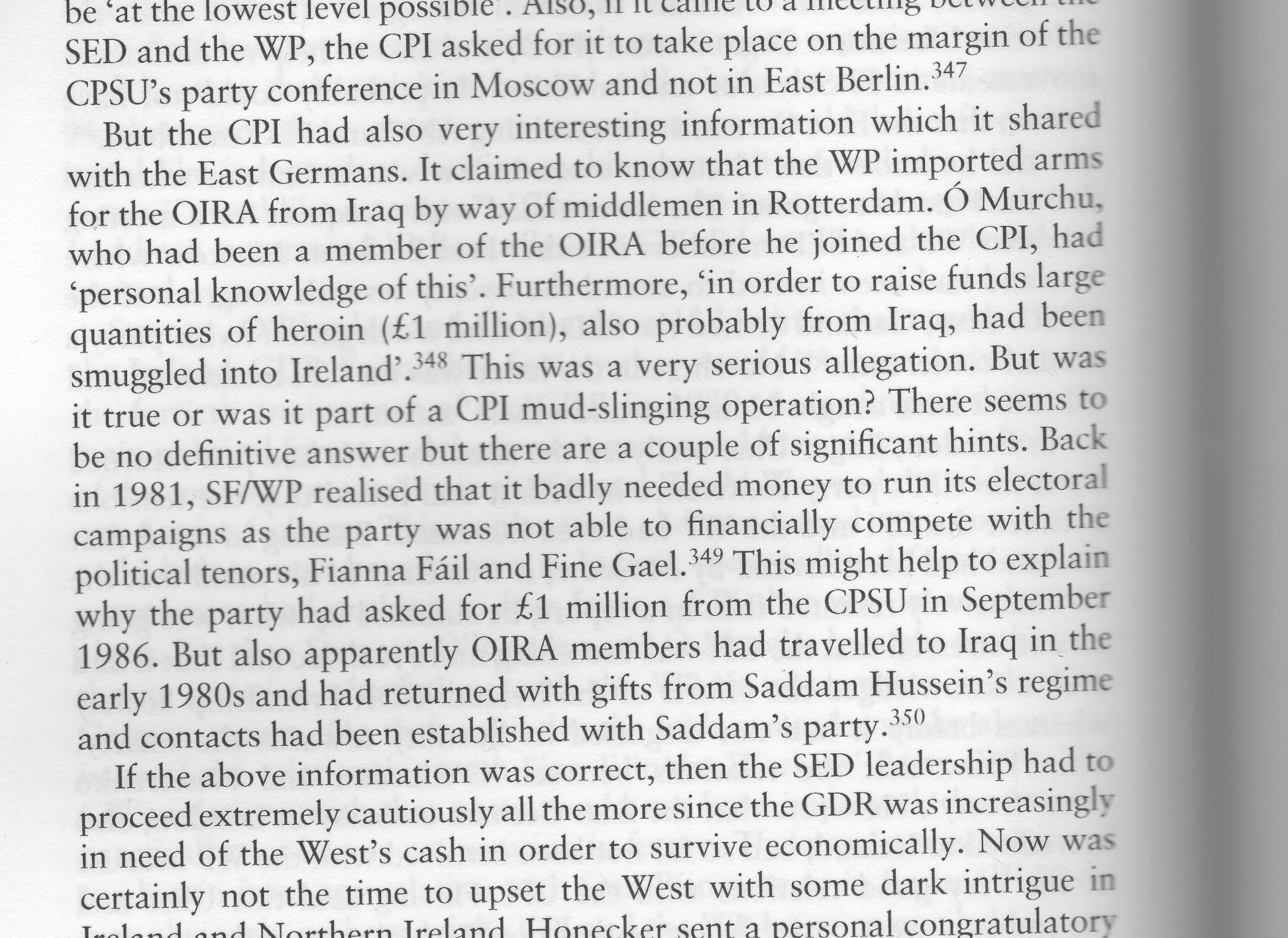
Here’s a story that I found on page 80 and I know that if I was a reviewer I would be highlighting this in my piece, along with another gem of a story that I will describe on another day.

First a bit of background. In the 1970’s and 1980’s, right up to the collapse of the Soviet Union, the Stalinist left in Ireland was represented by the Communist Party of Ireland (CPI) on the one hand, and the Workers Party (or its various other manifestations) on the other.

The two were in often vicious competition for the affections of the two biggies in the Communist world, the Communist Party of the Soviet Union (CPSU) and the Communist Party in its powerful neighbour, East Germany which was known as the SED, or Socialist Unity Party of Germany.

Because the Workers Party (WP) was growing in electoral strength – it eventually mustered seven deputies in Dail Eireann – and the CPI could hardly gather more than 500 votes, the CPSU favoured the WP over the CPI. That was important because it meant the WP were invited to all the conferences in Moscow, got up there on the platform with the party luminaries and had access to all that Moscow gold (and more as we shall see another day!).

The SED however seemed to still have a soft spot for the CPI and continued giving it a hearing, much to the WP’s undoubted irritation.

So, as you might expect, the rivalry between the CPI and the WP could get hot and heavy. While I would not want to be on the receiving end of WP hostility (they were people not averse to trying to get Loyalists to kill you and in my case nearly did), I have to say that the following account shows that the CPI were no slouches either.

Now, I have no idea whether the allegations made by the CPI are true or not. But I will say two things. One is that Prof. aan de Wiel gives them house room for compelling reasons that he explains at the end of the paragraph (the East Germans also took it all very seriously and kept some distance from the WP thereafter); the second is that, right or wrong, the story is damned sight more interesting and relevant from a reviewer’s viewpoint than any alleged blunders made by someone like myself.

Anyway here is the extract from the book. These events happened in 1986, by the way. Enjoy. I know I did.

sticks1So the question must be asked: why did The Irish Times not even mention this story? In 1986 the Workers Party was on the eve of its best every electoral performance while heroin addiction was at record levels in places like Dublin. Within a few years some of its leading members would join the Irish Labour party and are now in government. Did any of them know about this arrangement? Was it true? Shouldn’t The Irish Times at least be asking the question?

Nice Try Danny Morrison, Better Luck Next Time

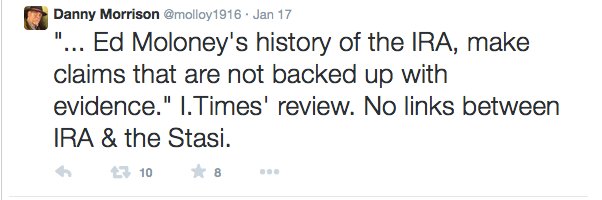
Followers of Danny Morrison’s Twitter feed received the message below on January 16th and those of them who are his fans were probably delighted to read it. Here it is:

MorrisonLife being too short as it is I am not on Danny’s Twitter list so I am grateful to a friend for alerting me to this message and sending me a copy.

Danny Morrison

Danny Morrison

Danny was excited over a review in the Irish Times of a recently published academic tome examining the relations between the East German intelligence service, the Stasi and Ireland between the foundation of the GDR in 1949 and the fall of the Berlin Wall in 1990. The book, published by Manchester University Press, was written by Jerome aan de Wiel and retails for an eye-watering £63.

The book is based on an examination of some 6,000 documents – what Mr aan de Wiel terms ‘surviving’ documents – retrieved from the Stasi’s files in East Berlin.

The reviewer, one Derek Scally, had this to write inter alia, much to Danny’s glee:

But what of the shadowy contacts between Belfast and East Berlin that pop up in many standard works on the Troubles? According to aan de Wiel, many of these works, such as Ed Moloney’s history of the IRA, make claims that are not backed up with evidence.

Danny Morrison as a callow youth - looks like a mug shot to me but an interesting one

Danny Morrison as a callow youth – looks like a mug shot to me but an interesting one

The comment angered me, needless to say, but it was also puzzling. As the friend who alerted me to the Morrison comment pointed out I never made any connections at all between the IRA and the Stasi in ‘A Secret History of the IRA’ (not ‘a history of the IRA’ as Scally called it).

I wrote to the publisher to complain and received back a very polite email containing a copy of a message the author had sent to the publisher in response to my complaint. It began, tellingly:

I have never said anything about Ed Moloney, and in fact was very careful about what I wrote.

And he quoted the relevant passage from his book:

In his impressive history of the IRA, Ed Moloney writes that PIRA (Provisional IRA) member Brian Keenan was said to have contacts with the East bloc, especially with the Stasi, but that concrete evidence to support this is not forthcoming. Keenan was often described as the tough Marxist within the IRA. As Moloney points out it was in fact the OIRA (Official IRA) that got support from the Soviet Union and the East bloc.

It is in fact the supposed links between the Stasi and the Officials which Mr aan de Wiel says is not supported by those ‘surviving’ Stasi papers; nothing to do with the Provisionals at all. But in his eagerness to take a swipe at myself the bold Danny either didn’t check or didn’t care. I suspect the latter.

Even so, Mr aan de Wiel adds an important qualification:

An important point must be emphasised though. This is not to say that it is absolutely certain that the Stasi did not do it, (i.e. supply the Officials with guns etc) but based on the evidence of the surviving written material it simply cannot be proved.

I would add my own qualification, based on my knowledge of said Officials, and that is to explore further the meaning of the word ‘surviving’ as in ‘surviving documents’.

Or, to put it another way, I would dearly like to get a glimpse at the airline manifests of incoming passengers at the airports in Berlin in the days immediately following the fall of the Wall, especially those whose airport of origin was either Dublin or Belfast and whose addresses were either in Gardner Place or the lower Falls Road, especially Cyprus Street.

Manchester University Press’ helpful commissioning editor, Tony Mason had this to say in his email to me:

From what Jerome has said below and from my reading of the relevant passages, this strikes me as incorrect quoting from the book by Derek Scally in his review in The Irish Times rather than anything wrong that Jerome has said. We may ask Jerome to ask The Irish Times to print a correction to this.

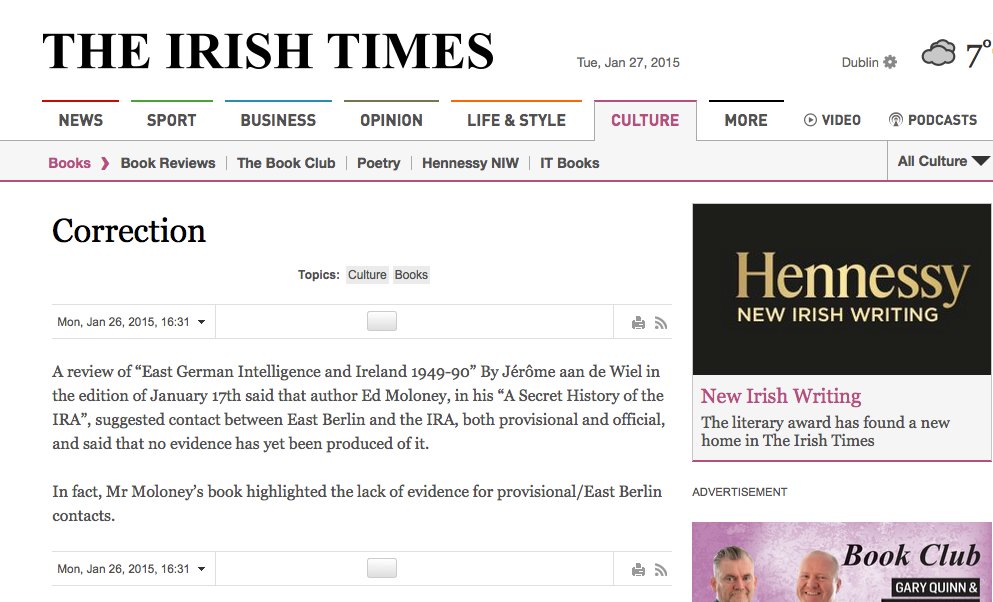
I don’t know if Mr aan de Wiel asked for a correction, but I did. Here it is:

ITimesSorry about that Danny.

Sinead O’Connor & Sinn Fein – Whatever Happened To That?

Remember Sinead O’Connor joining Sinn Fein and asking for a meeting with Gerry Adams? To discuss, ‘the creation of a new country’ and ‘a private matter’. That was back in mid-December. More than a month ago? Have any of Ireland’s journos bothered to follow up on that, or has the story just disappeared into the mystic, or down the drain like the dregs from the last pint of Guinness? Have they just plain forgotten and moved on to the next fleeting story? And what was ‘the private matter’? I’d like to know. Wouldn’t you?

sineadGerry-Adams.-007