The McGuigan Killing: So, Just How Independent Was The Independent Monitoring Commission?

lbo2RHEM

Vessels of Truth

It remains to be seen just how sham – as in Sham Fight at Scarva sham – the crisis over the Kevin McGuigan killing really is, but whatever the truth it seems inevitable that a new version of the Independent Monitoring Commission (IMC), will be set up to tell us in soothing, re-assuring words that there really is nothing to worry about.

The argument for a new IMC is that the PSNI really screwed up their handling of the killing, starting with a warning to the media not to blame the IRA followed within hours by an admission that it was indeed IRA fingers on the trigger that dispatched Mr McGuigan to eternity.

Sizable credibility problems then for Big George and his Merry Men. Cue a bunch of retired political hacks, superannuated cops and a George Smiley or two – Brits and Yanks only need apply – and the problem will be solved, not to mention the handy holiday money, expense account dining for a few months and the mirage of once again seeming relevant despite the advancing years.

But just how ‘independent’ was the Independent Monitoring Commission? Where did it get its information from? Were its sources really any different from those that assured us that it would be dangerous to speculate about IRA responsibility for killing the unfortunate Kevin McGuigan.

Well, in its last report – its 26th and longest report, published in July 2011 – the IMC went into some detail about how it went about its work, who it talked to and where its intelligence and information came from.

I am sure it will come as no surprise to my more cynical readers that the IMC relied in the main on the PSNI and MI5 for official intel. In other words what we’ll get with the new IMC  is the same information that George Hamilton would give the public anyway, except now it will be filtered through a bunch of former pols, cops and spooks and packaged in a polished, professional and media-friendly fashion.

But guess who else the IMC chatted to, aside from the usual community leaders, priests, vicars and the like? Well, none other than the paramilitary leaders whose lack of activity the IMC was supposed to be monitoring! And why not? Vessels of truth, all of them!

So, bring on the new IMC!

Information and Access

  1. 8.9  It was clear from the beginning that to be effective we needed the fullest possible access to information from both official and other sources. There were two main aspects.
  2. 8.10  First, with the police and intelligence authorities North and South we needed to demonstrate we could handle material responsibly, drawing on it for our analysis but not putting things into the public domain in a way which compromised their work or the safety of individuals23. We believe that the way we handled this material in our First Report was key here. Fruitful relations with these authorities were established from very early on and we have been struck by how forthcoming they were with information and comment. However, we sought always to maintain a proper distance as well as a capacity to question, and in some cases to disagree, and our conclusions were always our own. While we relied on much more than just their material, theirs was an input without which it would not have been possible to produce reports of any depth and authority.
  3. 8.11  Second, it was essential that we had sources other than official ones and in our statement in March 2004 and subsequently we invited people to approach us in confidence. We needed personal and local perspectives and also information. We usually obtained it face to face on our premises or on visits around Northern Ireland. Though many approached us on their own initiative, we frequently took the initiative ourselves and asked to see people, individually or in groups, and believe it was important that we did so. We wanted to ask questions and to hear what it was like in local communities; what paramilitaries were up to in different areas and what the communities really felt about them; how real was the support or the fear; how the facts and views locally tallied with what we heard from official sources; what senior members of paramilitary groups themselves thought, and sometimes whether and how they were trying to manipulate us. Moreover, we wanted more than simply the grass roots view. We needed analysis and perspective as well, and found it in many conversations, including with senior figures and commentators in Ireland North and South.

The McGuigan Killing: Were Murder Weapons Part Of Un-Decommissioned Cache?

Flaws In IRA Decommissioning – Irish Govt To Washington: ‘Fr. Reid told Paisley Weapons “Rusty & Dust-Covered and none from 1990’s”‘; U.S. Believed IRA Kept ‘Not Just Small Arms’; IMC & De Chastelain Never Accounted For Un-decommissioned Arms.
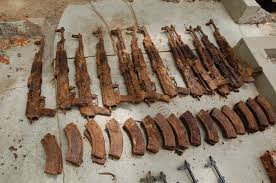
Were the weapons the IRA decommissioned 'rusty and dust-covered'?

Were the weapons the IRA decommissioned ‘rusty and dust-covered’?

The DUP told the Dublin government that it was aware of significant shortcomings in the final IRA decommissioning process of September 2005, including the possibility that the IRA had retained weapons, before the party agreed to go into government with Sinn Fein, according to a five-year old account of the negotiations that created the power-sharing government at Stormont.

At the same time the Bush administration in Washington believed the IRA had kept ‘not just small arms’ out of the reach of the international decommissioning body, suggesting that the IRA had held back heavier weapons than handguns.

Meanwhile a close reading of all the reports, post September 2005, issued by the Independent Monitoring Commission (IMC) and the Independent International Commission on Decommissioning (IICD) shows that while both bodies acknowledged that the IRA had retained weaponry neither body ever reported that the withheld weaponry was recovered or destroyed, or explained what happened to it.

The IMC said that the material that had not been surrendered by the IRA went  ‘beyond what might possibly have been expected to miss decommissioning such as a limited number of handguns kept for personal protection or some items the whereabouts of which were no longer known’. 

This appears to be a strong hint that high-powered weapons, such as automatic rifles were held back, a judgement that accords with the U.S. view of the quality of un-decommissioned weaponry at the time. It is believed that one of the weapons used to kill Mr McGuigan was a semi automatic rifle.

The IMC’s estimation of the withheld weaponry was initially significantly at variance with the IICD’s, which consistently downplayed its importance and scale. While the IMC implied that heavy weapons had been retained the IICD suggested only handguns had been involved; the US government reportedly sided, significantly, with the IMC’s initial assessment, on whose panel a former senior CIA official sat.

Both the IMC and the IICD ultimately agreed that the retained weaponry was kept back without the consent or knowledge of the IRA leadership – although it took some time for the IMC to chime with the IICD – but both bodies failed to provide evidence to support this assertion in their various reports.

Former Irish Justice Minister Michael McDowell (right) debates Gerry Adams. He claims government wanted the IRA to survive as an 'unarmed husk' to counter dissidents but failed to explain how this could be done without weapons

Former Irish Justice Minister Michael McDowell (right) debates Gerry Adams. He claims government wanted the IRA to survive as an ‘unarmed husk’ to counter dissidents but failed to explain how this could be done without weapons

Given that it is now known, courtesy of former U.S. special envoy, Mitchell Reiss’s review of Jonathan Powell’s book, ‘Great Hatred, Little Room’, that Sinn Fein president, Gerry Adams asked that the IRA be allowed to keep guns to counter any dissident threat – a request that was accepted by the Blair government but rejected by Dublin – this account begs the obvious questions: notwithstanding the formal rejection of Adams’ request, does the admission that some weapons were retained by the IRA mean this happened with the implicit approval and/or knowledge of the British, Irish and US governments and their security arms, as well as the DUP, and were some of these guns used to kill Kevin McGuigan?

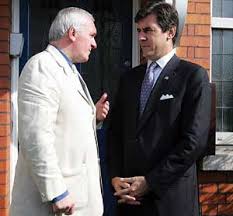
US peace envoy Mitchell Reiss (right) chats with former Irish Taoiseach, Bertie Ahern. Reiss revealed that Gerry Adams wanted to retain guns to use against dissidents

US peace envoy Mitchell Reiss (right) chats with former Irish Taoiseach, Bertie Ahern. Reiss revealed that Gerry Adams wanted to retain guns to use against dissidents. US believed IRA had retained ‘not just small arms’.

The account, published in ‘Peace Without Consensus’ by American academic, Mary-Alice Clancy in 2010 has been overlooked during the furore that has followed the killing of Kevin McGuigan outside his Short Strand home in East Belfast last month. Dr. Clancy was an academic at Exeter University at the time.

Her book contains fascinating, controversial and intriguing material about the inter-party negotiations conducted against the backdrop of a controversial decommissioning process undertaken by the IRA.

Not least of the unanswered questions that leap out of her book is the source of her material. In the book she cites only ‘Private information or correspondence’ but it is clear she had access to a wide range of documents and actors in this drama.

When asked by thebrokenelbow who her sources were, she declined to answer.

Ian Paisley told Dublin that the IRA had decommissioned no guns from 1990's and material destroyed was 'rusty and dust-covered'

Ian Paisley told Dublin that the IRA had decommissioned no guns from 1990’s and material destroyed was ‘rusty and dust-covered’

By far the most contentious claim in her book concerns the DUP’s awareness that IRA decommissioning was flawed and that, implicitly, public assurances from at least one of the two clerical witnesses about the completeness of IRA disarming was, at the least, misleading.

Fr Alex Reid, a Redemptorist monk based in the order’s Clonard and Antrim Rd monasteries, and a major player in the development of the Sinn Fein peace strategy since the early 1980’s, was chosen, along with the Rev Harold Good, a former president of the Methodist church, to be witnesses to final IRA decommissioning.

An alternative proposal from Gerry Adams that a simple declaration from the decommissioning supremo, General de Chastelain, that the IRA had completed disarming was vetoed by the DUP leader, the Rev Ian Paisley who instead supported the idea of having clerical witnesses, one Catholic, the other Protestant, validate the process.

This they did and in a statement issued on September 26th, 2005 they attested to the accuracy of the claim from de Chastelain that full IRA decommissioning had occurred, adding:

The experience of seeing this with our own eyes, on a minute-to-minute basis, provided us with evidence so clear and of its nature so incontrovertible that, at the end of the process, it demonstrated to us, and would have demonstrated to anyone who might have been with us, that beyond any shadow of doubt, the arms of the IRA have now been decommissioned.

However, according to Mary-Alice Clancy’s account, a very different version was given to Ian Paisley and his DUP colleagues, particularly by Fr Reid, whose account, because of his perceived closeness to Sinn Fein, carries added weight. Paisley then gave his version of that meeting to Irish officials who in turn passed it on to Washington.

Mary-Alice Clancy wrote:

…..there was also recognition that the IRA’s final act of decommissioning, whilst important, was imperfect. US sources contend that the IRA retained ‘not just small arms’; in its eighth report, IMC members alluded to this, stating that the ‘material goes beyond what might possibly have been expected to miss decommissioning’ (IMC 2006:20).

Ian Paisley Snr also appeared to be aware of this, as in a US copy of Irish officials’ meeting with the DUP, Paisley stated that when he asked Fr Alec Reid – one of the individuals who witnessed IRA disarmament – whether or not he had seen any weapons that appeared to be from the 1990’s, Reid said no, and that the weapons he saw were ‘rusty and dust-covered’. According to Paisley, Reid continued with his negative assessment until the other witness, Rev. Harold Good, intervened.

(Source is given as: ‘Private information provided to the author. p. 157)

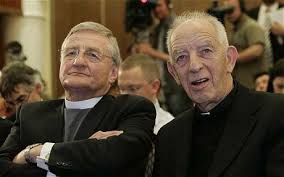
Fr Alex Reid (right) and Rev Harold Good. Witnesses to IRA decommissioning gave an account to Paisley at odds with their public statement

Fr Alex Reid (right) and Rev Harold Good. Witnesses to IRA decommissioning gave an account to Paisley at odds with their public statement. Fr. Reid died in November 2013.

Dr Clancy argues in her account that because of the pessimism engendered in the DUP by Fr Reid’s description of the decommissioning process, the DUP hardened its demand that Sinn Fein formally accept and recognise the PSNI before agreeing to enter the power-sharing government, a demand that the Blair government had been prepared to forego.

Dr Clancy does not explain why Ian Paisley was so exercised about IRA weapons from the 1990’s, especially since the Libyan arms shipments of the mid-1980’s would be regarded as larger and deadlier. Most of those shipments, supplied courtesy of the Gaddafi regime, were unloaded near Arklow and then hidden in dumps around Ireland.

Once Gaddafi mended his fences with the West, in the late 1990’s, he handed over a full manifest of weaponry supplied to the IRA, so the British could have checked whether all this had been decommissioned. Consequently, it would have been difficult for the IRA to hold any of the Libyan material back.

However it is now known that in the 1990’s the IRA shipped in weaponry from the U.S., allegedly with the help of a Florida-based gun-runner, Mike Logan, who reportedly is now ready to testify in court against his alleged IRA contact, former Northern Commander, Sean ‘Spike’ Murray. It is possible, but not known for sure, that Ian Paisley had these shipments in mind when he questioned Fr. Reid.

spike

Sean ‘Spike’ Murray. Former Northern Commander of the IRA is alleged to be at centre of Florida gun-running ring in 1990’s

There had been media reports about the Florida consignments in the late 1990’s and 2000, some years before IRA final decommissioning, so it is likely the DUP was aware of them.

The Belfast Telegraph this week reported:

Logan claims he sent Murray hundreds of weapons during his five-year gunrunning career which began after the IRA ceasefire and continued following the Good Friday Agreement.

Add on to all this the IICD and IMC’s admission that some IRA weapons were not decommissioned in 2005 – nor, it seems, at any stage – and an awkward issue raises its head, namely that the major players in the process may have been aware that the IRA had unofficially retained weapons to counter dissidents, that they had accepted this as a disagreeable necessity but could not officially or publicly acknowledge it.

If so, then the display of political anger in Belfast & Dublin following the McGuigan murder and the IRA’s involvement in it, may be contrived, to put it mildly.

Here is a chronology of key events in this episode:

1. Gerry Adams asks the Blair government if weapons can be held back from decommissioning for use against any dissident threat. This is Mitchell Reiss’ recollection of that event:

In July 2005, the IRA had finally agreed to decommission all its weapons. At the last minute, [Gerry] Adams called No 10 to demand that some of the weapons not be destroyed so that the IRA could arm itself against possible attacks from dissident members. Unless this was allowed, he threatened, decommissioning would not proceed. The Blair government conceded, but wanted to check with Dublin. Irish Minister for Justice Michael McDowell refused to acquiesce in the backsliding, despite enormous pressure. Powell told Adams of the problem, and Adams gave way. Decommissioning took place as planned.

2. September 2005. The IRA completes the decommissioning of its arsenals and statements from the IICD and the two clerical witness, Alex Reid and Harold Good claim that the process was complete. The IICD said it believed that the weapons destroyed were consistent with estimates of IRA weaponry given by security forces on both sides of the Border and represent “the totality” of IRA weapons.

3. January 26th, 2006. The IICD admits in a statement that not all the IRA’s weapons were destroyed but claimed they were small in number, included handguns, were retained for personal protection and area defence and that retention was not authorised by the IRA leadership. The IICD appeared to accept IRA assurances that not all weaponry was under the leadership’s control and might have gone astray when those keeping weapons had died or memories faded.

IICD1iicd2iicd3

General John de Chastelain, head of the IIDC. Along with the Independent Monitoring Commission, he failed to say what had happened to un-surrendered weapons retained by the IRA

General John de Chastelain, head of the IIDC. Along with the Independent Monitoring Commission, he failed to say what had happened to un-surrendered weapons retained by the IRA

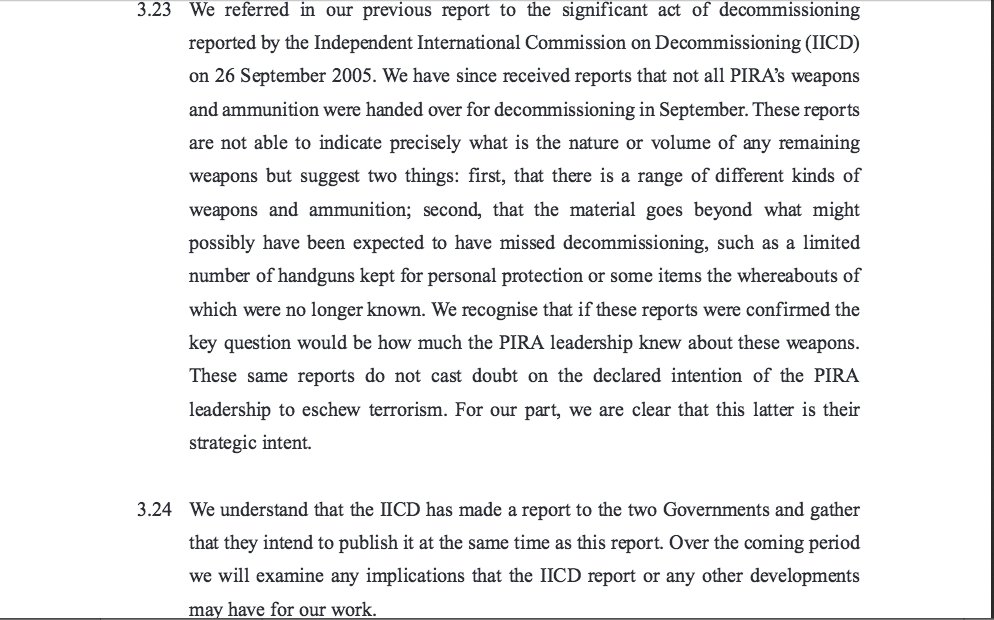
3. February 1st, 2006. Eighth report of the Independent Monitoring Commission

Three days later the Independent Monitoring Commission (IMC) published its eighth report which inter alia repeated the IICD’s claim that IRA weapons had been retained but there was a significant difference in tone. While the IICD had minimised the retention, the IMC went in the other direction, saying that “….the material goes beyond what might have been expected to have missed decommissioning, such as a limited number of handguns kept for person protection or some items the whereabouts of which were no longer known.” The IMC noted that this retention raised questions about the IRA leadership’s knowledge of this. Reading between the lines the IMC appeared to be echoing that anonymous U.S. source quoted by Mary-Alice Clancy that the IRA had kept back ‘not just small arms’.
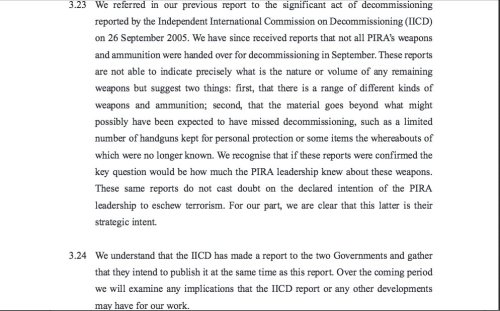
8th_report

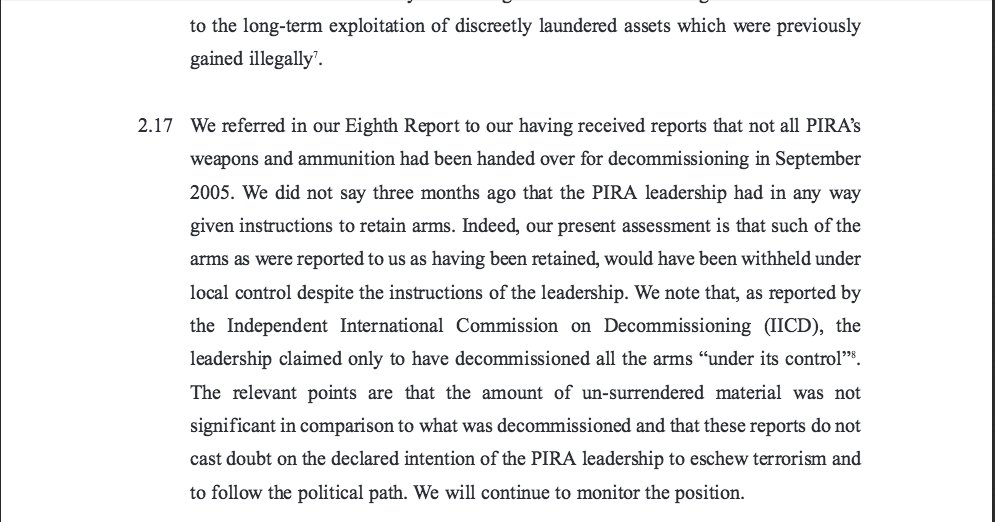
4. April 26th, 2006. Tenth report of the Independent Monitoring Commission

10th_report5. Further on in the same report, the IMC begins to claw back and readjust its position to be more in line with IICD, denying that it had suggested in February 2006 that the IRA leadership had authorised the retention, that the retention was really the fault of local IRA units who disobeyed the leadership and that the amount of un-surrendered material was not significant compared to what had been decommissioned. The IMC signalled its full agreement with the IICD by declaring its belief that it had no doubt that the intention of the IRA was to follow the political path and ‘eschew terrorism’:

10th_report_2_6. October 4th, 2006. IMC Twelfth report.

The IMC was by now fully backing the official line on the retained weapons, that it was nothing to do with the IRA leadership and might even have been carried out by a dissident group:

12th_report7. November 7th, 2007. 17th report of the IMC.

By this stage the un-decommisioned weapons didn’t even rate a mention in the IMC report. Instead the IMC said it was so confident of the veracity of the Provisionals journey into peaceful politics that it would limit from now on what it had to say about the IRA:

17th_report8. September 3rd, 2008. IMC’s nineteenth report.

By this point the IMC was ready to declare that the Provisionals had ‘all but’ completed the transformation into a wholly peaceful and politically-oriented organisation. Most of its war-oriented structures had been dismantled.

In no report, either by the IMC or the IICD, is there any indication of what happened to the un-surrendered IRA weapons and in particular whether this material was ever destroyed.

19th_report

9. August 12th, 2015. Former IRA member Kevin McGuigan was shot dead outside his Short Strand home. It is believed that he was killed in retaliation for the killing in May of IRA leader Gerard ‘Jock’ Davison. PSNI Chief Constable, George Hamilton confirms the suspicion that IRA members may have been involved in the McGuigan murder and says that the IRA still exists and has structures.

10. August 27th, 2015. Former Irish Justice Minister, Michael McDowell told The Irish Times that the Irish and British government had allowed the IRA to continue to exist in order to counter any threat from dissident republicans opposed to the Good Friday Agreement. The IRA was to be ‘an unarmed husk‘, he said. Mr McDowell did not explain how an unarmed IRA could counter armed dissidents.

Spurs & The Transfer Window: MoPo Grows Clay Feet…..

You don’t have to be a fan of Tottenham Hotspur, as I have been most of my life, to know that a storm of criticism has engulfed Daniel Levy, Chairman and CEO of Spurs for the last 14 years, in the wake of a transfer window which ended with Levy’s failure to secure the transfer of Saido Berahino from somewhere called West Bromwich to White Hart Lane.

Daniel Levy, brings an accountant's approach to soccer

Daniel Levy, brings an accountant’s approach to soccer

Levy, who has steered Spurs to only one trophy and a single season in the Champions League during his entire tenure, has a name for watching the pennies and for leaving his transfer deals to the last minute, an approach which his critics say is deeply flawed: it limits the choice of available players to those left on the shelf at the end of the window and costs the team points since the new players are not available for vital early games. This season Spurs have so far secured just two points – that is two draws – out of a possible nine, from three games and scored just two goals.

The challenge facing Levy was to recruit a striker to supplement Harry Kane in case of injury or bad form, as seems to be the case in the first three games. Hence the targeting of Berahino. The haggling with West Bromwich was fierce and has ended with the two teams offering widely differing accounts of the negotiations.

West Bromwich claimed that Spurs had offered to pay £6.5m in cash and the remaining £18.5m of the £25m fee in add-ons which would be paid if Berahino achieved certain results, such as international caps. In other words there was no guarantee that the full fee would ever be paid.

Spurs counter claim that an offer of £25m cash was made but rejected by West Bromwich’s pugnacious chairman, Jeffrey Peace, who maintained that Levy had left his offers far too late and they fell far short of what was necessary.

Spurs fans are in little doubt that Peace is giving the more truthful version. Levy has a track record of negotiating like this and too many in the media have been willing to credit the Spurs boss with qualities that are arguably quite stupid and counter productive. As usual the hacks have got the story wrong, some possibly in an effort to ingratiate themselves with Levy.

The sale of Gareth Bale to Real Madrid raised real questions about Levy’s knowledge of soccer and his eye for talent spotting. He used the £100m from the Bale sale to buy seven players, most of who have now been sold off for a loss after failing to deliver. Soccer pros say the difficulties of integrating seven new players in a pre-existing squad are almost insuperable and by going down this road, Levy made a basic amateurish mistake. He hired Franco Baldini to do the deals for him and clearly that proved to be a bad choice. Baldini has now been retired.

The real power at Spurs lies with a reclusive currency speculator and billionaire called Joe Lewis, a tax exile who spends most of his life on a luxury yacht somewhere in the Caribbean. Lewis, who owns a majority stake in ENIC, a holding company that owns Spurs, seems to regard Spurs not as a football team whose job is to win trophies or bring glory to the owner but as an investment vehicle. So transfers are scrutinised more for their implications for the Profit & Loss account than for the impact on the field.

Joe Lewis makes a point to Daniel Levy: 'Where's my money, Daniel!?'

Joe Lewis makes a point to Daniel Levy: ‘Where’s my money, Daniel!?’

To get back to the need for a new striker, which was the background to the drama.

During his 14 years in North London, Levy has hired ten managers and fired nine of them. His latest acquisition, Mauricio Pochettino, an former Argentine international and manager of Southampton, looked as if he was going to make a difference.

Mauricio Pochettino: His Master's Voice?

Mauricio Pochettino: His Master’s Voice?

But to judge from the reports in the wake of the Berahino fiasco, it seems Spurs’ new manager is made of poor stuff, content to follow obediently in Levy’s path.

Compare and contrast the two stories below, the first that appeared about ten days ago, the second which appeared today. Very disappointing. Bodes ill for the season:

This is what Pochettino said on August 20th

This is what Pochettino said on August 20th

Echoing Daniel Levy, this is what he said today

Echoing Daniel Levy, this is what he said today…..

....and here's more

….and here’s more

Syrian Refugees: Cameron’s Shame!

There will soon be, apparently, a debate in Britain about whether to leave the EU. The two stories reproduced below surely suggest that the wrong debate is planned. The EU should be debating whether to expel Britain, not the other way round! A country which voted into power a politician with the heartless views described below does not deserve to be included in any civilised forum.

A Turkish policeman discovers the drowned body of young Syrian refugee, presumably drowned as his family tried to flee the war

A Turkish policeman discovers the remains of a young Syrian refugee, presumably drowned as his family tried to flee the war

Cameron

In The Shadow Of The Butchers: Loyalist Paramilitaries On Film

‘Balaclava Street’, one of the most thoughtful and well-written of Loyalist blogs on the net (but not the only one), has an interesting, if somewhat overlong, look at the depiction of Loyalist paramilitaries in the movies.

balaclavastreet's avatarBalaclava Street

titlepicsmall

EXT. OCCUPIED IRELAND – DAY. Aerial shot flying over the rugged Irish countryside. Livestock, tractors, buildings below zip through our view as if in a model railway set. The drumming of the bodhran and mournful uilleann pipes. Cut to A VILLAGE CROSSROADS. Angle on our hero, Fergus O’Reilly (Mark Wahlberg), an IRA volunteer. Jaw set, handsome with his combat jacket and blonde sweepback ¾-length mullet. His eyes narrow as a British Army Land Rover heaves round a corner in the middle distance. Hands tighten around the command wire detonator in his hands. One press of the button will complete the firing circuit, bring revenge upon the invaders who 20 years ago killed his parents, razed their cottage to the ground, and set fire to their sheep. But at the last moment the Land Rover slows unexpectedly, and Fergus accidentally blows up a car full of nuns transporting a piece…

View original post 7,958 more words

The McGuigan Killing: Claims of ‘Unarmed IRA’ Are Ludicrous

Claims this week, first by former Irish Justice Minister Michael McDowell and now from former Taioseach, Bertie Ahern, that the British and Irish governments agreed to accept the continued existence of an unarmed IRA – “a withering husk” in McDowell’s words – to counter the threat from dissident republicans are so ludicrous they should be laughed out of the room.

Former Irish Justice Minister Michael McDowell

Former Irish Justice Minister Michael McDowell – “a withering, unarmed husk” of an IRA would stave off the dissidents

If such an impotent entity ever came into being how long would it have taken the Real or Continuity IRA, or any one of the multitudes of republican acronyms that have sprung up since 1997, to work out that the Provos had become, in that wonderful Belfast phrase, ‘a beaten docket’ and could be quickly taken out and sent scattering?

Former Taoiseach Bertie Ahern. Co-ordinated NI policy with McDowell and now claims that the IRA was to remain 'unarmed'.

Former Taoiseach Bertie Ahern. Co-ordinated NI policy with McDowell and now claims that the IRA was to remain ‘unarmed’.

A few days, a couple of weeks, a month or two? I don’t know but it surely would not have been long before the dissidents gleefully realised their adversaries were weak and defenceless, as vulnerable as fish in a barrel.

The only way a rump Provisional IRA could see off a threat from the dissidents was to be at least as well armed, if not better armed. And both the British and Irish governments, and especially their security advisers, would have known that.

IRA Volunters on patrol. Ahern & McDowell say an IRA bereft of weapons would have countered armed dissidents.

IRA Volunteres on patrol. Ahern & McDowell say an IRA bereft of weapons would have countered armed dissidents.

But neither government could afford to be found with their dicks in the honey pot, so to speak. And so, admitting the truth is not allowed.

So here is what I reckon may really have happened and we must base the alternative theory on the account provided by Mitchell Reiss, Bush’s peace process ambassador who is more credible and reliable than the other players if only because he had no dog in the fight, or if he did, that it was only a very small and insignificant one.

Here is what he wrote in his now famous review of Jonathan Powell’s book, ‘Great Hatred, Little Room’:

“In July 2005, the IRA had finally agreed to decommission all its weapons. At the last minute, [Gerry] Adams called No 10 to demand that some of the weapons not be destroyed so that the IRA could arm itself against possible attacks from dissident members. Unless this was allowed, he threatened, decommissioning would not proceed. The Blair government conceded, but wanted to check with Dublin. Irish Minister for Justice Michael McDowell refused to acquiesce in the backsliding, despite enormous pressure. Powell told Adams of the problem, and Adams gave way. Decommissioning took place as planned.”

What I suspect really happened was that when Blair’s proposed concession to Adams was discovered in Dublin the shit hit the fan in St Stephen’s Green, but for a reason altogether different from the one understood by Mitchell Reiss.

If Dublin had agreed to allow the IRA to remain armed it would have created the ingredients for a political scandal that would have overshadowed the Arms Trial imbroglio of 1970 which almost sent Charles Haughey to jail.

Not least of the consequences of making such a pact would be that Gerry Adams would have the Dublin government and a key adversary, Michael McDowell over a barrel.

A judicious leak at the right moment to the effect that an Irish government had permitted the IRA to keep weapons would destroy McDowell and his officials and the ensuing scandal would envelop another Fianna Fail Taoiseach, Bertie Ahern, and perhaps other members of the Cabinet. The threat to the very integrity of the state could not be understated.

No politician worth his salt would leave themselves open to such a vulnerability and while Mr McDowell has, understandably, now dressed his refusal to countenance an armed IRA in moral propriety, I suspect the truth may have been more complicated.

Which still left the problem of the Provos versus the dissidents unresolved. And that is why I would, if I had one, give a fortune to have been a fly on the wall when Jonathan Powell and Gerry Adams met to discuss what to do when McDowell said no.

Reiss says: “Adams gave way”. If so, why? Did he just throw up his hands in surrender? Did he accept the inevitability of casualties on his side, colleagues, comrades and friends gunned down by dissidents who did have weapons? And how did he justify such a meek surrender to his colleagues on the Army Council? Or was he made another offer that he couldn’t and wouldn’t refuse.

Here, I am wandering into the realm of pure speculation, I freely admit – and critics can attack me for that if they wish – but it is hypothesizing rooted in common sense.

What if Jonathan whispered the following, or something like it, into Gerry’s ear: “Listen, Gerry. Here’s the situation. We can’t be seen giving your people the green light to be armed. If it ever got out, Tony would be destroyed and Dublin just won’t wear it. But if your people were to, let’s say, acquire, or even hold back the necessary, I don’t think any of our people would make a fuss. How does that sound?”

Now, call it what you will, but to my ear and eye that would still amount to a government consenting to the continued existence of an armed IRA, with Dublin a conveniently silent but consenting partner. But there would be no fingerprints at the scene of the crime.

And if that, or something like it, is what really happened, is this why the Kevin McGuigan killing has spooked both governments and police forces and got their proverbial knickers in such a twist?

Is it possible that the truth is horribly simple: that both governments knew, not only that the IRA would continue to exist, but that it would also, by nod and wink, have to be allowed to retain weapons because otherwise it would be unable to deal with the dissidents? And that the greatest fear in Dublin & Belfast therefore is that this truth, of which they were aware, will be exposed?

Postscript:

In two reports published following the September 2005 supposed full act of decommissioning by the IRA – one in February 2006. the other in April 2006 – the Independent Monitoring Commission reported that not all the IRA’s weapons had been put out of commission.

That was immediately denied by the decommissioning supremo, General de Chastelain and a rift was opened up between the two main bodies responsible for monitoring the ceasefire.

In its next report, its 12th, published in October 2006, the IMC had an explanation for the un-decommissioned weapons which got everyone off the hook:

  1. The weapons which we had previously said had not been decommissioned the preceding September had in our view been withheld despite the instructions of the leadership.

Donald Trump And The Mob: 21 Questions From David Cay Johnston

David Cay Johnston, the former New York Times reporter, has long been one of my favourite financial journalists. With his curious mixture of class politics and libertarian zeal, he is a journalist who can be relied upon to regularly put American society under an uncomfortable microscope.

Here he poses some very disagreeable questions to Donald Trump, the billionaire property magnate and casino boss whose mix of populist economic policies and an American nativism that borders on fascism, has propelled him to the top spot in the Republican race for the presidential nomination.

It is  clear that Johnston regards Trump as a liar and a phony but it is the links his questions suggest between Trump and the mob, especially in New Jersey, that stand out. When you come to think of it casinos, the construction business and the mob, they all go together.

Here is the article posing 21 questions to Trump which appeared in The National Memo way back in mid-July, just as ‘The Donald’ was beginning his primary race surge. We could do with a David Cay Johnston or two in Irish journalism right now:

21 Questions For Donald Trump

21 Questions For Donald Trump

I have covered Donald Trump off and on for 27 years — including breaking the story that in 1990, when he claimed to be worth $3 billion but could not pay interest on loans coming due, his bankers put his net worth at minus $295 million. And so I have closely watched what Trump does and what government documents reveal about his conduct.

Reporters, competing Republican candidates, and voters would learn a lot about Trump if they asked for complete answers to these 21 questions.

So, Mr. Trump…

1. You call yourself an “ardent philanthropist,” but have not donated a dollar to The Donald J. Trump Foundation since 2006. You’re not even the biggest donor to the foundation, having given about $3.7 million in the previous two decades while businesses associated with Vince McMahon’s World Wrestling Entertainment gave the Trump Foundation $5 million. All the money since 2006 has come from those doing business with you.

How does giving away other people’s money, in what could be seen as a kickback scheme, make you a philanthropist?

2. New York Attorney General Eric T. Schneiderman successfully sued you, alleging your Trump University was an “illegal educational institution” that charged up to $35,000 for “Trump Elite” mentorships promising personal advice from you, but you never showed up and your “special” list of lenders was photocopied from Scotsman Guide, a magazine found at any bookstore.

Why did you not show up?

3. You claimed The Learning Annex paid you a $1 million speaking fee, but on Larry King Live, you acknowledged the fee was $400,000 and the rest was the promotional value.

Since you have testified under oath that your public statements inflate the value of your assets, can voters use this as a guide, so whenever you say $1, in reality it is only 40 cents? 

4. The one-page financial statement handed out at Trump Tower when you announced your candidacy says you’ve given away $102 million worth of land.

Will you supply a list of each of these gifts, with the values you assigned to them?

5. The biggest gift you have talked about appears to be an easement at the Palos Verdes, California, golf course bearing your name on land you wanted to build houses on, but that land is subject to landslides and is now the golf course driving range.

Did you or one of your businesses take a tax deduction for this land that you could not build on and do you think anyone should get a $25 million tax deduction for a similar self-serving gift?

6. Trump Tower is not a steel girder high rise, but 58 stories of concrete.

Why did you use concrete instead of traditional steel girders?

7. Trump Tower was built by S&A Concrete, whose owners were “Fat” Tony Salerno, head of the Genovese crime family, and Paul “Big Paul” Castellano, head of the Gambinos, another well-known crime family.

If you did not know of their ownership, what does that tell voters about your management skills?

8. You later used S&A Concrete on other Manhattan buildings bearing your name.

Why?

9. In demolishing the Bonwit Teller building to make way for Trump Tower, you had no labor troubles, even though only about 15 unionists worked at the site alongside 150 Polish men, most of whom entered the country illegally, lacked hard hats, and slept on the site.

How did you manage to avoid labor troubles, like picketing and strikes, and job safety inspections while using mostly non-union labor at a union worksite — without hard hats for the Polish workers?

10. A federal judge later found you conspired to cheat both the Polish workers, who were paid less than $5 an hour cash with no benefits, and the union health and welfare fund. You testified that you did not notice the Polish workers, whom the judge noted were easy to spot because they were the only ones on the work site without hard hats.

What should voters make of your failure or inability to notice 150 men demolishing a multi-story building without hard hats?

11. You sent your top lieutenant, lawyer Harvey I. Freeman, to negotiate with Ken Shapiro, the “investment banker” for Nicky Scarfo, the especially vicious killer who was Atlantic City’s mob boss, according to federal prosecutors and the New Jersey State Commission on Investigation.

Since you emphasize your negotiating skills, why didn’t you negotiate yourself?

12. You later paid a Scarfo associate twice the value of a lot, officials determined.

Since you boast that you always negotiate the best prices, why did you pay double the value of this real estate?

13. You were the first person recommended for a casino license by the New Jersey Attorney General’s Division of Gaming Enforcement, which opposed all other applicants or was neutral. Later it came out in official proceedings that you had persuaded the state to limit its investigation of your background.

Why did you ask that the investigation into your background be limited?

14. You were the target of a 1979 bribery investigation. No charges were filed, but New Jersey law mandates denial of a license to anyone omitting any salient fact from their casino application.

Why did you omit the 1979 bribery investigation?

15. The prevailing legal case on license denials involved a woman, seeking a blackjack dealer license, who failed to disclose that as a retail store clerk she had given unauthorized discounts to friends.

In light of the standard set for low-level license holders like blackjack dealers, how did you manage to keep your casino license?

16. In 1986 you wrote a letter seeking lenient sentencing for Joseph Weichselbaum, a convicted marijuana and cocaine trafficker who lived in Trump Tower and in a case that came before your older sister, Judge Maryanne Trump Barry of U.S. District Court in Newark, New Jersey, who recused herself because Weichselbaum was the Trump casinos and Trump family helicopter consultant and pilot.

Why did you do business with Weichselbaum, both before and after his conviction?

17. Your first major deal was converting the decrepit Commodore Hotel next to Grand Central Station into a Grand Hyatt. Mayor Abe Beame, a close ally of your father Fred, gave you the first-ever property tax abatement on a New York City hotel, worth at least $400 million over 40 years.

Since you boast that you are a self-made billionaire, how do you rationalize soliciting and accepting $400 million of welfare from the taxpayers?

18. You say that your experience as a manager will allow you to run the federal government much better than President Obama or Hillary Clinton. On Fortune Magazine’s 1999 list of the 496 most admired companies, your casino company ranked at the bottom – worst or almost worst in management, use of assets, employee talent, long-term investment value, and social responsibility. Your casino company later went bankrupt.

Why should voters believe your claims that you are a competent manager?

19. Your Trump Plaza casino was fined $200,000 for discriminating against women and minority blackjack dealers to curry favor with gambler Robert Libutti, who lost $12 million, and who insisted he never asked that blacks and women be replaced.

Why should we believe you “love” what you call “the blacks” and the enterprise you seek to lead would not discriminate again in the future if doing so appeared to be lucrative?

20. Public records (cited in my book Temples of Chance) show that as your career took off, you legally reported a negative income and paid no income taxes as summarized below:

1975
Income: $76,210
Tax Paid: $18,714

1976
Income: $24,594
Tax Paid: $10,832

1977
Income: $118,530
Tax Paid: $42,386

1978
Income: ($406,379)
Tax Paid: $0

1979
Income: ($3,443,560)
Tax Paid: $0

Will you release your tax returns? And if not, why not?

21. In your first bestselling book, The Art of the Deal, you told how you had not gotten much work done on your first casino, so you had crews dig and fill holes to create a show. You said one director of your partner, Holiday Inns, asked what was going on. “This was difficult for me to answer, but fortunately this board member was more curious than he was skeptical,” you wrote.

Given your admission that you used deception to hide your failure to accomplish the work, why should we believe you now?

The McGuigan Killing: Two Irish Times Articles To Read…..

Someone suggested to me that followers of this blog might be interested in reading two articles I wrote for The Irish Times on the continuing fallout from the Kevin McGuigan killing. One appeared last Saturday and the other today, Thursday.

Here they are. One is copied directly from the paper, the second is my unedited version sent to the paper on Wednesday (my ten free article limit having expired!) Hope you find them interesting:

Provisional IRA may have left stage, but not theatre

The year 2005 marked the end of the armed campaign but not the Provisional IRA

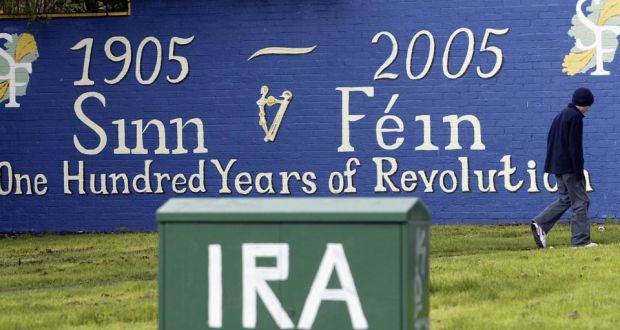
A mural in west Belfast from 2005, the year the IRA announced the ending of its armed campaign. Photograph: Paul McErlane/Getty ImagesA mural in west Belfast from 2005, the year the IRA announced the ending of its armed campaign. Photograph: Paul McErlane/Getty Images
Sat, Aug 22, 2015, 01:01

 The admission by Det Supt Kevin Geddes, the PSNI officer in charge of the Kevin McGuigan murder inquiry, that the Provisional IRA still exists, has access to high-powered weapons (one of the gunmen who killed McGuigan was armed with a semi-automatic rifle) and is so well organised that it has a command structure, has shocked the Irish political system, surprised many in the media and raised serious question marks over the survival of the powersharing government in Belfast.

But the revelation will have come as no surprise to two leading actors in the peace process drama at the time, in the summer of 2005, when the IRA announced the end of its armed campaign against the British presence in Northern Ireland, the point at which many people assume the IRA ceased to exist.

One was the then minister for justice in Dublin, Michael McDowell, and the other was George Bush’s ambassador to the peace process, Mitchell Reiss.

They were involved in an extraordinary spat with the British prime minister, Tony Blair, and his Northern Ireland adviser and chief of staff, Jonathan Powell, over precisely this issue, namely the retention by the Provisional IRA of an armed capacity and, presumably, an organisation to wield it.

Reiss recalled the altercation in a stinging review of Powell’s peace process memoir, Great Hatred, Little Room: “In July 2005, the IRA had finally agreed to decommission all its weapons. At the last minute, [Gerry] Adams called No 10 to demand that some of the weapons not be destroyed so that the IRA could arm itself against possible attacks from dissident members. Unless this was allowed, he threatened, decommissioning would not proceed. The Blair government conceded, but wanted to check with Dublin. Irish Minister for Justice Michael McDowell refused to acquiesce in the backsliding, despite enormous pressure. Powell told Adams of the problem, and Adams gave way. Decommissioning took place as planned.”

So we know that the Sinn Féin leadership wished to retain the ability to inflict and threaten violence and we know also that at least some in the British political establishment were amenable. We do not know for certain, but must assume that Blair and Powell consulted the security service, MI5 before agreeing to Adams’s demand and that they secured acquiescence at least from that quarter.

So important elements in the British system were favourably disposed to the view that the Provisionals needed to defend themselves against possible aggression from political opponents and, if there was a matter-of-fact quality to Det Supt Geddes’s acknowledgment that the IRA had not gone away, it can only sustain the suspicion that this has been an open secret in the security world for a long time, that notwithstanding the qualms of Dublin and Washington, new weapons were acquired from elsewhere and a blind eye subsequently turned to the whole business.

Circumstances

Indeed the circumstances of the Kevin McGuigan killing were a textbook example of the sort of fears expressed by Adams to Tony Blair a decade ago. In May, a leading Provisional activist, Gerard “Jock” Davison, was gunned down near Belfast city centre. Very quickly a former comrade with whom he had quarrelled was blamed and a week or so ago he was killed. To what extent were the killers, and those who ordered them, motivated by the fear that failure to retaliate would be seen as weakness and could invite further attacks against even more high-profile targets?

The need to defend its leaders and members is not the only reason an armed IRA survives. The IRA is enormously wealthy and continues to raise money in unorthodox and dubious ways. Some years ago, admittedly before the 2008 crash, its property portfolio alone – homes and businesses in Ireland, Europe, the US and even the Caribbean – was estimated by the Garda Special Branch to be worth over €200 million.

Someone needs to own, protect and administer all that wealth. Someone needs to provide protection to those who raise money in other ways. Money creates the need. What follows are guns and organisation. But there can be little doubt that fear of bloody feuding, a seemingly inevitable consequence of republican political shifts in the past, was the main factor in the Provisionals’ decision to retain an armed wing. The remarkable aspect of the last 20 years or so of the peace process is that despite a deep personal and ideological split with the Real IRA in 1997 and numerous splinters since, there has been so little internecine bloodshed.

Carnage

Compare that to the carnage that followed the Official IRA-Provisional IRA, or Official IRA-INLA splits and the peace process can be seen as an astonishingly calm affair. The Provisional-Real IRA split was, by comparison, almost a civilised transaction, negotiated in a businesslike way with no side taking too hard a line for fear of the consequences. Would it have been different had the Provisionals disarmed and disbanded? Most probably.

To be fair to the Provisional IRA, the organisation itself has never said that it has disbanded and the most that Sinn Féin figures will concede is that, as Gerry Kelly put it on Thursday, “The IRA has left the stage.” The stage perhaps, but not the theatre. The assumption that the IRA went away when it made its July 2005 announcement ending the armed campaign against the British is due almost entirely to an over-reading of the statement mixed with a large dollop of wishful thinking.

Nowhere in that statement did “P O’Neill” say that the IRA was disbanding. The precise words were: “All IRA units have been ordered to dump arms. All Volunteers have been instructed to assist the development of purely political and democratic programmes through exclusively peaceful means. Volunteers must not engage in any other activities whatsoever.”

In a crucial sense this was no different from the statement which heralded the end of the 1956-62 campaign: the IRA is stopping its war, will begin doing other things but is not going away. Subsequent new year and Easter statements refer variously to “the commitment and discipline of IRA Volunteers”. The IRA did not go away, not entirely. But for a lot of people it was comforting to believe that it had.

Ed Moloney is author of A Secret History of the IRA

The Irish Times headline on this piece was:

IRA has sharpened claws in absence of monitoring commission

Either IRA has got new weapons or it was not truthful on decommissioning

By Ed Moloney

In the course of his informative essay in this newspaper yesterday, describing why the Irish, British and US governments agreed back in 2005 that the survival of an “unarmed and withering husk” of an IRA was vital for the good of the peace process, former Justice Minister Michael McDowell gave a clue as to why things have now gone so badly wrong.

“Sinn Fein pressed for the abolition of the Independent Monitoring Commission (IMC)”, he wrote. “Its abolition leaves us back where we were prior to its creation: dependant on the police forces and their ministers for an assessment of the existence of and responsibility for paramilitary crime.”

The IMC was set up in 2004 and survived for seven years, tasked with producing regular reports detailing the level of republican and loyalist paramilitary activity, including any committed by the Provisional IRA. Its four commissioners were drawn from the UK, US and both parts of Ireland and included, in its final years, a former deputy director of the CIA and the former head of the Metropolitan Police anti-Terror Branch.

It is worth revisiting the first substantive report it produced following the IRA’s July 2005 decision to end its violence against the British presence in Northern Ireland. Published in October 2006, it had this to say of the Provisionals: “We remain of the view which we expressed in our report six months ago, namely that the PIRA leadership has committed itself to following the political path. In the period since then we have seen further evidence to support this.”

The report went on to detail some of that ‘further evidence’, including the disbandment of the IRA’s Quarter Master department, responsible for acquiring weapons; its engineering department, which made explosives and bombs and its training department. Volunteers had been stood down and the weekly stipend paid to activists stopped.

It was meaty stuff. Contrast that convincing detail with the statement issued by PSNI Chief Constable George Hamilton following the murder of Kevin McGuigan. His admission, first of all, that the IRA still existed came as a shock to a public which, in the absence of any other information, had been encouraged to believe it had gone away.

And then he seemed to say that while IRA members were involved in killing Mr McGuigan, the IRA itself wasn’t really responsible, conflicting words that arguably worsened an already vexed situation: “Some current Provisional IRA and former members continue to engage in a range of criminal activity and occasional violence in the interest of personal gain or personal agendas.”

The idea of the IMC was born in 2003 out of frustration with the slow pace of IRA decommissioning and a paucity of evidence that things were changing on the ground.

The brainchild of Michael HC McDowell, a former Irish journalist and now a US-based consultant, it won the backing of his namesake in the Irish Department of Justice as well as Mitchell Reiss, the former State Department official who had become George W Bush’s ambassador to the peace process. Both men were known to be almost apoplectic at the willingness of the Blair government to indulge Sinn Fein and the readiness of the British to minimise the consequence of IRA excesses such as the Northern Bank robbery or the murder of Robert McCartney.

The Northern Ireland Office opposed the idea, seeing it as impinging on their mandate. But the strongest resistance came from Sinn Fein. “They didn’t want it”, recalled Michael HC McDowell. “They were furious about the idea, complaining it would be dominated by spooks and securocrats. They wanted constructive ambiguity to continue unabated.”

It took seven years but eventually Sinn Fein got their way and the IMC was wound up. In the absence of regular reports about paramilitary activity and in the face mostly of reassuring silence from government and police services on both sides of the Border, the public began to think the IRA was a thing of the past, hence the level of shock at the revelation that not only had it not gone away but it had structures, guns and the personnel to use them.

It is also not beyond the bounds of possibility that in the absence of regular scrutiny by an IMC-like body the IRA has slipped back into bad old ways, taking advantage of the constructive ambiguity, not to mention personal ambition, that can also characterise the ways of senior policemen, civil servants and their ministers.

The problem with former Minister McDowell’s “unarmed and withering husk” thesis is that unarmed husks impress no-one, much less dissident republican opponents or a rank and file that needs constant reassurance that the peace process is not the biggest sell out since creation.

In that October 2006 report, the IMC made this bald statement about IRA weapons: “We do not believe that weapons have been acquired or developed”, and it went on to confirm its view that the IRA had destroyed its weapons arsenals in September 2005.

That, plainly, is no longer the case. Kevin McGuigan was killed with powerful weapons, one of them a semi-automatic rifle. Clearly, new weapons have been acquired or the IRA was not entirely truthful in September 2005.

On the question of IRA structures, Chief Constable Hamilton had this to say: “At this stage we assess that some Provisional IRA organisational infrastructure continues to exist but has undergone significant change since the signing of the Belfast Agreement in 1998. Some, primarily operational level structures were changed and some elements have been dissolved completely since 2005.”

That tells the public next to nothing and is in dismal contrast to the compelling detail provided by the IMC.

It is difficult to avoid the conclusion that the IRA has taken advantage of the IMC’s dissolution to harden up its husk and to give it some sharp claws. The solution, and perhaps the key to salvaging the peace process, is thus not hard to figure.

(Ed Moloney is author of ‘A Secret History of the IRA’)

The McGuigan Killing: Written On The Barn

Thanks to Lin Solomon for sending this interesting piece from Belfast novelist Glenn Patterson which appeared on the London Review of Books blog. Enjoy:

I have recently had occasion to reread a piece I wrote in November 2007 following the beating to death of Paul Quinn in a shed on the southern side of the Irish border by – local people said – the Provisional IRA. I mentioned Gerry Adams’s categorical denial of IRA involvement, I noted that the British and Irish governments were reassured by his call for those involved to be brought to justice, and referenced the further calls, from the Democratic Unionist Party, Sinn Féin’s partner in the (then new) power-sharing executive to wait to see if there was evidence of ‘corporate’ IRA responsibility, a phrase whose ‘Blairite banality’, I suggested, masked ‘a volte-face to rival Orwell’s “four legs good, two legs better”’.

Substitute the name Kevin McGuigan for Paul Quinn and the piece might have been written yesterday. 

Last week Detective Superintendent Kevin Geddes of the Police Service of Northern Ireland said the PSNI believed that Action Against Drugs – the gang that murdered Kevin McGuigan – included past and current members of the Provisional IRA. Cue the denials, not just of IRA involvement, but even of its existence. The IRA – Sinn Féin’s MLA for North Belfast, Gerry Kelly, was the first to come out with it – had, in a phrase revived from 2005, ‘left the stage’. (The Irish Times, misquoting Kelly repeatedly, used the term ‘left the State’, which might be wishful thinking.) Cue the calls for caution until it is proved the killing was sanctioned by the leadership, the warnings against other parties making political capital from it. Pace Sinn Féin, it is not only or even mostly ‘Unionists’ who are blaming the Provisionals: the people in the streets where Kevin McGuigan lived are blaming them. One Ulster Television news report claimed the laneway down which the gunmen made their escape was referred to locally as ‘Provo alley’.

At the weekend the PSNI’s chief constable, George Hamilton, clarified Geddes’s statement. The Provisional IRA continued to exist, he said, but in a much altered form. It was not involved in the preparation or commission of terrorist acts. Its main purpose was to ensure that republicans remained committed to peaceful and democratic means.

This is what is known as ‘a line’ and everyone is sticking to it. If this was a Radio 4 panel show there would be klaxons and cheers from the audience at the end of every interview. And if it was a Radio 4 panel show the winner, this week, would undoubtedly be Theresa Villiers, the secretary of state for Northern Ireland, who, while saying she was satisfied that all parties in the executive remained supportive of the principles of democracy and consent, blithely said she wasn’t surprised that the IRA continued to exist. We are surprised, Secretary of State, only because you and your predecessors have spent the last decade trying to convince us, in the face of evidence to the contrary, that it does not.

To return again to that 2007 article, I have a vague memory of feeling the Animal Farm allusion was perhaps overstating it. Nearly eight years on I don’t think it’s going too far to say the ladder is lying broken in the farmyard, the paintbrush and overturned pot of white paint beside it. And I really wouldn’t be surprised if, statement by statement, in the weeks ahead, we are asked to believe that what is now written on the barn is what we signed up to all along.

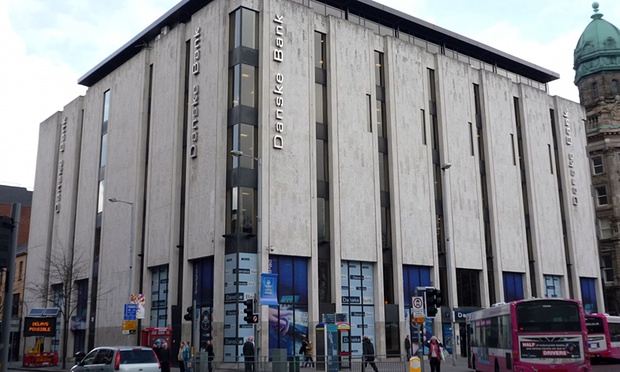
Competition To Rename Northern Bank Robbed By IRA Of £26.5 Million

Thebrokenelbow.com is proud to announce a competition to rename the Northern Bank building which was the scene in December 2004 of what was then the largest robbery in Irish or British criminal history. The IRA is believed to have been responsible and stole £26.5 million from the bank’s vaults in a mixture of new and used notes.

The former Northern Bank in Belfast City centre

The former Northern Bank in Belfast City centre

The Guardian today revealed that the bank, which the paper describes as a classic example of ‘brutalist’ architecture, has been listed as a building of historic or architectural interest by the Department of Environment.

However the DoE has not yet announced what name the building will be given and so to assist the process this blog is inviting readers to make their own suggestions. The winning prize will be, as usual, a lifetime subscription to the blog.

To start the process, here is thebrokenelbow.com’s own suggestion: Bobby Storey House.