Thanks to Maria Vivod for sending me this academic study of women and political conflict, ‘Sexed Pistols – The gendered impacts of small arms and pistols’, which includes a fascinating chapter on women in the IRA and UVF/RHC. Although published in 2009 this account by Miranda Alison is still timely and relevant. Enjoy:
The academic fields studying women, gender, armed conflict, small arms and light weapons are still relatively new. Thus far, research has tended to focus on women as victims of armed conflict, which is of course extremely important. There has been a corresponding emphasis on constructing women as somehow inherently or ‘‘naturally’’ more peaceful and peace loving and less violent than men, which has meant that the issue of women as the perpetrators of violence has been very much neglected.
As Vanessa Farr notes, women are often ‘‘referenced for their capability to make peace as a supposed organic by-product of their ability to mother and nurture. These lines of discourse have tended to promote a simple women=peace:men=war dichotomy.’’ Farr goes on to contend that we ‘‘have to question the idea that women are always and only victims and men always and only perpetrators of violence’’.1 However, Cynthia Enloe suggests that analysis of ‘‘Women in the military has never been an easy topic.’’ Challengingly, she describes how ‘‘gradually I began to realize that paying attention only to women as soldiers was simply too confining . .. To invest one’s curiosity solely in women as soldiers is to treat the militarization of so many other women as normal. If I slipped into that naive presumption, I probably would be allowing my own curiosity to become militarized.’’2
These are thought-provoking comments, and I do not wish to suggest that stark binary categories of women warriors versus women victim peacemakers are the only forms of agency or activism available to
women in war; clearly this is not the case. I also do not wish to suggest that combat is the only role that women have fulfilled in war or that their other, more common, auxiliary support roles are less significant. Indeed, war centrally relies on both men and women in a variety of support roles. As Farr notes, one form of women’s participation in the proliferation and
normalization of guns in the context of armed conflict is their role in smuggling and hiding weapons and/or their bearers,3 and this is one of
the topics covered by this chapter. Linda Grant de Pauw comments in her history of women in war that ‘‘Although some women in war appear in conventional combat roles, most do not. The reality of women’s experience is distorted by focusing exclusively on exceptional females, but it is also distorted by focusing only on the most typical.’’4 It remains the case that women who engage in organized violence have been consistently
under-examined, and that they fundamentally challenge our enduring image of women as natural peacemakers.
Research on female combatants and women involved in other ways with political violence is necessary for various reasons. In contrast to conventional wars, many contemporary conflicts ‘‘privatize violence’’, with more civilians being drawn into conflicts and the separation of (male) belligerents and civilians breaking down. Concomitantly, the stereotype of aggressive men and pacifist women is disrupted; particularly in civil wars and wars of liberation, women are also combatants and serve in a variety of other functions in both the military and armed groups.5 The breakdown of the home front/war front boundary in contemporary conflicts seems to be significant in resulting in increased numbers of female combatants. The increasing availability, portability and ease of use of small arms and light weapons are also contributing to this phenomenon.6 Nothing could be further from the truth than Martin van Creveld’s claim that in contemporary intra-state ‘‘low-intensity’’ wars women are staying away from combat roles.7
Significantly, if we see women as only victims of, not also as perpetrators of, violence and perpetuators of conflict, we are considering only part of the story. Simona Sharoni argues that ‘‘the prevalent view of women as victims of conflict . . . tends to overlook, explicitly or implicitly, women’s power and agency’’. 8

As Ronit Lentinpoints out, ‘‘Viewing women as homogeneously powerless and as implicit victims, does not allow us to theorize women as the benefactors of oppression, or the perpetrators of catastrophes.’’9 This prevents us from addressing and responding to the effects of women’s violence (even if this is only expressed through condoning or encouraging male violence) alongside men’s violence, and makes attempts at peacemaking, peacebuilding
or post-conflict reconstruction less effective. A greater acknowledgement and understanding of women’s participation in political violence is needed as part of an overall struggle towards peace. As Farr maintains, ‘‘Frames of reference that fail to interrogate the complex roles played by women, children, and non-combatant men in times of war show an incomplete picture of violent conflict. This leads to an equally incomplete understanding of how peacemaking should work; as a result, all too many reconstruction and peacebuilding efforts result in lamentable failure.’’
As part of the project to complete our picture of how armed conflict draws in different social actors, this chapter primarily addresses the issue of women’s involvement with paramilitary organizations,11 both republican and loyalist, in the Northern Ireland conflict. 12 The chapter draws on fieldwork I carried out in Ireland in 2003 as part of wider doctoral research on female combatants, utilizing in-depth semi-structured qualitative interviews with 11 female former republican paramilitary members, two female former loyalist paramilitary members and seven others involved to varying degrees with loyalist paramilitary activities. The approach of the research was to take women’s narrations of and reflections about their lives and experiences as primary documents deserving attention. The majority of interviews were obtained through ex-prisoner organizations, with some accessed through other community groups.
The chapter begins with a very brief outline of the Northern Ireland conflict, and then looks at two significant issues pertaining to small arms and light weapons in Northern Ireland: the contentious issue of disarmament/ decommissioning of paramilitary weapons and the problem of post conflict patterns of violence. It moves on to examine women’s role in the
concealment and transport of arms during the ‘‘Troubles’’, then addresses gender relations in both republican and loyalist paramilitary organizations.
It ends with two more speculative sections, on the sexual appeal of arms and paramilitarism and visual representations of paramilitary women.
The Northern Ireland conflict
From the outbreak of the violence in Northern Ireland in 1969 until the 1994 cease-fires, around 3,400 people were killed and over 20,000 injured.
13 The current population is almost 1.7 million, of whom around 53 per cent are of Protestant background and almost 44 per cent are of Catholic background.14 In the course of the struggle there have been deaths and injuries in Great Britain, the Republic of Ireland and continental Europe, but people in Northern Ireland have been the primary
victims. Nearly half the population (80 per cent in some areas) know someone injured or killed in the conflict,15 which has been over the constitutional status of Northern Ireland; that is, whether it should remain part of the United Kingdom of Great Britain and Northern Ireland or become part of a united Ireland. Political conflict has, broadly, taken place between British unionists and Irish nationalists.
People of Catholic background are primarily associated with the republican/nationalist movement and people of Protestant origins are mainly unionists/loyalists. The primary armed parties to the conflict have been republican paramilitaries, a variant of Irish nationalists who desire Northern Ireland to become part of an island-wide Irish republic; loyalist paramilitaries, a variant of British unionists who want Northern Ireland to remain part of the United Kingdom; and the British military forces. Although the absolute number of fatalities appears small when compared with other violent
conflicts, when one considers it in light of the tiny population of Northern Ireland as well as in terms of its long duration, this armed conflict certainly
qualifies as a war. Calling this period the ‘‘Troubles’’, as locals do, is at best a euphemism. Although there has been a cease-fire of the major militant groups since 1994 (on and off), and a political settlement was reached in 1998 with the Belfast Agreement,16 there is no guarantee that the foundation for a lasting peace has been laid. The peace process has been strained and precarious since it began, and in 2002 the Northern Ireland Assembly (the devolved government established with the Agreement) and the wider peace process became severely deadlocked over, among other things, the issue of Irish Republican Army (IRA) weapons decommissioning. The British government suspended the Assembly in October 2002 and direct rule from London was reintroduced. Further political strife ensued. However, following the IRA’s final act of decommissioning in September 2005, negotiations between the political parties of Northern Ireland and the British and Irish governments at St Andrews in October 2006 and subsequent political progress, the devolved Northern Ireland Assembly was restored in May 2007 and has been in operation since that time.
Women have participated in both republican and loyalist paramilitaries in Northern Ireland in a variety of roles, but have been more active in republican groups than in loyalist ones. Women have also been present in the Royal Ulster Constabulary (RUC), the Ulster Defence Regiment and the British military. However, the focus of this chapter is on non-state military groupings; accordingly, women’s roles in the various state security forces are not addressed here.17
The experience of community resistance in the 1970s helped to politicize many nationalist women and bring them into community activity. Women in nationalist areas have played an active role in community protests since the civil rights movement and are still, on the whole, more active in political and community groups than most Protestant women. Some female republican combatants active in the Troubles, such as Mairead Farrell and the Price sisters, came to be internationally known. Re-
publicans view themselves as being part of an unbroken political tradition going back to the 1798 United Irishmen rebellion (although this is highly contestable), and women have been significantly involved in all uprisings including and since that of 1798, though not in a direct military capacity in all of them. It has only been during the Troubles that women have been allowed into the IRA itself as ‘‘volunteers’’ (the organization’s term for combatants). Margaret Ward suggests that this shift came about as a result of both women demanding this change and men recognizingthe need to have some militarily trained women.18 In the late 1960s younger women joining Cumann na mBan (a women’s auxiliary organization set up to support and fundraise for the IRA, including providing first aid and hiding weapons) began expressing disillusionment with their subsidiary role and strongly argued for their integration into the IRA itself. Sympathetic male IRA officers eventually provided them with military training, but apparently this was at first carried out without the knowledge of the older Cumann na mBan women. When the Provisional IRA movement formed it maintained Cumann na mBan but allowed women to be seconded into the IRA, where they were militarily active but did not have the status of full members. With the later restructuring of the organization into cells, women were finally accepted into the IRA on an equal basis with men.
While the active involvement of women in republican paramilitaries has been comparatively well known, Rosemary Sales notes that ‘‘Much less is known about loyalist women paramilitaries . . . who appear to have had less prominence [and independence] within the movement.’’19 Elisabeth Porter suggests that ‘‘the nominal claim to socialist credentials in republicanism provides an ideological space for egalitarianism. The conservative leanings in much [of] loyalism stultify gender equality.’’20 Loyalist women’s activities have primarily been in the realms of ‘‘welfare work’’ (support for male prisoners and their families), first aid and cleaning, and moving and hiding weapons. Nevertheless, a minority of women have been involved in loyalist paramilitaries in more directly combative roles. The scale and extent of women’s presence and involvement in loyalist paramilitaries are very hard to gauge, and I found it extremely difficult to gain access to women willing to talk about their involvement. A community worker told me that in the rural mid-Ulster area, of around 300 ex-paramilitary members with whom she has contact, she knows only one woman who was directly involved. A male worker at the same organization told me of two more. The proportion is likely to have been slightly higher in urban Belfast, but I have no reliable figures to support this hypothesis.
Nira Yuval-Davis suggests that incorporating women into militaries in national liberation movements conveys the message that women are
(symbolically) equal members of the collectivity, and that all members of the collectivity are symbolically incorporated into the military.21 This ideology is significant in respect to Northern Ireland, where republicanism has constructed itself as a national liberation movement in a way that loyalism, concerned with bulwarking the British state and the political and social status quo against the republican threat, has not. In an interview, Peter,22 a loyalist ex-prisoner and community worker, made the
point that loyalists and republicans were ‘‘fighting two different wars’’. Republicans viewed the conflict as being a revolutionary war of resistance against the state, so there was a role for many people to play, including women. In contrast, in Peter’s words:
Loyalist paramilitaries were never about buildin’ a revolutionary movement. They were . . . involved in a low-intensity counter-terrorist war against republicans.

Now, what role is there for women to play in that? [Further,] if you are buildin’ a revolutionary movement then you have to be fightin’ that revolution on all fronts, and one of them is on that gender front – I mean you’ve gotta link your revolutions, you’ve gotta be all embracin’ and you link yourself to human rights issues and to gender issues . . . which the republicans have done. Loyalists
didn’t need to.
Peter also pointed out that ‘‘loyalists would define themselves [by] what they’re not, so you look at your enemy and everything he’s for, you’re against. So if republicans are embracing women’s rights, then again . . . [loyalists would] move against that.’’ The implications of Peter’s comments are that loyalism, being less of a cohesive movement than republicanism and not being a revolutionary movement, has not had the same perceived strategic or ideological need for women’s involvement that republicanism has had.
Small arms and light weapons in Northern Ireland
Disarmament/decommissioning of paramilitary weapons
As previously noted, one of the most significant factors in the 2002 suspension of the Northern Ireland Assembly was the issue of IRA disarmament,
though the suspension was finally triggered amid allegations of IRA intelligence-gathering in Stormont, the Assembly building. However,
disarmament has been a contentious part of the peace process since even before the 1994 cease-fires. Republicans have viewed disarmament as a matter to be resolved as part of the peace process rather than as a condition of entry to it, as unionists have. 23 In September 1997 the Independent International Commission on Decommissioning (IICD) came into existence by a treaty between the British and Irish governments. The IICD, chaired by General John de Chastelain, monitors and reports on acts of decommissioning. The 1998 Belfast Agreement committed all participants to the total disarmament of all paramilitary organizations (see Table 8.1 for estimates of paramilitary weapons stores from around that time). Initially it was intended that full decommissioning would be achieved within two years of the May 1998 referendum supporting th Agreement, but this proved to be unrealistic. Before the Northern Ireland Assembly even began functioning, the question of decommissioning threatened to unravel the whole process. Unionists demanded that the IRA disarm before the new Assembly opened, as a test of republicanism’s commitment to peaceful means (‘‘no guns, no government’’); republicans refused, since they viewed prior decommissioning as an attempt to isolate Sinn Fein (the political party of the Provisional republican movement) and create dissention among republicans. They also saw such preconditions as unhelpful and self-defeating. For republicans, decommissioning has been ‘‘not simply a strategic difficulty within the peace process but also an historical impossibility’’, since their view has been that ‘‘there was no precedent in Irish history for disarmament by insurgents either voluntarily or under pressure’’. They have also pointed out that their own decommissioning should be viewed in the context of a wider demilitarization of Northern Ireland, also including loyalist paramilitary groups, the security forces and ‘‘the thousands of legally held firearms in Northern Ireland which were mostly in Unionist hands’’.24 However, after many false starts, governing powers were transferred to the Assembly in December 1999 (though the Assembly would go on to be suspended a number of times).
To date there have been five acts of decommissioning witnessed by the IICD: four acts by the IRA in October 2001, April 2002, October 2003 and September 2005 and one act by the Loyalist Volunteer Force (LVF) in December 1998.25 The quantity of arms decommissioned by the LVF was very small and there have been no other official, witnessed acts of decommissioning by loyalist paramilitaries.26 In January 2004 the Independent
Monitoring Commission came into effect, established by an international agreement between the British and Irish governments. For its own part, the British government is committed to the normalization of security arrangements and practices, and has worked towards the removal of security installations and a serious reduction in the number and role of British forces in Northern Ireland. Indeed, by summer 2007 there remained no more than 5,000 soldiers in 11 locations in Northern Ireland (commensurate with other areas of the UK, for deployment around the world), as opposed to 27,000 soldiers in over 100 locations at the height of the Troubles. Operation Banner, the name for the British
Army’s 38-year operation in Northern Ireland, officially came to an end in August 2007.
Unionist political leaders have been extremely reluctant to accept the IRA’s steps towards decommissioning as clear evidence of a lasting commitment to non-violent political means, and expressed vocal disbelief that the IRA’s final act of decommissioning in September 2005 really represented the sum total of its outstanding stock of weapons. Part of the issue for unionists has been the lack of transparency in regard to decommissioning. As is its right according to the terms of the decommissioning scheme, the IRA has refused to specify how many weapons, ammunition and explosives have been ‘‘put beyond use’’ in each act, and therefore the IICD has been very restricted in terms of the details it can provide. Nevertheless, the IICD stated that the IRA’s third act of decommissioning involved a larger amount of weapons than the previous acts and included
light, medium and heavy ordnance and associated munitions as well as automatic weapons, ammunition, explosives and explosive material,
27 and has expressed the conviction that the fourth and final act did represent all the arms under the control of the IRA leadership.28 The IICD has an inventory of the arms concerned, but will not publicly disclose it without IRA agreement.
Kris Brown and Corinna Hauswedell argue that although disarmament of warring groups in the context of attempts to end conflicts has been crucial,
sometimes as part of demobilization and reintegration programmes, ‘‘the heightened status it has received in Northern Ireland, where it became
the core issue of dispute between rival sectarian groups during an eight-year period, is virtually unprecedented’’. The highly politicized nature of debates on disarmament has been unfortunate and unhelpful for the building of a stable peace, yet has served the strategic interests of both unionists and republicans at various points. Unionists have used
the issue to apply pressure on republicans and ‘‘compensate for political setbacks and failures incurred on other issues’’, while republicans have used it as a bargaining chip to push for desired political concessions.29 As the UN Development Programme (UNDP) has highlighted, disarmament
(and demobilization and reintegration) often has ‘‘a symbolic and political importance beyond the sum of its parts’’.30 This has certainly been the case in Northern Ireland, where ‘‘the symbolic value of guns
surpasses their inherent military potential’’ and ‘‘the issue of paramilitary arms . . . serv[ed] as the political foundation upon which both conflicting
parties anchored their positions’’.31 For republicans, ‘‘the symbolic importance of retaining weaponry served as political ballast, its purpose being to steady the Republican movement while it jettisoned much of its traditional ideology’’.32 Arms, then, became a symbol of continuity during a highly uncertain period of great change. Nevertheless, the eventual efforts of republicans at decommissioning have been spurred by their commitment to the survival of the new political institutions. For loyalists, the traditional construction of the purpose of their paramilitarism as being the provision of defence for the loyalist community, as part of their oft-mentioned ‘‘siege mentality’’, has reinforced their determination to refuse to decommission weapons in the context of their weaker and less consistent commitment to the new political order, a crisis of identity and perception of deepening political and socio-economic exclusion.33 Despite the participation of women in Northern Ireland in the transport, concealment and even usage of arms during the Troubles (discussed in a later section), a masculinist identity associated with paramilitarist gun possession and usage is as visible there as in other countries. As Wendy Cukier emphasizes, although ‘‘violence is not an exclusively male practice, it is linked to masculine identity and guns are a part of the dominant masculine code in many different cultures’’.34 However, this does not mean that those women who have had a more intimate relationship with small arms than other women, through their paramilitary activities, are more likely than men to be in favour of disarmament in the context of ‘‘peace’’. In fact, women on both sides of the politico-military divide who were interviewed for this study tended to see disarmament as a political red herring, a distraction from ‘‘more important’’ issues such as poverty, education and the broader constitutional question. Republican women, in true republican fashion, tended to view decommissioning as a ploy on the part of unionists to continue to block nationalist access to political power, while loyalist women tended to view it as an irrelevant issue since the IRA could easily procure more weapons and manufacture more explosives if it went back to war, even if its entire existing stock were to be put beyond use (which loyalists do not believe would ever happen). The recurring refrain essentially was ‘‘so
long as the guns are silent, it doesn’t matter if they still exist’’. This, however, is a problematic attitude in light of post-conflict patterns of violence in Northern Ireland (as elsewhere), which are discussed in the
next section.
New forms of violence
The UNDP has noted that demobilization of armed groups ‘‘is only possible when there is some measure of disarmament. Similarly, the success of demobilization efforts is contingent upon effective rehabilitation of the former combatants and their integration into civilian life or a restructured army.’’35 However, as Brown and Hauswedell point out, ‘‘the decommissioning debate [in Northern Ireland] occurred in the absence of any concept or programme of demobilization or ex-combatant reintegration’’. In fact, ‘‘no comprehensive approach towards alternative civilian options for members of paramilitary groups has been developed in Northern Ireland’’.36 This may have contributed to the fact that in the context of attempts to emerge from the protracted conflict and consolidate peace, violence in Northern Ireland has continued and at times increased, with new forms of violence emerging and increased rates of ‘‘ordinary’’, non-conflict-related crime. As the UNDP argues: Small arms and light weapons facilitate the creation of cycles of violence. At the local level, these cycles of violence distort attitudes and behaviour in a given society. In the most benign form, cultures of violence entail the normalization and glorification of war, weaponry, military force and violence in popular media, sport and recreation. At worst, cultures of violence celebrate armed violence and privilege violent solutions to peaceful ones in which individuals seek recourse to physical protection rather than dialogue and reconciliation.37

Caroline Moser contends that reducing one type of violence (political, economic and social violence are her three categories) does not necessarily reduce other types – in fact, it may lead to an increase in instances of other expressions of violence. She points out that after El Salvador’s peace accords and the subsequent reduction in political violence, rates
of murder and economic crime increased.38 Similar patterns may be occurring in Northern Ireland. It is a common complaint of locals in Belfast that ‘‘ordinary’’ street crime (economic crime and apparently motiveless violence) has increased rapidly since the easing of political tensions and
violence. Reports of racially motivated attacks have also significantly increased since the signing of the Belfast Agreement; so as sectarian and political violence has decreased with the cease-fires, racism and racist violence (social violence) appear to have increased.39 Evidence from other contexts also suggests that the wartime proliferation of small arms and light weapons contributes to a rise in levels of domestic violence against women involving small arms; political violence encouraged or supported in the context of war is transformed into interpersonal
violence, particularly in the ‘‘post-conflict period’’.40 More research in this area is vitally needed: there appears to be a lack of data despite domestic violence being a widespread problem in Northern Ireland.
Available statistics on domestic violence from the Police Service of Northern Ireland are beginning to improve, but do not disaggregate incidents of domestic violence into those involving weapons and those not involving weapons. Feminist and domestic violence activists, however, have carried out independent investigations that suggest that throughout the conflict and beyond:
The interaction of militarism and masculinity in Northern Ireland means that there is a much wider tendency [than in the rest of the United Kingdom or the Republic of Ireland] to use, or to threaten to use, guns in the control and abuse of women within the context of domestic violence. For a proportion of women within these households, the availability of guns has provided the additional fear that they or their children could be shot in conflicts involving domestic violence.41
The increased availability of guns in Northern Ireland has meant that particularly dangerous forms of violence have been used against women domestically. Monica McWilliams reports that a ‘‘significant feature of the incidents in which guns had been used in homicide or assault cases was that the majority of victims have been married to members of the security forces’’, who are entitled to apply for ‘‘personal protection weapons’’ to keep at home. Other men who do not keep weapons in the house, mostly members of paramilitary organizations, have threatened their partners with believable suggestions that they could get access to guns easily.42
One of the most significant and threatening developments since the signing of the Belfast Agreement has been the deepening intra-loyalist
violence. In the summer of 2000 a violent feud erupted between the Ulster Defence Association (UDA)/Ulster Freedom Fighters (UFF) and
the Ulster Volunteer Force (UVF), centred on the Shankill district of Belfast, which left dozens of families and hundreds of individuals homeless.
Internecine conflict between different paramilitary groups on the same side of the divide is by no means historically unknown in Northern Ireland, but the bitterness and violence associated with the feud between the UDA/UFF and the UVF in 2000 were unprecedented within loyalism and have left a legacy of suspicion and hatred. Brown and Hauswedell
note that in 2001 this violence also spilled over into threats and attacks on nearby Catholic homes and there was a significant rise in paramilitary attacks. 43 This outbreak was closely followed in 2002 by intra-UDA/UFF violence. Since then there has been a long and vicious internal feud within the UDA/UFF between different local leaders over the drugs trade, territory and power, originally centred on ‘‘C’’ Company leader Johnny Adair’s struggle for ascendancy (at times even while behind bars).44 In early 2003 this feud resulted in the expulsion of a number of families from their homes in Adair’s territory in the lower Shankill, and their flight to Scotland and England. Possibly because of the fragmented and haphazard nature of their origins, internal rivalry and competition between different areas have always been a significant problem for the UDA/UFF.45 However, again this feud was unusual in the intensity of its violence. In the two years after the 1994 cease-fires the number of paramilitary- style shooting casualties was very low, then rose to annual ratesof 72–73 in 1997 through 1999. In 2000, however, the number of such shooting casualties rose sharply to 136 and peaked at 186 in 2001, subsequently subsiding to a low of six in 2007.46 Significantly, between 1995 and the end of 2006 loyalists were responsible for over twice the number of paramilitary shooting casualties as republicans (764 versus 364).47 Since 2007, however, the balance of armed paramilitary violence appears to have shifted towards republicans as so-called ‘‘dissident republican groups’’ have targeted police and military personnel, though as of early 2009 the casualty figures remain low. The total number of shooting incidents is actually much higher than just the paramilitary shooting casualties – see Figure 8.1, which includes paramilitary-style shots fired, shots fired by the state security forces, shots heard and later confirmed, and other violent incidents involving shots fired (such as armed robbery), as well as bombing incidents. These figures are not disaggregated by sex, but judging by Northern Ireland patterns they are likely to represent largely (though not exclusively) male-on-male violence. Nevertheless, if women are less frequently the direct victims of shooting incidents outside of domestic violence, they are frequently indirect victims as partners or family members of those killed or injured
Edward Laurance and Sarah Meek point out that ‘‘the post-Cold War period has found many countries experiencing an increase in common crimes that can be directly traced to the availability of weapons’’, and note that this problem is often related to weapons left over from wars and not destroyed. ‘‘Crime does not occur in a vacuum, and the poverty
and relative deprivation of the populations explains a great deal of this crime wave. However, the use of military-style weapons has emboldened the disaffected and has added to the level of damage and insecurity in the communities involved.’’48 A significant feature of the recent phase of
Northern Ireland’s history is the transformation of loyalist paramilitarism and violence away from motivation by politics and towards ‘‘ordinary decent
crime’’, particularly drug smuggling and dealing. Brown and Hauswedell state that there has been a 500–1,000 per cent rise in drug usage within Protestant working-class areas since the mid-1990s.49 Turf wars over drugs, racketeering, extortion and prostitution were a significant factor in the internal splintering of the UDA/UFF.
This transformation of loyalist violence and purpose was a theme that emerged repeatedly in my interviews with loyalist women. All were concerned
at the implications of this shift for their communities, particularly for the lives of young women. Those who had participated in political violence in the earlier days of the Troubles were scathing and dismissive
of drug-dealing loyalist paramilitaries, whom they viewed as bringing loyalism into disrepute. According to Alison, ‘‘When money comes in, loyalty
goes out the window . . . The generation these days are only loyal to themselves and their own pockets.’’ She further said that ‘‘in the late 60s and the early 70s . . . they were there fightin’ a cause. I think a lot of them joins now for a cause for themselves; it’s not the same, it’s completely different. And the drugs situation has a lot to do with that.’’50
Women’s role in the concealment and transport of arms
In both republican and loyalist paramilitaries it was women who had primary responsibility for hiding and transporting small arms and explosive materials, as the gender ideologies of Northern Ireland meant that women were perceived, at least initially, as less dangerous than men. They have been consistently less likely to be stopped and searched than men. Members of the British military previously stationed in Northern Ireland to whom I have spoken informally maintained that they knew women engaged in such activities, but that there was a significant risk of negative publicity associated with searching women’s bodies. Presumably having female military members or police officers carry out body searches of women made this less problematic, but given their lower numbers this was not always an available option. Being searched or interviewed by women rather than by men was not, however, necessarily less problematic for the women being searched. Numerous accounts report physical and sexual molestation or harassment, and implicit or explicit threats of sexual violence, being meted out by male members of the security forces with the complicity of female colleagues, or by female members themselves. 51 Forcible and often violent strip-searching of female prisoners by female prison officers has also been an extremely significant gendered aspect of the prison experience for republican women, and on numerous occasions it has clearly been used deliberately as a gendered tactic of intimidation.
Many prisoners have experienced this as being psychologically akin to rape. Nevertheless, in Northern Ireland the politics of gender did give women greater freedom (though not without considerable risk) to carry out paramilitary roles, as can be seen in the following personal accounts.
Niamh52 joined Cumann na mBan as a teenager in the early 1970s, having belonged to a junior organization before that. She transported weapons and performed other supportive tasks, and was involved with Cumann na mBan for a number of years, being ‘‘active’’ from the 1980s. She stated that in the earlier years of the conflict ‘‘it was very much a
case where men fired the guns and women generally carried the guns’’, though this later changed for republican women.
For Maria,53 concealing weapons resulted in major life changes. After the Troubles began she and her husband allowed their house to be usedby the IRA for meetings and to hide weapons, explosive materials and money from bank robberies. This led to the arrest of herself and her husband in the early 1970s, when items were found in the house during a raid. When she was allowed out on bail she took her children and went on the run in the Irish Republic for a few years before returning north under an assumed name, after leaving her abusive husband. She lived a very ‘‘quiet life’’ in Belfast until the early 1980s, when she began disguising IRA operatives. Later she rejoined the IRA and went on ‘‘active service’’ until her imprisonment for her part in an attempted bombing. Maria is an example of the fact that, contrary to the maternalist feminist position, which claims a special relationship between women and peace on the basis of women’s biological or social role as mothers,54 motherhood can be as much a basis for militarism as for pacifism.55 A factor in her decision to rejoin was that one of her sons wanted to enlist in the IRA after he reached the end of his endurance when his girlfriend was sexually harassed by British soldiers. Maria was totally opposed to any of her children being involved, and conceptualizes her own participation as being in large part trying to create a better life for them:
I said ‘‘I am not gonna go and visit you in prison. I am not gonna bury you with a tricolour over you. I’ll do anything that has to be done, I will not see any of
you doin’ anything. When I first joined the IRA in 1970 it was with the view that my kids would never go through or suffer the indignities that we had to
suffer, and I am stickin’ to that.’’ And I went and I joined the IRA again. While in the case of republican women the concealment and transport of weapons was often one paramilitary role among many others, including more ‘‘active’’ roles, for many loyalist women it was their sole or primary role. All the loyalists I interviewed (both female and male) who had been personally involved in some way with paramilitary organization stated that, notwithstanding the few women who took more directly combative roles, there was a clear gendered division of labour in loyalist groups, with women being involved in support roles such as carrying
weapons and first aid, rather than close-quarter killing or planting bombs.
Tracey,56 an ex-UVF member, cleaned, stored and moved guns and drove on operations. She also admitted, though not in detail, to a more active involvement. She went to prison in the 1970s for weapons possession, after an initial murder charge was dropped, and served five years in Armagh prison. She explained to me that, although she was willing to work with small arms in other ways, when she joined the UVF she informed the organization that there was no way she would ever be involved
in armed robberies (one of the fundraising activities of paramilitary groups on both sides of the divide), since she viewed that as morally wrong. ‘‘You earn your money and I believe you’re entitled to it, and I
earn mine. I go out to work, earn my money and that’s mine. I wouldn’t lift a gun and take money off you. That is not up my street at all.’’
Two other loyalist women I interviewed, Ann57 and Alison,58 also engaged in the concealment and transport of weapons as well as activities not involving the use of arms, such as first aid and fundraising. On numerous occasions Ann took weapons away for male UVF members after they had been on an operation, as it was too risky for men to carry guns in case they were searched. She went out with men who were going on an operation, to carry the weapons to and from the job, and said that if women were caught with guns the men would say that they forced them to carry them. ‘‘Many’s the time a fella just walked past you, you just opened your bag [for the weapon] and walked on, you know?’’ She also went to inform young women that their paramilitary husbands had been killed and took away any weapons left in the house, before the RUC arrived. Ann initially became involved with the UVF through her husband’s membership of the organization and, like many militant women in Northern Ireland and other similar contexts, strategically utilized existing gender stereotypes to pursue her military objectives: Well, my husband was involved and they couldn’t be involved without you knowin’ some things, and you were used just. Didn’t have to be, if you didn’t want to do it you didn’t do it but, you know, you used to go up the road with your pram, the child sittin’ in it, and ‘‘hello’’ to the soldiers and they didn’t know what you had under the pram! [That is, concealed weapons.]
As I discussed earlier, local gendered ideologies combined with British military gendered expectations and concerns about publicity to provide
women like Ann with a certain space in which to operate. On the other hand, as I have asserted elsewhere, the known actions of militant women
may also in some cases contribute to the physical insecurity of other women, who could potentially be subject to unjust harassment as a consequence
of this.59
Later, Ann was asked actually to join the UVF, which she did. ‘‘Nobody forced me. It wasn’t all wives was in it but I think it was just like a chosen few at that time was asked. Well I mean you were doin’ the things anyway so why not, you know?’’ After joining the UVF she had weapons, physical exercise and drill training and did ‘‘certain things’’ but was ‘‘never involved the way the men were’’. In one incident she had to dispose of a gun, with a soldier standing nearby, in the middle of a fraught situation where her female companion had been shot in the back when their car got caught in crossfire between the IRA and the British Army. Her narrative of this incident suggests that, as was implied earlier, even
when the British military knew women were involved in such activities they were not always clear about how to respond to this – perhaps particularly
when dealing with Protestant women, given the at least tenuous (though inconsistent) relationship of mutual support between the state security forces and loyalist paramilitaries. The soldier witnessed Ann
run past him as she shouted ‘‘we’re Protestants, leave us alone!’’, concealing the gun under a coat until she threw it over a wall. She reported that the soldier appeared shocked and seemingly didn’t know what to do, but he later testified against her in court. However, Ann told the judge she had been forced to carry the weapon and, in another example of gender
ideologies at work in terms of differential treatment of men and women, the judge in her case dismissed the charges, telling her to go home and look after her children.
Alison’s father was imprisoned with a lengthy sentence for paramilitary offences when she was a child, and she and her sister worked in part-time jobs to help support the family. She married at 17 and, likeAnn, became involved in paramilitary activities through her husband. She never officially joined the Red Hand Commandos (her husband’s organization) or the UVF (her father’s organization), but was actively involved in support roles, primarily moving weapons. She makes a connection between loyalist women’s involvement and their need to protect their families – again, implicitly challenging the maternalist feminist argument – stating ‘‘I would be a person who would fight tooth and nail for my family. And if I thought anyone was gonna harm them in any shape or form, I wouldn’t care what measures I had to go to, I would do it.’’ She suggested that for many women, the reason they became involved was that the conflict began touching the lives of their families: It was affectin’ their families, it was affectin’ their husbands, it was affectin’ their kids. They were defendin’ their families and that’s why they did it. Because probably the man, in my opinion, they joined for to defend their country. Women would’ve joined to defend their families. Within the loyalist side, yeah, they would’ve joined because they were defendin’ their families and their homes.
Alison feels that ‘‘the women were the backbone of the paramilitaries, years ago; the men couldna done it without the women. You know, moving guns and things – the men didn’t do that, the women done that, so they did.’’ A number of times she went to Liverpool on the ferry from Belfast and came back with grip-bags full of guns. She remembers one occasion when there was ‘‘trouble’’ going on at the Springmartin estate in Belfast and she and other loyalist women hid rifles up under their long coats and pushed their way through the army to get them to a safe house. ‘‘It was easier for the women to do. But not only that, it took a dedicated woman to do it, it wasn’t every wife that would’ve supported their husbands in that affair. It took you to believe in it yourself.’’ This idea of loyalist women engaging in paramilitary activity from motivations of protecting their families and homes and loyalist men enlisting to ‘‘defend their country’’ (a more directly and abstractly political goal) is intriguing. The editors of Arms to Fight, Arms to Protect , the result of an
extensive oral history project on women in conflict situations around the world, suggest from their interviews that even when women strongly identify with a cause or community, they usually still participate in war as combatants only when their families or homes come under attack.60 This mirrors Turshen’s point, discussed earlier, about contemporary conflicts breaking down the boundary between (male) combatants and (female) civilians. Relatedly, Robert Miller’s discussion of gender in
societal transition periods is also relevant. Miller refers to Michelle Saint-Germain’s claim in regard to the Argentinean group Madres de la Plaza de Mayo that ‘‘Ironically, it was in many cases the invasion of the private sphere by government authorities that provoked women to enter . . . the public sphere.’’61 On the other hand, to what extent this holds true as a generalization about women who engage in political violence remains open for discussion. Even in the Northern Ireland context this deserves further investigation in regard to both loyalist and republican paramilitary women. Whether the different ideologies of loyalism and republicanism are significant in terms of defence of family having greater or lesser importance as a motivating factor is also an interesting question, given that loyalism places great importance on ‘‘traditional’’ gender roles
and women’s family concerns while republicanism is, in principle, more open to challenges to the status quo. As reported earlier, women such as Maria explicitly became involved with the IRA as a way, in their view, of protecting their children and creating a better life for them. On the other hand, it is worth noting that a male ex-IRA member turned community worker whom I spoke to suggested that there were many male IRA members over the years, particularly during periodsof intense IRA activity,
who joined the organization because it was the general social expectation in their communities at the time and their friends and peers were doing so, rather than because of a deeply held political belief. In contrast, he asserted, there was not the same community expectation of women and most of the female members he knew were more educated
about the struggle, ‘‘more political’’, in his words, andjoined from these motivations.
Gender relations in paramilitary organizations
Republicans
Like many others, Yuval-Davis notes that women have not easily been integrated into most state militaries and argues that ‘‘womanhood’’ is not easily incorporated within the imagery and experience of the military, which supposedly makes ‘‘boys’’ into ‘‘men’’. Woman-hating and homophobia are generally part of the training of male recruits, and rape and sexual harassment of female soldiers are common. In contrast, she asserts that in national liberation armies, with less formal hierarchical
and organizational frameworks, ‘‘a strong common ideological stance might help to transcend some of these tensions’’.62 This certainly seems to have some validity in many cases, particularly in contexts where liberation movements have drawn from socialist ideology, but the evidence from Northern Ireland is somewhat mixed. My interviewees’ experiences of gender relations within the IRA varied, primarily according to the time of their involvement. It seems that there was a significant change in attitude on the part of the organization and the male members over time. On the whole the younger women I interviewed, who were active in the 1980s and 1990s, did not report experiencing sexism or a lack of respect from male colleagues, nor any gendered division of labour (apart from the fact, as previously noted, that it was usually women who carried weapons away). In contrast, women who were involved in the early 1970s were more likely to report various incidents of sexism that excluded
them in some way or another from the struggle, or inhibited their participation.
In the early 1970s women had to fight hard to be allowed into the IRA itself rather than into Cumann na mBan. A male ex-prisoner told me that ‘‘in the early days they [women] were treated as just a wee bit more than coffee makers’’. When Teresa63 joined there were almost no other female volunteers anywhere in the country.
When you first approached the movement you’re told go and join Cumann na mBan and you said ‘‘no, I don’t want to join Cumann na mBan, I want to be a
volunteer’’, and you basically had to fight your way. Of course it depended on who you approached – if you approached the right man and you kind of sussed out somebody who was a bit more forward lookin’ than some of the older men.However, she reported that although she had to struggle to get in, once she was in ‘‘I must say I had a wonderful experience with the men that I worked with. They accepted me totally. I was treated just as another volunteer.’’ However, she concedes that ‘‘in many ways, lookin’ back I know they spoiled me in many ways [by being over-protective]’’. Like most of the women I interviewed, Teresa also stressed that her own experience should not necessarily be taken as representative of that of others. ‘‘Now there would’ve been other people in the Army [the IRA] who would’ve been very dismissive of women bein’ in the Army . . . I had a very positive experience in the Army but that’s not to say that there weren’t men there who were Neanderthals, you know, thought ‘what’s a girl doin’ in the Army?’ ’’ She believes that ‘‘once we broke the ice it was easier, you know, once we had actually joined and the precedent had been set, it then became easier for women to become volunteers’’. Mary,64 also involved in the struggle in the early 1970s, said that in those days ‘‘there were very very few women who would’ve made it into
the Army, but those of them who did make it into the Army . . . would’ve been treated exactly as [the men]. The fact that they were brass-necked enough to get in there in the first place would have meant that they had the same responsibilities and duties.’’ On the other hand, she also reflected that: I was to an extent tolerated as a necessary evil and did indeed even have my uses, but it is still essentially a male bastion and while I assumed a ‘‘male’’ role to some extent I never seen any evidence that my male counterparts embraced or took on any of the more traditional female roles. This differs slightly where the male had spent some time in prison but essentially I feel the whole experience did not further the cause of female emancipation.
Interestingly, Mary reported more instances of resistance to her involvement and leadership, as a woman, in republican political activities than in their military activities. Male republicans in Counties Kerry and Galway in the late 1970s gave her a cold welcome when she arrived to coordinate the H-Block campaign, though she asserts this would not have happened in Belfast or County Tyrone. ‘‘There was more equality within the military, and I would say that is probably because the soldiers respect [each other].’’ She also feels there was a difference in her parents’ attitude towards her involvement and their attitude towards her brothers’ involvement, although they did not try to stop her. Similarly Caral65 and
Maeve,66 involved in a later phase of the conflict, feel that their parents took their involvement and imprisonment harder because they were daughters rather than sons.
Teresa and Mary also indicated tensions in the early 1970s between female volunteers and the older women of Cumann na mBan over women’s appropriate gender roles. In Teresa’s words, ‘‘there was a great feelin’ within the Cumann na mBan circles of, oh, you kind of thought you were better than them – but it wasn’t a case of that, it was just a
case of Cumann na mBan had its place and it was great work that they did but it was just that I didn’t want to do that, I wanted to do somethin’ else, I wanted to have more of an active role than a supportive role.’’
Mary reported that: In the early ’70s when I came to Dublin [on the run] the women’s organization would’ve been quite standoffish from the couple of us women that weren’t in [Cumann na mBan] – I think the word ‘‘hussy’’ would’ve been used, you know? But I think that left, as society itself progressed that stopped. I don’t think that was an issue even in the late ’70s . . . It was just that first break had
to be made.
She remembers an incident ‘‘when this particular [Cumann na mBan] woman was being obnoxious and giving out about being treated properly, and this woman [volunteer] was getting ready to go out for the night clubbing, and the OC [commanding officer] made this woman [volunteer] stand guard all night on a training camp and was told ‘that’s equality for
you, dear’. Still in her finery!’’ However, Mary did admit that for their own part ‘‘we would’ve been scathing about them [too]. We would talk about them and their bandaids, you know, and their first-aid kits. Yeah, we would’ve been just as chauvinistic.’’
Maria was involved in supportive roles in the early days of the Troubles and then very active in the late 1980s to early 1990s. She experienced a real difference in respect between the two periods. ‘‘In the early days I would say it didn’t matter what you did, it was just ‘thanks love’, you know? ‘Good for you’, and like patronizing. But certainly the second time around I felt greatly respected. And I woulda been in charge of a job maybe . . . and I liked that . . . I liked knowin’ exactly what a job was about, where I was goin’.’’ Part of this, she feels, is due to the impact of male ex-prisoners, many of whom took some women’s studies classes in prison and experienced a certain re-education. ‘‘I was almost revered at
times and I couldn’t believe it, you know, that I was gettin’ this respect from men, and then we talked about women’s studies and all and I thought ‘God, so this is what the new men are like!’ In sayin’ that, mind you, there was still the ones who were still Mr Macho Man, you know? They tended to be the ones that hadn’t been to prison and hadn’t been educated in that way.’’ Similarly, Niamh felt that in the later phase of the conflict ‘‘in me own experience with people who have went to prison and come out, people who went to prison especially would be much more progressive in their attitudes towards feminism, towards equality’’. Nonetheless, she still encountered some sexist attitudes. At one point she was arrested and held for interrogation (before the time she was imprisoned) and afterwards she heard that a male volunteer had said ‘‘oh she’ll break [and reveal information]’’, which she believes he would not have said if she were a man. She remembers feeling very angry about the intimation. Although the interviewees who were active in the 1980s and 1990s generally said they were treated the same way as male volunteers and felt respected by their comrades, like Teresa they all stressed that they were speaking only from their personal experience and it was quite likely that others had had difference experiences.67 Like Teresa before them, both Eileen68 and Mairead 69 believe that their male comrades were a little more protective towards them and a little more concerned for their safety, perhaps even subconsciously. Eileen also suggested that ‘‘at the height of struggle people maybe were treated a little bit more equally in a sense, because there was so much to do and there was no point in saying well you go off and, you know, make the sandwiches while I – because there was too much stuff for people to do’’. In accordance with this suggestion and Mary’s reported experiences, Mairead also indicated that there has perhaps been greater gender equality within the military side of the republican movement than within the political side in termsof how people were treated and issues addressed. This view also fits with some of Caral’s comments. One of the few blatantly sexist incidents Mairead experienced was not in the IRA but in Sinn Fe´ in after her release from prison: I’m not going to say that there isn’t people with sexist views in the movement, there is. I’m not going to say I’ve never experienced sexism. But it was in a different part of the movement that I experienced sexism – you know, where people just hadn’t politicized themselves and were stuck in the past and then you were comin’ in and you were young and you were female and, you know, they were just goin’ like ‘‘yeah stick the kettle on’’ and you were goin’ like [sarcastically] ‘‘yeah, dead on, so I will’’.
Despite significant numbers of women being involved in the IRA, some male paramilitary members have not been comfortable with women
being on ‘‘active service’’ and, as well as occasionally refusing to go out on an ‘‘operation’’ with female volunteers,70 some seem to have maintained
conceptualizations of their masculinity that entail a certain relationship by which they derive status from possessing and using guns and respond to female comrades as constituting a potential threat to their
masculinity. Although Teresa asserted that on the whole her experiences within the IRA were of equal treatment, she also reported the odd occasion where a man ‘‘would expect to be given a better weapon than a woman, and certainly if that wasn’t the case they were kind of ‘why’s she gettin’ that and I’m gettin’ this?’ ’’ On the other hand, in her own experience ‘‘the people I was workin’ with would say ‘well because she knows how to use that and you don’t’. Quite a simple answer, you know, and gender wasn’t brought into it.’’
As I have already mentioned, the issue of motherhood is significant. However, it is an area in which the gender-blind approach of the IRA, in terms of treating male and female members in the same way, has infact had negative outcomes for women. Many active republican women over the course of the Troubles had children during their involvement, including four of my interviewees. The IRA has not had institutionalized childcare facilities for operatives and the organization does not seem to
have made any particular effort to facilitate the involvement of women with children. It was expected that a man with children would have a wife to care for them while he was on an operation, and it does not seem that much allowance was made for mothers, aside from giving them more prior notice than men about an operation so that they could
organize childcare arrangements themselves. Maria had small children during the first, more auxiliary phase of her involvement in the early 1970s. However, she chose to wait until her youngest was a reasonable age before becoming ‘‘active’’ and undertaking any operations that might have got her killed or imprisoned for a long period of time. Her youngest was 12 when she was imprisoned and was cared for by her older children. Emma71 had young children during her active involvement (in the Irish
National Liberation Army rather than the IRA) and was reliant on other women to help her to carry out her activities – her sisters cared for the children while she was out or away. She was married but the relationship was strained, and her husband was a fairly absent father as well as (I believe) being involved in the struggle himself. Bernadette72 actually gave birth to her first child during her trial, while on bail, and was allowed to keep her baby with her in prison for the first year. After that she was
forced to send the child out of jail, to be cared for by a female relative, her mother-in-law. Her husband, also ‘‘active’’, was not in prison at that time but their house was constantly being raided by the security forces and he was not able to care for their child full time. Caral’s children were around one and two years old when she was imprisoned, which must have been extremely hard, but she was unwilling to discuss this issueand I am unsure who cared for them.
Cynthia Cockburn cautions that ‘‘Even in liberatory national movements women are driven to a double militancy, organizing ‘in and against’ the movement to give a contrary spin to its prevailing gender relations. If women in the movement organize in the interests of women as women, and more so if they form anti-militarist and cross-ethnic women’s
projects, they are quickly cast as traitors.’’73 This dual struggle has been part of the experiences of women working within nationalist movements
across the globe, and Irish republicanism has been no exception. Caral feels that outside of the armed side of republicanism, where ‘‘first and foremost you were a soldier and that was it’’, in the wider movement
‘‘there was a certain amount of denial about, you know, we’re gonna build this utopia . . . Well I never seen that. I seen the same women who were struggling, who were demanding equality within every aspect of their life – and they got it within the movement, but they got it because they fought for it, not because it was the right thing to do.’’ One of the
reasons she never joined Sinn Fe´ in (though she has since this interview) was the party’s refusal of unequivocal support for abortion rights, which has been controversial within the party and is an example of feministnationalist internal tensions. Caral said ‘‘to me it’s the contradiction of fightin’ a struggle for national liberation, and it’s always been a big contradiction for me because yes, me and a fella will certainly take up arms to liberate A, B, C and D, but will the same comrade feel as strong about gettin’ equality for women? No, not them at all. And that’s a contradiction.’’
Loyalists
As I have previously noted, loyalist paramilitary groups have had a clearer sexual division of labour than republican groups. Further, my research
suggests that a common pattern for loyalist women was never officially to join a paramilitary organization but to be active in support roles
through association with their husbands. When I asked Alison about this she suggested it may simply have been because the men never thought to ask the women to enlist, but did not indicate a strong push from women themselves to join. ‘‘I don’t know, maybe because no one came and says to me ‘do you want to get swore in?’ If somebody came and said to me ‘do you wanna get swore in?’ I probably woulda said ‘yeah’. And I think that was the only reason.’’ It never occurred to her to ask to join, but she is clear that if she had been approached, she would have accepted. ‘‘Maybe they thought the women just didn’t want to, they were quite happy the way they were. They maybe just did not think of approaching them for to do it.’’ Linda,74 however, though never directly involved herself, maintained that there were a number of women in the past who wanted a
women’s military wing established in the UVF but they were not supported by the organization. There have been a few UVF women who engaged in the full range of military activities, but by all accounts they were rare and probably faced a lot of opposition. As noted earlier, access to such women willing to speak to researchers about their past is difficult, which I believe to be largely due to the greater community stigma attached to being a female loyalist paramilitary than a male one. Alison maintained that the majority of those women who joined loyalist paramilitary groups, in whatever role, would have done so with the backing and help of husbands but that ‘‘there would be some male chauvinist pigs out
there within the loyalist side thinkin’ that women couldn’t do just as good as a job as them ’uns’’. She claimed that most loyalist women would not
have wanted the same kinds of roles as men had. When I asked why not, she replied, ‘‘I don’t know. Well, from my experience and different bits and pieces that I would have done, I was just quite happy in exactly what I was doin’ because it meant I was still doin’ my bit, so I was. I was doin’ my bit.’’
The Ulster Defence Association did in fact have a women’s branch in the early years of the Troubles, but this was disbanded as early as 1974 after a number of its members murdered Ann Ogilby, a married Protestant woman who made prison visits to an unmarriedmale prisoner. Ogilby’s murder was a ‘‘romper-room’’ killing: she was beaten to death while her six-year-old daughter was sent out to buy sweets.75 Sales notes that this murder provoked widespread revulsion, even among UDA prisoners,
and suggests that although punishment of women seen to transgress the gendered rules of society has been tolerated within the Protestant community, as it has within the Catholic community,76 ‘‘the fact that it
was women, acting on their own initiative, who carried out this particularly brutal murder may have contributed to the condemnation’’.77 This illustrates the point that in many cases women who engage in organized violence (or in fact individual violence) are viewed as deviant in a way that men are not; women’s violence remains more socially shocking. Nevertheless, women have continued to be involved in the UDA, and in 1980 a Protestant woman claimed to Eileen Fairweather that of 13 people on the UDA’s inner council, at that time three were women.78 However, one of my interviewees informed me that women currently have no say in the workings of the inner council.79
Tracey, my only loyalist interviewee who engaged in more than support activities, explained that when she first joined the UVF there were a number of resistant male members. Because she was female they were ‘‘very iffy, but they seen then that I was genuine enough like, I wouldna talked’’. She noted that ‘‘I woulda said that most of the men didn’t want
women to be involved.’’ When I asked why not, she replied, ‘‘I don’t know. I don’t know – the female’s the weaker sex [they think] . . . I always seem to be the odd one out.’’ Over time they came to accept her but she gave the impression that this acceptance had to be hard earned through proving that she was trustworthy by not talking when arrested. With
some exceptions, men generally did not say things to her face, but a male paramilitary friend told her of some men who had made remarks about not wanting her to be involved in operations. ‘‘They don’t think
that’s a woman’s place. Like I was told one time I should be at home washing dishes. That’s the place to keep a woman, chained to the kitchen sink! [She laughs.] Aye, dead on. I says ‘get stuffed, wash them yourself!’ ’’ She reported that ‘‘I got an awful stick off men for, as they said, carryin’ on the way I was doin’ . . . I was a girl, I should be sittin’ knittin’, washin’ dishes and rearin’ [children].’’ Men seemed to assume that women were more likely to crack under interrogation and give away damning evidence – which, as noted in the section on republican women, was also an experience of Niamh. The week Tracey was in the army barracks being interrogated in relation to the incident she was later convicted for,
she refused to admit anything or make a statement until after all the men who had been arrested with her had made statements. She is proud of this, and feels it changed the way the men looked at her and earned her a lot of respect from them. She carries no bitterness towards the men who earlier doubted her, as she feels she proved them wrong.
The sexual appeal of arms and paramilitarism
An under-discussed aspect of the Northern Ireland conflict, and indeed of other armed conflicts and non-conflict armed societies, is the sexualization
of violence and weapons from women’s perspective. Although much is made of the sexualization of arms and violence for men , feminists have been more reluctant to address the question ofwomen who are attracted to this form of masculinity, and what this says about constructed femininity. This is a difficult area to assess, and requires extensive further investigation, but certainly one loyalist woman I interviewed raised the issue independently of my questions. Speaking of herself as a teenager, Linda
said, ‘‘when we’d a went out, me and my chum, it was all paramilitary ones we run about with, it’s the power . . . They’re the paramilitaries, you know . . . I truly believe that power’s the biggest aphrodisiac in the world, and that’s bein’ honest with you. I really do believe that.’’ She feels that this is what drew her to her husband, who is a UVF man. However, through her later involvement in community work she came to change her opinions in many areas and now believes that the attraction of the paramilitaries is one of the social problems facing young people in loyalist communities, alongside alcohol and drugs:
I always hear them sayin’ about wee boys gettin’ drawn in – I think they’re overlookin’ the wee girls out there that gets drawn in, and they get drawn in
in a big way because they see somebody with a flashy car, jewellery, you knowwhat I mean, and they are drawn in in a big way, definitely. It’s a power magnet for young girls. They’re concentrating on boys joining up, but what about the girls that’s goin’ out there and sleeping with them. . . [and then] bein’ dumpedcos there’s another young one’ll come along.
Related to this is the story conveyed by a male ex-UVF member about women’s behaviour at UVF weapons displays and public meetings – behaviour
vehemently denied by female loyalists when I asked them if his assertion was true. The man claimed that at such meetings, which involve paramilitary fundraising and displays of their weaponry, some young women become so overwhelmed and excited that they urinate on themselves and, therefore, are dubbed ‘‘pishies’’. This is not a tale I have heard from anyone else, so it is hard either to substantiate or to disprove, but the mere fact it was repeated is interesting in itself, given what it perhaps suggests about male expectations about female sexuality. Of further interest is the fact that the same man claimed that for women to advance through the ranks within loyalist paramilitaries they have to be sexually promiscuous with male paramilitary members. This, in fact, is something I have heard before. Again, however, some loyalist women I put this to were insulted and denied it. For Joy,80 a community worker with an unspecified past history of UDA loyalist activity, respect is important. She was irate about this man’s comment and told me to tell him to come down to the Shankill Road and say that to her, and she would ‘‘send him away with a red face!’’ Any woman who ‘‘went down that road’’, according to Joy, would lose all respect from others. ‘‘Any bitch can lie down with any dog. It takes a woman to stand up and say ‘no’.’’ The accusation of promiscuity operates here, again, as a means of social control of women, and specifically as a way to contain the challenge to gender norms presented by militant/combatant women.
Representations of paramilitary women
In stark contrast to the heroic images of female paramilitary members in republican street art (as well as women in other public, active roles), in the iconography of loyalist political murals in Northern Ireland the images are almost entirely masculine. The Northern Irish Protestant churches are conservative in many areas, including that of gender roles and relations, and Sales points out that ‘‘The imagery of the Protestant community is masculine, whether it is bowler-hatted Orange men celebrating
Protestantism’s triumph at the Battle of the Boyne, the archetypal Protestant worker (the skilled male manual worker), the harsh fundamentalist rhetoric of Ian Paisley or the balaclava-hooded Loyalist
paramilitaries.’’81 An interesting recent exception to this has been the media representation of Gina Adair, whose husband Johnny is a notorious UDA/UFF prisoner with links to drug dealing, extortion, prostitution and neo-Nazism as well as murder. Gina Adair has the reputation of beingas ‘‘hard’’ as Johnny; while his nickname is ‘‘Mad Dog’’, hers is ‘‘Mad Bitch’’ – an interesting gendered tag in itself, as well as being a play on the ‘‘dog’’ of his moniker. In early 2003 Gina and her children and associates
from the lower Shankill Road in Belfast were among those who fled Northern Ireland as the result of the internal split between the main UDA and Adair’s ‘‘C’’ Company. Tabloid newspapers have followed their progress continually since then, apparently relishing the reduced circumstances and loss of power of the Adair family. In the Sunday Mail Gina Adair’s situation in 2003 is contrasted with her so-called ‘‘heyday’’, with a photograph taken on the Shankill Road some time ago featuring her in a balaclava, miniskirt and belted UFF jumper, holding a Kalashnikov.82
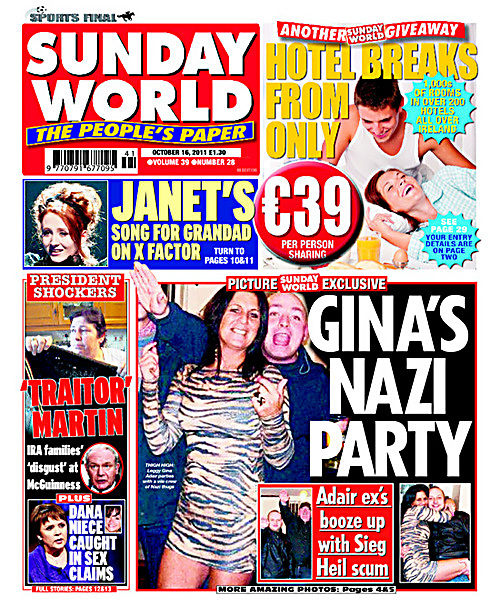
The image of an armed loyalist woman remains, however, much more unusual than that of an armed republican woman. Republicanism has promoted active images of women as ‘‘freedom fighters’’, and female paramilitary members are celebrated in a number of republican street murals in nationalist areas. Their representation in the media is also interesting. In 2003 and 2004 two newspaper articles on the Continuity IRA (CIRA, a still-active ‘‘dissident republican’’ breakaway group from the Provisional IRA) pictured female members. The Andersonstown News carried a front-page photograph of five CIRA members.83 Three
balaclava-hooded figures, clearly male, are seated with the central figure reading a prepared statement. The men are not visibly armed, though
there is a handgun placed on the table in front of the man reading the statement. Two other figures stand behind the men, each holding a handgun. Rather than balaclavas, their faces are partially obscured by scarves tied around their lower faces and large dark sunglasses, topped by berets. These two armed figures appear to be female. In fact, later in the article there is a close-up photograph of the face of one of the armed standing figures, with the caption ‘‘Show of Strength: Woman CIRA member at secret location armed with a 9mm Austrian Glock 17.’’ No further comment on the presence of women is made in the article.
The Sunday World tabloid similarly carried a front-page photograph of three CIRA members in another ‘‘show of strength’’ in Belfast.84 The central figure is an armed woman, flanked by two armed men, though another photograph later in the article shows a third armed man. The article lists the group as being armed with ‘‘at least one automatic rifle, two Uzi sub-machine guns and a pistol’’. Given what Teresa reported in her interview with me about male republicans sometimes demanding better weapons than their female comrades, it is interesting to note that it appears to be the woman in this photograph who is carrying the pistol, rather than a submachine gun or automatic rifle. Again, the men wear balaclavas while the woman wears a scarf and beret. On this occasion the female figure is not even wearing sunglasses and her eyes and forehead are clearly visible. Given the sexualization of ‘‘terrorist’’ women it is interesting to note that this female figure has impeccably manicured eyebrows and made-up eyes, and is clearly very attractive.
Mary told me that in the 1970s when she was a republican on the run in the Irish Republic the British authorities released a photograph of her in the newspapers along with her alleged crimes. She pointed out that the authorities could have used her driving licence or passport photograph, yet chose to use one taken outside a Dublin nightclub. ‘‘I was good press. At 21 years of age I was reasonably photogenic – without all these wrinkles!’’ The headlines referring to her, too, clearly indicate a sexualization of the female ‘‘terrorist’’ in terms of their media representation. I cannot repeat those particular headlines, as that would reveal Mary’s real identity, but there are other similar headers noted by Jayne Steel, such as ‘‘The Sexy Steps of Terror’’ (1996), ‘‘Bomb Gang Beauty’’ (1991) and so
on. As Steel points out, ‘‘A curious thing about the press in the United Kingdom seems to be its expectation and demand that female terrorists be young, beautiful and sexy. Clearly something quite strange, albeit very recognizable, is being suggested here about the proximity between fear and desire in which the signifying potential of women in a predominantly male media becomes an important stake in ‘the propagandawar’.’’85 This phenomenon is in fact by no means restricted to the Northern Ireland conflict. Much was made in the press of the beauty of Leila Khaled, the most famous female Palestinian ‘‘terrorist’’ until the recent intifada and its pattern of female Palestinian suicide bombers.86
Conclusions
This chapter has tried to enhance our understanding of the proliferation and use of small arms and light weapons in the context of armed conflict, by bringing a gendered analysis to bear on certain key issues related to the subject. The most significant findings are summarized here. The chapter has, in particular, illustrated how armed conflict draws in different social actors, by examining women’s involvement in republican and loyalist paramilitary groups in the Northern Ireland conflict. An interesting speculative
idea is the possibility that women who engage in political violence may sometimes be motivated by concerns about protecting their families and homes, rather than more abstractly political goals (though these con- cerns and goals can interlink), and that this sets them apart from men who engage in political violence. This idea is supported to an extent by some of my interviews with loyalist women, but is contradicted to an extent by some of my interviews with republican women. It is possible that this reflects differences between the motivating experiences of republican and loyalist women, as well as underlying ideological differences, but
given the difficulty in gaining access to loyalist paramilitary women and the lack of comparison with paramilitary men I would hesitate to argue this too strongly. The proposition nonetheless deserves further investigation both in Northern Ireland and in regard to other armed conflicts. It does not mean, however, that we should fall back into the old easy trap of assuming women are apolitical.

One significant aspect of women’s involvement in the proliferation and normalization of guns in many different contexts has been their role in smuggling and concealing weapons. This has certainly been important in the Northern Ireland conflict, where women on both sides of the politico-military divide have had primary responsibility in this area due to
gendered expectations of women’s and men’s differential behaviour and concerns over negative publicity (again stemming from gender ideologies)
about the searching of women’s bodies, which have provided them with a certain space to pursue their military objectives. Those gender ideologies have even, on occasion, meant that women (particularly women from the Protestant-unionist community) have escaped legal punishment for offences involving the transport of arms, such as in the case of Ann who was told by the judge in her trial to go home and look after her children. Ironically, however, those very same gendered ideas about women’s roles and women’s bodies have meant the deliberate use of brutal physical searches of ‘‘rebellious’’ political women (particularly women from the Catholic nationalist community), in the form of prison strip-searching, as a way to control and contain them.
Regardless of the participation of women in the transport, concealment and usage of arms during the conflict in Northern Ireland, a masculinist identity associated with the possession and usage of guns is nonetheless visible. Despite this, my research showed that women who have transported or used arms remain most likely to hold the view of their politico-military organizations on disarmament/decommissioning of paramilitary weapons, rather than sharing some kind of anti-masculinist, pro-disarmament perspective. That is to say, both republican and loyalist paramilitary women interviewed for this study generally saw the disarmament issue as an ultimately irrelevant political distraction from more important things, though their reasons for this varied according to their respective ‘‘sides’’ of the conflict. In fact, some loyalist women even independently raised the issue of the sexualization of arms and violence and the attraction many women in their community have for men who accord with this form of masculinity. If this suggests any lesson for other postconflict contexts, it is that militant women cannot be expected to be automatically any more pro-disarmament than militant men, despite the hyper-masculinity of gun cultures. It also suggests that the increasingly
well-recognized problem of the wartime proliferation of small arms and light weapons contributing to a rise in levels of domestic violence (in particular
involving weapons), which has happened in Northern Ireland as elsewhere, will not necessarily be independently recognized or acknowledged
by militant women, even those concerned with feminist issues.











 The Broken Elbow
You must be logged in to post a comment.