In the early 1990s, my father had an outlook-altering experience. A life-long South Florida accountant for individuals and small businesses, he had no involvement in politics and harbored a basic patriotic trust for American institutions, including its media – the type of uncritical faith we’re taught to have and easily adopt if we’re not paying close attention. But then one of his accounting clients, a manager of a Native American casino, ended up in a public business dispute with the tribe that owned it, and the local media extensively covered the dispute.
Because he had much first-hand knowledge of the controversy, he was able to see how many misleading claims and outright factual falsehoods were regularly stated as fact by the media covering that story. And he was both shocked and outraged by it. For the first time, he viscerally understood how easily and often false claims are circulated by respectable media outlets – whether due to laziness or gullibility or manipulation or malice or the difficulty of understanding complex events. And that personal realization made him much more skeptical in general about what media outlets told him and much more critical in how he assessed and processed it.
I was reminded of all this by a self-reflective, three-tweet observation from Hamilton Nolan of Gawker, which has been the subject of extensive media coverage over the last several weeks:
I can’t overstate how much I empathize with these sentiments. For the past decade, I’ve been writing critically about the American media, usually with a focus on the specific policy and legal topics I know best. So like most politically engaged people, I’ve long been rationally aware of how frequently deceitful and inaccurate claims are passed off by the most respected media outlets as fact, using highly authoritative tones. By itself, the Iraq War should have taught all of us that (though I regard the repeated attempt by ABC News to blame Iraq for the anthrax attack as a perhaps even more extreme example).
Still, nothing drives home that point viscerally like being personally involved in matters the media is reporting and thus having first-hand knowledge of what is being claimed. Over the past two years, there’s been extensive media coverage and public discussion of both the Snowden story and the building of First Look Media/The Intercept, in which I’ve been very personally involved. So much of what has been said and still gets said about those things – not just by random online commenters and conspiracy-mongers but by the largest and most influential media outlets – is just plainly wrong: not “wrong” in the sense of resting on unpersuasive opinions or even casting a misleading picture, but “wrong” in the sense of being factually, demonstrably false.
It’s so frequent, so common, that it’s impossible even to note all or even most of the falsehoods because one would never do anything else. And even if one devoted oneself to that task, many of the falsehoods would continue to thrive because of our reflexive assumption that what we read from respectable media outlets is true even if unaccompanied by evidence, and because most people lack the time and inclination to independently verify what they’re told about matters in which they have no personal stake.
But it’s a monumentally important experience for any journalist to have. It teaches a crucial lesson: it’s simultaneously humbling about the limits of one’s ability to fully understand complicated situations about which one has no first-hand knowledge, and illuminating about the inherent subjectivity with which we all view everything. After I briefly made this observation on Twitter in response to Nolan’s tweets, former Reuters editor-in-chief David Schlesinger wrote this:
Indeed. But that realization is equally vital for consumers of journalism. Journalistic objectivity is a sham, a horribly misleading and self-flattering conceit. Don’t simply trust claims made in authoritative media tones – even if, perhaps especially if, they work for the most influential media outlets – unless they point to evidence that confirms or at least suggests its truth. And when consuming journalism products, always consciously realize that, even when malice or other forms of bad faith are nonexistent, so much of what is said and claimed by journalists is simply untrue. Again, that’s an easy and seemingly obvious proposition to embrace in the abstract – few people would say they disagree with this – but as Nolan’s tweets show, its visceral truth becomes most apparent from personal experience.
I must confess to having mixed feelings about the British Labour Party. On the one hand I owe it an awful lot. Without the National Health Service, I probably would never have been able to walk or function like a normal human being. The horrors of the alternative, a class-based, wealth-biased system which still dominates America, Obamacare notwithstanding, tell me what life otherwise would have been like.
Nor would I have had the education I got, free from the year dot until I graduated from university. In fact better than free. Not only were all my fees paid but I got an annual grant to go to college. Unthinkable in this day and age!
In those days, the Labour Party paid more than lip service to the ideals of equality and the goal of social and economic justice. Where and when it all started to go wrong is a matter of debate but there’s no doubt in my mind that when Labour elected Blair as its leader and Mandelson as its guru – with the disgusting Frank Field, Thatcher’s best friend, crowing the background – then it was all over bar the crying.
I suppose the rock bottom was reached recently when Harriet Harman, acting Labour leader, voiced support for the Tories’ new, draconian welfare cuts of £12 billion, announced recently. As you can see in this article, those with disabilities are in the firing line; they may not suffer this time round but they sure as hell will soon. So it was a good thing I was born in the last century and not this.
There are, however, some tentative signs that the worm is turning, well maybe adjusting its rear view mirror might be more accurate. A substantial number of Labour MP’s voted against the Cameron welfare cuts when the House of Commons voted on it recently, while some contenders for the Labour leadership decided to abstain. That’s one pointer.
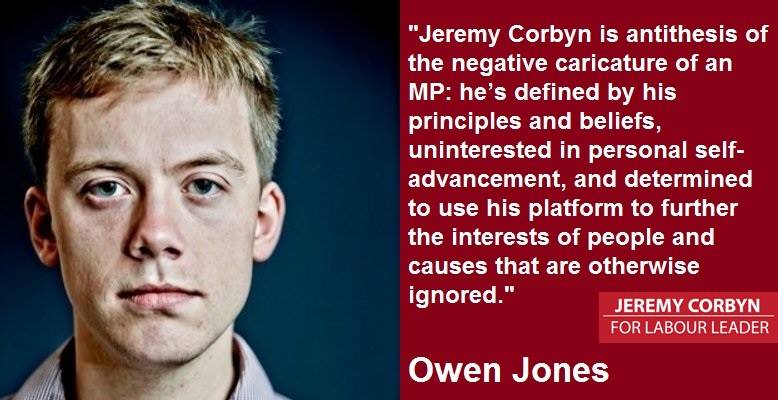
The other is the absolute panic surging through the ranks of the Blairite establishment at the groundswell of support in the Labour leadership polling for Jeremy Corbyn, the CP’ish left-winger from Islington. Corbyn is what people of my generation – which happens to be his – would recognise as a Tony Benn Labourite: pro the NHS, pro-nationalisation, pro-free education and so on.
What distinguishes him from the Blairites is that he actually believes in something while the Mandelson’s, Fields, Blairs and Browns see the Labour party almost entirely as a vehicle for personal enrichment and career fullfilment – in Blair’s case add a heavy dose of war-mongering.
The other aspect of Corbyn’s appeal is highlighted in this current piece from The New Statesman (an unlikely source, I know!). He is anti-austerity, and taps in to the zeitgeist (minus Tsipras!) current in Europe. Not surprisingly it is young members of the British Labour party who are his most ardent supporters. Wouldn’t it be fun if he won? The howls of outrage from the Blairites would alone be worth it.
Enjoy:
Who’s backing Jeremy Corbyn? The young
Perhaps it’s a form of the Streisand effect, but the more we hear about Jeremy Corbyn – and let’s be honest, most of it has been disparaging – the more people seem to like him. The commentators and politicians highlight his “outdated” socialist values, his flat cap, his supposed unelectability, and instead of turning away, many people (myself included) look at him and think: “yeah.” A YouGov poll for the Times has put Corbyn on course to win the leadership election, with a 17 point lead ahead of the other candidates.
The snobbery around Corbyn has been something to behold. And yet, the more the snobs and the political cardboard cut-outs, the Blairites and the Tories and the brown-nosers slag off and berate Corbynites (and in ways they would decry as “patronising” if they were directed towards shy Tory voters), the more Corbyn steadily gains support. In contrast to the other candidates, who have never taken him seriously and now appear to be panicking, Corbyn comes across as dignified, principled, unconcerned with personal advancement, and passionate about his politics.
Hearing Tristram Hunt on the Today programme yesterday, plumming off on one about how Corbyn supporters want to return to a “comfort zone of Labour politics” and how if Corbyn wins Labour will become little more than a “pressure group” because being an “anti-austerity populist party isn’t going to get us into government” didn’t make me “see sense” as Hunt probably intended. It just made me think, “screw you all, you don’t deserve to be in government.” From what other young new Labour recruits have been telling me, I’m not alone in thinking this.
It’s been reported that a significant portion of the support Corbyn is receiving is coming from new, young Labour members. People like me, who are too young to remember the unelectable eighties, or indeed what “a comfort zone of Labour politics” feels like. This certainly seemed to be the case at the Islington North meeting I attended last week, where people of all ages, but notably young people, stood up in support of Corbyn. And, despite what his opponents might say, it’s clear he has a support base outside of Islington.
Rebecca Chambers is 19 and from Southampton. She joined the Labour party this week to vote for Corbyn. “He is much more relatable than the ‘suits’ that you would ordinarily see in the forefront of a leadership vote like this,” she tells me, “which I think is more likely to win over voters (perhaps in a similar way to the ‘Everyman’ persona of Nigel Farage).” Joe Rivers, from Surrey, is nearly a decade older but feels similarly uninspired by the candidates: “I’m not sure Jeremy Corbyn would make a good PM and I’m not naive enough to think he’s going to lead Britain into some kind of socialist utopia,” he says, a standard disclaimer that is understandable in the face of the sneering Corbyn supporters are facing. Rivers has “zero trust” in MPs having voted Lib Dem in 2005 and 2010 and seen their U-turn on tuition fees. “It bothers me a lot that nobody in Westminster seems to have an ideology or stand for anything in particular,” he says. “In a political climate where everyone is so scared of losing votes that everything they say is endlessly caveated, no-one says anything at all. Jeremy Corbyn stands for something and, faced with the cruellest government since Thatcher, that counts for a lot.”
And that is the crux of what Corbyn supporters in their teens and twenties are telling me again and again: that the current crop of candidates are so uninspiring that you can forget about winning a general election – they’d rather just have someone who represents their views about inequality, for once. Better a passionate and interesting opposition that has moral conviction than a bunch of identikit shysters who will jettison their values as soon as electoral victory looks likely, is how the way of thinking goes. Those of us who are inspired by Corbyn can expect to be called young and idealistic, or be told we need to “do our research”, but there it is. It’s obvious that, for some young people at least, Corbyn is scratching a persistent anti-Blairite, anti-establishment itch.
Some of Corbyn’s ideals, such as re-nationalisation of the railways and the need to protect a publicly funded NHS undoubtedly have national appeal. Others, like the abolition of tuition fees and his anti-austerity stance, are policies with the potential to appeal to young people across the country (particularly those in danger of losing their housing benefit). Hunt is not wrong to make comparisons with Syriza and Podemos; some of those I spoke to in their teens and twenties cited the left wing movements on mainland Europe as inspirational. There’s an untapped stream of young people in Britain who feel their politics are not being represented. You see them on the austerity marches, on social media, in the words of Charlotte Church and Owen Jones and Mhairi Black. But the surge in support for Corbyn isn’t just about young people re-engaging with left-wing politics, it’s also to do with the quality Zoe Williams identified earlier this week as being central to Corbyn’s campaign; it’s about hope.
Hope, in fact, is the exact word that many of the Corbyn supporters in their teens and twenties conjure when I ask them “why him?” They feel that we are at a crucial point when it comes to deciding, as a nation and as a society, what our values are, and that only Corbyn offers an optimistic vision for the future. Jamie Scott, 19, from Luton admires Corbyn’s desire to “invest in housing and infrastructure that the country actually needs yet no other candidate is willing to sign up to”.
“All of the successes of the post-war government were based around investing to create a better society rather than not trying to improve peoples lives with the aim to ‘get by’ which is what I see in the other candidates”, he says.
Corbyn’s background also appeals. “He doesn’t come from the Oxbridge, SpAd/Researcher background which all of the other candidates do, an elite which is massively over-represented in Parliament,” says Jamie. “The other three candidates can’t connect to me as they do not inspire hope of anything better, simply more of the same.”
Some of the people I spoke to came from traditionally Labour-supporting households and think Corbyn represents a return to those values. “I think that, being from the North, it’s the IDEA of the Labour Party that I like,” says Alex McBride, 24, from Manchester, “the idea that my grandparents, and parents voted for them; for ideas like decency, fairness, representation, respect, unity, hope – ideas that transcend the Watford Gap at least!”
Laura Fisher, 24, meanwhile, “used to be pretty Tory” before going to university and becoming interested in feminism and social justice. Then, during the election, she was saddened to see her historically Labour-voting family sway to the right. “My family all live in working class areas in the North (Middlesbrough and York) and many of them were saying they were going to vote for UKIP. These were life-long Labour voters or at least supporters of what I feel are (or definitely were) Labour’s values.”
Laura says she knew that her family were not going to feel “any more listened to” by any of the other candidates. “I felt that Labour were looking in all the wrong places for their support and trying to replicate 1997, which was a once in a generation thing,” she says.
These are young Labour supporters who know their politics and their history, and have a clear vision of the sort of society in which they would like to live. They state the importance of fairness and inclusivity. They feel passionately that the generations that came before them have failed to provide for them, or have betrayed them politically, especially over student fees. They also feel that their voices have long gone unheard.
Lucie Spadone, 17, joined the Labour party last September, when she was 16, and as well as being inspired by Corbyn’s anti-austerity stance, also thinks that he would “give young people a platform to air their views” because his views are in line with theirs. Abby Tomlinson, the 17 year old activist who founded #milifandom, agrees that he is a vocal supporter of her generation. “I think he represents a voice for change that a lot of young people want to hear,” she says. “A lot of young people feel angry at all of the measures the government seems to be taking to make the lives of young people harder. The contempt David Cameron has for young people I think means that a lot want an alternative who they know will support them, and for a lot of people that person is Jeremy Corbyn.”
There’s certainly an excitement around Corbyn that is notable on social media and at demonstrations. Whether or not, as some commentators suggest, his popularity ends up being merely a blip, a symptom of the silly season after which Labour members and supporters will abandon the underdog and resign themselves to the centre ground remains to be seen. But you can’t deny that there’s a contingent of people in their teens and twenties out there who think he’s brilliant while remaining underwhelmed, if not disgusted, by the others and their perceived support for austerity.
I got a puzzled email in the last few days from one reader asking why so many INLA members turned out for Peggy O’Hara’s funeral in Derry when the INLA is on ceasefire and dissident, anti-process activity has almost ceased.
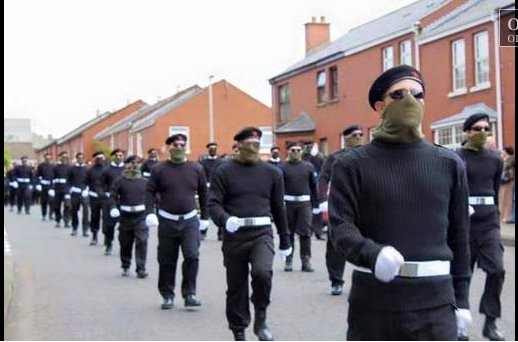
As you can see from the photos below the INLA turnout was impressive, as big or perhaps bigger than the group could muster when the bullets were flying:
I think the answer is quite simple. One word: ceasefire.
The experience of republican groups during the Troubles was that when ceasefires were called, as they were for the Officials in 1972 and for the Provos between 1975-76, 1994-1996 and 1997 onwards, membership surged but as soon as it seemed that life might get hairy again, it dwindled like air escaping from a balloon – as it did for the Officials during several inter-republican feuds in the Seventies and the Provos in 1977 and 1997.
There was even a name for such people: ceasefire soldiers.
I suspect the same thing has happened with the INLA. Now that there is next to no risk attached to being a member, and while being one of the lads still carries some clout in the communities, the INLA has probably experienced a upsurge in recruitment. Expect that to reverse if the INLA resumes hostilities.
American Whites are like the Prods in the North. The Blacks and Hispanics are the Catholics. Well, almost. This new film by Jose Antonio Vargas takes a sometimes uncomfortable look at the White population. Does any of it strike a chord with you?
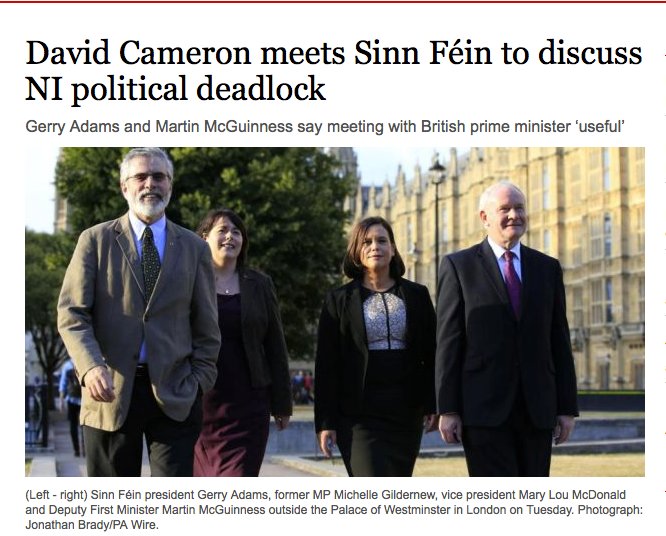
A little bird told me that the following was the highlight of today’s exchange between Gerry Adams and David Cameron at 10 Downing Street:
GA: “We’re dead serious, prime minister! If we don’t get the budget we want, if you don’t soften your austerity policies then we’ll have no choice. The Assembly will collapse!”
DC: (Swirling his forefinger in a wide circle) “There are people in offices all around us, Gerry, who are laughing their legs off as they listen in to this conversation.”
My thanks to The Catalunya Kid for researching this article.
By The Catalunya Kid
The website of Verbatim Communications, the public relations firm owned by Gareth Robinson, son of NI First Minister Peter Robinson, which has been linked to the NAMA property scandal recently highlighted in the Dail, was not active in its present form until January, 2014, according to an analysis of its internet timeline using the WayBackMachine Internet Archive tool.
Gareth & Peter Robinson
This was two years after Verbatim was paid thousands of pounds to host an event at Queens University Belfast which was paid for by the law firm, Tughans, which also handled the purchase of the £1.3 billion NI property portfolio from NAMA, by Cereberus, the New York-based private equity firm.
The analysis shows that a very simple website was set up in February 2011 with just the company’s name, an email address and a phone number, which appears to be for a cell phone: 07788435708. This is a different number than the one displayed on the current website: 028 90312909, which was created after January 5th, 2014.
The new Verbatim website, which has a more professional look although lacking the detail usually present on a business website, was therefore created just two or three months before Cereberus bought the NI property portfolio.
Mystery surrounds the transfer during the NAMA transaction of some £7 million to an Isle of Man bank account which had reportedly been earmarked for a NI politician.
Readers can log on to the WayBackMachine website and go through the same steps themselves described in the document below:
Go Set a Watchman turns out to be a hot mess of a book. The flashes of lyrical genius and ability to evoke the intensity of childhood play that come to fruition in To Kill a Mockingbird are in evidence, but so too are rather obscure discussions on constitutional law and the tenth amendment, an irritatingly pert main character, and a dull love interest. It’s nowhere near the novel Mockingbird is. It is much better than that.
In the days running up to Watchman’s release, Mockingbird fans – for there can be no other description, mere “readers” or “admirers” won’t suffice – set aside difficult ethical discussions of whether the 89-year-old Harper Lee was capable of really consenting to the publication of what many believed amounted to a rough first draft of her work.
Instead fans took to twitter with their wishlist of what they hoped for in the sequel. Some hoped Scout and Dill would be married. Some hoped Jem and Scout spent Christmases together, filling Maycomb County with the happy chatter of their adorable precocious children. Some hoped Boo Radley was out and about, perhaps working in telesales. Curiously though, no one seemed to be hoping that Atticus was a fully paid-up member of the White Citizen’s Council, bending his arthritis-addled hands to the fight against integration, and explaining to Scout: “The Negroes down here are still in their childhood as a people”.
Funny that no one saw that coming. Really, they should have. Because outside the white liberal fantasy that is To Kill a Mockingbird, the reality, the historical record shows us that (spoiler alert!) the vast majority of white Southerners were racist and didn’t want to sit next to black people in the theatre.
We did know that the so-called white trash Southerners, the KKK members, the Bob Ewells, the ignorant poor, didn’t want to sit next to black people. Mockingbird taught us that. What Watchman tells us, and tells us rather powerfully, is that racism is not confined to people who are so clearly not like us.
Some commentators on Watchman have suggested Atticus becomes racist as he gets older, as if some kind of dramatic ideological transformation has taken place in his worldview since Mockingbird. It’s nonsense. He was racist in Mockingbird, but just politer about it. He thinks everyone is equal in the eyes of the law, and everyone should be able to access justice. He doesn’t want Tom Robinson to be executed for a crime he didn’t commit. He thinks Tom Robinson is a good man. But he doesn’t want to sit next to him in a theatre.
Racism is not, and never has been, a yes/no question. Many white Southerners who risked considerable personal danger to challenge some forms of racial injustice were perfectly comfortable with other forms. The Committee on Interracial Co-operation, founded in 1919 in Atlanta in response to a wave of racial violence across the South, wanted to improve communication between white and black people in the South. But they didn’t want to end segregation. The Association of Southern Women for the Prevention of Lynching, founded in 1930, sought to protect people like Tom Robinson from the horrors of the lynch mob. But they didn’t want to end segregation.
Politeness in the South has always masked the kinder, gentler racism practised by middle-class whites. Shocked by the Supreme Court’s determination to force Southern states to abandon segregation, men like Atticus Finch – the “men of substance and character, responsible men, good men”, the men Jean Louise sees at the White Citizen’s Council – stop being polite.
The mistake made by so many fans of Mockingbird was to assume that a passion for justice and the rule of law went alongside a commitment to racial equality, and a determination to overcome prejudice. Sometimes, it didn’t. Civil rights activist Al Sharpton has said that Watchman, “reflects the reality of finding out that a lot of those we thought were on our side harboured some different personal feelings”.
This is what makes Watchman better than Mockingbird. It’s not better written, I doubt it’s going to win another Pulitzer, and since its release the list of actors queueing up to play Atticus in Mockingbird 2 got a lot shorter. But Watchman is a lot more honest. It doesn’t feed white America the comforting version of civil rights history where the bad guys are easily identifiable ignorant hicks, the good guys are heroic and noble white men with impeccable manners, and the black people are all subservient, respectful and endlessly patient.
Mockingbird is a child’s book, told by a child. Watchman is for grown-ups. It asks serious questions about what racism is. And it comes at a time when American desperately needs a grown-up conversation about race.
One of the enduring allegations of the last forty years has been that the state’s security agencies have been complicit in the sexual abuse , and possibly the murder of children. Kincora is the outstanding example but maybe not the only instance. In GB a major inquiry is about to start. It will not deal with Kincora. So , what next? The inquiry in Banbridge, chaired by Tony Hart, has been lumbering on for months. If you think that it is going to cut a swathe through the state , think again. Allegations have already been made against “prominent members of the community” , his words, not mine. The result? Anonymity orders. You are not allowed to know who these people are. This , despite social media naming one such person, an elected public representative, frequently. What is the point of these King Canute orders? “BP” , who says that…
(This is final of four articles exploring material that featured in the RTE documentary on collusion)
The Tommy Lyttle tape, dated August 1994
Towards the end of August 1994, the phone in my Bawnmore Road home in Belfast rang. I had been expecting the call and was not surprised to hear the voice of Tommy Lyttle, the former UDA Inner Council member and West Belfast Brigadier on the other end.
‘Tucker’, as he was known to friend and foe in the city, had been released from Maghaberry jail some months previously at the end of a near four year term for handling top secret security documents. Part of the evidence that convicted him was his fingerprints on RUC Special Branch documents detailing the IRA battle order in Belfast.
The documents had been stolen by an ordinary criminal from an unmarked police car along with a Special Branch handgun and two radio sets of the sort used in covert surveillance. The car had been parked outside the Stormont Hotel in East Belfast, a favourite watering hole for branchmen.
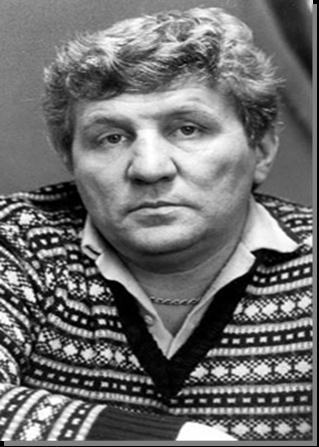
Tommy Lyttle, an early photograph
A desperate Special Branch proposed a deal with the UDA: if the Loyalists could recover the guns and radios from the guys who stole them, then they could keep the intel on the IRA; the guns & radios mattered but not the documents.
It was a great deal which Tommy Lyttle accepted; within days the haul was retrieved by the UDA in East Belfast which initially refused to return it until two of their men were also released from police custody. The Branch agreed, got their stuff back and the UDA was allowed to keep the documents. A few years later John Stevens charged Lyttle with possession of the very same documents and for that (and other documents donated by various security force members), he went to jail!
During all the months of his remand in 1990 in the decaying old Crumlin Road prison, myself and another reporter had paid him regular visits during which we had chatted about the unfolding Brian Nelson saga and the seemingly endless Stevens inquiry into security force collusion with Loyalists just like himself. It was the biggest story of that time and no-one knew more about it, at least from the UDA perspective, than Tommy Lyttle.
Tommy Lyttle’s downfall began because he was obliged to shoulder the blame inside the UDA for the Stevens inquiry, the ructions it caused inside the UDA and for the exposure of Brian Nelson as a British Army spy – even though all his colleagues in the UDA had shared and approved the decisions that led to the disaster.
Nelson’s outing was an embarrassment for all concerned, to the UDA because it made public what was well known but rarely acknowledged – the high level of security force infiltration of Loyalist groups – and to the British Army because it brought accusations of collusion and involvement in the killing of Belfast lawyer, Pat Finucane.
Who was ‘Bertie Scott’, the UDA’s special friend in the Special Branch?
The UDA killing of IRA activist Loughlin Maginn, shot dead at his Rathfriland, Co Down home in August 1989 by the UDA’s armed wing, was the loosened pebble that caused this landslide. Following his death, Nationalist leaders claimed Maginn was an ordinary innocent Catholic gunned down indiscriminately by savage sectarian gunmen, but the UDA knew otherwise.
Maginn was actually a member of the IRA’s South Down Brigade and the UDA knew this because they had been allowed into a local Ulster Defence Regiment (UDR) headquarters to video intelligence documents which listed Maginn as an IRA member. Armed with this information, they set out to kill him.
Angered by protestations of Maginn’s innocence afterwards, the UDA decided to make the background to the Maginn killing public, following this up by leaking to the media scores of security force montages, each carrying the photos and personal details of IRA and INLA activists.
Jim Craig, shot dead because of racketeering allegations and suspicions of dealings with republicans
The idea was to validate the claim that UDA intelligence was accurate, that it targeted known republican activists rather than ordinary Catholics and that it was able to do so thanks to the help of a host of sympathisers in the security forces, principally the UDR, RUC and British Army. In other words Nationalist critics had got it wrong.
Given the UDA’s track record in previous years of random attacks against Catholics, it was not a message likely to get a sympathetic hearing in the Nationalist community. But worse, for the UDA and especially Tommy Lyttle, the ploy backfired.
In 1989, the UDA was just recovering from a major internal bust-up with its roots in allegations of gangsterism and corruption centred on Jim Craig, a UDA leader who was also accused of colluding with the IRA, the INLA and the Official IRA, either in racketeering ventures or in helping republicans kill Loyalists. For instance, the Shankill Butcher leader, Lennie Murphy was alleged to have been set up by Craig for assassination by the IRA.
In March 1988, Andy Tyrie, for many years the Supreme Commander of the UDA and considered an ally and protector of Craig by some, was deposed; Craig himself was shot dead in an East Belfast bar in October 1988. Tommy Lyttle suspected that Craig had helped the IRA kill South Belfast UDA Brigadier, John McMichael in December 1987 not long after McMichael had aired complaints within the UDA hierarchy and in Craig’s earshot, about Craig’s dubious business dealings.
John McMichael and Andy Tyrie in their UDA heyday
In the convulsions that followed, Tommy Lyttle emerged as top dog. A leading figure in the UDA on the Shankill Road from the early 1970’s, who had joined the fledgling Loyalist group when an IRA bombing of a local furniture store killed two babies, he was probably the last of a generation of so-called ‘moderate’ UDA leaders who were as interested in politics as war. Contemporaries were people like Glen Barr and Harry Chicken who set up the New Ulster Political Research Group, which advocated independence for Northern Ireland.
Sir Desmond de Silva, in his report on the UDA killing of Pat Finucane, had this to say about him: “Lyttle was generally considered to be one of the older-generation, less militaristic figures on the Inner Council.” His gay son, John, who became a writer for the London Independent, captured some of his father’s complexity in a piece he wrote after his death in 1995.
Sammy Duddy – Tommy Lyttle said he and a member of the Inner Council were MI5 spies
After the turmoil in the UDA subsided, the organisation needed to choose a new leader. Tommy Lyttle was asked to take on the job, now reduced in title from ‘Supreme Commander’ to ‘Chairman of the Inner Council’, and agreed but on a year-by-year basis.
So, he was in charge when the decision was made to go public on the Loughlin Maginn killing and to leak other security force documents to the media. Predictably, the leaks caused a huge political row and the British were forced to ask John Stevens, then Deputy Chief Constable of Cambridgeshire, to investigate the collusion allegations.
The UDA, at the height of their power in 1972, parade past the Nationalist Unity Flats
It took Stevens over a decade and no less than three separate probes, to get to somewhere near the bottom of the affair and the headline result was the exposure of Brian Nelson and the arrest of over a dozen leading UDA figures, only some of whom went to trial and then to jail (about which, more later).
Needless to say Tommy Lyttle carried the can for all this inside the UDA and given that he was in charge when the decision was made to go public on Loughlin Maginn, he could hardly complain about that. And he was, without doubt, enthusiastic about the idea, personally supplying one journalist with a cache of the secret papers.
But the blame game went a stage further. Tommy Lyttle was labeled a tout and threats were made to his life. I can recall visiting him in Maghaberry prison at around this time and wishing I hadn’t. Unlike Crumlin Road jail, where cubicles gave some privacy, visits at Maghaberry were held in a canteen-style room with prisoners and their visitors seated at plastic tables in full view of each other. The glares from all around us could have wilted a tomato plant.
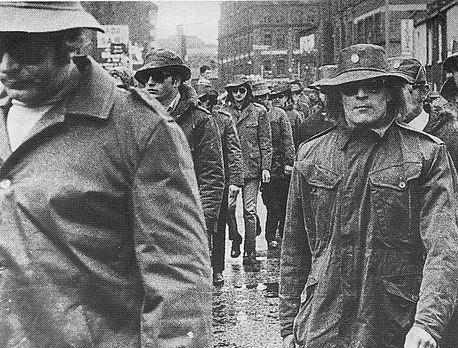
UDA men, on the march, 1972
Not long afterwards I covered the trial of a gang of UVF members from East Belfast who had kidnapped and slit the throat of a young Catholic girl, Anne-Marie Smyth, who had wandered unknowingly into their company at a bar. The press bench in this particular courtroom was close to the dock and at a break in proceedings, one of the UVF men stood up, leaned over towards me and hissed ‘Tommy Lyttle!’ into my face.
The allegations intensified in the months following his release from Maghaberry so when the phone rang in August 1994, I was not surprised to hear that this was the subject on his mind. We arranged to meet outside the city as by that point it was not safe for him to return to his Shankill Road home. “I want you to take this tape”, he said, as he handed over a cassette,”and if anything ever happens to me make it public.”
A massive heart attack, rather than an assassin’s bullet, claimed his life around a year later and thankfully, I never had reason to release the tape – until now. After his death, I told his widow about the tape, that it was his answer to the charge that he was a British agent and we agreed that if the right opportunity came along I would make it public.
The RUC crest
It was clear to me from all our conversations prior to this that a relationship had existed for some time between Tommy Lyttle and a senior officer in the RUC Special Branch, but rather than this being a normal informer-handler relationship, I had concluded that it was a collusive alliance from which both parties, UDA and RUC gained.
When the de Silva report was published, a whole chapter was devoted to Tommy Lyttle and his dealings with the security forces, including the RUC Special Branch, and it was clear that de Silva subscribed to the ‘collusive alliance’ explanation rather than the informer version of Tommy Lyttle’s UDA life.
The story of Tommy Lyttle’s relationship with a senior Special Branch officer takes up much of the tape that he gave me for safekeeping. And given that it adds to, as well as echos much of what de Silva has to say on the matter, it seems to me that the RTE documentary and now this fuller explanation were and are the appropriate places to give the tape a fuller airing.
I have heavily edited the tape, leaving fully intact only the story of the RUC Special Branch officer, and I have edited out the names of living UDA activists Tommy Lyttle named as possible British agents. I have also left out, for reasons of relevance, parts of the tape that deal with the Jim Craig affair.
Along with the tape, I also include a transcript which may make the recording a bit easier to follow and at the end I reproduce the chapter de Silva wrote on Tommy Lyttle. To complement the tape, I will also refer to notes of conversations I had with Tommy Lyttle about his dealings with the Special Branch.
UDA mural
Tommy Lyttle’s story chronicles an important phase in the history of British collusion with the UDA. From the circumstances surrounding the relationship, some of which I do not yet have the authority to write about, it is evident that the relationship between the UDA and the Special Branch officer, who firstly went by the name ‘Bertie Scott’ and then ‘Harry’ during his contacts with Tommy Lyttle, is a longstanding one.
Tommy Lyttle inherited ‘Bertie Scott’ from a man called Alan Snoddy, the UDA commander or Brigadier in South-East Antrim, a figure who kept a very low public profile. Snoddy was dying of cancer when he came to Tommy Lyttle to tell him about ‘Bertie Scott’ and to say that when he died then ‘Bertie Scott’ wanted Tommy Lyttle to replace him as the contact man with the UDA.
In his report, Desmond de Silva implied that the Special Branch contact with Tommy Lyttle was unauthorised but from what Lyttle told me in separate conversations that I noted afterwards, it is difficult not to conclude that the relationship had been approved elsewhere in the Special Branch.
When Alan Snoddy died, ‘Bertie Scott’ made himself known to Tommy Lyttle, introducing himself at a public event attended by other UDA chiefs, as if to assure Lyttle that no-one else would mind that the baton was being passed on in such an obvious way.
In his conversations with myself, Tommy Lyttle opened up slowly about ‘Bertie Scott’. He was, he told me, “…a local man, tallish, fair and wears glasses”, who sometimes worked out of England and sometimes Belfast. ‘Scott’ had been introduced to the UDA, to Alan Snoddy, by another Special Branch man, a long-time friend of the UDA who had died recently and whose first name was ‘Harry’. This SB officer, he said, was wither a Chief Inspector or Superintendent in the Branch. thebrokenelbow.com is not revealing this man’s surname for reasons explained below.
Sir Desmond de Silva: “No sound evidential basis” for the claim that Tommy Lyttle was an informer
Eventually, ‘Scott’ did try to recruit Lyttle as an agent, offering him £50,000 and an assurance that if anything happened to him, his family and loved ones would be looked after. Lyttle always insisted that he turned this down and ‘Scott’s’ repeated attempts to recruit him then ended the relationship.
Sceptics will say that this was, of course, a self-serving denial, that, in the immortal phrase, ‘he would say that, wouldn’t he?’ They may be right but I always believed him and that was because I think I knew the real reason he went as far as he did with ‘Bertie Scott’, and that was because he enjoyed the intrigue and the access it gave him to a secret world.
And I couldn’t help thinking that this man had been in the UDA for nearly two decades and if he was going to become an informer he would have done so long before this. From what he told me over the years there was no shortage of offers.
By the time of his death there was hardly a figure in the Belfast media who didn’t believe that Tommy Lyttle was a tout. I was one of the few exceptions, that is until the de Silva report was published. This is what de Silva had to say about this question:
It has been widely alleged in media reporting and in published books that ‘Tucker’ Lyttle was an RUC SB agent. Many of these allegations appear to be purely speculative and need to be treated with great caution. I am satisfied that there is no sound evidential basis for these reports.
And if Tommy Lyttle was not working for the Branch then just what was the relationship between this senior officer – who de Silva speculates was a Superintendent, just two ranks below the Head of the Special Branch – and the UDA’s Inner Council Chairman and Head of Intelligence? Clearly it was a collusive relationship. The remaining question is a simple one: was this Superintendent a rogue operator or was his relationship with Lyttle sanctioned at the highest levels? And if so, what did MI5 and the British Cabinet’s Joint Intelligence Committee know about it?
Brian Nelson – Succeeded Sammy Duddy as UDA intelligence chief. Like Duddy he also worked for British intelligence. Was one of his tasks to forewarn his handlers of UDA plots to kill IRA agents?
Whatever the truth it was evident from what Lyttle told me that ‘Scott’ was less interested in doing the UDA damage and more in using it to common advantage. Never once in our various pre-tape conversations about ‘Scott’, did he ever say that ‘Scott’ was looking for help to put UDA killers behind bars.
Instead, ‘Scott’ suggested, for example, that if Lyttle went along with the arrangement, he would suggest policies and tactics for the UDA, adding, according to my notes of conversations with him, “…..they would also suggest real targets to go for”.
‘Scott’ also made a suggestion for a joint UDA-UVF ceasefire in 1989, an idea that was eventually implemented in 1991 during the so-called Brooke-Mayhew talks and which arguably helped pressurise the IRA in the same direction. He told the UDA about an IRA spy in the ranks in South Belfast but insisted that the spy not be harmed but exposed in the media instead. That is the act of someone working in an official capacity, who doesn’t want blood on official hands, just in case it ever became public (as it did).
He also showed great interest in a UDA plot to kill an IRA leader in Ballymurphy who had been identified by Brian Nelson. The circumstances of the attempt and the fact that it was foiled when the area was swamped with troops suggests the IRA leader was a double agent, whose survival was of great concern to the British.
These facets of the relationship point not to the mischievous behaviour of a rogue officer but to an intelligence operation whose purpose was to influence the UDA in a largely friendly fashion, push it in desired directions and protect other assets from unwanted UDA attention.
The fact also that Tommy Lyttle inherited ‘Bertie Scott’ from Alan Snoddy, that this was clearly a longstanding arrangement with the UDA and that the UDA had clearly gained from it, were important props in Lyttle’s defence against the informer charge.
It is the inherited nature of the RUC Special Branch liaison with the UDA leadership that makes this business both intriguing and disturbing. Intriguing because of the unanswered detail of the relationship, not least how far back it went and whether it survived the later mayhem of the UDA’s ‘C’ Coy; and disturbing because the RUC’s motives could range from the very worst to the best: was the UDA shepherded towards killing some but not others?
Anyway, readers can make up their own minds. Here, to help them, are the edited tapes followed by a transcript and the extract from the de Silva report (my apologies for the poor quality of my editing but the transcript will show what I was aiming to do):
(My comments in bold and parenthesis)
Side 1: But the part in clearing myself, which I feel I must do, that annoys me is having to drag in the name of Alan Snoddy. Alan Snoddy, through……was the contact man. This person was known to…as ‘Bertie Scott’. Before Alan’s death when I was in hospital in Musgrave in April of (sound scuffle) 1988, Alan visited me to tell me something about something he had come across, from this source Bertie Scott. And I asked him why he wanted to tell me. He was accompanied by Joe English on the visit to the hospital and I asked him why he wanted to tell me. But he says he was told by Scott, “I trust no-one else in the council, but me.” (i.e. Tommy Lyttle)
Well I, I was flattered, but not knowing who Scott was or what he was or who he was with, I was worried that someone should make a statement like that. This was only four months before Alan’s death. Alan had told me that this contact had given him good and reliable information about events about to happen and had asked very little in return and confirmation of certain things. I told him I felt that… there must, he’s going to be asked something, someday that could compromise him, but he says that…..was dealing with it. He didn’t actually meet Scott, his…..dealt with it, so he felt he was on safe ground.
On my release from hospital, Alan came to visit me in June of 1988, the last Sunday. I was still recovering from the injuries and he told me that Scott had been in touch with him, had passed on vital information, in return he wanted to know about something that affected West Belfast Brigade. I… I asked, was he sure before he asked me that he wanted to ask me, he said yes. In return for the information he had received from Scott, Scott wanted to know about a military operation that had been carried out by West Belfast. This operation was against a taxi depot in the Springfield/Whiterock area, the name of the gentleman escapes me at the moment but no doubt other people are well aware who he is. I confirmed that there had indeed been such a military operation and his next words were to me, “Well don’t go back near it.”
After he left I contacted the people involved and told them what had taken place and where it had come from. They were a bit stunned but I passed on the information not to go back near that particular operation. The operation had been compromised by taking place it had been stopped, no-one was arrested, police raided the flat where the men were to return to after the operation, even though there was… (Side 1 ends)
(This is a reference to an aborted UDA assassination bid on a senior IRA figure in Ballymurphy. The operation had been facilitated by intelligence provided by Brian Nelson, who was secretly working for the British Army’s Force Research Unit. When the UDA gunmen arrived they found the area around the target flooded with troops, suggesting the British knew of the plan but wanted it stopped. Nelson came under suspicion and was roughly interrogated by UDA members using an electric cattle prod. De Silva makes reference to this incident and it was raised at Nelson’s trial in mitigation by ‘Colonel J’, the head of FRU, Brigadier Gordon Kerr.)
Side 2: …why they didn’t see it. But anyway they didn’t take it. It was immediately obvious there was a big security problem within the brigade. At this stage we now know that Nelson was involved both in setting up and having the operations stopped. But what puzzled and worried me at the time was even though I made them aware of what was going on, and pointed out that it was… a big problem, the military people dismissed it and didn’t see fit to carry out a proper inquiry.
Maybe I should have done, but you appoint people to jobs you expect them to do it and I always believe in leaving people to get on with the job and I always believed if you don’t know you can’t tell, “Oh I wasn’t aware of the ‘in’s and the ‘out’s of the particular thing, and didn’t want to be aware” but I thought nevertheless, and pointed out that there should have been an inquiry.
(The incident of the aborted Ballymurphy assassination operation raises intriguing questions, all of them to do with possible informers. Why did the British Army not want an IRA leader in the area killed? Was part of Nelson’s job to provide intel to his handlers about planned hits on IRA members who were also double agents, so they could be protected? Why did the UDA military people in West Belfast not hold an inquiry into this incident, and if they didn’t, why was Nelson roughly interrogated?)
I was also then very worried about Alan’s association with Bertie Scott. He had further occasion to speak to me about Scott before his death in August 1988. After his death, his…….approached me and said that Scott wanted anything he had, I had intended to pass on to me. I made other people aware of this. I also made them aware that this was a source that had been working with Alan Snoddy. Nobody objected, they seemed to think the information was worthwhile, and nobody got het up about it.
This went on for a couple of months,……back and forward with tit-bits, eh, asking the odd time about something and I would say, yay or nay, depending on the question. Then Scott asked…..to ask me how to get in touch. I refused. I said I was happy enough with the arrangement the way it was.
The next thing was then that… Scott rang me. I asked him where he got the number. He just laughed and said to a man in his position that was a minor problem, minor detail, and he said it would be in my best interests if I would speak to him. He was aware of undercurrents in the brigade directly against myself, the people, the same people who had been causing problems earlier, a couple of years earlier were now in a bigger way interested in taking over. With Craig and Fee now they’re out of the road, they felt that they should take over their income.
And I refused to talk to him. In ringing me, he said he would ring me back and we would call him… he would call himself Harry. So he was known to Bertie’s… as Bertie Scott to ………, but he contacted me and wanted to be known as Harry. I got curious about this character so I asked ………… what he knew about him. ……. says he met him through a policeman associate of his, an old Special Branch man Harry… Harry who’s now dead, his name escapes me at the moment, I have it, Harry… … anyway…
(Many republican readers will automatically think of Harry Taylor, a famous Special Branch officer active in the 1950’s and 1970’s. But I suspect he was dead or long retired by 1988. Tommy Lyttle mentioned another Harry who was a senior SB officer, either a Chief Inspector or Superintendent who was also a friend of the UDA and who had died around the time of his interaction with Alan Snoddy. I suspect, but cannot confirm, that this is the ‘Harry’ he was referring to. But until more concrete evidence becomes available to support this allegation I will withhold his surname.)
He said he had met him through this Special Branch friend of his. And that he drank with him in Clandyeboye Golf Club. It also emerged that …….. was doing dumping work for Harry, this Special Branch friend and eh… he told me some weird and wonderful stories about the whole thing. I seen a bad situation developing but I let it go.
Harry contacted me then… towards the end… of 1988 and says that he could reveal, and would reveal the names of people collaborating with the IRA and with the security forces if I would help him. I asked how I could help him and he told me of a particular incidence where a source passing on information to the IRA was exposed and would deeply inset… upset the IRA intelligence ring and plug a leak in the UDA intelligence in South Belfast.
When I questioned him on it… through ……………. and on the telephone, he mentioned the name of a person in South Belfast who was being compromised by this flow of information. This person, a well known UDA personality, was known to me and I agreed to meet Scott as I and ……….. knew him, to discuss the matter. What he revealed was that the UDA personality had to drink, because of where he lived, he carried on an unofficial Off License eh… and quite regularly, at weekends in particular, drank until 4 or 5 in the morning with associates who’d done a bit of talking. One of the associates, who had been in some way, connected, compromised by the IRA was passing on the information to them.
I agreed to set up at operation in which this person would be picked up and made to confess, not forcibly, but he was picked up and there was not a hair on his head harmed. He confessed and made a statement which was video recorded about his part and what had taken place and about setting up the UDA personality known as Moby Bickerstaff, for shooting by the IRA at the Park Centre. He also spoke of attempting to set up Jackie McDonald at the Beechlawn Hotel.
People there were aware of all this. People who had played their part in securing this man heard it, it was videoed, it was taped, and it was passed to the press. Olga Craig was invited along long so she… took it upon herself to do the story. It was a good story, it appeared in the Sunday Life and everybody was chuffed at the way it turned out and the credit came by the organisation. They were also aware of the part played by Mr Scott who they knew was a source that originated from Alan Snoddy.
(This incident, involving a South Belfast UDA member called Philip McVeigh is discussed at length in the de Silva report. McVeigh fled to Scotland afterwards where he gave media interviews about his experience.)
Scott then tried to tempt me with other such projects. He was aware that (another UDA Brigadier) had arranged a trip to London for us to speak to people in England, where we would attempt to reorganise and motivate units in England. He asked me would I meet him in England. I of course refused, and then he again tempted me with threats to my life, that he could help and it would be in my interests to talk to him.
I also received a letter, purporting to come from the Insurance Company, offering me all sorts of money and pointing out that my comrades had eh… people that I knew had availed of these services. It was a thinly disguised attempt to let you know there was great financial benefits to be secured if you eh… joined this Insurance Company. And I know that Sammy M’Cormack also received one such letter. I believe (a UDA Inner Council member) instigated the letters, believed then that (the Inner Council member) was working with these people (on and off tape TL told me the Inner Council member and Sammy Duddy were MI5 agents) and had played a part in everything that was happening to me, I think he was also involved in sending the letter to Sammy McCormack.
Sammy’s was different than mine in that eh… he was to ring a number if he was interested at a certain time. He didn’t ring the number at the certain time but rung it independently. It was a number in Wolverhampton and it turned out to be a public call back. I ignored the letter, tore it up and I advised Sammy to do the same.
But at the London, I agreed to meet Scott in London. Met him, I totally rejected his advances. He done the usual £50,000 and opened the suitcase when I met him at Marble Arch. I met him on the Saturday. It was the Saturday, Jimmy Craig was shot dead that Saturday night which took me completely by surprise.
Eh, it… after Jimmy’s death, Scott contacted me at the hotel, asked me to meet him on Sunday. After word of Jimmy’s death emerged and it was very, very important. I seen him on Sunday and he told what happened with Craig, what was going on, what had happened with Craig had spoiled a lot of plans for a big show trial where everything would be revealed and a lot of damage done and I told him I wasn’t aware of eh… what was happening that particular Saturday.
He opened the suitcase at Marble Arch, “There’s £50,000. This is yours after a year. If anything happens to you we’re gonna make sure such and such is looked after, your wife will be looked after, other people will be looked after blah, blah, blah…” I says no, and left him. I never seen him… eh… again. If I was gonna say I never seen him again I would be wrong. He pestered me on the phone, continued to pester me on the phone for weeks after until Christmas, he again said it was very important, that there was a threat to my life and would I meet him and he would give me the details and also that he would pass on information relating to another informer.
I again agreed to meet him. I met on a high street, Hyde Park High Street. He again offered me sums of money. I again refused and told him not to bother me again and as I was driving away he threw a package into the car. I drove away, I couldn’t very well stop the car, I was on the run, I was on the way out. I drove away going home, I guessed what was in the package. I had no way of contacting Harry, that he was known to me but Bertie Scott to …….. I contacted ………, asked him to get in touch with him and I would eh… there was something I wanted to see him about.
When I seen him I handed over the thousand pound which was in the package, turned away and left. I never seen him again. He tried… he phoned me a number times, even into the summer of ’89. I totally refused to see him or have anything more to do with him. A tactic they use is threats to your life. He knew my position was Head of Intelligence of the UDA. He knew I had been enlisted and still he held this position even though I was taken away as chairman. He knew I would be interested in informers and such like, but he played on that, but I never had any time, except the money offering, I never had any time given information about anyone.
There is NO one, absolutely no-one in prison because of anything I have said or done. No-one. I don’t think, I may have made some mistakes with Scott, I don’t think so, I think he had to be followed out and investigated and seen what he was at, when I seen what he was it, I then wouldn’t have anything further to do with him. That is the truth. It hurts if people are aware of that, but he was never a source of Tommy Lyttle’s. Tommy Lyttle didn’t cultivate it, cultivate him, he tried to cultivate Tommy Lyttle after the death of Alan Snoddy. I was interested in things he said, anybody would be interested in particular… in being told there were threats to your life, but I never compromised myself, never (indistinct) anything in any way.
There are also, it should be known, 22 known fingerprints in all documents relating to the Stevens Inquiry. Out of that 22 there was only ever… I’m taking about the Stevens Inquiry in Belfast… out of that 22, I think there was myself and my son (Thomas Jnr aka ‘Tosh’) , Matt Kincaid… eh, Bobby Philpott, Eric McKee, Winky Dodds faced charges. I know there was evidence, more overwhelming evidence against other people than there was against Matt Kincaid and Bobby Philpott but yet they weren’t charged. Well they were charged, the charges were dropped. I am certain that not only (an Inner Council member) and Sammy Duddy were working for the security forces some branch but other people, they had their charges dropped, or weren’t charged at all, were also working for them.(It is evident from a comparison of what Tommy Lyttle says here and what is published in the de Silva report about his contacts with an unnamed Special Branch officer, who we can only assume must have been ‘Bertie Scott’, as well as what Lyttle told other reporters, that he is minimising his contact with ‘Scott’ in this tape and not revealing the full extent of the exchanges between himself and the Special Branch man. Below is the relevant portions of de Silva’s report on Tommy Lyttle for purposes of comparison.)
One section is worth highlighting, the notes made by BBC reporter John Ware of one of his conversations with Lyttle (paragraph 20:27), concerning the UDA’s plans to kill Pat Finucane. If the ‘regular’ contact in the Special Branch is ‘Bertie Scott’, or ‘Harry’ as he became, and the relationship between the two men is as friendly and mutually beneficial as suspected, then here you have the RUC Special Branch effectively giving the UDA the green light to assassinate the lawyer. Here is Ware’s note, as reported by de Silva:
“Lyttle … confirmed that the original idea to murder Patrick Finucane came from two RUC detectives. While a prominent UDA gunman was being held in Castlereagh, an officer entered the interrogation room and said to his colleague: ‘Have you put it to him yet?’ They then suggested that the UDA shoot Finucane. Lyttle said that he was so astonished at this suggestion that he informed a regular contact in the RUC Special Branch: ‘I told him: ‘What the hell is going on in Castlereagh? Why is Finucane being pushed?’ The officer said that it would be ‘a bad blow for the Provos [the IRA] to have Finucane removed.’ Did that amount to approval that he should be shot? ‘Put it this way,’ said Lyttle, ‘He didn’t discourage the idea that he should be shot’.”










 The Broken Elbow
You must be logged in to post a comment.