Why such cynicism? Because it is merited. The crisis was a sham one from the get-go. Every single party to the St Andrews deal knew full well that Sinn Fein would need to maintain an armed wing in case the dissident republicans got uppity. The Provos wanted a more formal recognition, i.e. retention of some guns sanctified by Blair and Ahern but what they got instead was a nod and wink go-ahead. It was enough.
Even, or perhaps one should say especially, the DUP was aware that IRA decommissioning was incomplete but made no fuss, instead demanding something SF was wont to do anyway, which was to accept the PSNI. With that delivered, and the guns issue hopefully sidelined, Ian Paisley careened happily, nay enthusiastically into government with Sinn Fein.
Only when ‘Jock’ Davison and then Kevin McGuigan were killed by the non-existent wing did the loose thread begin to unravel the ball of deception. And but for Catherine McCartney’s brave denunciation of the PSNI would the police top brass have ever come clean on IRA responsibility for the McGuigan slaying? An interesting question.
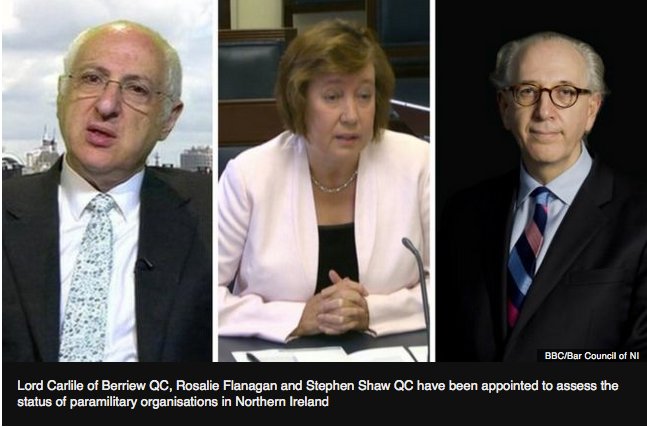
Here below is another take on the ‘crisis’ at Stormont, from former journalist and now US-based consultant, Michael McDowell who begins from the premise that the existing institutions have broken down, that another IMC-type body to monitor paramilitary activity just won’t wash, that a fresh start needs to be made and the Good Friday Agreement replaced. One doesn’t have to agree with all his arguments to know there is much truth in what he says.
But I rather think the gravy train will trundle down the tracks nonetheless. That gravy just tastes so gooooooood! And there’s so much of it!
The man and woman in the street are already sceptical that this latest of so many rounds of talks will produce broad agreement among the DUP, Sinn Fein, Ulster Unionists, SDLP and Alliance.
Of course, it is worth having talks, but if they don’t work, what is the Plan B of the two governments? Well, there isn’t one.
A quick election is demanded by Sinn Fein, with their eyes on the southern election next year, but a Northern Ireland election would meet the definition of insanity – ie, repeating the same old exercise and expecting a different result. Instead, we would have the familiar political stalemate in the Executive and Assembly; indeed, it might be worse.
Direct rule from Westminster is favoured by others, but that takes away local decision-making and puts it in the hands of English ministers.
Joint-authority, with London and Dublin, puts a greener tinge on the body politic and infuriates unionists and, in any case, Dublin is just slowly emerging from a disastrous economic mess.
What would work instead? After 37 years in North America, seven of them in Canada, the rest in Boston, New York and Washington, I believe in taking calculated (I stress, calculated) risks and having that old American “can-do” attitude, thinking-out-of-the-box, and, yes, a “do-no-harm-either” approach.
Well, if the local parties cannot agree on a package which specifies an Executive formed by voluntary coalition, collective Cabinet responsibility on policies, forced resignations for misbehaviour or corruption, other reasonable accommodations, an official Opposition in the Assembly with powers to call and hold ministers to account, and mechanisms to achieve a political majority of elected representatives in both communities to pass community-sensitive legislation and other safeguards, then it is up to London and Dublin to pick up the ball which the feuding parties kicked out of the political pram.
Let the two governments put a take-it-or-leave-it package rejected by the warring politicians directly to the people of Northern Ireland in a referendum.
After all, it is more than 17 years since the Good Friday Agreement was supported by a majority in both communities in a high-turnout vote.
If the package is supported by the electorate, then London and Dublin can legitimately call a meaningful Northern Ireland Assembly election on the basis of that mandate from the people of the province expressed in the referendum. If it is rejected, then it’s back to direct rule or something less than joint authority. Or, if a referendum is seen as too high-risk, then have London impose the package, with support, ideally, from Dublin and Washington.
Admittedly, in 1998, the majority unionist and nationalist parties campaigned for a “Yes,” and it is possible the DUP and Sinn Fein could join in an unholy alliance for a “No.” That’s a call for the two governments to make.
A lesser risk would entail relatively minor reforms to strengthen the centre and weaken the two main sectarian parties, perhaps though a Northern Ireland-wide electoral “list” system of voting, as used in Scotland, which would enable the Ulster Unionists, SDLP and Alliance to get a stronger foothold in the institutions than the current STV system allows.
Surely, though, it is time for bolder actions? Now is the time to take risks for peace, in the spirit of 1998.
Again, an election now, or in a few weeks, will achieve nothing but further acrimony, and no doubt the turnout will reach an historic low.
The options I am suggesting will be resisted not only by the NI political parties (barring, possibly, Alliance and, at a long shot, the UUs and SDLP), but by the pusillanimous mandarins of the Northern Ireland Office, the mediocre Nervous Nellies of the Northern Ireland Civil Service and the sneaking-regarders of the Irish Department of Foreign Affairs. These naysayers must be ignored.
Yes, there is a precedent: my IMC idea was championed by Tony Blair’s chief of staff, Jonathan Powell. Number 10 overruled the NIO’s opposition to it and Bertie Ahern and the Taoiseach’s office chose to ignore the Department of Foreign Affairs’ doubts. The IMC came into being because of strong political leadership by Blair and Ahern. They were the ultimate “deciders”.
The people of Northern Ireland again and again have shown that they support power-sharing (including in the unionist community, please note) and such cross-community initiatives as integrated education and sharing of public facilities.
We have had much talk about “a shared future” but, many years on, no agreement on what that might mean. Can we seriously tackle sectarianism? Can we deal effectively with the horrors committed in the past?
And, lurking like a demon around the political corner, are the harsh penalties for not enacting welfare reform, which Sinn Fein reneged on months ago, with savage cuts in spending which would hurt the very poorest families in Northern Ireland. Like it or not, the Tories were elected with a majority and promised to cut welfare monies if elected.
Then there’s the supposed panacea of corporation tax – huge cuts in social services might be needed to replace the $300m alleged “savings” on that triumph-of-hope-over-experience idea. David Cameron and Enda Kenny have a major opportunity to break the political logjam in the north and give the vast majority of people who support true power-sharing the kind of joined-up government which they voted for in the 1998 referendum – not the DUP-Sinn Fein cynical carving-up of power.
The men, women and, above all, the next generation of citizens of Northern Ireland deserve better of their politicians.
Just producing a new “improved” (?) IMC is not enough, and our 108 overpaid, over-expensed, do-nothing MLAs need to be pushed off the gravy train of the public trough if they cannot do their job, lead and reach an accord. Let London and Dublin seize the initiative if the northern parties will not agree.
And, finally, please keep the United States out of it all, except for backing a final package, and ignore Capitol Hill’s undistinguished Amen Chorus for Sinn Fein. The ball must stay firmly in London’s and Dublin’s court, where it should be.
There is a possible solution.





 The Broken Elbow
You must be logged in to post a comment.