Sinn Fein’s Pro-Austerity Record In North Belies Left-Wing Image in South

The analysis below, published by a Washington DC-based think tank, of Sinn Fein’s governmental record on economic and social policies North of the Border, sharply conflicts with the left-wing, progressive image of SF embraced by swathes of the British and Irish media, as well as many European leftists, in the wake of the recent Southern general election.

It chimes with an assessment of Sinn Fein that I arrived at a long time ago through many years reporting on the party, which is that this is an organisation with no real fixed socioeconomic ideology, is defined overwhelmingly by a drive to obtain power, and is ready to adopt whatever policies and political stance necessary to achieve and preserve power.

For Sinn Fein, political ideology is like a set of clothes which can be changed according to the weather or the occasion.

This means in practice that Sinn Fein has no difficulty implementing neoliberal economic policies in the North, while at the same presenting themselves as radical leftists in the South: https://inequality.org/?s=Sinn+Fein

Before Celebrating Sinn Féin Election Surge, Consider Their Pro-Austerity Record in the North of Ireland

‘The IRA Still Exists & “Oversees”* SF’, PSNI Tells Belfast Newspaper

In the seemingly endless debate about whether or not the Provisional IRA still exists and whether or not it controls Sinn Fein – questions that loom like Banquo’s ghost over negotiations about the formation of a new government in Dublin – little attention has been paid to a PSNI assessment made as recently as last November that the IRA did at that time exist and that it controlled Sinn Fein.

This begs the obvious question: if that was the status of the IRA/Sinn Fein partnership less than four months ago, did anything happen to alter it?

Asked about this this on Thursday at a committee hearing at Stormont, the current Chief Constable of the PSNI, Simon Byrne, kicked for touch and referred Assembly Members to the new Secretary of State and the Northern Ireland Office (i.e. MI5) for an answer.

However a PSNI spokesman, asked by the Belfast daily, the News Letter about the status of last November’s assessment of the IRA and its ‘oversight’ of Sinn Fein, said there had been ‘no change’.

That led the News Letter to publish the following article in yesterday’s edition, which is recommended reading for followers of thebrokenelbow.com. Politicians involved in talks with SF in Dublin about the new government might consider giving it more than a passing glance:

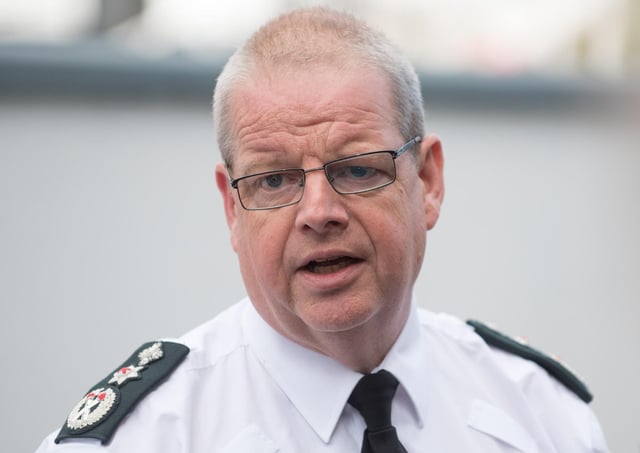
PSNI Chief Constable Simon Byrne has come under fire after declining to answer questions from the Stormont Justice Committee about the status of the Provisional IRA.


Friday, 14th February 2020, 1:06 pm
Updated
PSNI Chief Constable Simon Byrne appeared before Stormont's justice committee

PSNI Chief Constable Simon Byrne appeared before Stormont’s justice committee

Quizzed on the matter yesterday, Mr Byrne directed questions around an assessment of the Provisional IRA to the secretary of state and the Northern Ireland Office (NIO).

Mr Byrne replied: “The status of the Provisional IRA is not for me to comment on.”

The Northern Ireland Office has been asked to comment.

Mr Byrne’s comments have drawn attention in light of a statement from the PSNI to the News Letter in November which affirmed the continuing role of the Provisional IRA.

Four months ago the PSNI told this paper there had been “no change” since the 2015 government assessment; Prompted by the murder of Kevin McGuigan, the 2015 report said that the PIRA Army Council was still overseeing both Sinn Fein and the remaining structures of the terror organisation with an “over arching strategy”.

“With regards to PIRA, there has been no change since the Paramilitary Assessment in 2015,” the PSNI told the News Letter in November.

The government report, published in 2015 and based in part on PSNI assessments, concluded that the second largest political party in both Northern Ireland and – now the Republic of Ireland also – continues to be overseen by the deadliest terror group of the Troubles, which although much reduced in scale and “committed to the peace process”, still has “specific” departments and “regional command structures”, gathers intelligence, retains weapons and has been involved in “isolated incidents of violence, including murders”.

Jim Gamble, former head of PSNI Special Branch in Belfast, said Mr Byrne had “got caught between a rock and a hard place”.

“He has come into the role and is doing the best he can. But unlike [previous Chief Constable] George Hamilton, who had grown up with the RUC and PSNI and who had a deep understanding of the nuances here, Simon is only beginning to go through that particular learning curve.

“There is absolutely no doubt that the volume on IRA historic and contemporary links to politics has been turned right down, because they are not the same as other terrorist organisations; None can compete with the fact that Sinn Fein is inextricably linked to the IRA, and given the Good Friday Agreement and the work towards peace, then of course no other organisations would have the influence over the direction of policy within a political organisation that the IRA Army Council has [with Sinn Fein].”

TUV leader Jim Allister took issue with the Chief Constable’s reaction to questions yesterday.

“The Chief Constable’s comments to the Justice Committee about the status of the PIRA being a matter for the Secretary of State reminds Northern Ireland that there are double standards when it comes to criminality and terrorism in Northern Ireland,” he said. “Let’s not forget that the PIRA remain the most deadly murder group in Western Europe – something to which the graveyards of our Province bare chilling testimony.

Ken Funston, SEFF’s Advocacy Services Manager said it was “precisely the Chief Constable’s role” to respond to MLAs’ questions.

“He is a civil servant who must be accountable to those who are in positions of governance in this land,” he said. “He deliberately avoided the question rather than having to give an answer that others might have an issue with. If he had been asked a similar question on the status of republican dissidents or loyalists, there is little doubt that he would have answered the question. His failure to do suggests that he is allowing politics to interfere in the discharge of his role responsibilities”.

Asked to address the apparent discrepancy between the November statement and the Chief Constable’s comments yesterday, the PSNI gave a short comment and a link to the 2015 report.

“The assessment commissioned in 2015 by the then Secretary of State on Paramilitary Groups in Northern Ireland has not changed,” a PSNI spokeswoman said.

In November the editor of a leading NI blog said that it was “extraordinary” how little attention was given to the PSNI revelation that the IRA Army Council still oversees Sinn Fein strategy.

Slugger O’Toole Editor Mick Fealty told the News Letter: “We have accommodated ourselves to profoundly undemocratic norms. And one of the ways this shows itself is a general unwillingness to subject certain groups to the norms of accountability… And the idea that some people can be excused from that accountability on the basis that it is too political to subject them to accountability is a perfect example of that departure from democratic norms.”

Last week the News Letter reported that Provisional IRA members were linked to 26 murders since the signing of the Good Friday Agreement in 1998.

Although it is not possible to give exact figures, an examination by the Irish Independent in 2005 carried a detailed profile of 39 individual murders it said had been committed by members of the IRA from its 1994 ceasefire up until 2005. If accurate this would now equate to 26 murders since the Good Friday Agreement (GFA) in 1998.

A common theme, the Irish Independent found, was of individuals who had challenged IRA members in their own communities and paid a fatal price. In 2018 academic and NI Policing Board member Paul Nolan found that 38 catholic civilians had been killed by non-specified republican organisations since the GFA – a figure of similar proportions to the Independent’s.

Overall, Mr Nolan said republicans had taken 74 lives and loyalists 71 since the GFA.

* Thesaurus.com lists these as synonyms for ‘oversee’:

Meet SAS Commander Julian ‘Tony’ Ball, Robert Nairac’s Comrade-in-Arms

If Robert Nairac was involved in the Miami Showband massacre, the man who would have known more than most about his role was Julian ‘Tony’ Ball, a legendary former commander of a secret SAS unit based in Co. Armagh in the mid-1970’s, a squad that Nairac liaised with. JAMES KINCHIN-WHITE profiles the British soldier who was honoured by the Queen for shooting two civilians in Belfast while allegedly chasing Ballymurphy IRA leader Jim Bryson.
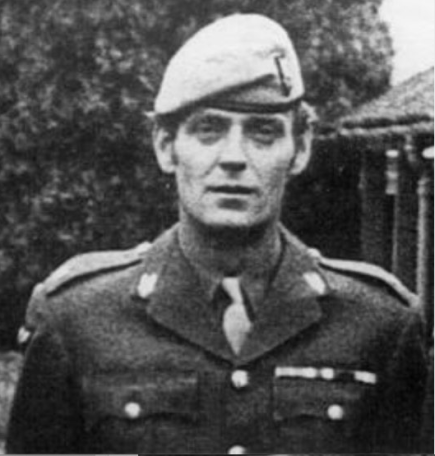
Julian Antony Ball, the SAS man who worked with Robert Nairac. He preferred to be called ‘Tony’

THE BEGINNING

Tony Ball enlisted in the British Army on 27th February 1961 as 23854005 Private Julian Antony Ball, the Parachute Regiment; he preferred to be called ‘Tony’. He began his military life as a squaddie, at the bottom of the military food chain, but ended as a highly decorated, but disillusioned officer who had cut his teeth fighting the IRA in West Belfast and Co Armagh but was never able to overcome the British Army’s deeply embedded class prejudices.

Later he served with ‘D’ Squadron, 22 Special Air Service regiment (SAS). His campaign medals indicate that during his first three years he served in Cyprus with the United Nations peace keeping force – most likely with 1 Para. Later he was awarded the General Service Medal (GSM) with clasps for campaign service in Borneo, South Arabia and Northern Ireland (NI). D Squadron were the only SAS unit deployed to NI in 1969 and the regiment were earlier deployed to Borneo and South Arabia. These deployments would account for the inscription ‘Trooper JA Ball – SAS’ on his GSM.

In August 1970, nine years after he joined the British Army as a private, the London Gazette announced that following his graduation from Mons Officer Cadet School, Julian Ball would hold the rank of Lieutenant, with effect 25 July 1970, and be assigned to the King’s Own Scottish Borderers regiment (KOSB). It is believed that Ball joined his regiment around 10 Sep 70 when it returned to Redford Barracks, Edinburgh, having completed its first emergency tour from May-September in NI.

On that occasion the KOSB battalion established its Tactical Headquarters (TAC HQ) at Girdwood Park in North Belfast where it came under command of 24 Infantry Brigade (replaced by 5 Airportable Brigade in July 1970). Although KOSB had briefly deployed to NI for five days during the marching season in July 1971, Tony Ball’s first full NI tour with the battalion was a four-month emergency tour from 28 Dec 1971 to 26 Apr 72. This time the battalion TAC HQ was located within Springfield Road joint Army/RUC barracks and its sub-units were deployed to locations within the West Belfast Tactical Area of Responsibility (TAOR).

Lt Ball commanded the Reconnaissance Platoon (Recce), regarded as an elite formation in Infantry battalions and traditionally part of Support Company. Around half the platoon travelled to NI with an advance party that arrived four weeks before the main body. Recce, in its conventional role, patrols ahead of rifle company combat units to locate and report on enemy positions. Its soldiers are therefore highly trained, both in surveillance, patrolling and in close quarter combat should they be discovered and attacked.

IN BALLYMURPHY, HUNTING BRYSON

In 1972 however, it was common for Recce to be split into smaller sections that were detached to each of the rifle companies and tasked with gathering or acting on intelligence to locate people, explosives and firearms. Tony (as he preferred to be addressed) commanded the section assigned to ‘C’ Company 1 KOSB based at the Henry Taggart Memorial Hall in Ballymurphy (see below).

Henry Taggart Memorial Hall (centre-left foreground) – the British Army’s base in Ballymurphy as seen in an RAF photograph

His section, nicknamed ‘the squirrels’, was a temporary addition to the sub-unit and required a unique radio Call Sign (c/s). The solution was to use the existing Coy prefix, ‘C’ for Charlie, with the number ‘7’ which was not used by any of the other platoons. Thus, c/s 37 became the unique identifier for the Recce detachment at Henry Taggart. For clarity and speed of communication the army used codewords as part of radio voice procedure. An officer or NCO in charge of any formation is known as ‘Sunray’ and thus, Tony Ball became ‘Sunray c/s 37’.

It is significant that it was Sunray c/s37 who arrested James Bryson, OC ‘B’ Company, 2nd Battalion, Provisional IRA, on the first full day of the KOSB tour. James Emerson Bryson has been described as ‘…a notorious and fearsome gunman’ who had joined the IRA following the introduction of internment in August 1971.

He was thought to have been involved in numerous shooting incidents including the killing of Lance Corporal Peter Sime (KOSB) on 7 April 72. LCpl Sime had been on duty in a sandbagged emplacement at the entrance to the Henry Taggart Hall but had left the post to speak to a bus driver who was reporting an attack on his vehicle. The driver said he heard a shot as he was speaking to the soldier who took a few steps before collapsing to the ground.

Ballymurphy IRA leader Jim Bryson, arrested by Ball, escaped from the Maidstone, returned to Ballymurphy and then was allegedly spotted by Ball who chased him but shot two civilians in the process

When Jim Bryson was first arrested by Tony Ball in Dec 71 he was subsequently incarcerated in the prison ship HMS Maidstone – a former submarine supply vessel moored in Belfast Lough. But he attained fabled status within the Republican movement when he and six other inmates – the ‘magnificent seven’ in IRA folklore – escaped on 17 Jan 1972.

In a scene reminiscent of a Second World War POW movie, the men camouflaged themselves with boot polish and covered themselves in butter to insulate themselves from the cold waters of Belfast harbour. Cutting through a steel bar in a porthole, they clambered down the ship’s steel cable and swam to safety, becoming an IRA legend – the so-called ‘magnificent seven’.

Nevertheless, Bryson’s escape proved more consequential than mere folklore might imply. At 0730 on the morning of 15 Apr 72 , just three months after the Maidstone escape, an RUC police officer driving to work contacted the Operations Room at the Henry Taggart hall to say he thought he had spotted Jim Bryson standing near the flats in Norglen Parade.

Despite having been on a search operation at 0145 that morning Tony Ball, not uncommonly restless, was up early. Perhaps the potential to apprehend a ‘notorious gunman’ suspected of killing a KOSB soldier was reason enough for him to follow up on this report. Taking his platoon sergeant and a private soldier as driver, the three men, all in civilian clothes, proceeded to the Turf Lodge area in an unmarked administration vehicle to search for the wanted man.

The patrol informed the Ops Room that they found nothing in Norglen Parade nor in nearby Ballymurphy – but on exiting the estate onto the Whiterock Road they said Bryson was seen in the company of another man. Ball, his sergeant and the driver jumped from their car, the NCO and driver giving chase to one of the men while Tony Ball went after ‘Bryson’.

THE CONWAY BROTHERS

The report noted that the man chased by the NCO was called ‘Gerard Conway’, that he had been hit by two 9mm rounds fired by the driver and then taken to hospital by c/s2 (c/s2 is the Fixed Infantry Call-sign for ‘B’ Company). It would seem therefore, that after the ‘contact’ had taken place c/s 37 requested or the Ops Room had sent a Quick Reaction Force (QRF) which would appear to have been provided by an element attached to ‘B’ Company (the ‘B’ Coy ‘Squirrels’, c/s 27 are recorded as also having been in the area).

Meanwhile, Lt Ball was reported to have been shot at by ‘Bryson’ who fired ‘3-4 shots’ at him before tripping and dropping “…a 9mm Star pistol Reg No. 1034212” as well as two magazines each containing three rounds of ammunition. Bryson, the report continues, ‘was very fast…..and escaped’.

By 0813 the Royal Military Police (RMP) at the Royal Victoria Hospital (RVH) have established that the man shot by the driver had been hit in both legs. A further RMP report at around 0825 confirms that a second man, suffering a gun-shot wound (GSW) to his hip, has also been admitted to hospital. After some initial confusion, he is identified as ‘John Conway’, the brother of the man admitted earlier.
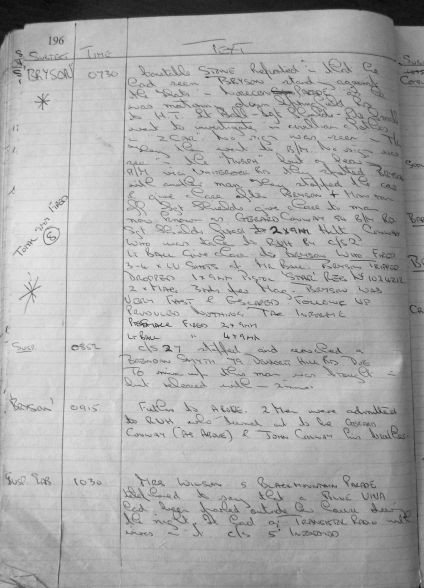
The KOSB Watchkeeper’s Diary records the alleged chase of Jim Bryson and the shooting of the Conway brothers

At 1050 on the morning of the shooting, 39 Brigade Ops Room reported to Headquarters Northern Ireland (HQNI) that John Conway was admitted to hospital and that “He may in fact be the chap they thought was Bryson”. (Authors emphasis) Around lunchtime the Ops Room at Henry Taggart received a telephone call from the KOSB Commanding Officer (CO) based at Springfield Road RUC Station who had information that Bryson, apparently in rude health, was reported ‘to be driving around in a Greyish Morris Marina’.

It was subsequently discovered that on the day of the shooting, John and Gerard Conway were, as they usually were on a Saturday morning, walking to catch a bus to the city centre where they had a fruit and vegetable stall. They ran off because they believed that the armed men in civilian clothes who jumped from a fast approaching car were loyalists’ intent on doing them harm. A media report quoted a witness who heard cries for help from one of the brothers. She said she saw three men in civilian clothes with guns who had a ‘friendly chat’ with unformed soldiers who arrived on the scene. She also said that another officer arrived and told one of the gunmen that “…he had shot the wrong bloody man.”

It is clear that within 3-4 hours of the shootings, both Brigade and HQNI recognized that the Conway brothers were victims of mistaken identity. The initial report sent by the plain-clothes patrol specifically states that they identified and approached only two men – a fact repeated in the 39 Brigade report to HQNI. Neither of the men was ‘James Bryson’, yet both were shot and neither of them was ever charged with an offence arising from the incident.

Yet, such was the ‘closed’ nature of the military reporting system that a contemporary understanding of the situation may well have been blurred during a period when one historian has argued that “HQNI could mistake overly aggressive groups of soldiers for high-functioning units”. However, misconceptions about the shooting of the Conway brothers were also caused by obfuscation by the authorities.

MUDDLED WITH THE MRF

For many years, including as recently as 2013, it had been assumed or claimed that the shooting had been the work of the Military Reaction Force (MRF) – a covert organization which operated in plain clothes and civilian type cars between 1971-1973.

Faligot (1984), Dillon (2003) and Cursey (2013), each contend, incorrectly, that the MRF were responsible for the shooting. The cause of this confusion was misdirection at the highest level of the NI government and was designed to maintain the secrecy surrounding the existence and identity of the undercover unit that was, in fact, targeting civilians in Nationalist areas of Belfast. [see MRF series in the Broken Elbow]

When the Secretary of State for Northern Ireland (SSNI), Willie Whitelaw, expressed his concern in August 1972, about the high number of ‘mystery’ shootings that began in Belfast in the Spring of that year, he was assured by the Chief Constable of the RUC that all such events were ‘thoroughly investigated’.

Witnesses to several incidents in West Belfast alleged that soldiers in plain clothes were involved and led to claims that Army assassination squads were operating in parts of the city. In a reference to covert army operations in Northern Ireland, Geoffrey Johnson-Smith, then Under Secretary of State for the Army, confirmed the existence of the unit by stating that the soldiers involved were subject to ‘normal military discipline’ and to the rules of engagement (RoE).

Earlier, the minutes of a meeting, copied to the Prime Minister’s office, contained a record of the operation that resulted in the shooting of the two brothers by a three-man plain-clothes military patrol in the Whiterock Road area of Belfast. Here the details are marked as ‘approved for disclosure’ by Lord Windlesham, Minister of State at the Northern Ireland Office (NIO) in order to ‘…dispel rumours that Army “Assassination squads” are operating.’

Neither Lord Windlesham nor any other government, military or police official saw fit to state precisely who did shoot the Conway brothers. If they had, it would have done much to reassure all concerned that the event had nothing to do with the operations of the specialist plain-clothes unit referred to by Geoffrey Johnston-Smith.

Whatever the degree of diligence during initial inquiries into mystery shootings, concern continued to be expressed about the actions of a plain clothes army unit identified as the ‘Military Reaction Force’. [The correct title is now known to be the ‘Mobile Reaction Force’ – see Broken Elbow ‘What’s In A Name?’].

But the timing and wording of the information approved for disclosure by Lord Windlesham convinced many observers that the incident was one of the first shootings by the MRF. It was precisely because the incident was known not to involve the MRF that disinformation was used to enhance the fog of war rather than inform the PM, parliament or the media. Indeed, a general staff officer assigned to department MO4 of the Ministry of Defence had this to say:

‘Although the term MRF has been used in the Press, only 2 papers have actually got the name right and the correctness of these newspapers reports has never been confirmed one way or the other by the Army.’

As far as the general policy of making official comment on intelligence gathering and plain clothes operations is concerned, there seems to be considerable advantage in maintaining as much confusion as possible’. (MO 4 was the department responsible for Military Operations in NI).

In sum, the MRF had nothing to do with the shooting of the Conway brothers and at this point in his career, Lt Julian Antony Ball had nothing to do with the MRF – though as we shall see that was to change.

Nevertheless, during the 71-72 KOSB tour which lasted 119 days, ‘Sunray c/s37’ was personally involved in four shooting incidents while his ‘Squirrels’ were involved in a further three. Moreover, Tony Ball’s name appears in the company Watchkeeper Diary on no less than 179 separate incidents ranging from explosives and weapons finds, arrests, searches and shooting incidents. He was shot at on several occasions, the target of a bomb on another and his platoon sergeant was slightly wounded by a nail bomb in the latter part of the tour.

THE MILITARY CROSS FOR SHOOTING THE CONWAY BROS

It is no surprise that Tony Ball was recommended for the award of the Military Cross for his performance and leadership during the tour – his performance taking a theatrical turn when a local householder described Ball and his Sergeant as ‘John Wayne’ and ‘Comanche’.

What is surprising was that the incident involving the shooting of the Conway brothers takes central place in the MC Citation with apparent disregard that two innocent men had been shot by the plain clothes patrol.

British Army citation for the award of a Military Cross to Ball. The incident dated April 15th, describes Ball’s alleged chase and confrontation of Jim Bryson but which was probably a case of mistaken identity in whichthentwo Conway brothers, innocent men on their way to work were shot

Curiously, the man who recommended Tony Ball for the award, the KOSB CO, noted in his Tour report that ‘no great advantage had been obtained’ through the use of plain clothes operations. Still, Lt Ball would soon be promoted and his military career become immersed in more secretive and controversial work. But what of the real James Bryson?

He was recaptured in September 1972 after a gun battle with soldiers in the Leeson Street area of the Lower Falls, Belfast. On this occasion he was remanded to Crumlin Road prison and though never convicted of any offence, he was being held on charges of attempted murder and possession of .45 revolver.

In February 1973 he was being taken to court through an underground passage between the prison and the courthouse when he and another inmate overpowered their guards forcing them to hand over their clothing. Bryson made his second successful escape by simply walking out of the rear of the court dressed in a Prison Officer’s uniform and climbing over a wall. His co-accused, similarly attired, attempted to flee by the front door and was recaptured.

Despite, or perhaps because of his fame in Republican folklore and his notoriety within the security forces, Bryson’s subsequent life was to prove very short. About one year after his capture by the Royal Anglians’, 25-year-old Jim Bryson was mortally wounded by a soldier firing from a covert Army Observation Post in disputed circumstances in the Ballymurphy estate. He was shot on 31 Aug and died in hospital on 22 Sept 1973.

To date, no one has been convicted of the killing of Lance Corporal Peter Sime.
After returning to Redford Barracks, Edinburgh, at the end of the tour, Lt Tony Ball MC was promoted to Captain on 25 July 1972. In May of the following year the battalion was posted to West Berlin and took up residence at Brooke Barracks where Tony Ball was the Motor Transport Officer (MTO).

Although he was popular with his men, his appointment was largely an administrative role usually assigned to officers with a ‘Quarter Master’ (QM) commission. It was therefore, a role that he may have considered to be something of an anti-climax given his background and his recent experiences in NI. He was variously described by men under his command as ‘one of the most honest men’, ‘the best officer I ever came across’, ‘a great leader and a fine man with a great sense of humour’.

Among his peers on the other hand, opinion was split. One contemporary described Ball as a “…slim, thin faced individual who had an excess of nervous energy [who] was not afraid of authority and would frequently bend the rules if he thought it necessary… nevertheless he was a good man to work with and could always be relied upon in a tight situation. A man to go to war with!””

Tony Ball, (far right with long sideburns) and fellow KOSB soldiers in the Henry Taggart Hall, Ballymurphy, apparently inspecting a captured arms cache

And back to ‘war’ he went. But, to understand when and where Tony Ball went it is necessary to appreciate the background and evolution of the Army’s special and covert forces. As we have seen, ‘confusion’ was considered to be beneficial to the maintenance of secrecy about such units and their operations and to this day many official files remain closed – embargoed for up to 100 years.

Nevertheless, as more information becomes available about the structures, processes and personalities involved in NI’s hidden war, a combination of a look back in time together with emerging facts and logical deduction allow for some sense of the thing to become apparent.

BRITAIN”S COLONIAL WARS SPAWN COVERT UNITS

During Britain’s decolonization process the Army made widespread use of covert forces, agents and informers. In pre-war Palestine, Orde Wingate had organized ‘Special Night Squads’ composed of British soldiers and members of the Jewish military organization – Haganah. These units were designed as mobile combat units to fight against Arab insurgents and a future Israeli Defense Minister, Moshe Dayan, was one of the first to join. Both Dayan and Wingate are remembered for their contribution to the evolution of the Israeli Defence Forces.

In post-war Palestine, one of Wingate’s ‘Chindit’ commanders from WWII, Brigadier Bernard Fergusson, was appointed to command the paramilitary wing of the Palestinian Police Force. He developed, with the support of General Bernard Montgomery, then the Chief of the Imperial General Staff, two covert ‘Special Squad’s’ to combat attacks by Jewish insurgents – and ‘give them a bloody nose’.

The allies, on this occasion, were Arab volunteers from the Palestinian Police and some British soldiers. Both ‘squads’ were commanded by specially selected officers, Major Roy Farran and Major Alistair McGregor, both of whom had led SAS squadrons during WWII.

(It is worth noting that the second commander of the MRF in 1972 was Alistair McGregor’s son Captain James Hamish McGregor, an officer in the Parachute Regiment)

At the end of Britain’s mandate in Palestine in 1948, Britain still had to contend with colonial emergencies in Malaya (1948-60), Kenya (1952-60), Cyprus (1955-59) and Aden (1963-67). Covert forces and pseudo-gangs were central to the counter-insurgency effort in each of these campaigns.
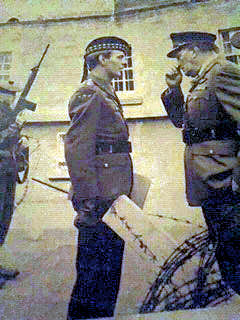
Then Lt.Tony Ball meeting General Sir John Mogg at an inspection of KOSB troops at the regiment’s Berwick-on-Tweed headquarters, circa 1971

In Malaya the security forces were up against the Malayan National Liberation Army (MNLA) – a communist inspired insurgency that had begun under a different name against the Japanese during WWII. In the early phases it was the police Special Branch that took the lead in forming pseudo-teams comprised of officers, troops and captured insurgents. These teams conducted psychological operations including false-flag bombing raids on guerilla groups.

In 1958 Major Frank Kitson, who would later serve as 39 Bde Commander in Belfast, was awarded a bar to his MC for his ‘…exceptional skill and leadership’ while serving as a Company Commander with the Rifle Brigade in Malaya where, during jungle operations, ‘…he attained the virtual elimination of two communist party branches’.

Earlier, in Kenya during the Mau-Mau uprising, Frank Kitson was awarded an MC where he had served as a District Intelligence officer. One of his contemporaries recalled that ‘Frank was a very conventional soldier, but his real forte lay in the gathering of intelligence.’ Kitson was tasked with setting up a military intelligence unit for ‘…identifying the terrorist organization and obtaining contact information’. His MC citation reads:

His greatest success has been in developing methods for the procurement of contact information. His methods have set the pattern for the rest of the Colony. They involve small parties in the guise of Mau-Mau mingling by night with Kikuyu [the largest ethnic group on Kenya] in areas where the presence of terrorists is suspected. On numerous occasions the precise location of a gang has been established.

The Pseudo-gang concept was central to Kitson’s methods. Captured insurgents would be trained to join a team of European and Kenyan soldiers. The group would pose as insurgents and infiltrate terrorist camps to gain information that could be developed into ‘contact intelligence’ – thereby enabling combat units to close with the enemy.

In what would prove to be a most accurate description of the subsequent development of the MRF in Belfast, Kitson describes how the Mau-Mau were reliant on the civil population and that countering the gangs demanded large volumes of information from ‘low-grade’ agents that would help to reveal enemy behaviour. In developing agents Kitson argued that “…speed is of the essence, even at the expense of quality…the screening and sorting out can come later.”

The Cyprus emergency has long been associated with the setting up of Internment camps and the incarceration of suspects without trial. However here too there is evidence of the use of covert operations involving turned terrorists. As in Kenya, these were facilitated by the actions of a District Intelligence Officer (DIO).

The DIO was Captain Lionel Savery of the Parachute Regiment who was also awarded a Military Cross for his endeavors. In his MC citation dated February 1957, an account is given of how he had built up an intelligence organization into a ‘most valuable’ unit of former EOKA sympathizers who now worked for the security forces.

On the other hand, Britain had announced its intention to withdraw completely from Aden and the security forces became a target of attacks from competing organizations intent on gaining post-colonial power. Consequently, natural allies, agents and informers, were thin on the ground. During the emergency, attacks by the National Liberation Front (NLF) and bombing and grenade attacks by FLOSY (Front for the Liberation of Occupied South Yemen) were common. To combat these a covert plain-clothes unit was formed under the leadership of Sgt Robert ‘Bobby’ Bogan of the Somerset and Cornwall Light Infantry (SCLI).

Bobby Bogen, like Tony Ball after him, led his battalion’s Reconnaissance Platoon from which he created a twelve-man specialist team who lived, dressed and acted like locals as they sought to blend in to the sewers and dark alleys. The unit, known as the ‘Special Branch Squad’, dressed in Arabic clothing with their skin darkened with boot polish. Armed with the Sterling sub-machine gun and Browning semi-automatic pistol, they infiltrated insurgent areas at night and ‘snatched or neutralized’ the bombers. For a full account see Edwards, (2015). ‘Q Cars’ were used for transport – battered old cars that also blended with the local environment.

In 1967, Sergeant Bogan and his men were the subject of a cartoon by JAK in the London Evening Standard:

They also featured in the DC Thomson comic ‘The Hornet’ which depicted the story of attempts to assassinate Bogan and his men. It is clear then, that the development of covert plain clothes units in NI was nothing new. It was an evolutionary concept adapted from many years of colonial experience by those responsible for its design. Nor was it the first plain clothes covert unit to be deployed in Belfast by the commander of 39 Infantry Brigade.

The less well known ‘Bomb Squad’ was a precursor to the MRF. It has semantic and structural similarities with Bogan’s earlier team in Aden and its purpose was to “Collect, collate, develop and act upon intelligence related to terrorist bombing activities.”

The unit would wear plain clothes, operate from civilian vehicles and have a formal relationship with RUC Special Branch (SB). A transcript of the source document states that the ‘Bomb Squad’ was a unique unit established in July 1971. But its first mention appears in Brigade Logs dated May-June when two incidents illustrate the level of secrecy surrounding the unit.

A uniformed patrol of the Light Infantry (LI) is confronted by a man dressed in civilian clothes, holding a pistol. The patrol commander reports that the man is lucky he was not shot. He then identifies himself as a soldier, stating that he is ‘special forces’ and produces a military ID card. A similar ‘blue-on-blue’ confrontation occurs on the night of 17 June when another LI patrol confronts a man walking along the Oldpark Road just before midnight. He also identifies himself as a soldier, produces an ID card and states he is a member of the SAS.

The source material provides an outline structure of the Bomb Squad (see below). It was commanded by Captain Arthur Watchus – a member of the Parachute regiment who had also served with the SAS. His second in command (2IC) is listed in the logs as a Lieutenant.

The Warrant Officer (WO2) is stated to be an Ammunition Technical Officer (ATO) whose function is to train members of the squad in techniques for gathering information about bombs. The ‘Q’ cars are said to be ‘new’ so as to avoid using ‘pool’ vehicles from HQNI which have become easily recognized over time.

The purpose and focus of Bomb Squad activity is evident from the Brigade log entries for the summer of 1971. The period had seen the commencement of a sustained PIRA bombing campaign – particularly in the commercial centre of Belfast – and Bomb Squad operations had secured the capture and conviction of a number of bombers.

The first mention of the MRF contained in 39 Bde Log Sheets occurs in October 1972 after which there is no further mention of the Bomb Squad. But, the relationship between the MRF and the ‘Bomb Squad’ is established in a later document in which Captain Watchus is identified as the OC MRF. Recruits for the MRF are sought from regular battalions on emergency tours with commanding officers instructed to select intelligent men of good disposition and good pistol shots. But in all other respects, they did not require any special pre-deployment training.

A second ‘Bomb Squad’ is also known to have existed and attached to 5 Airportable Brigade in 1971-72 when it was responsible for the Mid-Ulster and part of South Fermanagh Areas of Responsibility. The Commander of 5 Bde was not overly impressed with his ‘Bomb Squad’ which consisted of one officer and eight other ranks. It was tasked gaining information of ‘enemy intentions’ while working closely with the RUC and to conduct ‘limited anti-terrorist operations…in particular to intercept bombing attacks.’ The Brigade Commander had a poor view of information derived from RUC sources and cited this as his reason for disbanding his ‘Bomb Squad’ on 20 November 1971.

In the Belfast area the Brigade Logs pertaining to the Bomb Squad and MRF up to 29/30 April 1972 indicate that these units were performing surveillance duties checking on suspect vehicles, wanted men, addresses of interest and potential targets for bombers. But that changed on 29/30 April 1972. In fact, two things changed.

First, the MRF were contacted by an RUC officer in ‘A’ Division who provided information from SB that an armed robbery was planned for the following Monday morning at Robbs Department store in Castle Place, Belfast. The police requested that the MRF put soldiers inside the target building – possibly because the SB officers could be easily recognized.

The MRF response was to volunteer to conduct the operation subject to permission from 39 Brigade. They envisaged that ‘shooting’ might break out and asked Brigade to inform the regular army that should this occur, they should not open fire into the building unless they had been contacted by the MRF. Almost at a stroke, surveillance and reconnaissance had been transformed into ‘reaction’. Permission was granted by the Brigade Major (BM) though the outcome is not recorded.

The second thing that changed was that Brigadier Frank Kitson, the commander of 39 Infantry Brigade, came to the end of his tenure and returned to England to take up a new appointment as Commandant of the School of Infantry.
From this point forwards the Logs paint a very different picture of some of the activities of the Belfast based MRF – more reaction than surveillance and clearly embroiled in shooting incidents that resulted in fatalities and serious injuries to civilians. [see Broken Elbow MRF series starting here]

Controversial incidents involving the MRF are well documented and in 1972 these cumulated in a major set-back for the unit when the existence of a covert laundry operation, Four Square, was revealed to the Provisional IRA following their interrogation of two MRF agents whom they discovered, had been recruited from the PIRA ranks earlier in the year. The laundry van was attacked in the Twinbrook estate, Andersonstown, and the driver, Royal Engineer Sapper Ted Stuart, a native of NI, was shot and killed.
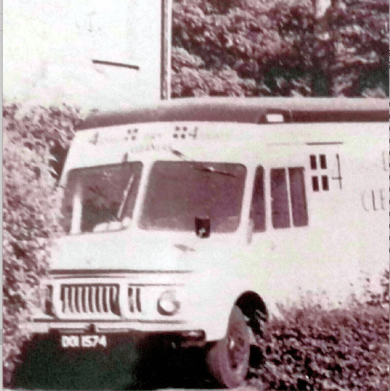
A rare photo of the Four Square laundry van used by the MRF to collect intelligence in west Belfast. It was ambushed by the IRA and its driver killed in an operation which blew the MRF’s cover and enhanced then IRA Belfast Commander Gerry Adams’ reputation as a master of counter-intelligence

A second MRF unit was introduced into 3 Infantry Brigade (Armagh) in the summer of 1972. And another was established in 8 Brigade (Derry). However, despite this expansion, the effect of the set-back and acrimony about previous shootings in Belfast, a decision was made to develop a more professional covert organization to supersede the MRF. As with its predecessors, the name of the new unit was kept secret and was changed several times during the four years of its existence.

Knowledge about the Special Reconnaissance Unit (SRU) first emerged 30 years after the creation of a Top-Secret briefing document prepared for a meeting between the British Prime Minister and the Irish Toaiseach held in April 1974. The document confirms that the first Plain Clothes army patrols in NI, now known to have been the ‘Bomb Squad’, commenced at Easter 1971. These were ‘reformed and expanded’ into Military Reaction Forces and later brought under the central command of HQNI ‘without RUC participation’. A ‘higher standard of training’ was developed to underpin the creation of the SRU which, in order to maintain secrecy, was referred to as NITAT(NI) – creating confusion with the genuine Northern Ireland Training and Advisory Teams established at the Close Quarter Battle range at Lydd in England and at a similar establishment in Sennelager, Germany.

In other documents discovered by ‘Justice for the Forgotten’ and the ‘Pat Finucane Centre’ the primary task of the SRU was clearly defined as ‘covert surveillance’ as a ‘preliminary’ to the arrest of suspects by regular uniformed troops. It was also tasked with the development and handling of agents or informers and to work closely with RUC SB. However the ‘stringent standards’ used to identify and select men for the new unit proved to be difficult to achieve:

“The new-style Special Reconnaissance Unit (SRU) has proved extremely effective, achieving successes out of all proportion to its size. But the Unit has yet to realise its full potential because it is undermanned; despite strenuous efforts to recruit men…there are at present only some 57 “operators” available for deployment against an establishment of 82.”

Part of the problem was a rule designed to limit criticism of using ‘special forces’ by ensuring that anyone with a background in the SAS could not serve with the SRU until three years after they had left the Hereford based special forces unit. This rule had already been ‘slightly breached’ when the newly selected Commanding Officer of the SRU had a somewhat closer connection with the SAS. The SRU became operational in May 1973.

In the event, the 3-year embargo on SAS personnel serving with the SRU was reduced to two years and then abandoned altogether when the situation worsened and the unit was under strength by thirty operators. Correspondence between the NIO and the Defence Secretariat clearly indicate that concealing the involvement of the SAS was a central priority:

“…there would be a considerable emotional reaction from extremists on both sides to the admission that the SAS were operating in Northern Ireland (they already suspect this and would see it merely as an admission forced from us), more moderate opinion both in Northern Ireland and elsewhere would be unlikely to get particularly excited about the use of the most effective means of defeating the terrorists…Nevertheless, a straight admission is to be avoided if possible”

BALL HEADS SAS UNIT IN CASTLE DILLON, JANUARY 1974 – NAIRAC LIAISES ON BEHALF OF BRITISH AMY HQ

Despite this, in the first week of January 1974, an officer and thirty men from the SAS arrived in Northern Ireland to form a full detachment of the SRU/NITAT. The leader was Julian Antony Ball, now back with the SAS, this time as an officer. The detachment was given the cover name 4 Field Survey Troop, Royal Engineers (RE), based at Castle Dillon, Co. Armagh – embedded with the genuine 33 Field Squadron RE which was housed in a separate part of the same base.

4 Field Survey Troop was an unusual name in that it did not actually exist; it appears to have been chosen solely for ‘local’ consumption and concealment. In documentation, the common cover name of NITAT was used for all three SRU detachments. Shortly after the arrival of the ‘Hereford’ types the Chief of the General Staff (CGS), on a visit to NI, was told that “NITAT was a continuing success”, and the recent reinforcements were well-integrated and doing a first-class job.

In May 1974 the Castle Dillon detachment gained additional assistance from the newly appointed 3 Infantry Brigade Liaison Officer Captain Robert Nairac – a Grenadier Guardsman chosen for this junior, but dangerous staff position.

Captain Robert Nairac – he liaised with Tony Ball’s SAS squad based at Castle Dillon, Co Armagh

Other SAS personnel had arrived in NI earlier under the previous limited embargo arrangements that allowed selected soldiers the option of leaving Hereford towards the end of their SAS training to join the SRU. A set of documents found during research by Ciaran McAirt of the ‘Paper Trail’ revealed the early location of a second SRU detachment.

In April 1974 two soldiers, LCpl Simpson and Ranger Tymon, were charged at Coleraine court with armed robberies at Garvagh the previous month. Both were based at Ebrington Barracks, Londonderry – and both had left the SAS to join the SRU. Yet again, extraordinary steps were taken to conceal the existence of the SRU and its relationship with the SAS. In a ‘Secret’ document distributed to the office of the Prime Minister, the Vice Chief of the General Staff and the Head of DS 10 (responsible for NI), the MOD stated that:

“…it was decided that Simpson exceptionally, should be defended at public expense to reduce the risk of disclosure of the SAS/SRU connection and SRU operations.”

As it turned out, Simpson and his colleague were found guilty and jailed for 6 years, but on the day after their first appearance at Coleraine court a further set-back impacted on the Derry SRU contingent when one the detachment’s operations ended badly. Captain Anthony Pollen, seconded from the Coldstream Guards, was killed while conducting surveillance duties in plain clothes during an Easter parade in Derry’s Bogside. He is often mis-quoted as having served with ’14 Int’, a unit that had not been created at that time.

The third SRU/NITAT unit was based in Belfast and known as ‘East Det’. The unit had been involved in the capture of Gerry Adams and ‘other high-ranking members of the Belfast Brigade HQ’ on 19th July 1973. It was also likely to have been involved in the SRU’s first operational mission in May of that year. This took place on the shores of Lough Neagh, Co. Antrim. After ‘lying-up’ in a derelict house on the north bank for two and a half days, the unit captured a total of seven men.

In sum, we can now clarify the existence of early British army plain clothes operations in NI evolving from the ‘Bomb Squad’ established in the Spring of 1971, through the MRF formed later the same year to the SRU (aka NITAT and 4 Field Survey Troop RE) which first deployed on operations in May 1973. Moreover, although Captain Tony Ball’s involvement with clandestine activity during the Troubles began at Castle Dillon in January 1974, his relationship with covert operations in NI did not end there. Three further developments were to impact on Tony Ball’s secret career.

First was the formal deployment of the Special Air Service to the province in January 1976 following a marked increase in sectarian killings in rural areas. This came to a head with the shooting of ten workmen on 5 January 1976 at Kingsmill, Co. Armagh. The regiment were heavily committed at the time with the Dhofar campaign in Oman and had been ‘volunteered’ to NI without prior warning by Prime Minister Harold Wilson.

The SAS were deployed to Bessbrook base (BBK) in South Armagh and quickly became embroiled in controversy. In April 76 during an operation to arrest a PIRA Staff Captain, Peter Cleary, the man was shot after he was alleged to have tried to grab hold of a weapon in an attempt to escape.

Shortly afterwards, in May, an SAS patrol had crossed into the Republic of Ireland in what became known as the Flagstaff Hill incident. Both incidents are well documented. However, during the subsequent trial of the soldiers in a Dublin court, the Squadron commander of the SAS unit was identified as Major Brian Baty.  Major Baty is one of the best-known special forces soldiers who had previously served as an enlisted man in Borneo with the Argyle and Sutherland Highlanders, and in Aden under the command of Colin Mitchell. Like Tony Ball, Baty was commissioned from the ranks.

It is not clear whether Tony Ball actually participated in the formal deployment of the SAS in 1976. However, a second development at around the same time was the introduction of what was known as the Northern Ireland Patrol Group (NIPG).

The NIPG had a strength of around 30 men drawn, similarly to the arrangements for the Bomb Squad and the MRF, from volunteers from resident battalions assigned to NI. They conducted ambush and surveillance tasks mainly in rural areas and always in uniform. Because the unit were not involved in covert plain clothes surveillance, no specialist training was considered necessary. Here again, it is not known whether Tony Ball was involved – but it was possible.

In a third, and related development, Tony Ball was very much involved – as was Brian Baty at a later date. Such had been the perceived impact of the SAS deployment and, with the limitations on their availability due to other commitments, to that of the NIPG, that it was decided that all major units deployed to NI would each provide a ‘Close Observation Platoon’ (COP) to augment the surveillance capacity of the special forces.

There is a common policy in the British army that on promotion, an officer or soldier is given a new appointment or transfer. Tony Ball’s promotion to Acting Major in October 1976 coincided with his appointment as Officer Commanding (OC) Pontrilas Army Training Area (PATA). Here, he would oversee the delivery of SAS type training for the newly designated COPs – the first course being for the 2nd Royal Green Jackets COP in preparation for their forthcoming tour in South Armagh (9 Dec 77 – 8 Apr 78).

This development it was argued, would provide a ten-fold increase in the number of troops available for ‘fully trained close-observational operations.

Close observation platoons are being formed by each major unit in Northern Ireland as part of the expansion of “SAS-type activities”….These platoons will take over the close observation role hitherto carried out by the NIPG…[they] will thus perform a role which is similar to but distinct from that of the SAS. Their method of operation will, however, provide the same justification for the issue of the Remington Wingmaster shotgun. Their surveillance operations will be carried out from covert Ops and, although they will operate in uniform, they will travel to their area of operations in civilianized cars.

BALL BECOMES A MERCENARY IN THE MIDDLE EAST, WHERE HE DIES IN CAR ACCIDENT

Having taken his career as far as he had, it is believed that Tony Ball, lacking the formal ‘staff qualification’ required for further promotion, decided to further his military career outside of the army. To this end he resigned his commission and was recruited by a prominent private security company, KMS (Keenie-meenie Services), to serve as a Lt. Col. In command of the Sultan of Oman’s Special Forces.

Ball succeeded Lt. Col. Andrew Nightingale, a former Intelligence Corps officer who had also worked with the SAS and was a senior member of KMS. After a short handover Tony Ball was driving Nightingale to Thumrait Airfield in the Dhofar governate of Oman when the vehicle crashed and both men were killed.

However, in his absence from NI a further development occurred June 1977 when the Army Surveillance Company was deployed. More popularly known as ’14 Int’, this unit, not unlike the SRU before it, was deployed in three detachments, viz, North Det (Derry), South Det (Armagh) and East Det (Belfast).

After his tour as SAS Squadron Commander in NI, Major Brian Baty was appointed Officer Commanding Training Wing at Hereford where he was responsible for ‘completely’ reforming the SAS Selection Course. Subsequently promoted to Lt. Col, Baty was given responsibility for overseeing the training of the tri-service ’14 Int’ personnel to prepare them for covert plain clothes operations in Northern Ireland.

Following his retirement from the army Brian Baty joined KMS and is believed to have undertaken government sponsored training in Sri Lanka and elsewhere. A documentary film may be produced later this year which provides some insight into the private security world of KMS.


Sinn Fein Leader Calls For Media Monitoring Body Against ‘Anti-SF Bias’

Well, that didn’t take long. Just a few days after the South’s general election thrust Sinn Fein to the doorstep of Government Buildings in Dublin, the mask has slipped.

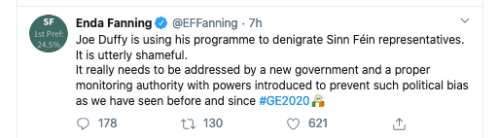
A prominent Dublin party activist by the name of Enda Fanning, who is a member of Sinn Fein’s ruling ard-comhairle, has used Twitter to  call for a new ‘monitoring authority’, ‘with powers’, to be set up by the incoming government to prevent criticism of elected Sinn Fein representatives by the media.

Here is the tweet issued by Mr Fanning yesterday afternoon which he published in response to items carried on RTE Radio One’s Joe Duffy programme and which Fanning said had ‘denigrated’ Sinn Fein representatives. Joe Duffy’s coverage, he claimed, was ‘utterly shameful’.

Sinn Fein was, of course, prominent in the campaign to repeal Section 31 of the Broadcasting Act which effectively censored that party from the airwaves in the South for most of the Troubles. The party presented itself to the world as a critic of government-led censorship and a friend of journalism in both Ireland and Britain.

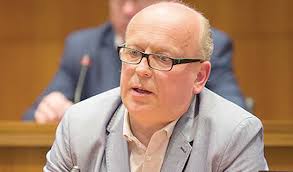
Former Dublin city councillor, Enda Fanning, wants a new government body to ban criticism of SF TD’s

But Mr Fanning’s tweet, which has not yet been disowned by Mary Lou McDonald or any of the party’s hierarchy, suggests that for some in SF that was merely a self-serving pose which hid a deeply authoritarian streak in the party’s make up and an intolerance of dissent that has a distinctly militaristic flavour.

Joe Duffy has the right to say whatever he wishes about Sinn Fein as long as he provides evidence to back up what he reports. Every journalist in Ireland should support him in his exercise of free speech and resist even the most misguided attempt to silence him.

Sinn Fein party leader Mary Lou McDonald needs to condemn Fanning’s remarks and publicly commit her party to the defence of the media’s right to free speech, especially in the reporting of her party.


‘They Haven’t Gone Away You Know’

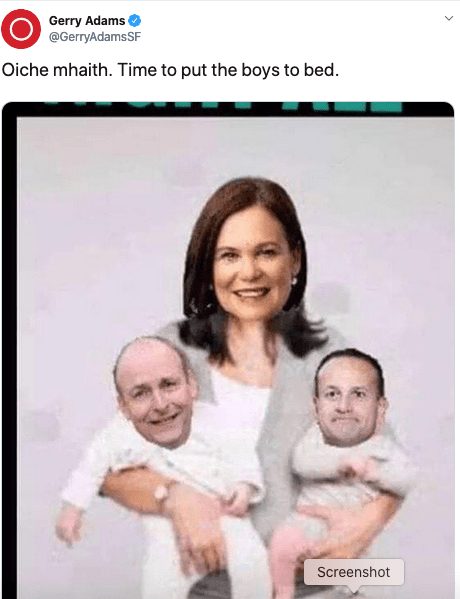
For a short while last night I thought that Gerry Adams might have finally grasped the nettle and had begun to prepare the way for the final chapter in the life of the Provisional IRA, with a tweet which proclaimed: ‘Time to put the boys to bed’.

It was only later that I realised this was a reference to a photo of Mary Lou McDonald, who I think, for economy’s purpose, we can call MLM from now on, holding two baby-sized figures of Leo Varadkar and Micheal Martin:

So, with significant elements of the media now ready to put the IRA question on the back shelf (I have just heard a reporter from Politico‘s European edition pronounce on the BBC World Service that the proof the IRA no longer existed or had influence on SF was the latter’s presence in a power sharing government with the DUP! I kid you not) both Fianna Fail and Fine Gael are likely to come under growing pressure to just drop the issue.

The problem for them is that the IRA has not gone away, most certainly in the North, where its continued existence as a smaller but none the less lethal force is seen as a deterrent to Loyalist violence, especially at this time of Unionist uncertainty and anxiety.

The Provos most certainly would not like to see the dissidents step into the breach should Loyalist paramilitaries re-activate. After all they came into being in 1969 as the defenders of the Catholic community, that was their raison d’etre. They are not about to hand that laurel over to anyone else.

There is another reason the IRA has not gone away and that is the financial nest egg – estimated a few years ago at some 400 million euros by the Irish government – that the IRA accumulated during the the peace process years (when the war was raging the IRA was always broke, but not after 1998).

That money was invested in apartments, hotels, bars and businesses in Ireland, Europe and elsewhere around the globe. That includes the £30 million or so stolen from the Northern Bank.

The IRA is also involved in the private security business, something that was midwifed by Ian Paisley, Martin McGuinness and current Gardai Commissioner, Drew Harris in his PSNI/MI5 days, and which provides regular income for many of their ex-Volunteers.

That money, the properties and businesses all belong to the IRA and no-one else (and God help the person who thinks otherwise). Someone has to look after it and to provide an income for retired or semi-retired Volunteers.

So there is a well-funded structure there which could, at reasonably short notice, be expanded in an emergency. In the meantime the managers of this apparatus can be seen at work in the corridors of Stormont and Leinster House, an arrangement that was described at some length, though with some discretion, by former SF TD Peader Toibin in this recent article.

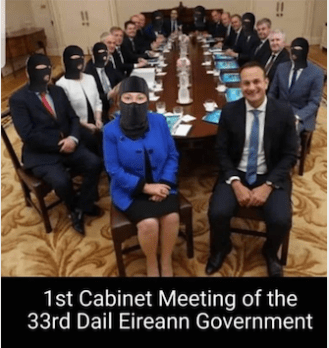
(A spoof photo doing the rounds on the internet captures the mainstream parties’ nightmare)

As the negotiations to form a new government begin do not be surprised to see the IRA question re-emerge and even dominate. Micheal Martin in particular cannot avoid it and nor can Leo Varadkar afford to be seen as softer on the question than his FF rival.

It might also suit Sinn Fein to force a second election out of such a deadlock in which they can then field a full slate of candidates and get close to the magic 81 seats by themselves, or with the help of some tame TD’s from one or other of the smaller parties.

The IRA hasn’t left the stage just yet, and it could play a significant role in the coming days. As Gerry Adams himself once proclaimed: ‘They haven’t gone away, you know!


Fintan O’Toole: A Man Who Cannot See A Bandwagon Without Jumping On It….

76A341D3-A6FA-4FC8-8504-0065B5C81961

https://www.irishtimes.com/opinion/fintan-o-toole-it-is-time-for-sinn-féin-to-come-in-from-the-cold-1.4160384

Does The IRA Still Call The Shots In Sinn Fein, So To Speak?

It remains to be seen whether, inspired by the likes of Una Mullally and others, The Irish Times’ leader writers are persuaded that the party led by Mary Lou McDonald is now  IRA-free, that an ocean of clear blue water separates Sinn Fein from its military wing, and that the 26 Co. electorate, due to go to the polls on February 8th, should no longer harbour reservations about that matter.

See here for the latest development.

But if the editorial team of Ireland’s paper of record is squirming with indecision and angst, its collective pen hovering hesitatingly and nervously over the opinion page, it could do worse than re-read this October, 2015 piece in their own paper by Colm Keena, then The Irish Times‘ Public Affairs correspondent (see full text below).

Keena, who was writing amid another crisis of confidence in the Good Friday Agreement caused by IRA activity, reminded his readers of a famous 1977 IRA Staff report which fell into the hands of the Gardai Special Branch.

That document set out the detail and terms of the so-called Adams’ cellular re-organisation of the IRA and definitively described the relationship between the military  and political wings of the Movement. It has never, to my knowledge, been retracted.

(This difficulty facing Mary Lou comes while in Belfast a senior republican is recovering in hospital from gunshot wounds arising from an attack believed to be linked to the Jock Davison/Kevin McGuigan IRA killings of 2015, incidents which led to Colm Keena putting pen to paper in The Irish Times in the first place. The recent victim was spared death by virtue of the bullet proof jacket he was wearing when he was shot? Why, in 2020, is such protection necessary?)

The 1977 re-organisation heralded a revival of the military side of the IRA and a rebirth of Sinn Fein under the leadership of Adams, Ivor Bell and Martin McGuinness, which in hindsight can be seen to carry the seeds of Sinn Fein’s eventual entry into electoral politics.

It needed only the life fluids of ten dead hunger strikers to nourish the growth of that plant into the abundant flora we see now, a blossom that seemingly is on the verge of sharing a shelf in the Cabinet Chamber of Government Buildings, Merrion Street.

The key sentence in that 1977 document reads: ‘Sinn Féin should come under army organisers at all levels.’ That is about as clear and unambiguous as it is possible to be.

Ted&Gerry

Ted Howell, flanked by Gerry Adams during the 1998 GFA negotiations in Belfast

The significance of the episode involving Ted Howell and Martin O Muilleoir over the CHI scandal is that it was fully and absolutely consistent with that sentence in the 1977 IRA document. I have known Ted Howell for many years and I can tell you he fits the bill. If you don’t believe me, go ask Noraid. Why would Sinn Fein south of Border order its affairs any differently? And what role does the IRA Director of Intelligence play in the Dail?

And when Mary Lou says that she and all SF candidates must now sign a pledge holding themselves ‘amenable’ to SF’s Ard-Chomhairle, as evidence that the IRA link has been broken, she begs the obvious question: ‘When and by whom was that statement of IRA supremacy over Sinn Fein – ‘at all levels’ – ever retracted?’.

The answer is ‘Never’ and ‘No-one’.

Here is that 2015 piece by Colm Keena:

IRA ‘oversight’ of Sinn Féin has roots in 1977 document

Gerry Adams part of group that sought to overhaul the republican movement

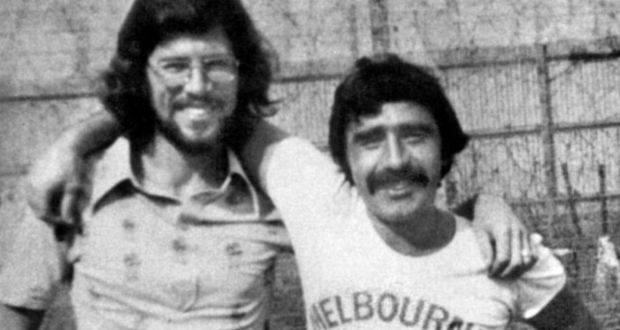
Gerry Adams in Long Kesh prison with Brendan Hughes. He would know whether the IRA oversees Sinn Fein

Gerry Adams in Long Kesh prison with Brendan Hughes. He would know whether the IRA oversees Sinn Fein

After last week’s report from the Secretary of State for Northern Ireland, Theresa Villiers, we know there is a body of congenitally conspiratorial men and women with access to guns who continue to think they control one of the most popular political movements on the island of Ireland.

However, it is typical of developments involving Sinn Féin and the IRA that the description of what is going on is ambiguous and inviting of speculation. Members of the IRA “believe” the organisation’s army council “oversees” both the IRA and Sinn Féin “with an overarching strategy”.

The report invites speculation that the men and women of the IRA might or might not be correct in their understanding as to what is going on. But if they don’t know, who does? Certainly not the electorate.

Gerry Adams is likely to have a good idea, but the extent to which anyone, inside or outside the republican movement, can comfortably rely for guidance from the man who says he was never in the IRA is itself a cause for concern.

He certainly has a clear understanding of the history of the relationship between the IRA and Sinn Féin and how it has evolved over the years. Back in the 1970s, he was part of a group that sought to overhaul the republican movement at a time when it was suffering from informers, declining morale and rejection by the communities on whose behalf it was supposedly fighting.

In late 1977, a document sketching out the new structure for the movement was found by the Garda in a flat occupied by IRA man Séamus Twomey. The malaise being experienced by the movement was to be addressed by a return to “secrecy and strict discipline”, it said.

“Army men must be in total control of all sections of the movement.” A new cell structure would help “gear ourselves towards a long-term armed struggle”.

Cells would be “specialised”, with “sniping cells, execution, bombing, robberies, etc” cells being put in place. “Sinn Féin should come under army organisers at all levels.” Sinn Féin’s work, the document said, “gains the respect of the people which in turn leads to increased support for the [IRA] cell”.

Echoes of 1970s strategy

Adams became president of Sinn Féin in 1983 and has held the position ever since. During that period, the main plot line has been that of the IRA dog being transformed into the Sinn Féin tail, and for that we can all be grateful. A lot of dying and suffering first had to occur along the way, however, and the Villiers report last week indicates the strategy being pursued by the IRA in the 1970s still has its echoes.

That the public wearily reacts to such a situation as being one of the prices to be paid for peace and almost unworthy of comment is an example of the damage the Provisional movement continues to do to public life, north and south of the Border.

Recently in this newspaper, former Fianna Fáil minister of state Martin Mansergh wrote that notwithstanding the mixed causes, motivations and results of the conflict in Northern Ireland, and the responsibilities of others, most people view the post-1969 IRA campaign as having been a major mistake from which it may take a long time to recover.

There must be very few people outside the membership files of Sinn Féin who would argue with that assessment, but that won’t stop Sinn Féin from trying to muddy the waters.

Murderous cause

In the wake of Sinn Féin’s successful performance in the 2014 local elections, Adams claimed the vote as support for the republican cause. Votes cast because of anger at social injustice, the bank bailout and other legitimate reasons were being claimed as support for a murderous cause that never received widespread support when it was under way.

It is better, of course, that people who in their early and middle adult years spent their time pursuing their political objectives by way of widespread misery and gore now spend their time delivering leaflets complaining about water charges and studying the latest Ipsos/MRBI opinion poll results in The Irish Times. That shouldn’t be allowed to take away from the dangers involved and the potential to further corrode the quality of public life north and south of the Border, however.

There was a type of lack of seriousness, and a willingness to pick and choose about rules, that lay behind the mismanagement of the economy during the boom years and the resultant economic crash. Voting for a political party with links to conspiratorial actors who occasionally indulge in murder is an odd response to a crisis with its roots in a failure of standards.

Colm Keena is Public Affairs Correspondent

Martin Dillon On Ruby Davison, An IRA Traitor and One Of Scap’s Spycatcher Colleagues

By Martin Dillon

Image result for funeral of ira men brendan davison

Spot the spies! Sinn Fein leaders give assassinated Ruby Davison an IRA send-off. Did they know he worked for British intelligence? On the extreme left, wearing a moustache is the IRA’s head spycatcher, also a British spy, Freddie Scappaticci

When I visited Belfast last November, I made my way to Milltown Cemetery where my parents, and many of my Dillon, Clarke and Carson relatives are buried. It was a cold, early morning when I strode through the pathways between the headstones, trying to recall the steps I took on Sundays as a child with my Uncle John Clarke. He knew the cemetery like a jig-saw puzzle he had repeatedly completed, upended and reset. I gazed at Black Mountain, no longer able to discern what was once known as the Hatchet Field. The mountain and its companion Divis Mountain, both towering over the city, held memories of the Blitz when Protestants and Catholics sheltered there nightly from Hitler’s Luftwaffe. They willingly put aside historical enmity and memories of the 1920 Pogroms because when a community is assailed from without it understands what binds it from within.

As I passed the Provisional IRA monument, I stopped momentarily, my eyes straying to a name, which I knew well – Brendan Davison. Some journalists have chosen over the years to spell his name Davidson, a fact that has not drawn much criticism from his family. Standing over his shared headstone, it struck me that some might reasonably conclude that Provisional IRA leaders had either mistakenly placed his name on a plaque in their hallowed ground, or they had been conned into thinking this Brendan Davison, whose nickname was “Ruby,” was an IRA hero like the others honoured in that same space, some of them hunger strikers. The decision to give “Ruby” Davison pride of place alongside Provisional IRA “heroes” was made in the immediate aftermath of his assassination in the Markets area of Belfast in 1988. The news of his demise was marked by the IRA’s assertion that he had been the victim of a Loyalist killer squad. The Provisionals accorded him what amounted to a state burial. When I exposed him as a British agent in my book, The Dirty War, the IRA denounced me, and some of his associates threatened my life.

Related image

Brendan ‘Ruby’ Davison

I subsequently pointed out that Davison was not just a British agent – his MI5 codename was Agent Ascot – he was one of the most important agents MI5 and Special Branch ran within the IRA during the Troubles. As the IRA Commander in the Markets area of Belfast, he had links to the IRA’s leadership and is operations throughout the city. He was in a position to betray IRA bombing runs into the city centre because the bombers often laid low in houses in the Markets before, or after their bombs exploded. He was also privy to IRA leadership plans for operations in other parts of the city,  Davison was not only an active, respected and feared IRA boss, he was a paedophile. That aspect of his secretive life was known to the IRA and his Intelligence handlers. Knowledge of his sexual proclivities gave his handlers sufficient dirt on him to keep him under their control. The fact that the IRA was aware of his perverted sexual history did not prevent them lionising him before, and especially after his death when they portrayed him as an IRA hero cut down in his prime by Loyalists. When I exposed him as British agent, the IRA refused to acknowledge the truth, just as they had overlooked his abuse of young boys in the Markets when he had total control of the area. They knew that he had a fondness for punishing local boys by spanking them with a wire brush. His legacy as a hero was later promoted and protected by his nephew, Gerard “Jock” Davison who was the IRA Commander in the Markets area. In 2015, he was shot dead in an IRA feud.

I think that it is fair to conclude that the IRA’s political leaders believe that they have successfully airbrushed the past, enabling them to leave Brendan Davison’s name and remains in their elaborately decorated Milltown Plot. They clearly hope that he will be admired and remembered with awe by future generations of young Republicans. That is so ridiculous; it is almost hard to believe. If Provisional Republican leaders had any integrity they would have had him interred elsewhere in Milltown, but of course they will not do that. It would be tantamount to admitting that they have known for three decades he was a British agent and paedophile; facts they have consistently lied about it.

This brings me to another issue: Who really murdered Davison in 1988?

Immediate suspicion fell on Loyalists. A security friend of mine, who knew him well, and claims he saved many lives by betraying the IRA, is like me unsure if the Loyalists alone were the guilty party. The hit was professionally planned and carried out by people who had accurate information about Davison’s exact location in the Markets area. On the morning he was killed, a young man who had spent the night with him was in his apartment, but his identity has remained secret. He knew nothing about the killing. Someone with close knowledge of Davison’s daily habits certainly did. At the time of his death, the IRA was becoming more and more suspicious of him. If its security people had arrested and brutally interrogated him, as they did many others, he might have given up a great deal of intelligence about his role as a spy. It should be noted that at this time, his friend, Freddie Scappaticci, was rising to prominence in the ranks of the Provisionals and he, too was a British agent. In fact, I believe that in his role as head of an IRA internal security unit, known as the “nuttin” squad” he helped shield Davison from IRA elements deeply suspicious of him.

Did the IRA kill Davison? One could argue that they had the means and intelligence to do it, and it would have been better for them to kill him than to interrogate and disappear him, given his deep roots in the IRA. His absence would have raised too many questions, and any hint that such a high ranking figure was a traitor would have generated serious morale issues among the rank and file who admired him.

Did the Loyalists kill him, and if so, why? The ranks of the Loyalist paramilitaries, especially the UDA, were replete with British agents. In East Belfast, a former British soldier, Brian Nelson, working for British Intelligence, ran the UDA’s Number One assassination unit. He provided the unit and other UDA killers with Intelligence on Republicans, which had been fed to him by his British Intel bosses. While the UDA targets were Republicans, more often than not they were not IRA members. Did those Intel bosses who selected targets for Nelson’s assassins mark Davison for death? If they did not, they had to surely know he had been marked for death since they were effectively running the people in charge of Loyalist hit squads throughout the city and beyond. Any Loyalist plan to kill a senior IRA figure like Davison would have come across the desks of Nelson, or other Loyalist leaders in MI5’s employ.

A source whom I trust suspects that there may have been a “rogue security forces element” that was unaware of Davison’s importance as an agent. The source asserts that MI5 and Special Branch know this truth, which is why they have always been reluctant to answer questions about his murder, fearing it might open up controversial lines of inquiry. It is not an unreasonable hypothesis, given that security figures I have contacted over the years have shied away from discussing it. Could it be that, aside from the higher level security operations which involved supplying Loyalists like Billy Wright and others with intelligence to target Republicans, there was another secret outfit carrying out its own assassinations? There was such a lower level operation in the early 70s known as the MRF – the Military Renaissance Force, sometimes referred to as the Military Reaction Force. Its creation was a throwback to Colonial operations in Aden, Cyprus and Kenya when the British used “counter gangs” to kill their enemies and to blame the killings on the groups they were targeting. Many of the MRF murders were branded sectarian killings by the authorities and the media. MRF hit squads had, as in Colonial times, terrorists in their ranks. The MRF trained members of IRA, UVF and UDA to operate with British soldiers, some of whom were members of the SAS. Their arsenal of weapons included the Thompson submachinegun, a gun closely associated with the IRA. By using the Thompson, the MRF knew that when they left Thompson bullet casing at a murder scene, blame would fall on the Provisionals or the Officials. Equally, it was a way of setting the two wings of the IRA at each other’s throats. It is my contention that the MRF squads may have killed many more people than we know. The BBC interviewed me about the MRF in the past decade, but the subsequent documentary was in my view incomplete. I suspected that it was not the fault of the programme makers but the BBC hierarchy in London under pressure from government lawyers. Knowing the way the MRF operated and its freelance-type strategies, it is possible that there could have been a similar “rogue security element” in the late 1980s which copied the MRF operations of the early 1970. An argument, which somehow contradicts that, is that targeted assassinations by the State had become more streamlined by the 1980s. Nevertheless, the prospect of rogue assassins cannot be ruled out since there remains so much we do not know about the Dirty War. There is much that remains hidden by the authorities which we may never know. I have been told that there has been an ongoing exercise to “scrub” highly sensitive security files from the Troubles because they could expose military and intelligence figures to legal action.

Before his death, Brendan “Ruby” Davison was becoming a liability for British counter intelligence chiefs. His paedophile lifestyle, allied to his often violent, erratic behavior stemming from his stressful role as Agent Ascot were gradually placing him at risk, leading to increasing chatter about him in the IRA’s internal security ranks. Threats by an IRA bomber in West Belfast to expose him as a traitor, led him to him outing his accuser as a spy and personally killing him. Knowing this, as they surely did, British Intel chiefs could have concluded that his days as a top agent in the IRA were numbered. Losing Davison would not at that point have seriously impacted counter- terror operations because a much bigger agent was already at the top of the IRA leadership chain in Belfast.
He was Davison’s close buddy, Freddie Scappaticci – Agent 6126 – with the MI5 codename, Stakeknife. He was a vicious narcissist and executioner who, like Davison, was an invaluable asset to British Intelligence. He and Ruby Davison shared a special relationship, often drinking together. I tend to believe there is much we do not know about this pair and what they shared. Scappaticci had an attachment to pornography and Davison was a paedophile. They each had to know the other’s sex secrets. Did each also know the other was a spy? It is an open question.

One of my sources speculated that Davison was used by his handlers to draw Scappaticci deep into the British Intelligence web, but I have no evidence to support the hypothesis. Nevertheless, I have often wondered why Scappaticci remarked, after Davison’s death, that he had failed his friend. It implied that he was in a position to protect him. If so, how? Did Scappaticci learn who murdered Davison? He would surely have demanded the information from his handlers, with whom he was very close. If indeed, a Loyalist hit squad was responsible, it is not inconceivable that it acted on the orders of the FRU – Research Unit – a British Military Intelligence outfit that was involved in many murders. It had carte blanche authority to do whatever it chose. I had links to MI5 and Special Branch. Was it the “rogue intelligence outfit” which one of my sources speculated killed Davison? That would be something Scappaticci might have subsequently learned, leading him to conclude that he could have saved Davison by asking his handlers to protect his friend. Perhaps, he could have warned them that Ruby was a spy for MI5 and Special Branch and should not be on one of their hit lists. As I say, there is much we do not know about these two British terrorist agents.
For its part, the IRA, as it did when faced with incontrovertible evidence about Davison’s treachery, refused to believe the truth about Scappaticci, even when it was clear that he was a traitor in their ranks. Unlike Davison, Scappaticci had and continues to have leverage over IRA leaders. While dead men like Davison tell no tales, Scappaticci is a living, walking encyclopedia of incriminating evidence against his former IRA colleagues. He knows enough to put many IRA operatives and leaders behind bars. He could if he wished name those who helped him run the “nuttin’ squad” or the leaders who approved his murders. The great irony about Scapp, as he is sometimes known, is that he was in charge of identifying and eliminating spies within the IRA, and yet he was the biggest spy of all. A former IRA man, who spoke to me about him, hinted that the IRA struck a deal with him when they learned that be was a British agent. They would not harm him, or his family, if he kept his mouth shut. That kind of deal suited everyone, including those British Intelligence figures who ran him. It makes IRA leaders less nervous about the prospect of ever being linked to a wide range of murders and violent acts.

For years since he was outed, Scapp had been living in Manchester under the watchful eye of MI5. He chose Manchester because it allowed him to attend matches of his favourite football club, Manchester United. MI5 spirited him back to Belfast last November to see his wife before she died. He has since been moved by his MI5 handlers to a small town north of Blackpool.

I believe that if Scappaticci had died, or been killed during the peace process of the 1990s, the IRA would have buried him with honours in its revered Milltown Plot alongside his buddy, Brendan “Ruby” Davison. There is no reason why they will not give him pride of place there at some time in the future since they have never, and will never likely admit that he was once the biggest British spy in their ranks.

Finally, I contend that if we were we to know the kinds of automatic weapons used to assassinate Davison, we might be in a better position to solve some of the mystery surrounding his sudden demise, who ordered his death, and the allegiances of the triggermen. For example, were the weapons parts of a batch that Brian Nelson helped acquire for the UDA, UVF and other loyalist paramilitary actors? Bullets casings at the murder scene in 1988, and bullet fragments removed from Davison’s body, could be matched to weapons seized from the UDA and UVF. And what about the PP weapon – Personal Protection weapon – which Davison often carried. I know that he had one, but there was no mention of it being found and removed from his apartment during searches of the property in the hours after his death. What kind of documentation was found among his possessions, and how much cash was he really holding? I know that his PP weapon had been provided to him by MI5 and that he kept cash payments from MI5 under his bed. Was the PP weapon removed from his apartment? If so, was it ever used in subsequent murders? The histology of the weapons would be an important element in an investigation of his murder. With that in mind, in August 2019, I requested details on the histology of the weapons from the PSNI under the Freedom of Information Act 2000.

The PSNI responded that it would not release this information to me.
I was informed that information was being withheld under Section 30 (1) Investigations and Proceedings conducted by Public Authorities – information held by public authority is exempt information if it is held for the purpose of any investigation which the public authority has a duty to conduct to withhold, with a view to it being ascertained if a person is going to be charged with an offence
It was PSNI speak for “Get lost!” and no mention was made of my query about Davison’s PP.

I penned a reply, asking for a review in which pointed out the following:
“The decision is especially difficult to understand in light of the fact that this murder does not appear to be linked to a live investigation. If evidence has come to light since it happened to encourage a new
Investigation, perhaps the family of the victim, and the public, should know that such a development has occurred. If there is no live investigation, why is the PSNI withholding the information I have requested, and when is it likely to release it?
……. If there is no ongoing investigation, why is this information on lock down?”

A reply was not long in coming. In October, I was again told my request had been rejected. However, the PSNI admitted that there was no live investigation, making my point that it was absurd that they were continuing to hide information about this murder almost three decades after it occurred. Who had placed a hold on it and why? One can only speculate. Clearly, there is something dirty in the shadows of this murder which some in the Intel community would prefer to remain classified. If this was simply an assassination carried out independently by UDA killers there would be no reason to deny my request for histology of the weapons. I contend that this killing falls neatly into the dirty war which has ongoing tentacles. For those who like detail, here is the reply, which I received from the PSNI:

This investigation is not currently a live investigation. However, the PSNI has a duty to protect all evidential/investigative information should further evidence come to light and as this was adequately explained within the response issued to you; I will not reiterate the rationale. In carrying out my review I have referred to the Information Commissioner’s Office’s (ICO) guidance on Section 30. PSNI is bound to deal with your request under the terms of the legislation which you have triggered when you submitted your request to us i.e. the Freedom of Information Act 2000. I would like to advise you that any information released under this legislation is considered to be a release into the public domain and not just to you as the requester. PSNI must therefore consider with all FOI requests whether the requested information is suitable to be placed into the public domain.

The ICO guidance advises that Section 30(1)(a)(i) is engaged if the information has been held “at any time” for the purpose of criminal investigations and proceedings. I have referred to the ICO guidance in relation to Section 30 which advises:

“8. Section 30(1) provides an exemption from the duty to disclose information that a public authority has held at any time for certain investigations or proceedings. As long as the other requirements of the exemption are satisfied, the exemption will apply to information even if it was not originally obtained or generated for one of those purposes and it will continue to protect information even if it is no longer being used for the specified investigation or proceeding. It is only necessary for the information to have been held at some point for those purposes.”

I have included the link to the ICO guidance on Section 30 Investigations and Proceedings which you may find helpful.

Click to access investigations-and-proceedings-foi-section-30.pdf

I have independently reviewed your request and I would agree that Section 30 (1)(a)(i) is engaged to your request for information.

If you remain unhappy about how your request has been handled you have the right to apply directly to the information Commissioner. The Information Commissioner’s local address is:-

Information Commissioner’s Office
3rd Floor
14 Cromac Place
Belfast
BT7 2JB

I am unhappy about the response. There is no reasonable justification for it, but I think that those of us who have carefully studied the dirty war know that this is a predictable response from hidden figures and organisations that ran part of that war.

I also know that seeking information about these issues under the Freedom of Information Act is a waste of time.

©Martin Dillon

Is There A Twist In The Robert Nairac/Irish News Story?

I’m told there is. We shall see,,,,,,,,

The Irish News And Robert Nairac: Where’s The Beef?

The Irish News led with the story (see above) this morning alleging that redacted Ministry of Defence documents handed over to a lawyer by the London government had named the missing – presumed killed and secretly buried by the IRA – British soldier, Robert Nairac as being involved in the Miami Showband massacre of 1975.

Three members of the popular band were killed and two UVF members died when the bomb they planted on the band’s van, designed to explode later and make it seem the band was involved in smuggling explosives, detonated prematurely, allegedly because of a faulty timer.

The Irish News story, which was by-lined by Connla Young and can be read below, is allegedly based on redacted Ministry of Defence documents which were handed over to a lawyer for a widow of one of the slain band members.

If true, the story is nothing short of sensational and scandalous, except that the story fails to back up this claim by quoting any passages from the British document(s) that support the story; nor does the paper reproduce any portions of the document(s), which would be normal journalistic practice. In short  no evidence was presented by the paper that the document(s) even exist or if they do that they genuinely reflect the thrust of The Irish News’ story.

So the question must be asked, why did The Irish News not follow standard journalistic practice? If the story is sound then it should be full of quotes from the document. But it is not. The Irish News needs to explain what happened. If the story is true then show us the evidence. If not, then the paper needs either to explain why no quotes from the document(s) were used or apologise to its readers for misleading them.

Thebrokenelbow.com emailed the author earlier today seeking access to the documents but late this evening Connla Young replied, saying she could not help.

This is an important issue for another reason. If The Irish News did not have evidence to support its story, such sloppiness undermines genuine efforts to discover the truth about controversial events involving British forces and discredits the journalistic profession as a whole. So the paper should produce the evidence if it has it, or explain why it ran with a story unsupported by independent facts.

Here is the text of The Irish News story:

Previously unseen British army intelligence documents have linked undercover British soldier Robert Nairac to the Miami Showband Massacre.

Three members of the band, including lead singer Fran O’Toole, died when loyalist killers stopped their minibus at a bogus UDR check point near Banbridge in Co Down in July 1975.

The attack was carried out by members the Glenanne Gang, which included RUC, UDR and UVF personnel.

Two loyalists also died when the bomb they were planting exploded prematurely.

British army documents have now linked SAS trained officer Robert Nairac to the atrocity.

While he has previously been connected to loyalist murders this is believed to be the first time MoD documents naming him have been made public.

Captain Nairac was abducted and killed by the IRA in 1977 and his body has never been found.

He is one of three people belonging to the group known as The Disappeared whose remains have yet to be located.

The Ministry of Defence papers were recently disclosed to solicitor Michael Flanigan who represents Fran O’Toole’s widow Valerie Andersen.

She is taking legal action against the MoD and PSNI chief constable.

It is understood the redacted documents contain suggestions that Captain Nairac obtained equipment and uniforms for the killers.

The file also claims that the British solider was responsible for the planning and execution of the attack.

Miami Showband massacre survivor Stephen Travers

Survivors, including justice campaigner Stephen Travers, have previously insisted a member of the killer gang spoke with an English accent.

In his 2015 book about the life of Captain Nairac, Alistair Kerr claimed the British soldier went on leave to Scotland on the same day as the Miami massacre.

Mr Travers last night said that when he learned of the document it was a “huge disappointment to me that I was right.

“It was the British army involved in the planning an execution,” he said.

It is believed many of the documents provided to Mr Flanigan have been redacted and that public interest immunity certificates have also been issued.

A hearing linked to the case is due to be heard in Belfast this morning.

Mr Flanigan last night said collusion was a feature.

“This is a case where collusion is self-evident and in those circumstances it is of concern that the defendants are seeking to rely so heavily on Public Interest immunity,” he said.

“We feel the state should be as open as possible in a case of this nature and will be asking the court to look at this issue.”