Thanks to MB for the tip. There really can’t be a graver offence for a journalist to commit than to claim someone has died when in fact they are very much alive, even if the person involved is a notorious UVF supergrass. Over to the Tele’s new owners, Mediahuis:
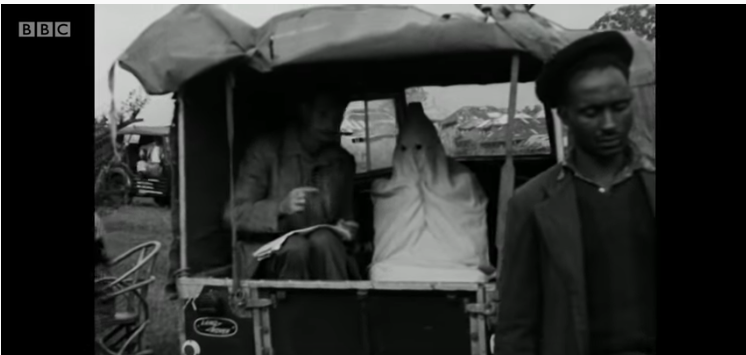
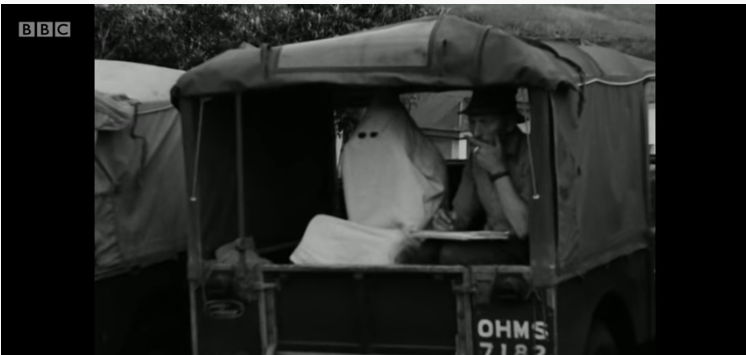
Those of my readers who were able to watch the television documentary ‘I, Dolours‘ will, I hope, remember that part of Dolours Price’s interview in which she described how, after being given a bye-ball by Brendan Hughes following her admission that she had been working for the British Army, the IRA in the lower Falls recognised Jean McConville in Hastings Street RUC barracks, draped in a blanket which was fitted with eye-holes, as she allegedly resumed her spying career by scrutinising a parade of IRA suspects who had been arrested by British troops.
Today I was watching Can’t Get You Out Of My Head, another brilliant film (which you can access on YouTube) made by that strange genius Adam Curtis, which begins with the end of empire in the post-war years, heralded by an uprising in Kenya, spear headed by the IRA of its time and place, an organisation called the Mau-Mau.,
One of the military minds leading the British fightback against the Mau-Mau was a young British subaltern by the name of Frank Kitson who would, some two decades later, as General Frank Kitson, command British military forces in Belfast in their war against the Irish Mau-Mau, the Provisional IRA.
Very early in the film there are scenes of the British Army in action in Kenya which those people who were paraded in front of a blanket-draped housewife in a Belfast police station all those years later would immediately recognise as mirroring their own experience. All that is different is the skin colour of those behind the hoods:
According to the article ‘Reg’s Working Class Party‘, Roy Greenslade was still a member of the CPB (ML), the Maoist Communist Party in Britain, when he went to Sussex University in 1974. The relevant section reads:
….the Party was not without its share of intellectual talent whose names entered the public arena:‘Bill’ William Franklin Ash, the writer, married to Ranjana Sidhanta Ash, freelance lecturer and writer of South Asian literatures, Roy Greenslade , an experienced tabloid news sub before going to Sussex University in 1974, and its share of teachers, Dorothy Birch and lecturers, Fawi Ibrahim at Willesden College of Technology, and the former LSE lecturer Nick Bateson.
We also know from his own writing that he was converted to the cause of physical force Irish republicanism, i.e. support for the Provisional IRA, in 1972 when he was in Derry at the time of Bloody Sunday, some two years before he went to Sussex University. So, presumably, he was a Maoist at the time. Also presumably, the IRA in Derry, then as later with Martin McGuinness as one of its leaders, regarded him then as a fraternal comrade at least.
And also presumably, the Provos in Derry continued to regard him in that favorable, dare one say comradely light in the intervening years, even when he became a full-time journalist, perhaps going so as far as opening doors to him closed to others – and granting him access to figures like Pat Doherty, one time Army Council member, IRA intelligence chief and the man whose job it was to locate venues in Co Donegal for high level IRA meetings, including the 1997 Army Convention, who became his friend.
That would make Roy Greenslade a very well connected man. Interesting, yes?
Yes, it’s true and thanks to TR for the tip, although Greenslade’s journey from Maoism to anti-Scargillism, to Provo fellow traveller does seem as if it could have been plucked from a Monty Python script. It seems that when Greenslade was a callow youth, well sort of, he was a member of the Communist Party of Great Britain (Marxist-Leninist), a Maoist breakaway from the pro-Soviet British Communist Party.
Here is the relevant part of a history of the CPGB (ML) taken from high-tide.pdf (High Tide: Reg’s Working Class Party)
The CPB (ML) reflected its leader with similar strengths and weaknesses: basically militant trade unionist, anti‐intellectual in temperament and regardless of it professed allegiance to Marxism‐Leninism, almost non‐ideological, operating with a set of beliefs instead of theoretical analyses and political correction in the light of practice. The theoretical poverty of the organisation was ‘well developed’ in what was the largest Maoist organisation in Britain. However the Party was not without its share of intellectual talent whose names entered the public arena: ‘Bill’ William Franklin Ash, the writer, married to Ranjana Sidhanta Ash, freelance lecturer and writer of South Asian literatures, Roy Greenslade , an experienced tabloid news sub before going to Sussex University in 1974, and its share of teachers, Dorothy Birch and lecturers, Fawi Ibrahim at Willesden College of Technology, and the former LSE lecturer Nick Bateson.
Interestingly, given the arc of Greenslade’s subsquent political journey, he was still in the Maoist group at the time of Bloody Sunday in Derry, the point at which, he says, his sympathy for the republican cause was born. When he finally broke with the party, and joined Robert Maxwell in trashing Arthur Scargill and the miners’ strike, remains an unanswered question. But seemingly his sympathy for the Provos survived.
But somehow wraps its all up in the peace process. Former Guardian editor, Alan Rusbridger today addressed what is arguably one of the most discreditable episodes in the paper’s recent history by devoting fourteen paragraphs of a twenty-three paragraph apologia on Greenslade to the Irish peace process and his/The Guardian’s role in helping Martin McGuinness and Gerry Adams negotiate their tortuous way towards IRA decommissioning. The embarrassment of Roy Greenslade is tacked on at the end, almost an afterthought, couched in ‘wouldn’t it have better if he had come clean about his IRA sympathies’ terms with a nod of regret in the direction of the much-abused Mairia Cahill. I doubt this will do. You can read the whole thing here. Thanks to PM for the tip.
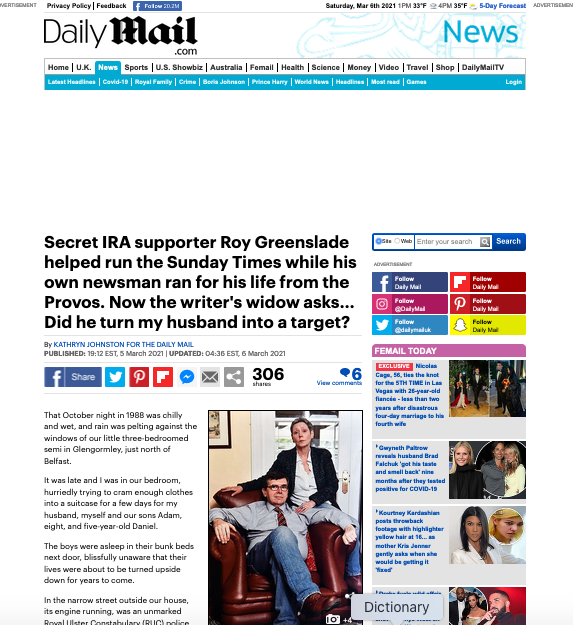
I can verify Kathryn Johnston’s account of an IRA plot to kill her husband, Liam Clarke in 1988 which she described in an article published in the Daily Mail yesterday. Several months after Clarke learned of the plot and left Belfast with his family, I was told about the plot by a senior Loyalist paramilitary leader who had himself been told about it by a senior figure in the RUC Special Branch.
In her article, Kathryn Johnston raised serious questions about the possible role in the plot played by Clarke’s then line manager in The Sunday Times, Roy Greenslade who has recently admitted being a secret supporter of the IRA and its armed campaign as early as 1972, more than a decade before the threat to Clarke.
She asked Greenslade to answer the following questions: ‘Did he know in advance about the IRA threat to kill my husband in 1988? Does he agree that by concealing his allegiance to the IRA he was lacking in his duty of care to a colleague who risked his life covering the Troubles and the Peace Process? And why, in 1995, did he accuse Liam of involvement with British intelligence and endanger him and his family?’
Roy Greenslade at a Sinn Fein event
Johnston wrote that the drama surrounding her husband began with an anonymous phone call warning him not to keep an appointment with a source arranged for the following day: ‘Liam told me he had been tipped off about a plot to kill him the next day. The plan was to lure him to a crowded bar in Belfast to meet a source, abduct him, shoot him in the head, then dump his body.’
The family fled to London where they stayed until they felt it safe to return to Ireland and decided to settle in Coleraine.
I was told about the plot to kill Liam Clarke by the late Shankill Road UDA leader Tommy Lyttle who told me that Clarke had arranged to meet a republican source in Maddens Bar in Berry Street at the bottom of Divis Street and this would provide the IRA with the opportunity to attack him.
Then, as now, Maddens was a popular haunt for Irish music fans but was regarded as being vulnerable to Loyalist attacks and so was avoided by heavy duty IRA types who preferred the more inaccessible Kelly’s Cellars around the corner, or drinking clubs deeper in west Belfast.
Maddens Bar
The version of events offered by the UDA chief differed in one major respect from the plot described by Clarke’s widow in the Daily Mail; in her version, her husband was to be abducted, shot dead and his remains ‘dumped’. In Tommy Lyttle’s telling, Clarke was to be shot dead in Maddens. The gunman would be the IRA’s then Belfast Brigade commander who was said to be especially irked by Clarke’s journalism.
Tommy Lyttle’s source was an RUC Special Branch man who called himself ‘Bertie Scott’, a figure who appears to have had a semi-advisory role in the UDA’s upper reaches. Lyttle inherited him when the South East Antrim Brigadier died and he is believed to have played a crucial role in persuading the UDA’s Inner Council to press the West Belfast UDA to abandon a well advanced plan to kill Gerry Adams by attaching a limpet mine to his car. The British Army spy, Brian Nelson was also privy to the plot. ‘Bertie Scott’s’ existence raises the darkest of questions about the RUC’s relationship with the North’s largest and most violent Loyalist group.
You can read Kathryn Johnston’s Daily Mail article here.
Many thanks to JM for this tip. In recent days, former Guardian columnist and journalistic academic, Roy Greenslade has presented himself to the world as a secret but stout ally of the IRA’s political wing Sinn Fein. He has, however, been less vocal about his past support for Margaret Thatcher’s campaign in the 1980’s to destroy the National Union of Mineworkers and its leader Arthur Scargill, by running what he later admitted was ‘a major smear campaign’ against Scargill while editing the Daily Mirror, then owned by the distinctly spookish Robert Maxwell, himself suspected of being an asset of Israeli and other Western intelligence agencies. During that episode, Greenslade insisted that the Mirror pay a huge sum of money to informer Roger Windsor, an ex NUM full-timer suspected, based on a considerable amount of hard evidence, of being a British State spy. Perhaps Sinn Fein would be wise to have a closer look at their English friend. You can read more here.
Pick up a copy from your newsagent, or log in to The Guardian or The Irish Times and search for a mention of Roy Greenslade’s admission this week that for many years he was a closet Provo who hid his sympathy for the IRA and you will be disappointed. Greenslade wrote a weekly column for The Guardian for more than a decade while he was often cited as a reliable source on British and Irish matters by the Times. But not a peep from either of them. As if it had never happened.
A bit of a hit job here on Roy Greenslade courtesy of one of The Men From The Daily Mail, who failed to make the link between Greenslade’s Donegal pal, Pat Doherty and the Balcome Street gang, but otherwise strong enough to wonder why Greenslade did it, given the negative fallout. File under ‘own goal’?
You can read Roy Greenslade’s admission of his sympathy and support for Sinn Fein here. I can’t speak for the other journalists he names but for my part the problem with his semi-secret endorsement of the Provos was that when he joined their ranks he entirely discarded the critical faculties that good journalists regard as vital for their work. In short, he became a Sinn Fein hack.





 The Broken Elbow
You must be logged in to post a comment.