I thought the Guardian actually missed the real story, which was a) that Corbyn was there at all, b) acknowledged with a wreath of poppies a war (1914-1918) most historians agree was fought in the interests of British imperialism, and c) was wearing a smart suit complete with a neat shirt and tie. Michael Foot how are ye?
Michael Foot at the cenotaph
In which case perhaps the headline should really have read: “Left-wing Labour Leader’s House Training Going Well”.
Powell’s NGO ‘works closely with MI6’, says Hillary Clinton email.
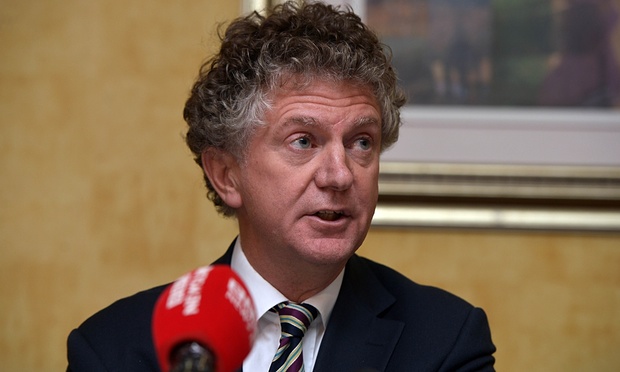
If, like myself, you were puzzled and even intrigued by the re-appearance in Belfast recently of Tony Blair’s ex-chief of staff, Jonathan Powell, and especially because he was in the company of Loyalist paramilitary leaders, then I may have an explanation.
But first a reminder of who Powell is and was.
A former journalist turned diplomat whose brother Charles, was Margaret Thatcher’s foreign policy adviser, Jonathan Powell teamed up with Blair in the early 1990’s after Blair ascended to the Labour leadership. And when Blair won the 1997 general election the new occupant of 10 Downing Street invited him to be his chief-of-staff.
Jonathan Powell, ex-Blair aide now runs Inter Mediate
It says a lot about Powell’s loyalty and value to Blair that he was the only one of his non-ministerial appointees to survive the often turbulent decade of New Labour in power. Not even Alastair Campbell could survive the machinations of New Labour, but Jonathan Powell somehow did.
In Ireland, of course, he will be remembered for his role as contact man between the IRA and Sinn Fein leadership and Downing Street during the seemingly endless negotiations that constituted the peace process.
Some of the other parties involved in the talks, many in Dublin but many more in Washington say that if the negotiations seemed to be unending then it was in no small measure down to Powell.
While the White House and the Irish Department of Justice believed, by the early 2000’s, that the time was ripe for playing hardball with the Provos, not least because Adams’ leadership was secure from dissident threat, Powell, supported by Blair, argued in favour of continuing the concession policy, presumably on the basis that the more the Provos were given, the more likely they would be to end their war and the less likely they would be shot in their beds by angry rivals.
The Powell/Blair approach also favoured turning a blind eye to continuing IRA activity – the December 2004, £26.5 million robbery of the Northern Bank in Belfast being a glaring example – in case hardliners took offense and turned against Adams.
The result was that the peace process became a world without end. And from the Provos’ point of view, why not? If Blair & Co were ready to give, give and give, why should they, of all people, call a halt?
The tensions between the three governments over the Blair/Powell approach to the IRA was, perhaps, best illustrated by the review of Powell’s post-peace process memoir, ‘Great Hatred, Little Room…’ written by the Bush ambassador to the peace process, Mitchell Reiss.
It contained this immortal paragraph, which succinctly summarised the Powell/Blair approach to negotiating with the IRA:
In July 2005, the IRA had finally agreed to decommission all its weapons. At the last minute, Adams called No. 10 to demand that some of the weapons not be destroyed so that the IRA could arm itself against possible attacks from dissident members. Unless this was allowed, he threatened, decommissioning would not proceed. The Blair government conceded, but wanted to check with Dublin. Irish Justice Minister Michael McDowell refused to acquiesce in the backsliding, despite enormous pressure. Powell told Adams of the problem, and Adams gave way. Decommissioning took place as planned.
When Blair left office, Jonathan Powell departed too. But while Blair almost immediately cashed in on the Irish peace process, securing the job of Middle East peace envoy amongst other lucrative opportunities – Powell became a banker, joining Morgan Stanley for a couple of years.
But then in 2011, having published a memoir of his time peace-making in Ireland, he decided it was time to cash in on his own experience and set up something called Inter Mediate, which describes its mission thus:
Inter Mediate’s mission is to advance conflict resolution and reconciliation through dialogue and mediation with the aim of achieving lasting settlement to violent and complex conflicts.
In 2014, Powell was appointed special UK envoy to Libya to engage in dialogue with the various warring groups, activity that doubtless has been performed via the good offices of Inter Mediate.
Thanks to some smart sleuthing by Chuck Ross of The Daily Caller, a libertarian website based in Washington DC, we now know a little more about Jonathan Powell’s Inter Mediate and its links to the British foreign policy establishment, including SIS, the Secret Intelligence Service aka MI6.
The evidence comes in the form of one of the thousands of emails that Hillary Clinton has been obliged to disclose to a Congressional committee investigating the background to the so-called Benghazi affair.
Hillary Clinton, then First Lady, meets new British Labour leader Tony Blair (right) at a reception in the home of SIdney Blumenthal (left)
This particular email unearthed by Ross is from a close buddy of Hillary Clinton by the name of Sidney Blumenthal who, if this Ken Silverstein profile is a reliable guide, is one of the most odious figures in American politics. Blumenthal and Jonathan Powell have been friends since the early 1990’s, when Powell was First Secretary at the British embassy in Washington.
Here is the email, which unashamedly touts business for Powell. ‘H’ is Hillary Clinton and ‘Sid’ is Sidney Blumethal. Note Hillary’s response: ‘I’d like to see Powell when he’s in the building’:
You will also, I hope, notice the line: ‘We work closely with FCO (Foreign and Commonwealth Office), NSC (National Security Council) and SIS in London…..’
So anyone dealing with Jonathan Powell and InterMediate should be aware that everything they do and say will probably make its way back to MI6 headquarters.
MI6 Headquarters on the south bank of the River Thames
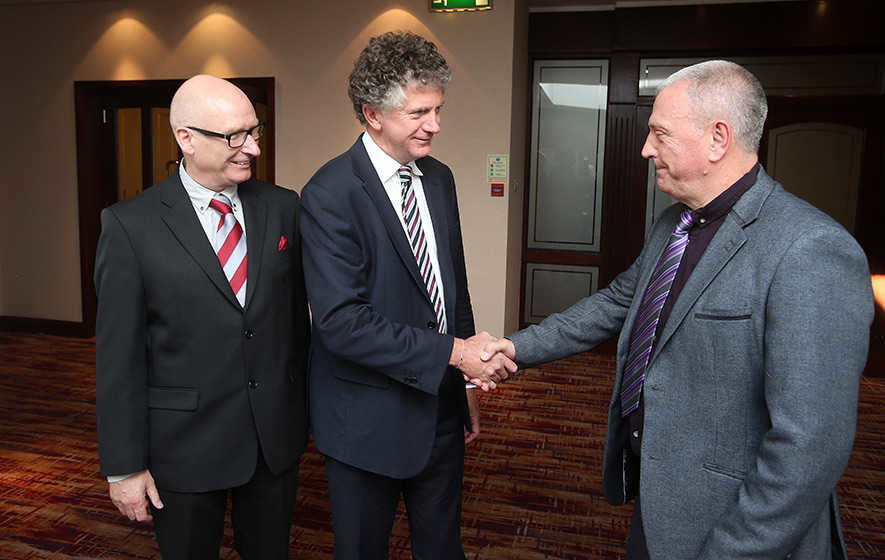
That now includes Jackie McDonald of the UDA and Billy Hutchinson, leader of the PUP, the UVF’s political wing who met with Jonathan Powell, in his Inter Mediate capacity, in Belfast in mid-October and agreed the establishment of a new Loyalist Communities Council.
Jonathan Powell meets Jackie McDonald (UDA) on the right and Billy Hutchinson (PUP) on left.
CORRECTION – Apparently the Belfast Telegraph’s decision to allow Martin Galvin a right of reply to Ruth Dudley Edwards’ article followed negotiations between the paper and Galvin after a complaint had been lodged with IPSO. It was an indirect rather than direct consequence of the complaint
Regular readers of this blog will know by now that thebrokenelbow.com does not have much regard for the integrity, independence and courage of IPSO, the post Leveson inquiry press ‘regulator’ whose job is to investigate readers’ complaints about low standards in high places in the British print media world.
Critics say that the Independent Press Standards Organisation, to give it its full title, is a creature of the press bosses and does not have the necessary power to punish erring newspapers with sufficient requital. My own experience with IPSO’s handling of a complaint about The Irish News’ fictitious coverage of the ‘Winky’ Rea case – read here, here and here – bore out that critique when it ruled against my complaint that The Irish News had invented a story about Rea’s oral history interview with Boston College.
So, it is a bit strange to report today that after IPSO ruled in favor of former Noraid publicity director Martin Galvin, the Belfast Telegraph has complied with an order to publish a right of reply to a quite extraordinarily hostile and venomous article about him written by that scourge of everything Irish-American and Irish Republican, Ruth Dudley Edwards and published in the same paper.
Even so, it took nine months for this to happen and Galvin was obliged to hire the services of Paul Tweed, a quite fearsome – and expensive – libel lawyer based in Belfast to achieve movement in his case.
I reproduce below the two articles, the first is Galvin’s reply which is due to appear in print sometime this week, the second is the Dudley Edwards’ article which sparked the whole thing off in January this year.
Martin Galvin
Reply to Ruth Dudley Edwards
RUTH DUDLEY EDWARDS-BELFAST TELEGRAPH COMPLAINT
A chara,
Imagine writing that British rule in Ireland was motivated solely by “hatred,” and Unionists supporting this “curse” could be labeled “ignorant, gullible or malign” or “typical of a particularly stupid strain”. Then claim that supporters of British forces “liked people to kill.” There would be a furious reaction to sentiments that seemed more bigotry than reasoned commentary.
Now apply those quoted words to the Irish leaders honored in 1916 commemorations, to American supporters of Irish independence or reunification from the mid-nineteenth century onwards, and then add Ms. Edwards’ insulting Irish-Americans while targeting me and readers may understand my indignation.
There is nothing new in British officials or apologists, blaming Irish Americans for civil rights protests or armed resistance to British rule. During my years as a National Director of the Irish Northern Aid Committee and Editor of the IRISH PEOPLE NEWSPAPER, British officials often resorted to this myth. It was designed to divert attention away from the inequities and injustices within British rule that were the real causes of conflict.
One typical illustration followed the murder of civil rights lawyer Pat Finucane in 1989. We charged British complicity and collusion in his murder in major protests and in Congress. The British Ambassador was outraged. He said the British government would never soil its hands with such misdeeds. Only misinformed Irish Americans would entertain such accusations. More than 20 years later, British secretary Owen Paterson apologized for collusion and the parts played in this murder by paid British Army and RUC agents.
Books and documentaries have exposed British collusion with loyalists in crimes back to the early 1970s, including 120 Glennane Gang murders and Dublin-Monaghan bombings. Irish-Americans were right, and decades ahead. British officials were misled or deliberately misled others.
Recently Martin McGuinness told reporter Eamonn Mallie, he had been “proud to be a member of the IRA.” Is it really plausible to suggest that those, including the Deputy First Minister of the British administration, who once fought to end British rule were not moved to do so by discrimination, or Internment or Bloody Sunday, but because Americans like me were aiding the families of Republican prisoners and highlighting injustice?
Ms Edwards takes this fiction to unprecedented extremes. Those who proclaimed an Irish Republic in her native Dublin in 1916 will be celebrated by millions for the Easter Rising which ultimately led to independence for 26 counties. Executed labour leader, James Connolly said of his British firing squad, “I will say a prayer for all brave men who do their duty according to their own lights.” Surely he and other leaders, who millions honour as patriots, deserve better than a sneering category “killed and died for hatred”
Ms. Edwards is correct that from the mid-nineteenth century onwards, there have been Americans who believed Ireland would be better served by independent Irish government than by British rule. Indeed she might have pointed to the beginning of that century and United Irishmen. They were proven right by British policies a half- century later, during the Great Hunger.
Their heirs in this generation marched the streets, flooded Congressional offices and Presidential forums until a Presidential candidate named Bill Clinton pledged in response to my question, that he would end visa censorship against Sinn Fein and put the north back on the American agenda. It is a proud legacy.
Certainly the commitment and contributions of Irish-Americans towards achieving a united Ireland may be unwelcome by some readers. I make no apology. Let us disagree in Connolly’s spirit, respecting others who do what they believe right according to their own differing lights. Would it not be “ignorant, gullible or malign” to do otherwise?
Slan,
MARTIN GALVIN
Ruth Dudley Edwards
Belfast Telegraph
Martin Galvin: He may be older, but his hatred remains intact
By Ruth Dudley Edwards
Published
26/01/2015
Remember Martin Galvin, that attention-seeking Irish-American who liked people to kill for Ireland? Well, he’s announced that conditions don’t exist at present for “the continuation of the armed struggle”. Why?
Galvin came to prominence as the publicity director for Irish Northern Aid (Noraid), which from the early-1970s claimed to raise money for the families of republican prisoners. Of course, by taking a financial burden off the IRA, they freed up money for weapons.
They also, said Galvin, ran “educational programs in the US,” which is a nice euphemism for spreading hate-filled anti-British propaganda.
Among those who believed that Noraid also raised money for US arms shipments to Northern Ireland was the US Department of Justice, which took them to court to demand they register the Provisional IRA as their “foreign principal”.
The judge ruled: “The uncontroverted evidence is that [Noraid] is an agent of the IRA, providing money and services for other than relief purposes.”
Noraid continued merrily on, shaking buckets in Irish pubs and extracting donations from ignorant, gullible or malign Irish-Americans.
From the mid-19th century, the island of Ireland was cursed by the interference of bitter Fenian exiles and their followers, who fomented and financed revolution.
They sat in their armchairs exulting as people thousands of miles away killed and died for hatred. Without them, there would almost certainly have been no rising in 1916.
Galvin was one of their heirs. He explained once that, as a 20-year-old New York fireman’s son, he visited Ireland and discovered that, 60 years earlier, his grandfather had emigrated because “an English landlord had determined that he could get a higher price from the field that my family farmed to support itself”.
This “made me see that this system, which had oppressed members of my own family, is oppressing people today”.
Galvin is typical of a particularly stupid, tunnel-visioned strain in Irish-America, that finds a romantic vision that suits and never questions it.
The only time I lost my temper on the US lecture circuit was when two Noraid women, who had never set foot in Ireland, told me I didn’t have a single drop of Irish blood in my veins.
Galvin, however, liked a bit of action and did sometimes visit. In 1984, at a time when he was excluded from the United Kingdom, he snuck into Northern Ireland to appear on republican platforms.
Violence broke out when the RUC tried to arrest him at a rally outside the Sinn Fein Belfast offices and, in the ensuing melee, Sean Downes was killed by a plastic bullet.
The police reservist who shot him was cleared of manslaughter after the judge saw a video of events, but, of course, for Galvin and Sinn Fein, his death – which they called murder – was a heaven-sent propaganda opportunity.
Galvin fell out with Sinn Fein over the peace process and quit Noraid. He became best friends with the Real IRA and Michael and Bernadette McKevitt, becoming the US support group for their 32 County Sovereignty Committee.
His comment on the Omagh bomb was: “People have to not simply react to the immediate, but to look to the bigger picture.”
Galvin has adjusted his sights a bit, thrilled to have been nominated as an aide to the Grand Marshal in this year’s Ancient Order of Hibernians St Patrick’s Day New York shindig. The Grand Marshal is Cardinal Dolan, Archbishop of New York.
Clearly, he had to make a big concession to avoid being blocked in the present climate, which is why he wrote an open letter to the AOH in which he said: “It is categorically untrue that I support armed actions today by any IRA, or as your writer puts it, ‘denounce the Sinn Fein leadership as traitors.'”
He’ll have his parade, but his hatred will remain intact. It’s clear from a recent interview that he hopes that politics will fail so “nationalist areas, or at minimum in republican heartlands” will give support again to violence.
As the Omagh relatives said in 2000 in a Press release after picketing a 32CSM fundraising event in which Galvin starred, he “is contributing nothing to the people of Ireland only misery”.
He is one of the most notorious British agents of the Troubles (not counting Freddie Scappaticci and the estimated one-in-three IRA members who were on the payroll of various British intelligence agencies by the time the peace process got serious.)
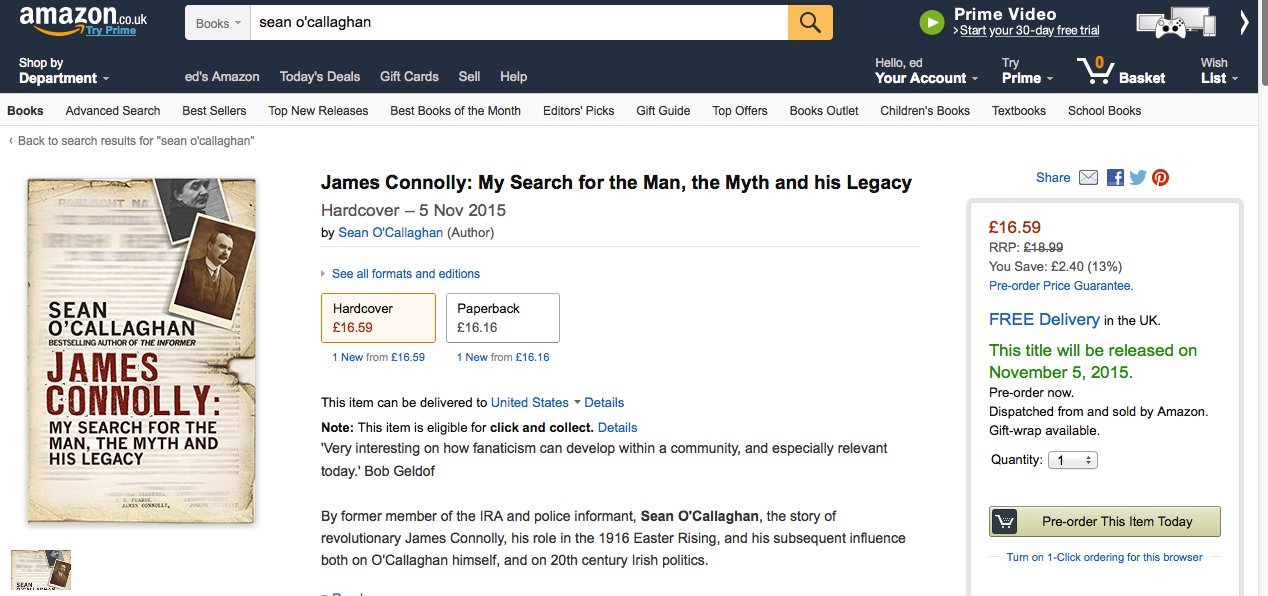
Sean O’Callaghan has now written a second book, this time about James Connolly. Yes, I’m serious. James Connolly. In the same sentence as Sean O’Callaghan!
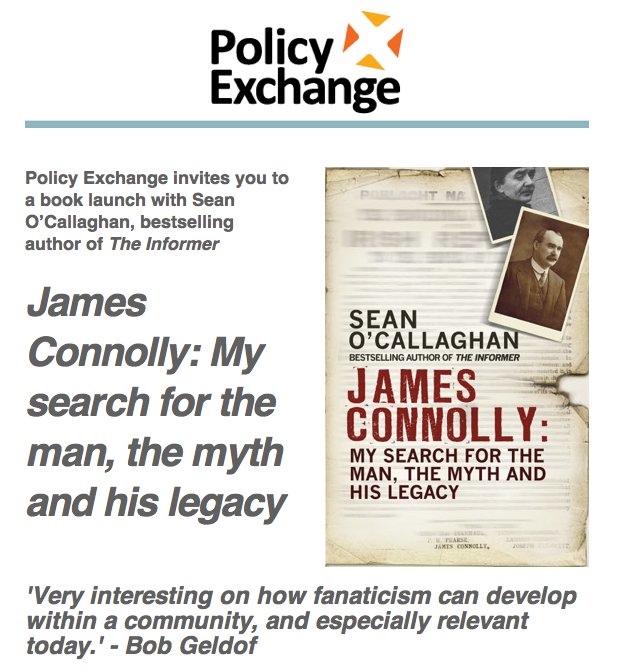
Published by a Random House imprint it is to be launched next Wednesday in London, at the headquarters of Policy Exchange, a leading Tory Party think tank.
Policy Exchange, co-founded by Tory Minister Michael Gove and once led by Daily Telegraph editor Charles Moore and later by Bush adviser David Frum (he of ‘the axis of evil’ speech), is now headed by Dean Godson, biographer of David Trimble and well known for his support of neoconservative causes, not least Israel’s unrelenting belligerence towards the Palestinians, and a biting hostility to British Islam.
Dean Godson – head of Policy Exchange
Policy Exchange has been described by The Daily Telegraph as, “the largest, but also the most influential think tank on the right” and is said to be David Cameron’s favourite source of policy ideas.
O’Callaghan played an important role fueling the British neoconservative analysis of the Irish peace process. This was based upon the idea that Gerry Adams & Co were really fooling the British, Irish and American governments into thinking they were genuine about peace while all the time waiting for the opportune moment- viz. a weakening of British will – to resume the IRA’s armed campaign.
The governments were therefore foolish, said the neocons, to engage in dialogue with the Provos, just as the US government would be foolish to encourage dialogue with Palestinians, Iranians and so on. Terrorist groups/regimes were unfailingly duplicitous, should never be talked to and must always be opposed by force of arms. Imagine Netanyahu stalking the streets of Belfast and you get the idea.
O’Callaghan’s role was to provide evidence of this duplicity even though it had been many, many years since he had access to the IRA’s inner councils. In truth he had no idea what was in the mind of Gerry Adams etc, but that was a minor detail.
The passage of time, if not an outbreak of common sense, has demonstrated how ludicrous was this neocon analysis. A moment’s reflection would have revealed an essential truth: you never tell lies to people who are predisposed to disbelieve you. You only deceive those who think every word you utter is gold-plated truth.
But what then to do with Mr O’Callaghan? After all there aren’t too many IRA veterans around who are so amenable to neocon blandishments. Might as well use him for something!
A clue possibly exists with the ringing endorsement given to O’Callaghan’s book by Sir Bob Geldof whose comment to Policy Exchange went like this:
Very interesting on how fanaticism can develop within a community, and especially relevant today.
That comment, underlining ‘fanaticism’, makes me wonder if the purpose of this exercise is to demonstrate how James Connolly and Jeremy Corbyn are really cut from the same extreme cloth. When you consider how much ink Policy Exchange’s big fan, The Daily Telegraph, has spilled documenting the various links between the Provos and the Corbyn team, the idea doesn’t seem so far-fetched.
Or, perhaps he is really talking about the similitude of James Connolly and the Prophet Mohammed.
Or both?
We shall see.
The Policy Exchance blurb continues:
Policy Exchange is delighted to welcome Sean O’Callaghan to the Ideas Space to launch his new book, James Connolly: My search for the man, the myth and his legacy. Sean O’Callaghan, a former senior member of the IRA, described as “the most important intelligence agent in the history of the Irish State” tells the story of revolutionary James Connolly, his role in the 1916 Easter Rising, and his subsequent influence both on O’Callaghan himself, and on 20th century Irish and British politics. Sean’s talk will be followed by a few words from Dr John Bew, Reader in History and Foreign Policy at the War Studies Department at King’s College London and Director of the International Centre for the Study of Radicalisation and Political Violence.
The Irish Times has today announced on its internet edition that it intends to mark the 35th anniversary of the 1981 IRA/INLA hunger strikes in 2016 by publishing a series of articles throughout the year, some written by academics and some culled from the paper’s archive from 1980 and 1981, aimed at ‘re-thinking’ the historic protests.
These will appear only on the web edition of the Times and will culminate in what the paper calls ‘a symposium’ on the subject.
This is how it described the mission:
Over the course of the next year, The Irish Times online will be publishing a series of articles by established and upcoming academics, exploring the strikes and their legacies from a huge range of perspectives, as well as republishing articles from its own archive and looking back from today’s standpoint with the intention of shedding new light on a seminal event in recent Irish history and familiarising a younger generation with this complex and contested episode.
I am sure regular readers of this blog will be very interested in what appears and thebrokenelbow.com will therefore ensure full coverage and analysis of the series. The Times lists some twenty-four topic headings that their academic experts will write about, ranging from the ‘Hunger strikes and the Catholic church’ to ‘Hunger strike murals’ and, intriguingly, ‘Gerry Adams in Long Kesh/Maze’. You can read the full list here.
Doubtless much will depend on the calibre of the academics and their political slant (and don’t tell me academics don’t have political views which influence their work!). Much of the key parts of the history of the hunger strikes are still a matter of huge disagreement which ought to be fully explored in the Times. Let’s hope that happens.
It doesn’t help, therefore, to see the Irish paper of record immediately offer an explanation for the ending of the 1980 hunger strike which is seriously at odds with the known facts, and the recorded memory of the leader of that protest.
This is how The Irish Times describes the finale:
On December 18th, 1980 the hunger strikers ended their first protest when strike leader Brendan Hughes called off the strike as Sean McKenna grew close to death, believing the British government had conceded on several demands. When the prisoners realised all five demands were not being met, they began to organise a second hunger strike.
The hunger strike did not end that way. It ended when Brendan Hughes made good on a promise he gave to Sean McKenna earlier in the protest not to let him die. When Hughes was informed by trusted medical staff that McKenna was close to death and could not survive much longer he took the unilateral decision to permit his transfer to hospital where his life was saved.
The British offer arrived afterwards and had nothing to do with Hughes’ decision.
This is what Hughes told Anthony McIntyre during his interview for the Boston College archive:
…After Sean asked me, I gave him a guarantee that I would not let him die. A few days later – now, I want to try and get the sequence correct here. Dr [David] Ross –he was the main doctor looking after the hunger strikers – came and informed me that Sean had only hours to live. It’s possible they were playing brinkmanship with me at this stage. And it’s possible that the cells were bugged and that they picked up what I had said to Sean. And they knew that if Sean went into a deep coma, that I would intervene. And that’s exactly what happened. Dr Ross came to me and told me that Sean would die within hours and he wanted permission … to take Sean to hospital. And this took place. There was a sudden rush of activity; prison orderlies took Sean on a stretcher up the wing. I was standing in the wing with Father Toner, Father Reid and Dr Ross … and I shouted up after Dr Ross, ‘Feed him.’ I had no guarantee at that point that anything was going to come from the British, no guarantee whatsoever. We all knew that they had offered us this deal (made at an earlier stage in the hunger strike) we had no guarantee that the deal would go through. We only had their word for it. The hunger strike was called off before the British document arrived. It was only later that night, I think; it was very late at night that Father Meagher*** and Bobby [Sands] arrived at my cell with the document. (Voices From The Grave – p 239)
There is another aspect of The Irish Times proposal, as described, that gives me cause for greater dismay. As any serious student of the period knows, a huge controversy has raged for many years now about the account of events dealing with a British offer to settle the protest given by Richard O’Rawe, a former IRA prisoner and public relations officer for the IRA prisoners during the hunger strike.
O’Rawe’s version, which he has written about in two widely acclaimed books, describes how a British proposal to resolve the hunger strike after the first four deaths was first accepted by the the prisoner’s leader, Brendan MacFarlane, but then rejected after an intervention from Gerry Adams, who headed a special Provisional Army Council committee charged with overseeing the protest.
Two members of the Army Council have told O’Rawe that they knew nothing about the exchange between Adams and MacFarlane or any of the negotiations with the British, which, if true, suggests that Adams kept all this secret from his comrades.
The truth of this is crucial. Because the British proposal was declined and the hunger strike thereby carried on, Owen Carron was able to stand for Bobby Sands’ vacated Fermanagh-South Tyrone seat unopposed by the SDLP, thereby guaranteeing his victory.
Had the protest ended with the British proposal, the SDLP surely would have ended its self-imposed ordinance not to oppose any hunger strike candidate in the constituency, the Nationalist vote would have split and almost certainly a Unionist, and not Owen Carron, would have triumphed at the by-election.
So accepting or refusing the British offer, as described by Richard O’Rawe, did more than determine whether hunger strikers woud die; the decision could and would determine the outcome of the Fermanagh-South Tyrone by-election and with it, the future direction of Sinn Fein’s political journey.
When the hunger strike finally did end, a Sinn Fein leadership proposal to adopt the strategy of electoral intervention at the party’s annual ard-fheis was immensely strengthened by the sight of Owen Carron, an elected Westminster MP, sitting with the platform leadership, visible evidence of the effectiveness of the strategy.
More importantly, had the Provos lost Fermanagh-South Tyrone – Bobby Sands’ seat – to the SDLP, the blow to republican morale would have been grievous, and support for electoralism proportionately damaged. But Carron’s victory meant that the move was overwhelmingly approved by Sinn Fein delegates. Logic suggests that continuing the hunger strike protest strengthened the hand of those in the Provo leadership who saw electoral politics as the way ahead.
From that SF decision to stand in elections on a strategic rather than a tactical basis, i.e. like all other normal political parties, was planted the seed of the peace process. And it would be no exaggeration to say that the seed was fertilised and made ready for planting when the proposed British deal to end the protest much earlier was turned down thanks to the intervention of the outside leadership.
Sinn Fein, of course, vigorously rejects O’Rawe’s account and so any treatment of the subject has to examine the argument the party makes – mostly by Danny Morrison and not at all by Gerry Adams who has remained silent on the matter. But all this should be aired. It is beyond argument, surely, that this episode is a stand alone candidate for inclusion in The Irish Times series.
It is such an important chapter not just in the history of the hunger strikes but in the history of the Troubles, and the subsequent peace process, that it merits a separate slot in any serious discussion of the 1980-1981 prison disputes.
But The Irish Times has managed to ignore it, at worst – or, at best, bury it in a wider discussion.
Whatever the reason this is not the most auspicious start to a series aimed at getting us all to re-think the hunger strikes!
The Northern Ireland’s Director of Public Prosecutions’ decision to recommend two criminal inquiries into the activities of the British state’s super-spy within the IRA codenamed Steaknife, also known as Freddie Scappaticci, doesn’t just raise embarrassing questions for Scappaticci’s handlers and his former comrades in the Provos.
Barra McGrory’s recommendation to the PSNI that they open up new investigations into the Steaknife scandal begs a big question of The Guardian newspaper: Will the left of centre, Labour party supporting (but iffy on Corbyn) news organisation now apologise to their Ireland correspondent, Henry McDonald?
In 2014, the paper’s Readers’ Editor took McDonald to task for basing a story relating to Steaknife and the IRA murder of two senior RUC officers, Harry Breen and Colin Buchanan, on a source The Guardian had previously regarded as a totally credible – a soldier, turned whistleblower, who belonged to the British Army’s secret Force Research Unit, the main agent-running organisation in the military.
The Guardian’s Readers Editor upheld a complaint from serial Steaknife denier and former BBC producer turned SF apologist-sans pareil, Paul Larkin about the use of Ian Hirst, aka ‘Martin Ingram’, in McDonald’s reporting.
Most notably the Readers’ Editor said McDonald should have mentioned that the judge in the Smithwick Tribunal into the Breen-Buchanan murder criticised Hurst and questioned his credibility.
Interestingly The Guardian indictment of McDonald paid no heed of the fact that Hirst refused to give evidence, not because he was reluctant or afraid to do so, but because he was barred from being cross examined in public and in front of the cameras covering the inquiry. Refused that, he then declined to give any testimony.
Nor did the paper ask why Hirst was not invited to give evidence to the De Silva inquiry into the murder of Pat Finucane, instead citing the De Silva’s investigation again as evidence of Hirst not being a credible witness – even though many previous reports in The Guardian, including those not written by McDonald, based their revelations about the Finucane murder on Hirst as a source.
Now it turns out that the DPP in Northern Ireland, a lawyer who was in a previous life Gerry Adams solicitor, believes Hirst is a credible enough source to justify a full fledged – we presume – investigation into his allegation that Scappaticci committed perjury in a Belfast court, therefore justifying a PSNI investigation into the incident.
Moreover the families of the some 24 people allegedly killed on Scappaticci’s direction weren’t the only ones who made complaints to Dr Maguire and his officers.
Ian Hirst also made a complaint and it appears that the ombudsman, Dr Maguire also regards the evidence the ex FRU soldier credible enough to force the DPP’s hand and ultimately perhaps that of PSNI Chief Constable George Hamilton.
The Guardian was clearly, if indadvertedly caught in a more sinister agenda last year. As far as loyal Provos were concerned the idea that Steaknife could be, or was a British spy, was too bitter a pill to swallow and so they moved to influence the media slant on the story.
Rather like the 9/11‘ Truthers’ or Holocaust deniers, the Scap-deniers thought they had scored a major victory with The Guardian condemnation of McDonald.
DPP Barra McGrory’s decision to heed what Hirst actually said, and then act upon his complaint – at least theoretically – seriously questions The Guardian’s decision to believe Mr Larkin rather than its own correspondent.
Let’s wait and see what McGrory’s investigation brings – and the advice ‘don’t hold your breath’ leaps to mind – but this is a big defeat for Mr Larkin and his disciples inside The Guardian.
A fascinating and potentially consequential article on the Red C blog by Richard Colwell, which appeared in mid-September, but which seemingly did not attract the media attention it deserved at the time, confirms the growing perception that in the South, Sinn Fein is a boat that may have missed the electoral tide.
Red C is a Dublin-based marketing and research company which carries out regular polling on support for the Dail parties.
Colwell argues that the polling data supports the proposition that the various and apparently endless series of scandals and crises endured by the party, from Mairia Cahill through to the continued existence of the Army Council, are chipping away at party support, perhaps as much as a percentage point each month.
More alarming for SF is Colwell’s suggestion that the greatest drift away from the party is by younger voters, usually considered SF’s most enthusiastic supporters.
This will make depressing reading for Sinn Fein since Colwell’s analysis points the party’s opponents towards the obvious strategy to see off the challenge from Gerry Adams and his colleagues: keep up the attacks on Sinn Fein’s credibility, honesty and transparency – and of course its links to the IRA.
The really interesting trend over the longer term however, has instead been the decline in support for Sinn Fein. Perhaps another sign of the move away from the protest vote at polling in the mid-term, back towards the more established parties.
The fall in 1st preference support for the party in this poll, is relatively small at 2% and well within the margin of error, so could effectively be discounted. The longer term trend in support however tells another story.
Back in December we were recording the highest levels of support seen for Sinn Fein in any RED C poll, reaching a high of 24% of the first preference vote. In today’s poll they secured just 16%, the worst level seen for the party since February 2014. That means that in effect the party has lost 8% support over the first 9 months of the year.
Over that period the loss in support hasn’t been a steady decline, with drops in January and March following scandals that were soon reversed to some extent in the months afterwards. The problem is that the gains haven’t been as strong as the losses, and so one scandal after another has seen a gradual seepage of voters away from the party at almost 1% a month for the past nine months.
The greatest declines are seen among younger voters, who of course are somewhat more flighty in their vote intention behaviour. In December last year almost a third of 18-34 year old voters claimed they were supporting Sinn Fein, but this has fallen to just over 1 in 5 (20%) voters now. A large chunk of these young voters have returned to Labour, while others claim they will vote for a variety of smaller parties.
The Labour shift is interesting, as it is also apparent that far less past Labour voters in general suggest they will now vote Sinn Fein, and offers the possibility that Labour could profit even more in the longer term from a further Sinn Fein decline in support.
For Sinn Fein the issues in the North in recent weeks appear to have done them no favours with voters, with declines in support occurring despite another high profile Anti-Water tax March in the past week, at which party figures were prominent. The gains they have made during the mid-term have been built on their support for the disenfranchised voters who feel let down by the government. In order to re-gain lost ground, they therefore need to move to settle matters in the North quickly, and so re-focus voters’ attention on the local issues they are fighting for on their behalf.
The question then is if this re-focus will be enough to regain voters, with the backdrop of an increasingly positive economic outlook, and an electorate who broadly believe that the country is currently on the right track.
If you cast your mind back to the NATO assault on Libya that led to the fall and death of Muammar Gaddafi, the disintegration of Libya as a functioning state and the rise in that country of ISIS, it was all justified on the basis of a supposed threat to the civilian population in Benghazi issued by the Gaddafi regime.
Gaddafi was said to be about to slaughter the people of Benghazi, who, in imitation of the people of Tunisia and inspired by what came to be known as the Arab Spring, were protesting against his regime, and to prevent this disaster the West launched a humanitarian intervention, the latest in a series of similar military adventures since Tony Blair first came up with the concept to justify military action in Kosovo during the Bill Clinton presidency.
The Libyan intervention was sold in the UK on that basis by the Cameron government and in the US by Obama’s then foreign policy adviser and now UN ambassador Samantha Power and by the Obama Secretary of State Hillary Clinton.
The intervention, both governments stressed, was solely to save human life and not to eject Gaddafi from power. Obama went so far as to issue a public assurance to that effect:
The task that I assigned our forces [is] to protect the Libyan people from immediate danger, and to establish a no-fly zone. Broadening our military mission to include regime change would be a mistake.
Now we already know that the threat to the people of Benghazi was exaggerated and bogus – just like Saddam’s possession of weapons of mass destruction – as this devastating report established.
But now comes confirmation that the claim that the intervention was not intended to overthrow Gaddafi was also suspect and that whatever was in Obama’s mind, his Secretary of State was in no doubt: this was about getting rid of Gaddafi.
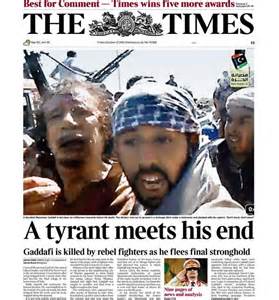
When Hillary Clinton appeared before the House Select Committee in Congress last week to be be interrogated about the jihadist attack on the CIA compound cum embassy in Benghazi, she was also asked about the infamous TV interview (see above) she gave just days after Gaddafi’s death at the hands of a jihadi mob.
Micah Zenko, a foreign policy expert at the Council on Foreign Relations, was the only observer to spot this exchange and the significance of Clinton’s response, which he then posted on his facebook page.
Here is the full text:
At the eleven-hour United States House Select Committee on Benghazi hearing yesterday, Sec. Hillary Clinton said something in passing that has received no attention by the committee members or the media.
When asked by Rep. Peter Roskam (R-IL) about a video clip that read, “We came, we saw, he died [meaning former Libyan President Muammar al-Gaddafi]. Is that the Clinton doctrine?” Clinton replied, “No, that was an expression of relief that the military mission undertaken by NATO and our other partners had achieved its end.”
What is now totally forgotten is that regime change WAS NOT the intended military mission of the Libya intervention in March 2011. As President Barack Obama stated (atfp.co/1kyBt2i) in a speech to the nation on March 28, 2011, “The task that I assigned our forces [is] to protect the Libyan people from immediate danger, and to establish a no-fly zone,” adding explicitly, “Broadening our military mission to include regime change would be a mistake.”
If the Select Committee on Benghazi had been interested in conducting an actual oversight hearing of the Obama administration’s policy toward Libya, a committee member could have pressed Clinton to explain why U.S. objectives shifted so markedly from protecting civilians to killing Qaddafi. Or, if regime change was the intended policy objective from the very beginning, why didn’t President Obama say so to the American public?
Unfortunately, such a line of questioning was not pursued yesterday, nor will it be in other committee hearings. A journalist should ask Clinton about this discrepancy, since she would be making similar speeches to the nation about America’s war aims.
So there you are. Like the invasion of Iraq, the invasion of Libya was not carried out for the reasons given to the world, but to advance Western political and other (mostly economic) interests by removing a leader considered an obstacle to those interests.
In this respect Hillary Clinton is in the same class as Tony Blair.
Put a date on, and identify the source for these two, separate extracts from British government-sponsored reports on the status of the Provisional IRA.
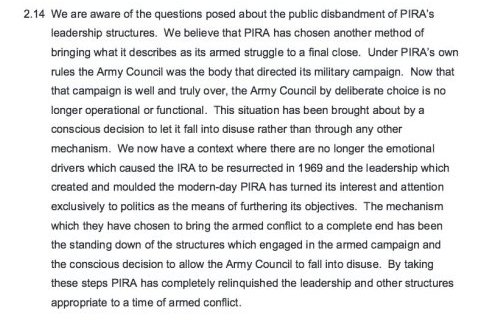
First this one:
And now this one:
Have you worked it out?
The first quote dates to September 2008 and came from the Independent Monitoring Commission (IMC); it was carried in a special, one-off report on the state of the Provisional IRA that had been asked for by the British and Irish governments so they could make a final judgement on the absorption of the Provos into peaceful politics.
It was considered at the time to be the final and definitive word on the IRA, so much so that subsequent IMC reports on paramilitary activity barely mentioned the Provos.
That September 2008 IMC report said that the IRA’s Army Council had ‘by conscious decision’ been allowed to fall ‘into disuse’ and ‘by deliberate choice was no longer operational or functional’.
So, no doubt about it, the Army Council had gone away, the war was over.
It is no accident that the widespread belief in Ireland that the IRA had ceased to exist – a belief rudely shattered by the killing of Kevin McGuigan by the IRA three months ago – can be dated to the publication of this IMC report.
And so we fast forward by seven years or so from that landmark 2008 IMC report and what do we now read about the IRA’s Army Council?
Well, to begin with it has experienced a Lazarus-style resurrection. It is back in action, no longer languishing in ‘disuse’, but back to being ‘operational’ and ‘functional’, albeit ‘in a much reduced form’.
But then we discover what this ‘much reduced form’ consists of. Well on top of the Army Council there is something called ‘a senior leadership’ – the PSNI/MI5 are coy about what this means but it sounds like a Chief of Staff to me – and below it some ‘departments’ whose functions we are not allowed to know and then something called ‘regional command structures’.
Could these possibly be Brigades, as in Belfast Brigade? We don’t know, because neither the PSNI, MI5 or the three wise monkeys chosen to endorse this report will tell us. If all this sounds familiar, that’s because it is basically the old Provisional IRA structure, albeit somewhat diminished: a Chief of Staff, an Army Council, Brigades and Departments.
(For information: The IRA was [or maybe is, should be the word?] divided into functional Departments like Operations, Intelligence, Finance, Training, Engineering, Internal Security and so on. The commanders of these Departments, grandly known as Directors, were known as the GHQ, or General Headquarters staff. IRA volunteers were assigned to a department which operated on a geographical basis. So, the Belfast Brigade Intelligence unit would work both with the Brigade leadership and the GHQ Intelligence Department to further the IRA’s war aims.)
But we then find that IRA members continue to gather intelligence on dissidents and possible informers (why would you care about informers if you weren’t doing anything illegal?) and the ‘storage of remaining weaponry’ continues, which we are told is done only so as to prevent it falling into the hands of dissidents and not, of course to shoot people like Kevin McGuigan. (It strikes me, that a better way to ensure such weapons don’t make their way to dissidents would be to hand them in, or throw them in the river!)
(This part of the report seems to confirm something that the IMC was loathe to admit, that some IRA weaponry was not decommissioned and was kept back to use against dissidents. Tony Blair had approved such a plan, according to former Bush envoy Mitchell Reiss, but that was vetoed by Irish Justice Minister, Michael McDowell. Gerry Adams then had a chat with Blair’s Chief of Staff, Jonathan Powell and was content with what he heard. I think we can now guess what the two men talked about and what happened subsequently.)
And then we are told: ‘PIRA members believe that the PAC (Provisional Army Council) oversees both PIRA and Sinn Fein with an overarching strategy’. Why the ‘PIRA members believe’ bit? What do MI5 and the PSNI believe? Do they also believe this but cannot bring themselves to admit that a significant part of Irish politics, North and South, is under the control of a small, un-elected military, or military-like conspiracy?
But here’s the kicker:
Individual PIRA members remain involved in criminal activity, such as large scale smuggling, and there have been isolated incidents of violence, including murders….however we judge that the assessment put forward by the Chief Constable in his public statement on 22 August remains accurate.
And what did PSNI Chief George Hamilton say about such murders, including that of Kevin McGuigan?
Well this:
We have no information to suggest that violence, as seen in the murder of Kevin McGuigan, was sanctioned or directed at a senior level in the Republican movement.
So, the Army Council that the IMC told us had faded away into insignificance is back with a bang, there is a ‘leadership’ behind it, and IRA Departments as well as ‘regional command structures’, intelligence gathering and weapons storage.
Smuggling, robbery and murder happen but the leadership knows nothing about any of this; and we are expected to believe that a leadership renowned and notorious for its control freakery allows killings to happen without its knowledge and/or approval?
Remember what the late John Kelly, a Provo founder member, had to say about Gerry Adams:
Not a sparrow falls from a tree but he does not know about it.
But then, after repeating their belief that the Provos are committed to the peace process and political methods, the MI5/PSNI report concludes,:
The group (i.e. the Provisional IRA) is not involved in targeting or conducting terrorist attacks against the (British) state or its representatives.
So, that’s okay, then.
When one reads this document, it is difficult not to come to this conclusion: The British state has done a deal with the Provisional leadership in which an armed and organised IRA rump continues to exist to protect its leadership cadre, eradicate opponents and further the political ambitions, North and South, of the IRA’s political wing, and as long as no hostility or violence is shown to the British state then a blind eye will be turned even to murder.
That is a state of affairs the DUP seems happy to accept. But what about the South? It could be Dublin’s turn soon to entertain such people in government.
Here are the relevant documents, beginning with today’s PSNI/MI5 report, the PSNI Chief Constable’s statement of August 22, 2015 and the September 2008 IMC report.
Chief Constable’s statement – PSNI’s assessment of the current status of the Provisional IRA.
22 Aug 2015
I want to respond to the requests from various quarters for me to bring some clarification regarding my assessment of the current status and activities of the Provisional IRA.
We should all remember at the outset that the stimulus for this public debate has been the tragic murder of Kevin McGuigan following the equally tragic murder of Gerard ‘Jock’ Davison. At the outset we would do well to remember that there are grieving families today and there are ongoing murder investigations that I will not compromise or jeopardise by unnecessary public commentary or speculation.
At this stage we assess that some Provisional IRA organisational infrastructure continues to exist but has undergone significant change since the signing of the Belfast Agreement in 1998. Some, primarily operational level structures were changed and some elements have been dissolved completely since 2005.
We assess that in the organisational sense the Provisional IRA does not exist for paramilitary purposes. Nevertheless, we assess that in common with the majority of Northern Ireland paramilitary groups from the period of the conflict, some of the PIRA structure from the 1990s remains broadly in place, although its purpose has radically changed since this period. Our assessment indicates that a primary focus of the Provisional IRA is now promoting a peaceful, political Republican agenda. It is our assessment that the Provisional IRA is committed to following a political path and is no longer engaged in terrorism. I accept the bona fides of the Sinn Fein leadership regarding their rejection of violence and pursuit of the peace process and I accept their assurance that they want to support police in bringing those responsible to justice. We have no information to suggest that violence, as seen in the murder of Kevin McGuigan, was sanctioned or directed at a senior level in the Republican movement.
Although still a proscribed organisation, and therefore illegal, we assess that the continuing existence and cohesion of the Provisional IRA hierarchy has enabled the leadership to move the organisation forward within the peace process. Some current Provisional IRA and former members continue to engage in a range of criminal activity and occasional violence in the interest of personal gain or personal agendas.
I want to comment on the connection, or lack of connection between the PIRA and the group calling itself ‘Action Against Drugs’. Action Against Drugs has emerged from within the Republican community from a range of backgrounds. Some are former members of the Provisional IRA, but others have links to Violent Dissident Republican groups and others are from a pure organised crime background. This group is intent on taking action against what it perceives as anti-social elements in Belfast but this is done in pursuit of their own criminal agenda. They are little more than an organised crime group in my view and we assess that Action Against Drugs is an independent group that is not part of, or a cover name for the Provisional IRA.
That said, in the McGuigan murder enquiry the SIO is appropriately following a line of enquiry that has shown connections and cooperation between Action Against Drugs as a group and a number of individuals who are members of the Provisional IRA. As I have just said, we are currently not in possession of information that indicates that Provisional IRA involvement was sanctioned or directed at a senior or organisational level within the Provisional IRA or the broader Republican movement.
In conclusion, I want families and communities to have confidence in the murder investigations that we are conducting. These investigations will be conducted with integrity, professionalism, in a thorough manner and without fear or favour.
I will not sacrifice my operational independence, or allow the investigation to be influenced by political commentary or even political consequences. We will go where the evidence takes us. I would again appeal for information from the community in assisting us on bringing those responsible to justice. Thank you.












 The Broken Elbow
You must be logged in to post a comment.