Category Archives: Uncategorized

Libya and the West: Deja Vu All Over Again

By grotesque happenstance I had just finished re-reading Ruth First’s groundbreaking account of the Libya that was inherited and refashioned by Gaddafi – “Libya – The Elusive Revolution” – as news came through that NATO airstrikes, possibly the work of one of Barack Obama’s predator drones, had killed Gaddafi’s youngest son, Seif al-Arab and three of his grandchildren, all reportedly under twelve years of age.
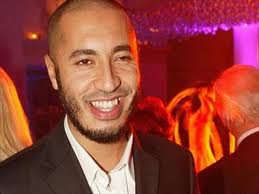
Seif al-Arab Gaddafi, the youngest son of the Libyan leader and a victim of a NATO missile strike

And then I had just completed the first edit of this post when the news broke that Obama had killed Osama bin Laden at a compound not far from the Pakistan capital Islamabad, apparently with no foreknowledge on the part of the Pakistanis and with a degree of contempt for Pakistani sovereignty that can only serve to destabilise the government there and vindicate those who followed the al Qaeda leader’s violently anti-American gospel.

Imagine how Americans would react if Mexican special forces landed outside Los Angeles, invaded a compound to kill a cocaine king hiding out there, didn’t tell the FBI a word about their plans and afterwards, as jubilant Mexican crowds waved flags and cheered in downtown Mexico City, the country’s president went on TV to boast of the deed and house-trained Mexican journalists went on air to bad mouth American co-operation in the war against drug cartels. How long would the US government survive?

So my first thought was really a question: and they wonder why people hate them enough to fly planes into their skyscrapers? My second thought was, I confess, on the conspiratorial side. Was it possible, I wondered, that American military planners had hoped for a double whammy here, wipe out Gaddafi on Saturday and Osama on Sunday to send a message of US military hegemony throughout the Middle East and Muslim world? Who knows.

The effort to remove the Al Qaeda leader was clearly a spectacular success that will strengthen Obama’s chances of re-election in 2012 and weaken domestic opposition to his plans to cut back government spending on the poor and sick. The bid to kill Gaddafi didn’t however go at all as well.

If confirmation was needed that Western intervention in Libya is really about regime change, installing a more reliable pro-Western government in Tripoli and exacting revenge on Gaddafi for his years of troublemaking and much less about protecting rebellious civilians from the Libyan leader’s vengeful retribution this effort to liquidate him was surely it.

NATO has now denied that its forces deliberately singled out the Libyan leader and claimed instead that their target was a military one, a command and control centre housed in the same building. Gaddafi’s family was an incidental target according to this version, but there’s a distinct flavor of the Mandy Rice-Davies in that response: “They would say that, wouldn’t they?”

The UN resolution authorizing military action limits NATO to protecting civilians and does not permit regime change or assassination bids on the Libyan leader or his family. If NATO had admitted Gaddafi was the target the mission in Libya would have been rendered illegal, hence the need for what many will see as the plausible but unprovable lie.

But the leadership rhetoric and military thinking emanating from Washington, London and Paris has been increasingly focussed on the goal of killing Gaddafi or coming so close to doing so it would scare him out of office. Take as an example this quote from Admiral Mike Mullen, chairman of the US Joint Chiefs of Staff, given to Reuters just after the use of predators was authorized: “Ultimately, he said, ‘Gaddafi’s gotta go’, and coalition actions ‘are going to continue to put the squeeze on him until he’s gone.’”

This weekend’s assassination bid on Gaddafi is the second strike against the Libyan leader in a week. His compound in Tripoli was targeted in late April and an office where he and his aides sometimes worked was destroyed. Western determination to remove Gaddafi seems absolute and in sharp contrast to the mild response to the murderous repression of protesters in Syria, whose brutal government’s survival is in the interests of America’s ally, Israel, or in Bahrain, where Saudi concerns dictate almost complete American passivity in the face of that regime’s murderous crushing of its citizens.

Hardly surprising then that many will see that self-interest and hypocrisy more than consideration for her citizens’ democratic wellbeing characterize the West’s disposition to the Arab Awakening in Libya. But then as far as this North African State is concerned it was ever thus. Which brings me back to Ruth First and her examination of the Libya that Gaddafi and his fellow ‘Free Officers’ took over in September 1969.

I first came across “Libya – The Elusive Revolution” in 1975, just after I had spent two years living and teaching at the University of Tripoli. The country had a great effect upon me and intrigued by the little history and politics I had learned, I wanted to know more. But we were expatriates in a country whose people and media were, for language reasons, virtually inaccessible. Our view of Libya was, to say the least, opaque.
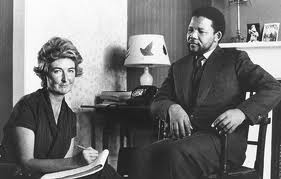
Ruth First and a young Nelson Mandela

Understandably the locals who did speak English, whether at the college or out at the farm where I lived, were very careful about what they said to foreigners and sometimes, as I learned on one occasion, with good reason. Consequently we had to rely on fellow expats for most of our information about Libya, Gaddafi and the politics of the place and a lot of that came filtered through ignorance, prejudice and plain stupidity.

So when I came across Ruth First’s account, which was published the year before I departed Libya, it was really an eye-opener. Much of what I had seen, heard or experienced while living there now made more sense and when I finally put her book down it was with a feeling of disappointment that I hadn’t known all this when I was living there, when it counted. The experience of life in Libya would have been richer.

But first a few words about Ruth First. Her parents were Latvian Jews who had emigrated to South Africa at the turn of the last century and they were founder members of the South African Communist Party. Ruth also joined the Party and at university in Witwatersrand she shared classes with a young Nelson Mandela and Eduardo Mondlane, a founder member of FRELIMO, the Mozambique liberation movement.

The South African Communist Party and the African National Congress went on to make an alliance against apartheid and together created the ANC’s military wing, Umkhonto we Sizwe, the Spear of the Nation. In 1949 Ruth First married a fellow Party member, the legendary Joe Slovo, the son of Jewish emigres from Lithuania who went on to become a leading light in the ANC (their union is a reminder of the progressive and radical tradition, pre-Israel, pre-1967, pre-neocons, pre-Bibi of so many Jewish political activists).
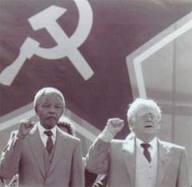
Joe Slovo and Nelson Mandela give a clenched fist salute under the hammer and sickle

Ruth First was immersed in anti-apartheid agitation and in 1963, when the South African authorities moved against and imprisoned ANC leaders such as Mandela, she was interned. After release she sought sanctuary abroad, mostly in Britain where she became an academic and latterly in Mozambique where she combined academic work with activism against apartheid.

In 1982 the South African police decided she was so much a thorn in their flesh that she had to die. A parcel bomb was sent to her office at the university in Maputo and she was killed instantly when she opened it. Her life story was made into a film, A World Apart which was written by her daughter Shawn Slovo. Another daughter, Gillian Slovo is a celebrated novelist.

Her study of Libya then is strongly influenced by her politics. Not in a propagandist way but by setting the country’s history and development against a background of the burgeoning Cold War, of Western colonial interests, both economic and strategic, which sometimes clashed and competed but often merged for mutually beneficial gain.

Not everyone will find this sort of approach readable or even acceptable. But in the case of Libya there really is very little choice because the place has been a plaything for foreign powers and interests for most of its existence and no attempt to understand Gaddafi or his present predicament is possible without knowing what is was that brought him to power.

The conditions that led to the coup that he and his fellow “Free” officers engineered have their direct roots in the politics of the Middle East and Cold War Europe in the aftermath of the Second World War.

Italy had succeeded the Ottoman Empire as Libya’s occupying power in 1911 and held the country until 1943 when the British defeated Rommel’s Afrika Corps at El Alamein. After the final German surrender the victorious allies, principally Britain, the US and France, with Italy accorded a bit player role, carved up the country in accordance with their Cold War and late colonial interests.

The Italian occupation of Libya was, as First described it, “the most severe….experienced by an Arab country in modern times” and this was especially so when Mussolini’s fascists came to power. Libya was deemed to be part of mainland Italy, as it virtually had been in the days of the Roman Empire, and ambitious plans were laid to resettle the country. Two hundred thousand hectares of land on arable coastal strip were confiscated and made available to some 90,000 Italian settlers who would, the plans envisaged, make up 10% of the population by 1938.

There was Libyan resistance to all this led by Omar Mukhtar, a Bedouin leader from the east of Libya, who fought a guerrilla war from desert oasis bases (and whose struggle was immortalized in the movie ‘Lion of the Desert’ starring Anthony Quinn). Italian reprisals were savage. Estimates of the number of Libyans killed
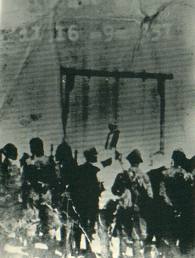
Omar Mukhtar, the Bedouin guerrilla leader was hanged by the Italians in 1931

by the Italians during the occupation range from 250,000 to 300,000 and this out of a population of no more than one million. Tens of thousands were imprisoned in concentration camps where they died of hunger and disease and between 1930 and 1931 alone, the Italians executed by hanging or firing squad 12,000 in the eastern province of Cyrenaica where, coincidentally, the current rebellion has its genesis.

It was really left to Britain and to a lesser extent France to shape Libya’s postwar fate. The Americans were players as well, but later in the game. Britain’s hold on Suez and therefore Egypt was weakening as the 1940’s came to an end. Egypt had gained nominal independence from Britain in 1922 and even though Egypt’s freedom to determine her own foreign policy was secured in 1936, Britain retained control of the Suez canal and therefore the flow of oil and commerce to and from the far east.

In the post-war years Egypt struck an even more assertive pose over Suez and growing but frustrated demands that it be returned entirely to Egyptian control helped fuel Nasser’s army officer-led revolution and overthrow of the monarchy in 1952. So having bases and influence in Libya, within striking distance of Suez at a time when Soviet influence in Nasser’s Egypt was on the rise was imperative to Britain.
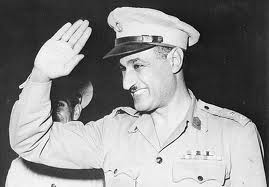
Gamal Abdel Nasser, the Egyptian leader and role model for Gaddafi

France had its North and Central African colonies to worry about: Algeria, which shares a south-western border with Libya; Tunisia, to Libya’s immediate west and Chad and Niger (the latter subsequently found to be a rich source of uranium), both with borders in the deep south of Libya. France sought influence and a presence in the deep south of Libya, in the province known as Fezzan in large part to stem any possibility of rebellion or foreign challenge to her control of, or influence over these colonies or soon-to-be former colonies.

The immediate post-war years were the age of ‘The Big Four’ in global diplomacy. The Soviet Union, the United States, Britain and France each demanded a say in the shaping of the new world although in practice it was usually the Soviets versus the rest, as the Cold War imposed the new reality. Post-Nazi Germany had been carved up into zones of influence, one for each of the victorious allies, and the same approach was tried in Libya, the former colony of another Axis power, but with less success.

The Western allies were determined to deny the Soviet Union a foothold in North Africa and this sometimes led to comical about-turns. All the powers agreed that at some point Libya would have to be given independence; what was at issue is who would have the ear of Libya’s rulers when that day dawned.

At first the Americans, eager to gain friends and influence in post war Italy, suggested that Libya be returned to her former imperial master for a decade under United Nations trusteeship, after which she would be granted independence. But when the Italian Communist Party began to grow in strength and popularity and the Soviets, seeing a perfect chance to gain influence in Libya through a proxy, seconded that proposal the Americans quickly went into reverse gear.

After the Korean War erupted in 1950, the Pentagon began to realise that Libya had strategic value. As First put it: “United States military planners resolved that the bases in Libya were not only useful but indispensable….(and) would keep the Soviet Union out of the Mediterranean”. In the immediate post-war years the US had spent $100 million dollars on the airbase at Wheelus near Tripoli but then decided to run it down. When the Korean War began she again reversed gear and poured more money and men into the base, then America’s first airbase in Africa.

King Idris, in the years before Gaddafi's coup

But what to do with Libya? The nearest Libya had to a monarch was Muhammed Idris bin Muhammad al-Mahdi as-Senussi, better known as King Idris, although his influence really did not extend much beyond his capital in Benghazi. He was also the head of an Islamic religious sect known as the Sanusi. Both the British and the Italians recognized him as the Emir of Cyrenaica in 1920 and later as the Emir of Tripolitania but when the Italians launched a military offensive in 1922 he fled Libya and sought refuge in Egypt as Omar Mukhtar’s guerrilla war intensified. When the Second World War came to North Africa, Idris made an alliance with the British against the Axis and after Germany’s defeat their partnership survived and prospered as Idris sought London’s favors and protection, giving the British in return the greatest influence over Libya’s putative new ruler of all the Western allies.

In the context of contemporary events it is important to note that Idris was essentially the leader of a sect and tribe which had its base in Cyrenaica with its capital in Benghazi. His ties to the western part of Libya were weak. Even when Libya was made independent and Idris elevated to the throne he chose to live in a palace in Tobruk, close to the border with Egypt and almost as far away from Tripoli as it was possible to get. Over the years resistance to Gaddafi’s hold on Libya has often been financed or led by members or supporters of the Idris clan, the rebellion against Gaddafi that began last February had its genesis in Idris’

The flag of King Idris' Libya has been adopted by the antiGaddafi rebels

capital, Benghazi and the rebels have chosen as their flag, the standard of Idris’ Libya. They have also made alliance with the same Western powers who put and kept Idris on the throne. Coincidence perhaps, but interesting nonetheless.

It was the British in close alliance with the French who decided that independence for Libya was the best way to keep “the Russian camel’s nose out of the Libyan tent”, as Ruth First put it. To do that Libya’s future was handed nominally to the United Nations to decide and in 1949 a resolution was passed at the General Assembly granting independence which would come into effect as early as possible in 1952.

It was not anti-imperial fervor or concern that the Libyan people should enjoy the fruits of national self-determination which persuaded the United States to back Britain and France in this project but cold, hard self-interest in the ideological and political-cum-military war against the Soviet Union.

The State Department official in charge of the Libyan desk, and America’s first ambassador in Tripoli, Henry Serrano Villard, writing post facto, set out the rationale, quoted at length in First’s book:

It may be worth noting that if Libya has passed under any form of United Nations trusteeship, it would have been impossible for the Territory to play a part in the defence arrangements of the free world. Under the UN trusteeship system the administrator of a trust territory cannot establish military bases; only in the case of a strategic trusteeship as in the former Japanese islands of the Pacific are fortifications allowed; and a ‘strategic trusteeship’ is subject to veto in the Security Council.

(But) as an independent entity Libya could freely enter into treaties and arrangements with the Western powers looking towards the defence of the Mediterranean and North Africa. This is exactly what the Soviet Union feared and what Libya did. The strategic sector of African seacoast which had proved so important in the mechanized war of the desert was coming into its own as a place of equal importance in the air age.

So the British with American support chose the route to Libyan independence via the United Nations. The French, worried about Algeria and her other colonies, put up some resistance and preferred a plan to give the three provinces, Tripolitania, Cyrenaica and Fezzan independence at some unstated date far off in the future. First wrote: “(France) was still fearful of the chain reaction in North Africa to the establishment of a new independent state….” But the British and Americans got their way.

To the untutored eye it looked as if the victorious Western powers had, as those who had fought a war to defeat fascist tyranny were expected to do, agreed to bestow a generous measure of self-determination, a democratic form of government and even a constitutional monarchy based on the British model to this most sadly abused Arab state. But that was for public consumption and anti-Soviet propaganda. The reality was that Libyan independence was to be a sham and Idris would be a puppet of the British and, through them, the Americans.

The game was given away, much to the horror of the newly appointed UN Commissioner in Libya, Adrian Pelt, when it was discovered that the British had negotiated the terms of a defence treaty with Idris long before independence was a reality, a treaty that was technically illegal and likely to scandalize world opinion and hobble Idris’ government before it took office should it become public knowledge.

So Pelt secured the agreement of the British that they should defer formal agreement of the treaty and even pretend to start negotiations only after independence arrived, although a separate deal with Idris that was confined to Cyrenaica was already in place and served as a model for the wider treaty.

As Ruth First wrote: “Anglo-American policy saw Libya as less a country or state than a strategic position for a series of military bases.” Britain got unlimited, exclusive and uninterrupted use of Libyan territory for military aircraft, was allowed to base its Tenth Armoured Division in the country, had an air base south of Tobruk and an RAF detachment was stationed at Idris airport in Tripoli to facilitate the strategic air corridor to East Africa, the Indian Ocean and the Far East.

The agreement was to last, initially, for twenty years and could be renegotiated when it expired. In return Britain made a contribution to Idris’ budget. This was the crux of the arrangement. In the 1940’s and early 1950’s Libya was one of the poorest nations on earth, eighty per cent of its population were nomads and its largest industry was the recycling of scrap metal from tanks and artillery pieces abandoned by the Axis and allies in the desert during the Second World War. As the Chinese would say the deal between Idris and the British was “an unequal treaty”, a document the King had little choice but to sign.

The Americans negotiated a similar arrangement for the use of the former Italian airbase at Wheelus outside Tripoli. Wheelus was integrated into Strategic Air Command and John Foster Dulles, Eisenhower’s fiercely anti-Communist
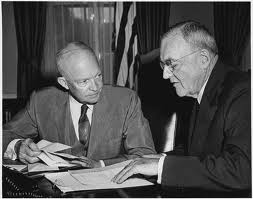
John Foster Dulles with Ike - flew to Libya to inspect America's new airbase

Secretary of State personally inspected the new acquisition which became a primary training base for NATO forces as well as providing American B-52 nuclear bombers access to southern Russia via Turkey and to key parts of Africa. In 1956 Wheelus became the headquarters of the Seventeenth Air Force.

Western interest in Libya was born out of a strategic necessity to confront the Soviet Union in the Mediterranean and the Middle East. With the development of intercontinental ballistic missile capacity, Libya’s value as a base for bombers diminished with the passage of time but in 1955 oil was discovered and quickly replaced defence as the focus of Western interests in this part of North Africa.

Nonetheless, Britain, America, France and in a minor way Italy all  had reason to regard Libya as a legitimate battleground in the historic conflict, ‘the great game’ against the Soviet Union and international Communism. But as the Western powers staked out their ground in Benghazi, Tripoli and Fezzan, the rest of the Arab world was throwing off the shackles of colonialism or embracing pan-nationalism in the struggle against Israel and her American ally and by so doing helped write King Idris’ death sentence.
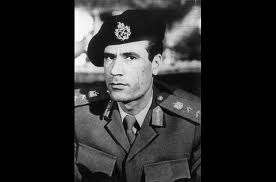
The young Gaddafi led the coup of 'Free' army officers against the pro-Western Idris regime

As Ruth First noted: “The price (of Libyan independence) was a state heavily committed to the West. This was to be the fundamental cause of the coup d’etat which overturned the monarchy” in 1969, a coup led by Muammar Gaddafi and his fellow “free” officers in the Libyan army. It is surely no accident that the same foreign forces, America, Britain, France and Italy have returned to extract their payback.
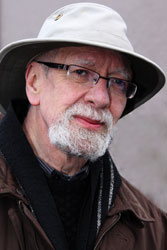
Brian Moore RIP

Brian Moore, aka Cormac, who drew cartoons in An Phoblacht-Republican News for over thirty years

I have just learned that Brian Moore, better known as the cartoonist Cormac, died recently in Belfast and reading some of the obits that appeared on the web and elsewhere, it struck me that his role in the development of republican, that is Provo republican, politics was not really given proper recognition by the various writers. He played a small part, for sure, but nonetheless an important one in its way in bringing about the leadership changes in the IRA and Sinn Fein that led us to where we are now.

He was originally a member of one of those Trotskyite groups – don’t ask me which one, but I have a notion it was an offshoot of the post-QUB, Peoples Democracy – which believed that national liberation struggles were more important than class ones, that supporting the Viet Cong and Che Guevara was more relevant than organising in the local Ford plant or giving out leaflets during strikes. In Ireland that meant backing the Provos and so it was that Brian Moore volunteered his services as cartoonist for Republican News and later An Phoblacht-Republican News (AP-RN).

As a cartoonist Brian Moore was strongly influenced by the American underground comix tradition of the late 1960’s and early 1970’s which was especially rich in the San Francisco area. That was no accident since San Francisco was at the centre of the Sixties counterculture ferment which was defined by political radicalism, disdain for mainstream values and liberal attitudes towards sex and drug use, all themes that were meat and drink in the world of underground comix.

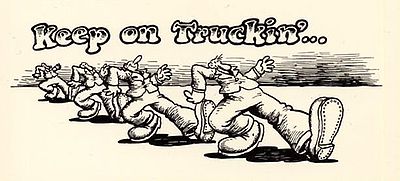
The comix were mostly self-published and although they had small circulations the cultural influence of publications like Zap Comix and characters like Fritz the Cat or the Fabulous Furry Freak Brothers was immense and stretched way beyond the west coast. One of the best of the underground cartoonists was Robert Crumb whose work and that of Brian Moore are strikingly similar. Two of Crumb’s creations, Mr Natural and Keep on Truckin’ could easily have jumped out of a Brian Moore cartoon in AP/RN or vice-versa.

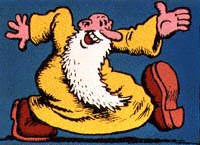
Mr Natural, a character created by San Francisco cartoonist Robert Crumb, and an inspiration for Cormac

Keep on Truckin', another Robert Crumb cartoon

It was Danny Morrison who as editor in the mid-1970’s brought Brian Moore into Republican News, the Provisional weekly that was set up by the Belfast Brigade of the IRA in 1970 under the direction of Jimmy Steele and Hugh McAteer, the latter a former Chief of Staff, the former an early Provo icon and veteran of the Thirties and Forties campaigns.

The early Republican News was almost a caricature of the early Provisionals and faithfully reflected the devout Catholicism and fierce anti-Communism of the new IRA’s founders. One of its first editorials railed against erstwhile comrades in the Official IRA, explaining the reasons why people of the calibre of Steele and McAteer had broken with them to set up the Provisional IRA in terms that Joe McCarthy would have been proud of: “Gradually into executive posts both in the IRA and Sinn Fein, the Red agents infiltrated and soon these men became the policy makers”. Its first editor later became a leader in the Tridentine Mass movement which was dedicated to returning the Catholic church to Latin rituals and the dogmas and attitudes of pre-Vatican II Catholicism.

By the time Brian Moore joined Republican News, both Steele and McAteer were dead and the IRA in Belfast was moving leftwards under the direction of Gerry Adams, Ivor Bell and Brendan Hughes whose influence was enormously significant even though all three men were in Long Kesh at the time, either as internees or jailed because of escape attempts from internment.

The IRA had just ended a long, debilitating ceasefire which had caused huge dissension within the organisation. The camp led by Adams, Bell and Hughes – then the IRA’s Young Turks – opposed the ceasefire, arguing that the leadership in Dublin had been tricked by the British into believing that withdrawal was on the cards. Instead, they said, the British had used the lengthy ceasefire to build up intelligence on the IRA and to refine their anti-terrorist strategy, notably by criminalising the IRA, which almost resulted in its defeat.

Danny Morrison, editor of Republican News, on a visit to Long Kesh, circa 1981

Danny Morrison had at first supported the 1974-75 ceasefire but was talked round by Adams and then became an enthusiastic convert to the anti-leadership cause. Adams & Co. were agitating to take over the IRA and the centerpiece of their argument was the conviction that a quick military victory was no longer possible, that the war against the British was going to be a long one and to survive that length of time, the IRA would need to become politically relevant to those from whom it drew support. That necessitated both that the IRA move leftwards and that it get involved politically, two ideas that not only would have been anathema to Jimmy Steele and Hugh McAteer and their confreres but contained within them the mustard seeds of the peace process.

Under Morrison’s editorship, Republican News became the vehicle for this agenda. Gerry Adams and like-minded IRA prisoners were given columns in the paper. Adams chose the Brownie byline (for a detailed explanation, see Voices From the Grave) to protect his anonymity as he pushed his programme, although everyone knew it was him, but others also wrote influential columns, not least Bobby Sands under the nom de plume, Marcella.

Hiring Brian Moore was an inspired move by Morrison and along with allowing the late John McGuffin, a friend and colleague of Moore’s, free rein to write The Brigadier column, an often hilarious send up of the British Army’s officer class, these moves helped make Republican News one of the most attractive and interesting political papers in Western Europe. The Cormac cartoon though was its distinctive feature and as Danny Morrison noted in his obituary of Moore it was often the first thing that readers would turn to.

The contrast represented by Morrison’s Republican News with the staid leadership that had led the IRA into the ceasefire disaster, old men with politics to match, could not have been greater. They were yesterday’s men, out of touch and out of date, whereas Adams & Co., as symbolised by their newspaper, were tomorrow’s young, vibrant and relevant hope for Irish republicans, people who were brimming with ideas and enthusiasm. In the world of political propaganda, hiring Brian Moore and transforming RN was the equivalent of ditching Thompson machine guns for Armalite rifles.

It was no accident either that when Gerry Adams made his move in the late 1970’s to consolidate the take over of the IRA that he and his allies had been long planning, they chose the organisation’s newspapers as a major battleground. In those days RN’s circulation was confined to the North; the IRA’s Southern supporters were sold An Phoblacht (The Republic) which was produced in Dublin and strongly reflected the views of the anti-Adams Southern leadership.

Adams’ victory, and his readiness to wade in the gutter to achieve it, was signaled when, after a fierce battle that involved badly smearing AP’s editor Gerry O’Hare, the two papers were fused. Any doubt as to who had won were settled when the first edition of the re-christened An Phoblacht-Republican News appeared. It was Republican News, in content, style and politics, with a slightly different name; An Phoblacht had been swallowed up and was no more. In this bitter little battle Brian Moore and Cormac had played a not insignificant role.

But what goes around, comes around. I doubt very much whether Danny Morrison’s observation remained correct throughout time and that when AP-RN moved into what can only be described as its Pyongyang Times phase, when pro-peace process political correctness became the stifling order of the day, people still as enthusiastically turned to the Cormac cartoon.

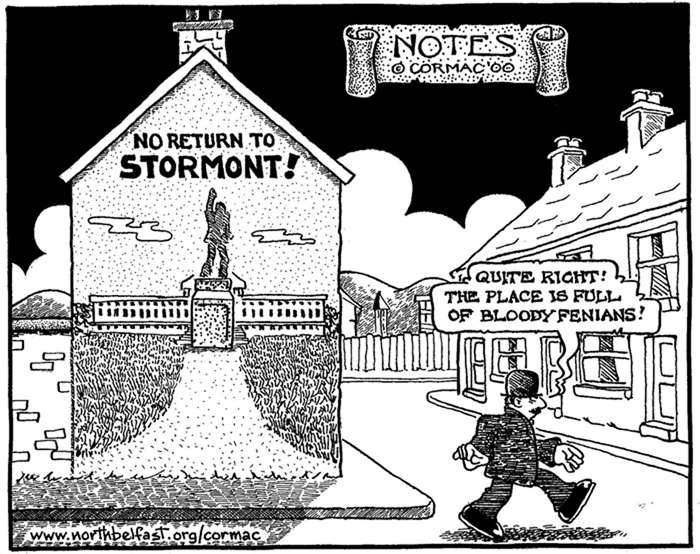
The truth is that, at the end, his cartoons became infected with the same malady, faithfully drawn to conform to that week’s orthodoxy. The cartoon chosen by AP-RN to accompany his obituary was typical of this, celebrating Stormont, once the symbol of partition and a prime target for destruction by the IRA, but now the Holy Grail partly because Sinn Feiners sit in its chamber but mostly because Unionists don’t like that. The cartoon is also, interestingly, a measure of how much sectarianism is now part of the Provo culture. In fact AP-RN became so dull that it is no longer sold as a newspaper, hawked as it once was, door-to-door by volunteers and is now only available on the web where it is read by an ever dwindling audience.

The politically correct Cormac cartoon chosen by AP-RN for Brian Moore's obituary

A Cormac cartoon from the time of the 1981 hunger strikes. More typical of the body of his work.

There was, though, another aspect of Brian Moore’s life that is worth remembering and that was as songwriter and performer for the Men of No Property, an eclectic group which produced original pro-IRA music and songs in the early 1970’s. Two of Moore’s creations, the self-explanatory England’s Vietnam and Jesus and Jesse, the story of Jesus Christ and Jesse James meeting in the Belfast of the early 1970’s, have become classics and also relics of what now seems to be a long-lost age. Their music is still on sale here. Here are those two songs for you to savour:

England’s Vietnam

Jesus and Jesse

David Cameron Makes His Bones in Libya, NeoCon-style

Whenever a national leader justifies aggressive military action against others by invoking the phrase “humanitarian crisis” – as Barack Obama did to explain why a no-fly zone was being imposed on Libya – the most appropriate reaction may not be “to reach for my revolver”, to quote a long-forgotten German playwright, however tempting that might be. But stretching out a hand for a zinc bucket to hurl into sounds like a pretty good alternative.

No fly zone declared


This is not to deny that Libya does indeed face a potential calamity. The embattled Col. Gaddafi, his family, tribe and assorted associates and hangers-on are facing political, financial and possibly physical extinction at the hands of rebels – whose precise political orientation remains a mystery despite a heavy media presence in their strongholds – and clearly they will fight, and fight dirty, to make sure that does not happen.

But this is not the first time that an oppressive regime has threatened its own people, or other countries’ people, with slaughter and that fact serves to highlight the embedded dishonesty and hypocrisy of the joint Obama-Cameron-Sarkozy venture. If the prospect of a “humanitarian crisis” was an honest reason for military intervention then the three national leaders would be pretty much doing nothing else every day except issuing threats or organizing military sorties into other peoples’ countries.

They would be telling the leaders of Bahrain, Syria, Saudi Arabia and Yemen, for instance, to lay off their pro-democracy protesters; they’d impose a no-fly zone over Zimbabwe or otherwise threaten to rein in Robert Mugabe, toss Cruise missiles at the Burmese military dictators and long ago have sent legions of the Green Berets, the SAS and the French Foreign Legion into Darfur.

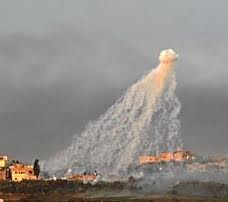
But they didn’t, and they wouldn’t have dreamed of doing it. No more than they would have ordered a no-fly zone in the Middle East in December 2008 when Israel invaded Gaza during Operation Cast Lead and rained white phosphorous

Western silence when Israel rained white phosphorous on Gaza

down on the heads of Palestinian children with murderous consequences for scores. Not only did that not happen but the newly-elected Obama, vacationing in Hawaii at the time, could not be persuaded to utter even one word of condemnation or disapproval.

To be fair to the US president, however, this is one military adventure which the Americans appear to have been the most reluctant to join. The lead has been taken instead by French president, Nicolas Sarkozy and British prime minister, David Cameron who heads a coalition Tory-Liberal Democrat government in London. The two Europeans had been pressing for action against Gaddafi for more than a week before Obama, apparently also urged to travel down this road by Hillary Clinton, finally gave in.

Sarkozy’s reasons for joining this anti-Gaddafi expedition have, according to one persuasive account, much to do with the confluence of two uncomfortable realities and very little with the catastrophe that inaction could bring to the unfortunate Libyans.

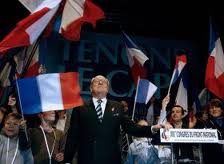
One is the impending French presidential election, due next April or May, and the other is his awful standing in the opinion polls. The latest of these showed

Pandering to Le Pen's National front did Sarkozy little good

him trailing behind the Socialists and the quasi-fascist, anti-immigrant National Front founded by Jean-Marie Le Pen. In a bid to fend off the challenge from the extreme right, Sarkozy last year decided to join Le Pen’s people in the gutter and ordered the expulsion of France’s Roma population.

Pandering to French xenophobia made little difference and now Sarkozy faces the real prospect of entering the history books as a one-term president. But as Margaret Thatcher discovered in the Falklands, as did George W Bush after the invasion of Iraq, nothing does quite as much good for a politician’s re-election prospects – particularly when you’re third in the polls – than a war, especially one your people believe you are leading.

For reasons that perhaps hark back to the days of “Freedom Fries” and the contrast that the sight of a French leader eager to fight a war alongside America

Sarkozy - no more "Freedom Fries"

makes, the US media have placed Sarkozy in the “no-fly zone” limelight. To be sure Sarkozy was the first to give official recognition to the Libyan rebels and French jets did fly the first missions over Benghazi but to focus on this risks missing one of the big stories of the Libyan adventure: the role of neocons in shaping British prime minister David Cameron’s enthusiastic support for the Libyan escapade.

And there is no doubting Cameron’s passion for this North African adventure. He was the first to call for a no-fly zone (as well as the arming of the rebels), in early March well ahead of Sarkozy who initially opposed the idea. Even when NATO turned him down and the Russians and Chinese promised to veto any attempt at the United Nations to dislodge the Libyan leader by force, he

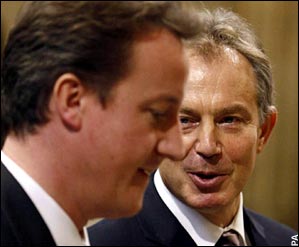
David Cameron with 'neocon Rex' Tony Blair

persisted. When he ducked a question in the House of Commons over whether he would wait for a UN resolution on Libya before committing Britain to a no-fly zone it raised the intriguing possibility that Cameron might be ready to go down the same path traveled by Tony Blair in 2003 when he and Bush cut a secret deal to go to war in Iraq without the UN’s approval.

And Cameron’s ministers have let it slip that, notwithstanding that the terms of the UN resolution do not authorize regime change, getting rid of Gaddafi and even killing him is very high on the British agenda.

His Defence Secretary, Liam Fox let it slip that the Libyan dictator could be targeted by Cruise missiles while his Chancellor, (like Timothy Geithner but with much more clout) George Osborne refused to rule out British troops being deployed on Libyan soil to overthrow him, telling a British television show only

Dave and Barry share a joke - but does Obama really know about his friend's friends?

that it was not planned “at this stage”. Should there be any doubt what the real intentions are, it is worth remembering that it was a British submarine that targeted Gaddafi’s compound in Tripoli with a missile strike shortly after the no-fly zone was authorised (the same compound, incidentally, bombed by Reagan in 1986 in a raid that killed Gaddafi’s adopted daughter).

So there seems reason to believe that in Cameron’s mind at least, the Libyan intervention is less a humanitarian intervention intended to relieve the hard-pressed rebels and avoid the slaughter of civilians and more a war whose aim is to overthrow the Gaddafi government and to achieve regime change.

David Cameron, like many British Tories, has some compelling reasons to get rid of Gaddafi although commercial motives such as access to Libyan oil and enhancing trade links are not among them. Cameron’s predecessor, Tony Blair long ago took care of Britain’s interests in that regard, secretly offering in 2005 to hand over Libyan dissidents hiding out in London (yes, the same ones whose friends in Libya the West is now so eager to protect) to Gaddafi and almost certain death (and later freeing the Lockerbie bomber) just at the time that Libyan oilfields were made available for public auction (by a remarkable coincidence by the time the hammer fell, BP and Shell had beaten out their US rivals and secured rights to all of Libya’s oil and natural gas resources).

Another reason could be Gaddafi’s nearly two decade-long sponsorship of the Provisional IRA. Over the years Libya gave the IRA many millions of dollars and tons of sophisticated weaponry, including ample supplies of the powerful explosive Semtex. By so doing the Libyan leader nourished a group that

Gaddafi gave the IRA weapons to use against Britain

otherwise would have posed a much less formidable threat to Britain. Getting payback for all those years spent helping out Irish terrorists who killed the Queen’s cousin, Lord Mountbatten and nearly wiped out the Thatcher Cabinet would certainly give Cameron and his colleagues much satisfaction but is insufficient by itself to explain the eagerness to attach Gaddafi’s scalp to their belt.

The clue to what is really going on in the Cameron cabinet can be found in the phrase that many believe describes their real but officially unstated aim: “regime change”. Consider these words to be published in the forthcoming issue of The Weekly Standard: “The only way this crisis will end – the only way we and our allies can achieve our objectives in Libya – is to remove Qaddafi from power. Containment won’t suffice. We must make ‘rollback’ the international strategy.”

British neocons want to do this to.........

....this guy

The Weekly Standard is, of course, the house magazine of the American neoconservative movement and the author of these words is the writer and think tanker, Max Boot. Although Boot dislikes the epithet, he is one of America’s foremost neocons. In fact there is hardly a neocon project of any significance in recent years that has not had Max Boot’s name attached to it at some stage or other, from the Project for a New American Century and the invasion of Iraq through to unquestioning fealty to Israel and particularly the Likud party.

And remember also that key defining document produced by American neoconservatism back in 1996, ‘Clean Break’, advice to Israeli’s incoming Likud premier, Benjamin  Netanyahu that a policy which embraced military force to topple unfriendly Arab regimes could ‘transcend’ the Arab-Israeli conflict, i.e. make an accommodation with Palestinians unnecessary. It is view heartily endorsed by the Atlanticists who populate the ranks of Britain’s neocons.

One of the most stubborn popular myths about neoconservatism is that it is a uniquely American phenomenon and given the baleful consequences that the doctrine had for the Bush White House, never mind the rest of the world, that is hardly surprising.

But neoconservatism’s roots do not belong in America and not even in the West Side of Manhattan, at least according to some in Cameron’s circle. The roots actually belong in Britain and, according to one of the doctrine’s leading

The Earl of Castlereagh - a founder of modern neoconservatism?

apostles, specifically in the British Tory party at the dawn of the nineteenth century when the doctrine of intervention in other countries’ affairs was legitimized, beginning with the effort to throw Napoleon off France’s imperial throne, and the basis laid for largely unopposed British colonial expansion during the rest of the century.

The claim, incidentally, is a necessary reminder that neoconservatism is just a fancy name for old-fashioned, interest-driven imperialism, justified in the nineteenth century in the name of bringing “civilization” to the rest of the world and nowadays to spread “democracy”.

Well, it looks as if Britain’s nineteenth century neocons have made a comeback and have a real, pivotal influence in Cameron’s Cabinet. The prime minister himself is not formally a neocon but he has surrounded himself with neocons,  given them key posts in government and has allowed his policies to be framed with significant input from neocon think tanks.

Consider the openly neocon members of Cameron’s Cabinet, nearly all of them members of the so-called Notting Hill set, a group of young ambitious Tories

Goerge Osborne as a young buck at Oxford - never had a proper job before politics

who spearheaded Cameron’s rise to the top of the Tory party. The leading figure is George Osborne, the Chancellor of the Exchequer whose economic policies will determine whether or not Cameron gets re-elected in 2014 or 2015. He is a crucial figure in Cameron’s government and has the prime minister’s ear every day. Back in 2003 when Bush and Blair were about to invade Iraq, Osborne – a member of the Anglo-Irish aristocracy – declared himself a “signed-up, card-carrying Bush fan” and told the House of Commons that he had been won over by the “excellent neoconservative case” for war.

The next most important figure is Cameron’s Education Secretary, Michael Gove who, when he is not advocating no fly zones in Libya, is busy constructing Britain’s version of charter schools. A former leader writer for the Times, Gove is the zealot who traces the origins of

Michael Gove - a key member of Cameron's 'Notting Hill set'

neoconservatism to a couple of early nineteenth century Tory Foreign Secretaries, George Canning and Robert Stewart, aka Viscount Castlereagh. An uncritical fan of Israel who barely bothers to disguise his contempt for all things Palestinian and Arab, Gove once compared Donald Rumsfeld to the sheriff played by Gary Cooper in High Noon.

More junior Tories make up the rest of Cameron’s neocon set. They include Greg Hands, George Osborne’s Private Parliamentary Secretary (PPS), the House of Commons’ version of a public school fag. Hands holds joint US and UK citizenship and returned to America in 2008 so he could vote for the McCain-Palin ticket. Culture Minister, Ed Vaizey is also a neocon as is Nicholas Boles, PPS to the Schools Minister.

So two of Cameron’s most important Cabinet colleagues, and close personal friends, are declared neocons and a group of junior, talented and up and coming government figures are with them. Others in Cameron’s Cabinet are “liberal interventionists”, like the Foreign Secretary William Hague. A cynic might observe that “liberal interventionists” are to neocons what call girls are to hookers. They’re in the same business but one is more honest than the other about what they do.

The founder, nay inspiration of the liberal interventionists is Bush’s old pal, Tony Blair, about whom Michael Gove once wrote an article titled, would you believe, “I can’t fight my feelings any more: I love Tony”. That was on the eve of the Iraq war. Guardian reporter Richard Seymour, whose insightful writing informs much of this post, once observed: “…for many Tories, Blair is neocon Rex.” So wherever he turns, Cameron is confronted by neocon influence or its surrogate, Blairism.

As with their American counterparts, many of these Cameronian neocons are leading figures in a bewildering array of overlapping Think Tanks and front groups and it is here that perhaps the greatest influence on Cameron can be seen.

Prime amongst these is Policy Exchange (PE), a conservative think tank based in Westminster which was founded by Michael Gove, now Cameron’s Education

Nicholas Boles, another Cameron ally and founder of Policy Exchange

Secretary, and Nicholas Boles who was until 2007 Policy Exchange’s Director and later Cameron’s head of policy. The Daily Telegraph, whose former editor Charles Moore is now PE’s chairman, called Policy Exchange “the largest, but also the most influential think tank on the right” while the New Statesman termed it David Cameron’s “favourite think tank”.

In the final years of Tony Blair’s premiership the Notting Hill set would meet at Policy Exchange’s offices to discuss the future of their party and out of that was born the idea that he should make a bid for the leadership. The measure of the think tank’s influence on Cameron and the regard with which he held it was on view in June 2005 when he chose a Policy Exchange event to launch his bid for the top job. When he succeeded, the think tank’s star rose along with him. Money flowed in from the City of London and with its income rising tenfold, Policy Exchange’s research staff grew by a factor of seven.

A key figure in Policy Exchange, and in shaping Cameron’s political direction during his premeirship, is its Research Director on security issues, Dean Godson, a former feature and leader writer for the Daily Telegraph and author of a celebrated if controversial biography of the Northern Ireland Unionist leader, David Trimble.*

Godson’s familial links to the neocon cause are impressive. His father Joseph, a Polish Jew who emigrated to America in 1926 at age 13, was a neoconservative before there were neoconservatives. A member of the American Communist Party he became disillusioned with Stalin at a very early stage and, skipping the Trotskyite phase, moved rightwards, joined the State department in 1950 and was stationed in London where he allegedly played a significant role meddling in the British Labour party’s internal politics much to the detriment of leftist figures like Nye Bevan, the father of British socialised medicine.

His other son Roy, based in Washington, is an expert in the shady business of counter intelligence/black propaganda and served on Reagan’s National Security Council where he helped Ollie North funnel Iranian cash to the Contras in Nicaragua.

Dean Godson’s two passions in life are Israel and Ireland, or to be more specific the cause of Likud and Ulster Unionism whose twin fates he saw threatened by the temptations of dialogue with untrustworthy terrorist adversaries, the PLO and the IRA, in the search for peace and political accommodation.

His friend David Frum, a Bush speechwriter famous, or infamous, for coining the phrase “axis of evil”, once wrote of the many anguished phone calls he would receive from Godson about the peace processes in Israel and Ireland during the 1990’s: “Dean kept pointing out….(that) they all shared a dangerous defect. They were attempts to make peace with terrorist adversaries who were not sincerely committed to peace”. (After the IRA called off its war and decommissioned its arsenals – thereby inconveniently demolishing Godson’s conspiracy theory – British neocons have instead turned to IRA dissidents as the next great threat, but less than convincingly)

Godson joined Policy Exchange when his benefactor Conrad Black lost control of the Daily Telegraph. The new editor, Martin Newland let Godson and Black’s wife and fellow writer, Barbara Amiel go because of their strident politics, as he later explained: “I soon came to recognise that (the Daily Telegraph was) speaking a language on geopolitical events and even domestic events that was dictated too much from across the Atlantic. It’s OK to be pro-Israel, but not to be unbelievably pro-Likud, it’s OK to be pro-American but not look as if you’re taking instructions from Washington. Dean Godson and Barbara Amiel were key departures.” Conrad Black once called Palestinians “vile and primitive” while Barbara Amiel, in one of her pieces, compared Arabs to “animals”.

At Policy Exchange, Godson’s singular contribution has been, according to his many critics, to fan the flames of British Islamaphobia under the guise of confronting Muslim extremism and his methods have sometimes brought the think tank into unwelcome controversy.

In 2007 PE published ‘The Hijacking of British Islam’ which purported to show that extremist Muslim literature which, inter alia, advocated the stoning of adulterers and the beheading of apostates, was on sale in twenty-five per cent of British mosques. A BBC investigation revealed however that a number of receipts allegedly issued by mosques for the literature had been forged on PC’s or were written by the same hand.

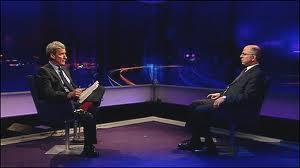
Dean Godson (right) being grilled by the BBC's Jeremy Paxman over allegations of forgery in a Policy Exchange report on British Muslims

None of this seems to have deterred David Cameron however. In February this year he chose his first speech on terrorism as prime minister to announce the failure of British multiculturalism, echoing Germany’s Angela Merkel, and the need for a tougher stance on Muslim groups allegedly promoting extremism. Government contacts with and financial support for such groups would be re-examined and, if necessary, withheld, he declared. The speech was a feather in the cap for Dean Godson and Policy Exchange; it was also a notable triumph for the Tory party’s neoconservatives and clear evidence that Cameron was open to persuasion on other issues.

Key figures in Policy Exchange also populate the ranks of the Cambridge-based, British branch of the Henry Jackson Society (HJS), set up in the midst of the Iraq war and so-named after the fiercely pro-Israel, anti-Communist Senator from Washington State, the late Henry ‘Scoop’ Jackson, a figure regarded as something between patron saint and founding father of the American neoconservative movement.

Signatories to the HJS’s statement of neocon principles include Cameron allies and Policy Exchange founders, Michael Gove and Nicholas Boles as well as George Osborne’s “fag”, Greg Hands. Some of its researchers, like Martyn Frampton, have inherited Godson’s obsession with the dangers of talking to terrorists and Frampton has also been to the fore in projecting the tiny, heavily infiltrated and mostly corrupt IRA dissident groups as a new and major threat to peace in Ireland.

The corollary of such alarmism of course is the need for extra anti-terrorist resources, unceasing vigilance (not to mention paranoia) and, ultimately, the military strength to tackle not just the terrorists but those abroad who may sponsor and fund them, whether they be of the Irish or Muslim variety. While many British neocons have warmly welcomed David Cameron’s support for intervention in Libya they also express dismay at his unaltered plans to run down Britain’s military strength. Neoconservatism and the military state, like love and regret, go hand in hand.

The Henry Jackson Society has been anything but shy advocating the invasion of Libya and the overthrow of Gaddafi. Type “Libya” into its website search bar and more than sixty articles and references appear, virtually all of them antagonistic to the Libyan leader or urging extreme action against him. One article written by HJS’s Global Security and Terrorism director George Grant and published recently in Rupert Murdoch’s Wall Street Journal was headlined “Put the Mad Dog Down”.

As the situation in Libya deteriorated it set up an emergency “Committee for a Democratic Libya”, headed by the subject of Dean Godson’s autobiographical magnum opus, David, now Lord Trimble, the former NI Unionist leader who expressed himself in favour of supplying the rebels with military equipment and the services of unspecified “experts”. Libya, he told its inaugural meeting, “is the sort of situation where it would be utterly wrong for us to hang back”.

Activists in the Henry Jackson Society can also be found at the International Center for the Study of Radicalisation (ICSR) based at King’s College London. Its publicly stated brief is to “educate the public in relation to diplomacy and strategy, public administration and policy, security and counter-terrorism and international conflict resolution.”

Its real function, fueling Islamaphobia, soon becomes apparent when you examine the biographies of just two of its research staff. One is an alleged Jihadist apostate called Shiraz Maher who doubles as a Senior Fellow at Policy Exchange. He claims that he was once a member of the extremist Hizb ut-Tahrir group but became disillusioned and quit. He now preaches a virulent anti-Islam gospel given credibility by his purported past history (the neocons’ Irish equivalent is Sean O’Callaghan, a former IRA leader and admitted spy for the Irish police and the British intelligence service, MI5).

Former Islamist Shiraz Maher......

....and Sean O'Callaghan, an IRA informer. Both apostates, and useful to the neocon cause

During Israel’s Operation Cast Lead, Maher wrote that British Muslims have a choice: “…between Hamas, a terrorist group committed to destroying a sovereign state and its people – and Israel, the region’s only democracy which is responding to that threat.”

The other is Alexander Meleagrou-Hitchens. Yes, you guessed it, the son of Christopher Hitchens, former Trot and post-9/11 convert in all but name to the neoconservative cause. The apple did not fall far from the tree. Also a Senior Fellow at Policy Exchange and a

Alexander Meleagrou-Hitchens - the apple fell not far from the tree

blogger for the Henry Jackson Society, Hitchens junior shares all of his father’s detestation of things Islamic and then some, as Strathclyde Sociology professor, David Miller observed in an August 2010 profile: “He has no truck with the idea that U.S., U.K., or Israeli foreign policy or human rights abuses contribute to terrorism. ‘It is the ideology of Islamism,’ he writes, ‘which is the primary root cause of jihadist terror.’ This puts him at odds even with the British intelligence agencies. Even they have acknowledged that the invasion of Iraq exacerbated opposition to the U.K.”

This then is the British neoconservative network that surrounds David Cameron. Iraq-style regime change is undeniably their goal with Muammar Gaddafi playing the role of Saddam Hussein. The Iraq invasion was based on the lie of weapons of mass-destruction (WMD) but it is the specter of a failed state that is being used by neocons to justify the action against Libya. As one of them wrote, the war between Gaddafi and his rebels could “create an Afghanistan on our doorstep….a source of terrorism and piracy”.

Perhaps, but there’s a large element of the self-fulfilling prophecy at the core of neoconservative thinking. It is worth remembering that Afghanistan became a failed state in the first place because of foreign intervention, first by the Russians and then the Americans. Had Afghanistan been left alone there would have been no Al Qaeda training camps, no 9/11. The Bush-Blair invasion of Iraq has likewise left the region more unstable than it was before, more susceptible to Iranian influence than could ever have been imagined in Sadam Hussein’s day.

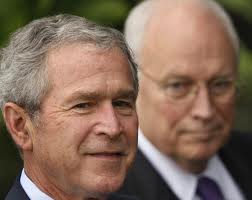
Obama is going down a road these two men travelled before him

The debacle of Iraq had sounded, many thought, the death knell of neoconservatism but the Arab Spring and the Libyan crisis have revived it. That, and the neocon clique that surrounds David Cameron. US president Barack Obama now finds himself attached to a project that many would have more readily associated with his predecessor. He can only hope that his foray into Libya will have a happier ending than the Bush-Cheney expedition to Iraq. If not he will have, in no small way, his British ally to thank as well as that ally’s neocon friends. Remember what the man, no friend of the neocons, said: “History repeats itself, first as tragedy, second as farce.”

*In the interests of full disclosure I should say that I know Dean Godson quite well and while our respective views of the world, and the Irish peace process, are poles apart, I like him and enjoy his company. I once spoke at a Policy Exchange debate on the NI peace process and found myself, gratifyingly I should add, in the minority. But he was, as always, a gracious and generous host.

St Patrick’s Day – Bah! Humbug!

Yuck!

I was going to write an angry piece about Irish-Americans and how each St Patrick’s Day they happily indulge, for the amusement of the rest of America, every demeaning, insulting and degrading stereotype of the Irish invented since the Famine. Would African-Americans so easily paint their lips white and put on a minstrel show? Would Chinese-Americans typecast themselves so quickly as Fu-Manchu or Charlie Chan? I think not. Anyway that was before I read this excellent piece on Salon.com by Aine Greaney which says everything I wanted to say and does so much better than I could.

More Yuck!

Beyond words!

Peter King Redux

I am grateful to Mark Devenport, political editor of the BBC in Belfast for this information. Congressman Peter King is hosting a St Patrick’s Day breakfast in Washington tomorrow (Wednesday, March 16th) and his two principal guests are Peter Robinson, the First Minister in Northern Ireland’s power-sharing government and Martin McGuinness, his deputy.

Robinson was for many years deputy to the Rev Ian Paisley, leader of the Democratic Unionist Party, NI’s extreme Unionist  grouping and for many years an opponent of all things Catholic and Irish. Martin McGuinness is number two to Gerry Adams, effectively the deputy leader of Sinn Fein, the IRA’s political wing.

Doubtless tomorrow’s breakfast will be heralded as another celebration of Northern Ireland’s transition from some forty years of bloodshed and terrorism to peace and political co-operation – which undoubtedly is the case.

But in the light of the controversy over Peter King’s hearings into purported American Muslim radicalization and his perceived hypocrisy given his own past as a cheerleader for IRA terrorism in Ireland, it is worth noting that not too long ago his two guests wore very different hats.

McGuinness was Chief of Staff of the IRA, that is its head honcho, from 1978 (when he took over from Gerry Adams) until 1982.

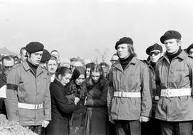
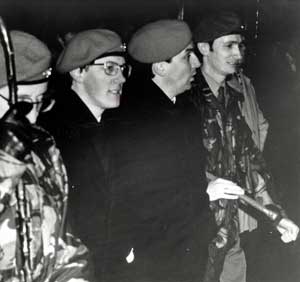
Martin McGuinness (extreme right) wearing the IRA's uniform at a paramilitary funeral in the early 1970's.

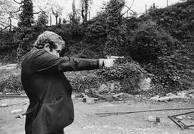
From 1984 until very recently he was the IRA’s Northern Commander, effectively its military leader responsible for directing the IRA’s day-to-day war against the British, which meant that he endorsed or organised every bombing, shooting, killing and other acts of what Peter King would regard as ‘terrorism’ if it was to happen in America rather than Northern Ireland. He was also the Chairman of the IRA’s Army Council, its supreme decision-making body, effectively the IRA chief diplomat and ambassador in dealings with outside bodies, such as the British and Irish governments.

Martin McGuinness fires a pistol

Peter Robinson was not always a politician who preached peaceful methods. His boss, Ian Paisley, has a long history of involvement in shady Loyalist paramilitary groupings, starting with the Ulster Volunteer Force (UVF) back in the 1960’s when the group killed the first of what would be 3,000 plus victims of the Troubles. As Paisley’s deputy Robinson was often the man in charge of the important details. Paisley and Robinson’s most celebrated expedition into the world of terrorism came in the late 1980’s and early 1990’s, not long after the Anglo-Irish Agreement which gave the Dublin government a say in Northern Ireland’s affairs.

Amidst outrage from Loyalists and Protestants, Paisley and Robinson set up a paramilitary group called Ulster Resistance which linked up with the two major Loyalist groups, the Ulster Defence Association (estimated to have killed at least 300 people in the Troubles) and the UVF (death toll, at least 480). In its very first action, an armed group of Ulster Resistance members crossed the Border and invaded Clontibret in Co. Monaghan. Shots were fired but the group, with one exception, fled when the Irish police arrived on the scene. The sole Ulster Resistance member left behind was Peter Robinson who was arrested and charged. He later pleaded guilty to taking part in an unlawful assembly.

Ulster Resistance’s claim to fame, or infamy, came when French police arrested some of it leaders in a Paris hotel as they were negotiating a second arms deal with representatives of the apartheid government in South Africa. Using its extensive contacts in Shorts missile factory in East Belfast, Ulster Resistance had already traded missile secrets for weapons and grenades. The latter were used in Michael Stone’s famous attack on IRA mourners in a West Belfast cemetery in 1988 which killed three people. The second deal apparently involved passing over details of Shorts Blowpipe missile system, weaons that were at the centre of the Iran-Contra scandal.

Peter Robinson (second left, wearing glasses) parades with Ulster Resistance members involved in the South African missile secrets-for-arms deal

When Peter King, Peter Robinson and Martin McGuinness break bread tomorrow in DC, doubtless they will inwardly congratulate themselves on how far their respective careers in politics have taken them. The rest of us might well reflect on another reality, that as Peter King organises his second hearing on American Muslim support for terrorism, but for their ambivalence, at least, towards terrorism or their outright support for it, none of them would be even be in Washington, never mind seated around this particular breakfast table.

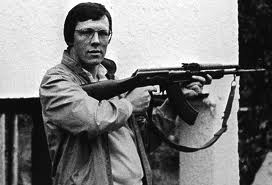
Peter Robinson totes an AK-47 during a trip to Israel, then a close ally of South Africa

Musings on the Irish General Election

Thanks to the Cedar Lounge for this link. It’s an RTE radio documentary called ‘Dogfight: Conor and Charlie’, that zeros in on one constituency, Dublin South-West during the recent general election campaign and the re-election bid of the area’s two former Fianna Fail TD’s, Conor Lenihan and Charlie O’Connor. Lenihan is the scion of a distinguished Fianna Fail family. His brother Brian was the finance minister in the FF-Greens coalition and the point man for the economic meltdown; his late father, also called Brian, was Charles Haughey’s ill-fated Tanaiste, and his aunt is Mary O’Rourke, a three time minister in Fianna Fail administrations.

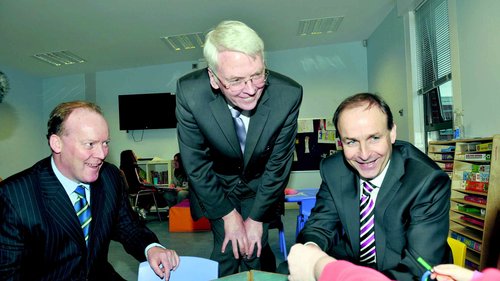
Conor Lenihan, Charlie O'Connor and new FF leader Micheal Martin in happier days

It is a great piece of radio and is required listening because it graphically illustrates why the general election went the way it did. What comes across as Lenihan and O’Connor separately canvass housing estates in places like Tallaght, is the sheer venom of so many of the voters towards Fianna Fail. The verbal abuse directed at the two men, the sheer anger at what the Fianna Fail government did to the Irish economy and the damage done by people like Brian Lenihan to ordinary lives is extraordinary. There are a couple of instances in the documentary where the two, soon to be ex-TD’s, are lucky to escape physical violence on the doorstep.

That anger became quantifiable on February 26th. Between them Lenihan and O’Connor barely ended up with half a quota and the contrast with 2007 could not be greater. Four years ago Lenihan topped the poll, exceeding the quota on first preference votes and O’Connor was not far behind. This time O’Connor outpolled Lenihan (evidence, surely, that being a brother of the finance minister did him only harm) while Labour and Sinn Fein took their seats, improving their share of the first preference votes respectively by 81% and 41%.

The documentary gives colour and atmosphere to the wider message coming from the general election result, which is that it was not a judgement about other parties’ policies, ideas and competence as alternatives but overwhelmingly an opportunity, grasped eagerly by the voters, to give Fianna Fail a severe kicking. Fine Gael, Labour and the independents, notably the left-wing ones, all benefited enormously from this revenge factor in the voters’ minds and so did Sinn Fein. In fact one of the striking features of the documentary was how some of the angriest voters saw voting for Sinn Fein as the best way of doing the most damage to Fianna Fail.

In that respect Fianna Fail’s tactic of leafletting constituencies with warnings that Sinn Fein’s vote could increase unless the party faithful answered the call on election day badly backfired since it served only to alert voters that this was the outcome most feared by FF.

Protest vote or not the results were translated into bums on seats in the Dail chamber and in that department, Sinn Fein saw its group of TD’s more than triple to fourteen even if the first preference vote rose by less than 45%. This was the result that Sinn Fein had hoped for and expected in 2007 but had it come about then, the Provos would almost certainly be political toast now. With fourteen seats under its belt in 2007, Sinn Fein would, in all likelihood, have taken the place of the Green Party in coalition with Fianna Fail and now would probably be in the same place as that party: utterly destroyed and without a single TD to its name.

With a result like that four years ago, the Shinners would have been able to boast that the peace process strategy had reached its medium term goal, even if the holy grail of Irish unity was still out of reach. That goal was to have SF bums nestling on chairs around cabinet tables in both parts of Ireland and a voice in the formulation of all-Ireland policies in each jurisdiction.

The chief architect of the process on the Republican side, Gerry Adams would have hailed this as a vindication of the decision to dump armed struggle and the IRA – and of all that preceded and enabled this, especially the controversial offers, deals and non-deals that accompanied six of the ten deaths during the 1981 hunger strike and the consequent foray into electoral politics.

Sinn Fein’s surprisingly poor showing in 2007 deprived Adams of that triumph but fortuitously so, as it turned out. However, luck, one of the biggest housing bubbles in economic history, the Anglo-Irish Bank and the most stupid, incompetent and possibly corrupt Fianna Fail government in the history of the State combined in the period since then to give Sinn Fein a second chance.

It seems pretty clear that for Sinn Fein to achieve in 2015 or 2016 what it failed to obtain four years ago, a certain set of conditions would have to exist. The major prerequisite would be that in four or five years time the Irish economy is every bit as damaged and derelict as it is now. That’s a distinct possibility but the downside for Sinn Fein is that if this were so then emigration would in all likelihood have returned to the distressing levels last seen in the early 1980’s and many of those leaving Ireland’s shores would be natural SF voters and therefore no longer available to the party (hence, I suspect, the reason for SF’s demand that emigrants be given the vote).

Another set of requirements would be that the recently elected Fine Gael-Labour coalition would be every bit as venal and bungling as Fianna Fail was, that when the next general election is called the voters are as angry as they were last month and, last but not least, that Sinn Fein has shown itself as a talented and inspirational opposition. Again, all three of those preconditions are by no means impossible, but neither are they anywhere near certain.

Then there would be the question of whether Sinn Fein should aim, as it did in 2007, to be the junior partner in the post 2015/2016 coalition government or the senior one. Since the election campaign would be focussed on attacking the FG-Labour government, coalition with either of those parties would be automatically ruled out (just as FG could not now contemplate a partnership with Fianna Fail).

That means that if Sinn Fein wants to be in government in four or five years time, its likely partner, possibly the only one available, will be Fianna Fail. Here’s where it starts to get tricky for SF. If Sinn Fein’s support is going to grow in the next four or five years it will in the main be at the expense of Fianna Fail yet it will need Fianna Fail to have recovered a lot of the support lost in the recent election for such a government to be viable. How to balance those competing demands will be a challenge.

If Sinn Fein’s participation in the next government is dependent upon Fianna Fail’s recovery, where then would SF’s extra votes come from except from the many independents who were elected last month, or the Labour party? The other option would be to set out to absorb as much of Fianna Fail’s support as possible, effectively replacing it as the Republican party of Ireland, and then cobble together a coalition from the remnants of FF and the scattering of independents.

What matters here is that in either scenario, aiming to be the junior or senior partner in the next coalition government, Sinn Fein would have to grow and develop – and be led – like a normal political party. The problem for Sinn Fein is that it is not a normal political party. It came to life as an offshoot of the IRA and it continues to behave, particularly in the way it handles its internal affairs, as an offshoot of the IRA, where obedience to an all-controlling leadership comes before all else.

The symptoms of this were visible in the years after the 2007 electoral setback with a series of resignations from party ranks in both parts of Ireland – perhaps twenty in all – and most damagingly in Dublin. Perhaps the most telling of these was the defection of Dublin councillor Killian Forde to the Labour Party in January 2010, a rising star who many predicted would go far. He chose his words carefully when he resigned but their import was unmistakable:

“The leadership of the party appeared to not recognise or were unwilling to accept that changes are long overdue. These changes were essential to transform the party into one that values discussions, accommodates dissent and promotes merit over loyalty and obedience. It is only logical that if you disagree with the direction of the party and are unable to change it there is no option but to leave.”

He didn’t put a name to the problem but we all know who he was talking about. Last week Gerry Adams was chosen as leader of the new, expanded Sinn Fein group in the Dail, replacing the dull but dependable Caoimhghín Ó Caoláin. He was picked for the job in the same way as Sadam Hussein was in Iraq, Hosni Mubarak in Egypt and Josef Stalin in Soviet Russia, with no rival or dissent worthy of the name and success absolutely assured. His selection has to be ratified by the Sinn Fein Ard Comhairle and it surely will be, as all his wishes have been.

Gerry Adams - President of SF since 1983 and now leader of the party in the Dail.

In assuming leadership of the Dail party, Gerry Adams may well have missed one of those opportunities that the great leaders recognise when they come along, that for the good of the party and the project for which they have struggled, it is time to stand aside for newer, younger and fresher blood.

Now it may be that Gerry Adams does see the reality of his situation and that when the new Dail sits, he will be leader in name only, that in practice he will let the Pearse Doherty’s shine and get their way in charting the party’s direction and shaping its decisions. If he does then Sinn Fein will have a betting chance of growing and, more importantly, attracting talented and ambitious people to its ranks and by so doing significantly improve the chances that it will end up in power in 2015 or 2016.

But it’s hard to teach an old dog new tricks. Even harder when there’s a great temptation to see the election result, and his own performance in Louth, as a massive vote of confidence in the way he goes about politics. Gerry Adams’ problem, as Killian Forde implied, is that he sees little difference in leading Sinn Fein and leading the IRA.

Surviving at the top of the IRA, as he did for so many years, required being on constant guard against dissent and brooking no disobedience of, or divergence from the leadership strategy, no matter how trivial, for fear that it will bloom and grow into a significant and even life-threatening challenge. (If you don’t believe this is how he ran the IRA, go ask Ruairi O Bradaigh, Ivor Bell or Micky McKevitt) That may be an acceptable style of leadership for an armed group waging a revolutionary war – or for a revolutionary leader intent on leading his army in a completely new direction – but it’s fatal for a political party in a democratic, parliamentary system.

It means, inter alia, that there’s a natural tendency for such leaders to surround themselves with untalented sycophants, valued mostly for their trustworthiness and dependability, or carpetbaggers who stare lovingly into their eyes and murmur compliments about standing on the shoulders of giants. These are precisely the sort of people who are not needed in a party that wants to flourish and expand.

In two years time, Gerry Adams will have been leader of Sinn Fein for thirty years. I can’t think of any European or Western party with a leader who’s been in office even half as long as he has. But over in North Africa there is one leader just as unwilling as he is to pass on the reins of power to others. Muammar Gaddafi, long time patron and sometime paymaster of the IRA, has been ruling Libya for forty years and is, as I write, stubbornly – and violently – resisting efforts to dislodge him from office. The two men’s lives intersected constantly over the last four decades and it looks like they will continue to do so till the bitter end.