Monthly Archives: May 2014

Gerry Adams And The Belfast Project – A Statement In Response

In the past few days a concerted attack has been made on the integrity of the Belfast Oral History Project, led by the leadership of Sinn Fein, in which the claim has been made that this was a ‘Get Gerry Adams’ enterprise designed to embarrass and discomfort Mr Adams.

I wish to refute this allegation in the strongest possible terms. It is a slur on my professional integrity as a journalist of over thirty years standing who has covered nearly every aspect and participant in the Troubles. It is a slur on the professionalism and detachment with which I know the lead IRA researcher Dr Anthony McIntyre approached his work interviewing the participants.

One simple reality has been overlooked. Mr Adams does not know what he is talking about. There were over 200 interviews from 26 participants housed in the Boston College archive and Mr Adams has not read them, does not know their full content and aside from two or three names that are in the public domain, does not know who was interviewed. He speaks from a position of almost complete ignorance about the archive.

Only one other person aside from myself and Dr McIntyre has read the full archive from beginning to end. That was Judge William Young who presided over the first hearing dealing with Boston College’s attempt to get the British subpoenas dismissed at the Federal District Court in Boston in December-January 2011/2012.

This is what he said about the archive: “This was a bona fide academic exercise of considerable intellectual merit.”

And he went on: “[These materials] are of interest – valid academic interest. They’re of interest to the historian, sociologist, the student of religion, the student of youth movements, academics who are interested in insurgency and counterinsurgency, in terrorism and counterterrorism. They’re of interest to those who study the history of religions.”

So how does one reconcile Mr Adams’ wild and unsubstantiated accusations based on almost complete ignorance of the archive’s contents with the opinion of a disinterested American judge who has actually read the entire archive? I don’t think it is possible to do so.

Judge Young was obliged to read the archive because of an extraordinary claim from Boston College that its academics could not help him decide which interviews were responsive to the subpoena because they had not read it.

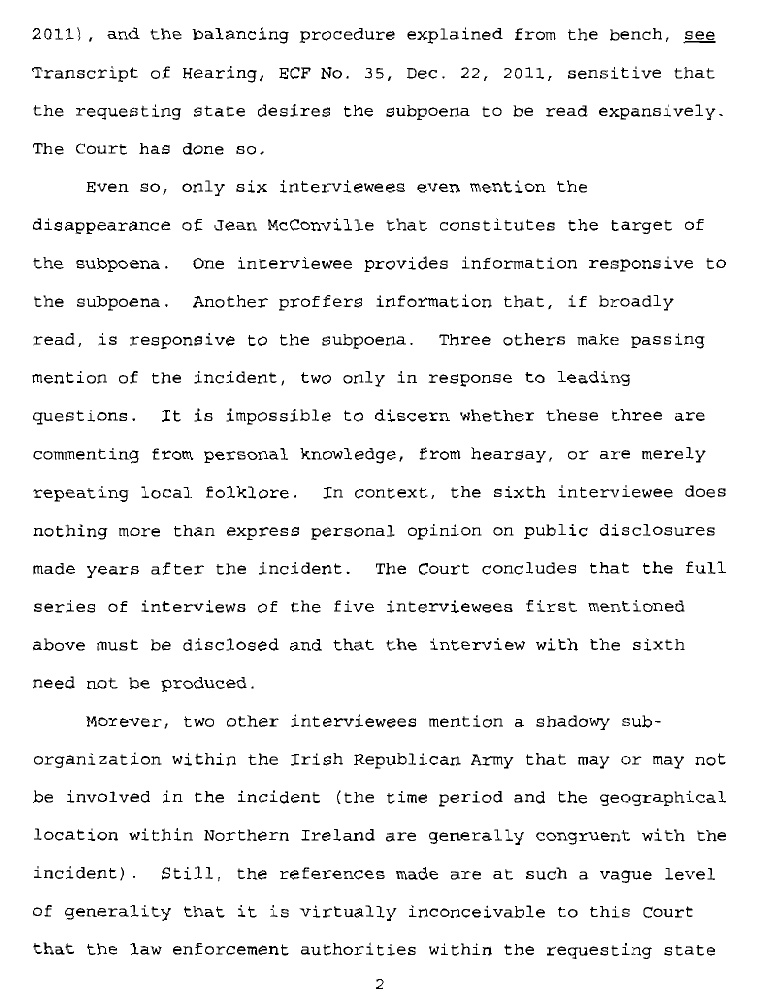
So the judge spent the Chistmas holidays reading the interviews to decide which ones should be handed over. In his judgement, which has been reproduced elsewhere on this blog. Judge Young could find only one interview that was fully responsive, i.e. that dealt directly with what had allegedly happened to Jean McConville.

Another ten or so interviews made some reference to her and because the British had asked the American courts to be “expansive” in their approach to the subpoena request he decided to also hand these over. This meant that even if an interviewee had said, “I don’t really know much about Jean McConville other than what I have read in the papers”, then that interview had to be surrendered.

Out of over 180 interviews that he read only eleven met Judge Young’s generous criteria for surrender. That is just under six per cent of the interviews reviewed by the judge. At one point in his judgement he referred to “….the paucity of information (about the McConville case) unearthed after extensive review by this court.”

If this was indeed a “Get Gerry Adams” project then all I can say is that we did not do a very good job of it.
‘Gerry Adams Hired Lawyer From Barra McGrory’s Old Office’ – Legal Sources

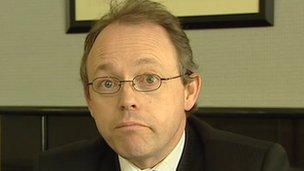
According to legal sources in Belfast, Gerry Adams hired a lawyer from the old law firm of the North’s Director of Public Prosecutions (DPP), Barra McGrory – who was himself Adams’ lawyer until 2011 –  to advise and help him during his interrogation by PSNI detectives at Antrim police station.

The attorney, who apparently does not specialise in criminal law, works at PJ McGrory & Co, the law firm founded by the DPP’s father, the late Paddy McGrory. His son Barra was appointed DPP in 2011 and heads the office which must now decide whether to charge Gerry Adams. The PSNI have referred a file of evidence to the DPP for consideration.

Legal sources also say that the direction of PSNI questioning of Adams points more towards a possible charge of IRA membership rather than involvement in the Jean McConville murder.

It is assumed that Barra McGrory will have to recuse himself from the case because he once acted as Gerry Adams’ lawyer, but it is not known whether he was aware that an employee from his old law firm had been hired to represent the Sinn Fein leader during his four-day detention at Antrim police station.

Gerry Adams And The Public Interest Factor

While we do not know, and probably will never find out, why the PSNI referred Gerry Adams’ file to the prosecution service for a decision on whether to charge him, it is very possible that ‘public interest’ considerations were high on the list of factors.

This is because of Adams’ post as an elected representative, the leader of one of Ireland’s largest political parties and because of his key role as the IRA broker of the peace process. Since his prosecution and/or conviction could have serious implications for the peace process, and therefore for British government policy, this may qualify his case for the ‘public interest’ argument and a government intervention to stop any prosecution.

It may also be the case that the decision was made solely or mainly because the police are unsure whether the evidence they have gathered would be sufficient to secure a conviction at trial and decided to pass the ball to the prosecution service’s lawyers to decide. But common sense suggests that ‘public interest’ is likely to be an element in the decision.

The doctrine of ‘public interest’ was devised by Sir Hartley Shawcross QC, a Labour Attorney-General in the first post-war British government who later became chief prosecutor at the Nuremburg war trials.

The doctrine was outline in a statement to the British House of Commons on January 29th 1951 from Shawcross which read:

“It is the duty of an Attorney-General, in deciding whether or not to authorise the prosecution, to acquaint himself with all the relevant facts, including, for instance, the effect which the prosecution, successful or unsuccessful as the case may be, would have upon public morale and order, and with any other considerations affecting public policy.

“In order so to inform himself, he may, although I do not think he is obliged to, consult with any of his colleagues in the Government; and indeed, as Lord Simon once said, he would in some cases be a fool if he did not. On the other hand, the assistance of his colleagues is confined to informing him of particular considerations which might affect his own decision, and does not consist, and must not consist, in telling him what that decision ought to be. The responsibility for the eventual decision rests with the Attorney-General, and he is not to be put, and is not put, under pressure by his colleagues in the matter.”

Given the profile and sensitivity of the case it seems unlikely that a decision of this gravity would be left to Barra McGrory’s deputy, assuming he recuses himself from the case. Instead she is likely to refer the case to the British Attorney-General, Dominic Grieve MP. In effect the British government will decide whether Gerry Adams ends up in the dock.

So in a nutshell Gerry Adams might end up a beneficiary of a rule which permits dropping a prosecution which might have an adverse impact on “public morale and order, and with any other considerations affecting public policy”.

Stand by for the mother and father of political rows if that happens.

Over To You Barra!

Barra McGrory - North's Director of Public Prosecution

Barra McGrory – North’s Director of Public Prosecutions

According to the BBC, Gerry Adams is to be released from custody at Antrim police station but a file will be sent to the Public Prosecution Service. For those not familiar with legal practice in the UK and Ireland, that means that the police think they may have material for a charge but want the Director of Public Prosecutions to make the final decision, which is usually governed by a calculation of whether a conviction can be secured.

Presumably the possible charge facing Gerry Adams, is in relation to the matter he has been questioned about, the disappearance of Jean McConville.

The irony of course is that the man in charge of the prosecution service, the Director of Public Prosecutions or DPP, is Barra McGrory who until his appointment in 2011 was none other than Gerry Adams’ own lawyer. Barra’s late father Paddy, a famous figure in the North’s legal and political world, was Adams’ lawyer before that (full disclosure: both Barra and Paddy were/are good friends of mine, as is his mother and sisters, and have been for many years).

Presumably, Barra McGrory will have to recuse himself from the decision-making process meaning that Gerry Adams will have a few more nervous months of waiting before he knows whether he is out of the woods.

Niall O’Dowd’s Bile Explained

As regular readers of Niall O’Dowd’s Irish Central website will know, the said Niall has been devoting a lot of time and space on ad hominem attacks on myself since the arrest of Gerry Adams.

While basing his attacks on the claim that the Boston oral history archive was set up by myself to undermine the Sinn Fein leader (read this blog post for a proper perspective on this) there is a subtext which explains the real reason for the animosity.

Essentially I found him out stealing my by-line and my articles, written for the Sunday Tribune in Dublin, to use in his Irish Voice newspaper back in the late 1980’s. It was a dirty, cheap thing to do and I confronted him about it (I chose not to go the legal route since that would endanger innocent people’s jobs) and demanded that he pay me a proper fee in future for using my journalism. He had no choice but to agree but our relationship was always a tense one, marked by mutual dislike.

I wrote about it in some length on this blog when O’Dowd first editorialised against myself and Anthony McIntyre and below is a reprint of the relevant part. But he is right about one thing: I dislike liars and will always use my journalism to expose them, whether it be lies from Niall O’Dowd, Gerry Adams, Ian Paisley or Margaret Thatcher.

Here is the extract. Enjoy:

Not for the first time, Niall O’Dowd cast aspersions on myself in the course of his editorial, suggesting that “deep hostility” to Sinn Fein on my part motivated the Belfast Project at Boston College which concentrated on interviewing “dissidents”.

Well the best answer I can give to this charge is to say that I am exactly the same journalist that I was in the late 1980’s when our paths first crossed. A brief history of the relationship between myself and Niall O’Dowd will help to fill out this explanation and account for the poison in our relationship.

Niall O’Dowd founded the Irish Voice in 1987. Not long afterwards it was suggested to him that he might hire myself as his Belfast correspondent. This he refused to do, on the grounds that I was regarded as being far too close to the IRA. It is easy to forget these things but in those days Niall O’Dowd would rather have been dead than be seen in the company of Gerry Adams and as for his sympathy for the North, well he always was very keen to get adverts from the Northern Ireland Tourist Board.

I presume he had been fed this line by his mates in the Department of Foreign Affairs then battling desperately to shore up the SDLP in its life or death electoral struggle with Sinn Fein. As the recent Northern Editor of The Irish Times, I had angered the DFA with my coverage of that battle, predicting correctly, for instance, that Sinn Fein would win seats at the SDLP’s expense in working class Nationalist areas due to their advantages in age, class, enthusiasm and drive. But sometimes truth-telling can get you into a heap of trouble. And it is sometimes remarkable how these phases in your career can be airbrushed out by people.

I heard about all this in Belfast but paid no heed to it. Until a year or so later when we took our annual vacation in New York, picked up a copy of The Irish Voice and lo and behold, staring out at me from the front page with the byline ‘From Ed Moloney in Belfast’, was a piece I had written the week before for the Sunday Tribune then my employer. I made enquiries and discovered that this had been going on for some time. In fact every week for months, O’Dowd had lifted my articles in the  Tribune and published them in the Irish Voice. I was never told about this, my permission was never sought and, needless to say, I was never paid.

Part of me was flattered by this, a part outraged. A year or so before I was poison but since then the quality of my coverage had clearly turned him round. That felt good. On the other hand he didn’t have the gumption to admit he had made a mistake and put our relationship on a proper footing. And then there was the cheapness, the willingness to steal my journalism – it was worth using in his paper, it added to his product but he didn’t want to pay for it. So, I have to say I was tempted to take legal action against him, so angry was I. But that could cost the paper money and jobs could be lost. So we made a deal. He would be able to use my pieces but he would pay me.

And so it went on until the peace process began to pick up speed. I approached that story in the same way I had all others, which was to dig as far as possible below the surface to discover what was really happening. And what a story it was! When an organisation like the IRA makes such a radical U-turn then it is rarely done in a straightforward way. Lies are told, tricks are played, extraordinary things happen and people get disappointed and disillusioned. But for a journalist like me it is all your dreams come true – great stories as far as the eye can see, a host of sources all with reason to talk. Sheer bliss! But the important point was that I had approached all my journalism, from Kincora, to Paisley, to the SDLP, to Billy Stobie – and more recently the Belfast Project at Boston College – in exactly the same spirit.

Alas Niall O’Dowd didn’t see it that way at all. Sometimes a journalist can dig too deep and the rows began, angry calls from New York about this or that article – presumably preceded by angry calls to him from Suffolk Road in West Belfast. Finally the break came. And the given reason? Well, I wasn’t writing original pieces for the Voice, just sending them articles that also appeared in the Sunday Tribune. That just wasn’t good enough complained Niall O’Dowd as he put the phone down.

And that was the end of my relationship with Niall O’Dowd and the beginning of what promises to be a lifelong enmity. Now, dear reader, you understand.

Boston Tapes Exclusive! Content Of Interviews Sought By PSNI Revealed!

The days since the arrest of Gerry Adams for questioning about his alleged role in the abduction, death and disappearance of Jean McConville have been distinguished by some of the laziest and sloppiest journalism I have ever experienced.

Unchecked allegations nestle comfortably beside outright lies as one journalist after another has speculated in particular about the contents of the interviews that were unfortunately and unnecessarily handed over to the DoJ/PSNI by Boston College.

Many journalists have gone to print without even a phone call to myself to check facts or allegations. Nor have they bothered to avail themselves of the mountain of information and original documents stored on the website created and studiously tended by Carrie McIntyre, partner of Anthony McIntyre.

Had they bothered to give the computer keyboard a couple of clicks they would have been able to access the most accurate and complete description of the content of the surrendered interviews available anywhere.

Only one person, other than myself and Anthony McIntyre has read the entire archive and that was the US Federal Court judge, William Young who heard the case seeking the dismissal of the PSNI subpoenas in December 2011.

Judge Young was obliged to read the entire archive after Boston College made the extraordinary claim (initially contained in a sealed affidavit to spare the college embarrassment but revealed inadvertently during proceedings) that it could not help him choose which interviews to hand over since the responsible staff member, college librarian Bob O’Neill, had never read them!

In his final judgement delivered in late January 2012, Young outlined his reasoning for choosing the interviews to be given to the PSNI and in so doing gave us a pretty good idea what was in them. This very important clue was hiding in plain sight on the website.

Since I have now done their work for them, perhaps journalists covering the story can now be a little bit more accurate in the reportage of what is and what is not in the interviews handed over to the PSNI. My apologies if what Judge Young has to say lacks the drama and sensation that reporters clearly yearn for.

Here then is the relevant part of Judge Young’s judgement.  I reproduce it without comment. These interviews discussed by Young were sought by the PSNI under a second subpoena served two or more months after the first. The first subpoena dealt with Brendan Hughes’ and Dolours Price’s interviews with Anthony McIntyre. I wish to repeat again for the umpteenth time: in her interview with Anthony McIntyre for the Belfast Project she did not, repeat not, that is NOT, even mention Jean McConville’s name much less describe her death.

Here is Judge Young’s summary of the contents of the subpoenaed interviews:

1-f41edc0c7f2-748ac643ab3-b0a0f20531